
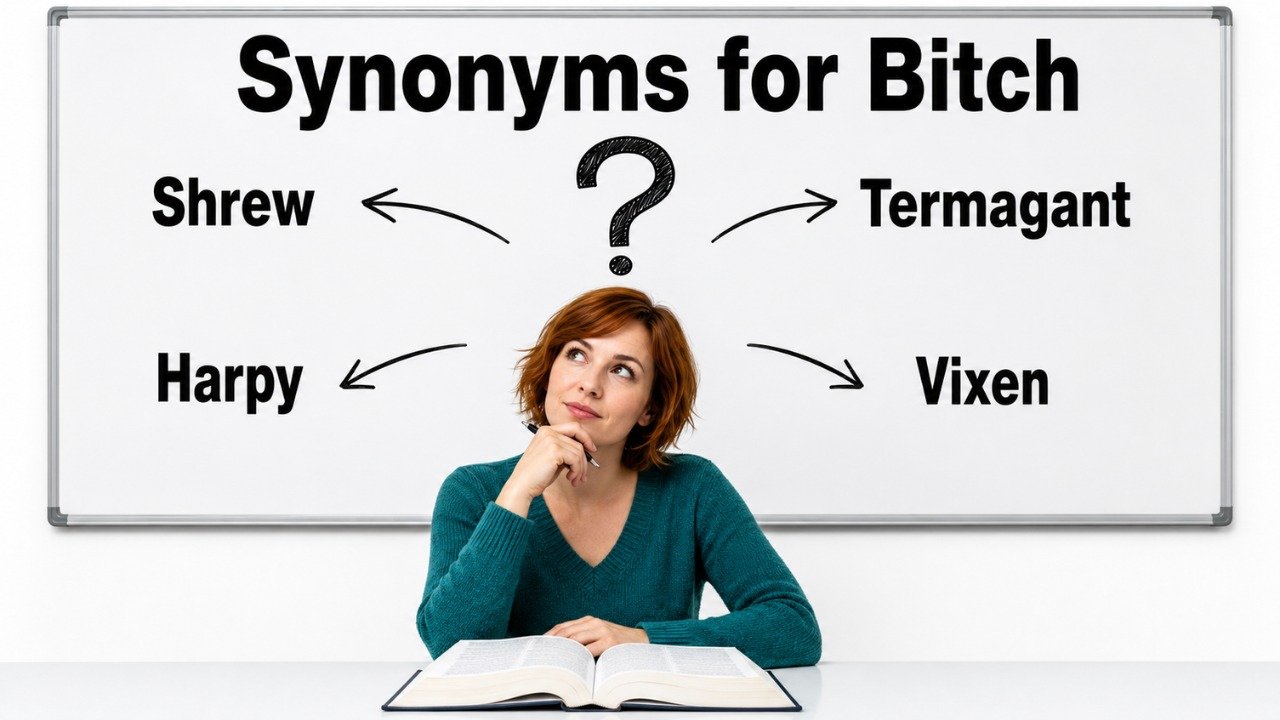
Quick Answer: Common synonyms for bitch include female dog, jerk, mean person, bully, nuisance, hassle, complain, gripe, grumble, and moan. The best choice depends strongly on context. Use female dog for the literal animal meaning, jerk or mean person when replacing the insulting meaning, nuisance or hassle for something difficult or annoying, and complain, gripe, or grumble when bitch is used as a verb. In formal writing, a precise neutral description is usually better than the original offensive term.
Pronunciation and Word Details
Word: Bitch.
Pronunciation: /bɪtʃ/
Part of Speech: Noun and verb.
Meaning: Bitch can mean a female dog, an offensive term for a person, something extremely difficult or annoying, or, as a verb, to complain repeatedly.
US Pronunciation:
UK Pronunciation:
What Does “Bitch” Mean?
Bitch has several meanings, and its tone changes dramatically according to context.
As a noun, its literal meaning is a female dog. In animal breeding and veterinary contexts, this meaning can be descriptive rather than insulting.
Example: The breeder recorded information about the bitch and her puppies.
In everyday conversation, however, bitch is widely recognized as a strong insult. It is especially offensive when directed at a woman because it can carry a degrading or sexist implication. It may also be directed at men, although the intended meaning and connotations can differ.
Example: He regretted calling his coworker a bitch during the argument.
Bitch can also describe something extremely difficult, frustrating, or unpleasant.
Example: That final repair was a bitch to complete.
As a verb, bitch means to complain, criticize, or grumble, especially repeatedly.
Example: They spent the afternoon bitching about the long delay.
Because these meanings are very different, choosing the right synonym requires understanding exactly how the word functions in a sentence.
Meaning, Tone, and Context of “Bitch”
Bitch can be neutral in its literal animal meaning, but its everyday human use is usually vulgar, insulting, emotional, and potentially offensive.
When referring to a female dog in a specialist animal context, the word has a legitimate descriptive meaning.
Example: The veterinarian examined the bitch after she gave birth.
When directed at a person, the term is much stronger. It can express anger, contempt, hostility, or disrespect. When used against women, it has a particularly gendered history and may sound sexist or degrading.
Some close friends may use the word jokingly or affectionately with one another. However, this use is highly context dependent. A term accepted within one friendship or group can be offensive when used by someone else.
In professional, academic, educational, workplace, and polite communication, neutral alternatives are usually more appropriate. Instead of using an insult, describe the actual behavior.
Example: Rather than calling someone a bitch, words such as rude, hostile, cruel, difficult, or disrespectful may communicate the intended criticism more clearly.
As a verb meaning complain, bitch is informal and vulgar.
Example: They kept bitching about the schedule.
A more neutral version would be:
Example: They kept complaining about the schedule.
When and How to Use “Bitch”
For a Female Dog: Bitch can literally refer to a female dog, especially in animal breeding contexts. Female dog is clearer for general audiences.
Example: The female dog stayed close to her puppies.
For Reporting an Insult: The word may appear when accurately reporting what someone said or describing offensive language.
Example: The witness said that one person called another a bitch during the argument.
For Describing an Unpleasant Person: In informal speech, bitch may be used as an insult for someone perceived as cruel, rude, spiteful, or difficult. A more precise description is usually better.
Example: Instead of insulting her, describe the behavior as rude or hostile.
For Complaining: As a verb, bitch can mean complain repeatedly or irritably.
Example: He spent the entire journey bitching about the traffic.
For Difficulty: In very informal speech, the word can describe a task, problem, or situation that is extremely difficult.
Example: Moving the heavy cabinet upstairs was a bitch.
For Frustration: Speakers sometimes use the word to add strong emotional emphasis to an unpleasant experience.
Example: That final examination was a bitch.
Because the word can easily offend, context, audience, relationship, and purpose should always guide its use.
Best Synonyms for Bitch
Female Dog: The clearest neutral replacement for the literal animal meaning.
Example: The female dog remained beside her puppies.
Jerk: An informal and gender neutral insult for an unpleasant or inconsiderate person.
Example: He was acting like a jerk during the meeting.
Mean Person: A direct description of someone who behaves unkindly.
Example: She thought the character was a mean person.
Bully: Someone who repeatedly intimidates, mistreats, or harms others.
Example: Nobody should tolerate a bully in the workplace.
Nuisance: A person, thing, or situation that causes inconvenience or annoyance.
Example: The constant noise became a nuisance.
Hassle: An annoying difficulty or inconvenient problem.
Example: Completing the paperwork became a major hassle.
Complain: To express dissatisfaction or unhappiness.
Example: Several passengers complained about the delay.
Gripe: To complain about something, usually informally.
Example: He continued to gripe about the new schedule.
Grumble: To complain in a low, dissatisfied manner.
Example: The workers grumbled about the early start.
Moan: To complain repeatedly, especially about something unpleasant.
Example: She spent the morning moaning about the weather.
50 Synonyms for Bitch with Short Meanings
- Female Dog: The neutral everyday term for a female dog.
- Female Canine: A formal or technical description of a female member of the dog family.
- Dam: A female animal that has produced offspring, especially in breeding contexts.
- Jerk: An informal term for an unpleasant or inconsiderate person.
- Bully: Someone who repeatedly intimidates or mistreats others.
- Mean Person: Someone who behaves in an unkind way.
- Nasty Person: Someone whose behavior is deliberately unpleasant.
- Unpleasant Person: Someone who is difficult or disagreeable to deal with.
- Rude Person: Someone who behaves disrespectfully or impolitely.
- Cruel Person: Someone who intentionally causes pain or distress.
- Spiteful Person: Someone who deliberately tries to hurt or upset others.
- Malicious Person: Someone who intends to cause harm.
- Obnoxious Person: Someone whose behavior is extremely irritating or offensive.
- Difficult Person: Someone who is challenging to communicate or work with.
- Hostile Person: Someone who behaves aggressively or unfriendly.
- Tormentor: Someone who repeatedly causes another person distress.
- Scold: An older term for someone who habitually criticizes or rebukes others.
- Nag: A person who repeatedly complains or pressures others.
- Shrew: An old insulting term for a bad tempered woman.
- Harridan: An old and strongly insulting term for an unpleasant woman.
- Virago: An old term historically used for a forceful or aggressive woman.
- Termagant: An old insulting term for a harsh or argumentative woman.
- Antagonist: A person who actively opposes another person.
- Troublemaker: Someone who regularly causes conflict or problems.
- Complain: To express dissatisfaction.
- Gripe: To complain informally about something annoying.
- Grumble: To complain quietly or repeatedly.
- Moan: To complain in a persistent way.
- Whine: To complain in an irritating or childish manner.
- Grouse: To complain frequently about something.
- Bellyache: To complain continuously about a problem.
- Carp: To complain repeatedly, often about small matters.
- Kvetch: To complain persistently in informal speech.
- Protest: To express strong dissatisfaction or objection.
- Object: To express disagreement or opposition.
- Fuss: To complain or become unnecessarily upset about something.
- Rant: To complain or speak angrily at length.
- Rail: To complain or protest angrily.
- Whinge: To complain persistently, especially in informal British English.
- Nuisance: Something or someone that causes annoyance.
- Hassle: An inconvenient or irritating difficulty.
- Pain: An informal term for an annoying person, task, or situation.
- Annoyance: Something that causes irritation.
- Problem: A situation that creates difficulty.
- Ordeal: A difficult or unpleasant experience.
- Nightmare: An extremely difficult or frustrating situation.
- Burden: Something difficult that creates responsibility or pressure.
- Challenge: A task or situation requiring considerable effort.
- Trouble: Difficulty, inconvenience, or problems.
- Headache: An informal term for a troublesome problem or responsibility.
Read Also:
Synonyms for Anonymous

Synonyms for Bitch by Context
When Bitch Means a Female Dog
The original literal meaning of bitch refers to a female dog. This meaning is very different from the insulting human use.
Female Dog: The clearest choice for general audiences.
Example: The female dog was resting beside her puppies.
Female Canine: A more technical description.
Example: The veterinarian examined the female canine.
Dam: Appropriate when specifically referring to the mother of offspring in breeding contexts.
Example: The records identify the dam of each puppy.
For ordinary writing, female dog is usually the clearest replacement.
When Bitch Means an Unpleasant Person
When bitch is used as an insult, the best alternative depends on the behavior being criticized.
Jerk: Useful for an inconsiderate or unpleasant person.
Example: He behaved like a jerk during the discussion.
Mean Person: Suitable when someone is deliberately unkind.
Example: The character initially appears to be a mean person.
Bully: Appropriate when someone intimidates or repeatedly mistreats others.
Example: The student reported the bully to a teacher.
Spiteful Person: Useful when someone intentionally tries to upset another person.
Example: Her actions made her seem spiteful rather than merely angry.
Rude Person: Best when the problem is disrespectful behavior.
Example: The customer was extremely rude to the staff.
These alternatives are often clearer because they describe the actual negative behavior instead of relying on a broad gendered insult.
When Bitch Means Complain
As a verb, bitch often means to complain repeatedly, usually in an irritated manner.
Complain: The strongest neutral general alternative.
Example: The passengers complained about the delay.
Gripe: A casual alternative for complaining.
Example: He kept griping about the workload.
Grumble: Suggests quieter dissatisfaction.
Example: Several employees grumbled about the early meeting.
Moan: Suggests persistent complaining.
Example: She spent an hour moaning about the weather.
Whine: Suggests irritating or immature complaining.
Example: He whined whenever he was asked to help.
When Bitch Means a Difficult Situation
Bitch can informally describe something unusually difficult, annoying, or frustrating.
Nightmare: Strong but less vulgar.
Example: Organizing all the documents was a nightmare.
Hassle: Suitable for inconvenient difficulties.
Example: Changing the reservation became a hassle.
Pain: Informal and common for irritating tasks.
Example: Fixing the old printer was a pain.
Ordeal: Best for a difficult or stressful experience.
Example: The long journey became an exhausting ordeal.
Headache: Useful for a problem requiring repeated attention.
Example: The scheduling conflict became a major headache.
When Bitch Means Someone Who Causes Conflict
Sometimes the insult is intended to describe someone as argumentative, hostile, or troublesome.
Troublemaker: Appropriate when the person regularly creates conflict.
Example: He gained a reputation as a troublemaker.
Hostile Person: Useful when aggression or hostility is the central behavior.
Example: The manager remained calm while dealing with a hostile person.
Antagonist: Appropriate when someone actively opposes another person.
Example: The antagonist repeatedly attempted to block their plans.
Another Word for Bitch
There is no single replacement that works for every meaning of bitch. For the common insulting use, jerk is one of the most useful alternatives because it expresses strong disapproval without carrying the same specifically gendered meaning. For the literal animal sense, use female dog. For the verb, complain is usually best.
Original: He called the rude character a bitch.
Better Option: He called the rude character a jerk.
Original: She was bitching about the schedule again.
Better Option: She was complaining about the schedule again.
Original: Completing that repair was a bitch.
Better Option: Completing that repair was a nightmare.
Original: The bitch stayed beside her puppies.
Better Option: The female dog stayed beside her puppies.
When Not to Use “Bitch”
Avoid using bitch casually when referring to a person unless you clearly understand the audience and context. It can be insulting, vulgar, and especially degrading when directed at women.
In professional communication, describe the behavior instead.
Weak: My supervisor is a bitch.
Better: My supervisor communicates harshly and often treats the team disrespectfully.
The second sentence provides useful information rather than merely expressing anger.
Avoid the term in formal reports when a neutral description is available.
Weak: The customer became a bitch when the request was refused.
Better: The customer became hostile when the request was refused.
Do not use the insulting sense when the literal animal meaning could create ambiguity.
Weak: The article repeatedly uses bitch without explaining that it refers to a female dog.
Better: The article uses female dog when writing for a general audience.
As a verb, bitch may also sound too vulgar for formal communication.
Weak: Several employees bitched about the new procedure.
Better: Several employees complained about the new procedure.
Avoid assuming that a joking use among close friends is acceptable in every situation. Relationship, consent, tone, and cultural context can significantly change how the word is received.
Words Commonly Confused With Bitch
Bitch vs Bitchy: Bitch can be a noun or verb. Bitchy is an adjective describing behavior perceived as spiteful, unpleasant, or irritable. Both can be offensive when applied to people.
Bitch vs Jerk: Bitch is stronger, more vulgar, and often gendered. Jerk is informal but generally less severe and can be used regardless of gender.
Bitch vs Bully: Bitch is a broad insult. Bully has a more specific meaning and refers to someone who repeatedly intimidates, controls, or mistreats others.
Bitch vs Shrew: Both can be insulting when applied to women, but shrew is older and strongly associated with traditional stereotypes about argumentative women.
Bitch vs Complain: Bitch can function as a vulgar verb meaning complain. Complain is neutral and appropriate in formal as well as everyday contexts.
Bitch vs Gripe: Both can refer to complaining, but gripe is milder and less offensive.
Bitch vs Nuisance: Bitch can describe a very difficult or frustrating situation informally. Nuisance simply means something that causes inconvenience or annoyance.
Which Synonym Should You Choose?
Choose female dog when discussing an animal with a general audience.
Choose dam when referring specifically to a female animal as the mother of offspring in an appropriate breeding context.
Choose jerk in casual speech when criticizing an unpleasant person without using the same gendered insult.
Choose mean person when you want simple, direct, and widely understandable language.
Choose bully when someone repeatedly intimidates or mistreats others.
Choose rude person when disrespectful behavior is the main issue.
Choose hostile person in reports, workplace writing, or formal descriptions when aggression is involved.
Choose complain in essays, reports, emails, professional communication, and neutral conversation when bitch is being used as a verb.
Choose gripe or grumble for casual complaints.
Choose hassle, pain, or headache for an annoying task or problem.
Choose nightmare or ordeal when the situation is extremely difficult.
The most effective replacement is usually the word that describes the exact behavior, problem, or meaning instead of merely matching the emotional strength of the original term.
Real Life Examples of “Bitch” in Sentences
Original: She spent the entire drive bitching about the traffic.
Better Option: She spent the entire drive complaining about the traffic.
Original: He called his coworker a bitch after the disagreement.
Better Option: He called his coworker a jerk after the disagreement.
Original: Repairing that old pipe was a bitch.
Better Option: Repairing that old pipe was a nightmare.
Original: The bitch remained beside her newborn puppies.
Better Option: The female dog remained beside her newborn puppies.
Original: They kept bitching about having to arrive early.
Better Option: They kept grumbling about having to arrive early.
Original: That paperwork was a bitch to complete.
Better Option: That paperwork was a hassle to complete.
Original: The character is presented as a bitch throughout the first chapter.
Better Option: The character is presented as a cruel and spiteful person throughout the first chapter.
Original: Stop bitching about every small inconvenience.
Better Option: Stop griping about every small inconvenience.
Original: Finding the source of the error was a bitch.
Better Option: Finding the source of the error was a major headache.
Original: He described her as a bitch because she refused to agree with him.
Better Option: He described her as difficult because she refused to agree with him.
Synonym Groups and Usage Differences
Literal Animal Group
Female dog, female canine, and dam belong to the literal animal group.
Female dog is clearest for general readers. Female canine sounds more technical. Dam refers specifically to a female animal in relation to her offspring.
Example: The female dog remained calm while the veterinarian examined her puppies.
General Insult Group
Jerk, nasty person, obnoxious person, mean person, and unpleasant person express criticism without exactly reproducing the original word’s gendered meaning.
Jerk is informal. Mean person is simple and direct. Obnoxious person emphasizes extremely irritating behavior.
Example: His selfish behavior made him seem like a jerk.
Cruel Behavior Group
Cruel person, spiteful person, malicious person, bully, and tormentor describe more specific forms of harmful behavior.
These choices are often better than a general insult because they tell the reader what the person actually did.
Example: The repeated intimidation showed that he was acting like a bully.
Complaint Group
Complain, gripe, grumble, moan, whine, grouse, carp, and bellyache refer to expressing dissatisfaction.
Complain is neutral. Gripe and grumble are informal. Whine often suggests that the complaint sounds childish or irritating.
Example: Several passengers grumbled about the delay.
Difficulty Group
Hassle, pain, headache, nightmare, ordeal, challenge, and problem describe difficult situations without the vulgarity of bitch.
Hassle suggests inconvenience. Nightmare expresses severe difficulty. Ordeal suggests an exhausting or distressing experience.
Example: Replacing all the damaged files became a nightmare.
Conflict Group
Hostile person, antagonist, troublemaker, and bully describe people involved in conflict.
These words should be chosen according to the person’s actual behavior rather than used as automatic replacements.
Example: The troublemaker repeatedly tried to start arguments among the group.
Antonyms of Bitch
Bitch has no single universal antonym because its meanings are very different. Opposites depend on context.
Male Dog: The contrasting sex term when bitch literally means a female dog, although it is not a grammatical antonym in every context.
Kind Person: Someone who behaves with kindness rather than cruelty.
Pleasant Person: Someone who is agreeable and enjoyable to interact with.
Friend: Someone who has a supportive personal relationship with another person.
Ally: Someone who provides support or cooperation.
Supporter: Someone who helps or encourages another person or cause.
Helper: Someone who provides assistance.
Praise: To express approval rather than complain or criticize.
Approve: To express acceptance rather than objection.
Commend: To speak positively about someone or something rather than complain about it.
Ease: Freedom from difficulty when contrasted with an extremely troublesome situation.
Comparison: Bitch vs Related Words
Bitch vs Jerk
Bitch is usually stronger and more offensive. When applied to a woman, it can carry a gendered and degrading implication. Jerk is also insulting but is generally less severe and gender neutral.
Example With Bitch: He angrily called the character a bitch.
Example With Jerk: He angrily called the character a jerk.
Bitch vs Mean Person
Bitch expresses strong emotional hostility, while mean person directly describes unkind behavior.
Example With Bitch: She said her neighbor was a bitch.
Example With Mean Person: She said her neighbor was a mean person who often insulted others.
The second version communicates the intended criticism more clearly.
Bitch vs Bully
Bitch is a general insult. Bully has a specific behavioral meaning involving intimidation, domination, or repeated mistreatment.
Example With Bitch: The student called the classmate a bitch.
Example With Bully: The student described the classmate as a bully because of the repeated intimidation.
Bitch vs Shrew
Both can be gendered insults, but shrew is older and less common in ordinary modern conversation. Neither is a good choice when a precise behavioral description is available.
Example With Bitch: The character angrily calls another woman a bitch.
Example With Shrew: The older story describes an argumentative woman as a shrew.
Bitch vs Complain
As a verb, bitch can mean complain, but it is much more vulgar and informal.
Example With Bitch: They bitched about the delay for an hour.
Example With Complain: They complained about the delay for an hour.
Bitch vs Gripe
Gripe is an informal word for complaining but lacks the strong vulgarity of bitch.
Example With Bitch: He kept bitching about the new rules.
Example With Gripe: He kept griping about the new rules.
Bitch vs Nuisance
When bitch describes a difficult thing, it expresses intense frustration. Nuisance is milder and usually refers to something annoying or inconvenient.
Example With Bitch: Fixing the problem was a bitch.
Example With Nuisance: The recurring problem became a nuisance.
Common Phrases and Expressions With Bitch
Bitch About: To complain repeatedly about something.
Example: They spent the evening bitching about the workload.
Bitch At Someone: To complain angrily or speak irritably to another person.
Example: He apologized for bitching at everyone when he was stressed.
Bitch and Moan: A vulgar informal expression meaning to complain continuously.
Example: They continued to bitch and moan about every small change.
A Bitch of a Job: A vulgar expression for a task that is extremely difficult.
Example: Removing the damaged flooring was a bitch of a job.
A Bitch of a Problem: A very difficult or frustrating problem.
Example: The recurring error became a bitch of a problem to diagnose.
Life Is a Bitch: A vulgar saying expressing the idea that life can be difficult or unfair.
Example: After several frustrating setbacks, he muttered that life is a bitch.
Son of a Bitch: A strong and offensive insult that can also appear as an emotional exclamation.
Example: The expression is generally inappropriate in polite or professional communication.
Bitch Session: An informal expression for a conversation mainly devoted to complaining.
Example: The discussion turned into a bitch session about workplace frustrations.
Resting Bitch Face: An informal and potentially insulting expression for a neutral facial expression that other people interpret as angry or unfriendly.
Example: Because the phrase judges someone’s appearance and can offend, neutral wording such as serious expression is often preferable.
Common Mistakes to Avoid
A major mistake is treating all synonyms for bitch as interchangeable. The word has several unrelated senses, so context must come first.
Female dog works for the literal animal meaning but cannot replace the insulting or complaining senses.
Incorrect: He female dogged about the long line.
Correct: He complained about the long line.
Another mistake is replacing one gendered insult with another old gendered insult simply because dictionaries list them together. Words such as shrew, harridan, virago, and termagant have specific histories and tones. They are not automatically better or more polite choices.
When describing someone’s behavior, precision is usually stronger than name calling.
Vague: She is a bitch.
Clearer: She repeatedly insults her coworkers and refuses to listen to their concerns.
Avoid using bitch casually in formal writing, workplace messages, reports, academic essays, or communication where the audience may find profanity inappropriate.
Do not assume that joking or affectionate uses are universally acceptable. A word used comfortably between close friends may sound hostile when used by someone outside that relationship.
Another common mistake is confusing complaint verbs.
Complain is broad and neutral. Grumble suggests quiet dissatisfaction. Gripe is informal. Whine often criticizes the manner of complaining. Rant suggests an extended angry speech.
Choose the verb according to the intensity and style of the complaint.
Repetition should also be avoided.
Repetitive: He kept bitching about the job, bitching about his schedule, and bitching about his coworkers.
Improved: He complained about the job, grumbled about his schedule, and criticized several coworkers.
Finally, consider whether an insult is necessary at all. Describing observable behavior usually produces clearer, more useful, and more professional writing.
Conclusion
The best synonyms for bitch depend entirely on meaning and context. Use female dog for the literal animal sense, jerk, mean person, bully, or a precise behavioral description for the insulting sense, and complain, gripe, or grumble when the word functions as a verb. For difficult situations, hassle, pain, headache, nightmare, and ordeal are useful alternatives. Because bitch can be vulgar and gendered, choosing a precise neutral synonym often makes communication clearer and more appropriate.
FAQs About Synonyms for Bitch
What is the best synonym for bitch?
Answer: It depends on the meaning. Jerk is a common alternative for the insulting sense, complain works for the verb, and female dog is best for the literal animal meaning.
What is a polite synonym for bitch?
Answer: There is no exact polite equivalent. Depending on the behavior, use difficult person, rude person, mean person, hostile person, or another precise description.
What is another word for bitch when it means complain?
Answer: Complain is the best neutral alternative. Gripe, grumble, moan, grouse, and whine are useful informal options.
What is the literal meaning of bitch?
Answer: The literal meaning is a female dog. In certain animal breeding contexts, the word can be descriptive rather than insulting.
Is jerk a synonym for bitch?
Answer: Jerk can replace bitch when the word is being used as a general insult for an unpleasant or inconsiderate person. Jerk is less specifically gendered.
What can replace bitch in formal writing?
Answer: Use a precise description such as rude person, hostile person, cruel person, difficult person, complain, nuisance, or problem according to the intended meaning.
Why should synonyms for bitch be chosen carefully?
Answer: Bitch has several meanings and can be strongly offensive when applied to people. The best replacement should match the exact meaning, behavior, tone, and audience.
