
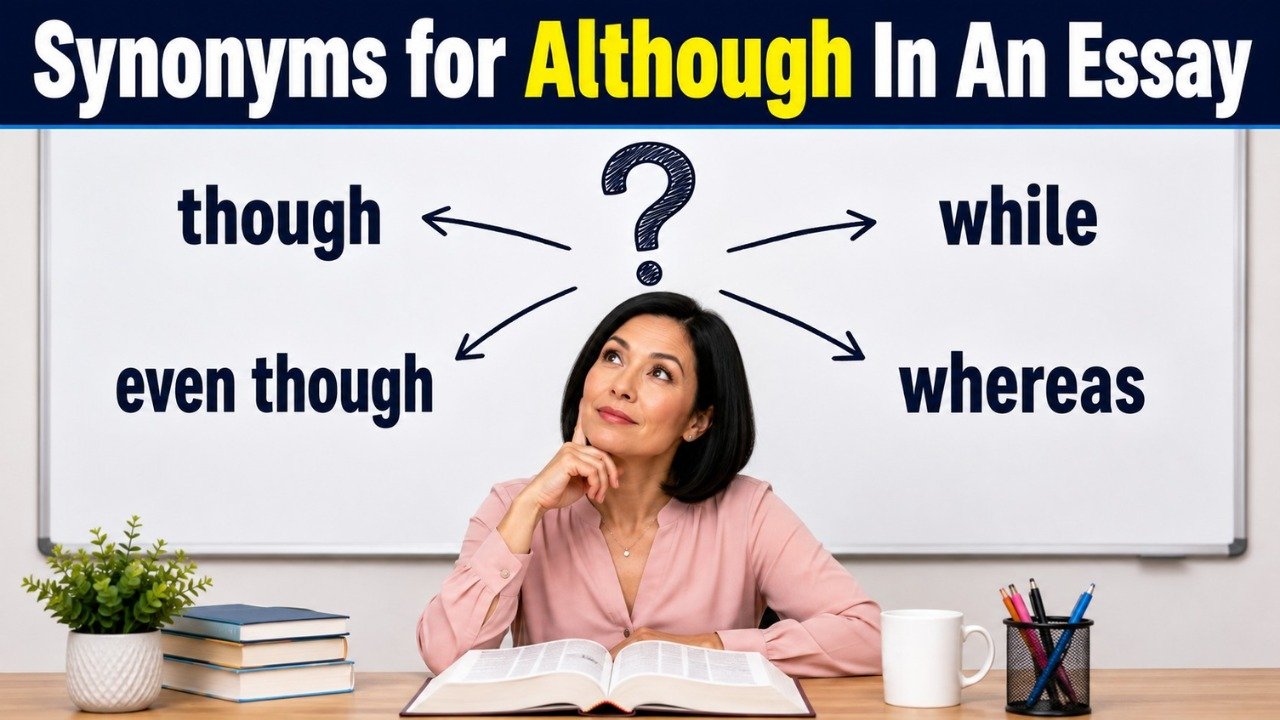
Quick Answer: The best synonyms for although in an essay include though, even though, while, whereas, albeit, despite the fact that, notwithstanding, however, nevertheless, and nonetheless. Use though for a natural and slightly less formal contrast, whereas for comparing two different facts, and albeit for a concise formal qualification. Use despite the fact that when you need a clear concessive phrase. However, nevertheless, and nonetheless work best as transitions between complete sentences rather than direct grammatical replacements for although.
Pronunciation and Word Details
Word: Although.
Pronunciation: /ɔːlˈðoʊ/
Part of Speech: Subordinating conjunction.
Meaning: Although introduces a fact that contrasts with the main statement or makes the result seem unexpected.
US Pronunciation:
UK Pronunciation:
What Does “Although” Mean?
Although means despite the fact that something is true. It introduces a contrast, limitation, concession, or unexpected result within a sentence.
Although is a subordinating conjunction. It connects a dependent clause to an independent clause and shows that the information in one clause does not prevent the result described in the other.
Example: Although the research was limited, the findings were valuable.
In this sentence, the limited research might normally reduce the value of the findings. The word although shows that the findings remained valuable despite that limitation.
Although can appear at the beginning or in the middle of a sentence.
Beginning Position: Although the theory is widely accepted, some questions remain unanswered.
Middle Position: Some questions remain unanswered, although the theory is widely accepted.
The word is especially useful in essays because it allows writers to acknowledge an opposing fact without abandoning their main argument. It can introduce limitations, recognize alternative opinions, compare evidence, or present an unexpected conclusion.
Meaning, Tone, and Context of “Although”
Although has a neutral to formal tone. It is common in essays, reports, academic discussions, analytical writing, professional communication, and careful everyday speech.
The word is polite and balanced because it allows a writer to recognize complexity. Instead of presenting an argument as completely certain, a writer can admit that another fact or viewpoint exists.
Academic Tone: Although the sample was small, the results reveal a consistent pattern.
Analytical Tone: Although the proposal offers several benefits, its financial risks require further consideration.
Balanced Tone: Although both arguments are reasonable, the second is supported by stronger evidence.
Conversational Tone: Although I was tired, I completed the assignment.
In formal essays, although is often more suitable than but when the writer wants to place greater emphasis on the main clause. It can also sound more integrated and analytical than beginning a separate sentence with however.
Although usually expresses concession. A concession occurs when a writer accepts that a particular fact is true before explaining why another fact, conclusion, or argument remains valid.
When and How to Use “Although”
For Presenting a Contrast
Use although when two ideas are true but appear to conflict.
Example: Although the policy reduced costs, it also created administrative difficulties.
The sentence recognizes a positive result while introducing a contrasting negative result.
For Acknowledging an Opposing View
Use although to recognize another opinion before presenting your main position.
Example: Although some critics consider the plan unrealistic, its main objectives are achievable.
This structure makes an argument appear balanced rather than dismissive.
For Introducing a Limitation
Use although when discussing a weakness, restriction, or exception.
Example: Although the study provides useful evidence, its conclusions cannot be applied to every population.
This use is especially valuable in research essays and critical analysis.
For Showing an Unexpected Result
Use although when the result is surprising because of the first fact.
Example: Although the weather conditions were severe, the event continued as planned.
Severe weather would normally cause cancellation, so the result is unexpected.
For Comparing Evidence
Use although to show that one piece of evidence does not completely cancel another.
Example: Although the first survey showed strong support, later responses were more divided.
For Creating a Balanced Introduction
Use although at the start of a paragraph when you want to recognize complexity before stating your main claim.
Example: Although technological development creates new opportunities, it can also increase social inequality.
For Qualifying a General Statement
Use although to prevent a statement from sounding too broad or absolute.
Example: The method is generally effective, although it may not work in every situation.
For Emphasizing the Main Clause
Place the more important information in the main clause.
Example: Although the initial results were disappointing, the final outcome was successful.
The main emphasis falls on the successful final outcome.
Best Synonyms for Although
Though
Synonym: Though means despite the fact that and is the closest everyday replacement for although.
Example: Though the evidence is incomplete, it supports the central argument.
Though is slightly less formal than although, but it remains acceptable in many essays.
Even Though
Synonym: Even though introduces a stronger or more surprising contrast.
Example: Even though the treatment was expensive, many patients considered it worthwhile.
Use even though when the contrast deserves extra emphasis.
While
Synonym: While can introduce a concession or contrast between two ideas.
Example: While the proposal has clear advantages, it also presents several risks.
In essays, while is useful for balanced comparisons. However, it can also refer to time, so the intended meaning must be clear.
Whereas
Synonym: Whereas directly compares two contrasting facts, groups, or situations.
Example: The first approach focuses on prevention, whereas the second emphasizes treatment.
Whereas is best when both sides of the comparison receive similar importance.
Albeit
Synonym: Albeit means although it is or although they are and introduces a brief qualification.
Example: The project was successful, albeit more expensive than expected.
Albeit is concise and formal, but it is usually followed by an adjective, adverb, or short phrase rather than a complete independent clause.
Despite the Fact That
Synonym: Despite the fact that introduces a clear contrast involving a complete clause.
Example: Despite the fact that the evidence was limited, the researchers reached a firm conclusion.
This phrase is clear but longer than although.
Notwithstanding the Fact That
Synonym: Notwithstanding the fact that means despite the truth of a particular fact.
Example: Notwithstanding the fact that demand had fallen, production continued.
This alternative is highly formal and should be used sparingly.
However
Synonym: However introduces a contrast between two complete statements.
Example: The evidence appears convincing. However, several important questions remain.
However is not normally a direct replacement for although within the same sentence. It usually begins a new sentence or follows a semicolon.
Nevertheless
Synonym: Nevertheless means despite what has just been stated.
Example: The experiment had several limitations. Nevertheless, it produced useful results.
It is formal and emphasizes that the second statement remains true.
Nonetheless
Synonym: Nonetheless means in spite of the previous fact or argument.
Example: The process was difficult. Nonetheless, the participants completed every stage.
Nonetheless is very similar to nevertheless and works well in formal essays.
50 Synonyms for Although with Short Meanings
Not every alternative below has the same grammatical structure as although. Some replace it directly, while others require the sentence to be rewritten as two clauses or separate sentences.
- Though: Despite the fact that.
- Even Though: Despite a particularly strong or surprising fact.
- While: Although or despite the fact that.
- Whereas: In contrast with the fact that.
- Albeit: Although it is or although they are.
- Despite the Fact That: Even though a stated fact is true.
- In Spite of the Fact That: Despite the truth of a complete statement.
- Notwithstanding the Fact That: Despite a fact that might affect the result.
- Notwithstanding That: Despite what has been stated.
- Granted That: Accepting that a particular fact is true.
- Even If: Regardless of whether a condition is true.
- Much As: Although to a considerable degree.
- While It Is True That: Acknowledging a valid fact before contrasting it.
- Although It Is True That: Recognizing a fact before presenting a qualification.
- Despite: Without being prevented by something.
- In Spite of: Regardless of a difficulty or opposing fact.
- Notwithstanding: Despite a circumstance or condition.
- Despite Being: Although someone or something has a stated quality.
- In Spite of Being: Regardless of having a stated condition.
- Regardless of: Without being affected by something.
- Regardless of the Fact That: Without allowing a fact to change the outcome.
- However: In contrast with the previous statement.
- Nevertheless: Despite what has already been mentioned.
- Nonetheless: In spite of the preceding fact.
- Still: Despite that fact.
- Yet: But despite what has been stated.
- Even So: Despite the situation just described.
- All the Same: Despite the previous fact or difficulty.
- That Said: Introducing a contrast or qualification.
- Having Said That: Acknowledging a previous point before limiting it.
- On the Other Hand: Introducing a contrasting perspective.
- By Contrast: Showing a clear difference from an earlier point.
- In Contrast: Presenting an opposite or noticeably different fact.
- Conversely: Introducing an opposite relationship or result.
- Despite This: In spite of the situation just mentioned.
- In Spite of This: Regardless of the preceding circumstance.
- Notwithstanding This: Despite the previous statement.
- For All That: Despite everything that has been mentioned.
- Be That as It May: Accepting a point before presenting a contrast.
- Admittedly: Recognizing a fact that may weaken an argument.
- Granted: Accepting that a point is valid.
- To Be Sure: Acknowledging the truth of a point before qualifying it.
- Then Again: Introducing another consideration or opposing idea.
- At the Same Time: Presenting a simultaneous contrast or qualification.
- On the Contrary: Introducing a directly opposing statement.
- But: Connecting two contrasting ideas.
- Except That: Introducing a limitation or exception.
- Only: Introducing a reservation or limiting condition.
- Even When: Despite something happening at a particular time.
- While Still: Showing that a condition continues despite another fact.
Read Also:
Synonyms for Whereas
Synonyms for Although by Context
When Although Introduces a General Contrast
Use these alternatives when two facts differ but neither one is necessarily surprising.
Useful Synonyms: Though, while, whereas, but, in contrast, by contrast.
Example With Although: Although the first method is faster, the second is more accurate.
Example With Whereas: The first method is faster, whereas the second is more accurate.
Whereas creates a direct comparison. Although places more emphasis on the main clause.
When Although Shows an Unexpected Result
Use these alternatives when the second fact remains true despite a strong obstacle.
Useful Synonyms: Even though, nevertheless, nonetheless, even so, still, yet.
Example With Although: Although the evidence was weak, the claim received widespread attention.
Example With Even Though: Even though the evidence was weak, the claim received widespread attention.
Even though gives the contrast greater emotional or logical emphasis.
When Although Introduces a Formal Qualification
Use these alternatives when adding a concise limitation to a formal statement.
Useful Synonyms: Albeit, notwithstanding, notwithstanding the fact that, to be sure.
Example With Although: The strategy was effective, although it was expensive.
Example With Albeit: The strategy was effective, albeit expensive.
Albeit is more concise, but it cannot always introduce a complete clause in the same way as although.
When Although Acknowledges an Opposing Argument
Use these alternatives when recognizing another viewpoint before defending your own.
Useful Synonyms: Admittedly, granted, granted that, while it is true that, that said.
Example With Although: Although critics raise valid concerns, the proposal remains practical.
Example With Granted That: Granted that critics raise valid concerns, the proposal remains practical.
Granted that explicitly accepts the opposing point before moving to the main argument.
When Although Connects Separate Sentences
Use sentence transitions when the contrasting ideas are long or deserve independent emphasis.
Useful Synonyms: However, nevertheless, nonetheless, still, even so, that said.
Example With Although: Although the research was extensive, it did not resolve the central question.
Example With However: The research was extensive. However, it did not resolve the central question.
The second version creates a stronger pause between the ideas.
When Although Refers to a Noun or Noun Phrase
Although normally introduces a clause. Use despite, in spite of, or notwithstanding before a noun phrase.
Example With Although: Although the team faced several delays, it completed the work.
Example With Despite: Despite several delays, the team completed the work.
Do not place a complete clause directly after despite unless you add the fact that.
Another Word for Although
Though is usually the best single word replacement for although because it has nearly the same meaning and grammatical function. However, the best alternative depends on the sentence structure, tone, and type of contrast.
Use whereas for direct comparison, even though for strong emphasis, and albeit for a concise formal qualification. Use however when the contrasting idea begins a separate sentence.
Original: Although the task was difficult, the students completed it successfully.
Better Option: Though the task was difficult, the students completed it successfully.
Original: Although the two systems appear similar, they operate differently.
Better Option: The two systems appear similar, whereas they operate differently in several important ways.
Original: The solution was effective, although it was temporary.
Better Option: The solution was effective, albeit temporary.
Original: Although the report was detailed, it omitted several important findings.
Better Option: The report was detailed. However, it omitted several important findings.
When Not to Use “Although”
Although is useful, but it should not appear repeatedly in every paragraph. Frequent repetition can make an essay sound mechanical and predictable.
When a Direct Comparison Is Needed
Use whereas when you are comparing two people, groups, methods, or results equally.
Weak: Although the first group preferred online learning, the second group preferred classroom instruction.
Better: The first group preferred online learning, whereas the second group preferred classroom instruction.
When the Contrast Needs a Separate Sentence
Use however, nevertheless, or nonetheless when both ideas are long and need individual emphasis.
Weak: Although the first investigation examined economic effects across several regions and industries, the second investigation focused on social effects within a single community.
Better: The first investigation examined economic effects across several regions and industries. By contrast, the second focused on social effects within a single community.
When a Noun Phrase Follows
Do not place a noun directly after although. Use despite or in spite of.
Weak: Although the heavy rain, the match continued.
Better: Despite the heavy rain, the match continued.
Better: Although the rain was heavy, the match continued.
When There Is No Real Contrast
Do not use although when the two clauses support each other rather than conflict.
Weak: Although the data was accurate, it provided reliable information.
Better: Because the data was accurate, it provided reliable information.
When the Meaning Is Cause and Effect
Although expresses concession, not cause.
Weak: Although the road was closed, the drivers used another route.
This sentence means the drivers used another route despite the closure, which may not be the intended meaning.
Better: Because the road was closed, the drivers used another route.
When the Contrast Is Too Weak to Matter
Avoid forcing although into a sentence when but provides a clearer and more natural connection.
Weak: The room was small, although it was clean.
Better: The room was small but clean.
When a More Precise Relationship Exists
Choose a word that clearly identifies comparison, exception, condition, or cause.
Weak: Although the first theory discusses social behavior, the second theory examines economic decisions.
Better: Whereas the first theory discusses social behavior, the second examines economic decisions.
Words Commonly Confused With Although
Although vs Though: Both mean despite the fact that. Although is slightly more formal and is common in essays. Though is more flexible and can also appear at the end of a sentence in informal usage.
Although vs However: Although is a subordinating conjunction that connects clauses within one sentence. However is a conjunctive adverb that usually connects separate sentences or follows a semicolon.
Although vs Despite: Although is followed by a subject and verb. Despite is followed by a noun, pronoun, or gerund phrase.
Although vs In Spite of: In spite of has the same basic meaning as despite. It must be followed by a noun phrase or gerund unless it appears as in spite of the fact that.
Although vs Whereas: Although introduces a concession or unexpected contrast. Whereas usually compares two different facts, people, methods, or situations.
Although vs Even Though: Even though expresses a stronger contrast. It suggests that the result is especially surprising.
Although vs Albeit: Although can introduce a full clause. Albeit normally introduces a shortened qualification, such as an adjective, adverb, or brief phrase.
Although vs Even If: Although introduces a fact that is accepted as true. Even if introduces a possible or hypothetical condition.
Although vs But: Both express contrast. Although creates a dependent clause, while but joins grammatical elements of equal importance.
Although vs Nevertheless: Although joins clauses within a sentence. Nevertheless refers back to a previous statement and often begins a new sentence.
Which Synonym Should You Choose?
Choose though when you want the closest natural replacement for although.
Choose even though when the contrast is strong, surprising, or important to the argument.
Choose while when presenting a balanced concession or comparing two related perspectives.
Choose whereas when directly comparing two groups, methods, facts, or outcomes.
Choose albeit when adding a short and formal qualification after the main statement.
Choose despite the fact that when clarity is more important than concision.
Choose despite when the next element is a noun, pronoun, or gerund phrase.
Choose however when the contrasting point deserves a separate sentence.
Choose nevertheless when the second statement remains true despite a serious obstacle.
Choose nonetheless when you need a formal transition meaning in spite of that.
Choose admittedly when recognizing a weakness in your own argument.
Choose granted that when temporarily accepting an opposing claim before responding to it.
Choose by contrast when highlighting a clear difference between evidence, results, or theories.
Choose on the other hand when introducing another perspective rather than directly rejecting the first one.
Choose still when the contrast is simple and the second statement remains true.
Real Life Examples of “Although” in Sentences
Original: Although the course was demanding, it improved the students’ analytical skills.
Better Option: Even though the course was demanding, it improved the students’ analytical skills.
Original: Although both solutions are practical, the second is more affordable.
Better Option: While both solutions are practical, the second is more affordable.
Original: Although the first group received additional training, the second group performed better.
Better Option: The first group received additional training, whereas the second group performed better.
Original: The building is attractive, although it is expensive to maintain.
Better Option: The building is attractive, albeit expensive to maintain.
Original: Although the researchers collected extensive data, they could not confirm the hypothesis.
Better Option: The researchers collected extensive data. However, they could not confirm the hypothesis.
Original: Although the journey was difficult, the team reached its destination.
Better Option: Despite the difficult journey, the team reached its destination.
Original: Although the evidence had several weaknesses, it contributed to the discussion.
Better Option: The evidence had several weaknesses. Nevertheless, it contributed to the discussion.
Original: Although the proposal was initially rejected, it was reconsidered later.
Better Option: In spite of its initial rejection, the proposal was reconsidered later.
Original: Although critics questioned the method, the researchers continued using it.
Better Option: Despite the fact that critics questioned the method, the researchers continued using it.
Original: Although the product was less expensive, it offered similar quality.
Better Option: The product was less expensive. Nonetheless, it offered similar quality.
Synonym Groups and Usage Differences
Direct Conjunction Group
This group includes though, even though, while, whereas, and granted that. These expressions can introduce clauses containing a subject and verb.
Though is the closest alternative. Even though adds emphasis. While creates a balanced contrast. Whereas directly compares two facts. Granted that acknowledges a point before qualifying it.
Example: While the evidence is useful, it does not prove the entire claim.
Formal Qualification Group
This group includes albeit, notwithstanding, and notwithstanding the fact that. These alternatives are suitable for formal essays, legal discussions, analytical reports, and carefully structured arguments.
Albeit is concise and normally introduces a short phrase. Notwithstanding is more formal and may sound heavy when overused.
Example: The results were promising, albeit preliminary.
Sentence Transition Group
This group includes however, nevertheless, nonetheless, even so, still, and yet. These words usually connect complete statements rather than replace although directly.
However introduces a general contrast. Nevertheless and nonetheless emphasize that the next statement remains true. Even so is slightly more conversational. Still and yet are concise.
Example: The available evidence is limited. Nevertheless, it supports further investigation.
Contrast Comparison Group
This group includes whereas, by contrast, in contrast, conversely, and on the other hand.
Whereas joins contrasting clauses. By contrast and in contrast emphasize differences. Conversely introduces an opposite relationship. On the other hand presents another side of an issue.
Example: The first method requires extensive preparation. By contrast, the second can be applied immediately.
Concession Group
This group includes admittedly, granted, to be sure, while it is true that, and be that as it may.
These expressions openly recognize a valid point before presenting a limitation or response. They are useful in argumentative essays because they demonstrate fairness and critical thinking.
Example: Admittedly, the policy involves significant costs. However, its long term benefits may justify the investment.
Preposition Group
This group includes despite, in spite of, notwithstanding, and regardless of.
These words and phrases are followed by nouns, pronouns, or gerunds rather than complete clauses.
Example: Despite facing strong opposition, the committee approved the proposal.
Antonyms of Although
Although does not have one exact antonym because it expresses a relationship between clauses. Its opposites depend on whether the intended relationship is cause, agreement, similarity, certainty, or expected result.
Because: Introduces a direct cause rather than a concession.
Since: Explains why something happens.
As: Introduces a reason or cause in certain contexts.
Therefore: Shows a logical result.
Consequently: Introduces an outcome caused by the previous fact.
Thus: Presents a result or conclusion.
Accordingly: Shows that an action or result follows logically.
Similarly: Introduces a comparable idea rather than a contrast.
Likewise: Shows agreement or similarity.
Correspondingly: Indicates a matching relationship.
Indeed: Strengthens or confirms a previous statement.
Furthermore: Adds supporting information rather than opposing it.
Moreover: Introduces another supporting point.
Because of: Introduces the reason for an outcome.
As a Result: Shows an expected consequence rather than an unexpected contrast.
Comparison: Although vs Related Words
Although vs Though
Although and though usually have the same meaning. Although is slightly more formal and is often preferred at the beginning of an academic sentence. Though is more natural in less formal writing.
Example With Although: Although the argument is persuasive, it lacks sufficient evidence.
Example With Though: Though the argument is persuasive, it lacks sufficient evidence.
Although vs Even Though
Even though creates a stronger contrast than although. It is useful when the result is particularly surprising.
Example With Although: Although she had limited experience, she completed the task successfully.
Example With Even Though: Even though she had no previous experience, she completed the task successfully.
Although vs While
Although emphasizes concession. While can express concession, comparison, or simultaneous time.
Example With Although: Although the plan is expensive, it may produce lasting benefits.
Example With While: While the plan is expensive, it may produce lasting benefits.
The sentences are similar, but while may sound more balanced and less focused on surprise.
Although vs Whereas
Although usually places greater emphasis on the main clause. Whereas presents a direct contrast between two equally important facts.
Example With Although: Although the first system is efficient, the second is more reliable.
Example With Whereas: The first system is efficient, whereas the second is more reliable.
Although vs However
Although joins a dependent clause to a main clause. However links independent statements and requires different punctuation.
Example With Although: Although the evidence was convincing, the jury remained uncertain.
Example With However: The evidence was convincing. However, the jury remained uncertain.
Although vs Despite
Although is followed by a clause. Despite is followed by a noun phrase or gerund.
Example With Although: Although the economy was unstable, the business continued to expand.
Example With Despite: Despite the unstable economy, the business continued to expand.
Although vs Albeit
Although introduces a full clause, while albeit normally introduces a shortened phrase.
Example With Although: The process was effective, although it was time consuming.
Example With Albeit: The process was effective, albeit time consuming.
Although vs Nevertheless
Although appears within a sentence and introduces a dependent clause. Nevertheless often begins a new sentence and refers to the entire previous statement.
Example With Although: Although the cost was high, the organization approved the purchase.
Example With Nevertheless: The cost was high. Nevertheless, the organization approved the purchase.
Although vs Even If
Although refers to a real or accepted fact. Even if refers to a possibility or imagined condition.
Example With Although: Although it is raining, the event will continue.
The rain is currently happening.
Example With Even If: Even if it rains, the event will continue.
The rain is only a possibility.
Although vs But
Although creates a dependent clause, while but joins two equal clauses, words, or phrases.
Example With Although: Although the room was small, it was comfortable.
Example With But: The room was small, but it was comfortable.
Common Phrases and Expressions With “Although”
Although It Is True That: Introduces an accepted fact before a contrast.
Example: Although it is true that the plan is expensive, its benefits may justify the cost.
Although It May Seem: Introduces an appearance that may not reflect reality.
Example: Although it may seem simple, the process requires careful planning.
Although Some Argue: Acknowledges an opposing viewpoint in an essay.
Example: Although some argue that the rule is unnecessary, it serves an important purpose.
Although This Suggests: Recognizes one interpretation before adding a limitation.
Example: Although this suggests a positive trend, more evidence is required.
Although Not: Introduces a concise qualification.
Example: The solution was useful, although not permanent.
Although Still: Shows that a condition continues despite another fact.
Example: The theory is influential, although still controversial.
Although Often: Introduces a common situation with an exception or contrast.
Example: The method, although often effective, can produce inconsistent results.
Although Generally: Qualifies a broad statement.
Example: The treatment is generally safe, although generally less effective for severe cases.
Although Initially: Contrasts an early condition with a later result.
Example: Although initially doubtful, the participants eventually supported the proposal.
Although Perhaps: Introduces a cautious or uncertain qualification.
Example: The conclusion is reasonable, although perhaps too broad.
Common Mistakes to Avoid
Using Although and But Together
Do not use although and but to introduce the same contrast in one sentence.
Incorrect: Although the task was difficult, but the students completed it.
Correct: Although the task was difficult, the students completed it.
Correct: The task was difficult, but the students completed it.
Using Although Before a Noun Phrase
Although must introduce a clause containing a subject and verb.
Incorrect: Although the bad weather, the event continued.
Correct: Although the weather was bad, the event continued.
Correct: Despite the bad weather, the event continued.
Treating However as a Direct Replacement
However cannot always replace although without changing the punctuation and sentence structure.
Incorrect: However the evidence was limited, the conclusion was accepted.
Correct: Although the evidence was limited, the conclusion was accepted.
Correct: The evidence was limited. However, the conclusion was accepted.
Confusing Although With Even If
Use although for a known fact and even if for a hypothetical condition.
Incorrect: Although the results change tomorrow, the conclusion will remain valid.
Better: Even if the results change tomorrow, the conclusion will remain valid.
Overusing Although
Repeatedly beginning paragraphs with although can make an essay sound formulaic.
Vary the structure with while, whereas, despite, however, nevertheless, admittedly, and by contrast.
Choosing an Overly Formal Synonym
Notwithstanding the fact that is grammatically correct, but it may sound unnecessarily heavy in a simple essay.
Weak: Notwithstanding the fact that the room was small, it was comfortable.
Better: Although the room was small, it was comfortable.
Using Whereas for an Unexpected Result
Whereas is best for comparison, not for every type of concession.
Weak: Whereas the weather was terrible, the event continued.
Better: Although the weather was terrible, the event continued.
Using Albeit Before a Full Independent Clause
Albeit usually introduces a shortened phrase rather than a full clause.
Weak: The solution was effective, albeit it was expensive.
Better: The solution was effective, albeit expensive.
Better: The solution was effective, although it was expensive.
Creating a Sentence Fragment
An although clause cannot normally stand alone as a complete sentence.
Incorrect: Although the research was extensive.
Correct: Although the research was extensive, it did not answer every question.
Misplacing Commas
Use a comma after an introductory although clause.
Correct: Although the evidence was limited, the findings were important.
A comma is often unnecessary when the although clause appears at the end and is essential to the meaning.
Correct: The findings were important although the evidence was limited.
A comma may be added before the final although clause when it introduces a clear afterthought or nonessential qualification.
Correct: The findings were encouraging, although further research is necessary.
Using a Synonym Without Changing the Grammar
Despite and in spite of cannot be followed by a complete clause unless the fact that is included.
Incorrect: Despite the results were disappointing, the researchers continued.
Correct: Despite the disappointing results, the researchers continued.
Correct: Despite the fact that the results were disappointing, the researchers continued.
Conclusion
The best synonyms for although in an essay depend on the type of contrast and the grammatical structure. Though is the closest direct replacement, while even though adds stronger emphasis. Whereas works best for direct comparisons, and albeit provides a concise formal qualification. Use despite before a noun phrase and however, nevertheless, or nonetheless between complete statements. Varying these alternatives can improve sentence flow, reduce repetition, and make an essay sound more precise, balanced, and academically polished.
FAQs About Synonyms for Although
What Is the Best Synonym for Although in an Essay?
Though is the closest general synonym. For more formal or specific contexts, use while, whereas, albeit, despite the fact that, however, or nevertheless.
Can I Use Though Instead of Although in Formal Writing?
Yes. Though is acceptable in most formal essays, but although may sound slightly more polished at the beginning of a sentence.
Is However a Synonym for Although?
However expresses a similar contrast, but it has a different grammatical function. Although joins a dependent clause to a main clause, while however usually connects separate sentences.
What Is a More Formal Word for Although?
Albeit, notwithstanding, nevertheless, and nonetheless are formal alternatives. The correct choice depends on whether you need a conjunction, preposition, or sentence transition.
Can I Start an Essay Sentence With Although?
Yes. Begin with an although clause, place a comma after it, and complete the sentence with an independent clause.
Example: Although the issue is complex, several practical solutions are available.
What Can I Use Instead of Although at the Beginning of a Paragraph?
You can use while, even though, admittedly, granted that, despite the fact that, or while it is true that. You may also rewrite the contrast using however or nevertheless in a separate sentence.
What Is the Difference Between Although and Despite?
Although is followed by a subject and verb. Despite is followed by a noun, pronoun, or gerund phrase.
Although Example: Although the test was difficult, most students passed.
Despite Example: Despite the difficult test, most students passed.
