
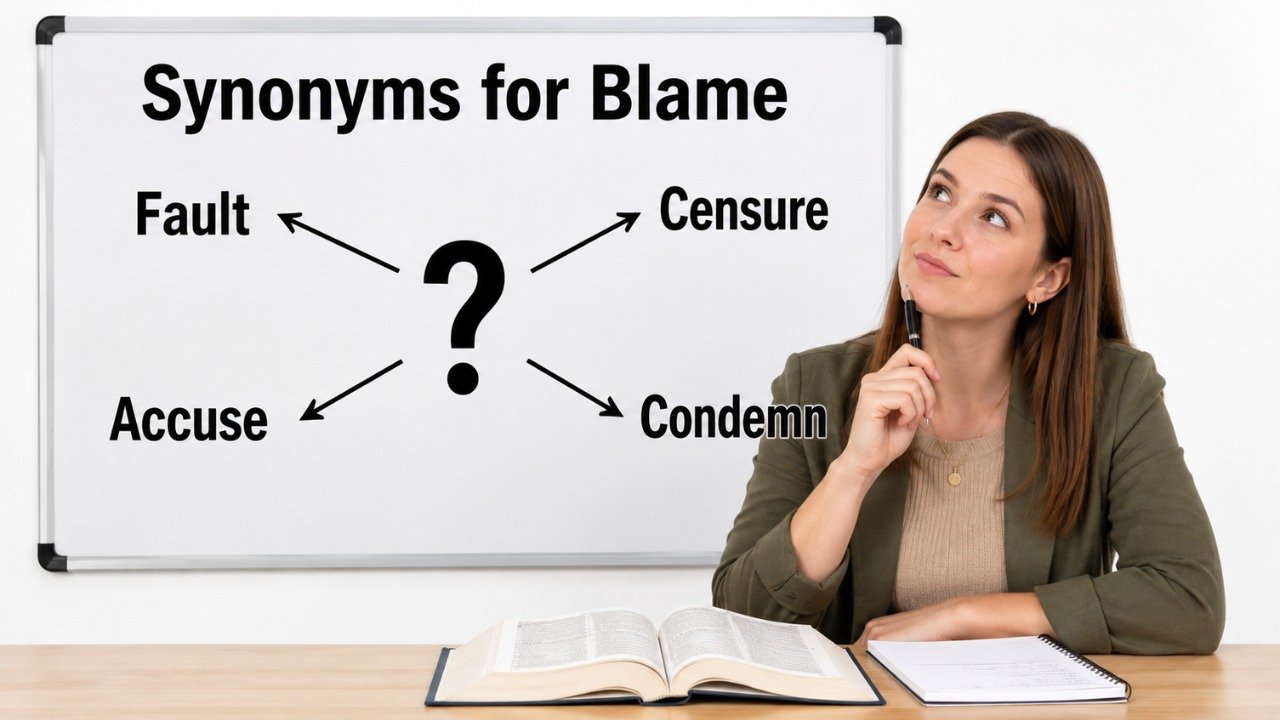
Quick Answer: Common synonyms for blame include fault, accuse, criticize, condemn, censure, reproach, faultfinding, responsibility, liability, and accountability. The best synonyms for blame depend on context. Use accuse when assigning wrongdoing to a person, fault in casual speech, censure or condemn in formal criticism, responsibility in neutral writing, accountability in professional contexts, reproach for personal disappointment, and liability when legal or financial responsibility is involved.
Pronunciation and Word Details
Word: Blame.
Pronunciation: /bleɪm/
Part of Speech: Noun and verb.
Meaning: To hold someone responsible for a mistake or bad result, or responsibility for something that went wrong.
US Pronunciation:
UK Pronunciation:
What Does “Blame” Mean?
Blame means to hold a person, action, event, or cause responsible for something negative.
As a verb, blame describes the act of saying that someone or something caused a problem, mistake, failure, or harmful result.
Example: She blamed the delay on poor planning.
As a noun, blame means responsibility or fault for something that went wrong.
Example: He accepted the blame for the mistake.
The word can appear in personal conversations, workplace discussions, formal reports, arguments, news writing, academic analysis, and everyday descriptions of cause and responsibility.
Blame can refer to genuine responsibility, but it can also describe unfair criticism when a person is accused without enough evidence.
Meaning, Tone, and Context of “Blame”
Blame is a common and generally neutral word, but its tone is often negative because it involves fault, criticism, or responsibility for an undesirable outcome.
Conversational Tone: Blame is very common in everyday speech.
Example: Do not blame me for the weather.
Emotional Tone: In arguments, blame can sound accusatory or confrontational.
Example: They kept blaming each other for the failure.
Formal Tone: In professional writing, responsibility, accountability, liability, censure, or attribution may sound more precise.
Example: The report assigned responsibility for the error to poor oversight.
Academic Tone: Blame may be used when discussing responsibility, social judgment, ethics, or causes, but more specific words are often useful.
Example: The study examined how people assign responsibility after failure.
Legal Tone: Liability is often more precise than blame when legal responsibility is involved.
Example: The court considered whether either party carried liability.
Moral Tone: Condemnation, reproach, and censure may express stronger moral criticism than blame.
When and How to Use “Blame”
For Assigning Responsibility
Use blame when saying that someone or something caused a problem or negative result.
Example: They blamed poor communication for the confusion.
For Personal Fault
Blame can describe responsibility for a mistake or harmful action.
Example: She accepted the blame for sending the wrong information.
For Criticism
Use blame when criticism focuses on who caused a problem.
Example: The manager blamed the team for missing the deadline.
For Causes
Blame can refer to a thing, condition, or circumstance rather than a person.
Example: Experts blamed heavy rain for the flooding.
For Shared Responsibility
Blame can also be divided among several people or causes.
Example: Both sides shared the blame for the disagreement.
For Avoiding Responsibility
The word is common in phrases describing people who refuse to accept fault.
Example: He tried to shift the blame onto someone else.
Best Synonyms for Blame
Fault: To hold someone responsible for a problem or mistake.
Example: I cannot fault her for making that decision.
Accuse: To say that someone has done something wrong.
Example: They accused him of ignoring the instructions.
Criticize: To express disapproval of someone’s actions or decisions.
Example: The report criticized the poor planning.
Condemn: To express very strong disapproval of an action or person.
Example: Community leaders condemned the harmful behavior.
Censure: To express formal or official disapproval.
Example: The committee censured the official for misconduct.
Reproach: To express disappointment or criticism toward someone.
Example: She reproached him for breaking his promise.
Responsibility: The state of being answerable for an action or result.
Example: She accepted responsibility for the mistake.
Accountability: The obligation to explain and accept responsibility for actions.
Example: Clear accountability was needed after the failure.
Liability: Legal or financial responsibility for damage or loss.
Example: The agreement defined each party’s liability.
Faultfinding: The habit or act of focusing on errors and shortcomings.
Example: Constant faultfinding damaged the team’s confidence.
50 Synonyms for Blame with Short Meanings
- Fault: Responsibility for a mistake or problem.
- Accuse: Say that someone has done something wrong.
- Criticize: Express disapproval of actions or decisions.
- Condemn: Strongly express disapproval.
- Censure: Formally criticize or disapprove.
- Reproach: Express disappointment or criticism.
- Faultfinding: Focusing repeatedly on mistakes.
- Responsibility: Being answerable for an action or result.
- Accountability: Obligation to accept responsibility.
- Liability: Legal or financial responsibility.
- Culpability: Responsibility for wrongdoing or fault.
- Guilt: Responsibility for an offense or wrongdoing.
- Criticism: Expression of disapproval.
- Condemnation: Strong public or moral disapproval.
- Reprimand: Official expression of disapproval.
- Rebuke: Sharp criticism of someone’s behavior.
- Admonition: Firm warning or criticism.
- Disapproval: Negative judgment about behavior or actions.
- Denunciation: Strong public criticism.
- Indictment: Serious accusation or criticism.
- Charge: Formal accusation of wrongdoing.
- Accusation: Statement that someone did something wrong.
- Allegation: Claim that wrongdoing occurred.
- Imputation: Attribution of fault or wrongdoing.
- Attribution: Assignment of a cause or responsibility.
- Responsibleness: State of being answerable for something.
- Answerability: Duty to explain or accept responsibility.
- Reproval: Expression of disapproval.
- Scolding: Strong spoken criticism.
- Chastisement: Severe criticism or punishment.
- Castigation: Harsh criticism.
- Discredit: Damage to reputation through criticism or fault.
- Denounce: Publicly criticize or condemn.
- Rebuke: Speak sharply against wrongdoing.
- Reprimand: Officially criticize someone.
- Chide: Criticize mildly for a fault.
- Scold: Criticize angrily.
- Admonish: Warn or criticize firmly.
- Censure: Express official criticism.
- Reprove: Criticize someone for wrongdoing.
- Upbraid: Criticize someone severely.
- Berate: Criticize angrily and repeatedly.
- Castigate: Criticize very severely.
- Denounce: Publicly express strong disapproval.
- Implicate: Connect someone with responsibility or wrongdoing.
- Incriminate: Make someone appear responsible for an offense.
- Hold Responsible: Treat someone as answerable for an outcome.
- Find Fault With: Criticize someone or something.
- Assign Responsibility: Identify who is answerable for an outcome.
- Lay Fault On: Place responsibility for a problem on someone or something.
Read Also:
Synonyms for Traveler

Synonyms for Blame by Context
When Blame Means Hold Someone Responsible
Useful alternatives include fault, accuse, hold responsible, implicate, incriminate, and assign responsibility.
Example: They blamed him for the mistake.
Alternative: They held him responsible for the mistake.
Hold responsible is often clearer and more neutral than blame in professional writing.
When Blame Means Criticize
Useful synonyms include criticize, censure, reproach, rebuke, reprove, admonish, and chide.
Example: She blamed him for ignoring the warning.
Alternative: She reproached him for ignoring the warning.
Reproach suggests personal disappointment, while censure suggests formal disapproval.
When Blame Means Strong Disapproval
Condemn, denounce, castigate, berate, and upbraid are stronger choices.
Example: The public blamed the leaders for the harmful decision.
Alternative: The public condemned the leaders for the harmful decision.
Condemn is much stronger than blame and suggests serious moral or public disapproval.
When Blame Means Responsibility
Responsibility, accountability, culpability, guilt, liability, and fault are useful noun alternatives.
Example: She accepted the blame for the error.
Alternative: She accepted responsibility for the error.
Responsibility is usually more neutral and professional than blame.
When Blame Means Legal Responsibility
Liability, culpability, accountability, and responsibility may fit formal or legal contexts.
Example: The company denied blame for the damage.
Alternative: The company denied liability for the damage.
Liability is more precise when legal or financial responsibility is being discussed.
Another Word for Blame
The best general replacement for blame is responsibility when the sentence refers to being answerable for an outcome. If blame is used as a verb, fault or accuse may be stronger alternatives. The best choice always depends on whether the sentence focuses on criticism, responsibility, wrongdoing, or legal liability.
Original: She accepted the blame for the mistake.
Better Option: She accepted responsibility for the mistake.
Original: They blamed him for the delay.
Better Option: They held him responsible for the delay.
Original: The manager blamed the staff for the error.
Better Option: The manager criticized the staff for the error.
Original: The report blamed weak oversight for the problem.
Better Option: The report attributed the problem to weak oversight.
When Not to Use “Blame”
Blame can sound emotional or accusatory when a more neutral word would communicate the idea more clearly.
When You Mean Neutral Responsibility
Weak: The report placed blame on the department.
Better: The report assigned responsibility to the department.
Responsibility sounds more objective in formal writing.
When You Mean Cause Rather Than Fault
Weak: Researchers blamed the change on lower temperatures.
Better: Researchers attributed the change to lower temperatures.
Attribution is more neutral when no wrongdoing is involved.
When You Mean Formal Criticism
Weak: The committee blamed the official.
Better: The committee censured the official.
Censure is more precise when formal disapproval is involved.
When You Mean Legal Responsibility
Weak: The business accepted blame for the loss.
Better: The business accepted liability for the loss.
Liability clearly identifies legal or financial responsibility.
When Repetition Becomes Distracting
Weak: They blamed the manager, blamed the workers, and blamed poor planning.
Better: They criticized the manager, held the workers responsible, and attributed part of the failure to poor planning.
Using context specific alternatives improves clarity.
Words Commonly Confused With Blame
Blame vs Fault: Blame can be a noun or verb and focuses on responsibility for something negative. Fault can also mean responsibility, but it may refer more directly to a mistake, weakness, or defect.
Blame vs Accuse: Blame means holding someone responsible. Accuse usually means directly claiming that someone committed a specific wrongdoing.
Blame vs Criticize: Blame assigns responsibility for a negative result. Criticize expresses disapproval but does not always assign responsibility.
Blame vs Responsibility: Blame often carries negative judgment. Responsibility is more neutral and can refer to duties as well as fault.
Blame vs Accountability: Accountability refers to the obligation to explain and accept responsibility. Blame focuses more on fault.
Blame vs Liability: Liability usually refers to legal or financial responsibility. Blame is broader and more conversational.
Blame vs Culpability: Culpability specifically refers to deserving blame for wrongdoing. It is more formal than blame.
Which Synonym Should You Choose?
Choose fault in everyday conversation when you mean holding someone responsible.
Choose accuse when someone is directly charged with wrongdoing.
Choose criticize when you want to express disapproval without necessarily assigning full responsibility.
Choose responsibility in reports, essays, emails, and professional writing when you need a neutral term.
Choose accountability when emphasizing the duty to explain decisions and accept consequences.
Choose culpability in formal writing when discussing responsibility for wrongdoing.
Choose liability when legal or financial responsibility is the main issue.
Choose censure for official or formal criticism.
Choose condemn when the disapproval is strong and moral.
Choose reproach when criticism is personal and connected with disappointment.
Choose attribution when explaining a cause without implying moral fault.
Real Life Examples of “Blame” in Sentences
Original: She accepted the blame for the mistake.
Better Option: She accepted responsibility for the mistake.
Original: They blamed the delay on poor communication.
Better Option: They attributed the delay to poor communication.
Original: He blamed his colleague for the missing files.
Better Option: He held his colleague responsible for the missing files.
Original: The manager blamed the team for poor results.
Better Option: The manager criticized the team for poor results.
Original: The report placed the blame on weak supervision.
Better Option: The report assigned responsibility to weak supervision.
Original: She blamed him for ignoring the warning.
Better Option: She reproached him for ignoring the warning.
Original: Officials blamed the contractor for the damage.
Better Option: Officials held the contractor accountable for the damage.
Original: The organization denied blame for the financial loss.
Better Option: The organization denied liability for the financial loss.
Original: The public blamed the decision makers for the failure.
Better Option: The public condemned the decision makers for the failure.
Original: Do not blame yourself for something you could not control.
Better Option: Do not fault yourself for something you could not control.
Synonym Groups and Usage Differences
Responsibility Group
Responsibility, accountability, liability, culpability, guilt, fault, and answerability belong to this group.
These words describe different degrees or types of responsibility.
Example: The investigation established accountability for the mistake.
Criticism Group
Criticism, reproach, censure, rebuke, reprimand, reproof, and admonition belong to this group.
These words focus more on disapproval than on identifying a cause.
Example: Her decision received strong criticism.
Accusation Group
Accuse, accusation, allegation, charge, implication, and incrimination belong to this group.
These terms are useful when someone is being connected with wrongdoing.
Example: The accusation was taken seriously.
Strong Disapproval Group
Condemn, denunciation, castigation, upbraiding, and berating express stronger judgment than ordinary blame.
Example: The harmful action received widespread condemnation.
Neutral Cause Group
Attribution, assign responsibility, identify the cause, and connect with are useful when discussing causes without emotional judgment.
Example: The report attributed the decline to several factors.
Antonyms of Blame
The opposite of blame depends on whether the word refers to criticism, fault, responsibility, or wrongdoing.
Praise: Express approval or admiration.
Commendation: Formal expression of approval.
Approval: Positive judgment or acceptance.
Credit: Recognition for causing a positive result.
Acquittal: Formal finding that a person is not guilty.
Exoneration: Removal of blame or responsibility.
Vindication: Proof that a person or decision was justified.
Absolution: Release from blame or guilt.
Forgiveness: Decision to stop holding wrongdoing against someone.
Excuse: Reason that reduces or removes fault.
Justification: Explanation showing that an action was reasonable.
Innocence: State of not being responsible for wrongdoing.
Comparison: Blame vs Related Words
Blame vs Fault
Blame is broader and can describe both assigning responsibility and the responsibility itself. Fault often focuses more directly on a mistake, weakness, or cause.
Example With Blame: They blamed him for the error.
Example With Fault: I cannot fault him for trying to help.
Blame vs Accuse
Blame means holding someone responsible for a negative outcome. Accuse means directly claiming that someone committed a particular wrong.
Example With Blame: She blamed him for the delay.
Example With Accuse: She accused him of hiding important information.
Blame vs Criticize
Blame focuses on responsibility. Criticize focuses on expressing disapproval.
Example With Blame: They blamed the manager for the decision.
Example With Criticize: They criticized the manager’s decision.
Blame vs Responsibility
Blame usually has a negative tone, while responsibility can be neutral or positive.
Example With Blame: He accepted the blame for the failure.
Example With Responsibility: He accepted responsibility for the project.
Blame vs Accountability
Blame identifies fault, while accountability emphasizes being answerable for actions and consequences.
Example With Blame: The discussion focused on who deserved blame.
Example With Accountability: The new policy created greater accountability.
Blame vs Liability
Blame is a general term. Liability is more precise for legal and financial responsibility.
Example With Blame: They denied blame for the damage.
Example With Liability: They denied liability for the damage.
Common Phrases and Expressions With Blame
Take the Blame: Accept responsibility for something negative.
Put the Blame On: Assign responsibility to someone or something.
Place the Blame: Identify a person or cause as responsible.
Shift the Blame: Move responsibility from yourself to someone else.
Share the Blame: Divide responsibility between several people or causes.
Accept the Blame: Admit responsibility for a problem.
Get the Blame: Be held responsible for something.
Blame Someone For Something: Hold a person responsible for an event or result.
Blame Something On Someone: Say that a person caused a problem.
Have Only Yourself to Blame: Be personally responsible for a negative result.
Common Mistakes to Avoid
Mistake One: Using blame and accuse as exact synonyms.
Accuse normally introduces a specific wrongdoing, while blame focuses on responsibility for a negative result.
Weak: She blamed him of lying.
Better: She accused him of lying.
The correct pattern is blame someone for something, not blame someone of something.
Mistake Two: Using the wrong preposition.
Use blame someone for an action and blame something on a person or cause.
Correct: They blamed him for the mistake.
Correct: They blamed the mistake on poor communication.
Mistake Three: Using blame when neutral cause is intended.
Blame can imply criticism. Use attribute when discussing a cause without judgment.
Weak: The report blamed the increase on seasonal demand.
Better: The report attributed the increase to seasonal demand.
Mistake Four: Confusing blame with responsibility.
Responsibility can describe duties and positive roles, while blame usually concerns a negative outcome.
Mistake Five: Overusing strong synonyms.
Condemn, castigate, and denounce are much stronger than ordinary blame. Use them only when serious disapproval is intended.
Mistake Six: Repeating blame in every sentence.
Mix suitable terms such as responsibility, fault, criticism, accountability, and attribution when their meanings fit.
Mistake Seven: Assigning blame without enough context.
In careful writing, explain what responsibility means rather than making a vague accusation.
Weak: Everyone was to blame.
Better: Poor planning, unclear instructions, and delayed communication all contributed to the failure.
Conclusion
The best synonyms for blame depend on whether you mean fault, criticism, responsibility, accusation, or legal liability. Fault and accuse work well in everyday language, while responsibility and accountability are more neutral for formal writing. Censure, reproach, and condemn express different levels of criticism, while liability and culpability suit more specialized contexts. Understanding these distinctions helps you use synonyms for blame accurately and choose wording that matches the exact tone, level of responsibility, and situation you want to describe.
FAQs About Synonyms for Blame
What is the best synonym for blame?
Fault is a strong general synonym, while responsibility is often better in neutral or professional writing.
What is another word for blame in formal writing?
Responsibility, accountability, culpability, censure, and attribution are useful formal alternatives depending on the context.
Is fault the same as blame?
They are closely related, but fault can also refer to a mistake, defect, or weakness. Blame focuses more broadly on assigning responsibility for something negative.
What is a stronger word than blame?
Condemn, censure, denounce, castigate, and accuse can sound stronger, depending on the intended meaning.
What is a neutral synonym for blame?
Responsibility is one of the most neutral alternatives. Attribution is also useful when discussing causes without criticism.
What is the difference between blame and accountability?
Blame identifies who or what is at fault. Accountability focuses on the duty to explain actions and accept responsibility for their consequences.
What is the opposite of blame?
Praise, credit, exoneration, vindication, absolution, forgiveness, and innocence can function as opposites depending on the context.
