
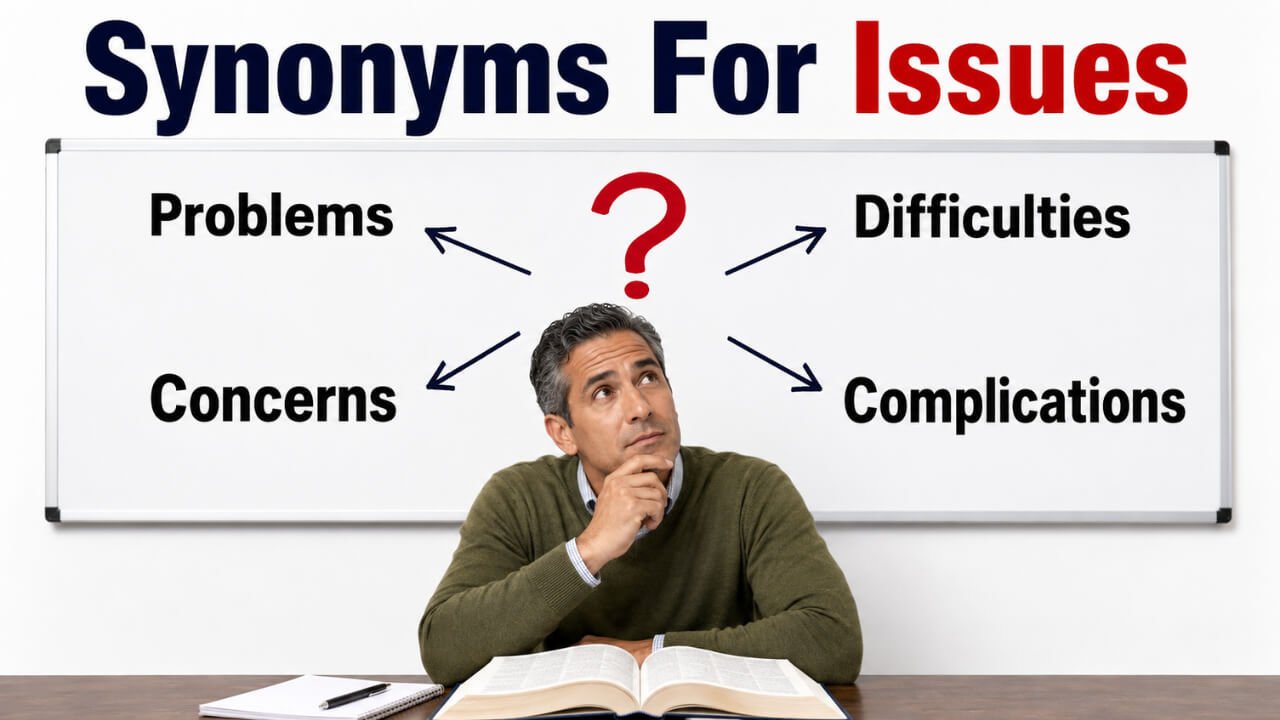
Quick Answer: The best synonyms for issues include problems, concerns, matters, challenges, difficulties, complications, topics, questions, disputes, and obstacles. Use problems for general trouble, concerns for sensitive or serious matters, challenges for difficult tasks, matters for formal topics, complications for added difficulty, and disputes when people disagree. The best choice depends on whether issues means problems, subjects, questions, conflicts, or concerns.
Pronunciation and Word Details
Word: Issues.
Pronunciation: /ˈɪʃuːz/ or /ˈɪsjuːz/.
Part of Speech: Plural noun.
Meaning: Issues are problems, concerns, questions, topics, or matters that need attention, discussion, or solution.
US Pronunciation:
UK Pronunciation:
What Does “Issues” Mean?
Issues means matters, problems, concerns, or topics that need attention. It is the plural form of issue, and it is commonly used as a noun.
The word can describe negative situations, such as technical issues, health issues, legal issues, or communication issues. It can also describe neutral subjects for discussion, such as policy issues, social issues, or workplace issues.
In a sentence, issues can refer to things that must be fixed, discussed, understood, managed, or decided.
Meaning, Tone, and Context of “Issues”
Issues is usually a neutral and flexible word. It can sound formal, professional, conversational, or serious depending on the context.
In everyday speech, people use issues to mean problems or difficulties. In professional writing, it often means concerns, matters, risks, or unresolved questions. In academic or technical writing, it may refer to topics, debates, defects, variables, or points of analysis.
The tone can change based on the sentence. Technical issues sounds practical. Serious issues sounds urgent. Personal issues sounds sensitive. Policy issues sounds formal and analytical.
When and How to Use “Issues”
For Problems: Use issues when something is not working correctly or needs to be fixed.
Example: The system has several issues that must be resolved today.
For Concerns: Use issues when referring to serious matters that people are worried about.
Example: The team discussed safety issues before approving the plan.
For Topics: Use issues when talking about subjects for discussion or debate.
Example: The meeting covered financial issues, staffing needs, and future goals.
For Conflicts: Use issues when people disagree or have unresolved tension.
Example: The partners still have issues about the final agreement.
For Sensitive Matters: Use issues when the subject may be personal, emotional, legal, or difficult.
Example: She is dealing with family issues and needs some time.
Best Synonyms for Issues
Problems: Difficult situations that need solutions.
Example: The report lists the main problems affecting productivity.
Concerns: Matters that cause worry or require careful attention.
Example: The manager listened to employee concerns about workload.
Challenges: Difficult tasks or situations that require effort.
Example: The project faced several challenges during development.
Difficulties: Problems that make something harder to do.
Example: The students had difficulties understanding the instructions.
Matters: Subjects, topics, or situations requiring attention.
Example: These legal matters should be reviewed carefully.
Complications: Extra problems that make a situation more complex.
Example: The delay created complications for the entire schedule.
Topics: Subjects being discussed, studied, or explained.
Example: The article covers important topics in grammar and vocabulary.
Questions: Points that need answers, clarification, or discussion.
Example: The committee raised questions about the new policy.
Disputes: Arguments or disagreements between people or groups.
Example: The contract disputes were settled after several meetings.
Obstacles: Things that block progress or make success harder.
Example: Budget limits became obstacles to completing the work.
50 Synonyms for Issues with Short Meanings
- Problems: Situations that need solutions.
- Concerns: Matters that cause worry or attention.
- Challenges: Difficult situations that require effort.
- Difficulties: Things that make progress harder.
- Complications: Added problems that create complexity.
- Matters: Subjects or situations needing attention.
- Topics: Subjects for discussion or study.
- Questions: Points needing answers or clarification.
- Disputes: Serious disagreements between people.
- Obstacles: Things that block progress.
- Troubles: General problems or difficulties.
- Setbacks: Events that slow progress.
- Barriers: Things that prevent movement or success.
- Hurdles: Difficulties that must be overcome.
- Dilemmas: Situations involving difficult choices.
- Predicaments: Difficult or unpleasant situations.
- Conflicts: Clashes between ideas, people, or interests.
- Disagreements: Differences in opinion.
- Debates: Discussions involving different views.
- Controversies: Public disagreements or disputed matters.
- Defects: Faults in something made or designed.
- Faults: Weaknesses, errors, or imperfections.
- Errors: Mistakes in action, writing, or judgment.
- Bugs: Technical faults in software or systems.
- Glitches: Small technical problems.
- Risks: Possible problems or dangers.
- Threats: Things that may cause harm.
- Worries: Thoughts or matters causing anxiety.
- Grievances: Complaints about unfair treatment.
- Complaints: Statements of dissatisfaction.
- Objections: Reasons for disagreement or opposition.
- Reservations: Doubts or concerns about something.
- Limitations: Restrictions or weaknesses.
- Weaknesses: Areas that lack strength or effectiveness.
- Shortcomings: Failures to meet expectations.
- Drawbacks: Negative points or disadvantages.
- Snags: Small unexpected problems.
- Pitfalls: Hidden problems or dangers.
- Complications: Factors that make something harder.
- Cases: Specific situations or matters.
- Affairs: Matters, events, or concerns.
- Points: Specific details or discussion items.
- Subjects: Things being discussed or studied.
- Themes: Main ideas or repeated subjects.
- Considerations: Factors that should be thought about.
- Circumstances: Conditions connected to a situation.
- Situations: Sets of conditions or events.
- Incidents: Events that may require attention.
- Conditions: Factors affecting a situation.
- Concerns: Important matters that deserve attention.
Read Also:
Synonyms for This Shows

Synonyms for Issues by Context
When Issues Means Problems
Use these synonyms when issues refers to something wrong, difficult, or in need of a solution.
Problems: The software problems affected every user.
Difficulties: The team faced difficulties during the final stage.
Troubles: Financial troubles delayed the expansion.
Setbacks: Several setbacks slowed the project.
Complications: New complications appeared after the first review.
When Issues Means Concerns
Use these synonyms when issues refers to worries, sensitive matters, or things that need careful attention.
Concerns: Parents raised concerns about student safety.
Worries: Her worries about the decision were understandable.
Reservations: The board had reservations about the proposal.
Risks: The plan includes financial risks.
Grievances: Workers shared grievances about unfair schedules.
When Issues Means Topics
Use these synonyms when issues refers to subjects for discussion, study, or debate.
Topics: The lesson covers several grammar topics.
Subjects: The conference focused on important subjects.
Matters: The report discusses legal matters.
Points: The speaker explained three key points.
Themes: The essay explores major social themes.
When Issues Means Disagreements
Use these synonyms when issues refers to conflict, tension, or opposing views.
Disputes: The neighbors settled their property disputes.
Conflicts: The policy created conflicts between departments.
Disagreements: Their disagreements were handled professionally.
Debates: Public debates continued for weeks.
Controversies: The decision caused several controversies.
When Issues Means Technical Faults
Use these synonyms when issues refers to systems, machines, apps, files, or processes that are not working properly.
Bugs: The update fixed several bugs.
Glitches: A few glitches appeared during testing.
Errors: The file had formatting errors.
Defects: The product defects were found during inspection.
Faults: The engineer identified faults in the equipment.
Another Word for Issues
Another word for issues is problems, especially when you mean difficulties that need to be fixed. However, the best replacement depends on context. Use concerns for worries, matters for formal topics, challenges for difficult tasks, and disputes for disagreements.
Original: The company is facing several issues with delivery.
Better Option: The company is facing several problems with delivery.
Original: We need to discuss these issues before the meeting ends.
Better Option: We need to discuss these matters before the meeting ends.
Original: Employees raised issues about the new schedule.
Better Option: Employees raised concerns about the new schedule.
Original: The two sides have issues over the contract terms.
Better Option: The two sides have disputes over the contract terms.
When Not to Use “Issues”
Do not use issues when a more specific word would make your sentence clearer. The word can sound vague if readers do not know whether you mean problems, topics, concerns, questions, or conflicts.
Avoid using issues repeatedly in the same paragraph. Repetition can make writing sound weak or careless. Choose a stronger synonym when the meaning is clear.
Weak: The report discusses many issues with many other issues in the plan.
Better: The report discusses several concerns and planning problems.
Weak: The machine has issues.
Better: The machine has electrical faults.
Weak: We talked about issues in class.
Better: We talked about grammar topics in class.
Weak: They have issues with each other.
Better: They have unresolved conflicts with each other.
Words Commonly Confused With Issues
Issues vs Problems: Issues can mean problems, topics, or concerns, while problems usually means difficulties that need solutions.
Issues vs Concerns: Issues is broader, while concerns focuses on worry, risk, or careful attention.
Issues vs Matters: Matters sounds more formal and often refers to subjects, situations, or responsibilities.
Issues vs Topics: Topics are subjects for discussion, while issues may include problems or debated matters.
Issues vs Challenges: Challenges suggests difficulty that can be overcome, while issues may simply need attention or resolution.
Issues vs Disputes: Disputes are disagreements, while issues can also mean neutral subjects or technical problems.
Issues vs Complications: Complications are extra difficulties, while issues can be general problems or concerns.
Which Synonym Should You Choose?
Choose problems when writing about things that are wrong or need solutions.
Choose concerns when writing about worries, safety, risk, feelings, or sensitive matters.
Choose matters when writing in a formal, professional, or legal context.
Choose challenges when you want a more positive or solution focused tone.
Choose difficulties when something is hard to do or understand.
Choose complications when extra problems make a situation more complex.
Choose topics when referring to subjects in lessons, articles, meetings, or discussions.
Choose questions when something needs clarification, explanation, or an answer.
Choose disputes when people or groups disagree.
Choose obstacles when something blocks progress or success.
Real Life Examples of “Issues” in Sentences
Original: The team found several issues in the final report.
Better Option: The team found several errors in the final report.
Original: We need to talk about budget issues.
Better Option: We need to talk about budget concerns.
Original: The device has connection issues.
Better Option: The device has connection problems.
Original: The teacher explained the main issues in the chapter.
Better Option: The teacher explained the main topics in the chapter.
Original: They still have issues about the contract.
Better Option: They still have disputes about the contract.
Original: The project faced issues during testing.
Better Option: The project faced complications during testing.
Original: Please tell me about any issues with the schedule.
Better Option: Please tell me about any difficulties with the schedule.
Original: The article discusses health issues in older adults.
Better Option: The article discusses health concerns in older adults.
Original: These issues must be solved before launch.
Better Option: These problems must be solved before launch.
Original: The plan has a few issues we should review.
Better Option: The plan has a few weaknesses we should review.
Synonym Groups and Usage Differences
Problem Group
This group includes words that describe something wrong or difficult. Use it when the meaning is negative and a solution is needed.
Example: The company fixed the delivery problems before the deadline.
Concern Group
This group works best when issues means worries, risks, or sensitive matters. It sounds careful and professional.
Example: The committee reviewed safety concerns before making a decision.
Discussion Group
This group includes words for subjects, points, and topics. Use it when issues means something to discuss rather than something broken.
Example: The meeting focused on training topics and policy matters.
Conflict Group
This group is useful when issues refers to disagreement, argument, or opposition.
Example: The dispute between the departments required mediation.
Technical Fault Group
This group fits machines, systems, documents, tools, and technical processes.
Example: The technician repaired the network fault in the morning.
Progress Barrier Group
This group works when issues means something blocking success.
Example: The team removed several obstacles before completing the task.
Antonyms of Issues
Solutions: Answers or fixes to problems.
Answers: Clear responses to questions or doubts.
Resolutions: Settlements or final solutions to conflicts.
Advantages: Positive points or benefits.
Strengths: Positive qualities or strong points.
Benefits: Helpful or valuable results.
Improvements: Changes that make something better.
Agreements: Shared understanding or accepted decisions.
Clarity: Clear understanding without confusion.
Certainty: Confidence without doubt.
Ease: Lack of difficulty or trouble.
Harmony: Peaceful agreement or balance.
Comparison: Issues vs Related Words
Issues vs Problems
Issues can mean problems, topics, or concerns. Problems is more direct and usually means something is wrong.
Example With Issues: The meeting covered several workplace issues.
Example With Problems: The meeting focused on problems with employee scheduling.
Issues vs Concerns
Issues is broader. Concerns sounds more careful and often refers to worry, risk, or sensitive matters.
Example With Issues: The report mentions privacy issues.
Example With Concerns: The report mentions privacy concerns.
Issues vs Matters
Issues can sound neutral or negative. Matters sounds formal and is often used for business, legal, or serious discussion.
Example With Issues: We discussed payment issues.
Example With Matters: We discussed payment matters.
Issues vs Challenges
Issues may sound negative or general. Challenges sounds more active and can suggest difficulty that can be overcome.
Example With Issues: The project had issues with timing.
Example With Challenges: The project faced timing challenges.
Issues vs Complications
Issues is a general word. Complications means extra problems that make a situation harder.
Example With Issues: The process had several issues.
Example With Complications: The process had several complications after the rule change.
Issues vs Topics
Issues may suggest problems or debated subjects. Topics simply means subjects for discussion or study.
Example With Issues: The article explains major education issues.
Example With Topics: The article explains major education topics.
Common Phrases and Expressions With Issues
Technical Issues: Problems with systems, devices, software, or equipment.
Health Issues: Medical or physical concerns.
Personal Issues: Private problems or sensitive life matters.
Legal Issues: Matters connected to law, rights, or rules.
Financial Issues: Money related problems or concerns.
Communication Issues: Problems in sharing, receiving, or understanding information.
Serious Issues: Important problems that require urgent attention.
Unresolved Issues: Problems or matters that have not been settled.
Current Issues: Topics or concerns happening now.
Key Issues: The most important matters in a situation.
Common Mistakes to Avoid
One common mistake is using issues too often when a more exact synonym would work better. Instead of repeating issues, choose words like problems, concerns, topics, questions, faults, or disputes.
Another mistake is using issues when the meaning is unclear. For example, The document has issues could mean errors, missing sections, formatting faults, or unclear wording. A stronger sentence would say exactly what is wrong.
Writers also confuse issues with topics. Use topics when nothing is wrong and you simply mean subjects for discussion. Use issues when the subject involves concern, debate, difficulty, or attention.
Avoid choosing a synonym that changes the tone. Disputes sounds more serious than issues. Challenges sounds more positive than problems. Concerns sounds more polite and careful than troubles.
Conclusion
Understanding synonyms for issues helps you write with better clarity, tone, and accuracy. Use problems for general difficulties, concerns for worry or risk, matters for formal subjects, challenges for difficult tasks, topics for discussion, and disputes for disagreement. The word issues is useful, but it can be vague when overused. Choosing the right synonym makes your meaning clearer and your writing more natural.
FAQs About Synonyms for Issues
What are the best synonyms for issues?
The best synonyms for issues are problems, concerns, challenges, matters, difficulties, complications, topics, questions, disputes, and obstacles.
What is another word for issues in professional writing?
In professional writing, good alternatives include concerns, matters, challenges, complications, risks, and questions.
What is another word for technical issues?
Good synonyms for technical issues include technical problems, bugs, glitches, errors, faults, and system defects.
Are issues and problems the same?
They are similar, but not always the same. Problems usually means something is wrong, while issues can also mean topics, concerns, questions, or disputes.
What is a formal synonym for issues?
Formal synonyms for issues include matters, concerns, considerations, questions, complications, and disputes.
What is a positive synonym for issues?
A more positive synonym is challenges. It suggests difficulty, but also effort, progress, and possible improvement.
What is the opposite of issues?
Opposites of issues include solutions, answers, resolutions, advantages, strengths, clarity, and agreement.
