
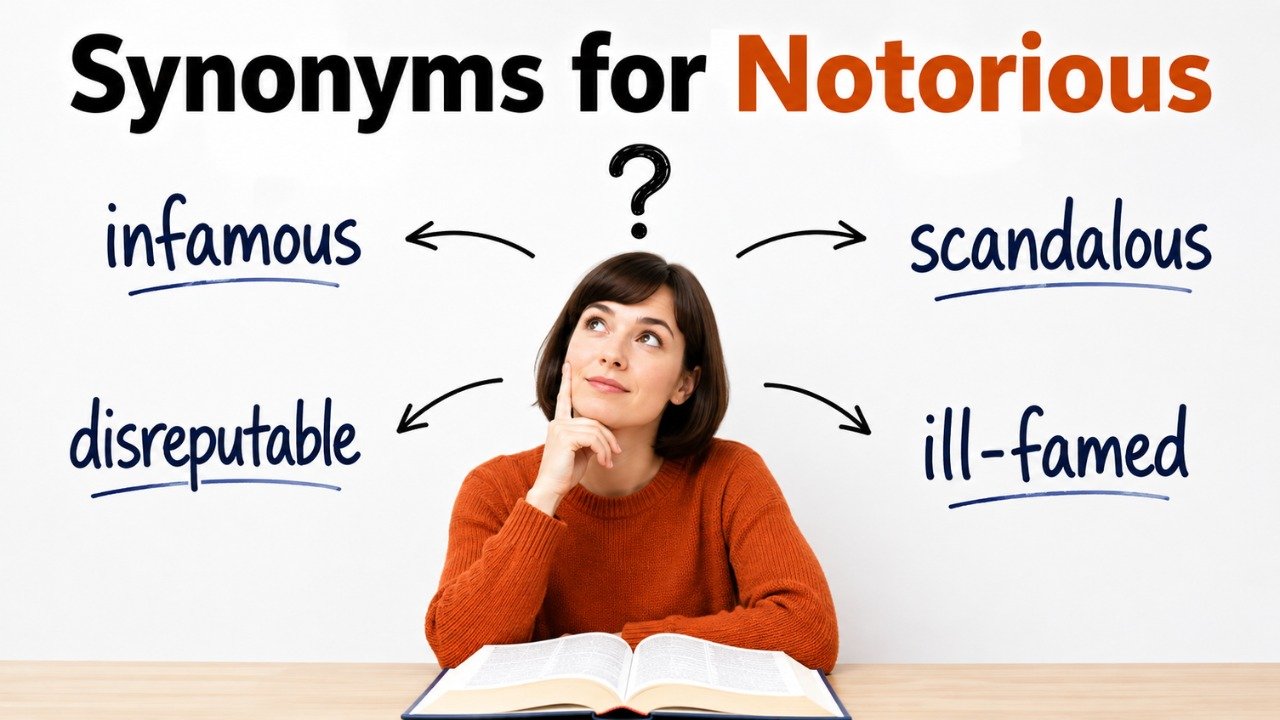
Quick Answer: The best synonyms for notorious include infamous, disreputable, scandalous, disgraced, reviled, nefarious, corrupt, shameful, unsavory, and of ill repute. When searching for synonyms for notorious, choose infamous for someone widely known for wrongdoing, disreputable for a person or business with a poor reputation, scandalous for shocking conduct, and reviled for someone strongly hated by the public. Nefarious works best when emphasizing evil intentions, while disgraced describes someone who has lost respect because of misconduct.
Pronunciation and Word Details
Word: Notorious.
Pronunciation: /nəʊˈtɔːriəs/
Part of Speech: Adjective.
Meaning: Widely known for something bad, harmful, dishonest, or unpleasant.
US Pronunciation:
UK Pronunciation:
What Does “Notorious” Mean?
Notorious means widely known for something negative, harmful, dishonest, or socially unacceptable. It is an adjective used to describe a person, place, organization, event, habit, or problem that has gained a bad reputation.
A notorious person is not simply famous. The person is famous because of criminal behavior, dishonesty, cruelty, scandal, or another undesirable quality.
For example, a criminal may become notorious because of repeated crimes. A road may be notorious because many accidents occur there. A company may become notorious for treating customers badly.
The word can describe several kinds of negative recognition.
Person: The official became notorious for accepting bribes.
Place: The neighborhood was notorious for frequent theft.
Problem: The software was notorious for crashing during important tasks.
Habit: He was notorious for arriving late to every meeting.
Event: The incident became one of the most notorious scandals in local history.
Although notorious usually carries a serious negative meaning, it is sometimes used humorously for a harmless but annoying habit.
Humorous Use: She is notorious for eating the last piece of cake.
In this example, the behavior is not dangerous or criminal. The speaker uses notorious playfully to exaggerate the person’s reputation.
Meaning, Tone, and Context of “Notorious”
Notorious has a strong and clearly negative tone. It suggests that a person or thing is widely recognized for an undesirable reason.
The word is common in formal writing, journalism, historical discussion, crime reporting, essays, biographies, and everyday conversation. It can describe serious wrongdoing, but it can also describe persistent faults, unreliable products, unpleasant places, or annoying habits.
Formal Tone: Notorious is appropriate in reports, essays, historical writing, and professional analysis when a subject has a documented negative reputation.
Conversational Tone: In casual speech, notorious can describe someone who is well known for an irritating or amusing habit.
Emotional Tone: The word often expresses criticism, disapproval, fear, or disgust.
Historical Context: Writers use notorious for rulers, criminals, scandals, disasters, and acts that remain negatively remembered.
Legal Context: The word may describe a criminal, gang, fraud scheme, or location strongly associated with unlawful activity.
Social Context: It can describe someone whose repeated behavior has created a negative public image.
Technical Context: Notorious may describe a recurring flaw, difficult process, unsafe system, or commonly recognized problem.
Because notorious already contains a negative meaning, it should not normally describe positive fame. A talented musician may be famous or renowned, but not notorious unless the musician is known for misconduct.
When and How to Use “Notorious”
For a Person With a Bad Reputation
Use notorious when a person is widely recognized for criminal, dishonest, cruel, or unacceptable conduct.
Example: The notorious fraudster deceived hundreds of investors.
For Criminal Activity
Use notorious when describing criminals, gangs, illegal schemes, or places strongly associated with crime.
Example: The district was once notorious for organized theft.
For Public Scandals
Use notorious when an event, decision, or person becomes widely known because of controversy or misconduct.
Example: The mayor resigned after a notorious corruption scandal.
For Repeated Bad Behavior
Use notorious when someone regularly behaves in an annoying, unreliable, or irresponsible way.
Example: He is notorious for canceling appointments without warning.
For Dangerous Places
Use notorious for roads, buildings, neighborhoods, or locations known for danger or unpleasant conditions.
Example: The mountain pass is notorious for sudden storms.
For Persistent Problems
Use notorious when a product, system, process, or situation has a widely recognized fault.
Example: The old printer was notorious for becoming jammed.
For Historical Discussion
Use notorious when describing people or events remembered negatively over a long period.
Example: The prison became notorious for its cruel treatment of inmates.
For Humorous Exaggeration
Use notorious playfully when describing a harmless habit that everyone recognizes.
Example: My brother is notorious for telling the same story at every dinner.
Best Synonyms for Notorious
Infamous
Synonym: Infamous means widely known for something extremely bad, criminal, or disgraceful.
Example: The ruler became infamous for his cruelty.
Disreputable
Synonym: Disreputable describes someone or something that is not respected because of dishonest or improper behavior.
Example: The business was controlled by a disreputable owner.
Scandalous
Synonym: Scandalous describes conduct that causes public shock, anger, or disapproval.
Example: The investigation exposed scandalous misuse of public funds.
Disgraced
Synonym: Disgraced describes someone who has lost honor or respect because of wrongdoing.
Example: The disgraced official disappeared from public life.
Reviled
Synonym: Reviled means strongly hated and criticized by many people.
Example: The corrupt commander was reviled by the population.
Nefarious
Synonym: Nefarious describes actions or people that are extremely wicked or criminal.
Example: The group was involved in a nefarious scheme.
Corrupt
Synonym: Corrupt describes someone who abuses power for dishonest or illegal gain.
Example: The corrupt inspector accepted payments from contractors.
Shameful
Synonym: Shameful describes behavior that deserves embarrassment, guilt, or public disapproval.
Example: The report revealed shameful treatment of vulnerable workers.
Unsavory
Synonym: Unsavory describes a person, activity, or place that seems dishonest, unpleasant, or morally questionable.
Example: He developed connections with several unsavory figures.
Of Ill Repute
Synonym: Of ill repute describes someone or something that has a widely recognized bad reputation.
Example: The establishment had long been considered a place of ill repute.
50 Synonyms for Notorious with Short Meanings
Some words below are direct synonyms, while others are close alternatives suited to particular reasons for a bad reputation.
- Infamous: Widely known for something extremely bad.
- Disreputable: Lacking respect because of dishonest behavior.
- Scandalous: Causing public shock or moral outrage.
- Disgraced: Having lost honor or public respect.
- Dishonorable: Showing a lack of honesty or moral principles.
- Shameful: Deserving shame or strong disapproval.
- Discreditable: Likely to damage someone’s reputation.
- Disgraceful: Shockingly improper or unacceptable.
- Ignominious: Associated with public shame or humiliation.
- Tainted: Damaged by scandal, suspicion, or wrongdoing.
- Discredited: No longer trusted or respected.
- Reviled: Strongly hated and publicly criticized.
- Despised: Regarded with intense dislike or contempt.
- Detested: Hated very strongly.
- Loathed: Deeply disliked or hated.
- Condemned: Publicly judged to be wrong or unacceptable.
- Feared: Known for causing danger, harm, or terror.
- Nefarious: Extremely wicked or criminal.
- Villainous: Cruel, evil, or criminal in character.
- Wicked: Morally wrong or deliberately harmful.
- Corrupt: Dishonest and willing to abuse power.
- Crooked: Dishonest, illegal, or morally corrupt.
- Criminal: Connected with illegal conduct.
- Lawless: Ignoring or violating legal rules.
- Unscrupulous: Willing to act dishonestly for personal advantage.
- Unprincipled: Lacking moral standards or integrity.
- Depraved: Morally corrupt in a severe way.
- Vile: Extremely unpleasant, immoral, or offensive.
- Odious: Deserving intense dislike or disgust.
- Contemptible: Deserving no respect because of bad behavior.
- Despicable: Deserving strong hatred or moral condemnation.
- Reprehensible: Deserving serious criticism or blame.
- Deplorable: Shockingly bad and worthy of condemnation.
- Unsavory: Unpleasant, dishonest, or morally questionable.
- Objectionable: Offensive or unacceptable to many people.
- Offensive: Causing anger, disgust, or disapproval.
- Scandal Plagued: Frequently connected with public controversy.
- Of Bad Repute: Known for having a poor reputation.
- Of Ill Repute: Widely regarded as disreputable.
- Badly Regarded: Viewed negatively by other people.
- Unfavorably Known: Recognized mainly for negative qualities.
- Widely Condemned: Criticized and rejected by many people.
- Publicly Disgraced: Shamed before the public because of misconduct.
- Known for Wrongdoing: Recognized because of harmful or dishonest acts.
- Famous for Misconduct: Widely recognized because of improper behavior.
- Associated With Scandal: Strongly connected with public controversy.
- Linked to Crime: Commonly connected with criminal activity.
- Remembered for Cruelty: Known historically for harsh or brutal conduct.
- Feared for Brutality: Widely recognized for violent or cruel behavior.
- Noted for Corruption: Commonly recognized for dishonest use of power.
Read Also:
Synonyms for Another Reason

Synonyms for Notorious by Context
When Notorious Means Famous for Wrongdoing
Infamous is the strongest general alternative when someone is widely known because of serious wrongdoing. It works especially well for criminals, cruel leaders, harmful events, and historical scandals.
Example: The infamous gang leader avoided capture for several years.
Known for wrongdoing is a clearer and less dramatic phrase when the writer wants to explain the reputation directly.
Example: The official was known for wrongdoing throughout his career.
When Notorious Means Having a Bad Reputation
Disreputable, of bad repute, and of ill repute focus on damaged social standing rather than fame alone.
Example: The lawyer refused to represent the disreputable company.
Example: The building had become a place of bad repute.
These choices work well for businesses, establishments, professions, groups, and individuals who are no longer trusted or respected.
When Notorious Means Connected With Scandal
Scandalous, disgraced, tainted, and scandal plagued are useful when public controversy has damaged a person or organization.
Example: The scandalous agreement was hidden from the public.
Example: The tainted organization struggled to regain trust.
Scandalous describes the conduct itself, while disgraced usually describes the person who has suffered a loss of respect.
When Notorious Means Strongly Hated
Reviled, despised, detested, and loathed emphasize public hatred rather than simple recognition.
Example: The reviled governor faced protests in every major city.
Example: The brutal commander was despised by his own soldiers.
Choose these words when the public response is more important than the person’s fame.
When Notorious Means Morally Evil
Nefarious, villainous, wicked, depraved, and vile emphasize moral corruption or deliberate harm.
Example: The criminals developed a nefarious plan to steal confidential records.
Example: The villainous leader punished anyone who questioned his authority.
These words are stronger and more emotional than notorious. They describe character or conduct, not merely reputation.
When Notorious Means Dishonest
Corrupt, crooked, unscrupulous, and unprincipled are best for dishonesty, abuse of authority, fraud, or unethical conduct.
Example: The corrupt administrator directed contracts toward his friends.
Example: The unscrupulous seller concealed important defects.
When Notorious Describes a Dangerous Place or Problem
Feared, dangerous, unreliable, and widely condemned may replace notorious depending on the exact issue.
Example: The feared crossing becomes especially dangerous during winter.
Example: The unreliable system regularly loses important information.
Notorious describes the reputation of the problem, while dangerous and unreliable describe the problem more directly.
When Notorious Is Used Humorously
Famous, known, and well known can replace notorious when the behavior is harmless and the negative tone is playful.
Example: She is famous among her friends for forgetting birthdays.
These alternatives sound gentler and avoid suggesting serious wrongdoing.
Another Word for Notorious
The best single replacement for notorious is usually infamous. Both words describe someone or something widely known for a negative reason. However, infamous often sounds stronger and is more suitable for serious crimes, cruelty, historical wrongdoing, or major scandals.
The best alternative depends on what created the negative reputation. Use disreputable for lost respect, scandalous for shocking conduct, reviled for public hatred, and corrupt for dishonest use of power.
Original: The notorious criminal escaped from custody.
Better Option: The infamous criminal escaped from custody.
Original: They avoided the notorious business owner.
Better Option: They avoided the disreputable business owner.
Original: The minister made a notorious decision.
Better Option: The minister made a scandalous decision.
Original: The notorious official accepted illegal payments.
Better Option: The corrupt official accepted illegal payments.
When Not to Use “Notorious”
Do not use notorious when the subject is known for a positive achievement. The word nearly always suggests a bad reputation.
Weak: She is a notorious scientist who discovered a new treatment.
Better: She is a renowned scientist who discovered a new treatment.
Do not use notorious when only a few people know about the behavior. The word normally suggests broad recognition.
Weak: He is notorious in his family for leaving the door open.
Better: He is known in his family for leaving the door open.
Avoid notorious when a more specific adjective can explain the exact problem.
Weak: The manager was notorious.
Better: The manager was notorious for intimidating employees.
Avoid using notorious repeatedly in the same paragraph. Replace it with a more precise alternative.
Weak: The notorious leader controlled a notorious group in a notorious district.
Better: The infamous leader controlled a criminal group in a dangerous district.
Do not use notorious as a direct substitute for dangerous. Something can be dangerous without being widely known.
Weak: We entered a notorious forest that nobody had visited before.
Better: We entered a dangerous forest that nobody had visited before.
Avoid notorious when you merely mean popular or recognizable.
Weak: The restaurant is notorious for its delicious desserts.
Better: The restaurant is famous for its delicious desserts.
A playful use can sometimes describe a harmless habit, but the surrounding context should make the humor obvious.
Words Commonly Confused With Notorious
Notorious vs Famous: Famous means widely known and can be positive, negative, or neutral. Notorious means widely known specifically for something bad.
Notorious vs Infamous: Both words express negative fame. Infamous often suggests more serious disgrace, crime, cruelty, or historical wrongdoing.
Notorious vs Renowned: Notorious expresses negative recognition. Renowned expresses admiration for excellence, ability, or achievement.
Notorious vs Scandalous: Notorious describes a person or thing with a bad reputation. Scandalous describes behavior or information that causes shock and public outrage.
Notorious vs Disreputable: Notorious emphasizes being widely known. Disreputable emphasizes lacking respect or trust.
Notorious vs Disgraced: Notorious describes an established bad reputation. Disgraced describes someone who has lost honor because of a particular failure or revelation.
Notorious vs Nefarious: Notorious focuses on reputation. Nefarious focuses on extremely wicked or criminal intentions.
Notorious vs Corrupt: Notorious can refer to many negative qualities. Corrupt specifically refers to dishonesty, bribery, abuse of power, or moral decay.
Notorious vs Dangerous: Notorious describes what something is known for. Dangerous directly states that something may cause harm.
Which Synonym Should You Choose?
Choose infamous when describing someone or something widely known for serious crimes, cruelty, betrayal, or disgrace.
Choose disreputable when discussing a person, business, establishment, or group that lacks public trust or respect.
Choose scandalous when the main idea involves shocking behavior, controversy, improper relationships, or misuse of authority.
Choose disgraced when someone once held respect but lost it after wrongdoing became public.
Choose reviled when emphasizing that a person is hated, rejected, or strongly criticized by many people.
Choose nefarious when describing deliberately evil plans, secret crimes, or wicked intentions.
Choose corrupt when the subject involves bribery, fraud, dishonest leadership, or abuse of official power.
Choose unsavory in conversation or descriptive writing when a person, place, or activity seems unpleasant or morally questionable.
Choose shameful when judging conduct that deserves guilt, embarrassment, or public criticism.
Choose of ill repute in formal or traditional writing when describing a place, person, or establishment with a recognized bad reputation.
For essays and reports, infamous, disreputable, corrupt, and scandalous are usually the clearest choices.
For historical writing, infamous, reviled, disgraced, and remembered for cruelty can provide useful precision.
For casual conversation, unsavory, crooked, badly regarded, or well known for bad behavior may sound more natural.
For crime related writing, infamous, criminal, lawless, nefarious, and linked to crime are effective.
For humorous examples, use famous, known, or well known unless strong exaggeration is intentional.
Real Life Examples of “Notorious” in Sentences
Original: The politician became notorious for accepting bribes.
Better Option: The politician became infamous for accepting bribes.
Original: The bar was notorious for illegal gambling.
Better Option: The bar was of ill repute because of illegal gambling.
Original: The road is notorious for serious accidents.
Better Option: The road is widely known for serious accidents.
Original: The company became notorious after several fraud investigations.
Better Option: The company became disreputable after several fraud investigations.
Original: The prison was notorious for its harsh conditions.
Better Option: The prison was infamous for its harsh conditions.
Original: The director was notorious for insulting employees.
Better Option: The director was reviled for insulting employees.
Original: The group created a notorious plan to steal the records.
Better Option: The group created a nefarious plan to steal the records.
Original: The official led a notorious administration.
Better Option: The official led a corrupt administration.
Original: He is notorious for arriving late.
Better Option: He is well known for arriving late.
Original: The district was once notorious for violent crime.
Better Option: The district was once feared for its violent crime.
Synonym Groups and Usage Differences
Negative Fame Group
Infamous, unfavorably known, famous for misconduct, and known for wrongdoing focus on recognition caused by bad behavior.
Infamous is the strongest and most natural direct synonym. The longer phrases provide clarity when the reader may not understand exactly why the subject is negatively known.
Example: The infamous thief became the subject of several investigations.
Damaged Reputation Group
Disreputable, disgraced, discredited, tainted, of bad repute, and of ill repute emphasize a loss of respect or trust.
Disgraced often describes a fall from a respected position. Discredited suggests that claims, authority, or reliability are no longer accepted.
Example: The disgraced executive was removed from the organization.
Scandal Group
Scandalous, scandal plagued, publicly disgraced, and associated with scandal describe public controversy and shocking revelations.
Scandalous usually modifies behavior, statements, decisions, or events. Scandal plagued commonly describes a person or organization affected by repeated controversies.
Example: The scandal plagued administration struggled to maintain public confidence.
Public Hatred Group
Reviled, despised, detested, loathed, and condemned focus on how other people react to the subject.
Reviled is especially useful when the subject receives strong public hatred and criticism.
Example: The cruel ruler remained reviled long after his death.
Moral Evil Group
Nefarious, villainous, wicked, depraved, vile, odious, and despicable describe severe moral wrongdoing.
These words are stronger than notorious because they directly judge the person or action as evil or morally unacceptable.
Example: Investigators uncovered a nefarious plan to exploit vulnerable families.
Dishonesty Group
Corrupt, crooked, unscrupulous, unprincipled, and criminal focus on dishonest or illegal conduct.
Corrupt is best for abuse of power. Crooked is more conversational. Unscrupulous emphasizes a willingness to ignore moral limits for personal benefit.
Example: The unscrupulous contractor charged customers for work that was never completed.
Shame Group
Shameful, disgraceful, dishonorable, ignominious, and discreditable describe actions that bring embarrassment or dishonor.
Ignominious is formal and often describes a humiliating failure or ending.
Example: The commander suffered an ignominious defeat after abandoning his troops.
Danger Group
Feared, linked to crime, remembered for cruelty, and feared for brutality focus on the specific reason for a negative reputation.
These alternatives are useful when notorious alone does not explain the danger clearly.
Example: The gang was feared for its brutality toward local residents.
Antonyms of Notorious
The opposite of notorious depends on whether the contrast concerns reputation, morality, fame, or public respect.
Renowned: Widely known and admired for excellence.
Respected: Regarded positively because of good character or achievement.
Honorable: Guided by honesty, fairness, and strong moral principles.
Reputable: Having a good and trustworthy public reputation.
Esteemed: Highly respected and valued.
Admired: Viewed with approval and appreciation.
Celebrated: Publicly praised for success or achievement.
Distinguished: Recognized for exceptional ability or service.
Virtuous: Showing strong moral goodness.
Upright: Honest, responsible, and morally respectable.
Trustworthy: Deserving confidence because of reliable behavior.
Unknown: Not widely recognized by the public.
Obscure: Not famous or commonly known.
Innocent: Not responsible for wrongdoing.
Commendable: Deserving approval or praise.
Comparison: Notorious vs Related Words
Notorious vs Infamous
Notorious and infamous both describe negative fame. Notorious can describe anything widely known for an undesirable reason, including an unreliable product or an annoying habit. Infamous usually carries a stronger sense of serious disgrace, crime, or evil.
Example With Notorious: The hotel was notorious for poor service.
Example With Infamous: The dictator became infamous for ordering brutal punishments.
Notorious vs Famous
Famous is neutral and simply means widely known. It can describe positive achievements, negative behavior, or general recognition. Notorious always adds a negative meaning.
Example With Notorious: The official was notorious for dishonesty.
Example With Famous: The artist was famous for her detailed paintings.
Notorious vs Renowned
Notorious expresses criticism or disapproval. Renowned expresses admiration and respect.
Example With Notorious: The prison was notorious for its cruelty.
Example With Renowned: The university was renowned for its medical research.
Notorious vs Disreputable
Notorious emphasizes widespread recognition. Disreputable emphasizes a lack of trust, honor, or respect.
Example With Notorious: The gang became notorious throughout the region.
Example With Disreputable: He refused to work with the disreputable agency.
Notorious vs Scandalous
Notorious describes an established reputation. Scandalous describes shocking or improper behavior that may create such a reputation.
Example With Notorious: The businessman was notorious for dishonest deals.
Example With Scandalous: The investigation revealed scandalous financial practices.
Notorious vs Disgraced
Notorious means widely known for something bad. Disgraced means that a person has lost a previously respected position because of misconduct.
Example With Notorious: The notorious criminal appeared in court.
Example With Disgraced: The disgraced judge resigned after the evidence became public.
Notorious vs Nefarious
Notorious describes negative recognition. Nefarious directly describes wicked or criminal actions.
Example With Notorious: The neighborhood was notorious for illegal trade.
Example With Nefarious: The criminals used nefarious methods to obtain private information.
Notorious vs Corrupt
Notorious can refer to any widely recognized negative characteristic. Corrupt specifically describes dishonesty, bribery, moral decay, or abuse of power.
Example With Notorious: The ruler was notorious for his harsh policies.
Example With Corrupt: The corrupt ruler stole money from public accounts.
Common Phrases and Expressions With Notorious
Notorious Criminal: A criminal widely recognized for serious offenses.
Notorious Gang: A criminal group widely feared or condemned.
Notorious Scandal: A controversy remembered for shocking misconduct.
Notorious Reputation: A widely recognized negative public image.
Notorious Habit: A bad or annoying behavior that someone repeatedly displays.
Notorious Case: A legal or criminal case known for disturbing or controversial details.
Notorious Figure: A person widely recognized for negative actions.
Notorious for Corruption: Widely known for dishonest use of power.
Notorious for Violence: Widely recognized for violent behavior.
Notorious for Being Late: Commonly known for repeated lateness.
Common Mistakes to Avoid
Using Notorious for Positive Fame
Notorious should not normally describe respected achievements, talent, beauty, or success.
Incorrect: The notorious doctor saved thousands of lives.
Correct: The renowned doctor saved thousands of lives.
Confusing Notorious With Famous
Famous does not automatically carry a negative meaning. Notorious always suggests an undesirable reputation.
Incorrect: The city is notorious for its beautiful gardens.
Correct: The city is famous for its beautiful gardens.
Using a Synonym That Changes the Meaning
Reviled means hated, while corrupt means dishonest. These words cannot replace notorious in every sentence.
Unclear: The road is corrupt for accidents.
Correct: The road is notorious for accidents.
Failing to Explain the Reason
Notorious often sounds incomplete when the reader does not know why the person or thing has a bad reputation.
Vague: The manager was notorious.
Clear: The manager was notorious for humiliating employees during meetings.
Repeating Notorious Too Often
Using the same adjective repeatedly makes writing sound mechanical.
Repetitive: The notorious criminal entered a notorious district controlled by a notorious gang.
Improved: The infamous criminal entered a dangerous district controlled by a feared gang.
Using Notorious When the Subject Is Unknown
Notorious implies that many people recognize the negative reputation.
Incorrect: The previously unknown thief was notorious before committing his first crime.
Correct: The previously unknown thief became notorious after committing several major robberies.
Choosing an Overly Strong Alternative
Words such as depraved, vile, and nefarious are much stronger than notorious. Use them only when the conduct deserves severe moral condemnation.
Too Strong: He followed a nefarious habit of leaving dirty cups on the table.
Better: He was notorious for leaving dirty cups on the table.
Creating Unnatural Phrases
Not every close synonym works with the same grammar.
Incorrect: The company was infamous of poor service.
Correct: The company was infamous for poor service.
Correct: The company had a disreputable history.
Conclusion
The most useful synonyms for notorious include infamous, disreputable, scandalous, disgraced, reviled, nefarious, corrupt, and unsavory. Infamous is usually the closest replacement when someone is widely known for serious wrongdoing. Disreputable focuses on a lack of respect, while scandalous emphasizes shocking conduct. Choose reviled for public hatred, corrupt for dishonesty, and nefarious for evil intentions. Understanding these differences helps you select a precise alternative that matches the subject, tone, and seriousness of each sentence.
FAQs About Synonyms for Notorious
What Is the Best Synonym for Notorious?
Infamous is usually the best synonym for notorious. It describes a person, event, or place widely known for something seriously bad or disgraceful.
Is Notorious the Same as Famous?
No. Famous means widely known and may be positive, negative, or neutral. Notorious means widely known specifically for something negative.
What Is a Formal Synonym for Notorious?
Infamous, disreputable, discredited, and of ill repute are suitable formal alternatives. The best choice depends on the reason for the negative reputation.
Can Notorious Be Used Positively?
Notorious is normally negative. In casual conversation, it may be used humorously for a harmless habit, but it should not describe respected achievements.
What Is the Difference Between Notorious and Infamous?
Both express negative fame, but infamous often sounds stronger. It is commonly used for serious crimes, cruelty, betrayal, and major historical wrongdoing.
What Is a Synonym for a Notorious Person?
An infamous, disreputable, disgraced, reviled, corrupt, or unsavory person may be described as notorious. Choose the word that explains why the person has a bad reputation.
What Is the Opposite of Notorious?
Common opposites include renowned, respected, reputable, honorable, esteemed, admired, and trustworthy. Unknown and obscure can also be opposites when the focus is on public recognition.
