
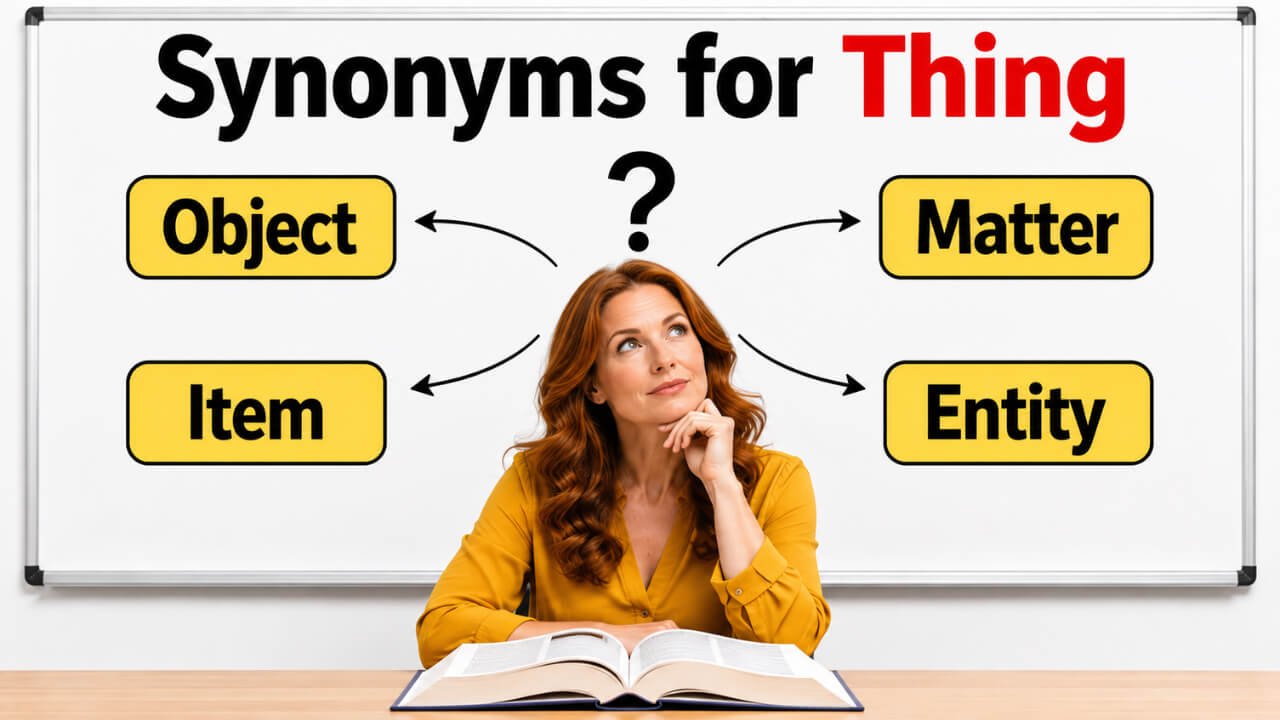
Quick Answer: Synonyms for thing include object, item, article, entity, matter, issue, subject, topic, idea, and detail. Use object for a physical thing, item for one thing in a list, matter for a serious concern, issue for a problem, subject for discussion, idea for a thought, and detail when you mean one specific part of something.
Pronunciation and Word Details
Word: Thing
Pronunciation: /θɪŋ/
Part of Speech: Noun
Meaning: Thing means an object, idea, matter, situation, action, or detail that is not named more specifically.
US Pronunciation:
UK Pronunciation:
What Does “Thing” Mean?
Direct Answer: Thing means a person, object, idea, matter, situation, event, or detail when the speaker does not name it exactly.
As a noun, thing is one of the most common and flexible words in English. It can describe a physical object, an abstract idea, a topic of discussion, a problem, a task, or a general situation. For example, “Put that thing on the table” refers to an object, while “The important thing is honesty” refers to an idea or point.
Thing works in casual speech, simple writing, and general explanations. However, in formal writing, it is often better to replace thing with a more exact word such as object, item, issue, matter, subject, element, factor, or detail.
Meaning, Tone, and Context of “Thing”
Tone: Thing is neutral, common, and conversational.
Casual Context: Thing is very natural in everyday speech because people often use it when the exact name is not needed or not known.
Formal Context: Thing can sound too vague in essays, reports, professional emails, and academic writing. More precise synonyms usually make formal writing stronger.
Emotional Context: Thing can sound gentle or informal when used for people, animals, habits, memories, or feelings, as in “poor thing” or “the best thing that happened.”
Abstract Context: Thing can refer to ideas, facts, details, qualities, events, issues, or situations.
Practical Use: Thing is useful when you want simple language, but it becomes weak when readers need specific meaning.
When and How to Use “Thing”
For A Physical Object: Use thing when you do not know or do not need the exact name of an object.
Example: There is a small thing under the chair.
For A General Idea: Use thing when talking about a thought, point, or concept in a simple way.
Example: The main thing is to stay calm.
For A Problem Or Matter: Use thing when the exact issue is already understood.
Example: We need to talk about one thing before the meeting.
For A Situation: Use thing when describing a general event or condition.
Example: The whole thing became confusing after the delay.
For Casual Speech: Use thing in everyday conversation when a more exact word is not necessary.
Example: I forgot the thing I wanted to say.
For Emphasis: Use thing when pointing to the most important part of a sentence.
Example: The best thing about the plan is its simplicity.
Best Synonyms for Thing
Object: A physical item that can be seen or touched.
Example: The object on the shelf looked old.
Item: One object, point, or entry in a list or group.
Example: Please check each item before packing.
Article: A particular object, often one of many similar objects.
Example: Each article of clothing was folded neatly.
Entity: Something that exists as a separate unit.
Example: The organization became a separate entity.
Matter: A subject, issue, or concern that needs attention.
Example: This matter should be handled carefully.
Issue: A problem, topic, or point for discussion.
Example: The main issue is the lack of time.
Subject: A topic being discussed, studied, or written about.
Example: The subject of the essay is personal growth.
Topic: A specific area of discussion or writing.
Example: The topic of today’s lesson is vocabulary.
Idea: A thought, plan, or concept.
Example: Her idea helped improve the project.
Detail: A small part of something larger.
Example: One detail in the report needs correction.
50 Synonyms for Thing with Short Meanings
- Object: A physical item.
- Item: One thing in a list or group.
- Article: A particular object or piece.
- Entity: Something that exists separately.
- Matter: A subject or concern.
- Issue: A problem or topic.
- Subject: A topic of study or discussion.
- Topic: A point or area being discussed.
- Idea: A thought or concept.
- Detail: A small part of something.
- Point: A specific idea or fact.
- Element: One part of a larger whole.
- Factor: Something that affects a result.
- Aspect: One side or feature of something.
- Feature: A noticeable quality or part.
- Part: A piece of a whole.
- Piece: A single portion or object.
- Component: A part of a system.
- Unit: One separate part or item.
- Article: An individual object or written piece.
- Belonging: A personal possession.
- Possession: Something owned by someone.
- Property: Something owned or controlled.
- Asset: Something valuable or useful.
- Product: Something made or offered.
- Tool: An object used for a purpose.
- Device: A machine or useful object.
- Instrument: A tool used for a special task.
- Material: Physical substance or content.
- Stuff: Informal word for things or materials.
- Goods: Items for sale or use.
- Commodity: A useful or tradeable product.
- Concern: A matter needing attention.
- Affair: A matter, event, or situation
- Business: A matter or concern.
- Case: A situation or example.
- Situation: A set of conditions.
- Circumstance: A condition affecting something.
- Event: Something that happens.
- Occurrence: An event or happening.
- Incident: A specific event.
- Fact: Something true or real.
- Concept: A general idea.
- Thought: An idea in the mind.
- Notion: A belief or idea.
- Quality: A characteristic or feature.
- Trait: A feature of a person or thing.
- Task: A piece of work to do.
- Activity: Something people do.
- Action: Something done.
Read Also:
Synonyms for Nature

Synonyms for Thing by Context
When Thing Means A Physical Object
Useful Synonyms: Object, item, article, piece, device.
Example: Place each item in the correct box.
Explanation: These synonyms work when thing refers to something you can see, touch, move, hold, buy, or use.
When Thing Means A Topic Or Matter
Useful Synonyms: Matter, issue, subject, topic, point.
Example: The main issue is the cost of the plan.
Explanation: These choices are useful in discussions, meetings, essays, reports, and serious conversations.
When Thing Means An Idea
Useful Synonyms: Idea, concept, thought, notion, point.
Example: The concept is simple, but the process takes time.
Explanation: These synonyms fit when thing means something in the mind rather than a physical object.
When Thing Means A Detail Or Part
Useful Synonyms: Detail, element, aspect, feature, factor.
Example: One detail changed the meaning of the sentence.
Explanation: These words help when thing refers to a smaller part of a larger subject, plan, object, or explanation.
When Thing Means A Situation Or Event
Useful Synonyms: Situation, case, affair, event, incident.
Example: The whole situation became harder to manage.
Explanation: These choices are better when thing refers to something that happened or a set of conditions.
When Thing Means A Possession
Useful Synonyms: Belonging, possession, property, asset, goods.
Example: She packed her belongings before leaving.
Explanation: These synonyms work when thing refers to something owned, carried, stored, sold, or used.
Another Word for Thing
Direct Answer: Another word for thing is item when you mean one object. The best alternative depends on context. Use object for something physical, matter for a serious concern, issue for a problem, subject for discussion, and idea for a thought or concept.
Original: Put that thing on the desk.
Better Option: Put that object on the desk.
Original: There is one thing we must discuss.
Better Option: There is one matter we must discuss.
Original: The thing I like most is the simple design.
Better Option: The feature I like most is the simple design.
Original: That thing caused the delay.
Better Option: That issue caused the delay.
When Not to Use “Thing”
Repetition: Do not repeat thing many times in formal writing because it can sound vague and weak.
Weak: The thing about this thing is that many things are unclear.
Better: The problem with this matter is that several details are unclear.
Unclear Meaning: Avoid thing when readers need to know whether you mean an object, issue, idea, detail, or situation.
Weak: The thing in the report needs attention.
Better: The financial detail in the report needs attention.
Too Casual: Thing can sound too informal in academic essays, professional reports, and business messages.
Weak: The first thing in the study is important.
Better: The first finding in the study is important.
Less Accurate: Thing may hide the exact meaning when a better word is available.
Weak: The thing that affected sales was timing.
Better: The factor that affected sales was timing.
Words Commonly Confused With Thing
Thing vs Object: Thing is broad and can mean an object, idea, matter, or situation. Object usually means a physical item.
Thing vs Item: Thing is general, while item often means one entry in a list, set, order, or collection.
Thing vs Matter: Thing can be casual and vague. Matter is more formal and usually means a subject, concern, or issue.
Thing vs Issue: Thing can mean almost anything. Issue usually means a problem, question, or topic for discussion.
Thing vs Subject: Thing is general. Subject means the topic being discussed, studied, or written about.
Thing vs Stuff: Thing can be singular or general. Stuff is informal and usually refers to many things or materials together.
Thing vs Entity: Thing is common and simple. Entity is more formal and means something that exists as a separate unit.
Thing vs Idea: Thing can be physical or abstract. Idea only refers to a thought, plan, or concept.
Which Synonym Should You Choose?
Choose object when writing about a physical thing that can be seen, touched, moved, or described.
Choose item when referring to one thing in a list, order, menu, collection, or group.
Choose article when writing about a specific object, especially clothing, goods, or individual pieces.
Choose entity when formal writing needs to describe something that exists separately.
Choose matter when discussing a serious topic, concern, or subject that needs attention.
Choose issue when the thing is a problem, question, or point of disagreement.
Choose subject when writing about something being studied, discussed, or explained.
Choose topic when referring to the focus of a lesson, article, speech, or conversation.
Choose idea when the thing is a thought, plan, belief, or concept.
Choose detail when the thing is a small part of a larger explanation, report, design, or story.
Real Life Examples of “Thing” in Sentences
Original: I forgot the thing I needed from the store.
Better Option: I forgot the item I needed from the store.
Original: What is that thing on the table?
Better Option: What is that object on the table?
Original: The best thing about the plan is its cost.
Better Option: The best feature of the plan is its cost.
Original: We need to discuss one important thing.
Better Option: We need to discuss one important matter.
Original: The thing causing the delay is unclear.
Better Option: The factor causing the delay is unclear.
Original: That thing in your essay needs more support.
Better Option: That point in your essay needs more support.
Original: The whole thing was confusing.
Better Option: The whole situation was confusing.
Original: She said one thing that changed my mind.
Better Option: She said one idea that changed my mind.
Original: The thing I noticed first was the color.
Better Option: The detail I noticed first was the color.
Original: This thing is not easy to solve.
Better Option: This issue is not easy to solve.
Synonym Groups and Usage Differences
Object Group
Words: Object, item, article, piece, device.
Use: Choose these words when thing means something physical.
Example: The device on the counter belongs in the kitchen.
Topic Group
Words: Matter, issue, subject, topic, point.
Use: Choose these words when thing means something discussed, explained, studied, or solved.
Example: The subject of the meeting was employee training.
Idea Group
Words: Idea, concept, thought, notion, fact.
Use: Choose these words when thing means something mental, logical, or abstract.
Example: The concept sounds simple at first.
Detail Group
Words: Detail, element, aspect, feature, factor.
Use: Choose these words when thing means one part of something larger.
Example: One factor changed the final result.
Situation Group
Words: Situation, case, circumstance, event, incident.
Use: Choose these words when thing refers to what happened or the conditions around something.
Example: The situation became easier after the explanation.
Possession Group
Words: Belonging, possession, property, asset, goods.
Use: Choose these words when thing means something owned, stored, carried, or sold.
Example: He kept his belongings in a small bag.
Antonyms of Thing
Nothing: No thing, object, idea, or matter.
Nobody: No person, especially when thing is wrongly used for a person.
Person: A human being, often contrasted with an object or thing.
Absence: Lack or nonexistence of something.
Void: Empty space or complete lack.
Nonexistence: State of not existing.
Emptiness: State of having nothing inside or present.
Zero: No amount or no quantity.
No Object: Lack of a physical item.
No Matter: No issue, concern, or subject to discuss.
Comparison: Thing vs Related Words
Thing vs Object
Difference: Thing can refer to an object, idea, issue, action, or situation. Object usually refers to a physical item.
Example With Thing: I found a strange thing in the drawer.
Example With Object: I found a strange object in the drawer.
Thing vs Item
Difference: Thing is general and casual. Item is more specific and often means one entry in a list or group.
Example With Thing: I need one thing from the shop.
Example With Item: I need one item from the shop.
Thing vs Matter
Difference: Thing can sound casual or vague. Matter sounds more formal and means a subject or concern.
Example With Thing: There is one thing we should discuss.
Example With Matter: There is one matter we should discuss.
Thing vs Issue
Difference: Thing can mean almost anything. Issue usually means a problem, question, or topic that needs attention.
Example With Thing: This thing is slowing us down.
Example With Issue: This issue is slowing us down.
Thing vs Subject
Difference: Thing is broad. Subject refers to the main topic of discussion, writing, study, or conversation.
Example With Thing: The thing we studied was interesting.
Example With Subject: The subject we studied was interesting.
Thing vs Detail
Difference: Thing can refer to a whole object, idea, or situation. Detail means one small part of something larger.
Example With Thing: One thing in the design looked unusual.
Example With Detail: One detail in the design looked unusual.
Common Phrases and Expressions With Thing
The Main Thing: The most important point or matter.
One Thing: A single point, issue, object, or idea.
Another Thing: An additional point or matter.
The Right Thing: The correct or moral action.
The Same Thing: An identical object, idea, action, or situation.
A Good Thing: Something helpful, positive, or lucky.
A Bad Thing: Something harmful, negative, or unwanted.
No Such Thing: Something that does not exist.
First Thing: The earliest task or first action.
The Thing Is: A phrase used before explaining the main point.
Common Mistakes to Avoid
Mistake 1: Using thing too often in formal writing. Replace it with object, matter, issue, subject, detail, or factor when possible.
Mistake 2: Using thing when the reader needs exact meaning. Clear writing names the object, idea, problem, or detail directly.
Mistake 3: Confusing thing with stuff. Thing can refer to one object or idea, while stuff usually refers to many things together in an informal way.
Mistake 4: Using object for abstract ideas. Object usually means a physical item, so use idea, concept, matter, or issue for abstract meaning.
Mistake 5: Calling a person a thing in serious writing. Use person, individual, child, worker, friend, or another respectful noun.
Mistake 6: Choosing issue when there is no problem. Issue suggests difficulty or debate, so use topic, subject, detail, or point when the meaning is neutral.
Conclusion
Synonyms for thing help you replace a broad and sometimes vague word with clearer language. Use object for physical items, item for lists, matter for serious concerns, issue for problems, subject or topic for discussion, idea for thoughts, and detail for small parts. Thing is useful in casual speech, but stronger synonyms make formal writing, essays, reports, and explanations more precise, natural, and reader friendly.
FAQs About Synonyms for Thing
What is the best synonym for thing?
Answer: The best synonym for thing is item when you mean one object. Use matter when you mean a topic or concern.
What are simple synonyms for thing?
Answer: Simple synonyms include object, item, piece, matter, issue, idea, point, and detail.
What is a formal synonym for thing?
Answer: Formal synonyms for thing include object, entity, matter, subject, factor, element, and aspect.
What is another word for thing in an essay?
Answer: In an essay, use point, idea, factor, issue, subject, element, or detail, depending on meaning.
What is another word for thing when it means object?
Answer: Use object, item, article, piece, device, or tool when thing means a physical object.
What is another word for thing when it means problem?
Answer: Use issue, matter, concern, case, or situation when thing means a problem.
Why should I avoid using thing too often?
Answer: Thing can sound vague and repetitive. More specific words make your writing clearer, stronger, and easier to understand.
