
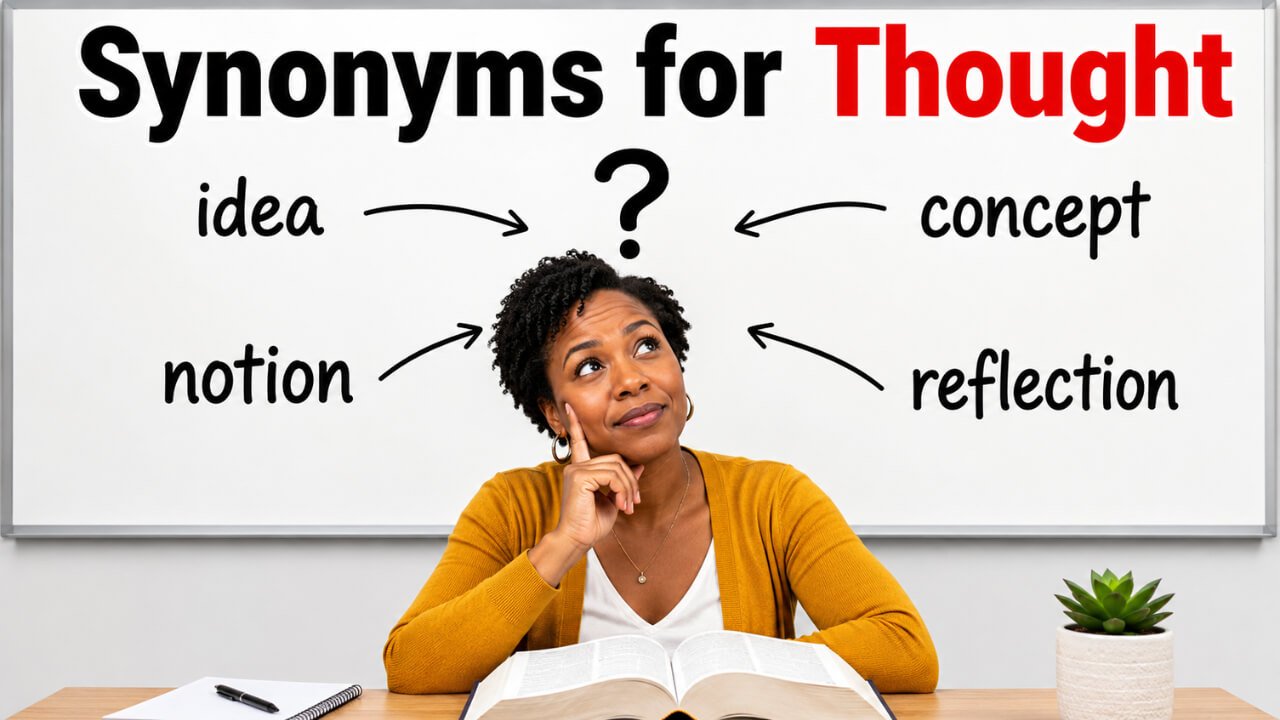
Quick Answer: Synonyms for thought include idea, opinion, belief, view, notion, reflection, consideration, reasoning, judgment, and impression. Use idea for casual speech, opinion for personal views, belief for strong accepted ideas, reflection for deep thinking, consideration for careful review, and reasoning for logical explanation. The best synonym depends on whether you mean a mental idea, a personal opinion, careful thinking, memory, or judgment.
Pronunciation and Word Details
Word: Thought
Pronunciation: /θɔːt/
Part of Speech: Noun and past tense verb
Meaning: A thought is an idea, opinion, belief, memory, or act of thinking formed in the mind.
US Pronunciation:
UK Pronunciation:
What Does “Thought” Mean?
Thought means an idea, opinion, belief, memory, or mental process that happens in the mind. It is most commonly used as a noun when talking about what someone thinks, feels, remembers, believes, or considers.
Thought can also be the past tense of the verb think, as in I thought about the answer. As a noun, it appears in phrases such as a thought, deep thought, positive thought, final thought, and a personal thought. It works in casual conversation, emotional writing, formal discussion, academic explanation, and reflective language.
Meaning, Tone, and Context of “Thought”
Thought is a neutral and flexible word. It can sound simple in daily conversation, emotional in personal writing, serious in reflective writing, and formal in academic or professional discussion. Because it has many uses, the correct synonym depends on the exact meaning.
When thought means a simple mental idea, use idea, notion, or concept. When it means a personal position, use opinion, view, belief, or perspective. When it means careful thinking, use reflection, consideration, contemplation, or deliberation. When it means logic, use reasoning, analysis, or judgment.
When and How to Use “Thought”
For an Idea: Use thought when something comes into the mind as a suggestion, concept, or possibility.
Example: A helpful thought came to her during the discussion.
For an Opinion: Use thought when asking or sharing what someone thinks about a topic.
Example: Please share your thought about the new plan.
For Careful Thinking: Use thought when a decision, question, or problem needs attention.
Example: This issue requires serious thought.
For Reflection: Use thought when describing deeper mental activity or personal review.
Example: After some thought, he understood the mistake.
For Emotion or Memory: Use thought when a feeling, memory, or inner reaction appears in the mind.
Example: The old song brought back a happy thought.
For Past Thinking: Use thought as the past tense of think when describing what someone believed or considered earlier.
Example: I thought the answer was correct.
Best Synonyms for Thought
Idea: A mental suggestion, plan, or concept.
Example: She had an idea for improving the article.
Opinion: A personal belief or judgment about something.
Example: His opinion changed after the discussion.
View: A way of thinking about a topic.
Example: Her view on the issue was practical.
Belief: Something accepted as true or real.
Example: His belief shaped his final decision.
Notion: A simple idea or impression, often not fully developed.
Example: He had a notion that the plan could work.
Reflection: Deep and careful thinking.
Example: Quiet reflection helped her understand the problem.
Consideration: Careful thought before making a choice.
Example: The proposal needs careful consideration.
Reasoning: Logical thinking used to reach a conclusion.
Example: Her reasoning was clear and convincing.
Judgment: An opinion formed after thinking and evaluation.
Example: His judgment was based on the facts.
Impression: A feeling or idea formed from experience.
Example: My first impression was positive.
50 Synonyms for Thought with Short Meanings
- Idea: A mental suggestion or concept.
- Opinion: A personal view or judgment.
- View: A way of seeing or understanding something.
- Belief: Something accepted as true.
- Notion: A simple or general idea.
- Concept: An abstract idea or mental category.
- Reflection: Deep and careful thinking.
- Consideration: Careful thought before a decision.
- Reasoning: Logical thinking used to reach a conclusion.
- Judgment: An opinion formed after evaluation.
- Impression: A feeling or idea based on experience.
- Perception: The way something is understood.
- Perspective: A particular way of thinking.
- Mindset: A settled way of thinking.
- Understanding: Knowledge or awareness of meaning.
- Thinking: The mental process of forming ideas.
- Contemplation: Deep and serious thought.
- Meditation: Calm and focused thinking.
- Deliberation: Careful thinking before action.
- Analysis: Detailed study or examination.
- Interpretation: An explanation of meaning.
- Conclusion: An idea reached after thinking.
- Assumption: Something believed without full proof.
- Theory: An idea used to explain something.
- Hypothesis: A possible explanation to test.
- Insight: A clear understanding of something.
- Observation: An idea based on noticing something.
- Suggestion: An idea offered for consideration.
- Plan: An idea for future action.
- Proposal: A suggested idea or course of action.
- Intention: A purpose or planned idea.
- Purpose: The reason behind an action.
- Imagination: The ability to form mental pictures.
- Sentiment: A feeling or emotional opinion.
- Feeling: An emotional reaction or belief.
- Attitude: A settled way of thinking or feeling.
- Position: A stated opinion on a subject.
- Standpoint: A personal position or viewpoint.
- Outlook: A general way of viewing life or events.
- Memory: A thought about something past.
- Recollection: A remembered thought or event.
- Awareness: Knowledge that something exists.
- Cognition: Mental activity involving knowledge and thought.
- Mental image: A picture formed in the mind.
- Inner voice: Private mental expression or self talk.
- Brainwave: A sudden idea or thought.
- Considered view: An opinion formed after careful thought.
- Point of view: A personal way of seeing something.
- Inference: A conclusion formed from evidence.
- Realization: A sudden understanding or awareness.
Read Also:
Synonyms for Next

Synonyms for Thought by Context
When Thought Means an Idea
When thought means an idea, choose words that show something formed in the mind. These synonyms work well in casual speech, writing, planning, and discussion.
Idea: I have an idea for the introduction.
Concept: The concept is easy to understand.
Notion: She had a notion that the answer was incomplete.
Suggestion: His suggestion improved the final paragraph.
When Thought Means an Opinion
When thought means a personal view, choose words that show judgment, belief, or position.
Opinion: Her opinion was clear and honest.
View: His view on the matter changed slowly.
Perspective: A fresh perspective can improve the discussion.
Position: Their position was based on careful review.
When Thought Means Careful Thinking
When thought means serious mental effort, choose words that show attention, reflection, and review.
Reflection: The topic deserves reflection.
Consideration: The decision needs careful consideration.
Contemplation: The question led to long contemplation.
Deliberation: The final choice came after deliberation.
When Thought Means Logical Thinking
When thought refers to logic, analysis, or explanation, use stronger terms that fit essays, reports, and formal writing.
Reasoning: Her reasoning was easy to follow.
Analysis: The analysis showed a clear pattern.
Judgment: His judgment was based on facts.
Inference: The inference came from strong evidence.
When Thought Means a Feeling or Memory
When thought includes emotion, memory, or personal reaction, choose softer words.
Feeling: I had a feeling that something was wrong.
Impression: My first impression was positive.
Sentiment: The message expressed a kind sentiment.
Memory: The place brought back a warm memory.
Another Word for Thought
Idea is often the best single replacement for thought because it is simple, natural, and useful in many sentences. However, the best alternative depends on context. Use opinion when you mean a personal view, reflection when you mean deep thinking, consideration when you mean careful review, and reasoning when you mean logical explanation.
Original: I had a thought about the project.
Better Option: I had an idea about the project.
Original: What is your thought on this topic?
Better Option: What is your opinion on this topic?
Original: This problem needs more thought.
Better Option: This problem needs more consideration.
Original: Her thought was based on clear facts.
Better Option: Her reasoning was based on clear facts.
When Not to Use “Thought”
Do not use thought when the sentence needs a more specific word. If you mean a personal view, opinion is clearer. If you mean deep thinking, reflection or contemplation may be better. If you mean logic, reasoning is stronger. If you mean a planned action, idea, plan, or proposal may sound more natural.
Weak: His thought about the rule was different.
Better: His opinion about the rule was different.
Weak: The report needs more thought.
Better: The report needs more analysis.
Weak: She gave a thought for the event.
Better: She gave a suggestion for the event.
Weak: My thought is that we should wait.
Better: My view is that we should wait.
Weak: The thought behind the decision was strong.
Better: The reasoning behind the decision was strong.
Words Commonly Confused With Thought
Thought vs Idea: Thought can mean any mental activity, while idea usually means a suggestion, plan, or concept formed in the mind.
Thought vs Opinion: Thought is broader. Opinion means a personal belief or judgment about something.
Thought vs Belief: Thought can be temporary or passing. Belief is usually stronger and more settled.
Thought vs Reflection: Thought can be simple or brief. Reflection means deeper and more careful thinking.
Thought vs Reasoning: Thought may be emotional, casual, or general. Reasoning is logical thinking used to support a conclusion.
Thought vs Consideration: Thought is broad. Consideration means careful attention before making a decision.
Thought vs Impression: Thought can be any idea. Impression is a feeling or idea formed from an experience.
Which Synonym Should You Choose?
Choose idea when talking about a simple mental suggestion, plan, or concept.
Choose opinion when asking what someone personally thinks about a topic.
Choose view when writing about someone’s way of seeing an issue.
Choose belief when the thought is strong, personal, or accepted as true.
Choose reflection when writing about deep thinking, personal growth, memory, or meaning.
Choose consideration when something needs careful attention before a decision.
Choose reasoning when explaining logic, evidence, arguments, or conclusions.
Choose judgment when the thought comes after evaluation or decision making.
Choose impression when describing an early feeling or reaction.
Choose perspective when comparing different ways of understanding the same topic.
Real Life Examples of “Thought” in Sentences
Original: I had a thought about your article.
Better Option: I had an idea about your article.
Original: What is your thought on this decision?
Better Option: What is your opinion on this decision?
Original: Her thought was different from mine.
Better Option: Her view was different from mine.
Original: The problem needs more thought.
Better Option: The problem needs more consideration.
Original: His thought was based on strong facts.
Better Option: His reasoning was based on strong facts.
Original: That thought made her smile.
Better Option: That memory made her smile.
Original: I shared my thought during the meeting.
Better Option: I shared my suggestion during the meeting.
Original: The thought behind the plan was clear.
Better Option: The purpose behind the plan was clear.
Original: She paused in thought before answering.
Better Option: She paused in reflection before answering.
Original: His thought about the topic was thoughtful.
Better Option: His perspective on the topic was thoughtful.
Synonym Groups and Usage Differences
Idea Group
This group includes idea, concept, notion, suggestion, and proposal. Use these words when thought means something formed in the mind or offered for discussion.
Example: Her idea made the plan easier to understand.
Opinion Group
This group includes opinion, view, belief, position, and standpoint. Use these words when thought means a personal judgment or way of seeing something.
Example: His opinion helped shape the final decision.
Reflection Group
This group includes reflection, contemplation, meditation, consideration, and deliberation. Use these words when thought means slow, careful, or deep thinking.
Example: Quiet reflection helped her choose wisely.
Logic Group
This group includes reasoning, analysis, judgment, interpretation, and conclusion. Use these words when thought is connected to logic, facts, and explanation.
Example: The reasoning behind the answer was clear.
Feeling Group
This group includes impression, sentiment, feeling, memory, and recollection. Use these words when thought is emotional, personal, or based on experience.
Example: The old photo brought back a happy memory.
Antonyms of Thought
Carelessness: Lack of careful thinking.
Neglect: Failure to give attention or thought.
Ignorance: Lack of knowledge or awareness.
Confusion: Lack of clear understanding.
Impulsiveness: Acting without enough thought.
Mindlessness: Acting without awareness or attention.
Forgetfulness: Failure to remember something.
Disregard: Lack of attention or concern.
Inattention: Failure to focus or think carefully.
Misunderstanding: Incorrect understanding of meaning.
Comparison: Thought vs Related Words
Thought vs Idea
Thought is broad and can mean any mental activity or inner idea. Idea is more specific and usually means a suggestion, concept, or plan.
Example With Thought: I had a thought about the topic.
Example With Idea: I had an idea for the topic.
Thought vs Opinion
Thought can be general, private, or unfinished. Opinion is a clearer personal judgment about something.
Example With Thought: Share your thought about the rule.
Example With Opinion: Share your opinion about the rule.
Thought vs Belief
Thought may be temporary, casual, or passing. Belief is stronger and usually means something a person accepts as true.
Example With Thought: She had a thought about success.
Example With Belief: She had a belief about success.
Thought vs Reflection
Thought can be quick or simple. Reflection means deeper, slower, and more serious thinking.
Example With Thought: The question gave him a thought.
Example With Reflection: The question led him to reflection.
Thought vs Reasoning
Thought can be emotional, personal, or general. Reasoning is logical thinking that explains why something is true or reasonable.
Example With Thought: His thought was interesting.
Example With Reasoning: His reasoning was convincing.
Thought vs Impression
Thought is an idea in the mind. Impression is a feeling or judgment formed from an experience.
Example With Thought: I had a thought about her answer.
Example With Impression: I had a good impression of her answer.
Common Phrases and Expressions With Thought
Deep Thought: Serious and careful thinking.
Second Thought: A changed or reconsidered opinion.
Food for Thought: Something that makes you think.
Train of Thought: A connected flow of ideas.
Thought Process: The way someone thinks through something.
Thought Pattern: A repeated way of thinking.
Passing Thought: A quick idea that does not stay long.
Careful Thought: Serious attention before a choice.
Positive Thought: A hopeful or encouraging idea.
Final Thought: A closing idea or last opinion.
Common Mistakes to Avoid
A common mistake is using thought when the sentence needs a clearer synonym. Idea is better for a suggestion, opinion is better for a personal view, and reasoning is better for logic. Using thought too often can make writing sound vague or repetitive.
Another mistake is confusing thought as a noun with thought as the past tense of think. In I thought about it, the word is a verb. In I had a thought, it is a noun. Also avoid unnatural phrases like give a thought for the meeting when give a suggestion or share an idea is clearer.
Conclusion
Synonyms for thought help you choose clearer words for ideas, opinions, beliefs, reasoning, and reflection. Use idea for a simple mental concept, opinion for a personal view, belief for something accepted as true, reflection for deep thinking, and reasoning for logic. The word thought is useful and flexible, but a more specific synonym can make your writing stronger, smoother, and easier to understand.
FAQs About Synonyms for Thought
What are the best synonyms for thought?
The best synonyms for thought are idea, opinion, belief, view, notion, reflection, consideration, reasoning, judgment, and impression.
What is another word for thought in casual speech?
Idea is usually the best casual synonym for thought. You can say I had an idea instead of I had a thought.
What is another word for thought in formal writing?
In formal writing, use consideration, reasoning, reflection, judgment, analysis, or interpretation, depending on the meaning.
What is another word for deep thought?
Good synonyms for deep thought include reflection, contemplation, meditation, deliberation, and consideration.
Is thought the same as opinion?
Not always. Thought is broader and can mean any idea in the mind. Opinion means a personal judgment or view about something.
Is thought the same as idea?
Thought and idea are very close, but idea is often more specific. Use idea for a suggestion, plan, or concept.
What is the opposite of thought?
The opposite of thought depends on context. Useful antonyms include carelessness, neglect, ignorance, confusion, impulsiveness, and mindlessness.
