
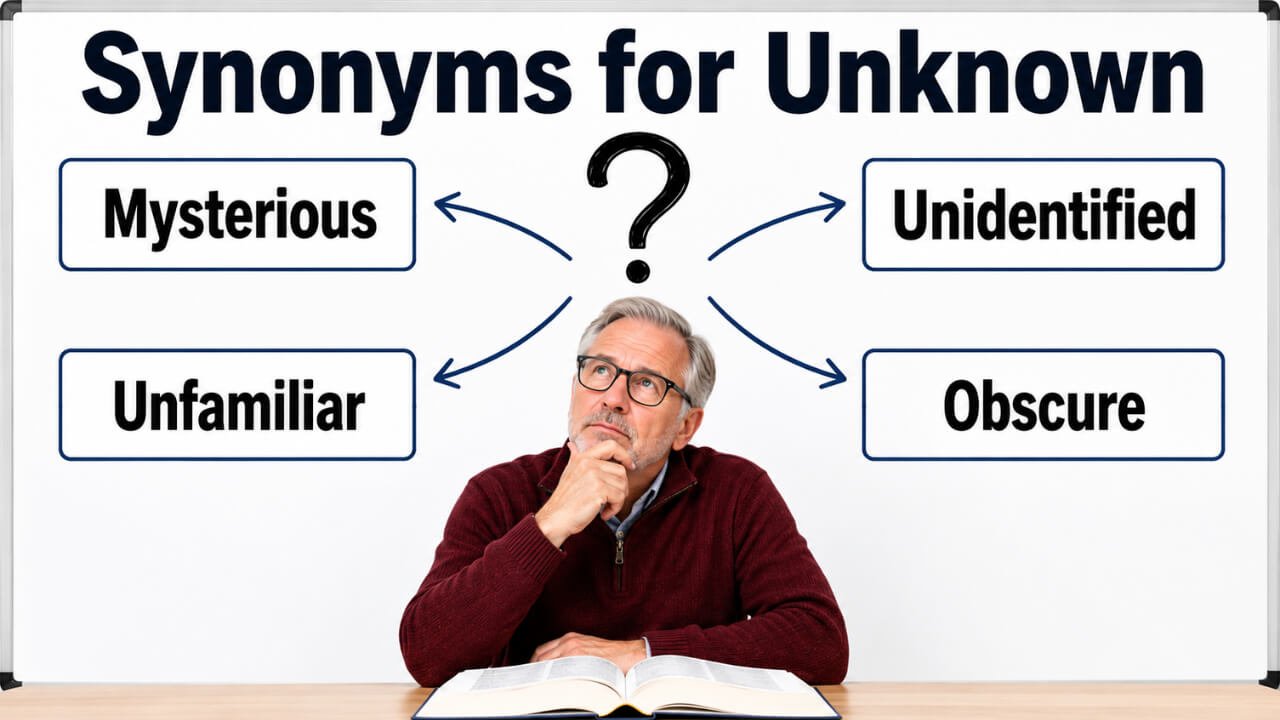
Quick Answer: The best synonyms for unknown include unidentified, unfamiliar, obscure, anonymous, unnamed, undiscovered, uncertain, unexplained, unrecognized, and undisclosed. Use unidentified when a person or object has not been recognized, unfamiliar for something you do not know well, obscure for something little known, and anonymous when a person’s identity is hidden. In formal writing, unidentified, undetermined, undisclosed, and unrecognized are often best. In casual speech, unfamiliar, strange, unclear, and mysterious sound more natural.
Pronunciation and Word Details
Word: Unknown.
Pronunciation: /ʌnˈnoʊn/
Part of Speech: Adjective and noun.
Meaning: Unknown describes someone or something that is not known, identified, recognized, understood, or discovered.
US Pronunciation:
UK Pronunciation:
What Does “Unknown” Mean?
Unknown means not known, identified, recognized, understood, or familiar. It can describe a person, object, fact, cause, place, quantity, or future event when information about it is missing.
As an adjective, unknown modifies a noun.
Example: The cause of the noise remains unknown.
As a noun, unknown refers to a person, thing, fact, or situation that is not understood or identified.
Example: Exploring the deep ocean involves many unknowns.
The word can appear in several sentence contexts. An unknown person has not been identified. An unknown fact has not been discovered. An unknown place may be unfamiliar or unexplored. An unknown result has not yet been determined.
Meaning, Tone, and Context of “Unknown”
Unknown is a neutral and widely used word. It can appear in casual conversation, formal reports, academic writing, technical explanations, news writing, scientific discussions, and everyday descriptions.
In formal writing, unknown often describes missing information, unidentified causes, uncertain values, or facts that have not been established.
Example: The long term effect of the change is currently unknown.
In casual conversation, unknown may describe unfamiliar people, places, or situations.
Example: We entered an unknown part of the town.
The word can also create an emotional tone. The unknown may suggest mystery, curiosity, uncertainty, fear, or possibility.
Example: She felt nervous about stepping into the unknown.
In technical or mathematical contexts, an unknown is a value that must be calculated or discovered.
Example: The letter represents the unknown value in the equation.
When and How to Use “Unknown”
For an Unidentified Person: Use unknown when a person’s name or identity has not been established.
Example: An unknown caller left a brief message.
For a Missing Cause: Use unknown when the reason for an event has not been discovered.
Example: The machine stopped working for an unknown reason.
For an Unfamiliar Place: Use unknown when someone has no previous knowledge of a location.
Example: The hikers entered unknown territory.
For an Undetermined Result: Use unknown when an outcome cannot yet be predicted or confirmed.
Example: The final cost remains unknown.
For Hidden Information: Use unknown when information has not been revealed or made available.
Example: The author’s real identity is unknown.
For a Technical Value: Use unknown as a noun for a value that must be found through calculation or investigation.
Example: We must solve the equation to find the unknown.
For an Emotional Idea: Use the unknown to describe an uncertain future or unfamiliar experience.
Example: He was excited rather than afraid of the unknown.
Best Synonyms for Unknown
Unidentified: Not recognized or connected with a known identity.
Example: Police found an unidentified object near the entrance.
Unfamiliar: Not previously known, seen, experienced, or recognized.
Example: The road looked unfamiliar after the storm.
Obscure: Not widely known or easily understood.
Example: The book describes an obscure historical event.
Anonymous: Having a name or identity that is not revealed.
Example: An anonymous donor paid for the repairs.
Unnamed: Not given or identified by a name.
Example: The story takes place in an unnamed village.
Undiscovered: Not yet found, noticed, or learned about.
Example: Scientists believe many species remain undiscovered.
Uncertain: Not known or decided with confidence.
Example: The outcome of the discussion is uncertain.
Unexplained: Not understood because no reason or explanation has been provided.
Example: The sudden change remains unexplained.
Unrecognized: Not identified, noticed, accepted, or acknowledged.
Example: Her early work remained unrecognized for years.
Undisclosed: Not revealed or made public.
Example: The agreement was signed for an undisclosed amount.
50 Synonyms for Unknown with Short Meanings
- Unidentified: Not recognized or connected with a known identity.
- Unfamiliar: Not known through previous experience.
- Obscure: Not widely known or clearly understood.
- Anonymous: Having a hidden or unrevealed identity.
- Unnamed: Not identified by a name.
- Undiscovered: Not yet found or learned about.
- Uncertain: Not known or decided confidently.
- Unexplained: Not understood or accounted for.
- Unrecognized: Not identified, noticed, or acknowledged.
- Undisclosed: Not revealed or made public.
- Unspecified: Not clearly named, described, or stated.
- Undetermined: Not yet decided, measured, or established.
- Unconfirmed: Not proven or officially verified.
- Unverified: Not checked or shown to be true.
- Unresolved: Not explained, decided, or settled.
- Unclear: Not easy to understand or determine.
- Mysterious: Difficult to understand or explain.
- Hidden: Kept out of sight or knowledge.
- Secret: Known by only a limited number of people.
- Concealed: Deliberately kept hidden from view or knowledge.
- Unrevealed: Not shown, announced, or explained.
- Unreported: Not officially recorded or communicated.
- Undocumented: Not supported or described by written records.
- Unrecorded: Not written down or formally preserved.
- Unnoticed: Not seen, recognized, or observed.
- Unseen: Not viewed, noticed, or experienced.
- Unheard: Not heard or previously known about.
- Unobserved: Not watched, noticed, or examined.
- Unexamined: Not studied, considered, or investigated.
- Unexplored: Not investigated, visited, or studied.
- Uncharted: Not mapped, recorded, or fully understood.
- Untested: Not examined through experience or testing.
- Strange: Not familiar or easily recognized.
- Foreign: Unfamiliar because it comes from another place or experience.
- Novel: New, original, or previously unfamiliar.
- New: Not previously known, used, or experienced.
- Little Known: Known by very few people.
- Not Known: Lacking recognition, information, or understanding.
- Not Identified: Not connected with a specific person or thing.
- Not Named: Not given a particular name.
- Not Established: Not proven, confirmed, or accepted.
- Not Determined: Not yet decided or calculated.
- Not Disclosed: Not shared or revealed.
- Not Recognized: Not identified or acknowledged.
- Not Understood: Lacking a clear explanation or meaning.
- Puzzling: Difficult to understand or explain.
- Enigmatic: Mysterious and difficult to interpret.
- Cryptic: Unclear because the meaning is hidden or indirect.
- Incognito: Using a hidden or changed identity.
- Nameless: Having no known or stated name.
Read Also:
Synonyms for Building

Synonyms for Unknown by Context
When Unknown Means Unidentified
Use these words when a person, object, owner, caller, or source has not been identified.
Unidentified: Best for a person or object whose identity has not been established.
Example: An unidentified vehicle was parked outside.
Anonymous: Best when someone intentionally keeps a name or identity private.
Example: The complaint was submitted by an anonymous employee.
Unnamed: Best when a name is not provided in a report or story.
Example: An unnamed official confirmed the decision.
Nameless: Best when something has no known name or is intentionally left without one.
Example: The traveler rested in a nameless village.
When Unknown Means Unfamiliar
Use these alternatives when something has not been seen, experienced, or recognized before.
Unfamiliar: The most direct choice for something you do not know well.
Example: She heard an unfamiliar voice outside.
Strange: Suitable for something unfamiliar that also seems unusual.
Example: A strange sound came from the roof.
Foreign: Useful for an idea, custom, feeling, or experience that seems unfamiliar.
Example: The working method was completely foreign to him.
New: Best for a situation or experience encountered for the first time.
Example: Starting a business was a new experience for her.
When Unknown Means Undiscovered
Use these words when a place, fact, object, species, or idea has not yet been found or investigated.
Undiscovered: Not yet found or recognized.
Example: The forest may contain undiscovered plants.
Unexplored: Not yet visited, studied, or investigated.
Example: Much of the cave remains unexplored.
Uncharted: Not mapped or fully understood.
Example: The team entered uncharted territory.
Unexamined: Not yet studied or considered carefully.
Example: The report raises several unexamined questions.
When Unknown Means Uncertain
Use these alternatives when an answer, result, value, cause, or future event has not been decided.
Uncertain: Not confidently known or predicted.
Example: The future of the project is uncertain.
Undetermined: Not yet calculated, decided, or established.
Example: The exact delivery date is undetermined.
Unconfirmed: Not officially proven or verified.
Example: The meeting time remains unconfirmed.
Unresolved: Not yet explained, decided, or settled.
Example: Several important issues remain unresolved.
When Unknown Means Hidden
Use these alternatives when information exists but has not been shared or revealed.
Undisclosed: Not made public or communicated.
Example: The property was purchased for an undisclosed price.
Unrevealed: Not yet announced or shown.
Example: The winner’s identity remained unrevealed.
Secret: Intentionally kept from general knowledge.
Example: They met at a secret location.
Concealed: Deliberately hidden from sight or understanding.
Example: The document contained a concealed message.
When Unknown Means Little Known
Use these alternatives for a person, fact, place, or subject that few people know about.
Obscure: Not widely known or easily understood.
Example: He researched an obscure branch of science.
Little Known: Known by only a small number of people.
Example: The article describes a little known tradition.
Unrecognized: Not noticed, identified, or appreciated.
Example: The artist remained unrecognized during her lifetime.
Unheard Of: Not previously known or considered.
Example: Such a method was unheard of at the time.
Another Word for Unknown
The best single replacement for unknown is often unidentified, but the right alternative depends on what is not known. Use unfamiliar for a lack of experience, uncertain for an undecided result, undiscovered for something not yet found, and undisclosed for hidden information.
Original: The unknown man left before anyone spoke to him.
Better Option: The unidentified man left before anyone spoke to him.
Original: We traveled through an unknown area.
Better Option: We traveled through an unfamiliar area.
Original: The cause of the failure is unknown.
Better Option: The cause of the failure is undetermined.
Original: The final payment amount is unknown.
Better Option: The final payment amount is undisclosed.
When Not to Use “Unknown”
Do not use unknown when a more precise word can clearly explain why information is missing. Unknown may sound vague when you need to distinguish between an unidentified person, an uncertain result, an undisclosed amount, or an unexplained event.
Weak: An unknown person submitted the report without a name.
Better: An anonymous person submitted the report without a name.
Unknown can also be inaccurate when something is known but not widely recognized. In that context, obscure or little known is more precise.
Weak: The writer published an unknown novel in 1920.
Better: The writer published an obscure novel in 1920.
Avoid unknown when you mean that an answer has not been officially confirmed.
Weak: The opening date is unknown.
Better: The opening date is unconfirmed.
Do not use unknown repeatedly in the same paragraph when different meanings are intended.
Weak: The unknown caller reported an unknown problem caused by an unknown substance.
Better: The unidentified caller reported an unexplained problem caused by an unrecognized substance.
Unknown may also sound too dramatic in simple situations.
Weak: I faced the unknown menu at the new restaurant.
Better: I faced an unfamiliar menu at the new restaurant.
Words Commonly Confused With Unknown
Unknown vs Unidentified: Unknown has a broad meaning and can describe missing knowledge of any kind. Unidentified specifically means that the identity of a person or thing has not been established.
Unknown vs Unfamiliar: Unknown means not known at all. Unfamiliar usually means not known well through personal experience.
Unknown vs Anonymous: Unknown means the identity is not known. Anonymous often means the person deliberately chooses not to reveal a name.
Unknown vs Uncertain: Unknown describes missing information. Uncertain describes doubt, lack of confidence, or an outcome that has not been decided.
Unknown vs Obscure: Unknown may mean completely not known. Obscure usually means known by few people or difficult to understand.
Unknown vs Mysterious: Unknown is neutral and factual. Mysterious suggests curiosity, secrecy, or difficulty in finding an explanation.
Unknown vs Undisclosed: Unknown means information is unavailable or missing. Undisclosed means someone has chosen not to reveal the information.
Unknown vs Unexplained: Unknown can refer to any missing fact. Unexplained specifically describes something whose cause or reason is not understood.
Which Synonym Should You Choose?
Choose unidentified when writing about a person, caller, object, vehicle, owner, or source whose identity is not known.
Choose unfamiliar when describing a place, face, voice, word, method, subject, or experience that someone does not know well.
Choose anonymous when a person intentionally keeps their identity private.
Choose unnamed when a report, article, or statement does not provide a person’s name.
Choose obscure when describing a person, fact, place, book, or subject that is known by very few people.
Choose undiscovered when something has not yet been found, noticed, or studied.
Choose uncertain when discussing an unpredictable result, doubtful future, or lack of confidence.
Choose undetermined when a value, date, cause, or decision has not yet been established.
Choose unexplained when an event has occurred but no clear reason has been found.
Choose undisclosed when a name, price, location, amount, or detail is intentionally not revealed.
Choose unconfirmed when information has been reported but not officially verified.
Choose mysterious when you want to create a stronger emotional sense of curiosity or secrecy.
Real Life Examples of “Unknown” in Sentences
Original: The identity of the caller is unknown.
Better Option: The identity of the caller is unidentified.
Original: We saw an unknown face in the crowd.
Better Option: We saw an unfamiliar face in the crowd.
Original: The disease has an unknown cause.
Better Option: The disease has an unexplained cause.
Original: They purchased the house for an unknown amount.
Better Option: They purchased the house for an undisclosed amount.
Original: The final result is still unknown.
Better Option: The final result is still uncertain.
Original: The scientist studied an unknown species.
Better Option: The scientist studied an undiscovered species.
Original: The article was written by an unknown author.
Better Option: The article was written by an anonymous author.
Original: The village was unknown to most travelers.
Better Option: The village was little known to most travelers.
Original: The exact delivery date is unknown.
Better Option: The exact delivery date is undetermined.
Original: Her contribution remained unknown for many years.
Better Option: Her contribution remained unrecognized for many years.
Synonym Groups and Usage Differences
Identity Group
Unidentified, anonymous, unnamed, nameless, and incognito relate to names and identities. Unidentified means an identity has not been established. Anonymous suggests a hidden identity. Unnamed means a name has not been provided. Incognito describes someone intentionally hiding behind another identity.
Example: The anonymous writer published the article under a different name.
Familiarity Group
Unfamiliar, strange, foreign, novel, and new describe something outside a person’s previous knowledge or experience. Unfamiliar is neutral, while strange may suggest that something also feels unusual.
Example: The instructions used several unfamiliar terms.
Discovery Group
Undiscovered, unexplored, uncharted, unexamined, and unseen refer to things that have not yet been found, visited, studied, or observed.
Example: Researchers entered an unexplored section of the forest.
Uncertainty Group
Uncertain, undetermined, unconfirmed, unresolved, and unclear describe answers, outcomes, values, or decisions that have not been firmly established.
Example: The reason for the delay remains undetermined.
Explanation Group
Unexplained, puzzling, mysterious, enigmatic, and cryptic describe information or events that are difficult to understand.
Example: Investigators examined the mysterious disappearance.
Secrecy Group
Undisclosed, unrevealed, hidden, secret, and concealed suggest that information exists but is not available to everyone.
Example: The company was sold for an undisclosed amount.
Recognition Group
Obscure, little known, unrecognized, unnoticed, and unheard describe people or things that have received little attention or recognition.
Example: The museum displayed work by a little known painter.
Antonyms of Unknown
The opposite of unknown depends on whether the word refers to identity, familiarity, certainty, discovery, or understanding.
Known: Recognized or understood.
Identified: Connected with a particular name or identity.
Familiar: Known through previous experience.
Recognized: Identified, noticed, or acknowledged.
Named: Given or identified by a specific name.
Discovered: Found or learned about.
Certain: Known or decided with confidence.
Determined: Officially decided, calculated, or established.
Confirmed: Proven or officially verified.
Explained: Made clear through a reason or description.
Understood: Clearly known or comprehended.
Visible: Able to be seen or noticed.
Recorded: Preserved in written, digital, or other lasting form.
Documented: Supported by written evidence or records.
Disclosed: Revealed or made public.
Comparison: Unknown vs Related Words
Unknown vs Unidentified
Unknown is a broad term for anything that is not known. Unidentified specifically refers to a person or object whose identity has not been established.
Example With Unknown: The reason for the alarm is unknown.
Example With Unidentified: An unidentified person activated the alarm.
Unknown vs Unfamiliar
Unknown suggests no knowledge or recognition. Unfamiliar suggests limited knowledge or a lack of personal experience.
Example With Unknown: The location of the missing document is unknown.
Example With Unfamiliar: The office layout was unfamiliar to the new employee.
Unknown vs Anonymous
Unknown means an identity is not known. Anonymous means an identity has not been provided and may have been intentionally hidden.
Example With Unknown: The owner of the bag is unknown.
Example With Anonymous: An anonymous customer donated the supplies.
Unknown vs Obscure
Unknown may mean completely not known. Obscure usually means not widely known or difficult to understand.
Example With Unknown: The source of the signal is unknown.
Example With Obscure: The researcher studied an obscure language.
Unknown vs Uncertain
Unknown refers to missing information. Uncertain refers to doubt or an outcome that cannot be confidently predicted.
Example With Unknown: The exact cause is unknown.
Example With Uncertain: The future of the plan is uncertain.
Unknown vs Mysterious
Unknown is neutral and factual. Mysterious adds a sense of secrecy, curiosity, or difficulty.
Example With Unknown: The package came from an unknown sender.
Example With Mysterious: A mysterious package appeared at the door.
Unknown vs Undisclosed
Unknown means information is unavailable. Undisclosed suggests that the information is known by someone but has not been revealed.
Example With Unknown: The total cost is unknown.
Example With Undisclosed: The painting sold for an undisclosed price.
Unknown vs Unexplained
Unknown can describe any missing detail. Unexplained describes an event, action, or condition that has no clear reason.
Example With Unknown: The object’s origin is unknown.
Example With Unexplained: The building experienced an unexplained loss of power.
Common Phrases and Expressions With “Unknown”
Unknown Person: Someone whose identity has not been established.
Unknown Caller: A caller whose name or number is not recognized.
Unknown Cause: A reason that has not been discovered or explained.
Unknown Origin: A starting point or source that has not been identified.
Unknown Author: A writer whose identity is not known.
Unknown Location: A place that has not been identified or revealed.
Unknown Quantity: An amount that has not been calculated or established.
Unknown Variable: A value that must be found through calculation.
Unknown Territory: A place, subject, or situation that is unfamiliar or unexplored.
Unknown Future: A period ahead whose events cannot be predicted.
Fear of the Unknown: Anxiety caused by uncertainty about what may happen.
Step Into the Unknown: To begin an unfamiliar or uncertain experience.
Common Mistakes to Avoid
Using Unknown for Every Missing Detail: Unknown is broad, but a precise synonym often communicates more information. Use unidentified for identity, uncertain for outcomes, and unexplained for causes.
Confusing Unknown With Anonymous: An unknown person has not been identified. An anonymous person may deliberately hide their name.
Confusing Unknown With Unfamiliar: Something unknown is not known. Something unfamiliar may be partly known but not recognized through personal experience.
Overusing Mysterious: Mysterious adds emotion and suspense. Do not use it when a neutral word such as undetermined or unidentified is more suitable.
Using Obscure Incorrectly: Obscure usually means little known or difficult to understand. It does not always mean completely unknown.
Repeating Unknown Too Often: Replace repeated uses with context specific words to improve clarity and sentence variety.
Unnatural: The unknown unknown man entered the room.
Better: The unidentified man entered the room.
Choosing an Inaccurate Synonym: Do not replace unknown with secret unless the information is intentionally hidden.
Weak: The cause of the accident is secret.
Better: The cause of the accident is unknown.
Using Vague Language: Explain what is unknown whenever the context is not obvious.
Vague: Several things remain unknown.
Better: The cause, exact time, and total cost remain unknown.
Conclusion
The best synonyms for unknown depend on what information is missing. Use unidentified for people or objects, unfamiliar for new experiences, obscure for little known subjects, and anonymous for hidden identities. Undiscovered fits things not yet found, while uncertain and undetermined describe unsettled results. Choose unexplained for missing causes and undisclosed for information that has not been revealed. Selecting a precise alternative makes your sentences clearer, more natural, and better suited to formal writing, reports, essays, and everyday conversation.
FAQs About Synonyms for Unknown
What Is the Best Synonym for Unknown?
Unidentified is a strong general synonym when a person or object has not been recognized. The best choice still depends on the sentence context.
What Is Another Word for an Unknown Person?
Unidentified person is the most neutral option. Anonymous person works when the individual intentionally hides their identity.
Is Mysterious a Synonym for Unknown?
Yes, but mysterious has a stronger emotional tone. It suggests that something is difficult to explain, secretive, or interesting.
What Is a Formal Synonym for Unknown?
Undetermined, unidentified, undisclosed, unspecified, and unconfirmed are suitable formal alternatives in reports, essays, and professional writing.
What Is the Difference Between Unknown and Unfamiliar?
Unknown means not known or identified. Unfamiliar means not recognized or not known well through previous experience.
Can Unknown Be Used as a Noun?
Yes. As a noun, unknown refers to a person, thing, value, or fact that has not been identified or understood.
Example: The equation contains two unknowns.
What Is the Opposite of Unknown?
Common opposites include known, identified, familiar, recognized, discovered, certain, confirmed, and explained.
