
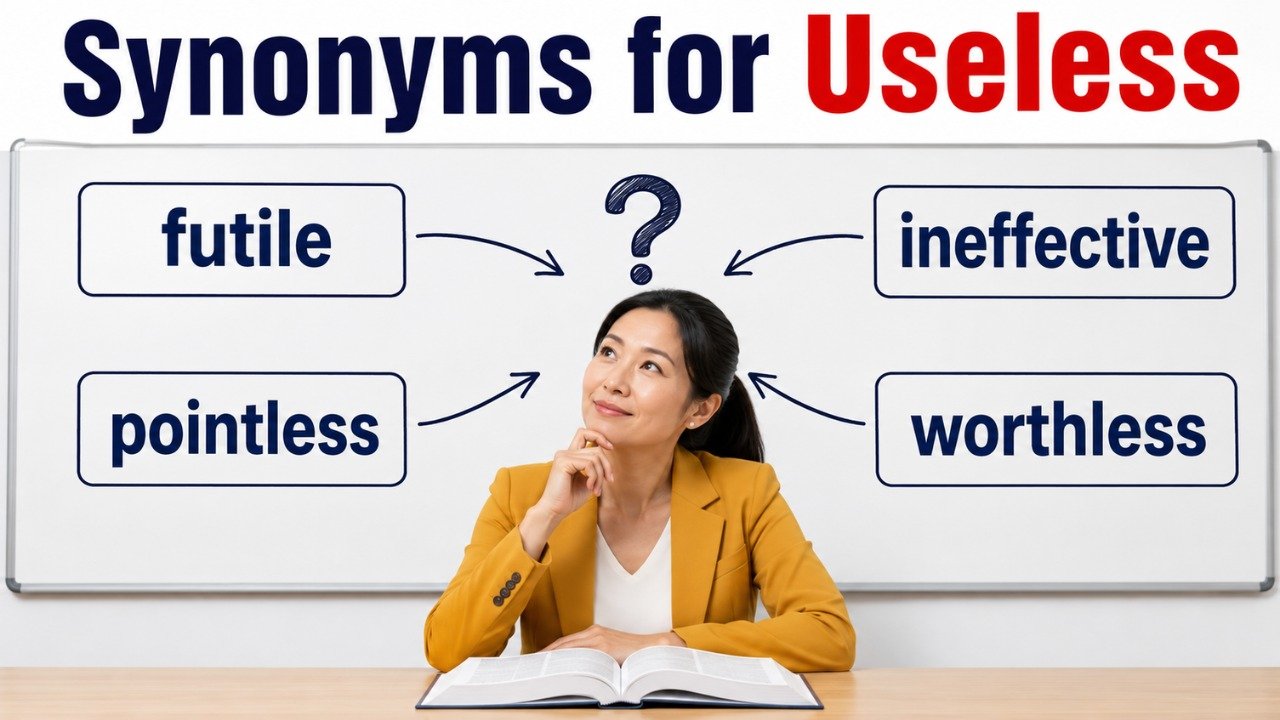
Quick Answer: The best synonyms for useless include ineffective, worthless, pointless, futile, unhelpful, impractical, inoperative, obsolete, unproductive, and unnecessary. Among these synonyms for useless, ineffective is best for a method that does not produce results, while worthless describes something with little or no value. Pointless suits actions without a meaningful purpose, futile describes efforts that cannot succeed, and inoperative is useful for machinery that does not work. Use obsolete for outdated items, impractical for ideas that cannot work well, and unhelpful for advice that provides no assistance.
Pronunciation and Word Details
Word: Useless.
Pronunciation: /ˈjuːsləs/
Part of Speech: Adjective.
Meaning: Unable to provide help, value, purpose, or the intended result.
US Pronunciation:
UK Pronunciation:
What Does “Useless” Mean?
Useless means unable to perform a useful function, provide value, or achieve the desired result.
The word useless is an adjective. It can describe an object that does not work, a method that fails, advice that offers no help, an action without purpose, or an outdated tool that is no longer needed.
Example: The damaged charger was useless because it could no longer supply power.
Useless can describe something completely ineffective.
Example: The medicine was useless against that particular infection.
It can also describe something that has no practical purpose in a specific situation.
Example: Thick winter clothing is useless in extremely hot weather.
The word may refer to an unsuccessful effort.
Example: It was useless to argue after the final decision had been made.
Useless can also describe a person, but this use is usually harsh and insulting. It is often better to criticize a specific action, skill, or performance instead of judging the whole person.
Harsh: He is useless.
More Precise: He needs more training before he can complete this task independently.
The meaning of useless depends on context. It may mean broken, ineffective, unnecessary, outdated, impractical, irrelevant, or without value.
Meaning, Tone, and Context of “Useless”
Useless usually has a negative and critical tone. It expresses a lack of usefulness, effectiveness, value, purpose, or practical benefit.
Neutral Tone: The word can sound neutral when describing an object that no longer works.
Example: The battery is useless once it loses its ability to hold a charge.
Critical Tone: Useless often communicates disappointment with a method, product, idea, or result.
Example: The instructions were useless because they left out several important steps.
Strong Tone: Useless is stronger than unhelpful or inconvenient. It often suggests that something provides no benefit at all.
Example: The damaged map was completely useless in the unfamiliar area.
Conversational Tone: The word is common in everyday speech.
Example: This broken pen is useless.
Formal Tone: Useless may appear in reports and essays, but more precise alternatives such as ineffective, irrelevant, obsolete, inoperative, or impractical are often better.
Example: The analysis found that the earlier method was ineffective.
Technical Tone: In technical writing, terms such as nonfunctional, inoperative, defective, incompatible, or obsolete give clearer information.
Example: The device became inoperative after the internal component failed.
Emotional Tone: When applied to a person, useless can express anger, contempt, or frustration.
Example: Calling an employee useless attacks the person rather than explaining the performance problem.
Writers should choose a synonym that identifies why something is not useful. An object may be broken, a strategy may be ineffective, a task may be pointless, and a tool may be obsolete.
When and How to Use “Useless”
Use useless when something cannot provide help, serve its purpose, produce results, or offer practical value.
For Broken Objects
Explanation: Use useless when an object can no longer perform its intended function.
Example: The cracked container was useless because it could not hold water.
For Ineffective Methods
Explanation: Use useless when a method fails to produce the expected result.
Example: The old cleaning technique was useless against the deep stain.
For Unhelpful Advice
Explanation: Use useless when guidance does not solve the problem or provide useful information.
Example: The vague advice was useless to someone who needed clear instructions.
For Pointless Actions
Explanation: Use useless when an action has no meaningful purpose or benefit.
Example: Continuing the argument seemed useless after everyone had agreed to leave.
For Futile Efforts
Explanation: Use useless when an attempt has no realistic chance of success.
Example: It was useless to search the empty building after the missing items had been found elsewhere.
For Outdated Tools
Explanation: Use useless when a tool or system has become outdated and can no longer meet current needs.
Example: The old software became useless after it stopped supporting the required file type.
For Irrelevant Information
Explanation: Use useless when information has no connection to the current question or task.
Example: The extra statistics were useless because they did not relate to the research topic.
For Impractical Ideas
Explanation: Use useless when an idea cannot work under real conditions.
Example: The proposal was useless without enough time, staff, or equipment.
For Unnecessary Items
Explanation: Use useless when an item is not needed in a particular situation.
Example: An umbrella is useless during a completely dry indoor event.
For Failed Results
Explanation: Use useless when a result cannot support a decision or solve a problem.
Example: The incomplete test results were useless for making an accurate diagnosis.
Best Synonyms for Useless
Ineffective
Synonym: Unable to produce the intended or expected result.
Example: The advertising method was ineffective because it did not reach the intended audience.
Worthless
Synonym: Having no practical, financial, or meaningful value.
Example: The damaged document was worthless because the important information could not be read.
Pointless
Synonym: Having no useful purpose, reason, or benefit.
Example: Repeating the same complaint without suggesting a solution felt pointless.
Futile
Synonym: Unable to succeed despite effort.
Example: Their attempt to repair the completely destroyed machine was futile.
Unhelpful
Synonym: Failing to provide useful assistance, guidance, or information.
Example: The brief response was unhelpful because it did not answer the main question.
Impractical
Synonym: Not suitable or realistic for actual use.
Example: The plan was imaginative but impractical for a small budget.
Inoperative
Synonym: Not working or unable to function.
Example: The elevator remained inoperative until the damaged motor was replaced.
Obsolete
Synonym: No longer useful because something newer has replaced it.
Example: The outdated equipment became obsolete when the new system was installed.
Unproductive
Synonym: Failing to create useful progress, work, or results.
Example: The meeting became unproductive because the discussion lacked a clear goal.
Unnecessary
Synonym: Not needed or required.
Example: The additional approval step was unnecessary and slowed the process.
50 Synonyms for Useless with Short Meanings
- Ineffective: Unable to produce the intended result.
- Worthless: Having no practical or meaningful value.
- Pointless: Lacking a useful reason or purpose.
- Futile: Unable to succeed despite effort.
- Unhelpful: Providing little or no useful assistance.
- Impractical: Unsuitable for realistic use.
- Inoperative: Not functioning or working.
- Obsolete: No longer useful because it is outdated.
- Unproductive: Failing to produce useful progress or results.
- Unnecessary: Not needed for the situation.
- Fruitless: Producing no successful result.
- Vain: Unable to achieve the desired outcome.
- Ineffectual: Lacking the power to create an effect.
- Unavailing: Failing to bring success or benefit.
- Nonfunctional: Unable to perform its intended function.
- Inoperable: Unable to be used or operated.
- Unserviceable: Not suitable for continued use.
- Defective: Containing a fault that prevents proper use.
- Broken: Damaged and unable to work correctly.
- Malfunctioning: Working incorrectly or unreliably.
- Dysfunctional: Unable to operate in a normal or effective way.
- Unworkable: Impossible or extremely difficult to carry out.
- Unsuitable: Not right for a particular purpose.
- Unfit: Not suitable or capable of serving a purpose.
- Inadequate: Not sufficient for the required task.
- Insufficient: Not enough to meet a need.
- Incapable: Unable to perform a required action.
- Powerless: Unable to create change or influence.
- Helpless: Unable to provide help or take effective action.
- Meaningless: Lacking clear meaning, purpose, or value.
- Purposeless: Having no useful aim or objective.
- Needless: Unnecessary and serving no useful purpose.
- Superfluous: More than is needed or useful.
- Redundant: No longer needed because it is repeated or replaced.
- Irrelevant: Unrelated to the matter being considered.
- Nonessential: Not necessary or central.
- Valueless: Having no measurable or practical value.
- Discardable: Suitable for removal because it has little further use.
- Expendable: Not important enough to preserve or keep.
- Idle: Not being used or producing useful work.
- Sterile: Producing no useful ideas, progress, or results.
- Barren: Lacking useful results, ideas, or development.
- Abortive: Failing before achieving the intended result.
- Unsuccessful: Not achieving the desired outcome.
- Hopeless: Having no reasonable chance of success.
- Wasteful: Using resources without producing enough value.
- Of No Use: Unable to help or serve a purpose.
- Good for Nothing: Informally unable to provide useful value.
- Without Value: Providing no meaningful benefit.
- Beyond Use: Too damaged, outdated, or unsuitable to be useful.
Read Also:
Synonyms for Constant

Synonyms for Useless by Context
When Useless Means Ineffective
Use ineffective, ineffectual, powerless, unavailing, unsuccessful, or inadequate when something fails to achieve its intended result.
Example With Useless: The treatment was useless for reducing the symptoms.
Example With Ineffective: The treatment was ineffective for reducing the symptoms.
Example With Unavailing: Every attempt to restart the damaged machine proved unavailing.
Ineffective is the most natural formal choice. Ineffectual often describes weak actions, policies, or leadership. Unavailing emphasizes that an effort did not succeed.
When Useless Means Worthless
Use worthless, valueless, without value, or good for nothing when something has no practical or meaningful value.
Example With Useless: The damaged certificate was useless.
Example With Worthless: The damaged certificate was worthless.
Example With Valueless: The unreadable record was valueless as evidence.
Worthless is strong and may refer to practical, emotional, or financial value. Valueless is more formal and less emotional.
When Useless Means Pointless
Use pointless, meaningless, purposeless, needless, or futile when an action has no useful reason or likely benefit.
Example With Useless: Continuing the discussion was useless.
Example With Pointless: Continuing the discussion was pointless.
Example With Futile: Trying to change the completed decision was futile.
Pointless emphasizes the absence of a purpose. Futile emphasizes the absence of any realistic chance of success.
When Useless Means Broken
Use broken, defective, malfunctioning, nonfunctional, inoperative, or inoperable when an object or system does not work.
Example With Useless: The damaged printer was useless.
Example With Nonfunctional: The damaged printer was nonfunctional.
Example With Inoperative: The printer remained inoperative after the electrical failure.
Broken is natural in casual speech. Nonfunctional and inoperative are more precise in formal or technical writing.
When Useless Means Impractical
Use impractical, unworkable, unsuitable, unfit, or inadequate when an idea or item cannot meet real needs.
Example With Useless: The proposal was useless in a small workplace.
Example With Impractical: The proposal was impractical in a small workplace.
Example With Unworkable: The schedule was unworkable because it required everyone to be present at the same time.
Impractical suggests that an idea may sound reasonable but cannot work easily. Unworkable suggests that it cannot be successfully carried out.
When Useless Means Outdated
Use obsolete, redundant, outdated, or beyond use when something is no longer useful because conditions or technology have changed.
Example With Useless: The old equipment became useless.
Example With Obsolete: The old equipment became obsolete.
Example With Redundant: The manual process became redundant after the automated system was introduced.
Obsolete refers to something replaced by newer developments. Redundant means no longer needed because another method performs the same function.
When Useless Means Unnecessary
Use unnecessary, needless, superfluous, redundant, or nonessential when something is not required.
Example With Useless: The extra page was useless.
Example With Unnecessary: The extra page was unnecessary.
Example With Superfluous: The report contained several superfluous details.
Unnecessary is the clearest general choice. Superfluous has a more formal tone and means more than what is needed.
When Useless Means Irrelevant
Use irrelevant, unrelated, immaterial, or nonessential when information does not help with the current subject.
Example With Useless: The comment was useless during the technical discussion.
Example With Irrelevant: The comment was irrelevant during the technical discussion.
Example With Nonessential: The nonessential details were removed from the summary.
Irrelevant is best when information does not relate to the topic. Nonessential means related information that is not necessary.
When Useless Means Unproductive
Use unproductive, fruitless, sterile, barren, or idle when an activity produces no useful progress.
Example With Useless: The meeting was useless.
Example With Unproductive: The meeting was unproductive.
Example With Fruitless: The search proved fruitless after several hours.
Unproductive works well for meetings, work sessions, and discussions. Fruitless describes efforts that produce no successful result.
Another Word for Useless
The best single replacement for useless is ineffective when describing something that does not achieve its intended purpose. However, the most accurate alternative depends on why the subject is not useful.
Use worthless when something has no value, pointless for an action without purpose, inoperative for a machine that does not work, and obsolete for an outdated tool or system.
Original: The new method was useless.
Better Option: The new method was ineffective.
Original: The damaged device was useless.
Better Option: The damaged device was inoperative.
Original: Arguing about the finished decision was useless.
Better Option: Arguing about the finished decision was pointless.
Original: The old system became useless after the upgrade.
Better Option: The old system became obsolete after the upgrade.
When Not to Use “Useless”
Avoid useless when it sounds too harsh, vague, emotional, or less accurate than another word.
When Describing a Person
Calling a person useless is insulting and does not identify the actual problem.
Weak: The new employee is useless.
Better: The new employee needs additional training in the reporting process.
When a Method Is Only Partly Effective
Useless suggests that something provides no benefit at all.
Weak: The method was useless because it solved only half of the problem.
Better: The method was only partially effective because it solved half of the problem.
When an Object Can Be Repaired
A damaged object may not be permanently useless.
Weak: The printer is useless.
Better: The printer is temporarily inoperative and requires repair.
When the Real Meaning Is Irrelevant
Use irrelevant when information does not relate to the subject.
Weak: That statistic is useless to this discussion.
Better: That statistic is irrelevant to this discussion.
When the Real Meaning Is Unnecessary
Use unnecessary or redundant when an item is not needed.
Weak: The second approval is useless.
Better: The second approval is unnecessary.
When the Real Meaning Is Outdated
Use obsolete when newer technology has replaced an older tool.
Weak: The old storage format is useless.
Better: The old storage format is obsolete.
When Writing a Formal Report
Useless may sound emotional or judgmental in professional analysis.
Weak: The old procedure is useless.
Better: The old procedure is ineffective and no longer meets current requirements.
When Evidence Is Limited
Do not describe something as useless before testing its effectiveness properly.
Weak: The new idea is useless because it sounds unusual.
Better: The new idea requires testing before its practical value can be assessed.
Words Commonly Confused With Useless
Useless vs Ineffective: Useless suggests no practical benefit, while ineffective means unable to produce the intended result. Something may be ineffective for one purpose but useful for another.
Useless vs Worthless: Useless describes a lack of practical function. Worthless describes a lack of value, which may be practical, emotional, or financial.
Useless vs Pointless: Useless can describe objects, methods, or actions. Pointless usually describes an action, discussion, or effort without a meaningful purpose.
Useless vs Futile: Useless describes something that provides no help. Futile describes an effort that has no realistic chance of success.
Useless vs Unhelpful: Useless is stronger and suggests no benefit. Unhelpful means something does not provide enough assistance but may still contain some value.
Useless vs Impractical: Useless means unable to serve a useful purpose. Impractical means difficult or unrealistic to use under actual conditions.
Useless vs Obsolete: Useless is a general description. Obsolete specifically means no longer useful because a newer method or item has replaced it.
Useless vs Broken: Broken means physically or mechanically damaged. A broken object may still be partly useful, while a useless object provides no useful function in the situation.
Useless vs Irrelevant: Useless refers to a lack of benefit. Irrelevant means unrelated to the current subject or purpose.
Useless vs Unnecessary: Useless means unable to provide benefit. Unnecessary means not needed, even if the item itself works perfectly.
Which Synonym Should You Choose?
Choose ineffective when a strategy, treatment, method, or policy does not produce the expected result.
Choose worthless when an object, document, investment, or item has no practical or meaningful value.
Choose pointless when an action, argument, discussion, or task has no useful purpose.
Choose futile when an effort has no reasonable chance of success.
Choose unhelpful when advice, information, feedback, or a response does not provide enough assistance.
Choose impractical when a plan or idea cannot work easily in real conditions.
Choose inoperative when formal or technical writing describes machinery or equipment that is not working.
Choose nonfunctional when a device, feature, or component cannot perform its intended function.
Choose defective when a fault causes an object to work incorrectly.
Choose obsolete when an item or process has been replaced by something newer.
Choose redundant when something is no longer needed because another item performs the same function.
Choose unnecessary when something is simply not required.
Choose irrelevant when information does not relate to the main subject.
Choose unproductive when a meeting, discussion, activity, or work period produces little progress.
Choose fruitless when a search, effort, or investigation produces no result.
Choose unworkable when a plan cannot be carried out successfully.
Choose inadequate when something is not sufficient for a particular need.
Choose meaningless when words, actions, or symbols lack clear meaning or value.
Choose wasteful when an activity uses time, money, or materials without enough benefit.
Choose of no use in casual or neutral conversation when you want a softer phrase.
Real Life Examples of “Useless” in Sentences
Original: The old instructions were useless.
Better Option: The old instructions were unhelpful.
Original: The damaged remote control was useless.
Better Option: The damaged remote control was nonfunctional.
Original: The marketing strategy was useless.
Better Option: The marketing strategy was ineffective.
Original: Continuing the argument was useless.
Better Option: Continuing the argument was pointless.
Original: Their attempt to stop the flood with a small barrier was useless.
Better Option: Their attempt to stop the flood with a small barrier was futile.
Original: The outdated machine became useless.
Better Option: The outdated machine became obsolete.
Original: The extra details were useless to the report.
Better Option: The extra details were irrelevant to the report.
Original: The proposed schedule was useless for a large team.
Better Option: The proposed schedule was impractical for a large team.
Original: The meeting was useless because no decisions were made.
Better Option: The meeting was unproductive because no decisions were made.
Original: The second form was useless because the same information had already been collected.
Better Option: The second form was redundant because the same information had already been collected.
Synonym Groups and Usage Differences
Failure Group
This group includes ineffective, ineffectual, unsuccessful, futile, unavailing, and abortive. These words describe something that fails to produce the desired result.
Example: The earlier strategy was ineffective because it ignored the main cause of the problem.
Lack of Value Group
This group includes worthless, valueless, without value, and good for nothing. These words describe something with little or no meaningful benefit.
Example: The damaged record was worthless as proof.
Lack of Purpose Group
This group includes pointless, purposeless, meaningless, needless, and futile. These words describe actions or ideas without a useful aim.
Example: Repeating the same unsupported claim was pointless.
Broken Function Group
This group includes nonfunctional, inoperative, inoperable, defective, broken, malfunctioning, and dysfunctional. These words describe objects or systems that do not work properly.
Example: The machine remained inoperative until the replacement component arrived.
Practicality Group
This group includes impractical, unworkable, unsuitable, unfit, inadequate, and insufficient. These words describe ideas or items that cannot meet practical needs.
Example: The plan was unworkable because it required more workers than were available.
Outdated Group
This group includes obsolete, redundant, beyond use, and unserviceable. These words describe something that can no longer serve a useful modern function.
Example: The older process became obsolete after a faster system was introduced.
Unnecessary Group
This group includes unnecessary, needless, superfluous, redundant, and nonessential. These words describe something that is not required.
Example: Several superfluous paragraphs were removed from the final report.
Lack of Progress Group
This group includes unproductive, fruitless, sterile, barren, and idle. These words describe activities that create no useful development.
Example: The discussion became unproductive when everyone repeated the same opinions.
Lack of Relevance Group
This group includes irrelevant, nonessential, and unrelated. These words describe information that does not help with the current subject.
Example: The reviewer removed irrelevant details from the summary.
Antonyms of Useless
The opposite of useless depends on whether the word refers to function, value, effectiveness, relevance, or necessity.
Useful: Able to provide help or serve a purpose.
Helpful: Providing assistance or making a task easier.
Effective: Producing the intended result.
Valuable: Having practical, emotional, or financial worth.
Worthwhile: Deserving the time, effort, or resources required.
Practical: Suitable for actual use.
Functional: Working correctly and serving its intended purpose.
Operational: Ready and able to work.
Productive: Creating useful progress or results.
Meaningful: Having clear purpose, value, or importance.
Relevant: Directly connected to the subject.
Necessary: Required for a particular purpose.
Essential: Extremely important or required.
Beneficial: Producing a positive effect.
Efficient: Producing results without wasting resources.
Serviceable: Suitable and reliable enough for use.
Capable: Able to perform the required task.
Suitable: Appropriate for a particular purpose.
Successful: Achieving the desired result.
Profitable: Producing a useful gain or advantage.
Comparison: Useless vs Related Words
Useless vs Ineffective
Useless suggests that something provides no practical benefit. Ineffective means that it does not achieve a specific intended result.
Example With Useless: The broken device was useless.
Example With Ineffective: The treatment was ineffective against the illness.
Useless vs Worthless
Useless relates mainly to function or benefit. Worthless relates to a complete lack of value.
Example With Useless: The wet matches were useless.
Example With Worthless: The damaged certificate was worthless as evidence.
Useless vs Pointless
Useless can describe an object, idea, or action. Pointless usually describes an activity without a worthwhile purpose.
Example With Useless: The broken lock was useless.
Example With Pointless: Continuing the argument was pointless.
Useless vs Futile
Useless describes a lack of practical help. Futile describes an attempt that cannot succeed.
Example With Useless: The damaged map was useless.
Example With Futile: Their attempt to move the heavy object without equipment was futile.
Useless vs Unhelpful
Useless is stronger and may suggest no benefit at all. Unhelpful suggests that something does not provide enough support.
Example With Useless: The completely blank guide was useless.
Example With Unhelpful: The brief explanation was unhelpful because it lacked examples.
Useless vs Impractical
Useless means unable to provide value or serve a purpose. Impractical means unsuitable for real conditions.
Example With Useless: The damaged tool was useless.
Example With Impractical: The expensive plan was impractical for a small organization.
Useless vs Obsolete
Useless is a broad term. Obsolete means outdated and replaced by something newer.
Example With Useless: The damaged equipment was useless.
Example With Obsolete: The equipment became obsolete after modern technology replaced it.
Useless vs Redundant
Useless means unable to provide a benefit. Redundant means no longer necessary because something else performs the same role.
Example With Useless: The unreadable copy was useless.
Example With Redundant: The duplicate form became redundant after the records were combined.
Common Phrases and Expressions With Useless
Completely Useless: Unable to provide any practical benefit.
Practically Useless: Providing so little benefit that it has almost no value.
Rendered Useless: Made unable to work or serve its purpose.
Become Useless: Lose the ability to provide value or perform a function.
Useless Information: Facts or details that do not help with the current purpose.
Useless Effort: Work that produces no useful result.
Useless Tool: An object that cannot perform the required task.
Useless Advice: Guidance that provides no practical help.
Useless Without Something: Unable to function unless another item or condition is present.
It Is Useless to Try: An expression meaning that an attempt has no realistic chance of success.
Common Mistakes to Avoid
Applying Useless to a Person
Calling a person useless is harsh, vague, and often unfair.
Incorrect: She is useless at work.
Improved: She needs more practice with the new reporting system.
Using Useless When Something Is Partly Helpful
Useless suggests a complete lack of benefit.
Incorrect: The guide was useless, although two sections answered my questions.
Improved: The guide was only partly helpful because most sections lacked detail.
Confusing Useless With Unnecessary
An unnecessary item may still be useful in another situation.
Incorrect: The spare chair works perfectly, but it is useless because we do not need it today.
Improved: The spare chair is unnecessary for today’s meeting.
Confusing Useless With Obsolete
An old item is not automatically obsolete, and an obsolete item may still function.
Incorrect: The working machine is useless because a newer model exists.
Improved: The working machine is becoming obsolete because a newer system performs the task more efficiently.
Choosing an Unnatural Synonym
Not every alternative fits every noun.
Unnatural: The meeting was inoperative.
Natural: The meeting was unproductive.
Using Useless Too Repeatedly
Repeated use makes writing vague and monotonous.
Weak: The useless tool came with a useless guide and a useless replacement part.
Better: The defective tool came with an unhelpful guide and an incompatible replacement part.
Failing to Explain Why Something Is Useless
A precise explanation helps readers understand the problem.
Vague: The software is useless.
Clear: The software is incompatible with the required file format.
Using Strong Language in Formal Writing
Reports should describe the specific failure instead of relying on emotional wording.
Weak: The old policy is useless.
Better: The old policy is ineffective because it does not address current workplace needs.
Conclusion
The best synonyms for useless include ineffective, worthless, pointless, futile, unhelpful, impractical, inoperative, and obsolete. Use ineffective for methods that fail, worthless for things without value, and pointless for actions without purpose. Futile suits efforts that cannot succeed, while inoperative describes machinery that does not work. Obsolete is best for outdated systems, and irrelevant fits information that does not support the topic. Choosing a precise synonym makes your writing clearer, fairer, and more informative.
FAQs About Synonyms for Useless
What Is the Best Synonym for Useless?
Ineffective is the best general synonym when something does not achieve its intended result.
What Is a Polite Synonym for Useless?
Unhelpful, ineffective, unsuitable, or not useful can sound more polite and less judgmental.
What Is a Formal Synonym for Useless?
Ineffective, ineffectual, inoperative, obsolete, inadequate, and unproductive are useful formal alternatives.
What Is a Stronger Word Than Useless?
Worthless, futile, hopeless, and completely ineffective can express a stronger lack of value or success.
Are Useless and Pointless the Same?
Not exactly. Useless describes something that provides no practical benefit, while pointless usually describes an action without a meaningful purpose.
What Is a Synonym for a Useless Object?
Broken, nonfunctional, defective, inoperative, unserviceable, or beyond use may describe a useless object.
What Is the Opposite of Useless?
Useful, helpful, effective, valuable, practical, functional, and beneficial are common opposites of useless.
