
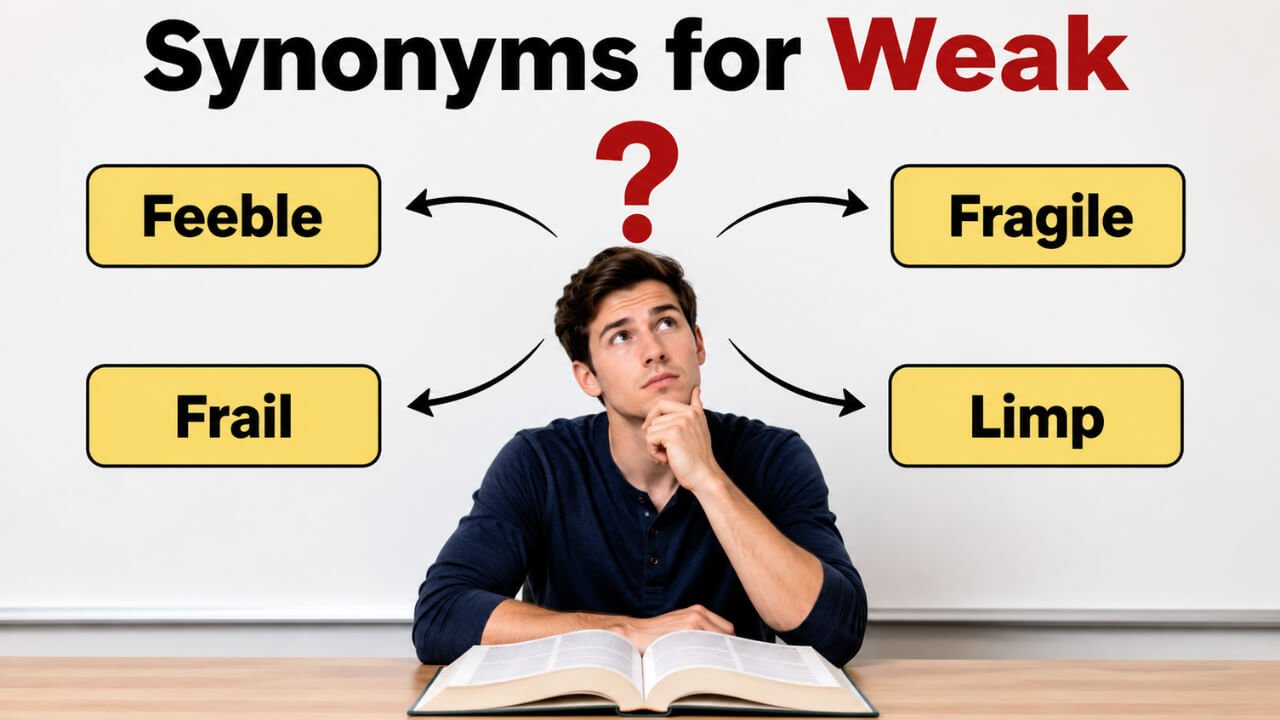
Quick Answer: The best synonyms for weak are frail, feeble, fragile, powerless, vulnerable, ineffective, inadequate, faint, unconvincing, and flimsy. Use frail or feeble for limited physical strength, fragile for something easily damaged, powerless for a lack of authority, vulnerable for exposure to harm, ineffective for poor results, inadequate for something insufficient, faint for low sound or light, unconvincing for an argument, and flimsy for weak materials or poorly supported claims.
Pronunciation and Word Details
Word: Weak
Pronunciation: /wiːk/
Part of Speech: Adjective
Meaning: Lacking physical strength, power, effectiveness, intensity, quality, or support.
US Pronunciation:
UK Pronunciation:
What Does “Weak” Mean?
Weak means lacking the strength, power, quality, influence, or effectiveness needed for a particular purpose. It is mainly used as an adjective and can describe people, objects, arguments, signals, performances, economies, emotions, and many other things.
When weak describes a person, it may refer to limited physical strength, poor health, tiredness, or a lack of energy.
Example: He felt weak after working without rest.
When it describes an object or structure, weak means that the material is not strong enough to resist pressure or damage.
Example: The weak shelf could not support the heavy books.
Weak can also describe an argument, explanation, excuse, or piece of evidence that is not convincing or well supported.
Example: The claim was based on weak evidence.
In other contexts, weak may describe low intensity.
Example: The radio received a weak signal.
It may also describe poor performance, limited authority, an unstable economy, or an ineffective response.
Example: The team produced a weak performance during the final match.
Because weak has several meanings, the best synonym depends on what lacks strength. A physically weak person may be frail, while a weak argument may be unconvincing or unsupported.
Meaning, Tone, and Context of “Weak”
Weak has a neutral meaning in many practical contexts, but it can sound negative, critical, or insensitive when used to describe a person’s character, emotions, or abilities.
In medical or physical descriptions, weak may communicate low strength or energy.
Example: Her legs felt weak after the long climb.
In academic and formal writing, weak often evaluates evidence, reasoning, research methods, conclusions, or explanations.
Example: The study reached a weak conclusion because the sample was too limited.
In business writing, weak may describe demand, leadership, performance, sales, productivity, or economic activity.
Example: Weak demand reduced production during the final quarter.
In technical contexts, it may refer to signals, materials, connections, passwords, systems, or structural support.
Example: A weak connection caused repeated interruptions.
In conversation, weak can also mean disappointing, poor, or unimpressive.
Example: That was a weak excuse for arriving late.
Writers should use the word carefully when referring to people. Calling someone weak may sound judgmental because it can suggest poor character or a lack of courage. More precise words such as tired, vulnerable, hesitant, inexperienced, or physically frail may communicate the intended meaning more respectfully.
When and How to Use “Weak”
For Limited Physical Strength
Use weak when a person or body part cannot produce normal strength or energy.
Example: His arms felt weak after carrying the equipment upstairs.
For Poor Health
Weak may describe someone who is physically unwell, exhausted, or recovering from illness.
Example: She remained weak for several days after the fever ended.
For an Unconvincing Argument
Use weak when a claim, explanation, argument, or conclusion lacks strong reasoning or evidence.
Example: The writer presented a weak argument because no relevant examples were included.
For Insufficient Evidence
Weak can describe evidence that is limited, unreliable, unclear, or unable to support a conclusion.
Example: The accusation was based on weak evidence.
For Poor Performance
Use weak for results, work, writing, leadership, sales, or performance that falls below expectations.
Example: The company reported weak performance during the first half of the year.
For Low Intensity
Weak may describe light, sound, taste, smell, color, signals, or other forms of intensity.
Example: A weak light appeared through the fog.
For Limited Authority
Use weak when a person, institution, or government lacks enough influence or control.
Example: Weak leadership created confusion among the team members.
For an Unstable Structure
Weak can describe materials, foundations, joints, or structures that cannot resist pressure.
Example: The wall collapsed because its foundation was weak.
For a Personal Limitation
Weak may describe an area in which someone lacks skill, knowledge, or confidence.
Example: Mathematics was his weakest subject at school.
For Low Economic Activity
Weak can describe demand, growth, investment, trade, or an economy performing below its normal level.
Example: Weak consumer demand affected several local businesses.
Best Synonyms for Weak
Frail
Synonym: Frail means physically delicate, lacking strength, or easily harmed.
Example: The frail patient needed assistance when walking.
Feeble
Synonym: Feeble means noticeably lacking physical strength, force, or effectiveness.
Example: He made a feeble attempt to lift the heavy box.
Fragile
Synonym: Fragile means easily broken, damaged, or harmed.
Example: The fragile container required careful handling.
Powerless
Synonym: Powerless means unable to control a situation or influence an outcome.
Example: Residents felt powerless to stop the sudden changes.
Vulnerable
Synonym: Vulnerable means exposed to harm, attack, criticism, or damage.
Example: Small businesses are vulnerable during periods of economic uncertainty.
Ineffective
Synonym: Ineffective means unable to produce the intended result.
Example: The original strategy was ineffective and required revision.
Inadequate
Synonym: Inadequate means not sufficient, suitable, or strong enough for a need.
Example: The building had inadequate protection against heavy rain.
Faint
Synonym: Faint means low in strength, sound, light, color, or intensity.
Example: A faint sound came from the empty hallway.
Unconvincing
Synonym: Unconvincing means unable to make someone believe or accept an argument.
Example: His explanation was unconvincing because it lacked specific details.
Flimsy
Synonym: Flimsy means physically thin and weak or poorly supported by facts.
Example: The chair was made from flimsy material.
50 Synonyms for Weak with Short Meanings
- Frail: Physically delicate and lacking strength.
- Feeble: Noticeably lacking physical force or energy.
- Fragile: Easily damaged, broken, or harmed.
- Delicate: Requiring careful handling because of limited strength.
- Infirm: Physically weak because of illness or age.
- Debilitated: Seriously weakened by illness, injury, or exhaustion.
- Exhausted: Having very little energy remaining.
- Tired: Lacking energy because of effort or insufficient rest.
- Weary: Physically or mentally tired after continued effort.
- Powerless: Unable to control events or influence an outcome.
- Helpless: Unable to protect oneself or act without assistance.
- Vulnerable: Open to injury, damage, criticism, or attack.
- Defenseless: Lacking protection against danger or attack.
- Unprotected: Not guarded against possible harm.
- Ineffective: Failing to produce the intended result.
- Inefficient: Producing poor results while wasting time or resources.
- Inadequate: Not strong, suitable, or sufficient enough.
- Insufficient: Not enough to satisfy a need or requirement.
- Deficient: Lacking an important quality, amount, or feature.
- Poor: Below the expected standard or quality.
- Inferior: Lower in quality, strength, or value.
- Faulty: Containing a defect that reduces effectiveness.
- Flawed: Damaged by an error, weakness, or limitation.
- Unsound: Not reliable, stable, logical, or structurally strong.
- Unstable: Likely to change, fail, or collapse.
- Shaky: Uncertain, unstable, or poorly supported.
- Flimsy: Thin, weak, or lacking solid support.
- Brittle: Hard but likely to crack or break easily.
- Faint: Low in sound, light, color, strength, or intensity.
- Dim: Producing little light or lacking clarity.
- Soft: Low in force, sound, pressure, or impact.
- Low: Limited in level, amount, strength, or intensity.
- Mild: Gentle or limited in strength and severity.
- Diluted: Made weaker by adding another substance.
- Watery: Thin, diluted, or lacking a strong taste.
- Thin: Lacking richness, substance, density, or strength.
- Bland: Lacking strong flavor, character, or interest.
- Unconvincing: Failing to persuade or create belief.
- Unsupported: Lacking evidence, reasoning, or reliable support.
- Questionable: Open to doubt because of poor reliability.
- Doubtful: Uncertain, unreliable, or unlikely to succeed.
- Tenuous: Very weak, slight, or poorly supported.
- Hollow: Lacking sincere meaning, value, or substance.
- Superficial: Limited to the surface and lacking depth.
- Indecisive: Unable to make clear or confident decisions.
- Timid: Lacking courage or confidence.
- Irresolute: Uncertain and lacking firm determination.
- Submissive: Too willing to accept another person’s control.
- Faltering: Losing strength, confidence, or effectiveness.
- Lackluster: Unimpressive and lacking energy or quality.
Read Also:
Synonyms for Establish

Synonyms for Weak by Context
When Weak Means Physically Frail
Use frail, feeble, infirm, debilitated, tired, exhausted, or weary when describing limited physical strength or energy.
Example With Weak: The patient remained weak after the treatment.
Example With Frail: The patient remained frail after the treatment.
Frail suggests a delicate physical condition and a greater risk of harm. Feeble often emphasizes very limited strength or effort. Debilitated is more formal and usually describes serious weakness caused by illness, injury, or exhaustion.
Tired and weary are better when the weakness is temporary and caused by effort or lack of rest.
When Weak Means Easily Damaged
Use fragile, delicate, flimsy, brittle, unstable, or unsound for objects and materials that may break, bend, collapse, or fail.
Example With Weak: The weak frame could not support the weight.
Example With Flimsy: The flimsy frame could not support the weight.
Fragile means easily damaged and may describe both physical objects and sensitive situations. Flimsy suggests that something was made from material that is too thin or poorly constructed. Brittle describes something that is hard but breaks easily.
Unsound is useful for structures, plans, or principles that lack stability.
When Weak Means Ineffective
Use ineffective, inefficient, inadequate, deficient, poor, inferior, faulty, or lackluster when something fails to achieve the desired result.
Example With Weak: The organization gave a weak response to the problem.
Example With Ineffective: The organization gave an ineffective response to the problem.
Ineffective directly means that something does not work. Inadequate suggests that the response, resource, or effort is not sufficient. Lackluster is more suitable for an unimpressive performance that lacks energy.
When Weak Means Unconvincing
Use unconvincing, unsupported, questionable, doubtful, tenuous, hollow, superficial, flawed, or unsound for arguments, claims, evidence, or explanations.
Example With Weak: The essay contains a weak explanation of the final result.
Example With Superficial: The essay contains a superficial explanation of the final result.
Unconvincing focuses on the failure to persuade. Unsupported means that no reliable evidence has been provided. Tenuous suggests that the connection between ideas is very slight. Hollow describes words or promises that lack substance or sincerity.
When Weak Means Low in Intensity
Use faint, dim, soft, low, mild, diluted, watery, thin, or bland for light, sound, flavor, color, smell, signals, and other forms of intensity.
Example With Weak: The device received a weak signal.
Example With Faint: The device received a faint signal.
Faint is useful for sound, light, smell, and signals that are barely noticeable. Mild describes something gentle or limited in strength. Diluted and watery are appropriate for liquids or flavors made less concentrated.
Bland means that food, writing, or an experience lacks a strong or interesting quality.
When Weak Means Powerless
Use powerless, helpless, vulnerable, defenseless, unprotected, submissive, or timid when discussing limited authority, protection, confidence, or control.
Example With Weak: The local committee was too weak to enforce the decision.
Example With Powerless: The local committee was powerless to enforce the decision.
Powerless means unable to influence the outcome. Helpless suggests being unable to act without support. Vulnerable means exposed to harm, while defenseless emphasizes the absence of protection.
When Weak Means Uncertain
Use shaky, doubtful, indecisive, irresolute, faltering, questionable, or unstable when confidence, commitment, reliability, or certainty is limited.
Example With Weak: The manager showed weak leadership during the crisis.
Example With Indecisive: The manager showed indecisive leadership during the crisis.
Indecisive refers to difficulty making decisions. Irresolute describes a lack of firm determination. Faltering suggests that confidence, speech, progress, or performance is beginning to fail.
Another Word for Weak
Frail is often the best single replacement for weak when describing limited physical strength. However, the strongest alternative depends on context. Ineffective is better for a strategy, unconvincing for an argument, faint for a sound, fragile for an object, and powerless for limited authority.
Original: The weak patient needed help standing.
Better Option: The frail patient needed help standing.
Original: The committee proposed a weak solution.
Better Option: The committee proposed an ineffective solution.
Original: The speaker gave a weak explanation.
Better Option: The speaker gave an unconvincing explanation.
Original: A weak light appeared in the distance.
Better Option: A faint light appeared in the distance.
When Not to Use “Weak”
Weak can be too general when a more precise adjective would explain exactly what is wrong. It may also sound insensitive when used to judge someone’s personality, emotions, or response to hardship.
When Describing Temporary Tiredness
Weak may suggest a more serious physical problem than simple tiredness.
Weak: She was weak after studying all night.
Better: She was exhausted after studying all night.
When Evaluating an Argument
Weak does not explain whether the argument lacks evidence, logic, relevance, or detail.
Weak: The writer made a weak argument.
Better: The writer made an unsupported argument that lacked reliable evidence.
When Describing a Poor Strategy
Use ineffective when the main problem is failure to produce results.
Weak: The advertising strategy was weak.
Better: The advertising strategy was ineffective.
When Referring to an Easily Broken Object
Fragile or flimsy may describe the material more clearly.
Weak: The box was weak.
Better: The box was flimsy and could not hold heavy items.
When Describing Low Sound or Light
Faint, dim, or soft may offer a more exact description.
Weak: A weak sound came through the wall.
Better: A faint sound came through the wall.
When Describing Someone’s Character
Calling a person weak can sound harsh or insulting. Identify the exact behavior instead.
Weak: He is weak.
Better: He becomes hesitant when making difficult decisions.
When Discussing Limited Authority
Powerless or ineffective may be clearer than weak.
Weak: The council was weak during the dispute.
Better: The council was powerless to enforce its decision.
Words Commonly Confused With Weak
Weak vs Frail: Weak is a broad word for limited strength or effectiveness. Frail usually describes a physically delicate person or an object that can be easily damaged.
Weak vs Feeble: Weak can describe physical strength, arguments, signals, and performance. Feeble usually suggests extremely limited physical force, energy, or effort.
Weak vs Fragile: Weak means lacking strength. Fragile means easily broken, damaged, or emotionally harmed.
Weak vs Vulnerable: Weak describes limited strength or power. Vulnerable means exposed to possible harm even when the person or object is not naturally weak.
Weak vs Powerless: Weak may mean having limited influence. Powerless means having no effective ability to control a situation.
Weak vs Ineffective: Weak is a general negative description. Ineffective specifically means failing to produce the intended result.
Weak vs Inadequate: Weak suggests low strength, quality, or effectiveness. Inadequate means insufficient for a particular need or standard.
Weak vs Faint: Weak can refer to many kinds of limited strength. Faint is more precise for low sound, light, smell, color, signals, or physical awareness.
Weak vs Flimsy: Weak applies broadly. Flimsy usually describes thin materials, poor construction, or an argument with little support.
Weak vs Tenuous: Weak is common and general. Tenuous is more formal and describes a slight connection, uncertain relationship, or poorly supported claim.
Which Synonym Should You Choose?
Choose frail when describing a physically delicate person, especially when strength has been reduced by age or poor health.
Choose feeble when an effort, voice, movement, or physical action has very little force.
Choose fragile when something is easily broken, damaged, or emotionally disturbed.
Choose delicate when careful treatment is necessary because something is sensitive or easily harmed.
Choose debilitated in formal or medical contexts when illness or injury has seriously reduced strength.
Choose powerless when a person or group cannot control an event or influence a decision.
Choose vulnerable when someone or something is exposed to possible harm, attack, loss, or criticism.
Choose ineffective when a strategy, method, policy, response, or treatment does not produce the intended result.
Choose inadequate when a resource, explanation, amount, or response is not sufficient.
Choose inefficient when a process produces poor results while wasting time, energy, or resources.
Choose unconvincing when an argument, excuse, performance, or explanation fails to persuade.
Choose unsupported when a claim lacks evidence, facts, examples, or logical reasoning.
Choose tenuous in formal writing when a connection, claim, or relationship is very slight.
Choose flimsy when an object is poorly made or an excuse lacks believable support.
Choose faint when referring to light, sound, smell, color, signals, or physical sensations with low intensity.
Choose mild when something has limited strength or severity but is not necessarily negative.
Choose diluted when a liquid, solution, idea, or effect has become weaker through reduction or addition.
Choose indecisive when a person or leader struggles to make firm decisions.
Choose timid when someone lacks confidence or courage in a particular situation.
Choose lackluster when a performance, response, or piece of work is unimpressive and lacks energy.
Real Life Examples of “Weak” in Sentences
Original: The weak child struggled to carry the bag.
Better Option: The frail child struggled to carry the bag.
Original: The lawyer presented a weak argument.
Better Option: The lawyer presented an unsupported argument.
Original: We could hear a weak sound outside the window.
Better Option: We could hear a faint sound outside the window.
Original: The chair has weak legs.
Better Option: The chair has flimsy legs.
Original: The manager offered a weak response to the complaint.
Better Option: The manager offered an inadequate response to the complaint.
Original: The medicine had a weak effect.
Better Option: The medicine had a mild effect.
Original: The group was too weak to influence the decision.
Better Option: The group was powerless to influence the decision.
Original: The company reported weak financial performance.
Better Option: The company reported poor financial performance.
Original: The essay ends with a weak conclusion.
Better Option: The essay ends with an unconvincing conclusion.
Original: The weak connection interrupted the call.
Better Option: The unstable connection interrupted the call.
Synonym Groups and Usage Differences
Physical Strength Group
Frail, feeble, infirm, debilitated, exhausted, tired, and weary describe limited physical energy or strength.
Frail and infirm often describe a continuing physical condition. Exhausted, tired, and weary usually describe temporary loss of energy. Debilitated is stronger and more formal.
Example: The debilitated patient required additional care and rest.
Damage and Structure Group
Fragile, delicate, flimsy, brittle, unstable, shaky, and unsound describe things that may break, collapse, or fail.
Fragile and delicate emphasize the need for careful handling. Flimsy suggests poor construction. Brittle refers to material that cracks easily. Unstable and unsound are useful for structures and systems.
Example: The engineers discovered that the foundation was structurally unsound.
Effectiveness Group
Ineffective, inefficient, inadequate, insufficient, deficient, poor, inferior, and faulty describe low quality or poor results.
Ineffective means a method does not work. Inefficient means it works poorly or wastes resources. Inadequate and insufficient mean that something does not meet a need.
Example: The existing safety measures were inadequate during severe weather.
Argument and Evidence Group
Unconvincing, unsupported, questionable, doubtful, tenuous, hollow, superficial, and flawed apply to claims, reasoning, evidence, explanations, or promises.
Unsupported is best when evidence is missing. Tenuous describes a weak connection. Hollow suggests a lack of substance or sincerity. Superficial means that an explanation lacks depth.
Example: The conclusion was based on a tenuous connection between two unrelated events.
Intensity Group
Faint, dim, soft, low, mild, diluted, watery, thin, and bland describe reduced strength in sound, light, flavor, color, concentration, or effect.
Faint works well for barely noticeable sensations. Dim refers mainly to light or clarity. Bland describes little flavor or character. Diluted means reduced in concentration.
Example: The soup tasted bland because it contained too much water.
Power and Protection Group
Powerless, helpless, vulnerable, defenseless, unprotected, submissive, and timid describe limited control, protection, or confidence.
Powerless focuses on control. Helpless suggests an inability to act. Vulnerable and defenseless focus on exposure to danger. Timid refers to limited courage or confidence.
Example: Without legal protection, the workers remained vulnerable to unfair treatment.
Confidence and Stability Group
Indecisive, irresolute, faltering, shaky, unstable, and doubtful describe uncertainty, limited determination, or declining confidence.
Indecisive applies to decisions. Irresolute describes weak determination. Faltering suggests that confidence or progress is starting to fail.
Example: His faltering response showed that he was uncertain about the proposal.
Antonyms of Weak
The opposite of weak changes according to whether the word describes physical strength, evidence, performance, intensity, authority, or structure.
Antonym: Strong means having physical power, solid quality, or considerable force.
Antonym: Powerful means having great strength, influence, or control.
Antonym: Robust means strong, healthy, and able to resist difficulty.
Antonym: Sturdy means firmly built and unlikely to break.
Antonym: Durable means able to remain in good condition for a long time.
Antonym: Stable means firm, reliable, and unlikely to fail or change suddenly.
Antonym: Effective means producing the intended result.
Antonym: Efficient means achieving strong results without wasting resources.
Antonym: Adequate means sufficient for a particular purpose or requirement.
Antonym: Convincing means able to persuade through clear reasoning or evidence.
Antonym: Compelling means strongly persuasive or difficult to ignore.
Antonym: Supported means backed by evidence, facts, or reliable reasoning.
Antonym: Intense means having a high degree of strength or force.
Antonym: Bold means confident, noticeable, or strong in appearance.
Antonym: Resilient means able to recover from pressure, damage, or hardship.
Comparison: Weak vs Related Words
Weak vs Frail
Weak is a broad adjective for limited strength, quality, or effectiveness. Frail usually describes a physically delicate person or something that can be easily damaged.
Example With Weak: He felt weak after missing several meals.
Example With Frail: The frail man walked carefully with assistance.
Weak vs Feeble
Weak may describe any limited form of strength. Feeble suggests extremely little force, energy, effectiveness, or effort.
Example With Weak: She gave a weak response to the question.
Example With Feeble: She made a feeble attempt to defend the decision.
Weak vs Fragile
Weak means lacking strength. Fragile emphasizes the risk of breaking or suffering damage.
Example With Weak: The old container was weak.
Example With Fragile: The glass container was fragile and required careful handling.
Weak vs Vulnerable
Weak focuses on limited power or strength. Vulnerable focuses on exposure to harm or loss.
Example With Weak: The army was weak after months of conflict.
Example With Vulnerable: The village was vulnerable because it lacked protection.
Weak vs Powerless
Weak may mean having little influence. Powerless means being unable to change or control a situation.
Example With Weak: The committee had weak authority.
Example With Powerless: The committee was powerless to reverse the decision.
Weak vs Ineffective
Weak gives a general negative evaluation. Ineffective clearly states that something does not produce the desired result.
Example With Weak: The policy was weak.
Example With Ineffective: The policy was ineffective because it did not address the main problem.
Weak vs Inadequate
Weak suggests low strength or quality. Inadequate means not sufficient for a need, purpose, or standard.
Example With Weak: The building had weak security.
Example With Inadequate: The building had inadequate security for such valuable equipment.
Weak vs Faint
Weak can refer to many limitations. Faint is more exact for low sound, light, smell, color, or sensation.
Example With Weak: A weak light appeared through the curtains.
Example With Faint: A faint light appeared through the curtains.
Weak vs Flimsy
Weak is broad, while flimsy commonly refers to thin materials, poor construction, or excuses with little support.
Example With Weak: The table appeared weak.
Example With Flimsy: The flimsy table shook whenever someone touched it.
Weak vs Tenuous
Weak is common in everyday and formal writing. Tenuous is more formal and describes a very slight or uncertain connection.
Example With Weak: The evidence has a weak connection to the conclusion.
Example With Tenuous: The evidence has a tenuous connection to the conclusion.
Common Phrases and Expressions With “Weak”
Weak Argument: A claim that lacks convincing reasoning or evidence.
Weak Evidence: Information that provides little reliable support for a conclusion.
Weak Point: An area of limited strength, skill, protection, or quality.
Weak Signal: A signal with low power or unreliable reception.
Weak Performance: Work or activity that falls below the expected standard.
Weak Economy: An economy with limited growth, demand, production, or employment activity.
Weak Foundation: A physical or logical base that lacks stability and support.
Weak Leadership: Leadership that lacks direction, authority, confidence, or effectiveness.
Weak Link: The least reliable or effective part of a group, system, or process.
Weak Excuse: An explanation that sounds unconvincing or does not justify an action.
Common Mistakes to Avoid
Repeating Weak Too Often
Repeatedly using weak can make writing vague and monotonous. Select a more exact synonym based on the cause of the weakness.
Repetitive: The weak plan was supported by weak evidence and produced weak results.
Improved: The flawed plan was supported by insufficient evidence and produced disappointing results.
Choosing a Physical Synonym for an Argument
Frail and infirm normally describe people or physical conditions. They are rarely suitable for reasoning or evidence.
Unnatural: The essay contains a frail argument.
Natural: The essay contains an unconvincing argument.
Using Fragile When You Mean Ineffective
Fragile means easily damaged. It does not normally mean that a method fails to work.
Unnatural: The training method was fragile.
Natural: The training method was ineffective.
Confusing Vulnerability With Weakness
A person or system may be vulnerable without being weak. Vulnerability means exposure to a particular threat.
Vague: The secure system became weak after the update.
Precise: The update made the system vulnerable to unauthorized access.
Using Poor When Greater Precision Is Needed
Poor is broad and can refer to low quality, limited ability, or insufficient resources. A more exact word often improves clarity.
Vague: The report contains poor evidence.
Precise: The report contains insufficient evidence.
Confusing Weak With Weaken
Weak is an adjective. Weaken is a verb meaning to make or become less strong.
Incorrect: The new rule may weak the system.
Correct: The new rule may weaken the system.
Confusing Weak With Weakly
Weak describes a noun. Weakly is an adverb that describes how an action is performed.
Adjective: His voice was weak.
Adverb: He spoke weakly after waking.
Describing People Insensitively
Calling someone weak may sound insulting or dismissive. Describe the exact condition, emotion, or behavior when possible.
Insensitive: She is emotionally weak.
Precise: She felt vulnerable after experiencing a serious disappointment.
Using Weak Without Explaining Why
In analytical writing, explain whether something lacks evidence, detail, logic, reliability, strength, or effectiveness.
Unclear: The conclusion is weak.
Clear: The conclusion is unconvincing because it introduces claims that are not supported by the evidence.
Conclusion
Choosing accurate synonyms for weak makes writing clearer, more specific, and more respectful. Use frail or feeble for physical strength, fragile or flimsy for easily damaged objects, ineffective for poor results, unconvincing for arguments, faint for low intensity, and powerless for limited authority. Vulnerable is best when something is exposed to harm, while inadequate describes something that does not meet a requirement. The most suitable word depends on what is weak and why it lacks strength.
FAQs About Synonyms for Weak
What Is the Best Synonym for Weak?
Frail is a strong replacement for physical weakness. Ineffective is better for methods, unconvincing for arguments, faint for low intensity, and powerless for limited authority.
What Is a Formal Synonym for Weak?
Formal alternatives include inadequate, ineffective, deficient, debilitated, tenuous, unsupported, inferior, and unsound. Choose the word that matches the context.
What Is Another Word for a Weak Person?
Frail, feeble, infirm, tired, exhausted, or debilitated may describe physical weakness. Use these words carefully and only when they accurately describe the condition.
What Is a Synonym for a Weak Argument?
Unconvincing, unsupported, flawed, tenuous, questionable, superficial, and unsound are useful alternatives for a weak argument.
What Is a Synonym for Weak Evidence?
Insufficient, unreliable, unsupported, questionable, limited, or tenuous may replace weak when describing evidence.
What Is the Opposite of Weak?
Common opposites include strong, powerful, robust, sturdy, effective, convincing, stable, resilient, and intense.
Can Weak Describe Both People and Things?
Yes. Weak can describe people, body parts, structures, arguments, evidence, signals, flavors, leadership, economies, performances, and systems.
