
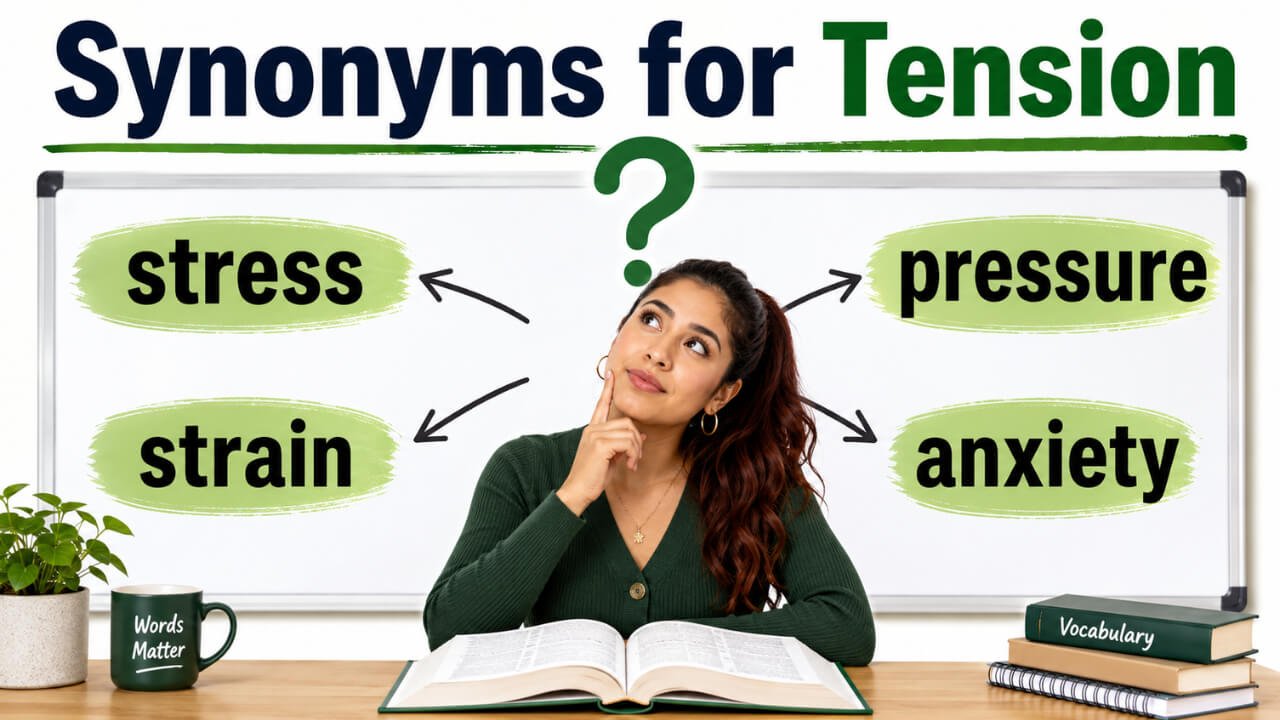
Quick Answer: The best synonyms for tension are stress, strain, anxiety, pressure, unease, suspense, friction, conflict, tightness, and tautness. Use stress or anxiety for emotional discomfort, strain for mental or physical pressure, friction or conflict for troubled relationships, suspense for uncertainty in a story, tightness for muscles, and tautness for something stretched firmly. The exact keyword synonyms for tension covers several meanings, so the most accurate replacement depends on whether you are describing feelings, relationships, physical discomfort, dramatic anticipation, or technical force.
Pronunciation and Word Details
Word: Tension.
Pronunciation: /ˈten.ʃən/
Part of Speech: Noun.
Meaning: A feeling, condition, or force involving mental pressure, conflict, tightness, suspense, or stretching.
US Pronunciation:
UK Pronunciation:
What Does “Tension” Mean?
Tension means a state of mental pressure, emotional unease, conflict, physical tightness, suspense, or pulling force.
As a noun, tension can describe how a person feels when worried or uncomfortable. It can also refer to disagreement between people, groups, or communities. In stories and films, tension is the suspense that makes an audience wonder what will happen next.
The word also has physical and technical meanings. Muscle tension describes tight or contracted muscles, while tension in a rope, cable, or material refers to the pulling force acting through it.
The sentence context usually reveals which meaning is intended.
Emotional Context: She felt tension before speaking to the large audience.
Relationship Context: Tension developed between the two colleagues.
Story Context: The unexpected sound increased the tension in the scene.
Physical Context: Stretching helped reduce the tension in his shoulders.
Technical Context: The cable must maintain enough tension to remain secure.
Meaning, Tone, and Context of “Tension”
Tension is generally a neutral word, but it often describes an uncomfortable, serious, or emotionally charged situation. It is suitable for formal writing, academic discussion, professional communication, news style reporting, technical explanation, and everyday conversation.
When tension refers to emotions, its tone is usually negative. It suggests stress, nervousness, or difficulty relaxing.
When it describes relationships, the word suggests disagreement, distrust, hostility, or unresolved problems. It may describe mild discomfort between two people or serious conflict between larger groups.
In creative writing, tension can have a positive function. Writers create tension to hold the reader’s attention and build anticipation.
In physical or scientific contexts, tension is technical and neutral. It describes tight muscles or a pulling force within a rope, cable, surface, or material.
When and How to Use “Tension”
For Emotional Strain: Use tension when someone feels nervous, worried, pressured, or unable to relax.
Example: There was noticeable tension in her voice before the interview.
For Relationship Conflict: Use tension when people are uncomfortable with one another because of disagreement, resentment, or mistrust.
Example: Tension between the neighbors increased after the argument.
For Suspense: Use tension when a story, scene, or situation creates uncertainty and anticipation.
Example: The slow footsteps created tension before the door opened.
For Physical Tightness: Use tension when muscles feel tight, stiff, or contracted.
Example: Gentle movement helped relieve the tension in his neck.
For Technical Force: Use tension for the pulling force within a rope, wire, cable, or similar object.
Example: The engineer checked the tension in the supporting cable.
For Social Discomfort: Use tension when an atmosphere feels awkward, uneasy, or emotionally charged.
Example: Everyone noticed the tension during the meeting.
For Serious Disagreement: Use tension when conflict exists but has not yet become open confrontation.
Example: Political tension continued to affect negotiations.
Best Synonyms for Tension
Stress
Stress: Mental or emotional pressure caused by demanding circumstances.
Example: Work related stress made it difficult for him to sleep.
Strain
Strain: Pressure, difficulty, or excessive demand affecting the mind, body, or a relationship.
Example: Financial problems placed strain on the family.
Anxiety
Anxiety: A feeling of worry, nervousness, or fear about an uncertain outcome.
Example: Her anxiety increased as the examination approached.
Pressure
Pressure: A demanding influence that causes stress, urgency, or discomfort.
Example: He felt pressure to complete the report before noon.
Unease
Unease: A mild feeling of worry, discomfort, or uncertainty.
Example: A sense of unease spread through the room.
Suspense
Suspense: Excited or nervous uncertainty about what will happen next.
Example: The final chapter was filled with suspense.
Friction
Friction: Disagreement or irritation between people or groups.
Example: Different working styles caused friction within the team.
Conflict
Conflict: Serious disagreement, opposition, or struggle.
Example: The decision created conflict between the two departments.
Tightness
Tightness: A physically tense, firm, or restricted condition.
Example: She experienced tightness across her shoulders.
Tautness
Tautness: The condition of being stretched tightly without slack.
Example: The tautness of the rope kept the structure stable.
50 Synonyms for Tension with Short Meanings
- Stress: Mental or emotional pressure.
- Strain: Excessive demand or difficulty.
- Anxiety: Worry about an uncertain outcome.
- Pressure: A demanding or stressful influence.
- Unease: Mild worry or discomfort.
- Nervousness: An unsettled or worried feeling.
- Apprehension: Anxiety about something that may happen.
- Worry: Concern about a problem or possibility.
- Agitation: A disturbed or restless emotional state.
- Distress: Severe emotional discomfort or suffering.
- Restlessness: Difficulty remaining calm or relaxed.
- Discomfort: Physical or emotional uneasiness.
- Fear: An emotional response to danger or threat.
- Dread: Strong fear about a future event.
- Suspense: Uncertainty that creates anticipation.
- Anticipation: Expectation of something about to happen.
- Uncertainty: Lack of confidence about an outcome.
- Excitement: Strong emotional energy or expectation.
- Intensity: A powerful or concentrated emotional quality.
- Drama: Emotional excitement created by conflict or uncertainty.
- Friction: Irritation or disagreement between people.
- Conflict: Serious opposition or disagreement.
- Hostility: Unfriendly or aggressive feeling.
- Discord: Lack of agreement or harmony.
- Disagreement: A difference in opinion or position.
- Rivalry: Competition that creates strained relations.
- Antagonism: Active dislike or opposition.
- Resentment: Anger caused by unfair treatment or insult.
- Distrust: Lack of confidence in someone’s honesty or intentions.
- Opposition: Resistance to an idea, person, or action.
- Tightness: A firm or restricted physical feeling.
- Stiffness: Difficulty moving because of tightness.
- Tautness: The condition of being stretched firmly.
- Rigidity: A stiff condition that resists movement.
- Contraction: The tightening or shortening of muscles.
- Constriction: A narrowing or tightening condition.
- Pull: A force that draws something toward a direction.
- Force: Physical energy acting on an object.
- Load: Weight or force carried by a structure.
- Traction: Pulling force or firm gripping action.
- Emotional Strain: Mental pressure caused by difficult feelings.
- Mental Pressure: Psychological demand or emotional burden.
- Nervous Strain: Stress connected with worry or fear.
- Strained Relations: An uncomfortable relationship affected by conflict.
- Uneasy Atmosphere: A setting filled with discomfort or uncertainty.
- Mounting Pressure: Stress or urgency that continues to increase.
- Dramatic Suspense: Uncertainty designed to hold attention.
- Muscular Tightness: Firmness or contraction within the muscles.
- Surface Force: A pulling effect acting across a surface.
- Tensile Stress: Internal pulling force within a material.
Read Also:
Synonyms for Weak

Synonyms for Tension by Context
When Tension Means Emotional Strain
Tension often describes the mental pressure a person experiences during a difficult, uncertain, or demanding situation.
Useful synonyms include stress, anxiety, strain, pressure, nervousness, apprehension, worry, agitation, and unease.
Example With Tension: She felt tension while waiting for the results.
Example With Anxiety: She felt anxiety while waiting for the results.
Example With Unease: She felt a growing sense of unease while waiting for the results.
Use stress when the feeling comes from demands or responsibilities. Use anxiety when worry or fear is the main emotion. Use unease for a milder and less specific feeling of discomfort.
When Tension Means Conflict
Tension can describe troubled relationships, disagreement, or hostility between people or groups.
Useful synonyms include friction, conflict, discord, hostility, rivalry, antagonism, resentment, opposition, and strained relations.
Example With Tension: Tension developed between the two managers.
Example With Friction: Friction developed between the two managers.
Example With Conflict: Conflict developed between the two managers.
Friction usually suggests repeated irritation. Conflict is stronger and may involve open disagreement. Discord describes a lack of harmony, while hostility suggests active unfriendliness.
When Tension Means Suspense
In storytelling, tension is the uncertainty or anticipation that keeps the audience interested.
Useful synonyms include suspense, anticipation, uncertainty, excitement, intensity, and drama.
Example With Tension: The silence added tension to the final scene.
Example With Suspense: The silence added suspense to the final scene.
Example With Intensity: The silence added intensity to the final scene.
Suspense is usually the clearest replacement when the audience is waiting to discover what happens. Intensity is better when the scene feels emotionally powerful rather than uncertain.
When Tension Means Physical Tightness
Tension may refer to muscles that are tight, stiff, or difficult to relax.
Useful synonyms include tightness, stiffness, contraction, constriction, rigidity, and muscular strain.
Example With Tension: She noticed tension in her lower back.
Example With Tightness: She noticed tightness in her lower back.
Example With Stiffness: She noticed stiffness in her lower back.
Tightness is the most natural everyday replacement. Stiffness emphasizes reduced movement, while contraction describes the physical shortening or tightening of muscle tissue.
When Tension Means Technical Force
In engineering and physics, tension is a pulling force transmitted through a rope, wire, cable, chain, or material.
Useful alternatives include pull, force, load, tensile stress, traction, and surface force.
Example With Tension: The cable is under considerable tension.
Example With Pulling Force: The cable is under considerable pulling force.
Example With Tensile Stress: The material is experiencing tensile stress.
Tension is often the most technically accurate term. Tensile stress is more specific when discussing force distributed within a material.
Another Word for Tension
Strain is one of the best general replacements for tension because it can describe emotional pressure, physical difficulty, or stress within a relationship. However, the best alternative still depends on the intended meaning.
Use anxiety for worried feelings, friction for relationship problems, suspense for storytelling, tightness for muscles, and tensile force for technical contexts.
Original: She could feel the tension before the presentation.
Better Option: She could feel the anxiety before the presentation.
Original: Tension between the partners affected the project.
Better Option: Friction between the partners affected the project.
Original: The writer increased the tension near the ending.
Better Option: The writer increased the suspense near the ending.
Original: Exercise helped reduce the tension in his legs.
Better Option: Exercise helped reduce the tightness in his legs.
When Not to Use “Tension”
Tension can become vague when a more specific word would explain the situation better. Avoid using it repeatedly when you can identify the exact type of feeling, disagreement, physical condition, or force.
Do not use tension for every form of sadness, anger, fear, or conflict. These emotions have different meanings and should not be treated as interchangeable.
Use anxiety when worry is central, conflict when disagreement is open, suspense when describing a story, and tightness when discussing muscles.
Weak: She felt tension about what might happen tomorrow.
Better: She felt anxiety about what might happen tomorrow.
Weak: The two groups entered a period of tension and began arguing openly.
Better: The two groups entered a period of conflict and began arguing openly.
Weak: The mystery story contained a lot of tension.
Better: The mystery story contained a great deal of suspense.
Weak: He visited a therapist because of tension in his shoulder muscles.
Better: He visited a therapist because of tightness in his shoulder muscles.
Weak: The material broke because it experienced some tension.
Better: The material broke because the tensile stress exceeded its limit.
Words Commonly Confused With Tension
Tension vs Stress: Tension is a broad condition involving emotional strain, conflict, tightness, suspense, or force. Stress usually refers to pressure affecting the mind, body, or material.
Tension vs Anxiety: Tension may describe general nervous discomfort, while anxiety involves worry, fear, or concern about possible outcomes.
Tension vs Pressure: Pressure is an external demand or influence. Tension is often the internal feeling or strained condition that pressure creates.
Tension vs Suspense: Tension can describe many forms of strain. Suspense specifically describes uncertain anticipation about what will happen next.
Tension vs Conflict: Tension may exist before people openly argue. Conflict usually involves visible disagreement, opposition, or struggle.
Tension vs Strain: Both words can describe pressure or difficulty. Strain often emphasizes excessive demand, while tension emphasizes tightness, unease, or opposing forces.
Tension vs Tightness: Tension may be emotional, social, physical, or technical. Tightness mainly refers to a restricted or firmly contracted physical condition.
Tension vs Hostility: Tension suggests discomfort or troubled relations. Hostility is stronger and includes active dislike, aggression, or unfriendliness.
Which Synonym Should You Choose?
Choose stress when demands, responsibilities, or difficult circumstances cause emotional pressure.
Choose strain when pressure affects a person, body, relationship, or system over time.
Choose anxiety when someone feels worried, fearful, or uncertain about a future result.
Choose pressure when an outside demand, deadline, expectation, or responsibility causes discomfort.
Choose unease when the discomfort is mild, uncertain, or difficult to explain.
Choose friction when repeated irritation or differences create problems between people.
Choose conflict when disagreement becomes serious, visible, or direct.
Choose hostility when people or groups show strong dislike or aggression.
Choose suspense when describing uncertainty in a story, scene, mystery, or dramatic situation.
Choose intensity when a moment feels emotionally powerful but not necessarily uncertain.
Choose tightness when referring to muscles, restricted movement, or a firm physical sensation.
Choose tautness when describing a rope, wire, fabric, or surface that is stretched firmly.
Choose tensile stress in technical reports about materials under pulling force.
For essays and formal reports, strain, anxiety, conflict, suspense, and tensile stress provide greater precision.
For professional emails, pressure, concern, disagreement, or strained relations may sound clearer than tension.
For casual conversation, stress, worry, awkwardness, and tightness are often more natural.
Real Life Examples of “Tension” in Sentences
Original: Tension filled the room before the results were announced.
Better Option: Unease filled the room before the results were announced.
Original: She experienced tension during the difficult interview.
Better Option: She experienced anxiety during the difficult interview.
Original: Financial tension affected the entire household.
Better Option: Financial pressure affected the entire household.
Original: Tension between the coworkers had become obvious.
Better Option: Friction between the coworkers had become obvious.
Original: Years of tension led to an open argument.
Better Option: Years of conflict led to an open argument.
Original: The director created tension through long periods of silence.
Better Option: The director created suspense through long periods of silence.
Original: He felt tension across his upper back.
Better Option: He felt tightness across his upper back.
Original: The rope lost tension after the knot became loose.
Better Option: The rope lost tautness after the knot became loose.
Original: International tension weakened the negotiations.
Better Option: International hostility weakened the negotiations.
Original: The final pages were filled with tension.
Better Option: The final pages were filled with dramatic suspense.
Synonym Groups and Usage Differences
Emotional Strain Group
Stress, anxiety, pressure, nervousness, apprehension, worry, agitation, and unease describe uncomfortable mental or emotional states.
Stress is linked to demands. Anxiety focuses on worry or fear. Nervousness is often temporary, while apprehension involves concern about something expected.
Example: Her apprehension increased as the meeting approached.
Conflict Group
Friction, conflict, discord, hostility, rivalry, antagonism, resentment, and opposition describe tension between people or groups.
Friction suggests ongoing irritation. Discord means a lack of harmony. Hostility and antagonism are stronger because they involve active opposition or dislike.
Example: Continued friction made cooperation difficult.
Suspense Group
Suspense, anticipation, uncertainty, excitement, intensity, and drama describe the emotional energy created by an unknown outcome.
Suspense is strongest when the audience is waiting for an answer. Anticipation may be positive or negative. Intensity describes emotional strength.
Example: The unanswered question created suspense.
Physical Tightness Group
Tightness, stiffness, rigidity, contraction, constriction, and muscular strain describe restricted or firm physical conditions.
Tightness is broad and natural. Stiffness suggests difficulty moving. Constriction emphasizes narrowing, while contraction describes tightening within muscles.
Example: Gentle stretching reduced the stiffness in her neck.
Technical Force Group
Pull, force, load, traction, tensile stress, and surface force describe physical effects related to stretching or pulling.
Pull and force are general terms. Load describes force carried by a structure. Tensile stress describes internal force within a stretched material.
Example: The support must withstand the tensile stress.
Antonyms of Tension
The opposite of tension depends on whether the word describes emotions, relationships, physical tightness, suspense, or technical force.
Calm: A peaceful state without worry or agitation.
Relaxation: Freedom from mental or physical strain.
Ease: A comfortable condition without difficulty or pressure.
Peace: A condition without conflict or disturbance.
Harmony: Agreement and balanced relations between people.
Agreement: A shared opinion or accepted decision.
Trust: Confidence in another person’s honesty or intentions.
Comfort: A state of physical or emotional well being.
Certainty: Confidence about what is true or likely to happen.
Looseness: A condition without firmness or tightness.
Slackness: Lack of tension in a rope, cable, or material.
Flexibility: The ability to bend or move without stiffness.
Release: The reduction or removal of pressure or tightness.
Resolution: The successful settlement of a disagreement or problem.
Comparison: Tension vs Related Words
Tension vs Stress
Tension is broader than stress. It may refer to emotional unease, conflict, suspense, muscle tightness, or pulling force. Stress mainly refers to pressure placed on a person, relationship, object, or system.
Example With Tension: Tension grew between the two team members.
Example With Stress: Long working hours caused significant stress.
Tension vs Anxiety
Tension is a condition of nervous strain or discomfort. Anxiety is a more specific feeling of worry, fear, or concern about what may happen.
Example With Tension: She noticed tension in the room.
Example With Anxiety: She felt anxiety about the medical examination.
Tension vs Pressure
Pressure usually comes from an external demand, expectation, deadline, or force. Tension often describes the emotional or physical condition created by that pressure.
Example With Tension: The tension became difficult to ignore.
Example With Pressure: The deadline placed pressure on the entire team.
Tension vs Suspense
Tension can occur in emotions, relationships, bodies, stories, and materials. Suspense is limited to anticipation and uncertainty about an outcome.
Example With Tension: Tension increased as the discussion became more serious.
Example With Suspense: Suspense increased as the character approached the locked room.
Tension vs Conflict
Tension may involve silent discomfort or unresolved disagreement. Conflict is more direct and often includes argument, resistance, or confrontation.
Example With Tension: There was tension between the two departments.
Example With Conflict: The disagreement developed into open conflict.
Tension vs Strain
Tension emphasizes tightness, unease, or opposing forces. Strain emphasizes excessive pressure, effort, or demand placed on someone or something.
Example With Tension: She felt tension in her shoulders.
Example With Strain: Lifting the heavy box caused muscle strain.
Common Phrases and Expressions With “Tension”
Build Tension: Gradually create suspense, pressure, or discomfort.
Ease Tension: Make an uncomfortable situation less serious or stressful.
Relieve Tension: Reduce emotional pressure or physical tightness.
Release Tension: Allow stress, tightness, or stored force to decrease.
Create Tension: Produce conflict, suspense, discomfort, or pressure.
Rising Tension: A strained condition that is becoming more serious.
Mounting Tension: Pressure or conflict that continues to increase.
Nervous Tension: Emotional strain connected with worry or fear.
Muscle Tension: Tightness or contraction within the muscles.
Surface Tension: The force that causes the surface of a liquid to behave like a stretched layer.
Common Mistakes to Avoid
Repeating Tension Too Often: Using the same word several times can make a paragraph sound vague or monotonous. Replace it with a precise alternative when the meaning changes.
Wrong: The tension caused tension between the workers, and the tension became worse.
Better: The pressure caused friction between the workers, and the conflict became worse.
Choosing an Overly Strong Synonym: Hostility and conflict are stronger than mild tension. Do not use them when the situation only feels slightly awkward.
Wrong: Hostility filled the room during the quiet discussion.
Better: Unease filled the room during the quiet discussion.
Confusing Tension With Anxiety: Anxiety is an emotion, while tension may also describe relationships, stories, muscles, and physical forces.
Wrong: The cable was under severe anxiety.
Better: The cable was under severe tension.
Using Suspense Outside Story Contexts: Suspense relates to uncertainty about an outcome. It does not usually replace emotional stress or muscle tightness.
Wrong: He felt suspense in his shoulders after exercise.
Better: He felt tightness in his shoulders after exercise.
Using Tension Vaguely: Explain what kind of tension is present when the context is not obvious.
Vague: The situation caused tension.
Clear: The delayed decision caused anxiety among the employees.
Ignoring Technical Accuracy: In scientific writing, general alternatives such as worry or pressure may not communicate the correct force.
Wrong: The rope was carrying emotional strain.
Better: The rope was under tension.
Conclusion
The keyword synonyms for tension includes words for emotional pressure, conflict, suspense, physical tightness, and technical force. Stress, strain, anxiety, pressure, and unease work well for difficult feelings. Friction, discord, hostility, and conflict describe troubled relationships. Suspense and anticipation fit stories, while tightness and stiffness describe the body. Tautness and tensile stress are useful in physical or technical contexts. Choosing the synonym that matches the exact meaning makes every sentence clearer, more natural, and more precise.
FAQs About Synonyms for Tension
What Is the Best Synonym for Tension?
Strain is one of the most flexible alternatives. Stress, anxiety, conflict, suspense, and tightness may be better in more specific contexts.
What Is a Formal Synonym for Tension?
Strain, pressure, friction, conflict, apprehension, and tensile stress are suitable formal alternatives, depending on the intended meaning.
What Is Another Word for Emotional Tension?
Stress, anxiety, nervousness, unease, apprehension, and emotional strain can describe emotional tension.
What Is Another Word for Tension Between People?
Friction, conflict, discord, hostility, antagonism, and strained relations describe tension between people or groups.
What Is a Synonym for Tension in a Story?
Suspense is usually the best synonym. Anticipation, uncertainty, intensity, and drama may also fit certain scenes.
What Is a Synonym for Physical Tension?
Tightness, stiffness, contraction, constriction, and muscular strain are useful alternatives for physical tension.
Are Stress and Tension the Same?
They overlap, but they are not always identical. Stress usually describes pressure or demand, while tension can also refer to conflict, suspense, tight muscles, or pulling force.
