
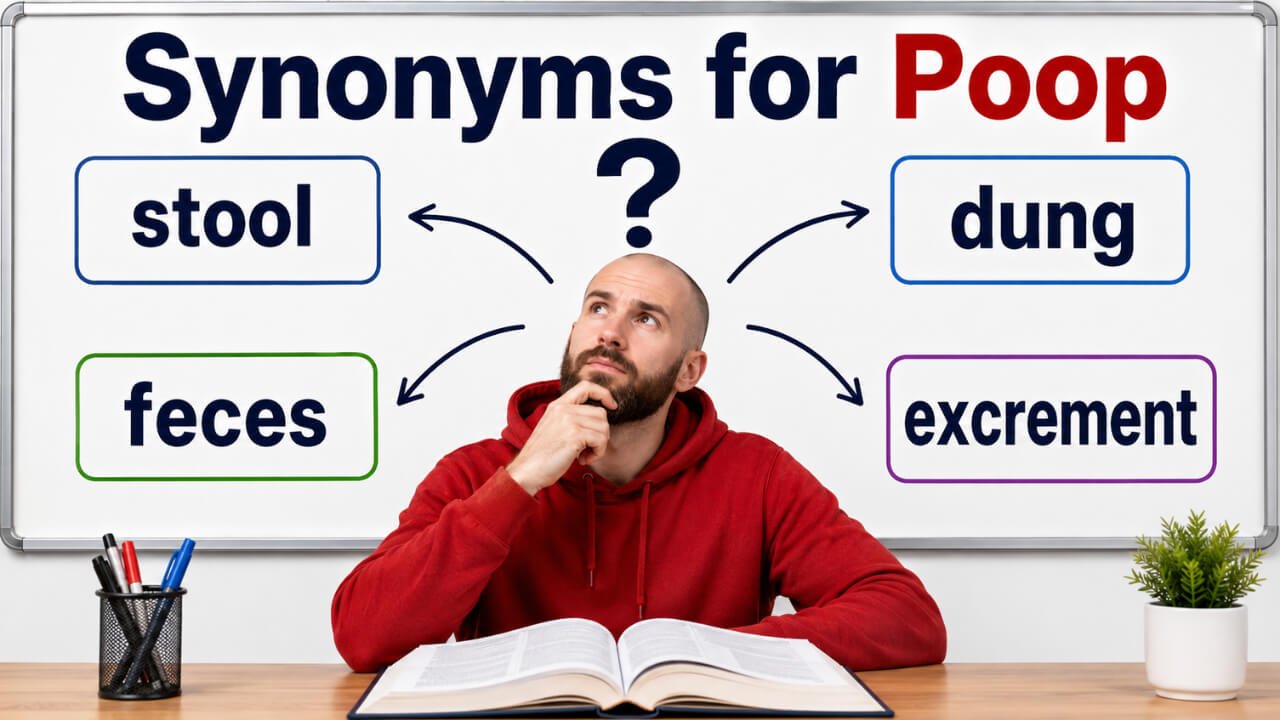
Quick Answer: The best synonyms for poop are stool, feces, bowel movement, excrement, waste, droppings, dung, manure, scat, and number two. Use stool in polite or medical communication, feces in scientific writing, bowel movement for the act of passing waste, excrement as a formal general term, droppings or scat for animal waste, and number two in casual or child friendly conversation. Because synonyms for poop vary greatly in tone, choose a word that matches the audience, setting, and intended meaning.
Pronunciation and Word Details
Word: Poop.
Pronunciation: /puːp/
Part of Speech: Noun and verb.
Meaning: As a noun, poop means solid waste removed from the body, while as a verb, it means to pass that waste.
US Pronunciation:
UK Pronunciation:
What Does “Poop” Mean?
Poop means solid waste that leaves the body through the bowels.
The word can function as both a noun and a verb. As a noun, it refers to the waste itself. As a verb, it describes the act of passing solid waste.
Noun Example: The dog left poop near the garden gate.
Verb Example: The child said that he needed to poop.
Poop is an informal and conversational word. Adults often use it when speaking with children, discussing pets, making jokes, or talking casually about digestion. In medical, academic, or scientific writing, terms such as stool, feces, bowel movement, or excrement are usually more suitable.
The intended meaning also changes according to context. Baby poop may be discussed when talking about infant care. Dog poop refers to pet waste, while animal droppings, manure, dung, and scat describe waste from particular animals or settings.
Meaning, Tone, and Context of “Poop”
Poop is an informal word with a direct but usually mild tone. It is less formal than stool, feces, excrement, or bowel movement, but it is generally less offensive than stronger slang terms.
The word is common in everyday conversation, especially when people discuss children, pets, toilet training, digestion, or humorous situations. It can sound childish in serious professional writing, so the audience and purpose should guide the word choice.
In family conversation, poop often sounds natural and easy to understand. A parent may ask whether a young child needs to poop. A pet owner may talk about cleaning up dog poop. These uses are casual and familiar.
In healthcare communication, stool or bowel movement often sounds more precise and respectful. Feces and fecal matter are more technical and are common in scientific explanations.
In farming and animal care, dung, manure, droppings, and animal waste may be more accurate. In wildlife study, scat is often the preferred term.
Some slang alternatives are crude or vulgar. They may appear in casual speech, but they are unsuitable for polite, academic, medical, or professional communication.
When and How to Use “Poop”
For Everyday Conversation: Use poop when speaking casually about bodily waste without needing a formal or technical term.
Example: I need to clean the cat poop from the litter area.
For Child Friendly Communication: Use poop when explaining toilet habits to a young child in simple language.
Example: Tell me when you need to poop.
For Pet Care: Use poop when discussing waste removal, house training, or cleaning after an animal.
Example: Please pick up the dog poop from the lawn.
For Informal Health Discussion: Use poop when discussing digestion casually with family or close friends.
Example: Certain foods can change the color of your poop.
For Humor: Poop may appear in light jokes or playful conversation because it sounds less harsh than vulgar slang.
Example: The children laughed at the silly poop joke.
For Medical Communication: Replace poop with stool or bowel movement when clarity and professionalism are important.
Example: The patient reported an unusual change in stool consistency.
For Scientific Writing: Use feces, fecal matter, excrement, or waste instead of poop.
Example: The researchers examined the animal feces.
For Animal Identification: Choose droppings, dung, scat, guano, or pellets according to the animal and setting.
Example: The ranger identified deer scat beside the trail.
Best Synonyms for Poop
Stool
Synonym: Solid waste passed from the digestive system.
Example: The nurse asked whether the patient had noticed blood in the stool.
Feces
Synonym: A formal or scientific word for solid bodily waste.
Example: The laboratory received a sample of animal feces for examination.
Bowel Movement
Synonym: The act or result of passing solid waste from the body.
Example: He had a normal bowel movement after breakfast.
Excrement
Synonym: Waste matter discharged from a person or animal.
Example: Animal excrement should be removed from the walkway.
Waste
Synonym: Unwanted matter removed from the body.
Example: The digestive system helps the body eliminate waste.
Droppings
Synonym: Small pieces of solid waste left by animals.
Example: Bird droppings covered part of the outdoor bench.
Dung
Synonym: Solid waste produced by large animals.
Example: The farmer cleared the cattle dung from the enclosure.
Manure
Synonym: Animal waste, often collected or used to improve soil.
Example: The gardener added well prepared manure to the soil.
Scat
Synonym: Animal feces, especially when examined or identified outdoors.
Example: The tracks and scat showed that a fox had passed nearby.
Number Two
Synonym: A polite and informal expression for a bowel movement.
Example: The child said that she needed to go number two.
50 Synonyms for Poop with Short Meanings
- Stool: A polite or medical word for solid bodily waste.
- Feces: A formal and scientific term for solid waste.
- Excrement: Waste discharged from a person or animal.
- Bowel Movement: The act or result of passing solid waste.
- Waste: Unwanted matter removed from the body.
- Solid Waste: Firm waste produced by digestion.
- Bodily Waste: Unwanted material discharged from the body.
- Human Waste: Waste matter produced by people.
- Fecal Matter: Solid digestive waste described formally.
- Fecal Waste: Waste consisting of feces.
- Intestinal Waste: Waste material passing through the intestines.
- Digestive Waste: Material remaining after digestion.
- Excreta: Waste matter discharged from the body.
- Droppings: Small pieces of animal waste.
- Animal Waste: Waste matter produced by animals.
- Pet Waste: Feces left by a domestic animal.
- Dung: Solid waste from large animals.
- Manure: Animal waste collected or used for soil.
- Scat: Animal feces found in outdoor environments.
- Guano: Waste produced by bats or seabirds.
- Frass: Waste produced by insects.
- Pellets: Small rounded pieces of animal waste.
- Rabbit Pellets: Small firm droppings produced by rabbits.
- Bird Droppings: Waste left by birds.
- Dog Mess: An informal term for dog waste.
- Cowpat: A flat pile of cow dung.
- Cow Pie: An informal expression for cow dung.
- Buffalo Chip: A dried piece of buffalo dung.
- Horse Apples: An informal term for horse droppings.
- Muck: Dirt or waste, especially around farm animals.
- Ordure: A formal and old fashioned term for excrement.
- Night Soil: Human waste historically collected for disposal or agricultural use.
- Coprolite: Fossilized animal feces.
- Meconium: The first stool passed by a newborn baby.
- Number Two: A polite casual expression for passing stool.
- Poo: A mild informal term for poop.
- Doo Doo: A childish expression for bodily waste.
- Poopoo: A playful or child friendly version of poop.
- Caca: A childish or informal word for feces.
- Doodie: A playful informal term for poop.
- Dookie: A slang term for feces.
- Turd: A rude or blunt word for a piece of feces.
- Crap: An informal and sometimes impolite term for feces.
- Shit: A vulgar term for feces.
- Mess: A polite vague term for waste that needs cleaning.
- Deposit: A humorous indirect term for waste left somewhere.
- Motion: A formal expression for a bowel movement in some contexts.
- Evacuation: The act of emptying waste from the bowels.
- Defecation: The formal term for passing feces.
- Elimination: The process of removing bodily waste.
Read Also:
Synonyms for Tension

Synonyms for Poop by Context
When Poop Means Stool in Medical Communication
Stool is usually the clearest polite alternative when discussing health, digestion, symptoms, or medical testing. Feces, fecal matter, bowel movement, and excrement are also useful, but their tone and meaning differ.
Example With Poop: The patient noticed a change in her poop.
Example With Stool: The patient noticed a change in her stool.
Example With Bowel Movement: The patient noticed a change in her bowel movements.
Stool refers to the waste itself. Bowel movement may describe the event, frequency, or result of passing waste. Feces sounds more scientific and is common when discussing samples, organisms, or biological processes.
When Poop Means the Act of Passing Waste
When poop is used as a verb, useful alternatives include defecate, pass stool, have a bowel movement, relieve oneself, eliminate waste, and use the toilet.
Example With Poop: The dog needs to poop before we leave.
Example With Defecate: The animal needs to defecate before transport.
Example With Have a Bowel Movement: The child needs to have a bowel movement.
Defecate is formal and clinical. Have a bowel movement sounds polite and neutral. Relieve oneself is indirect and may refer to urination or defecation, so it is less specific.
When Poop Refers to Animal Waste
Droppings, dung, manure, scat, guano, frass, and pellets are more specific alternatives for animal poop.
Example With Poop: We found animal poop beside the path.
Example With Scat: We found animal scat beside the path.
Example With Droppings: We found animal droppings beside the path.
Use scat when identifying wildlife waste outdoors. Droppings is a broad term for waste from birds and smaller animals. Dung is common for larger animals. Manure often refers to animal waste collected for agricultural use.
When Poop Is Used in Child Friendly Speech
Poo, doo doo, poopoo, caca, doodie, and number two are mild expressions often used with young children.
Example With Poop: Do you need to poop?
Example With Number Two: Do you need to go number two?
Example With Poo: Do you need to do a poo?
These words may be appropriate at home or during toilet training, but they can sound childish in professional or academic communication.
When Poop Is Used as Slang
Crap, turd, dookie, and shit are slang alternatives. Their level of politeness varies greatly.
Example With Poop: There was poop on the floor.
Example With Crap: There was crap on the floor.
Example With Turd: There was a turd on the floor.
Crap and turd sound crude or impolite. Shit is vulgar and should be avoided in formal, respectful, workplace, academic, or family friendly writing.
When Poop Means Waste in Formal Writing
Excrement, excreta, human waste, bodily waste, fecal matter, and solid waste may be suitable in reports, sanitation guidance, environmental writing, or formal explanations.
Example With Poop: Improper disposal of poop can create sanitation problems.
Example With Human Waste: Improper disposal of human waste can create sanitation problems.
Example With Excreta: Improper disposal of excreta can create sanitation problems.
Human waste is clear when referring specifically to people. Excreta may include more than solid waste, while fecal matter refers directly to feces.
Another Word for Poop
Stool is usually the best single replacement for poop when you need a polite, clear, and neutral word. It works well in health discussions, educational content, and respectful conversation.
However, the best alternative depends on context. Feces is more scientific, bowel movement describes the act or event, droppings refers to animals, and number two suits casual speech.
Original: The doctor asked about the color of his poop.
Better Option: The doctor asked about the color of his stool.
Original: The baby had not pooped since yesterday.
Better Option: The baby had not had a bowel movement since yesterday.
Original: We found poop from a wild animal near the trees.
Better Option: We found animal scat near the trees.
Original: Please clean the horse poop from the stable.
Better Option: Please clean the horse dung from the stable.
When Not to Use “Poop”
Poop may sound too casual, childish, vague, or humorous in medical, academic, scientific, legal, environmental, and professional writing. A more precise alternative often improves clarity.
Do not use poop when the type of waste, action, or animal matters. Choose stool for health communication, feces for science, bowel movement for the act, manure for agricultural use, and scat for wildlife identification.
Avoid replacing poop with vulgar slang when the audience expects respectful language.
Weak: The laboratory tested the poop for bacteria.
Better: The laboratory tested the fecal sample for bacteria.
Weak: The report explains how poop affects water quality.
Better: The report explains how human waste affects water quality.
Weak: The patient had trouble pooping.
Better: The patient had difficulty passing stool.
Weak: Researchers discovered ancient poop in the cave.
Better: Researchers discovered fossilized feces in the cave.
Weak: The farmer spread poop across the field.
Better: The farmer spread manure across the field.
Words Commonly Confused With Poop
Poop vs Stool: Poop is informal, while stool is neutral and commonly used in health related communication. Stool can also mean a simple seat, so context determines the meaning.
Poop vs Feces: Poop is conversational. Feces is formal, scientific, and usually treated as a mass noun rather than a countable item.
Poop vs Bowel Movement: Poop usually refers to the waste or the act of passing it. Bowel movement primarily describes the event or process.
Poop vs Excrement: Excrement is a formal general term for bodily waste. Depending on context, it may refer to waste from people or animals.
Poop vs Manure: Manure usually means animal waste collected, processed, or used to improve soil. Not every example of animal poop is being used as manure.
Poop vs Dung: Dung usually refers to waste from larger animals such as cattle, horses, or elephants. Poop is broader and more informal.
Poop vs Droppings: Droppings are pieces of animal waste, especially from birds or smaller animals. Poop may refer to either human or animal waste.
Poop vs Diarrhea: Poop is solid bodily waste in general. Diarrhea is a condition involving frequent loose or watery stools, so it is not a direct synonym.
Poop vs Sewage: Sewage is liquid and solid waste carried through a drainage system. It includes more than poop and should not be used as an exact replacement.
Poop vs Defecation: Poop can name the waste or the action. Defecation refers specifically to the bodily process of passing feces.
Which Synonym Should You Choose?
Choose stool when writing politely about digestion, symptoms, color, consistency, or medical care.
Choose feces when writing scientific, biological, laboratory, or academic content.
Choose bowel movement when discussing how often someone passes waste or whether the process was normal.
Choose excrement when you need a formal general term for waste from a person or animal.
Choose human waste when discussing sanitation, disposal, contamination, or environmental health.
Choose droppings when referring to waste left by birds, rodents, rabbits, or other small animals.
Choose dung when discussing waste from cattle, horses, elephants, or other large animals.
Choose manure when animal waste has been collected or used in farming and gardening.
Choose scat when discussing wildlife tracking, outdoor identification, or animal behavior.
Choose guano for waste from bats or seabirds.
Choose frass when referring specifically to insect waste.
Choose number two, poo, or doo doo in casual or child friendly speech.
Choose poop in relaxed everyday conversation where a simple informal word is appropriate.
Choose crap or turd only when an intentionally crude tone fits the situation.
Avoid vulgar alternatives in essays, reports, professional emails, educational materials, and respectful conversation.
Real Life Examples of “Poop” in Sentences
Original: The nurse asked whether the child’s poop looked unusual.
Better Option: The nurse asked whether the child’s stool looked unusual.
Original: He had not pooped for two days.
Better Option: He had not had a bowel movement for two days.
Original: The scientist collected bear poop near the river.
Better Option: The scientist collected bear scat near the river.
Original: Bird poop covered the car window.
Better Option: Bird droppings covered the car window.
Original: The farmer removed cow poop from the barn.
Better Option: The farmer removed cow dung from the barn.
Original: The gardener added animal poop to the soil.
Better Option: The gardener added manure to the soil.
Original: Workers disposed of the poop safely.
Better Option: Workers disposed of the human waste safely.
Original: The report described bacteria found in poop.
Better Option: The report described bacteria found in fecal matter.
Original: The dog pooped beside the path.
Better Option: The dog defecated beside the path.
Original: The child said that she needed to poop.
Better Option: The child said that she needed to go number two.
Synonym Groups and Usage Differences
Medical and Neutral Group
Stool, bowel movement, feces, fecal matter, excrement, defecation, and elimination belong to the medical or neutral group.
Stool is usually the most polite and familiar option. Feces and fecal matter sound more scientific. Bowel movement focuses on the event, while defecation names the physical process.
Example: The patient reported a change in stool color.
Everyday and Child Friendly Group
Poop, poo, doo doo, poopoo, caca, doodie, and number two are common in informal or child friendly communication.
Poop and poo are widely understood. Doo doo, poopoo, caca, and doodie sound more childish. Number two is an indirect expression that avoids naming the waste directly.
Example: The parent asked whether the child needed to go number two.
General Waste Group
Waste, solid waste, bodily waste, human waste, digestive waste, excreta, and fecal waste describe poop in broader formal contexts.
Human waste is useful in sanitation discussions. Fecal waste is more specific, while excreta may include different types of bodily waste.
Example: The facility requires safe disposal of human waste.
Animal Waste Group
Droppings, scat, dung, pellets, guano, frass, bird droppings, and animal waste describe waste from animals.
Droppings works for many animals. Scat is useful for wildlife. Dung is common for large animals. Guano and frass refer to specific animal groups.
Example: The guide identified fox scat near the rocks.
Farming Group
Manure, dung, muck, cowpat, cow pie, horse apples, and buffalo chip are associated with farms, grazing animals, or rural environments.
Manure is the most suitable word when animal waste is collected or used for soil. Cow pie and horse apples are informal and humorous.
Example: The farmer stored manure for later use in the fields.
Slang and Vulgar Group
Crap, turd, dookie, and shit are informal alternatives with stronger tones.
Crap and turd can sound rude or crude. Dookie is playful slang. Shit is vulgar and unsuitable for polite or formal writing.
Example: The crude expression was replaced with stool in the final report.
Scientific and Specialized Group
Coprolite, meconium, fecal matter, excreta, guano, and frass are specialized terms.
Coprolite means fossilized feces. Meconium is the first stool of a newborn. Guano refers to bat or seabird waste, while frass refers to insect waste.
Example: The fossilized material was identified as a coprolite.
Antonyms of Poop
Poop has no exact dictionary antonym because it names a substance or bodily action. However, several words express contrasting ideas related to cleanliness, sanitation, waste removal, or the inability to pass stool.
Cleanliness: A condition without dirt or bodily waste.
Hygiene: Practices that maintain personal and environmental cleanliness.
Sanitation: Safe management and removal of waste.
Purity: Freedom from contamination or unwanted material.
Clean Surface: An area without fecal matter or other waste.
Waste Removal: The process of clearing unwanted matter.
Disinfection: Cleaning that reduces harmful contamination.
Constipation: Difficulty passing stool, which contrasts with a normal bowel movement.
Retention: The holding of waste rather than its release.
Continence: Control over bowel movements.
Comparison: Poop vs Related Words
Poop vs Stool
Poop is casual and familiar. Stool is neutral, polite, and more appropriate in medical or educational contexts.
Example With Poop: The child’s poop looked darker than usual.
Example With Stool: The child’s stool looked darker than usual.
Poop vs Feces
Poop is common in everyday conversation. Feces is a scientific and formal term for solid bodily waste.
Example With Poop: The dog left poop near the fence.
Example With Feces: The sample contained traces of animal feces.
Poop vs Bowel Movement
Poop can refer to the substance or the action. Bowel movement usually refers to the event of passing stool.
Example With Poop: The baby pooped after feeding.
Example With Bowel Movement: The baby had a bowel movement after feeding.
Poop vs Excrement
Poop is informal and direct. Excrement is formal and can describe waste from either humans or animals.
Example With Poop: The walkway had animal poop on it.
Example With Excrement: The walkway was contaminated with animal excrement.
Poop vs Droppings
Poop is broad and may refer to humans or animals. Droppings usually refers to separate pieces of waste left by animals.
Example With Poop: There was bird poop on the railing.
Example With Droppings: There were bird droppings on the railing.
Poop vs Dung
Poop is a general informal word. Dung normally refers to waste from larger animals.
Example With Poop: The elephant poop was removed from the enclosure.
Example With Dung: The elephant dung was removed from the enclosure.
Poop vs Manure
Poop simply names bodily waste. Manure refers to animal waste considered as agricultural material or soil enrichment.
Example With Poop: The animals produced a large amount of poop.
Example With Manure: The farmer collected manure for the fields.
Poop vs Diarrhea
Poop refers generally to solid digestive waste. Diarrhea describes loose or watery stool and the condition that causes it.
Example With Poop: The puppy’s poop looked normal.
Example With Diarrhea: The puppy developed diarrhea during the night.
Common Phrases and Expressions With “Poop”
Dog Poop: Waste produced by a dog.
Baby Poop: Stool passed by a baby.
Poop Bag: A bag used to collect pet waste.
Poop Scoop: A tool used to collect animal waste.
Take a Poop: An informal expression meaning to have a bowel movement.
Need to Poop: A casual way to express the need to pass stool.
Go Poop: A simple command or expression often used with children or pets.
Poop Smell: An unpleasant odor caused by fecal waste.
Poop Stain: A mark left by fecal matter.
Poop Joke: A joke involving bodily waste or toilet humor.
Common Mistakes to Avoid
Using Poop in Formal Writing: Poop may sound childish or unprofessional in reports, essays, medical documents, and academic explanations.
Weak: The study examined bacteria in poop.
Better: The study examined bacteria in fecal samples.
Treating Every Alternative as Interchangeable: Stool, bowel movement, manure, scat, and feces describe related ideas but do not fit every sentence.
Wrong: The patient provided a manure sample.
Better: The patient provided a stool sample.
Confusing the Substance With the Action: Feces and stool name the waste, while defecation and bowel movement often describe the process.
Wrong: The doctor asked how many feces he had that day.
Better: The doctor asked how many bowel movements he had that day.
Using Animal Terms for Human Waste: Dung, droppings, guano, and scat normally refer to animals.
Wrong: The patient reported unusual droppings.
Better: The patient reported unusual stool.
Using Manure Too Broadly: Manure is mainly animal waste considered in a farming or gardening context.
Wrong: The dog left manure on the carpet.
Better: The dog left poop on the carpet.
Using Vulgar Words Without Considering Tone: Strong slang may offend readers or make useful information sound disrespectful.
Wrong: The medical guide explains changes in shit color.
Better: The medical guide explains changes in stool color.
Using Feces as a Countable Singular Noun: In formal English, feces is normally treated as a mass noun.
Wrong: The animal left a feces near the tree.
Better: The animal left feces near the tree.
Repeating Poop Too Often: Repetition can make an article sound childish or imprecise. Vary the wording according to context.
Weak: The dog poop was beside more poop, so we cleaned all the poop.
Better: The dog waste was beside several other droppings, so we cleaned the entire area.
Choosing an Unclear Euphemism: Words such as mess or deposit may be too vague when exact meaning matters.
Vague: The nurse examined the mess.
Clear: The nurse examined the stool sample.
Conclusion
The best synonyms for poop depend on tone, audience, and context. Stool is polite and useful for health communication, while feces and fecal matter suit scientific writing. Bowel movement describes the act of passing waste. Droppings, dung, manure, and scat are more accurate for animals. Number two, poo, and doo doo fit casual or child friendly speech. Understanding these differences helps you choose language that is clear, respectful, natural, and appropriate for every situation.
FAQs About Synonyms for Poop
What Is the Best Polite Synonym for Poop?
Stool is usually the best polite synonym. Bowel movement is also suitable when referring to the act of passing waste.
What Is the Medical Word for Poop?
Stool and feces are common medical terms. Stool often sounds more patient friendly, while feces is more scientific.
What Is Another Word for Animal Poop?
Droppings, dung, scat, manure, pellets, and animal waste are useful alternatives. The best choice depends on the animal and context.
Is Bowel Movement the Same as Poop?
They are closely related, but bowel movement usually describes the event of passing stool. Poop can refer to either the waste or the action.
Is Manure a Synonym for Poop?
Manure can mean animal poop, especially when it is collected or used in agriculture. It is not normally used for human waste.
Is Poop a Formal Word?
No. Poop is an informal word used mainly in casual, humorous, pet related, or child friendly conversation.
What Is a Scientific Synonym for Poop?
Feces, fecal matter, excrement, and excreta are scientific or formal alternatives, depending on the exact context.
