
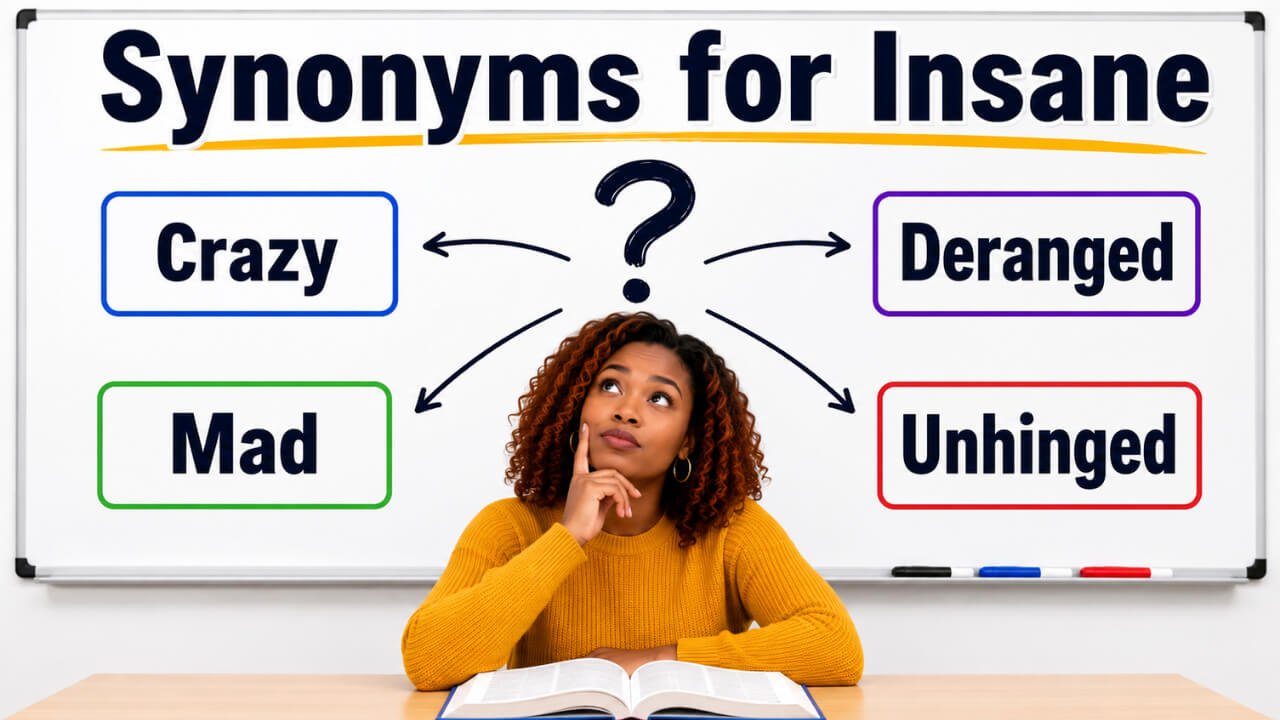
Quick Answer: The best synonyms for insane are irrational, absurd, unreasonable, reckless, extreme, outrageous, chaotic, unbelievable, disturbed, and unstable. Use irrational or unreasonable for decisions that lack sound judgment, absurd for ideas that make little sense, and reckless for dangerous behavior. Extreme and outrageous suit excessive situations, while unbelievable can describe something surprisingly impressive in casual speech. Disturbed and unstable may describe serious emotional or mental difficulty, but careful and respectful language is usually better when discussing a person’s mental health.
Pronunciation and Word Details
Word: Insane
Pronunciation: /ɪnˈseɪn/
Part of Speech: Adjective
Meaning: Extremely unreasonable, shocking, uncontrolled, or affected by serious mental disturbance, depending on the context.
US Pronunciation:
UK Pronunciation:
What Does “Insane” Mean?
Insane means extremely unreasonable, irrational, shocking, uncontrolled, or mentally disturbed. It is an adjective used to describe a person, decision, amount, experience, situation, or level of intensity.
In its traditional meaning, insane referred to someone believed to have a severe mental disorder. This use is now often considered outdated, insensitive, or too vague for respectful mental health communication. More accurate language should be used when describing a real medical or psychological condition.
In everyday conversation, insane frequently acts as an informal intensifier. It may describe something extremely difficult, impressive, expensive, crowded, fast, or surprising.
Irrational Decision: Approving the plan without reviewing the risks seemed insane.
Extreme Amount: The repair bill was insane.
Impressive Performance: Her performance in the final round was insane.
Chaotic Situation: Traffic became insane after the event.
Dangerous Behavior: Driving that quickly in heavy rain was insane.
The intended meaning depends strongly on context. A sentence about an insane price usually means extremely high, while an insane decision means irrational or reckless. An insane performance may mean astonishingly good rather than mentally disturbed.
Meaning, Tone, and Context of “Insane”
Insane is a strong and emotionally charged word. Its tone may be critical, dramatic, informal, exaggerated, or insensitive depending on how it is used.
In casual conversation, insane often means amazing, unbelievable, extreme, or shocking.
Example: The view from the mountain was insane.
In critical writing, it may describe an idea, choice, or behavior that seems irrational or dangerously unreasonable.
Example: Ignoring every safety warning would be insane.
In dramatic descriptions, insane can emphasize speed, pressure, expense, noise, difficulty, or intensity.
Example: The workload became insane near the deadline.
The word is generally unsuitable for formal medical writing because it does not identify a specific condition. It may also offend or stigmatize people experiencing mental health difficulties.
Insensitive: The patient is insane.
Respectful: The patient is experiencing a serious mental health condition.
In essays, reports, professional emails, and academic writing, more precise synonyms such as irrational, unreasonable, extreme, unstable, chaotic, or clinically unwell are usually clearer.
When and How to Use “Insane”
For Irrational Ideas
Use insane informally when an idea seems completely unreasonable or unsupported by logic.
Example: Expecting one employee to finish the entire project overnight is insane.
For Reckless Decisions
Use it when a choice creates obvious and unnecessary danger.
Example: Entering the damaged building without safety equipment would be insane.
For Extreme Amounts
Use insane casually to emphasize an unusually high price, number, speed, workload, or level.
Example: The amount of paperwork required was insane.
For Chaotic Situations
Use it to describe an environment that feels uncontrolled, confusing, or overwhelming.
Example: The station was insane during the evening rush.
For Impressive Results
In informal positive speech, insane can mean amazing, exceptional, or astonishing.
Example: The musician’s final performance was insane.
For Strong Emotional Emphasis
Use it when you want to express shock, disbelief, excitement, or frustration.
Example: It is insane how quickly the weather changed.
For Mental Health References
Avoid using insane as a general description of a person with a mental health condition. Choose respectful and accurate language based on the known situation.
Insensitive: He became insane after the accident.
Better: He experienced serious psychological distress after the accident.
Best Synonyms for Insane
Irrational
Synonym: Not guided by reason, logic, or sound judgment.
Example: Refusing the only practical solution seemed irrational.
Absurd
Synonym: Completely unreasonable, illogical, or impossible to take seriously.
Example: The claim was so absurd that nobody accepted it.
Unreasonable
Synonym: Not fair, sensible, or based on realistic expectations.
Example: The manager placed unreasonable demands on the team.
Reckless
Synonym: Careless about danger or the possible consequences of an action.
Example: His decision to ignore the warning was reckless.
Extreme
Synonym: Far beyond an ordinary or acceptable level.
Example: The region experienced extreme heat throughout the week.
Outrageous
Synonym: Shockingly excessive, unacceptable, or surprising.
Example: The additional fee was outrageous.
Chaotic
Synonym: Completely disorganized, confused, or uncontrolled.
Example: The office became chaotic during the sudden move.
Unbelievable
Synonym: So surprising, impressive, or extreme that it is difficult to believe.
Example: The team produced an unbelievable result.
Disturbed
Synonym: Emotionally troubled or affected by serious distress.
Example: The character appears deeply disturbed by the experience.
Unstable
Synonym: Not steady, predictable, emotionally balanced, or secure.
Example: The situation remained unstable after the sudden change.
50 Synonyms for Insane with Short Meanings
- Irrational: Not based on logic or reason.
- Unreasonable: Not sensible, fair, or realistic.
- Absurd: Completely illogical or ridiculous.
- Nonsensical: Having no clear meaning or good sense.
- Illogical: Not following reasonable thought.
- Senseless: Lacking meaning, purpose, or judgment.
- Ridiculous: Extremely unreasonable or difficult to take seriously.
- Preposterous: Contrary to reason or common sense.
- Ludicrous: So unreasonable that it seems laughable.
- Foolish: Showing poor judgment or little wisdom.
- Reckless: Ignoring danger or possible consequences.
- Rash: Acting too quickly without careful thought.
- Foolhardy: Taking unnecessary and unreasonable risks.
- Impulsive: Acting suddenly without planning.
- Irresponsible: Failing to consider duties or consequences.
- Dangerous: Likely to cause harm or serious problems.
- Risky: Involving a strong possibility of harm or failure.
- Wild: Extreme, uncontrolled, or highly unusual.
- Extreme: Far beyond normal limits.
- Outrageous: Shockingly excessive or unacceptable.
- Unbelievable: Extremely surprising or impressive.
- Astonishing: Causing great surprise.
- Incredible: Exceptionally impressive or difficult to believe.
- Extraordinary: Far beyond what is normal or expected.
- Phenomenal: Remarkably successful or impressive.
- Remarkable: Unusual enough to deserve attention.
- Stunning: Extremely impressive or surprising.
- Overwhelming: Too intense or powerful to manage easily.
- Intense: Extremely strong or concentrated.
- Excessive: Greater than what is reasonable or necessary.
- Chaotic: Completely confused or disorganized.
- Frantic: Wildly anxious, rushed, or uncontrolled.
- Frenzied: Filled with uncontrolled excitement or activity.
- Uncontrolled: Not restrained, directed, or properly managed.
- Unrestrained: Not limited or held back.
- Disorderly: Lacking organization, control, or calm.
- Turbulent: Full of disorder, conflict, or sudden change.
- Erratic: Unpredictable and inconsistent.
- Unstable: Not steady, secure, or predictable.
- Unpredictable: Difficult to anticipate or understand.
- Disturbed: Emotionally troubled or seriously distressed.
- Deranged: Severely disordered in thought or behavior.
- Unhinged: Acting in an extremely uncontrolled or irrational way.
- Crazed: Wildly excited, frightened, or uncontrolled.
- Delusional: Holding strong beliefs that conflict with reality.
- Delirious: Confused or highly excited because of illness or intense emotion.
- Crazy: Extremely unreasonable, unusual, or exciting in informal speech.
- Mad: Angry, irrational, or wildly enthusiastic, depending on context.
- Bizarre: Very strange or difficult to explain.
- Shocking: Causing intense surprise, alarm, or disbelief.
Read Also:
Synonyms for Interest

Synonyms for Insane by Context
When Insane Means Irrational
Irrational, illogical, unreasonable, absurd, nonsensical, and senseless describe thoughts or decisions that lack sound reasoning.
Irrational is often the most precise choice when a decision is influenced by fear, emotion, or unsupported beliefs. Illogical focuses on faulty reasoning, while unreasonable suggests that an expectation or demand is unfair or unrealistic.
Irrational: His fear of harmless insects was irrational.
Illogical: The argument was illogical because its conclusion did not follow the evidence.
Unreasonable: Expecting an immediate answer was unreasonable.
Absurd: The suggestion that nobody needed sleep was absurd.
Nonsensical: The explanation sounded completely nonsensical.
When Insane Means Reckless
Reckless, foolhardy, rash, impulsive, irresponsible, dangerous, and risky describe actions that ignore possible harm.
Reckless is stronger than risky because it suggests that a person failed to care about obvious danger. Foolhardy emphasizes unnecessary courage or confidence. Rash describes a decision made too quickly.
Reckless: Driving through the flooded road was reckless.
Foolhardy: Attempting the climb without preparation was foolhardy.
Rash: Quitting without another plan was a rash decision.
Impulsive: His impulsive purchase caused financial difficulty.
Irresponsible: Leaving the equipment unattended was irresponsible.
When Insane Means Extreme
Extreme, excessive, outrageous, intense, overwhelming, and wild describe something beyond an ordinary or reasonable level.
Extreme is suitable for formal and neutral writing. Outrageous communicates stronger criticism or shock. Wild is more casual and may describe prices, weather, crowds, or behavior.
Extreme: The workers faced extreme pressure.
Excessive: Excessive noise made concentration difficult.
Outrageous: The restaurant charged an outrageous amount for a simple meal.
Intense: The final stage required intense concentration.
Wild: Prices have become wild during the busy season.
When Insane Means Amazing
Unbelievable, incredible, phenomenal, astonishing, remarkable, extraordinary, and stunning describe something surprisingly impressive.
These alternatives are useful when insane has a positive informal meaning. Phenomenal and extraordinary sound more polished, while unbelievable and incredible remain natural in conversation.
Unbelievable: The athlete made an unbelievable recovery.
Incredible: The view from the valley was incredible.
Phenomenal: The new student made phenomenal progress.
Astonishing: The final result was astonishing.
Remarkable: She showed remarkable patience under pressure.
Stunning: The performance ended with a stunning display.
When Insane Means Chaotic
Chaotic, frantic, frenzied, disorderly, uncontrolled, turbulent, and overwhelming describe situations with little calm, order, or control.
Chaotic is the clearest general alternative. Frantic describes rushed and anxious activity. Frenzied suggests uncontrolled energy, while turbulent often describes conflict or repeated change.
Chaotic: The first day of the move was chaotic.
Frantic: Staff made frantic efforts to complete the work.
Frenzied: The announcement caused frenzied activity in the office.
Disorderly: The meeting became disorderly after the argument.
Turbulent: The organization experienced a turbulent period.
When Insane Describes Unstable Behavior
Unstable, erratic, disturbed, unhinged, crazed, and unpredictable can describe concerning behavior, but they differ in tone and precision.
Unstable and erratic may be appropriate when describing behavior or conditions without making a diagnosis. Unhinged, crazed, and deranged are strong informal words that may sound insulting when directed at a person.
Unstable: His behavior became increasingly unstable.
Erratic: The driver’s erratic movements concerned nearby motorists.
Unpredictable: Her responses became unpredictable under pressure.
Disturbed: The novel presents a deeply disturbed character.
Use respectful medical or psychological language when a real person’s health is involved.
Another Word for Insane
Irrational is often the best single replacement for insane when describing an idea, belief, decision, or reaction that lacks sound reasoning. However, the strongest alternative depends on context. Use extreme for amounts, reckless for dangerous actions, chaotic for uncontrolled situations, and incredible for impressive experiences.
Original: It would be insane to ignore the safety report.
Better Option: It would be irrational to ignore the safety report.
Original: The price of the repair was insane.
Better Option: The price of the repair was outrageous.
Original: The office was insane this morning.
Better Option: The office was chaotic this morning.
Original: Her final performance was insane.
Better Option: Her final performance was incredible.
When Not to Use “Insane”
Avoid insane when the meaning is unclear. The word can describe poor judgment, extreme amounts, impressive results, mental disturbance, or chaotic conditions. A precise synonym helps readers understand the sentence immediately.
Weak: The situation was insane.
Better: The situation was chaotic and difficult to control.
Do not use insane in formal reports when a neutral word communicates the same idea.
Weak: The project faced an insane increase in costs.
Better: The project faced an extreme increase in costs.
Avoid using insane to describe a person with a known or suspected mental health condition.
Weak: The patient was insane.
Better: The patient was experiencing severe psychological distress.
Do not use insane when the intended meaning is positive but the audience may interpret it negatively.
Weak: The new design is insane.
Better: The new design is remarkably creative.
Avoid repeating insane as a general intensifier.
Weak: The insane crowd made an insane amount of noise during the insane event.
Better: The enormous crowd created overwhelming noise during the chaotic event.
Do not choose a mental health related synonym when the sentence only means impressive, expensive, or extreme.
Weak: The meal was deranged.
Better: The meal was extraordinary.
Words Commonly Confused With Insane
Insane vs Irrational: Insane is a broad and emotional word. Irrational specifically means not based on reason or logic.
Insane vs Absurd: Insane may describe a decision, amount, situation, or person. Absurd usually describes an idea, claim, rule, or situation that makes no sense.
Insane vs Reckless: Insane can mean unreasonable or extreme. Reckless specifically describes behavior that ignores danger or consequences.
Insane vs Extreme: Insane is informal and dramatic in many contexts. Extreme is more neutral and suitable for formal descriptions of amounts, weather, pressure, or conditions.
Insane vs Chaotic: Insane may express surprise or criticism. Chaotic specifically means disorganized, confused, or uncontrolled.
Insane vs Unstable: Insane is a vague description. Unstable means not steady, predictable, secure, or emotionally consistent.
Insane vs Delusional: Insane is broad and often informal. Delusional has a more specific psychological meaning involving beliefs that strongly conflict with reality.
Insane vs Incredible: Insane may be positive or negative. Incredible usually expresses strong surprise or admiration.
Insane vs Crazy: Both words are informal and may describe something extreme, unusual, or exciting. Both can also sound insensitive when used for mental health.
Insane vs Mad: Insane usually means irrational or extreme. Mad may mean angry, mentally disturbed, or highly enthusiastic depending on regional and sentence context.
Which Synonym Should You Choose?
Choose irrational when describing a thought, fear, belief, or decision that lacks reason.
Choose illogical when an argument or conclusion does not follow a sensible pattern.
Choose unreasonable when a request, expectation, price, or demand is unfair or unrealistic.
Choose absurd when an idea is so unreasonable that it is difficult to take seriously.
Choose reckless when a person ignores clear danger or possible consequences.
Choose foolhardy when someone takes an unnecessary risk because of overconfidence.
Choose extreme in reports, essays, professional emails, and formal explanations about unusually high levels.
Choose excessive when something goes beyond what is necessary, healthy, or acceptable.
Choose outrageous when expressing strong criticism of a price, demand, statement, or action.
Choose chaotic when describing a confused and uncontrolled environment.
Choose frantic when people are acting quickly because of anxiety, urgency, or pressure.
Choose erratic when behavior, movement, or performance changes unpredictably.
Choose unstable when a condition, system, situation, or pattern lacks steadiness.
Choose unbelievable or incredible in casual speech when something is surprisingly good.
Choose remarkable, extraordinary, or phenomenal in polished writing about impressive results.
Choose disturbed only when emotional trouble is relevant and the wording is respectful.
Choose a specific medical or psychological term only when it is accurate, known, and appropriate for the context.
Real Life Examples of “Insane” in Sentences
Original: The amount of traffic this morning was insane.
Better Option: The amount of traffic this morning was overwhelming.
Original: Their plan to finish the building in one day was insane.
Better Option: Their plan to finish the building in one day was absurd.
Original: It was insane to enter the river during the storm.
Better Option: It was reckless to enter the river during the storm.
Original: The final score was insane.
Better Option: The final score was astonishing.
Original: The office became insane before the deadline.
Better Option: The office became chaotic before the deadline.
Original: The ticket price was insane.
Better Option: The ticket price was outrageous.
Original: Her ability to remember details is insane.
Better Option: Her ability to remember details is remarkable.
Original: The driver made an insane turn across the road.
Better Option: The driver made a dangerous turn across the road.
Original: The amount of work required is insane.
Better Option: The amount of work required is excessive.
Original: The audience’s reaction was insane.
Better Option: The audience’s reaction was frenzied.
Synonym Groups and Usage Differences
Logic and Reason Group
Irrational, illogical, unreasonable, absurd, nonsensical, senseless, ludicrous, and preposterous describe ideas or actions that lack good judgment.
Irrational often relates to emotion or unsupported thinking. Illogical focuses on faulty reasoning. Absurd, ludicrous, and preposterous express stronger disbelief.
Example: The proposal was not merely unreasonable. Its central claim was completely illogical.
Risk and Judgment Group
Reckless, rash, impulsive, foolhardy, irresponsible, dangerous, and risky relate to actions that may cause harm.
Reckless and foolhardy suggest serious disregard for danger. Rash and impulsive focus on acting before thinking carefully. Risky describes danger without necessarily criticizing the person.
Example: The journey was risky, but leaving without supplies would have been reckless.
Intensity and Excess Group
Extreme, excessive, intense, overwhelming, outrageous, and wild describe unusually high levels.
Extreme is neutral and flexible. Excessive communicates that a limit has been passed. Outrageous expresses criticism, while wild sounds more conversational.
Example: The extreme heat created an overwhelming demand for water.
Surprise and Praise Group
Incredible, unbelievable, astonishing, phenomenal, remarkable, extraordinary, and stunning express amazement.
Incredible and unbelievable are common in conversation. Remarkable and extraordinary are stronger choices for essays and professional writing. Phenomenal emphasizes outstanding achievement.
Example: The researchers made remarkable progress and achieved an extraordinary result.
Disorder and Confusion Group
Chaotic, frantic, frenzied, uncontrolled, disorderly, turbulent, and unpredictable describe a lack of calm or organization.
Chaotic refers to general disorder. Frantic emphasizes anxiety and speed. Frenzied suggests intense collective activity. Turbulent often describes periods of conflict or rapid change.
Example: The evacuation began calmly but became chaotic when the second alarm sounded.
Mental and Emotional Distress Group
Disturbed, unstable, erratic, delusional, delirious, deranged, unhinged, and crazed can relate to altered thought or behavior, but they are not interchangeable.
Delusional and delirious have specific meanings and should not be used casually in serious health discussions. Deranged, unhinged, and crazed are strongly emotional and may insult or stigmatize a person.
Example: The patient appeared confused and delirious during the fever.
Antonyms of Insane
The appropriate opposite of insane depends on whether the word means irrational, extreme, chaotic, mentally disturbed, or astonishing.
Rational: Guided by reason and clear judgment.
Reasonable: Fair, sensible, and realistic.
Logical: Following a clear and valid pattern of thought.
Sensible: Showing practical wisdom and good judgment.
Sound: Reliable, healthy, or based on good reasoning.
Wise: Showing experience and careful judgment.
Prudent: Careful about risks and future consequences.
Responsible: Aware of duties and possible results.
Controlled: Properly managed or restrained.
Orderly: Organized, calm, and well arranged.
Stable: Steady, secure, and predictable.
Calm: Free from intense excitement or disorder.
Moderate: Remaining within normal or reasonable limits.
Ordinary: Normal rather than extreme or unusual.
Believable: Easy to accept as true or realistic.
Comparison: Insane vs Related Words
Insane vs Irrational
Insane is stronger, broader, and more emotional. Irrational specifically describes thinking or behavior that does not follow reason.
Example With Insane: Ignoring every evacuation warning would be insane.
Example With Irrational: His fear remained irrational even after the risk was explained.
Insane vs Absurd
Insane may describe extreme behavior, amounts, conditions, or experiences. Absurd usually refers to something clearly unreasonable or ridiculous.
Example With Insane: The workload became insane near the deadline.
Example With Absurd: The claim that the work required no time was absurd.
Insane vs Reckless
Insane may suggest that a choice is unreasonable. Reckless clearly indicates a lack of concern for danger.
Example With Insane: It was insane to drive through the storm.
Example With Reckless: Driving through the storm without working lights was reckless.
Insane vs Extreme
Insane is informal and expressive. Extreme is neutral and works better in formal descriptions.
Example With Insane: The temperature outside is insane.
Example With Extreme: The region is experiencing extreme temperatures.
Insane vs Outrageous
Insane can express surprise, praise, or criticism. Outrageous usually communicates shock, anger, or disapproval.
Example With Insane: The number of applications was insane.
Example With Outrageous: The company charged an outrageous cancellation fee.
Insane vs Chaotic
Insane is vague and can have many meanings. Chaotic specifically describes a lack of organization or control.
Example With Insane: The airport was insane this morning.
Example With Chaotic: The airport became chaotic after several flights were cancelled.
Insane vs Unstable
Insane is a broad and potentially insensitive description. Unstable means not steady, secure, or predictable.
Example With Insane: His behavior seemed insane.
Example With Unstable: His behavior became unstable during the period of severe stress.
Insane vs Delusional
Insane has no precise clinical meaning in ordinary modern usage. Delusional specifically relates to a firmly held belief that conflicts with reality.
Example With Insane: Calling the person insane does not explain the condition.
Example With Delusional: The character becomes delusional and believes that strangers are following him.
Insane vs Incredible
Insane may be positive or negative. Incredible usually describes something extremely impressive or surprising.
Example With Insane: Her performance was insane.
Example With Incredible: Her performance was incredible.
Insane vs Crazy
Insane and crazy are both strong informal words. Crazy is especially common for unusual, exciting, unreasonable, or excessive situations. Neither word is ideal for respectful mental health descriptions.
Example With Insane: The price increase is insane.
Example With Crazy: We experienced a crazy amount of demand.
Common Phrases and Expressions With “Insane”
Drive Someone Insane: Cause intense frustration, stress, or annoyance.
Go Insane: Become extremely distressed or lose emotional control.
Absolutely Insane: Completely unreasonable, extreme, or astonishing.
Completely Insane: Far beyond what seems sensible or normal.
Sounds Insane: Appears irrational, unbelievable, or difficult to accept.
Insane Amount: An extremely large quantity.
Insane Price: A shockingly high or unreasonable cost.
Insane Speed: An extremely fast and possibly dangerous speed.
Insane Idea: A plan that appears irrational, unrealistic, or reckless.
Insane Talent: Exceptional ability described with informal emphasis.
Common Mistakes to Avoid
Using Insane in Formal Writing
Insane often sounds emotional, vague, or conversational. Use a precise term in academic, professional, technical, or legal writing.
Weak: The survey showed an insane rise in demand.
Better: The survey showed an extraordinary rise in demand.
Using Insane as a Medical Diagnosis
Insane is not a precise diagnosis. It should not replace the name of a known mental health condition.
Weak: The report concluded that the person was insane.
Better: The report described the person’s symptoms and documented psychological condition.
Using Insane for Every Extreme Situation
The word loses impact when it appears repeatedly.
Weak: The insane weather caused insane traffic and an insane delay.
Better: The extreme weather caused severe traffic and a lengthy delay.
Choosing a Negative Synonym for a Positive Meaning
When insane means impressive, do not replace it with disturbed, deranged, or irrational.
Incorrect: Her singing was deranged.
Correct: Her singing was phenomenal.
Choosing a Praise Word for Dangerous Behavior
Incredible and amazing may accidentally make reckless behavior sound admirable.
Weak: His incredible decision to cross the damaged bridge shocked everyone.
Better: His reckless decision to cross the damaged bridge shocked everyone.
Confusing Irrational With Illogical
Irrational often describes a person’s fear, belief, reaction, or choice. Illogical usually describes reasoning, arguments, or conclusions.
Example: Her fear was irrational, and the explanation supporting it was illogical.
Confusing Delirious With Delusional
Delirious describes severe confusion, often caused by illness, fever, medication, or another physical condition. Delusional describes firmly held false beliefs.
Incorrect: The patient was delusional because of a high fever and could not stay awake.
Better: The patient was delirious because of a high fever and could not stay awake.
Using Unhinged Carelessly
Unhinged is a strong informal judgment. It can sound insulting when used for a real person.
Weak: My colleague is unhinged because she disagreed with the plan.
Better: My colleague strongly disagreed with the plan and reacted emotionally.
Ignoring the Sentence Context
A synonym that works for an insane price may not work for an insane decision.
Price: Outrageous, excessive, or extreme.
Decision: Irrational, reckless, or unreasonable.
Performance: Incredible, phenomenal, or stunning.
Situation: Chaotic, frantic, or uncontrolled.
Conclusion
The most suitable synonyms for insane depend on the meaning and tone of the sentence. Irrational, absurd, and unreasonable describe ideas that lack logic. Reckless and foolhardy suit dangerous choices, while extreme and outrageous describe excessive amounts. Chaotic and frantic work for uncontrolled situations. Incredible, phenomenal, and remarkable are better for positive praise. When discussing mental health, avoid vague or stigmatizing labels and choose respectful, accurate language that describes the person’s condition or experience clearly.
FAQs About Synonyms for Insane
What Is the Best Synonym for Insane?
Irrational is the best general synonym when insane describes a decision or belief that lacks reason. Extreme, chaotic, reckless, or incredible may fit other contexts.
What Is a Formal Synonym for Insane?
Irrational, unreasonable, extreme, unstable, disturbed, and psychologically unwell are more suitable in formal writing, depending on the intended meaning.
What Is a Positive Synonym for Insane?
Incredible, phenomenal, astonishing, extraordinary, remarkable, and stunning work when insane means extremely impressive.
What Is a Synonym for an Insane Idea?
Absurd, irrational, preposterous, ludicrous, nonsensical, and unreasonable can describe an idea that makes little sense.
What Is a Synonym for an Insane Price?
Outrageous, excessive, extreme, unreasonable, and unbelievable are natural alternatives for an unusually high price.
Is Crazy a Synonym for Insane?
Yes. Crazy is a common informal synonym for insane, but both words may sound insensitive when used to describe a person’s mental health.
Is Insane a Rude Word?
It can be rude or stigmatizing when directed at a person or used as a mental health label. It is generally less harmful when used informally for prices, crowds, difficulty, or impressive results, although a more precise word is often clearer.
