
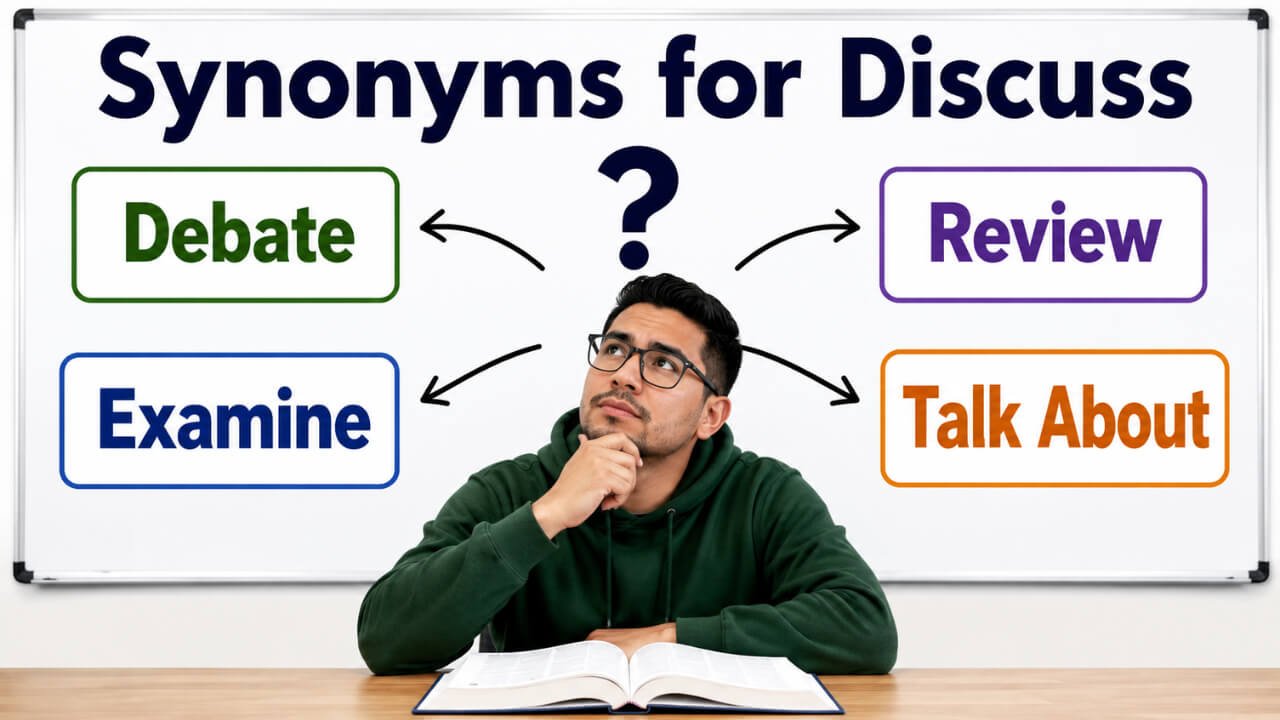
Quick Answer: The best synonyms for discuss include talk about, examine, consider, debate, review, analyze, explore, address, deliberate, and confer. Among the most useful synonyms for discuss, talk about fits casual conversation, while examine, analyze, and explore suit essays, reports, and formal writing. Debate works when people present opposing views. Review is best for checking information, address suits important problems, and deliberate describes careful discussion before making a decision.
Pronunciation and Word Details
Word: Discuss.
Pronunciation: /dɪˈskʌs/.
Part of Speech: Verb.
Meaning: To talk or write about a subject in detail, often to exchange ideas, examine information, or reach a decision.
US Pronunciation:
UK Pronunciation:
What Does “Discuss” Mean?
Discuss means to talk or write about a subject carefully and in some detail. It is a verb that commonly describes an exchange of ideas, opinions, facts, questions, or possible solutions.
People can discuss a problem during a meeting, discuss an idea in an essay, or discuss their plans in a private conversation. The word does not always imply disagreement. A discussion may be friendly, formal, academic, emotional, or practical.
Discuss normally takes a direct object. You discuss a topic, issue, plan, or question. In standard grammar, discuss about is usually incorrect because the meaning of about is already contained in the verb.
Meaning, Tone, and Context of “Discuss”
Discuss has a neutral and flexible tone. It works naturally in formal writing, academic essays, professional meetings, classroom conversations, personal communication, and everyday speech.
In formal contexts, discuss often means to examine a subject carefully. A report may discuss the causes of a problem, while a meeting may discuss possible solutions. In academic writing, it can introduce analysis, comparison, interpretation, and evaluation.
In casual conversation, discuss can sound slightly more organized or serious than talk about. Friends may talk about a film, but a group may discuss an important decision.
Discuss is usually polite and balanced. It does not automatically suggest conflict. Debate and argue are stronger because they involve opposing views, while discuss can simply mean sharing information or considering a subject together.
When and How to Use “Discuss”
For Sharing Ideas: Use discuss when two or more people exchange thoughts about a subject.
Example: The students discussed their ideas before beginning the project.
For Examining a Topic: Use discuss when writing or speaking about an issue in detail.
Example: The article discusses several causes of workplace stress.
For Making Decisions: Use discuss when people consider different choices before agreeing on an action.
Example: We need to discuss the available options before making a decision.
For Solving Problems: Use discuss when a group talks about a difficulty and possible solutions.
Example: The team met to discuss the delay and find a practical solution.
For Academic Writing: Use discuss when analyzing, interpreting, or evaluating a subject.
Example: The essay discusses how language influences personal identity.
For Personal Matters: Use discuss when talking seriously about feelings, relationships, or plans.
Example: They discussed their future goals openly.
For Professional Communication: Use discuss when introducing a subject in a meeting, report, or message.
Example: I would like to discuss the revised schedule with you.
For Comparing Views: Use discuss when people consider different perspectives without necessarily arguing.
Example: The group discussed both sides of the proposal.
Best Synonyms for Discuss
Talk About
Synonym: To speak about a subject in a general or casual way.
Example: We talked about our weekend plans over lunch.
Examine
Synonym: To consider a subject carefully and in detail.
Example: The report examines the effects of poor communication.
Consider
Synonym: To think about or discuss something before making a choice.
Example: The committee considered several possible solutions.
Debate
Synonym: To discuss a subject by presenting different or opposing opinions.
Example: The students debated whether the rule should be changed.
Review
Synonym: To discuss or examine information again in order to evaluate it.
Example: We reviewed the results during the meeting.
Analyze
Synonym: To examine a subject closely by studying its parts, causes, or meaning.
Example: The researchers analyzed the information before reaching a conclusion.
Explore
Synonym: To discuss or investigate a subject from several perspectives.
Example: The book explores the relationship between memory and identity.
Address
Synonym: To discuss or deal with an important issue or problem.
Example: The speaker addressed the concerns raised by the audience.
Deliberate
Synonym: To discuss something carefully before making a decision.
Example: The panel deliberated before announcing its final choice.
Confer
Synonym: To discuss a matter formally or privately with another person.
Example: The two managers conferred before approving the proposal.
50 Synonyms for Discuss with Short Meanings
- Talk About: To speak about a subject.
- Examine: To study or discuss carefully.
- Consider: To think about before deciding.
- Debate: To discuss opposing views.
- Review: To examine information again.
- Analyze: To study details, causes, or meaning.
- Explore: To consider a subject broadly.
- Address: To deal with a topic or problem.
- Deliberate: To discuss carefully before deciding.
- Confer: To hold a formal or private discussion.
- Converse About: To exchange thoughts through conversation.
- Consult: To discuss something in order to seek advice.
- Negotiate: To discuss terms in order to reach agreement.
- Discourse On: To speak or write about a subject at length.
- Comment On: To give an opinion about something.
- Speak About: To communicate information about a topic.
- Go Over: To review or discuss details.
- Look At: To consider a subject or problem.
- Assess: To discuss and judge quality or importance.
- Evaluate: To examine and form a judgment.
- Investigate: To examine facts in order to understand something.
- Study: To examine a subject carefully.
- Explain: To discuss something so it becomes understandable.
- Describe: To give details about a subject.
- Present: To introduce information for consideration.
- Raise: To introduce a topic for discussion.
- Mention: To refer briefly to a subject.
- Cover: To discuss a subject within a speech or text.
- Treat: To discuss a subject in writing or speech.
- Handle: To discuss and manage a matter.
- Tackle: To address a difficult subject or problem.
- Engage With: To consider and respond to an idea.
- Reflect On: To think and speak carefully about something.
- Reason About: To discuss through logical thought.
- Exchange Views On: To share different opinions about a subject.
- Share Ideas About: To communicate thoughts on a topic.
- Compare: To discuss similarities and differences.
- Argue: To present reasons for or against a position.
- Contemplate: To consider a subject deeply.
- Ponder: To think carefully about a question.
- Interpret: To discuss the meaning of something.
- Question: To examine an idea through doubt or inquiry.
- Brainstorm: To discuss and generate possible ideas.
- Resolve: To discuss a problem until a solution is found.
- Chat About: To talk casually about a subject.
- Dialogue About: To exchange views in a thoughtful conversation.
- Touch On: To mention or discuss something briefly.
- Take Up: To begin considering or discussing a subject.
- Air: To express and discuss an opinion or concern openly.
- Hash Out: To discuss a problem thoroughly until an agreement is reached.
Read Also:
Synonyms for Insane

Synonyms for Discuss by Context
When Discuss Means Talk About
Talk about, speak about, chat about, converse about, and share ideas about are suitable when people exchange information in an ordinary conversation.
Talk about is the most natural casual alternative. Chat about suggests a relaxed conversation, while converse about sounds more formal and thoughtful.
Example: We chatted about our plans while waiting for dinner.
When Discuss Means Examine Carefully
Examine, analyze, explore, investigate, study, assess, and evaluate work well when a subject requires detailed attention.
Examine is broad and formal. Analyze focuses on parts, patterns, and causes. Explore suggests considering several ideas or perspectives without necessarily reaching one conclusion.
Example: The report analyzes the reasons behind the sudden change.
When Discuss Means Consider Before Deciding
Consider, deliberate, confer, consult, review, and reflect on are useful when people discuss something before taking action.
Deliberate suggests a careful and serious process. Confer often describes a private or professional discussion. Consult means seeking information, guidance, or advice.
Example: The committee deliberated for several hours before reaching a decision.
When Discuss Means Present Opposing Views
Debate, argue, question, reason about, and exchange views on fit situations involving different positions.
Debate is structured and may remain respectful. Argue can mean presenting reasons, but it may also suggest anger or conflict in everyday speech.
Example: The participants debated the advantages and disadvantages of the proposal.
When Discuss Means Deal With a Problem
Address, tackle, handle, resolve, take up, and hash out are useful when the discussion concerns a challenge or disagreement.
Address is common in professional and formal writing. Tackle suggests active effort. Hash out is informal and means discussing details until a solution or agreement is reached.
Example: The meeting addressed several concerns about the new process.
When Discuss Means Mention in Writing
Cover, treat, present, describe, comment on, touch on, and interpret work well when an article, essay, report, or speech includes a subject.
Cover means to include and discuss information. Treat is formal and often refers to how a text deals with a subject. Touch on means to mention something briefly.
Example: The final chapter touches on the long term effects of the decision.
Another Word for Discuss
Talk about is the most common general replacement for discuss in everyday conversation. It sounds natural, simple, and direct.
In formal writing, examine is often a stronger choice because it suggests careful attention. Analyze works when details or causes are studied, while debate is better when people hold opposing views. The best alternative depends on the purpose, tone, and depth of the conversation.
Original: We need to discuss the schedule tomorrow.
Better Option: We need to talk about the schedule tomorrow.
Original: The essay discusses the causes of social change.
Better Option: The essay examines the causes of social change.
Original: The group discussed both sides of the issue.
Better Option: The group debated both sides of the issue.
Original: The meeting discussed several customer concerns.
Better Option: The meeting addressed several customer concerns.
When Not to Use “Discuss”
Avoid discuss when a more precise verb can show exactly what happened. If people disagreed formally, debated may be clearer. If a report studied evidence, analyzed may be stronger. If someone only referred briefly to a topic, mentioned is more accurate.
Discuss can also sound too formal in relaxed conversation. Talk about or chat about may sound more natural when the subject is casual.
Do not use discuss about in standard English. Discuss already means talk about, so the word about is unnecessary after it.
Weak: We discussed about the new schedule.
Better: We discussed the new schedule.
Weak: The report discusses the numbers in detail.
Better: The report analyzes the numbers in detail.
Weak: She discussed her name during the introduction.
Better: She mentioned her name during the introduction.
Weak: We discussed movies for a few minutes.
Better: We chatted about movies for a few minutes.
Words Commonly Confused With Discuss
Discuss vs Talk: Discuss suggests attention to a particular subject. Talk is broader and may describe any spoken communication.
Discuss vs Talk About: Both expressions have similar meanings. Discuss is slightly more formal, while talk about sounds more conversational.
Discuss vs Debate: Discuss means exchanging ideas about a subject. Debate specifically involves different or opposing positions.
Discuss vs Argue: Discuss can be calm and cooperative. Argue may mean presenting reasons, but it can also suggest conflict or anger.
Discuss vs Explain: Discuss means considering or talking about a subject. Explain means making the subject easier to understand through details or reasons.
Discuss vs Mention: Discuss involves some detail. Mention means referring to something briefly without developing it fully.
Discuss vs Describe: Discuss means examining a subject or exchanging views. Describe means giving details about appearance, qualities, or events.
Discuss vs Review: Discuss may introduce new ideas. Review usually means examining material, progress, or information that already exists.
Which Synonym Should You Choose?
Choose talk about for casual speech, friendly conversations, and everyday subjects.
Choose examine for essays, reports, academic writing, and detailed formal analysis.
Choose analyze when studying causes, patterns, evidence, data, or individual parts.
Choose explore when considering several ideas, possibilities, or perspectives.
Choose debate when people present different or opposing views.
Choose deliberate when a group discusses something carefully before making a decision.
Choose confer for private, professional, or formal communication between people.
Choose consult when someone discusses a matter to receive advice or expert guidance.
Choose review when checking plans, results, documents, or previous information.
Choose address when dealing with a concern, question, challenge, or serious issue.
Choose negotiate when discussing conditions, responsibilities, prices, or agreements.
Choose chat about for relaxed and informal conversation.
Choose mention when a subject receives only brief attention.
Choose cover when describing what a report, speech, lesson, or article includes.
Choose hash out when describing an informal but detailed effort to solve a disagreement.
Real Life Examples of “Discuss” in Sentences
Original: We discussed the problem during the meeting.
Better Option: We addressed the problem during the meeting.
Original: The essay discusses the effects of stress on sleep.
Better Option: The essay examines the effects of stress on sleep.
Original: They discussed their holiday plans after dinner.
Better Option: They talked about their holiday plans after dinner.
Original: The students discussed both opinions in class.
Better Option: The students debated both opinions in class.
Original: The managers discussed the final proposal privately.
Better Option: The managers conferred about the final proposal privately.
Original: The report discusses the information collected during the study.
Better Option: The report analyzes the information collected during the study.
Original: We discussed several creative ideas for the event.
Better Option: We brainstormed several creative ideas for the event.
Original: She discussed the issue with an experienced adviser.
Better Option: She consulted an experienced adviser about the issue.
Original: The article discusses how traditions change over time.
Better Option: The article explores how traditions change over time.
Original: They discussed the disagreement until they found a solution.
Better Option: They hashed out the disagreement until they found a solution.
Synonym Groups and Usage Differences
Conversation Group
Talk about, speak about, chat about, converse about, and share ideas about all describe verbal communication.
Talk about is neutral and common. Chat about is relaxed and informal. Converse about suggests a longer or more thoughtful exchange.
Example: The friends chatted about their favorite books.
Analysis Group
Examine, analyze, investigate, study, assess, and evaluate suggest careful attention to a subject.
Analyze focuses on details and relationships. Assess and evaluate involve forming a judgment. Investigate often means searching for facts or causes.
Example: The researchers investigated the reasons for the unexpected result.
Decision Group
Consider, deliberate, confer, consult, review, and reflect on relate to discussion before a decision.
Consider can involve private thought or group discussion. Deliberate suggests seriousness, while consult involves seeking another person’s knowledge.
Example: The panel reviewed every application before choosing the finalists.
Disagreement Group
Debate, argue, question, negotiate, and exchange views on involve different positions or interests.
Debate focuses on opposing arguments. Negotiate aims to reach an agreement. Question means challenging an idea or asking whether it is correct.
Example: The two sides negotiated until they agreed on fair terms.
Problem Solving Group
Address, tackle, handle, resolve, hash out, and take up describe dealing with an issue.
Address is formal and neutral. Tackle suggests determination. Resolve focuses on reaching a successful conclusion.
Example: The team tackled the most urgent problem first.
Writing Group
Cover, treat, present, describe, interpret, comment on, and touch on describe how written or spoken material handles a topic.
Cover means to include information. Interpret focuses on meaning. Touch on indicates that the subject receives only brief attention.
Example: The introduction briefly touches on the history of the subject.
Antonyms of Discuss
The opposite of discuss may involve avoiding a subject, hiding information, refusing communication, or ignoring an issue.
Avoid: To stay away from a subject or conversation.
Ignore: To give no attention to something.
Dismiss: To reject a subject as unimportant.
Overlook: To fail to notice or consider something.
Conceal: To keep information hidden.
Suppress: To prevent thoughts or concerns from being expressed.
Withhold: To choose not to share information.
Evade: To avoid answering or dealing with a subject.
Silence: To stop someone from speaking or sharing views.
Neglect: To fail to give a matter proper attention.
Exclude: To leave a topic out of a discussion.
Disregard: To ignore information, advice, or concerns.
Comparison: Discuss vs Related Words
Discuss vs Talk About
Discuss and talk about can often replace each other. Discuss is slightly more formal and may suggest a focused exchange, while talk about sounds natural in casual conversation.
Example With Discuss: We discussed the proposed changes during the meeting.
Example With Talk About: We talked about our weekend plans over breakfast.
Discuss vs Debate
Discuss means exchanging information or ideas. Debate involves presenting different sides of a question, often through organized arguments.
Example With Discuss: The group discussed ways to improve the process.
Example With Debate: The group debated whether the process should be replaced.
Discuss vs Analyze
Discuss means talking or writing about a subject. Analyze means examining its details, parts, relationships, or causes.
Example With Discuss: The article discusses recent changes in education.
Example With Analyze: The article analyzes the causes of those changes.
Discuss vs Explain
Discuss means considering a topic in some detail. Explain means making an idea clear by providing reasons, steps, or supporting information.
Example With Discuss: The class discussed the new scientific theory.
Example With Explain: The teacher explained how the theory works.
Discuss vs Mention
Discuss implies meaningful attention or detail. Mention means referring to something briefly.
Example With Discuss: The report discusses several possible solutions.
Example With Mention: The report mentions one possible solution in the introduction.
Discuss vs Review
Discuss is a broad term for exchanging or presenting ideas. Review means checking, examining, or reconsidering existing material.
Example With Discuss: We discussed ideas for the new project.
Example With Review: We reviewed the completed project before publication.
Discuss vs Address
Discuss focuses on communication about a topic. Address suggests actively dealing with a question, concern, or problem.
Example With Discuss: The meeting discussed the recent complaints.
Example With Address: The meeting addressed the causes of the recent complaints.
Common Phrases and Expressions With “Discuss”
Discuss in Detail: To examine a subject thoroughly.
Discuss Further: To continue considering a subject.
Discuss Openly: To talk honestly without hiding concerns.
Discuss Privately: To speak about something away from other people.
Discuss the Matter: To consider a particular issue or situation.
Discuss the Possibility: To consider whether something could happen.
Discuss the Options: To examine the available choices.
Discuss the Results: To analyze or interpret findings.
Discuss the Issue: To consider a problem or important subject.
Discuss With Someone: To exchange ideas or information with another person.
Common Mistakes to Avoid
A common grammar mistake is placing about directly after discuss. Since discuss already means talk about, standard English normally uses a direct object.
Incorrect: We discussed about the problem.
Correct: We discussed the problem.
Do not confuse discuss with explain. A person may discuss a topic without making every detail clear. Use explain when the purpose is to improve understanding.
Avoid using discuss when only a brief reference is intended. Mention is more accurate when a subject receives little attention.
Do not replace discuss with debate unless opposing views are involved. A peaceful exchange of information is not always a debate.
Be careful with the sentence pattern discuss with. The subject comes immediately after discuss, while the person may follow with.
Correct: I discussed the proposal with my manager.
Incorrect: I discussed with my manager the proposal.
Avoid repeating discuss throughout a paragraph. Replace it with examine, address, consider, review, explore, or another precise alternative when the meaning supports the change.
Choose synonyms according to tone. Hash out is useful in informal conversation but may sound unsuitable in an academic report. Deliberate sounds formal and should not replace discuss in every everyday sentence.
Conclusion
Choosing the right synonyms for discuss can make writing clearer, more natural, and more precise. Talk about suits casual conversation, while examine, analyze, and explore work well in essays and reports. Debate describes opposing views, deliberate suggests careful decision making, and confer fits formal private communication. Use address for problems, review for existing information, and negotiate for reaching an agreement. Always match the synonym to the purpose, tone, and depth of the conversation.
FAQs About Synonyms for Discuss
What Is the Best Synonym for Discuss?
Talk about is the best general alternative in everyday conversation. Examine is often better in formal or academic writing.
What Is a Formal Synonym for Discuss?
Examine, analyze, deliberate, confer, consider, and address are useful formal synonyms.
What Is a Casual Synonym for Discuss?
Talk about and chat about are natural casual alternatives.
Is Debate the Same as Discuss?
Not exactly. Discuss means exchanging ideas, while debate normally involves opposing opinions or arguments.
Is It Correct to Say Discuss About?
No. In standard English, use discuss the topic rather than discuss about the topic.
What Synonym for Discuss Works Best in an Essay?
Examine, analyze, explore, consider, and evaluate are strong choices for essays, depending on the task.
What Is the Difference Between Discuss and Explain?
Discuss means to talk or write about a subject. Explain means to make the subject easier to understand through details or reasons.
