
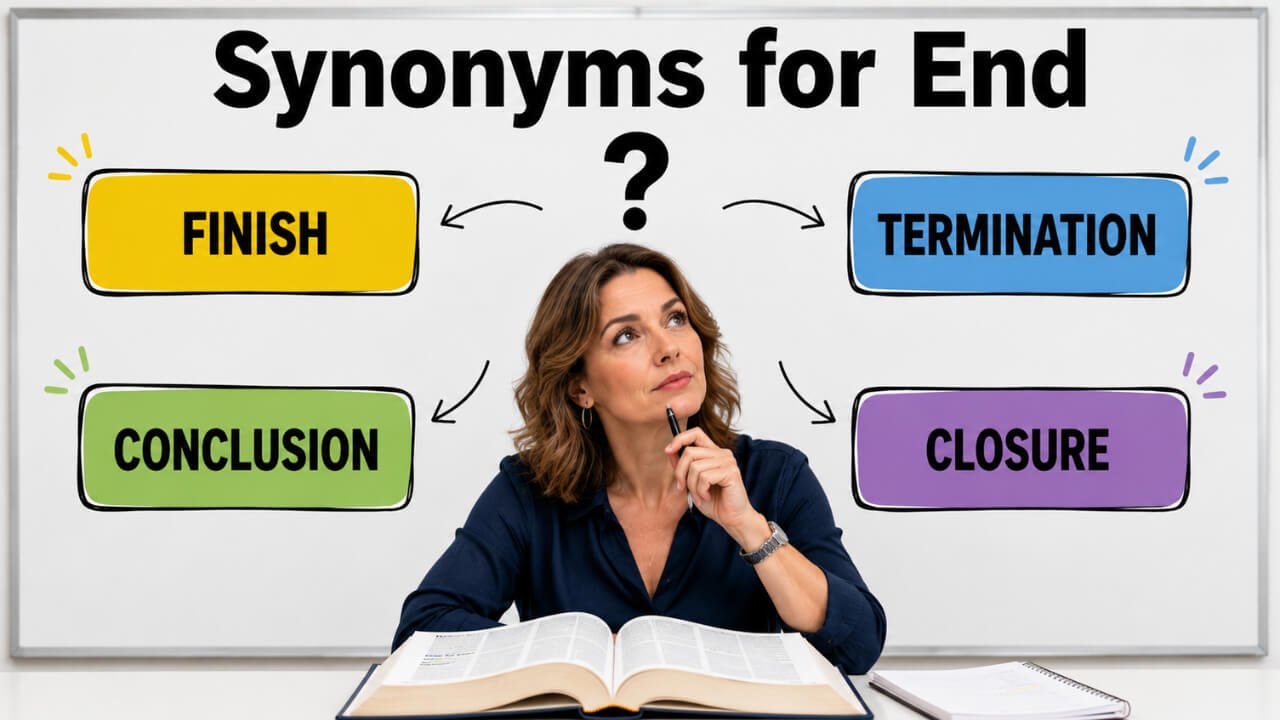
Quick Answer: Common synonyms for end include conclusion, finish, close, completion, termination, cessation, finale, outcome, limit, and resolution. Conclusion works well for essays, arguments, and formal writing. Finish and close are natural in everyday speech. Termination is suitable for official, legal, or technical situations. Cessation emphasizes the stopping of an activity. Outcome refers to the final result, while limit describes the farthest point or boundary. Finale suits performances and events, and resolution suggests that a problem has been settled.
Pronunciation and Word Details
Word: End.
Pronunciation: /end/.
Part of Speech: Noun and verb.
Meaning: The final point of something or the act of bringing something to a finish.
US Pronunciation:
UK Pronunciation:
What Does “End” Mean?
End means the final point, final stage, or stopping point of something. It can refer to the conclusion of an event, the edge of an object, the result of an action, or the purpose behind a decision.
As a noun, end describes the last part of something.
Example: The end of the story surprised everyone.
As a verb, end means to stop, finish, or bring something to a conclusion.
Example: The meeting will end at noon.
The word can also describe a physical boundary, a goal, a result, or the termination of an activity.
Physical Point: She stood at the end of the hallway.
Final Result: The project had a successful end.
Purpose: They worked toward a common end.
Stopping an Action: The manager ended the discussion politely.
Meaning, Tone, and Context of “End”
End is a neutral and highly flexible word. It appears naturally in casual conversation, formal writing, academic discussion, business communication, literature, instructions, and technical explanations.
In everyday speech, end often means finish or stop.
Example: What time does the movie end?
In formal writing, words such as conclusion, termination, cessation, or outcome may provide greater precision.
Example: The report reached a clear conclusion.
End can sound emotional when it describes a relationship, life, opportunity, or important period.
Example: The announcement marked the end of an era.
It can also sound practical and unemotional when referring to time, location, or structure.
Example: The office is located at the end of the street.
The intended meaning depends on whether end refers to completion, location, purpose, result, limitation, or destruction.
When and How to Use “End”
For Completion: Use end when something reaches its final stage.
Example: The training program will end in August.
For Stopping an Activity: Use end when an action, process, or situation stops.
Example: The new agreement could end the dispute.
For a Final Part: Use end to identify the last section of a story, speech, journey, or period.
Example: The answer appears near the end of the chapter.
For a Physical Boundary: Use end for the outermost point of a place or object.
Example: A small table stood at the end of the bed.
For a Result: Use end when discussing what finally happens after a process.
Example: Their efforts produced a positive end.
For a Purpose: Use end when describing the goal behind an action.
Example: Education should be treated as an end in itself.
For a Limit: Use end when something cannot continue beyond a certain point.
Example: Her patience finally came to an end.
For Death or Destruction: Use end carefully when referring to the loss of life or the destruction of something.
Example: The disease brought an early end to his life.
Best Synonyms for End
Conclusion: The final part of a discussion, text, event, or process.
Example: The essay needs a stronger conclusion.
Finish: The point at which an activity or task is completed.
Example: The runners approached the finish.
Close: The final stage of an event, period, or activity.
Example: The ceremony came to a close.
Completion: The state of being fully finished.
Example: The team celebrated the completion of the project.
Termination: The official or complete ending of an agreement, process, service, or position.
Example: The contract allows termination with written notice.
Cessation: The stopping of an activity or condition.
Example: The treatment led to the cessation of pain.
Finale: The final part of a performance, event, or series.
Example: The concert ended with a dramatic finale.
Outcome: The final result of a situation or process.
Example: Everyone was pleased with the outcome.
Limit: The point beyond which something cannot continue.
Example: The fence marks the limit of the property.
Resolution: The settlement or satisfactory conclusion of a problem.
Example: Both sides worked toward a peaceful resolution.
50 Synonyms for End with Short Meanings
- Conclusion: The final part of something.
- Finish: The point at which an activity is completed.
- Close: The final stage of an event or period.
- Completion: The state of being fully finished.
- Termination: An official or complete ending.
- Cessation: The stopping of an activity.
- Finale: The last part of a performance or event.
- Resolution: The settlement of a problem or conflict.
- Culmination: The highest or final point of a process.
- Outcome: The final result of a situation.
- Result: What happens because of an action.
- Consequence: An effect produced by an action or decision.
- Endpoint: The final point in a process, route, or period.
- Terminus: The final station or destination of a route.
- Limit: The farthest point something can reach.
- Boundary: A line marking the edge of an area.
- Edge: The outermost part of an object or place.
- Extremity: The farthest point or outermost part.
- Tip: The narrow or final point of an object.
- Last: The final person, thing, or stage.
- Final: The concluding part or event.
- Expiration: The point when a period of validity ends.
- Expiry: The end of a fixed period of use or validity.
- Closure: The act of bringing something to a satisfactory end.
- Shutdown: The closing or stopping of a system or operation.
- Halt: A complete stop in movement or activity.
- Stop: The point at which something no longer continues.
- Discontinuation: The act of ending a product, service, or activity.
- Abolition: The official ending of a practice or system.
- Elimination: The complete removal of something.
- Cancellation: The decision that a planned event will not happen.
- Dissolution: The formal ending of an organization or partnership.
- Destruction: The act of completely ruining something.
- Demise: The end or failure of something, or the death of a person.
- Death: The end of life.
- Ruin: The destruction or complete failure of something.
- Goal: The purpose toward which an effort is directed.
- Purpose: The reason or intended aim of an action.
- Aim: A result that someone hopes to achieve.
- Objective: A specific goal or desired result.
- Destination: The final place reached during a journey.
- Target: A result or point someone intends to reach.
- Wrap up: The final part or completion of an activity.
- Wind up: The act of bringing something to a close.
- Break: A point at which an activity stops.
- Adjournment: The formal ending or suspension of a meeting.
- Sunset: The planned ending of a rule, service, or program.
- Exhaustion: The complete use of a supply or resource.
- Fulfillment: The achievement or completion of a goal.
- Consummation: The final completion of a process or plan.
Read Also:
Synonyms for Little

Synonyms for End by Context
When End Means Finish or Completion
Conclusion, finish, completion, close, culmination, finale, and wrap up describe the final stage of an activity, event, or piece of writing.
Conclusion is common in essays, reports, arguments, and formal discussions.
Example: The conclusion summarizes the main argument.
Finish is more conversational and often describes tasks, races, or physical work.
Example: We are close to the finish of the renovation.
Completion emphasizes that every required part has been finished.
Example: Payment is due upon completion of the work.
Finale is especially suitable for performances, shows, and celebrations.
Example: Fireworks formed the finale of the festival.
When End Means Stop an Action
Stop, halt, cessation, termination, shutdown, discontinuation, abolition, and cancellation describe the stopping of an activity, service, system, or condition.
Stop is the simplest everyday alternative.
Example: The rain finally stopped.
Halt suggests a sudden or forceful stop.
Example: Officials ordered a halt to construction.
Cessation is more formal and often appears in medical, legal, or academic writing.
Example: The medication caused a cessation of symptoms.
Termination often refers to contracts, employment, services, or formal arrangements.
Example: The policy explains the conditions for termination.
When End Means a Boundary or Final Point
Endpoint, limit, boundary, edge, extremity, tip, and terminus describe the farthest or final physical point.
Endpoint is often used for routes, processes, systems, and periods.
Example: The village is the endpoint of the trail.
Boundary refers to a dividing line between areas.
Example: The river forms the northern boundary of the region.
Edge is common when referring to the outer part of an object or surface.
Example: Place the vase near the edge of the table.
Terminus is commonly used for the final station or destination of a transport route.
Example: The train reached its northern terminus.
When End Means Result or Outcome
Outcome, result, consequence, resolution, and culmination describe what finally happens after an action, decision, or process.
Outcome is a neutral word for the final result.
Example: The outcome depends on several factors.
Result is suitable for experiments, tests, actions, and decisions.
Example: The final result exceeded expectations.
Consequence often refers to an effect, especially one caused by a decision or mistake.
Example: Delays were an unintended consequence of the change.
Resolution suggests that uncertainty, disagreement, or difficulty has been settled.
Example: The discussion led to a fair resolution.
When End Means Goal or Purpose
Goal, purpose, aim, objective, target, and destination can replace end when it means the intended purpose of an action.
Goal is suitable for personal, professional, or general achievements.
Example: Their main goal is to improve public safety.
Purpose explains why something is done.
Example: The purpose of the review is to identify errors.
Objective is more formal and often describes a measurable goal.
Example: The primary objective is to reduce waste.
Aim is natural in both formal and conversational writing.
Example: Our aim is to provide clear information.
When End Means Death or Destruction
Death, demise, destruction, ruin, elimination, and dissolution can describe the end of a life, system, organization, tradition, or structure.
Death directly refers to the end of life.
Example: The story explores life and death.
Demise can describe death, failure, or the disappearance of an organization or idea.
Example: Poor planning caused the demise of the project.
Dissolution is appropriate for the formal ending of a partnership, organization, or legal body.
Example: The members approved the dissolution of the association.
Another Word for End
The best single replacement for end is often finish because it works naturally as both a noun and a verb. However, the most accurate alternative depends on whether end refers to completion, a result, a boundary, a purpose, or an official termination.
Original: The meeting came to an end at noon.
Better Option: The meeting came to a close at noon.
Original: We need to end the investigation soon.
Better Option: We need to conclude the investigation soon.
Original: The end of the project was successful.
Better Option: The completion of the project was successful.
Original: Nobody expected that end.
Better Option: Nobody expected that outcome.
When Not to Use “End”
End is useful, but it can sound vague when a more specific word would explain exactly what has finished or stopped.
Avoid end when the sentence needs to distinguish between a conclusion, result, boundary, purpose, cancellation, or formal termination.
Weak: The study had a surprising end.
Better: The study produced a surprising result.
End can also become repetitive when it appears several times in the same paragraph.
Weak: At the end of the event, the speaker ended the discussion with an ending statement.
Better: At the close of the event, the speaker concluded the discussion with a final statement.
Avoid using end when finish sounds more natural for an ordinary task.
Weak: I need to end my homework.
Better: I need to finish my homework.
Avoid termination in casual situations because it may sound overly formal or severe.
Weak: We completed the termination of dinner.
Better: We finished dinner.
Avoid finale unless you are describing the final part of a performance, series, or dramatic event.
Weak: The finale of the office meeting was brief.
Better: The conclusion of the office meeting was brief.
Words Commonly Confused With End
End vs Finish: End can describe the final point of almost anything, while finish often emphasizes completing a task, race, or activity.
End vs Ending: End is the final point itself, while ending often refers to the way a story, film, relationship, or event concludes.
End vs Conclusion: End is general, while conclusion is more formal and commonly refers to writing, arguments, discussions, or reasoning.
End vs Result: End describes where something stops, while result describes what an action produces.
End vs Outcome: End refers to a final point, while outcome refers to the final situation produced by a process.
End vs Limit: End can mean the final stage, while limit means the point beyond which something cannot continue or increase.
End vs Goal: End can mean purpose in formal expressions, but goal more clearly describes something a person hopes to achieve.
End vs Termination: End is neutral and general, while termination is formal and often refers to contracts, services, employment, or legal arrangements.
End vs Closure: End describes stopping or finishing, while closure can suggest emotional acceptance or a satisfactory resolution.
Which Synonym Should You Choose?
Choose conclusion: Use conclusion for essays, reports, speeches, arguments, and formal discussions.
Choose finish: Use finish for tasks, races, meals, physical work, and casual conversation.
Choose close: Use close for meetings, ceremonies, events, seasons, and periods of activity.
Choose completion: Use completion when you want to emphasize that all required work has been done.
Choose termination: Use termination in legal, official, technical, contractual, or employment related writing.
Choose cessation: Use cessation when formally describing the stopping of an activity, condition, or behavior.
Choose outcome: Use outcome when discussing the final result of a process, decision, competition, or situation.
Choose result: Use result for tests, research, experiments, calculations, actions, and reports.
Choose resolution: Use resolution when a disagreement, mystery, or problem has been settled.
Choose limit: Use limit when describing a maximum level, boundary, or point that cannot be passed.
Choose finale: Use finale for performances, celebrations, series, and dramatic events.
Choose endpoint: Use endpoint for routes, timelines, processes, systems, and technical explanations.
Choose goal: Use goal when end means a desired achievement or purpose.
Choose wrap up: Use wrap up in casual speech when describing the final part of a meeting, project, or activity.
Real Life Examples of “End” in Sentences
Original: The class will end at three o’clock.
Better Option: The class will finish at three o’clock.
Original: The manager ended the meeting with a short announcement.
Better Option: The manager concluded the meeting with a short announcement.
Original: We reached the end of the walking trail.
Better Option: We reached the endpoint of the walking trail.
Original: The end of the investigation was unexpected.
Better Option: The outcome of the investigation was unexpected.
Original: The company decided to end the service.
Better Option: The company decided to discontinue the service.
Original: The event came to an end after sunset.
Better Option: The event came to a close after sunset.
Original: The new policy could end the confusion.
Better Option: The new policy could resolve the confusion.
Original: The end of the performance received loud applause.
Better Option: The finale of the performance received loud applause.
Original: The fence stands at the end of the property.
Better Option: The fence stands at the boundary of the property.
Original: Their main end was to protect the community.
Better Option: Their main goal was to protect the community.
Synonym Groups and Usage Differences
Completion Group
Conclusion, finish, completion, close, culmination, finale, and wrap up refer to the final stage of something.
Conclusion is formal, finish is conversational, completion emphasizes full achievement, and finale suggests a memorable final part.
Example: The project reached completion ahead of schedule.
Stopping Group
Stop, halt, cessation, shutdown, termination, cancellation, and discontinuation describe an activity that no longer continues.
Stop is general, halt suggests sudden interruption, and termination suggests an official decision.
Example: The announcement confirmed the termination of the service.
Boundary Group
Limit, boundary, edge, endpoint, extremity, tip, and terminus describe the final physical or measurable point.
Boundary marks a division, edge describes an outer surface, and limit describes the maximum possible level.
Example: The mountain marks the western boundary of the region.
Result Group
Outcome, result, consequence, resolution, and culmination describe what finally develops from a process.
Outcome is neutral, consequence often suggests cause and effect, and resolution indicates that a problem has been settled.
Example: Careful planning produced a successful outcome.
Purpose Group
Goal, purpose, aim, objective, target, and destination describe something a person intends to achieve.
Goal is broad, objective is often measurable, and purpose explains the reason behind an action.
Example: The main objective is to improve accuracy.
Death and Destruction Group
Death, demise, destruction, dissolution, elimination, and ruin describe the loss, failure, or disappearance of something.
Death refers directly to life, while demise can also describe the failure of a plan, organization, or tradition.
Example: Financial difficulties caused the demise of the business.
Antonyms of End
The opposite of end changes according to meaning. When end means the final point, its opposite may be beginning or start. When it means stopping, its opposite may be continuation or renewal.
Beginning: The first part of something.
Start: The point at which an activity begins.
Opening: The initial part of an event, text, or performance.
Commencement: A formal beginning.
Launch: The introduction or beginning of a project, service, or activity.
Origin: The point from which something develops.
Continuation: The act of carrying on without stopping.
Extension: An added period that allows something to continue.
Renewal: The act of beginning again or extending validity.
Revival: The return of an activity, idea, or condition.
Creation: The act of bringing something into existence.
Birth: The beginning of life or development.
Introduction: The opening section or first presentation of something.
Survival: The continuation of life or existence.
Growth: The process of developing or increasing.
Comparison: End vs Related Words
End vs Finish
End is broader and can refer to time, location, purpose, life, or completion. Finish usually focuses on completing an activity or reaching the last stage.
Example With End: The road ends near the river.
Example With Finish: Please finish the report before noon.
End vs Conclusion
End is general, while conclusion is more formal and often refers to writing, reasoning, speeches, and discussions.
Example With End: We left at the end of the event.
Example With Conclusion: The conclusion explains the main findings.
End vs Termination
End is neutral and suitable for most situations. Termination is more official and may suggest legal, contractual, technical, or employment related action.
Example With End: The program will end next month.
Example With Termination: The agreement allows early termination.
End vs Outcome
End describes the final point of something. Outcome describes the final result produced by events or actions.
Example With End: We arrived before the end of the ceremony.
Example With Outcome: The outcome of the vote remained uncertain.
End vs Limit
End can describe where something stops, while limit describes the maximum amount, level, or boundary allowed.
Example With End: The path ends beside the lake.
Example With Limit: The speed limit is clearly displayed.
End vs Closure
End simply describes completion or stopping. Closure may suggest a formal conclusion, permanent closing, or emotional acceptance.
Example With End: The course ends in September.
Example With Closure: The final conversation gave her emotional closure.
End vs Finale
End is a general term for the last part of anything. Finale is mainly used for performances, celebrations, and dramatic final events.
Example With End: The audience left at the end of the show.
Example With Finale: The musical finale impressed the audience.
Common Phrases and Expressions With End
At the End: At the final point of a place, period, or activity.
Example: The answers appear at the end of the book.
In the End: Finally, after everything has been considered or completed.
Example: In the end, they accepted the proposal.
Come to an End: To stop or finish.
Example: The long discussion finally came to an end.
Put an End To: To cause something to stop permanently.
Example: The agreement put an end to the dispute.
From Beginning to End: Throughout the entire period or process.
Example: The story remained interesting from beginning to end.
End of the Day: The conclusion of a day or the most important final consideration.
Example: At the end of the day, safety is the main concern.
End Result: The final result of a process.
Example: The end result was better than expected.
End in Sight: A sign that a difficult or lengthy situation will soon finish.
Example: After months of work, there is finally an end in sight.
No End To: A very large or seemingly unlimited amount of something.
Example: There seems to be no end to her creativity.
Make Ends Meet: To have enough money to pay necessary expenses.
Example: They worked extra hours to make ends meet.
Common Mistakes to Avoid
One common mistake is using end when result or outcome would communicate the meaning more accurately.
Unclear: The experiment had a useful end.
Clearer: The experiment produced a useful result.
Another mistake is repeating end too often within the same paragraph. Replace repeated uses with conclusion, finish, close, outcome, or completion when appropriate.
Repetitive: At the end of the meeting, the manager ended the discussion with an end statement.
Improved: At the close of the meeting, the manager concluded the discussion with a final statement.
Do not confuse at the end with in the end. At the end refers to the final point of a place, time, or event. In the end means finally or after everything has happened.
Correct: We spoke at the end of the meeting.
Correct: In the end, we reached an agreement.
Use the correct preposition with end. The end of refers to the final part of something. An end to refers to stopping a situation or activity.
Correct: The end of the story was surprising.
Correct: The new rule brought an end to the confusion.
Avoid formal synonyms in casual situations unless the tone requires them.
Unnatural: We celebrated the termination of dinner.
Natural: We celebrated after finishing dinner.
Avoid choosing finish when the sentence refers to a result rather than a completed activity.
Incorrect: Nobody predicted the finish of the election.
Better: Nobody predicted the outcome of the election.
Conclusion
Synonyms for end vary according to whether the word refers to completion, stopping, location, purpose, or result. Conclusion works well in essays and formal discussions, while finish and close suit everyday situations. Termination and cessation are useful in official or technical writing. Outcome and result describe what finally happens, while boundary, limit, and endpoint identify a final physical or measurable point. Choosing the most precise alternative makes each sentence clearer, more natural, and better suited to its context.
FAQs About Synonyms for End
What Is the Best Synonym for End?
Finish is the most versatile everyday synonym. Conclusion is usually better for formal writing, while termination suits official situations.
What Is a Formal Synonym for End?
Conclusion, termination, cessation, completion, and culmination are useful formal alternatives. The best choice depends on what is ending.
What Is Another Word for the End of a Story?
Ending, conclusion, finale, resolution, and close can describe the final part of a story.
Can Outcome Replace End?
Outcome can replace end when the sentence refers to a final result. It cannot usually replace end when referring to time, location, or a physical boundary.
What Is the Difference Between End and Finish?
End is broader and can describe a final time, point, purpose, or result. Finish usually emphasizes completing an activity or task.
What Is a Synonym for Bringing Something to an End?
Conclude, finish, stop, terminate, complete, halt, and discontinue can all mean bringing something to an end.
What Is the Opposite of End?
Common opposites include beginning, start, opening, commencement, continuation, renewal, and revival.
