
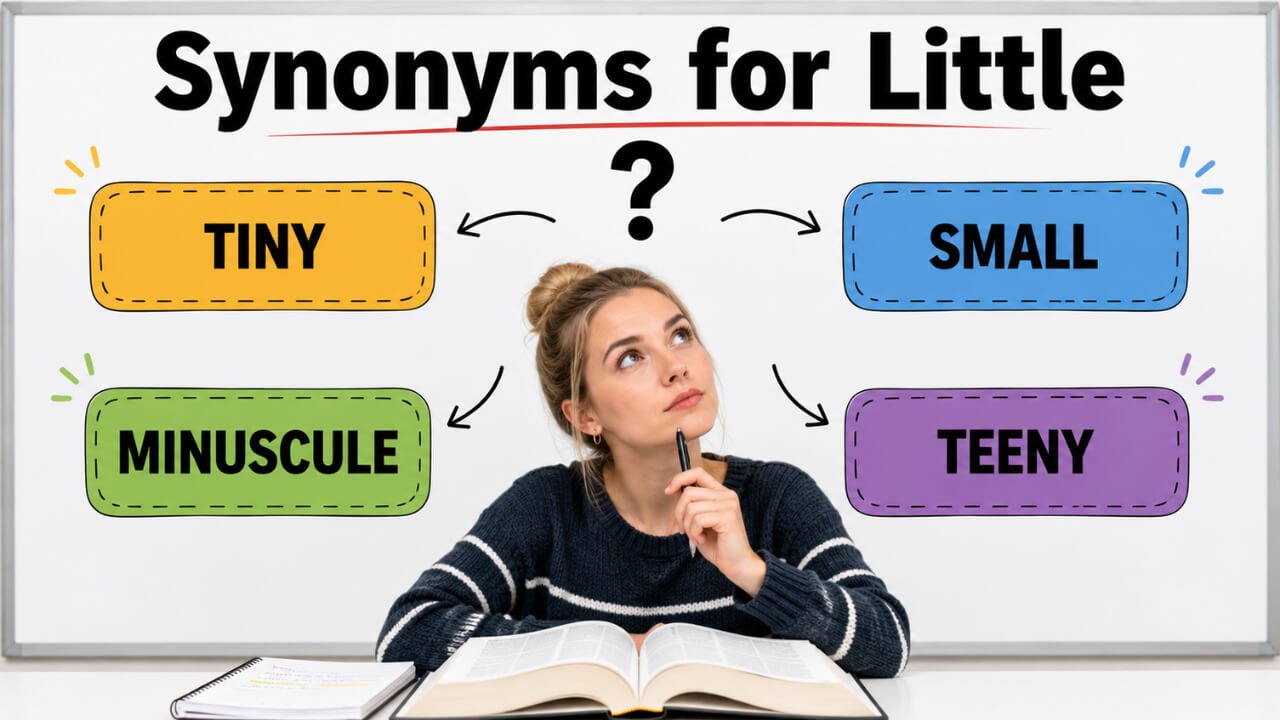
Quick Answer: The best synonyms for little include small, tiny, miniature, slight, limited, minimal, young, brief, minor, and insignificant. Use small for general size, tiny for extremely small objects, limited or minimal for quantity, young for age, brief for time, and minor for importance. In formal writing, minimal, limited, negligible, and insignificant are often more precise. In casual conversation, small, tiny, a bit of, and not much usually sound more natural.
Pronunciation and Word Details
Word: Little.
Pronunciation: /ˈlɪt.əl/
Part of Speech: Adjective, determiner, pronoun, adverb, and noun.
Meaning: Small in size, amount, degree, age, duration, or importance.
US Pronunciation:
UK Pronunciation:
What Does “Little” Mean?
Little means small in size, amount, degree, age, time, or importance. It is a flexible word that can function as an adjective, determiner, pronoun, adverb, or noun.
As an adjective, little can describe the size or age of a person, animal, place, or object.
Example: They live in a little house near the lake.
As a determiner, it describes a small amount of something that cannot usually be counted individually.
Example: We have little time remaining.
As a pronoun, it can stand alone to represent a small amount.
Example: Little was known about the problem.
As an adverb, it means only slightly or not very much.
Example: She little understood how important the decision was.
Little can also express affection when describing a child, animal, or familiar object.
Example: The little puppy followed her around the garden.
Meaning, Tone, and Context of “Little”
Little is usually a neutral and conversational word, but its tone changes according to context. It can sound affectionate, descriptive, negative, dismissive, or informal.
When little describes size, it is generally neutral.
Example: A little table stood beside the window.
When it describes a child or animal, it can sound warm and affectionate.
Example: Their little boy started school this year.
When little refers to quantity without the article a, it often has a negative meaning. It suggests that the amount is smaller than needed or expected.
Example: There is little hope of finishing today.
The phrase a little has a more positive or neutral meaning because it suggests that some amount is available.
Example: There is a little hope of reaching an agreement.
In formal reports, academic writing, and professional communication, words such as minimal, limited, minor, negligible, or insufficient may provide greater precision.
Little can also sound dismissive when it reduces the importance of a person, concern, or achievement.
Example: Calling the project a little hobby made his work sound unimportant.
When and How to Use “Little”
For Small Size: Use little to describe something that is physically small.
Example: She placed the keys inside a little wooden box.
For Small Amounts: Use little before an uncountable noun to describe a small quantity.
Example: There was little water left in the bottle.
For Young Age: Use little to describe a young child or animal.
Example: The little girl carried a bright umbrella.
For Short Duration: Use little when an action or event takes only a small amount of time.
Example: We have little time before the meeting begins.
For Minor Importance: Use little when something has limited importance, effect, or value.
Example: The change made little difference to the final result.
For Affection: Use little when speaking warmly about a child, pet, object, or familiar place.
Example: Their little dog sleeps beside the door.
For Negative Quantity: Use little without a when the available amount is insufficient.
Example: He showed little interest in the proposal.
For Positive Quantity: Use a little when some amount exists and may be enough.
Example: She added a little sugar to the tea.
Best Synonyms for Little
Small: Limited in physical size, amount, or extent.
Example: They opened a small shop near the station.
Tiny: Extremely small in size.
Example: A tiny insect landed on the leaf.
Miniature: A very small version of something larger.
Example: The museum displayed a miniature model of the castle.
Slight: Small in degree, amount, or physical form.
Example: There was a slight improvement in his condition.
Limited: Restricted in amount, number, range, or availability.
Example: The team had limited time to complete the task.
Minimal: Extremely small in amount or degree.
Example: The repairs caused minimal disruption.
Young: Having lived for only a short time.
Example: The young child was learning to read.
Brief: Lasting for a short period.
Example: They had a brief conversation before leaving.
Minor: Small in importance, seriousness, or effect.
Example: The report contained a minor error.
Insignificant: Too small or unimportant to have much effect.
Example: The difference between the totals was insignificant.
50 Synonyms for Little with Short Meanings
- Small: Limited in size, amount, or importance.
- Tiny: Extremely small.
- Miniature: A smaller version of something larger.
- Compact: Small but efficiently arranged.
- Petite: Small and delicately built.
- Slight: Small in amount, degree, or physical form.
- Diminutive: Unusually or noticeably small.
- Minute: Extremely small or difficult to notice.
- Microscopic: So small that it is difficult to see.
- Undersized: Smaller than the usual or expected size.
- Wee: Very small, especially in informal speech.
- Teeny: Extremely small in casual language.
- Puny: Small and physically weak.
- Mini: Smaller than the standard version.
- Narrow: Small in width or range.
- Low: Small in level, amount, or height.
- Short: Small in length, height, or duration.
- Limited: Restricted in amount, range, or availability.
- Minimal: As small as possible in amount or degree.
- Modest: Relatively small and not excessive.
- Meager: Smaller in amount than needed or expected.
- Scant: Barely sufficient in quantity.
- Sparse: Present only in small amounts or numbers.
- Insufficient: Not enough for a particular need.
- Negligible: Too small to have an important effect.
- Fractional: Forming only a very small part.
- Marginal: Very small in amount, value, or effect.
- A bit of: A small amount of something.
- A touch of: A slight amount or degree.
- Not much: Only a small quantity.
- Hardly any: Almost no amount at all.
- A small amount of: A limited quantity of something.
- A modicum of: A small but noticeable amount.
- Young: Having lived for only a short time.
- Younger: Less advanced in age.
- Youthful: Having the qualities or appearance of youth.
- Junior: Younger or lower in position.
- Juvenile: Young or not fully developed.
- Minor: Young, legally underage, or less important.
- Brief: Lasting for a short time.
- Momentary: Continuing for only a moment.
- Fleeting: Passing quickly.
- Passing: Temporary and not lasting.
- Short lived: Existing for only a brief period.
- Trivial: Too unimportant to deserve serious attention.
- Insignificant: Small in importance or effect.
- Unimportant: Having little value or influence.
- Petty: Small and unimportant, often in an irritating way.
- Inconsequential: Having no important result or effect.
- Small scale: Limited in size, scope, or activity.
Read Also:
Synonyms for Diversity

Synonyms for Little by Context
When Little Means Small in Size
Small, tiny, miniature, compact, petite, diminutive, minute, and undersized describe limited physical size.
Small is the most general replacement. Tiny is stronger and emphasizes extremely limited size. Miniature refers to a smaller copy or model of something. Compact describes something small that has been arranged efficiently.
Example: They bought a compact car that was easy to park.
Petite is commonly used for a small and delicately built person. Diminutive is more formal and often emphasizes an unusually small appearance.
Example: The diminutive performer had a powerful voice.
When Little Means Small in Amount
Limited, minimal, meager, scant, sparse, negligible, insufficient, and marginal describe a small quantity or degree.
Limited is useful when an amount is restricted. Minimal means extremely small but does not always suggest a problem. Meager and scant often imply that the amount is not enough.
Example: The family survived on a meager supply of food.
Negligible describes an amount so small that it has almost no effect.
Example: The change had a negligible impact on the total cost.
When Little Means Young
Young, younger, youthful, junior, juvenile, and minor can replace little when it refers to age.
Young is the clearest general alternative. Younger is used when comparing age. Junior may describe a younger family member, student, worker, or competitor.
Example: Her younger brother joined the school this year.
Juvenile is more formal and is often used in legal, scientific, or developmental contexts. Minor refers to someone who has not reached legal adulthood.
Example: The program provides support for juvenile participants.
When Little Means Short in Time
Brief, momentary, fleeting, passing, and short lived describe something that lasts for a small amount of time.
Brief is the most flexible formal alternative. Momentary means lasting for only a moment. Fleeting suggests that something passes quickly and may be difficult to hold or notice.
Example: She felt a fleeting sense of doubt.
Short lived describes something that ends sooner than expected.
Example: Their excitement was short lived after the event was cancelled.
When Little Means Unimportant
Minor, trivial, insignificant, unimportant, petty, marginal, and inconsequential describe limited importance or effect.
Minor is usually neutral and suitable for reports, essays, and professional communication. Trivial suggests that something does not deserve serious attention. Petty often carries a negative tone and can describe small complaints or arguments.
Example: They wasted time discussing petty disagreements.
Inconsequential means that something has no meaningful result.
Example: The formatting issue was inconsequential.
When Little Expresses Affection
Little can express warmth when describing children, pets, homes, or familiar possessions. Depending on the sentence, possible alternatives include young, tiny, dear, sweet, or beloved.
These words are not always direct replacements because affection often comes from the complete phrase rather than the word little alone.
Example: Their dear child greeted every visitor with a smile.
Example: The tiny puppy curled up beside the chair.
Another Word for Little
Small is the best general replacement for little when describing size. However, the strongest alternative depends on whether little refers to quantity, age, duration, importance, or affection.
Use tiny for extremely small objects, limited for restricted amounts, young for age, brief for time, and minor for importance.
Original: They rented a little apartment near the office.
Better Option: They rented a small apartment near the office.
Original: We have little information about the incident.
Better Option: We have limited information about the incident.
Original: She noticed a little change in his expression.
Better Option: She noticed a slight change in his expression.
Original: The delay caused little inconvenience.
Better Option: The delay caused minimal inconvenience.
When Not to Use “Little”
Avoid little when its meaning is unclear. The word may refer to size, amount, age, importance, or duration, so a more precise synonym can improve understanding.
Weak: The study produced little change.
Better: The study produced minimal change.
Do not use little with plural countable nouns when you mean a small number. Use few instead.
Weak: Little students attended the optional class.
Better: Few students attended the optional class.
Little may sound too casual in formal reports when discussing quantities, evidence, risks, or results.
Weak: There was little improvement in performance.
Better: There was minimal improvement in performance.
Avoid little when it could sound dismissive or insulting. Calling someone’s problem, business, or achievement little may suggest that it is unimportant.
Weak: She talked about her little career problem.
Better: She talked about a minor difficulty in her career.
Little can also sound childish or overly affectionate in professional communication.
Weak: Please complete this little task before lunch.
Better: Please complete this brief task before lunch.
Use young rather than little when age is the main point and affection is not intended.
Weak: The research involved little participants.
Better: The research involved young participants.
Words Commonly Confused With Little
Little vs Small: Little and small can both describe size. Little often sounds more personal, emotional, or informal, while small is usually neutral and precise.
Little vs Few: Little is used with uncountable nouns, while few is used with plural countable nouns. Say little water but few bottles.
Little vs A Little: Little suggests an amount that is insufficient. A little means some amount is available and often has a more positive meaning.
Little vs Less: Little describes a small amount. Less compares two quantities and means a smaller amount.
Little vs Least: Least is the superlative form used for the smallest amount or degree among three or more possibilities.
Little vs Young: Little may describe a child affectionately, while young directly describes age.
Little vs Minor: Little is broad and conversational. Minor is more formal and specifically describes limited importance, seriousness, or rank.
Little vs Tiny: Little means small, while tiny places stronger emphasis on extremely small size.
Which Synonym Should You Choose?
Choose small when describing general size in neutral writing or conversation.
Choose tiny when the object is extremely small and you want stronger emphasis.
Choose miniature when describing a reduced copy, model, or version of something larger.
Choose compact when something is small but efficiently designed or arranged.
Choose slight when describing a small change, movement, difference, injury, or degree.
Choose limited when discussing restricted time, money, evidence, access, or resources.
Choose minimal when a quantity, effect, cost, or risk is extremely small.
Choose meager or scant when the available amount is smaller than needed.
Choose young when age is the intended meaning.
Choose brief when discussing a short meeting, message, explanation, or period.
Choose minor when writing formally about a small problem, error, injury, change, or role.
Choose negligible when a difference or effect is too small to matter.
Choose insignificant when something has limited importance or influence.
Choose a bit of or a touch of in casual conversation when referring to a small amount.
Choose few rather than little with plural countable nouns.
In reports and essays, limited, minimal, minor, negligible, and insufficient usually provide better precision. In emails, small, brief, slight, and limited often sound clear and professional. In casual speech, little, tiny, a bit of, and not much are natural choices.
Real Life Examples of “Little” in Sentences
Original: They bought a little table for the kitchen.
Better Option: They bought a compact table for the kitchen.
Original: There is little evidence supporting the claim.
Better Option: There is limited evidence supporting the claim.
Original: She felt a little pain in her shoulder.
Better Option: She felt slight pain in her shoulder.
Original: The little boy waited beside his mother.
Better Option: The young boy waited beside his mother.
Original: We had little time to prepare.
Better Option: We had limited time to prepare.
Original: The update made little difference.
Better Option: The update made a negligible difference.
Original: They held a little meeting after lunch.
Better Option: They held a brief meeting after lunch.
Original: The document contained a little mistake.
Better Option: The document contained a minor mistake.
Original: He showed little enthusiasm for the idea.
Better Option: He showed minimal enthusiasm for the idea.
Original: A little bird sat on the fence.
Better Option: A tiny bird sat on the fence.
Synonym Groups and Usage Differences
Size Group
Small, tiny, miniature, compact, diminutive, petite, and undersized describe physical dimensions.
Small is neutral and general. Tiny is more emphatic. Miniature describes a reduced version of something. Compact suggests efficient use of limited space.
Example: The designer created a compact desk for small rooms.
Quantity Group
Limited, minimal, meager, scant, sparse, insufficient, and negligible describe restricted amounts.
Limited does not always suggest a problem. Meager, scant, and insufficient usually mean the amount is not enough. Negligible means the amount is too small to matter.
Example: Only a scant supply of medicine remained.
Age Group
Young, younger, youthful, junior, juvenile, and minor relate to age or development.
Young is neutral and widely useful. Junior may refer to a younger person or lower position. Juvenile and minor are more formal and may appear in legal or scientific contexts.
Example: The young athlete competed in the junior division.
Time Group
Brief, momentary, fleeting, passing, and short lived describe limited duration.
Brief is suitable for formal and casual writing. Momentary describes something lasting only an instant. Fleeting often describes emotions, thoughts, opportunities, or impressions.
Example: A fleeting smile appeared on her face.
Importance Group
Minor, trivial, insignificant, petty, marginal, and inconsequential describe limited importance.
Minor is neutral and professional. Trivial can dismiss something as unworthy of attention. Petty often describes small minded behavior or unimportant disagreements.
Example: The report required only minor corrections.
Degree Group
Slight, minimal, marginal, fractional, and negligible describe a low level or degree.
Slight is common for changes, differences, movements, and feelings. Fractional describes a very small part. Marginal often refers to a small improvement, difference, or benefit.
Example: The new method produced a marginal improvement.
Antonyms of Little
The opposite of little changes according to whether it refers to size, quantity, age, duration, or importance.
Large: Greater than average in size or amount.
Big: Considerable in physical size, degree, or importance.
Huge: Extremely large.
Enormous: Very great in size, amount, or degree.
Abundant: Available in a large quantity.
Ample: More than enough for a particular need.
Much: A large amount of something uncountable.
Many: A large number of countable people or things.
Major: Important, serious, or considerable.
Significant: Important enough to produce a noticeable effect.
Important: Having considerable value, influence, or meaning.
Substantial: Large in amount, size, or importance.
Mature: Fully developed in age, thought, or growth.
Older: More advanced in age.
Lengthy: Lasting for a long time.
Extensive: Covering a large area, range, or amount.
Comparison: Little vs Related Words
Little vs Small
Little and small can both describe limited size. Small is generally neutral, while little may express affection, familiarity, or personal feeling.
Example With Little: She carried a little bag decorated with flowers.
Example With Small: She carried a small bag that met the size requirement.
Little vs Tiny
Little means small, but tiny describes something extremely small.
Example With Little: A little crack appeared in the wall.
Example With Tiny: A tiny crack was visible near the window.
Little vs Few
Little is used with uncountable nouns. Few is used with plural countable nouns.
Example With Little: We have little information about the event.
Example With Few: We have few details about the event.
Little vs A Little
Little has a negative meaning and suggests that the amount is not enough. A little has a more positive meaning and shows that some amount exists.
Example With Little: There is little chance of success.
Example With A Little: There is a little chance of success.
Little vs Slight
Little is general and conversational. Slight is more precise when describing a small difference, change, movement, pain, or degree.
Example With Little: There was a little change in temperature.
Example With Slight: There was a slight change in temperature.
Little vs Limited
Little describes a small amount, while limited emphasizes restriction or lack of availability.
Example With Little: We have little time remaining.
Example With Limited: We have limited time remaining.
Little vs Minor
Little can describe size, age, quantity, or importance. Minor mainly describes something less serious or important.
Example With Little: The adjustment made little difference.
Example With Minor: The document required a minor adjustment.
Little vs Minimal
Little is common in general conversation. Minimal is more formal and means extremely small in amount or degree.
Example With Little: The process caused little disruption.
Example With Minimal: The process caused minimal disruption.
Little vs Young
Little can affectionately describe a child. Young directly refers to age and is more neutral.
Example With Little: Their little daughter loves drawing.
Example With Young: Their young daughter has started attending school.
Common Phrases and Expressions With Little
A Little Bit: A small amount or degree.
Little by Little: Gradually and in small stages.
Very Little: An extremely small amount.
Too Little Too Late: An action that is insufficient because it happened after the useful time.
Little or No: Almost none or none at all.
Little More Than: Only slightly more than something.
Little One: An affectionate expression for a child or small animal.
Little Chance: A low possibility of success.
Little Time: A short amount of available time.
Think Little Of: Have a low opinion of someone or something.
Make Little Of: Treat something as unimportant or fail to understand it.
Every Little Bit Helps: Even a small contribution can be useful.
Common Mistakes to Avoid
A common mistake is using little with plural countable nouns. Little belongs with uncountable nouns, while few belongs with countable nouns.
Incorrect: There were little chairs in the room.
Correct: There were few chairs in the room.
Do not overlook the difference between little and a little. Little often communicates shortage, while a little communicates the presence of some amount.
Negative Meaning: We have little time, so we may not finish.
Positive Meaning: We have a little time, so we can review the document.
Avoid using less with plural countable nouns when fewer is required.
Incorrect: Less students attended the lecture.
Correct: Fewer students attended the lecture.
Use less with uncountable quantities.
Correct: We have less time today.
Do not automatically replace little with tiny. Tiny is much stronger and may exaggerate the size.
Unnatural: The report contained a tiny problem involving missing records.
Natural: The report contained a minor problem involving missing records.
Avoid using little when it could sound condescending. Describing someone’s company, concern, role, or achievement as little may reduce its importance.
Dismissive: She runs a little business from home.
Neutral: She runs a small business from home.
Do not use littler when smaller would sound more natural. Littler is grammatically possible in some informal contexts, but smaller is usually preferred for physical size.
Awkward: This room is littler than the other one.
Natural: This room is smaller than the other one.
Avoid repeating little throughout the same paragraph. Use precise alternatives such as small, slight, limited, brief, minor, or young according to the intended meaning.
Conclusion
Understanding synonyms for little helps you describe size, quantity, age, duration, and importance with greater precision. Small is the best general alternative, while tiny emphasizes extremely limited size. Limited and minimal work well for amounts, young describes age, brief refers to time, and minor expresses reduced importance. Because little can sound affectionate, negative, vague, or dismissive, the best replacement depends on the sentence. Choosing a context specific synonym makes writing clearer, more natural, and easier to understand.
FAQs About Synonyms for Little
What is the closest synonym for little?
Small is the closest general synonym for little. However, limited, young, brief, or minor may be more accurate in specific contexts.
What is a stronger word than little?
Tiny is stronger when describing physical size. Minimal, negligible, or insignificant can provide stronger emphasis for amount or importance.
What is a formal synonym for little?
Limited, minimal, slight, minor, negligible, and insufficient are useful formal alternatives, depending on the intended meaning.
What is the difference between little and few?
Little is used with uncountable nouns, such as water or time. Few is used with plural countable nouns, such as bottles or hours.
Do little and a little have the same meaning?
No. Little suggests that an amount is insufficient, while a little means that some amount is available.
Can little mean young?
Yes. Little can describe a young child or animal, especially in warm or affectionate language. Young is the clearer neutral alternative.
What is the opposite of little?
Common opposites include large, big, abundant, much, major, significant, mature, and lengthy. The correct antonym depends on the meaning of little in the sentence.
