
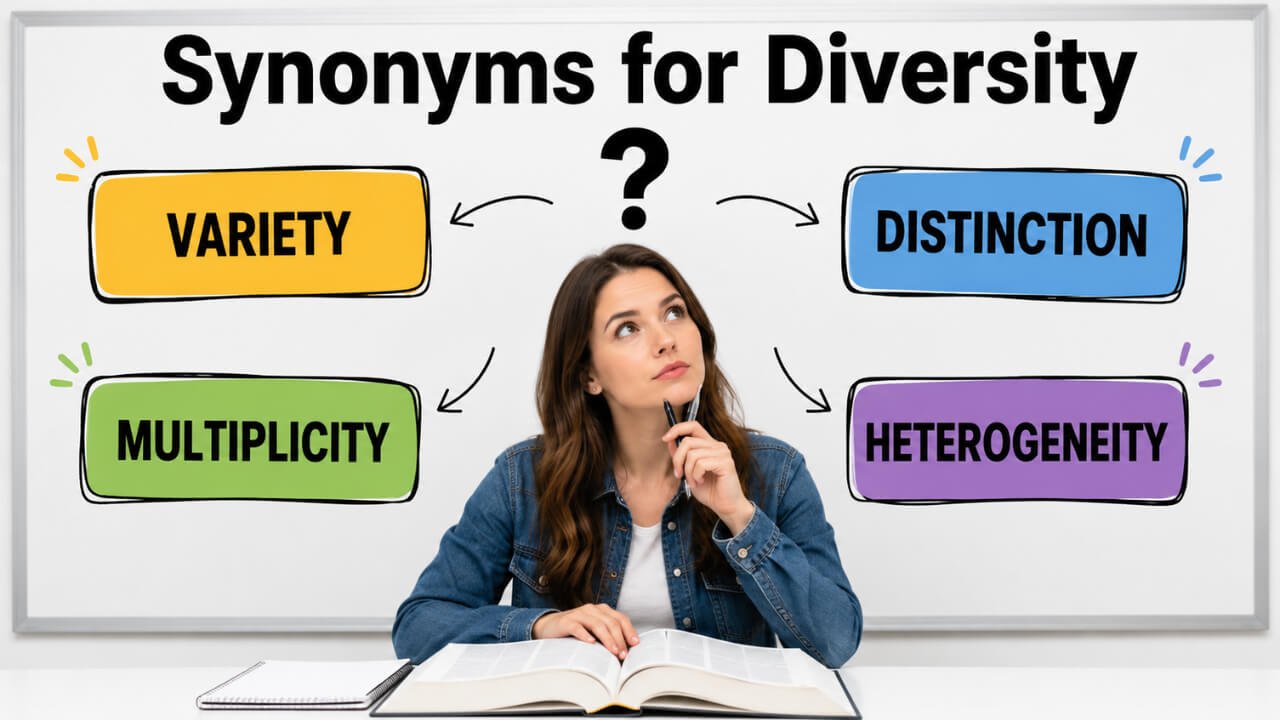
Quick Answer: The best synonyms for diversity include variety, difference, range, mixture, multiplicity, plurality, variation, heterogeneity, assortment, and representation. Variety is the best general replacement when discussing many different types of things. Heterogeneity suits formal, academic, scientific, or technical writing. Plurality emphasizes the presence of several groups or viewpoints. Representation works best when discussing people, communities, identities, or participation. Range and assortment are useful for products, choices, skills, ideas, and experiences.
Pronunciation and Word Details
Word: Diversity
Pronunciation: /daɪˈvɜːrsəti/
Part of Speech: Noun
Meaning: The presence of many different people, qualities, ideas, types, or forms within a group or place.
US Pronunciation:
UK Pronunciation:
What Does “Diversity” Mean?
Diversity means the presence of differences within a group, environment, collection, or system. It is an abstract noun commonly used to describe variation among people, ideas, cultures, species, experiences, abilities, or choices.
The word can refer to visible differences, such as age, appearance, or physical features. It can also describe less visible differences involving knowledge, language, beliefs, skills, backgrounds, perspectives, or ways of thinking.
In social contexts, diversity often refers to the inclusion and representation of people from different communities and backgrounds.
Example: The organization values diversity among its employees.
In biology, diversity describes the range of living organisms found in an environment.
Example: The forest contains an impressive diversity of plant species.
In writing and conversation, diversity can also describe a broad selection of ideas, products, styles, or experiences.
Example: The course offers a diversity of topics for students to explore.
The intended meaning depends on what is varied and why those differences matter.
Meaning, Tone, and Context of “Diversity”
Diversity has a neutral, formal, and generally positive tone. It is commonly used in academic writing, workplace communication, education, science, public policy, community discussions, cultural studies, environmental writing, and everyday conversation.
In social and professional contexts, diversity often suggests that people with different backgrounds, identities, experiences, and perspectives are present within the same group. In these situations, the word may be connected with fairness, representation, participation, and inclusion.
In academic or scientific writing, diversity can have a more technical meaning. Researchers may discuss biological diversity, genetic diversity, linguistic diversity, cultural diversity, or intellectual diversity.
In ordinary conversation, variety may sound more natural than diversity when referring to food, clothing, products, entertainment, or choices.
Formal Context: The study examined linguistic diversity across the region.
Professional Context: A diversity of experiences can improve group decision making.
Scientific Context: Habitat loss threatens the diversity of local wildlife.
Everyday Context: The market offers a wide variety of fresh produce.
Diversity is not always interchangeable with inclusion. Diversity describes who or what is present, while inclusion describes whether those people or differences are welcomed, respected, and involved.
When and How to Use “Diversity”
For Different People and Backgrounds
Use diversity when discussing a group containing people with different cultures, ages, abilities, experiences, identities, or personal backgrounds.
Example: The school encourages diversity among its students and teaching staff.
For Different Ideas and Viewpoints
Use diversity to describe the presence of multiple perspectives, opinions, or approaches.
Example: Diversity of thought helped the committee consider several possible solutions.
For Cultural Differences
Use diversity when discussing languages, customs, traditions, beliefs, art forms, or community practices.
Example: The festival celebrated the cultural diversity of the region.
For Biological Variety
Use diversity when describing the number and range of plants, animals, organisms, or genes in an ecosystem.
Example: Protecting natural habitats helps preserve biological diversity.
For Products and Choices
Use diversity when a collection contains many types, styles, or options. Variety is often a more conversational alternative in this context.
Example: The store is known for the diversity of its handmade products.
For Skills and Experiences
Use diversity to describe a broad collection of abilities, qualifications, and professional experiences.
Example: The team benefits from the diversity of its members’ skills.
For Academic Analysis
Use diversity when examining differences within a population, subject, system, or body of information.
Example: The research explores the diversity of learning methods used in modern classrooms.
For Creative Expression
Use diversity to describe differences in style, design, storytelling, music, art, or performance.
Example: The exhibition displayed an impressive diversity of artistic styles.
Best Synonyms for Diversity
Variety
Synonym: The presence of many different types, forms, or choices.
Example: The restaurant offers a variety of vegetarian meals.
Range
Synonym: A broad selection extending across different types or levels.
Example: The program attracts people with a wide range of abilities.
Multiplicity
Synonym: A large number and variety of people, things, or possibilities.
Example: The issue has a multiplicity of possible causes.
Plurality
Synonym: The presence of more than one group, belief, viewpoint, or form.
Example: The community supports a plurality of cultural traditions.
Heterogeneity
Synonym: The condition of being made up of different or contrasting elements.
Example: The researchers examined the heterogeneity of the population.
Mixture
Synonym: A collection formed by combining different people, things, or qualities.
Example: The neighborhood contains a mixture of old and modern buildings.
Variation
Synonym: Differences occurring within a group, pattern, or category.
Example: The study found considerable variation in reading ability.
Assortment
Synonym: A collection of different types of objects or options.
Example: The shop displayed an assortment of handmade decorations.
Representation
Synonym: The presence or participation of people from different groups.
Example: The council improved the representation of younger residents.
Breadth
Synonym: The wide extent or scope of ideas, knowledge, choices, or experiences.
Example: The breadth of her experience made her suitable for the position.
50 Synonyms for Diversity with Short Meanings
- Variety: The presence of many different types or forms.
- Range: A broad selection of options, qualities, or levels.
- Variation: Differences found within a group or pattern.
- Multiplicity: A large number and variety of elements.
- Plurality: The presence of several groups, ideas, or forms.
- Heterogeneity: A condition containing different kinds of elements.
- Mixture: A combination of different people, things, or qualities.
- Assortment: A collection containing several different types.
- Selection: A group of different items available to choose from.
- Spectrum: A complete range of related qualities or possibilities.
- Breadth: A wide scope of knowledge, experience, or choice.
- Scope: The extent or range covered by something.
- Richness: An abundance of valuable differences or qualities.
- Representation: The presence of people from different groups.
- Inclusion: The act of welcoming different people into a group.
- Inclusiveness: The quality of accepting and involving different people.
- Difference: A quality that makes one person or thing unlike another.
- Distinction: A clear difference between people, things, or categories.
- Dissimilarity: A lack of sameness between two or more things.
- Distinctiveness: The quality of being noticeably different.
- Variability: The ability or tendency to differ or change.
- Diversification: The process of adding different types or options.
- Multiformity: The presence of many different forms.
- Manifoldness: The quality of being numerous and varied.
- Variegation: The state of containing different forms, colors, or qualities.
- Mixedness: The condition of being composed of different elements.
- Complexity: A condition created by many connected and different parts.
- Contrast: A noticeable difference between people, ideas, or things.
- Divergence: The process of becoming different in direction or form.
- Differentiation: The process of identifying or creating differences.
- Disparity: A significant difference between conditions or amounts.
- Uniqueness: The quality of being unlike anything else.
- Individuality: The qualities that make a person or thing distinct.
- Distinctness: The condition of being clearly separate or different.
- Pluralism: The acceptance of different groups, beliefs, or viewpoints.
- Multiculturalism: The presence and recognition of multiple cultures.
- Cultural Variety: The presence of different cultures and traditions.
- Social Variety: Differences among people and social groups.
- Demographic Variety: Differences in age, background, identity, or population.
- Linguistic Variety: The presence of different languages or speech forms.
- Biological Variety: The range of living organisms in an environment.
- Ecological Variety: Differences among ecosystems, habitats, and species.
- Genetic Variation: Differences in inherited traits within a population.
- Intellectual Variety: The presence of different ideas and ways of thinking.
- Perspective Variety: The presence of different viewpoints or interpretations.
- Experiential Variety: Differences in personal or professional experience.
- Skill Variety: A broad collection of different abilities.
- Choice: A selection of different available possibilities.
- Abundance: A large and plentiful supply of different things.
- Blend: A combination of different elements forming one whole.
Read Also:
Synonyms for Dignity
Synonyms for Diversity by Context
When Diversity Means Variety
Variety, range, assortment, selection, spectrum, and breadth work well when diversity refers to many available types, choices, or forms.
Variety is the most natural option for everyday communication. Range emphasizes how far the choices extend, while assortment usually refers to a collection of physical items.
Example: The menu offers a wide variety of traditional dishes.
Example: The course covers a broad range of subjects.
Example: The box contained an assortment of colorful fabrics.
When Diversity Means Human Differences
Representation, inclusion, plurality, social variety, demographic variety, and multiculturalism are useful when discussing differences among people.
Representation focuses on whether different groups are present. Inclusion focuses on whether those people can participate fully. Multiculturalism specifically refers to the presence and recognition of different cultures.
Example: Greater representation improved the quality of the discussion.
Example: Inclusion requires every participant to feel respected.
Example: The city is known for its multiculturalism.
When Diversity Means Different Ideas
Plurality, intellectual variety, perspective variety, breadth, multiplicity, and pluralism suit discussions about ideas, opinions, beliefs, and approaches.
Plurality emphasizes that several viewpoints exist. Pluralism suggests that these differences are accepted or encouraged.
Example: A plurality of opinions was expressed during the meeting.
Example: Intellectual variety can lead to more creative solutions.
Example: The institution supports pluralism in academic debate.
When Diversity Means Biological Variety
Biological variety, ecological variety, genetic variation, richness, variability, and heterogeneity are useful in environmental and scientific contexts.
Biological variety refers to different forms of life. Genetic variation describes inherited differences within a species or population. Ecological variety concerns differences among habitats and ecosystems.
Example: The island contains remarkable biological variety.
Example: Genetic variation can help a population adapt to change.
Example: The region’s ecological variety supports many species.
When Diversity Means Difference
Difference, distinction, dissimilarity, contrast, disparity, and divergence emphasize how people or things are unlike one another.
Difference is neutral and general. Contrast highlights noticeable differences. Disparity often describes an unequal or significant difference in amounts, opportunities, or conditions.
Example: There is a clear difference between the two methods.
Example: The contrast between the designs was immediately visible.
Example: The report identified a disparity in access to resources.
When Diversity Means a Combination
Mixture, blend, mixedness, assortment, and combination describe different elements brought together.
Mixture is broad and neutral. Blend often suggests that the elements work together smoothly. Mixedness focuses on the state of containing different components.
Example: The town contains a mixture of historic and modern architecture.
Example: Her writing is a blend of humor and serious reflection.
When Diversity Means Wide Experience
Breadth, experiential variety, skill variety, range, and scope work well when discussing knowledge, qualifications, abilities, or experience.
Breadth emphasizes wide coverage. Range highlights several different abilities or experiences. Scope refers to the full extent of what is included.
Example: The breadth of his professional experience strengthened the team.
Example: Applicants demonstrated a wide range of technical skills.
Another Word for Diversity
Variety is the best general alternative to diversity because it clearly describes the presence of several different types, forms, ideas, or choices. However, the most accurate replacement depends on whether the sentence concerns people, cultures, species, perspectives, products, or experiences.
Original: The library offers a diversity of reading materials.
Better Option: The library offers a variety of reading materials.
Original: The research examined the diversity of opinions in the community.
Better Option: The research examined the plurality of opinions in the community.
Original: The forest is valued for its diversity of wildlife.
Better Option: The forest is valued for its biological richness.
Original: The committee wants to improve diversity among its members.
Better Option: The committee wants to improve representation among its members.
When Not to Use “Diversity”
Diversity can sound vague when the sentence does not explain what kind of differences are present. A more specific synonym may give readers clearer information.
Weak: The event offered a great deal of diversity.
Better: The event offered a wide variety of cultural performances.
Avoid diversity when range or variety would sound more natural in ordinary descriptions of products, food, clothing, or choices.
Weak: The shop sells a diversity of candles.
Better: The shop sells a variety of candles.
Do not use diversity as an automatic substitute for inclusion. A group may contain different people without giving everyone equal participation, respect, or influence.
Weak: The policy improved diversity by making every employee feel welcome.
Better: The policy improved inclusion by making every employee feel welcome.
Avoid using diversity when disparity is the intended meaning. Diversity is generally neutral or positive, while disparity often refers to inequality.
Weak: The report discusses income diversity between the two areas.
Better: The report discusses income disparity between the two areas.
Do not use diversity when describing one isolated difference between two items.
Weak: There is a diversity between the two answers.
Better: There is a difference between the two answers.
Avoid repeating diversity many times in the same paragraph.
Weak: The program supports cultural diversity, diversity of thought, and diversity of professional experience.
Better: The program supports cultural diversity, varied perspectives, and a broad range of professional experience.
In highly technical writing, choose the term used within the relevant field. Heterogeneity, genetic variation, species richness, or demographic variation may communicate the intended concept more precisely.
Words Commonly Confused With Diversity
Diversity vs Variety: Diversity often refers to meaningful differences within a group or system. Variety usually refers to several available types or choices and sounds more conversational.
Diversity vs Inclusion: Diversity describes who or what is present. Inclusion describes whether different people are welcomed, respected, involved, and able to participate.
Diversity vs Equality: Diversity concerns differences. Equality concerns giving people the same rights, treatment, opportunities, or access.
Diversity vs Equity: Diversity refers to the presence of differences. Equity concerns fair support based on different needs and circumstances.
Diversity vs Representation: Diversity describes the overall range of differences. Representation focuses on whether particular groups are present and visible.
Diversity vs Multiculturalism: Diversity can include differences in age, ability, knowledge, experience, language, and many other qualities. Multiculturalism specifically concerns the presence and recognition of multiple cultures.
Diversity vs Heterogeneity: Diversity is widely used in general and social contexts. Heterogeneity is a more technical term describing a group made up of different elements.
Diversity vs Disparity: Diversity refers to variation or difference. Disparity usually refers to an unequal or significant difference in conditions, resources, or outcomes.
Diversity vs Plurality: Diversity refers broadly to many differences. Plurality emphasizes the presence of several groups, options, beliefs, or viewpoints.
Diversity vs Difference: Difference can describe one point of contrast. Diversity describes many differences existing within a larger group or system.
Which Synonym Should You Choose?
Choose variety for general writing about products, choices, foods, styles, activities, or experiences.
Choose range when emphasizing the extent of available options, skills, ages, abilities, or viewpoints.
Choose assortment when describing a collection of different physical objects.
Choose mixture when different people, qualities, styles, or elements have been combined.
Choose blend when the combined elements work together smoothly as one whole.
Choose plurality when discussing several beliefs, viewpoints, communities, or political positions.
Choose pluralism when different beliefs, cultures, or viewpoints are actively accepted and supported.
Choose representation when discussing whether people from different groups are present in a workplace, institution, committee, or public activity.
Choose inclusion when the sentence concerns participation, belonging, respect, access, or involvement.
Choose multiculturalism when writing specifically about the presence and recognition of multiple cultures.
Choose heterogeneity for academic, scientific, statistical, or technical writing about a group containing unlike elements.
Choose variation when describing measurable differences within data, behavior, language, performance, or biological traits.
Choose disparity when discussing unequal conditions, opportunities, resources, or results.
Choose biological variety or ecological variety when writing about plants, animals, habitats, or ecosystems.
Choose breadth when emphasizing the wide extent of someone’s knowledge, experience, interests, or abilities.
Choose multiplicity when highlighting the large number and complexity of different possibilities or causes.
Real Life Examples of “Diversity” in Sentences
Original: The school welcomes diversity among its students.
Better Option: The school welcomes students from a variety of backgrounds.
Original: The garden contains an impressive diversity of plants.
Better Option: The garden contains an impressive range of plants.
Original: The committee benefits from diversity of thought.
Better Option: The committee benefits from a plurality of perspectives.
Original: The store offers great diversity in its product collection.
Better Option: The store offers a broad assortment of products.
Original: The report examined the diversity of household income.
Better Option: The report examined the variation in household income.
Original: The forest is protected because of its natural diversity.
Better Option: The forest is protected because of its biological richness.
Original: The team’s diversity helped it understand different customers.
Better Option: The team’s broad representation helped it understand different customers.
Original: The city is admired for its cultural diversity.
Better Option: The city is admired for its multicultural character.
Original: The course encourages diversity in academic discussion.
Better Option: The course encourages pluralism in academic discussion.
Original: Her diversity of experience made her a strong candidate.
Better Option: The breadth of her experience made her a strong candidate.
Synonym Groups and Usage Differences
Variety and Choice Group
Variety, range, assortment, selection, spectrum, breadth, and scope describe different options, forms, or possibilities.
Variety is the most flexible everyday term. Assortment often refers to physical items, while spectrum suggests a continuous range between two extremes.
Example: The workshop covered a broad spectrum of creative techniques.
Human Representation Group
Representation, inclusion, inclusiveness, social variety, demographic variety, and multiculturalism relate to differences among people and communities.
Representation asks who is present. Inclusion asks who is welcomed and involved. Multiculturalism focuses specifically on cultural differences.
Example: Better representation gave more community members a voice.
Difference Group
Difference, distinction, dissimilarity, contrast, distinctiveness, and distinctness describe qualities that make people or things unlike one another.
Distinction suggests a clear dividing feature. Distinctiveness often highlights a memorable or special quality.
Example: The distinctiveness of each regional style was easy to recognize.
Academic and Technical Group
Heterogeneity, multiplicity, variability, differentiation, divergence, and disparity are common in academic, analytical, and technical writing.
Heterogeneity describes unlike elements within a group. Variability refers to the degree of change or difference. Disparity usually highlights inequality.
Example: The study measured variability in student performance.
Cultural and Social Group
Plurality, pluralism, multiculturalism, cultural variety, linguistic variety, and demographic variety describe differences in society, language, beliefs, and culture.
Plurality means that several groups or views are present. Pluralism suggests acceptance of those differences.
Example: Linguistic variety reflects the region’s long cultural history.
Biological Group
Biological variety, ecological variety, genetic variation, richness, and variability describe differences in living organisms and natural systems.
Biological variety has a broad meaning, while genetic variation refers specifically to inherited differences within a population.
Example: Genetic variation improves the ability of some species to adapt.
Combination Group
Mixture, blend, mixedness, multiformity, and variegation describe collections formed from unlike elements.
Blend often suggests harmony. Mixture is more neutral and does not necessarily imply that the parts fit together smoothly.
Example: The design uses a blend of traditional and contemporary styles.
Individual Difference Group
Uniqueness, individuality, distinctiveness, and distinction focus on the qualities that make a person or thing different from others.
Uniqueness suggests that something is unlike anything else. Individuality emphasizes personal character or identity.
Example: The artist’s individuality is visible in every painting.
Antonyms of Diversity
The opposite of diversity depends on whether the sentence concerns variety, difference, representation, biology, or thought.
Uniformity: The condition of being the same throughout.
Sameness: A lack of meaningful difference.
Similarity: The quality of being alike.
Homogeneity: The condition of containing elements of the same type.
Conformity: Behavior or appearance that follows one common standard.
Consistency: The condition of remaining similar or unchanged.
Standardization: The process of making things follow one uniform model.
Monotony: A lack of variety that makes something repetitive or dull.
Uniformness: The quality of having little or no variation.
Singularity: The condition of involving only one type or form.
Exclusion: The act of preventing people from participating or belonging.
Segregation: The separation of people into different groups.
Imbalance: Uneven representation or distribution.
Narrowness: A limited range of ideas, experiences, or choices.
Identicalness: The condition of being exactly alike.
Repetition: The continued use of the same form, idea, or pattern.
Comparison: Diversity vs Related Words
Diversity vs Variety
Diversity often describes meaningful differences among people, ideas, cultures, or living organisms. Variety usually describes a selection of different types or choices.
Example With Diversity: The team values diversity of experience and perspective.
Example With Variety: The menu offers a variety of fresh salads.
Diversity vs Inclusion
Diversity concerns the presence of differences. Inclusion concerns whether different people feel welcomed, respected, and involved.
Example With Diversity: The group includes people from many professional backgrounds.
Example With Inclusion: Every member is encouraged to contribute to the discussion.
Diversity vs Representation
Diversity describes the overall range of differences. Representation focuses on whether particular communities or groups are present.
Example With Diversity: The class has considerable cultural diversity.
Example With Representation: The committee needs stronger representation from rural communities.
Diversity vs Heterogeneity
Diversity is common in general, social, cultural, and environmental writing. Heterogeneity is more technical and often appears in academic or scientific analysis.
Example With Diversity: The city is known for its cultural diversity.
Example With Heterogeneity: The researchers measured the heterogeneity of the sample.
Diversity vs Plurality
Diversity emphasizes many kinds of differences. Plurality emphasizes that several groups, beliefs, or options exist together.
Example With Diversity: The conference welcomed a diversity of professional experiences.
Example With Plurality: The debate reflected a plurality of political opinions.
Diversity vs Multiculturalism
Diversity includes many kinds of differences, such as age, experience, skill, culture, and ability. Multiculturalism specifically describes the presence and recognition of different cultures.
Example With Diversity: The workplace values diversity in skills and experience.
Example With Multiculturalism: The curriculum promotes multiculturalism through the study of several cultural traditions.
Diversity vs Disparity
Diversity is a neutral description of differences. Disparity usually refers to an unequal or unfair difference.
Example With Diversity: The region contains a diversity of economic activities.
Example With Disparity: The report identified a disparity in access to education.
Diversity vs Variation
Diversity describes the overall presence of different types. Variation refers to particular differences or changes within a group, measurement, or pattern.
Example With Diversity: The landscape has remarkable ecological diversity.
Example With Variation: Researchers observed variation in rainfall across the region.
Common Phrases and Expressions With Diversity
Cultural Diversity: The presence of different cultures, customs, and traditions.
Biological Diversity: The range of living organisms within an environment.
Workplace Diversity: Differences in background, identity, experience, and ability among workers.
Diversity of Thought: The presence of different ideas, opinions, and approaches.
Diversity of Experience: A range of personal, educational, or professional experiences.
Diversity and Inclusion: The presence of differences combined with meaningful participation and belonging.
Linguistic Diversity: The presence of multiple languages or forms of speech.
Genetic Diversity: The range of inherited differences within a species or population.
Cultural and Social Diversity: Differences involving traditions, communities, lifestyles, and social backgrounds.
Promote Diversity: To encourage the presence and participation of different people or ideas.
Celebrate Diversity: To recognize and appreciate meaningful differences.
Value Diversity: To respect the benefits of different perspectives, identities, or experiences.
Increase Diversity: To bring a wider range of people, ideas, or elements into a group.
Lack of Diversity: The absence of sufficient variation or representation.
Rich Diversity: A large and valuable range of differences.
Common Mistakes to Avoid
A common mistake is treating diversity and inclusion as identical. Diversity describes the presence of differences, while inclusion concerns participation, respect, and belonging.
Unclear: The group achieved inclusion by adding people from different backgrounds.
Clearer: The group increased diversity by adding people from different backgrounds.
Another mistake is using diversity where variety sounds more natural.
Unnatural: The café offers a diversity of desserts.
Natural: The café offers a variety of desserts.
Avoid using diversity to describe one difference between two objects. Use difference, distinction, or contrast instead.
Incorrect: The diversity between the two plans is obvious.
Correct: The difference between the two plans is obvious.
Do not use disparity as a general synonym for diversity. Disparity often implies inequality or an uneven difference.
Incorrect: The garden contains a disparity of flowers.
Correct: The garden contains a variety of flowers.
Writers should also avoid vague claims about diversity. Explain what kind of variation is present.
Vague: The course supports diversity.
Specific: The course supports cultural diversity and a plurality of academic viewpoints.
Avoid repeating diversity several times when more precise alternatives are available.
Repetitive: Diversity in culture and diversity in experience contribute to diversity in thought.
Improved: Cultural variety and different life experiences contribute to a broader range of perspectives.
Do not assume that a visible mixture of people automatically proves inclusion, fairness, or equal influence. Choose words that accurately describe the specific idea.
Be careful with technical contexts. Biological diversity, genetic variation, species richness, and ecological variety have related but distinct meanings. Select the term that matches the subject being discussed.
Avoid forcing formal alternatives into casual sentences. Heterogeneity may be correct in research writing but can sound unnecessarily technical in everyday communication.
Overly Formal: The restaurant offers considerable heterogeneity in its menu.
Natural: The restaurant offers considerable variety in its menu.
Conclusion
Useful synonyms for diversity include variety, range, plurality, mixture, heterogeneity, representation, and breadth. Variety suits general choices and collections, while representation works best when discussing people and communities. Plurality describes multiple viewpoints, and heterogeneity is appropriate for academic or technical analysis. Biological variety and genetic variation suit environmental topics. Because each alternative highlights a different type of difference, selecting synonyms for diversity according to context makes writing more accurate, natural, and informative.
FAQs About Synonyms for Diversity
What Is the Best Synonym for Diversity?
Variety is the best general synonym for diversity. It works naturally when discussing different types, choices, forms, ideas, or experiences.
What Is a Formal Synonym for Diversity?
Heterogeneity, multiplicity, plurality, and variability are useful formal alternatives. The best choice depends on the academic or technical context.
What Is Another Word for Cultural Diversity?
Multiculturalism, cultural variety, cultural plurality, and cultural richness are useful alternatives for cultural diversity.
Are Diversity and Inclusion Synonyms?
No. Diversity describes the presence of differences, while inclusion describes whether different people are welcomed, respected, and able to participate.
What Is a Synonym for Diversity of Thought?
Plurality of perspectives, intellectual variety, range of viewpoints, and diversity of opinion are suitable alternatives.
What Is a Scientific Synonym for Diversity?
Heterogeneity, variation, species richness, biological variety, and genetic variation may be appropriate in scientific writing.
What Is the Opposite of Diversity?
Common opposites include uniformity, sameness, homogeneity, conformity, and monotony. The most accurate antonym depends on the sentence.
