
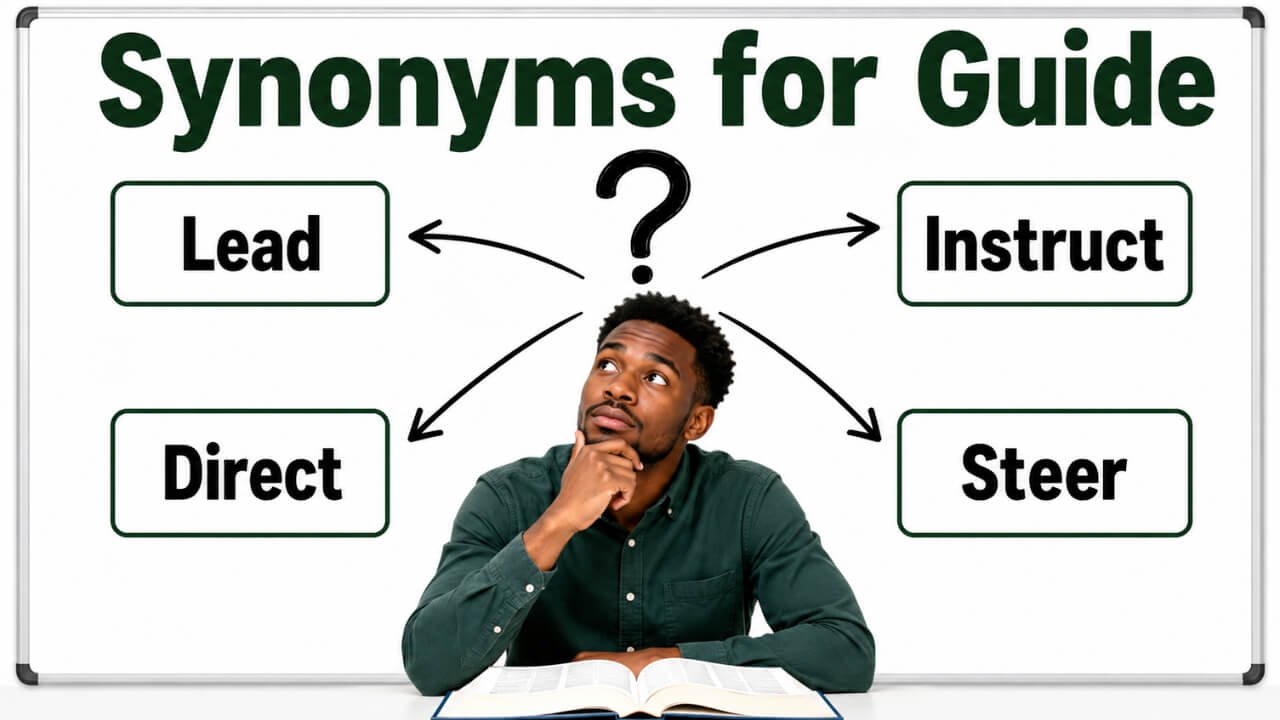
Quick Answer: The best synonyms for guide include lead, direct, instruct, advise, mentor, coach, escort, navigate, manual, and handbook. The phrase synonyms for guide can describe people, actions, or written resources. Use lead when showing direction, direct when controlling a process, instruct when teaching steps, advise when offering recommendations, mentor for personal development, escort for physical assistance, and manual for a written source of information.
Pronunciation and Word Details
Word: Guide.
Pronunciation: /ɡaɪd/
Part of Speech: Noun and verb.
Meaning: A guide is a person, resource, or action that provides direction, information, instruction, or support.
US Pronunciation:
UK Pronunciation:
What Does “Guide” Mean?
Guide means to show someone the correct direction, explain how something works, or help a person make a decision. As a verb, it describes the act of leading, teaching, advising, or directing someone. As a noun, it can refer to a person who leads others or a document that provides useful instructions.
The word works in many sentence contexts. A person can guide visitors through a building, guide a student through a difficult lesson, or guide a team toward a goal. A book, manual, or set of instructions can also serve as a guide.
As a Verb: The teacher guided the students through the assignment.
As a Person: Our guide showed us the safest path.
As a Resource: This guide explains the application process clearly.
Meaning, Tone, and Context of “Guide”
Guide is generally a neutral, helpful, and positive word. It often suggests support without complete control. Someone who guides another person usually provides direction while allowing that person to participate, learn, or make choices.
In formal writing, guide may describe leadership, professional advice, educational support, or an important principle. In everyday conversation, it often refers to showing someone where to go or explaining what to do.
The word is common in education, travel, leadership, personal development, business communication, technical instructions, and decision making. Its tone can become more authoritative when it means direct or control, but it is usually softer than command or order.
Formal Context: The policy will guide future decisions.
Educational Context: The tutor guided the learner through the exercise.
Conversational Context: Can you guide me to the nearest entrance?
Technical Context: The manual guides users through the setup process.
When and How to Use “Guide”
For Physical Direction
Use guide when someone helps another person move toward a place or follow a safe route.
Example: A volunteer guided the visitors to their seats.
For Teaching
Use guide when a teacher, instructor, or knowledgeable person explains a process gradually.
Example: The trainer guided the group through each exercise.
For Advice
Use guide when someone provides helpful suggestions that influence a decision.
Example: Her experience guided her choice of career.
For Leadership
Use guide when a person helps a group move toward a goal without sounding overly controlling.
Example: The manager guided the team through a difficult transition.
For Written Instructions
Use guide for a document, article, handbook, or resource that explains a subject.
Example: This study guide covers the main ideas in each chapter.
For Principles
Use guide when a belief, value, or rule influences behavior or judgment.
Example: Honesty should guide every important decision.
For Personal Support
Use guide when someone helps another person develop skills, confidence, or understanding.
Example: A trusted mentor guided her during the early years of her career.
Best Synonyms for Guide
Lead
Synonym: To show the way or move ahead of others.
Example: She led the guests toward the main hall.
Direct
Synonym: To control, organize, or point someone toward a particular action.
Example: The coordinator directed everyone to the correct room.
Instruct
Synonym: To teach someone how to perform a task.
Example: The trainer instructed the employees on the new procedure.
Advise
Synonym: To offer an opinion or recommendation.
Example: The counselor advised him to review every option carefully.
Mentor
Synonym: To support someone’s long term personal or professional development.
Example: An experienced editor mentored the new writer.
Coach
Synonym: To train someone and improve performance through practical support.
Example: She coached the speakers before the presentation.
Escort
Synonym: To accompany someone to a destination for assistance or protection.
Example: An attendant escorted the visitors into the building.
Navigate
Synonym: To find or plan a route through a place, process, or challenge.
Example: The adviser helped us navigate the complicated application process.
Manual
Synonym: A written document containing instructions or practical information.
Example: The manual explains how to operate the equipment safely.
Handbook
Synonym: A compact reference containing essential information about a subject.
Example: The employee handbook outlines workplace expectations.
50 Synonyms for Guide with Short Meanings
- Lead: To show the way toward a destination or goal.
- Direct: To point, manage, or control an action.
- Instruct: To teach someone how to do something.
- Advise: To offer a helpful recommendation.
- Counsel: To provide thoughtful or professional advice.
- Mentor: To support someone’s long term development.
- Coach: To train and encourage better performance.
- Teach: To help someone gain knowledge or skills.
- Conduct: To lead people through an activity or place.
- Escort: To accompany someone to a destination.
- Accompany: To go somewhere with another person.
- Navigate: To find a route through a place or process.
- Steer: To control movement or influence direction.
- Pilot: To lead something through a difficult process.
- Shepherd: To watch over and direct a group carefully.
- Show: To demonstrate where to go or what to do.
- Demonstrate: To explain something by showing it in action.
- Explain: To make an idea or process easier to understand.
- Orient: To help someone become familiar with a place or situation.
- Inform: To provide useful facts or knowledge.
- Assist: To help someone complete a task.
- Support: To provide encouragement, help, or direction.
- Influence: To affect a person’s decision or behavior.
- Govern: To control actions through rules or principles.
- Manage: To organize and control a process or group.
- Supervise: To oversee work and provide direction.
- Facilitate: To make a process easier to complete.
- Tutor: To teach someone individually.
- Train: To develop skills through instruction and practice.
- Enlighten: To give someone greater knowledge or understanding.
- Adviser: A person who gives recommendations.
- Counselor: A person who offers professional guidance.
- Mentor: An experienced person who supports development.
- Coach: A person who improves another person’s skills.
- Teacher: A person who provides education.
- Instructor: A person who teaches practical knowledge or methods.
- Leader: A person who directs a group toward a goal.
- Escort: A person who accompanies and assists another.
- Companion: A person who travels or spends time with another.
- Navigator: A person who determines the correct route.
- Pathfinder: A person who discovers or shows a new way.
- Director: A person who controls or manages an activity.
- Conductor: A person who leads a group or organized activity.
- Manual: A document containing instructions.
- Handbook: A practical reference containing essential information.
- Tutorial: A lesson that explains a process clearly.
- Reference: A source used to find reliable information.
- Roadmap: A plan showing how to reach a goal.
- Instructions: Detailed directions for completing a task.
- Directory: An organized source of names, places, or information.
Read Also:
Synonyms for Display

Synonyms for Guide by Context
When Guide Means Lead or Direct
Lead, direct, steer, conduct, pilot, and shepherd are useful when guide describes moving people or controlling progress.
Lead is the most natural general replacement. Direct suggests greater authority and control. Steer often describes influencing a choice or outcome. Conduct is suitable for organized tours, activities, or events. Pilot works well for difficult projects or unfamiliar processes.
Example: She guided the group toward the exit.
Alternative: She led the group toward the exit.
Example: The chairperson guided the discussion.
Alternative: The chairperson directed the discussion.
When Guide Means Teach or Explain
Instruct, teach, demonstrate, tutor, train, explain, and enlighten work when guide refers to learning.
Instruct is best for clear steps or formal teaching. Demonstrate involves showing a method in action. Tutor usually describes individual academic support. Train focuses on developing practical ability through repeated practice.
Example: The expert guided us through the repair.
Alternative: The expert instructed us through the repair process.
Example: She guided the student through the calculation.
Alternative: She tutored the student on the calculation.
When Guide Means Advise or Support
Advise, counsel, mentor, coach, assist, support, and influence fit situations involving decisions or development.
Advise focuses on recommendations. Counsel sounds more thoughtful or professional. Mentor describes long term development. Coach usually involves practical improvement, motivation, and measurable performance.
Example: His values guided his decision.
Alternative: His values influenced his decision.
Example: A senior colleague guided her career development.
Alternative: A senior colleague mentored her.
When Guide Means Accompany
Escort, accompany, conduct, shepherd, and show are suitable when someone physically goes with another person.
Escort may suggest assistance, formality, safety, or protection. Accompany simply means going with someone. Show is more casual and usually appears in expressions such as show someone around.
Example: The host guided us to our table.
Alternative: The host escorted us to our table.
Example: She guided the guests around the garden.
Alternative: She showed the guests around the garden.
When Guide Means a Helpful Person
Adviser, counselor, mentor, coach, teacher, instructor, leader, navigator, and companion can describe a person who provides direction.
The best choice depends on the type of help. An adviser offers recommendations. A teacher provides knowledge. A mentor supports long term growth. A navigator identifies the best route through a literal or figurative challenge.
Example: He became my guide during the project.
Alternative: He became my adviser during the project.
When Guide Means a Written Resource
Manual, handbook, tutorial, reference, roadmap, instructions, and directory can replace guide when it refers to written information.
A manual contains detailed operational information. A handbook provides essential rules or facts. A tutorial teaches a process. A roadmap presents stages, goals, or future plans.
Example: Read the guide before using the equipment.
Alternative: Read the manual before using the equipment.
Another Word for Guide
Lead is often the best general verb replacement for guide because both words can describe showing someone the correct direction. However, the best alternative depends on whether the sentence involves movement, education, advice, leadership, or written information.
Use direct for authority, instruct for teaching, advise for recommendations, mentor for development, escort for physical assistance, and manual for a written resource.
Original: She guided the visitors through the museum.
Better Option: She led the visitors through the museum.
Original: The specialist guided us through the procedure.
Better Option: The specialist instructed us on the procedure.
Original: His teacher guided him when choosing a subject.
Better Option: His teacher advised him when choosing a subject.
Original: This guide explains the safety rules.
Better Option: This handbook explains the safety rules.
When Not to Use “Guide”
Guide can sound too general when a more precise word would explain the action clearly. Avoid it when the sentence needs to show whether someone taught, commanded, advised, accompanied, or managed another person.
It may also become repetitive in educational or instructional writing. Replacing it with teach, demonstrate, explain, instruct, or coach can make the meaning more specific.
When Authority Is Important
Use direct, command, manage, or supervise when the person has formal control.
Weak: The supervisor guided the workers to complete the urgent task.
Better: The supervisor directed the workers to complete the urgent task.
When Formal Advice Is Given
Use advise or counsel when the focus is on recommendations rather than direction.
Weak: The lawyer guided her about the agreement.
Better: The lawyer advised her about the agreement.
When Detailed Teaching Is Involved
Use instruct, teach, train, or demonstrate when someone explains a method.
Weak: The technician guided us how to install the part.
Better: The technician instructed us on how to install the part.
When Someone Simply Travels With Another Person
Use accompany or escort when no instruction or leadership is involved.
Weak: Her friend guided her to the event.
Better: Her friend accompanied her to the event.
When Referring to a Specific Document
Use manual, handbook, tutorial, directory, or reference when the type of resource matters.
Weak: Check the guide for the operating instructions.
Better: Check the manual for the operating instructions.
Words Commonly Confused With Guide
Guide vs Lead: Guide often suggests helpful direction and support, while lead may suggest taking the first position or assuming responsibility for progress.
Guide vs Direct: Guide sounds cooperative and supportive. Direct sounds more authoritative and controlled.
Guide vs Instruct: Guide can involve general support, while instruct specifically means teaching someone what to do.
Guide vs Advise: Guide may influence an entire process. Advise usually means giving a recommendation or opinion.
Guide vs Mentor: Guide can describe brief or practical help. Mentor usually describes a continuing developmental relationship.
Guide vs Coach: Guide is broad, while coach focuses on improving ability, confidence, or performance.
Guide vs Escort: Guide involves showing the way or providing information. Escort mainly means accompanying someone to a destination.
Guide vs Manual: Guide can be a person, action, or resource. Manual specifically refers to a written instructional document.
Guide vs Handbook: A guide may cover a process or topic broadly. A handbook usually contains condensed rules, facts, or procedures for regular use.
Guide vs Directory: A guide explains or advises. A directory mainly organizes contact details, names, locations, or categories.
Which Synonym Should You Choose?
Choose lead when someone shows the way toward a place, goal, or result.
Choose direct when a person controls an activity, gives firm instructions, or manages movement.
Choose instruct when explaining a procedure, rule, method, or technical process.
Choose teach when helping someone gain knowledge or understanding over time.
Choose advise when offering a recommendation about a choice or decision.
Choose counsel when providing careful, serious, or professional advice.
Choose mentor when supporting someone’s long term personal, academic, or professional growth.
Choose coach when improving practical skills, confidence, habits, or performance.
Choose escort when accompanying someone for assistance, politeness, or protection.
Choose navigate when helping someone move through a complicated system, situation, or challenge.
Choose manual when referring to detailed written instructions for equipment or procedures.
Choose handbook when referring to a practical collection of rules, facts, or essential information.
Choose tutorial when explaining a process through a structured lesson.
Choose roadmap when presenting goals, stages, priorities, or a future plan.
Choose reference when describing a source that readers consult for accurate information.
Real Life Examples of “Guide” in Sentences
Original: The receptionist guided us to the waiting area.
Better Option: The receptionist directed us to the waiting area.
Original: The teacher guided the class through the difficult chapter.
Better Option: The teacher instructed the class on the difficult chapter.
Original: Her older colleague guided her during her first year at work.
Better Option: Her older colleague mentored her during her first year at work.
Original: The signs guided drivers toward the correct entrance.
Better Option: The signs directed drivers toward the correct entrance.
Original: His principles guided every major decision.
Better Option: His principles influenced every major decision.
Original: The trainer guided the participants through the routine.
Better Option: The trainer coached the participants through the routine.
Original: A staff member guided the guests to their seats.
Better Option: A staff member escorted the guests to their seats.
Original: This guide explains how to prepare for the examination.
Better Option: This handbook explains how to prepare for the examination.
Original: The consultant guided the organization through the change.
Better Option: The consultant helped the organization navigate the change.
Original: She guided the child in solving the puzzle.
Better Option: She assisted the child in solving the puzzle.
Synonym Groups and Usage Differences
Direction Group
Lead, direct, steer, navigate, conduct, and pilot relate to movement or progress.
Lead is the broadest option. Direct suggests authority. Steer means controlling or influencing direction. Navigate is useful for complicated routes or systems. Pilot often describes managing something through a challenging period.
Example: She steered the discussion toward a practical solution.
Teaching Group
Instruct, teach, train, tutor, demonstrate, and explain involve learning.
Teach is broad and natural. Instruct focuses on specific directions. Train develops practical ability. Tutor often involves individual academic support. Demonstrate means showing how something works.
Example: The instructor demonstrated the correct technique.
Advice Group
Advise, counsel, influence, enlighten, and inform involve knowledge or recommendations.
Advise is suitable for most decisions. Counsel sounds more serious and thoughtful. Inform provides facts without necessarily suggesting an action. Influence describes an effect on someone’s thinking or behavior.
Example: The counselor advised her to consider every possible outcome.
Development Group
Mentor, coach, support, assist, and facilitate focus on progress and improvement.
Mentor usually suggests a continuing relationship. Coach is more practical and performance focused. Support provides general help. Facilitate means making a process easier.
Example: An experienced colleague mentored him throughout the project.
Accompaniment Group
Escort, accompany, conduct, shepherd, and show relate to going with someone.
Escort can imply safety or formality. Accompany is neutral. Shepherd suggests carefully keeping a group together. Show is casual and natural when introducing a place.
Example: The host showed the visitors around the building.
Leadership Group
Lead, manage, govern, supervise, direct, and conduct involve control or responsibility.
Manage focuses on organization. Govern relates to rules or principles. Supervise means overseeing work. Direct involves giving clear instructions or controlling an activity.
Example: She supervised the team during the final stage.
Written Resource Group
Manual, handbook, tutorial, reference, roadmap, instructions, and directory describe informational resources.
Manual is best for detailed operating information. Handbook covers rules and essential facts. Tutorial teaches a process. Roadmap presents stages and goals. Directory organizes useful details.
Example: The tutorial explains each stage of the process clearly.
Antonyms of Guide
The opposite of guide depends on whether guide means lead, advise, teach, assist, or provide clear direction. Some antonyms describe giving wrong information, while others describe refusing support or making progress more difficult.
Mislead: To cause someone to believe or follow something incorrect.
Confuse: To make information or direction difficult to understand.
Disorient: To make someone uncertain about position or direction.
Hinder: To make progress more difficult.
Obstruct: To block movement, understanding, or progress.
Abandon: To leave someone without needed help or support.
Neglect: To fail to provide proper attention or assistance.
Discourage: To reduce someone’s confidence or willingness to act.
Conceal: To hide information that could provide direction.
Follow: To move behind another person rather than lead.
Ignore: To give no attention to someone’s need for direction.
Prevent: To stop an action or process from moving forward.
Comparison: Guide vs Related Words
Guide vs Lead
Guide emphasizes helping someone find the right way. Lead often emphasizes taking responsibility or moving in front of others.
Example With Guide: She guided the new employee through the daily routine.
Example With Lead: She led the department through a major change.
Guide vs Direct
Guide sounds supportive and collaborative. Direct sounds firmer and usually suggests greater authority.
Example With Guide: He guided the students during the activity.
Example With Direct: He directed the students to leave the room quietly.
Guide vs Instruct
Guide may involve support throughout a process. Instruct focuses on giving knowledge, rules, or specific steps.
Example With Guide: The expert guided us through the planning stage.
Example With Instruct: The expert instructed us to complete the form first.
Guide vs Advise
Guide can involve continuing assistance. Advise usually means offering a recommendation about what someone should do.
Example With Guide: Her manager guided her throughout the project.
Example With Advise: Her manager advised her to revise the schedule.
Guide vs Mentor
Guide can describe brief or situational help. Mentor suggests ongoing support for personal or professional growth.
Example With Guide: A colleague guided him through the registration process.
Example With Mentor: A senior colleague mentored him for several years.
Guide vs Coach
Guide provides direction in a broad sense. Coach helps someone improve skills, confidence, behavior, or performance.
Example With Guide: She guided him through the interview process.
Example With Coach: She coached him to answer interview questions confidently.
Guide vs Escort
Guide means showing a route or explaining a place. Escort emphasizes accompanying someone.
Example With Guide: The volunteer guided the visitors around the center.
Example With Escort: The volunteer escorted the visitors to the main entrance.
Guide vs Manual
Guide can refer to any helpful source. Manual usually contains detailed instructions about a product, system, or procedure.
Example With Guide: This guide offers useful writing advice.
Example With Manual: The manual explains how to operate the machine.
Guide vs Handbook
Guide often teaches a process or introduces a subject. Handbook provides essential information, rules, or procedures for repeated use.
Example With Guide: The guide explains how to plan the project.
Example With Handbook: The handbook lists the organization’s policies.
Common Phrases and Expressions With “Guide”
Guide Someone Through: To help a person complete a process or understand a situation.
Guide the Way: To show the correct direction or set an example for others.
Guiding Principle: A belief or rule that influences decisions and behavior.
Practical Guide: A useful resource focused on real actions and methods.
Complete Guide: A resource that covers most or all important parts of a subject.
Study Guide: A resource designed to help someone prepare for a lesson or examination.
Travel Guide: A person or resource that provides information about a place.
User Guide: A document explaining how to use a system, item, or service.
Step by Step Guide: Instructions presented in a clear and logical order.
Guide by Example: To influence others through personal behavior rather than commands.
Guide to Success: Advice or instructions intended to help someone achieve a goal.
Beginner’s Guide: A simple introduction created for someone with little experience.
Common Mistakes to Avoid
One common mistake is using guide when a more exact verb would improve clarity. In technical writing, instruct or demonstrate may explain the action more precisely. In professional decision making, advise or counsel may be more suitable.
Writers also repeat guide too frequently in educational content. Varying it with explain, teach, lead, assist, or direct can make the writing smoother.
Avoid confusing guide with control. Guiding usually allows some independence, while commanding or directing may involve stronger authority.
Do not use escort when the sentence involves teaching rather than physical accompaniment. Similarly, do not use mentor for a brief interaction because mentoring normally suggests continuing development.
Be careful with grammar after guide. Natural structures include guide someone through a process, guide someone toward a goal, and guide someone in making a decision.
Unnatural: She guided me about completing the form.
Natural: She guided me through the process of completing the form.
Unclear: The document guided the equipment.
Clear: The manual guided the operator through the equipment setup.
Repetitive: The guide guided readers through the guide.
Improved: The handbook led readers through the instructions.
Conclusion
The best synonyms for guide depend on whether the word describes leadership, teaching, advice, movement, or a written resource. Use lead or direct for direction, instruct or teach for learning, advise or counsel for recommendations, mentor or coach for development, and escort for physical accompaniment. Manual, handbook, tutorial, and roadmap are strong noun alternatives. Understanding these synonyms for guide will help you choose more accurate, natural, and engaging language for conversations, essays, instructions, reports, and professional writing.
FAQs About Synonyms for Guide
What Is the Best Synonym for Guide?
Lead is the best general verb synonym. Manual is a strong alternative when guide refers to a written instructional resource.
What Is a Formal Synonym for Guide?
Direct, instruct, counsel, facilitate, and supervise are suitable formal alternatives, depending on the context.
What Is Another Word for a Person Who Guides Others?
Mentor, adviser, counselor, leader, coach, instructor, and navigator can describe a person who guides others.
Can Mentor Be a Synonym for Guide?
Yes. Mentor is appropriate when someone provides continuing support for another person’s personal, academic, or professional development.
What Is a Synonym for Guide in Teaching?
Teach, instruct, tutor, train, demonstrate, coach, and explain are useful choices for educational contexts.
What Is Another Word for a Written Guide?
Manual, handbook, tutorial, reference, roadmap, directory, and instructions are useful alternatives for a written guide.
What Is the Difference Between Guide and Direct?
Guide suggests supportive direction, while direct usually suggests stronger authority, control, or specific instructions.
