
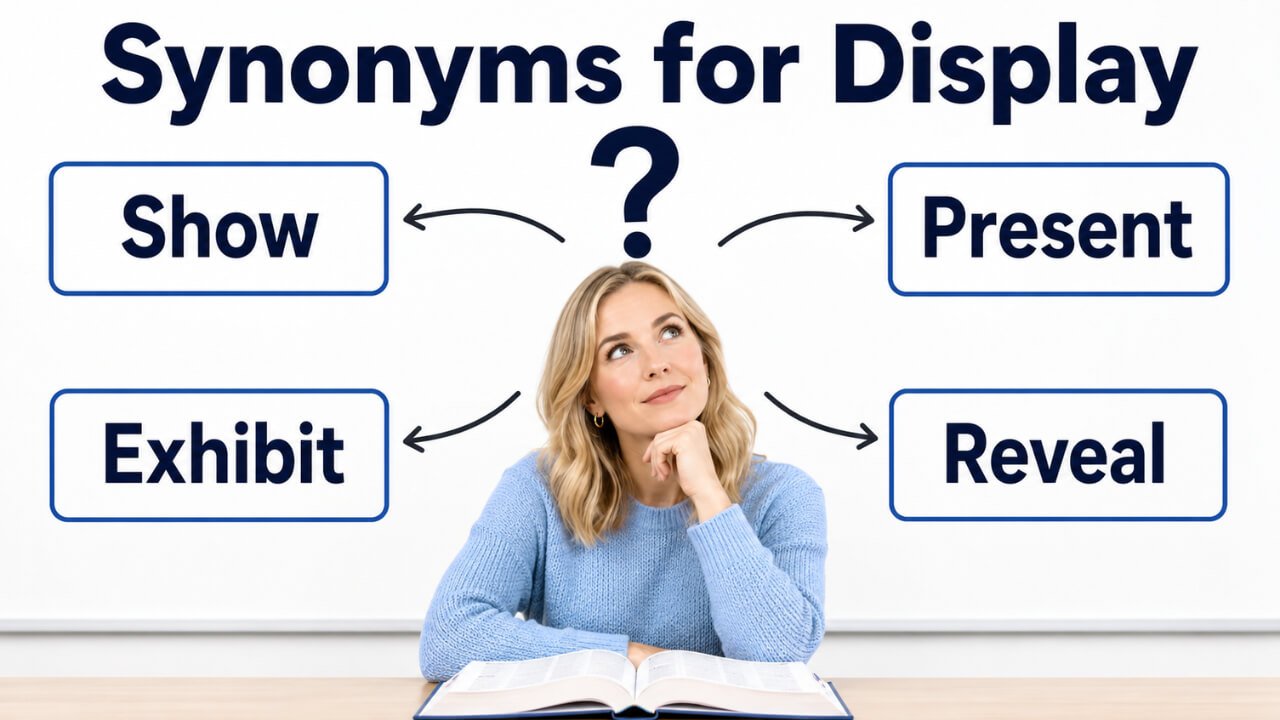
Quick Answer: Synonyms for display include show, present, exhibit, reveal, demonstrate, showcase, portray, indicate, express, and arrange. Use present in formal writing, show in everyday conversation, exhibit for objects placed before the public, demonstrate for proof or ability, reveal for hidden information, express for emotions, and showcase for impressive qualities. The best synonyms for display depend on whether you mean showing information, presenting an object, expressing a feeling, proving a fact, or arranging something for attention.
Pronunciation and Word Details
Word: Display.
Pronunciation: /dɪˈspleɪ/.
Part of Speech: Verb and noun.
Meaning: Display means to show, present, arrange, or make something visible, or it can refer to a visual presentation or screen.
US Pronunciation:
UK Pronunciation:
What Does “Display” Mean?
Display means to show something so that people can see, notice, examine, or understand it. It works as both a verb and a noun.
As a verb, display can describe showing an object, presenting information, expressing emotion, demonstrating skill, or making a quality noticeable. For example, a museum may display artwork, a report may display results, and a person may display confidence.
As a noun, display refers to an arrangement, presentation, exhibition, or visual screen. A store display contains arranged products, while a digital display presents text, images, or data.
The exact meaning depends on the sentence. In “The chart displays the results,” display means presents. In “She displayed great patience,” it means demonstrated or showed. In “The flowers formed a beautiful display,” it refers to an attractive arrangement.
Meaning, Tone, and Context of “Display”
Display is a neutral and versatile word used in formal, casual, academic, professional, creative, and technical contexts. It usually communicates the idea of making something visible or noticeable.
In everyday conversation, show is often more natural than display. Someone may say, “Show me the photograph,” rather than “Display the photograph.” Display sounds more deliberate and organized because it often suggests that something has been placed, arranged, or presented for attention.
In academic and professional writing, display commonly describes charts, tables, results, evidence, behavior, or measurable qualities. A graph may display changes, while a participant may display a particular response.
In emotional contexts, display can describe visible feelings or attitudes. A person can display anger, affection, patience, courage, or confidence.
In technical contexts, display may refer to a screen, panel, visual interface, or the process of presenting digital information. Its tone remains objective and precise in these situations.
When and How to Use “Display”
For Showing Objects: Use display when an object is placed where people can see or examine it.
Example: The gallery will display several historical paintings.
For Presenting Information: Use display when data, text, images, or results appear in a clear visual form.
Example: The chart displays the monthly sales figures.
For Expressing Emotion: Use display when a feeling becomes visible through words, behavior, facial expressions, or actions.
Example: He displayed genuine concern for the injured visitor.
For Demonstrating Ability: Use display when someone shows a skill, quality, or level of performance.
Example: The musician displayed remarkable control throughout the performance.
For Providing Evidence: Use display when facts, results, or actions make something clear.
Example: The results display a significant improvement in reading ability.
For Arranging Products: Use display when products or objects are organized to attract attention.
Example: The shop displayed the new collection near the entrance.
For Digital Information: Use display when a device or screen presents visual content.
Example: The monitor displays the current temperature.
For Public Presentation: Use display when something is intentionally shown to an audience.
Example: The students displayed their projects during the school exhibition.
Best Synonyms for Display
Show: To make something visible or understandable.
Example: Please show the final design to the committee.
Present: To formally introduce, offer, or place something before an audience.
Example: The researcher will present the findings tomorrow.
Exhibit: To place an object where the public can view it.
Example: The museum will exhibit rare sculptures this month.
Reveal: To make hidden or unknown information visible.
Example: The investigation revealed several important details.
Demonstrate: To show clearly through evidence, action, or performance.
Example: The results demonstrate the value of regular practice.
Showcase: To present the best features of someone or something attractively.
Example: The event will showcase the work of local artists.
Portray: To represent a person, feeling, or situation in words or images.
Example: The painting portrays a peaceful village scene.
Indicate: To show that something exists, is true, or is likely.
Example: The figures indicate a steady increase in demand.
Express: To communicate a thought, emotion, or attitude.
Example: Her face expressed surprise and relief.
Arrange: To organize objects in a particular order or visual presentation.
Example: They arranged the flowers in a circular pattern.
50 Synonyms for Display with Short Meanings
- Show: To make something visible or known.
- Present: To formally place something before an audience.
- Exhibit: To show an object publicly.
- Reveal: To uncover something previously hidden.
- Demonstrate: To prove or show something clearly.
- Indicate: To point to or provide evidence of something.
- Portray: To represent through words, images, or performance.
- Depict: To show something in a picture or description.
- Illustrate: To explain or show through an example or image.
- Express: To communicate a thought, feeling, or quality.
- Manifest: To make a quality or condition clearly noticeable.
- Expose: To uncover or make something visible.
- Disclose: To make private information known.
- Unveil: To reveal something publicly for the first time.
- Feature: To give special attention or importance to something.
- Showcase: To present attractive or impressive qualities.
- Advertise: To present something to attract public attention.
- Arrange: To organize items in a particular order.
- Mount: To prepare and place something for public viewing.
- Stage: To organize a public presentation or event.
- Project: To show an image on a surface or screen.
- Screen: To present visual content on a screen.
- Broadcast: To transmit information to an audience.
- Publish: To make written or visual content publicly available.
- Post: To place information where others can view it.
- Put on View: To place something where it can be seen.
- Presentation: A formal showing of information or ideas.
- Exhibition: A public showing of objects or creative work.
- Demonstration: An act of showing how something works.
- Showing: An event or act in which something is presented.
- Arrangement: An organized placement of objects.
- Layout: The planned visual organization of information or objects.
- Spectacle: An impressive or unusual public sight.
- Array: An attractive or organized group of things.
- Collection: A group of related objects shown together.
- Selection: A chosen group of items for viewing.
- Assortment: A varied collection of objects.
- Spread: A wide and noticeable arrangement of items.
- Lineup: An organized series of people, objects, or features.
- Panel: A surface or section that presents information.
- Monitor: A screen that shows digital information.
- Interface: A visual area through which information is presented.
- Visualization: A visual representation of information or data.
- Representation: A form that shows or stands for something.
- Illustration: A picture or example that explains something.
- Portrayal: A representation of a person, event, or situation.
- Evidence: Information that shows or supports a conclusion.
- Expression: A visible or spoken sign of a feeling or idea.
- Manifestation: A clear sign or appearance of a quality.
- Disclosure: The act of making information known.
Read Also:
Synonyms for Bold

Synonyms for Display by Context
When Display Means Show
When display simply means making something visible, the best alternatives include show, present, reveal, feature, and put on view.
Show is the most natural choice in everyday speech. Present sounds more formal and usually involves an audience. Feature suggests giving something special attention.
Example: The guide showed the visitors a collection of ancient tools.
Example: The report presents the information in a clear table.
When Display Means Exhibit Publicly
When objects, products, artwork, or collections are placed before the public, use exhibit, showcase, mount, stage, or unveil.
Exhibit is common for museums, galleries, fairs, and public collections. Showcase emphasizes the attractive or impressive qualities of what is being presented. Unveil is suitable when something is revealed publicly for the first time.
Example: The gallery will exhibit the artist’s latest paintings.
Example: The festival showcases traditional clothing and crafts.
When Display Means Reveal Information
When display involves making facts or hidden details known, use reveal, disclose, expose, indicate, or demonstrate.
Reveal is the most general option. Disclose often refers to private or official information. Expose usually suggests uncovering something that was deliberately hidden.
Example: The report revealed an unexpected change in customer behavior.
Example: The records disclosed the total cost of the project.
When Display Means Express Emotion
When feelings, attitudes, or personal qualities become visible, use express, show, manifest, demonstrate, or exhibit.
Express is best for communicating emotions through words, behavior, or facial expressions. Manifest is more formal and describes a quality becoming clearly noticeable.
Example: She expressed sincere gratitude for the assistance.
Example: The child showed excitement when the doors opened.
When Display Means Demonstrate Skill
When someone displays talent, knowledge, courage, patience, or ability, use demonstrate, show, exhibit, reveal, or manifest.
Demonstrate is suitable for formal writing and performance evaluation. Exhibit often refers to behavior or a noticeable personal quality.
Example: The candidate demonstrated strong leadership during the activity.
Example: The player exhibited impressive control under pressure.
When Display Means Arrange Objects
When display refers to organizing items for visual effect, use arrange, mount, stage, organize, lay out, or present.
Arrange focuses on placement and order. Mount often describes preparing artwork, photographs, or information for viewing.
Example: The staff arranged the books according to subject.
Example: The photographs were mounted along the main wall.
When Display Refers to a Screen
When display means a device or surface that presents digital information, use screen, monitor, panel, interface, or visual panel.
Screen is the most familiar term. Monitor usually refers to a complete viewing device. Panel may describe a smaller information surface or control area.
Example: The screen shows the current schedule.
Example: The monitor presents detailed performance information.
Another Word for Display
Show is often the best single replacement for display because it is clear, natural, and suitable for many contexts. However, the best alternative depends on what is being displayed and why it is being shown.
Use present for formal information, exhibit for public objects, demonstrate for evidence or ability, and express for emotions.
Original: The graph displays changes in temperature.
Better Option: The graph shows changes in temperature.
Original: The museum displays traditional clothing.
Better Option: The museum exhibits traditional clothing.
Original: She displayed excellent communication skills.
Better Option: She demonstrated excellent communication skills.
Original: His expression displayed genuine disappointment.
Better Option: His expression revealed genuine disappointment.
When Not to Use “Display”
Do not use display when a simpler or more precise word would make the sentence clearer. Display may sound overly formal in casual conversation, especially when show communicates the same idea naturally.
Weak: Can you display the photograph to me?
Better: Can you show me the photograph?
Avoid display when you mean explain. Showing information and explaining information are different actions.
Weak: The teacher displayed why the answer was incorrect.
Better: The teacher explained why the answer was incorrect.
Do not use display when reveal is needed to emphasize hidden information becoming known.
Weak: The investigation displayed the secret arrangement.
Better: The investigation revealed the secret arrangement.
Avoid display when express is more natural for feelings communicated through words.
Weak: She displayed her concerns during the conversation.
Better: She expressed her concerns during the conversation.
Do not repeat display several times in one paragraph. Choose synonyms that reflect each exact meaning.
Weak: The report displays the figures, displays the differences, and displays the final result.
Better: The report presents the figures, illustrates the differences, and reveals the final result.
Words Commonly Confused With Display
Display vs Show: Show is broader and more conversational. Display often suggests deliberate presentation, arrangement, or visual placement.
Display vs Present: Display focuses on making something visible. Present often involves formally giving information, ideas, or material to an audience.
Display vs Exhibit: Exhibit commonly describes objects, artwork, products, or qualities placed before public attention. Display can refer to both public and private presentation.
Display vs Demonstrate: Display means to show something. Demonstrate means to prove, explain, or show clearly through evidence, action, or performance.
Display vs Reveal: Display makes something visible, while reveal makes something previously hidden or unknown visible.
Display vs Express: Display can describe emotions becoming noticeable. Express emphasizes communicating those feelings through words, actions, or appearance.
Display vs Portray: Display places something before viewers. Portray represents a person, event, emotion, or situation through language, art, or performance.
Display vs Depict: Display means to show something directly. Depict means to represent it in a picture, description, or artistic form.
Display vs Screen: Display can be an action or a visual presentation. Screen usually refers to the surface or device on which visual information appears.
Display vs Monitor: A display is any visual presentation or viewing surface. A monitor is a particular device used to show digital content.
Which Synonym Should You Choose?
Choose show for casual conversation, simple instructions, and general explanations.
Choose present for formal meetings, academic writing, reports, essays, and organized information.
Choose exhibit when referring to artwork, historical objects, products, collections, or behavior.
Choose showcase when the purpose is to emphasize attractive, impressive, or valuable qualities.
Choose demonstrate when showing proof, ability, knowledge, skill, or the effect of something.
Choose reveal when hidden, surprising, or previously unknown information becomes visible.
Choose disclose when private, sensitive, official, or financial information is made known.
Choose indicate when facts, signs, or results suggest a particular meaning or conclusion.
Choose illustrate when examples, pictures, charts, or comparisons help explain an idea.
Choose portray when describing how a person, situation, or emotion is represented in writing or art.
Choose depict when referring to a visual or written representation of a scene.
Choose express when discussing emotions, beliefs, ideas, concerns, or opinions.
Choose arrange when objects are placed in a planned visual order.
Choose screen or monitor when referring to digital information shown on a device.
Choose visualization when data or complex information is presented in a visual form.
Real Life Examples of “Display” in Sentences
Original: The museum displays several ancient coins.
Better Option: The museum exhibits several ancient coins.
Original: The table displays the final results.
Better Option: The table presents the final results.
Original: She displayed great courage during the emergency.
Better Option: She demonstrated great courage during the emergency.
Original: His face displayed clear disappointment.
Better Option: His face revealed clear disappointment.
Original: The event displayed the work of young designers.
Better Option: The event showcased the work of young designers.
Original: The diagram displays how the system works.
Better Option: The diagram illustrates how the system works.
Original: The evidence displays a clear connection between the events.
Better Option: The evidence indicates a clear connection between the events.
Original: The screen displays the current time.
Better Option: The screen shows the current time.
Original: She displayed her opinions clearly during the discussion.
Better Option: She expressed her opinions clearly during the discussion.
Original: The entrance displayed colorful flowers.
Better Option: The entrance featured a colorful arrangement of flowers.
Synonym Groups and Usage Differences
General Showing Group
Show, present, feature, and put on view describe making something visible or available for attention. Show is the most flexible and conversational word, while present sounds more organized and formal.
Example: The report presents the main findings in a simple format.
Public Exhibition Group
Exhibit, showcase, mount, stage, and unveil describe showing objects, performances, products, or creative work publicly. Showcase emphasizes quality, while unveil suggests a first public appearance.
Example: The exhibition showcased the work of emerging artists.
Evidence Group
Demonstrate, indicate, reveal, prove, and illustrate describe showing that something is true or meaningful. Demonstrate is strong in formal analysis, while indicate is more cautious.
Example: The findings indicate a gradual improvement in performance.
Emotion Group
Express, show, manifest, exhibit, and reveal describe making emotions or attitudes noticeable. Express often suggests intentional communication, while reveal can describe an emotion that becomes visible unintentionally.
Example: Her voice revealed a sense of uncertainty.
Representation Group
Portray, depict, illustrate, and represent describe showing a person, event, idea, or scene through language, art, or imagery.
Example: The novel portrays family life during a period of change.
Arrangement Group
Arrange, mount, organize, stage, and lay out describe placing objects in a planned order for viewing.
Example: The team arranged the materials in clearly marked sections.
Digital Group
Screen, monitor, panel, interface, and visualization relate to digital or electronic presentations. Screen is the general surface, while interface describes the visual system through which a user receives information.
Example: The interface presents each option in a clear menu.
Disclosure Group
Reveal, disclose, expose, and unveil involve making information or objects known. Disclose is often formal, expose may carry a negative meaning, and unveil often suggests a planned public introduction.
Example: The document disclosed several previously unknown expenses.
Antonyms of Display
The antonyms of display depend on whether it means showing, revealing, expressing, or arranging something.
Hide: To keep something where it cannot be seen.
Conceal: To deliberately prevent something from being discovered.
Cover: To place something over an object so it is not visible.
Suppress: To prevent information, emotion, or evidence from becoming known.
Withhold: To refuse to provide or reveal something.
Remove: To take something away from view.
Store: To place something somewhere for future use rather than display.
Obscure: To make something difficult to see or understand.
Disguise: To change the appearance of something to hide its identity.
Mask: To cover or hide a feeling, quality, or fact.
Restrict: To limit access to information or objects.
Withdraw: To remove something from public presentation.
Bury: To hide information or place it where it is difficult to find.
Minimize: To make something appear less noticeable or important.
Restrain: To control or prevent the expression of emotion.
Comparison: Display vs Related Words
Display vs Show
Display usually suggests deliberate or organized presentation. Show is a general word that works naturally in most everyday situations.
Example With Display: The library displays new books near the entrance.
Example With Show: Please show me where the history books are kept.
Display vs Present
Display emphasizes visibility, while present emphasizes formally delivering or introducing information to an audience.
Example With Display: The screen displays the final score.
Example With Present: The manager will present the annual report.
Display vs Exhibit
Display can describe almost anything made visible. Exhibit is more strongly connected with public objects, artwork, products, and noticeable behavior.
Example With Display: The office displays photographs of former employees.
Example With Exhibit: The gallery will exhibit modern paintings.
Display vs Demonstrate
Display means to show a quality or object. Demonstrate means to show something clearly enough to prove it or explain how it works.
Example With Display: The student displayed confidence during the interview.
Example With Demonstrate: The student demonstrated how the machine operated.
Display vs Showcase
Display is neutral, while showcase suggests presenting the best or most impressive features of something.
Example With Display: The event displayed several new products.
Example With Showcase: The event showcased the most innovative products.
Display vs Reveal
Display involves making something visible. Reveal emphasizes that it was previously hidden, secret, or unknown.
Example With Display: The chart displays the current figures.
Example With Reveal: The final figures reveal a serious decline.
Display vs Express
Display describes an emotion or attitude becoming visible. Express focuses on communicating that emotion or idea.
Example With Display: He displayed frustration through his behavior.
Example With Express: He expressed his frustration in a calm discussion.
Display vs Depict
Display means to show something directly. Depict means to represent something through an image, description, or artistic work.
Example With Display: The hall displays a collection of paintings.
Example With Depict: The paintings depict life in a coastal village.
Common Phrases and Expressions With “Display”
On Display: Placed where people can see or examine it.
Display Screen: A surface that shows digital information or images.
Display Case: A protective container used to show valuable objects.
Public Display: An action, object, or expression shown openly before other people.
Visual Display: A presentation that communicates through images, text, colors, or shapes.
Display Information: To make facts or data visible.
Display Emotion: To make a feeling noticeable through expression or behavior.
Display Confidence: To behave in a way that shows certainty and self belief.
Display Results: To present findings, figures, or outcomes visually.
Display Skills: To demonstrate an ability through action or performance.
Common Mistakes to Avoid
Using Display in Every Context: Display is versatile, but it is not always the most natural choice. Use show in casual speech, present in formal situations, and demonstrate when evidence or skill is involved.
Confusing Display With Explain: Display means to show, while explain means to make something understandable through details or reasons.
Choosing Reveal Without Hidden Information: Reveal is suitable when something was unknown or concealed. Use show or present when the information was already available.
Using Exhibit Too Broadly: Exhibit works naturally with artwork, objects, products, and behavior. It may sound unnatural for ordinary instructions or casual requests.
Ignoring the Noun and Verb Difference: Display can be an action or a thing. In “They display the products,” it is a verb. In “The product display looks attractive,” it is a noun.
Using the Wrong Preposition: Information usually appears on a screen, in a report, or within a section. Choose the preposition according to the location of the content.
Repeating Display: Avoid using the same word several times in nearby sentences. Replace it with show, present, indicate, demonstrate, reveal, or illustrate when appropriate.
Using Display for Private Feelings: A person may feel an emotion without displaying it. Display means that the feeling becomes visible through words, facial expressions, or behavior.
Confusing Screen and Display: A screen is the physical viewing surface, while display can refer to the visual content, the surface, or the act of showing information.
Writing Vague Sentences: Explain what is being displayed and why it matters. Specific nouns make the sentence clearer and more useful.
Conclusion
Synonyms for display include show, present, exhibit, demonstrate, reveal, showcase, express, illustrate, and arrange. Show works well in casual speech, while present suits reports and formal communication. Exhibit and showcase are useful for public objects or impressive work. Demonstrate fits skills and evidence, reveal introduces hidden information, and express describes emotions. Choosing a context specific replacement helps readers understand whether something is being presented, proven, arranged, represented, or made visible.
FAQs About Synonyms for Display
What Is the Best Synonym for Display?
Show is the best general synonym for display. Present, exhibit, demonstrate, reveal, and showcase may be more accurate in specific contexts.
What Is a Formal Synonym for Display?
Present, demonstrate, exhibit, indicate, manifest, and disclose are useful formal alternatives. The best choice depends on whether you are showing information, evidence, objects, or qualities.
What Is Another Word for Displaying Information?
Presenting, showing, illustrating, visualizing, and communicating are useful alternatives for displaying information.
What Is Another Word for a Product Display?
A product display can be called a showcase, arrangement, presentation, exhibition, layout, or product presentation.
Is Display the Same as Show?
Display and show are similar, but display often suggests deliberate arrangement or visual presentation. Show is broader and more common in everyday speech.
What Is a Synonym for Displaying Emotion?
Expressing, showing, revealing, manifesting, and exhibiting are suitable synonyms for displaying emotion.
What Is the Difference Between Display and Demonstrate?
Display means to make something visible or noticeable. Demonstrate means to show something clearly through evidence, action, or explanation.
