
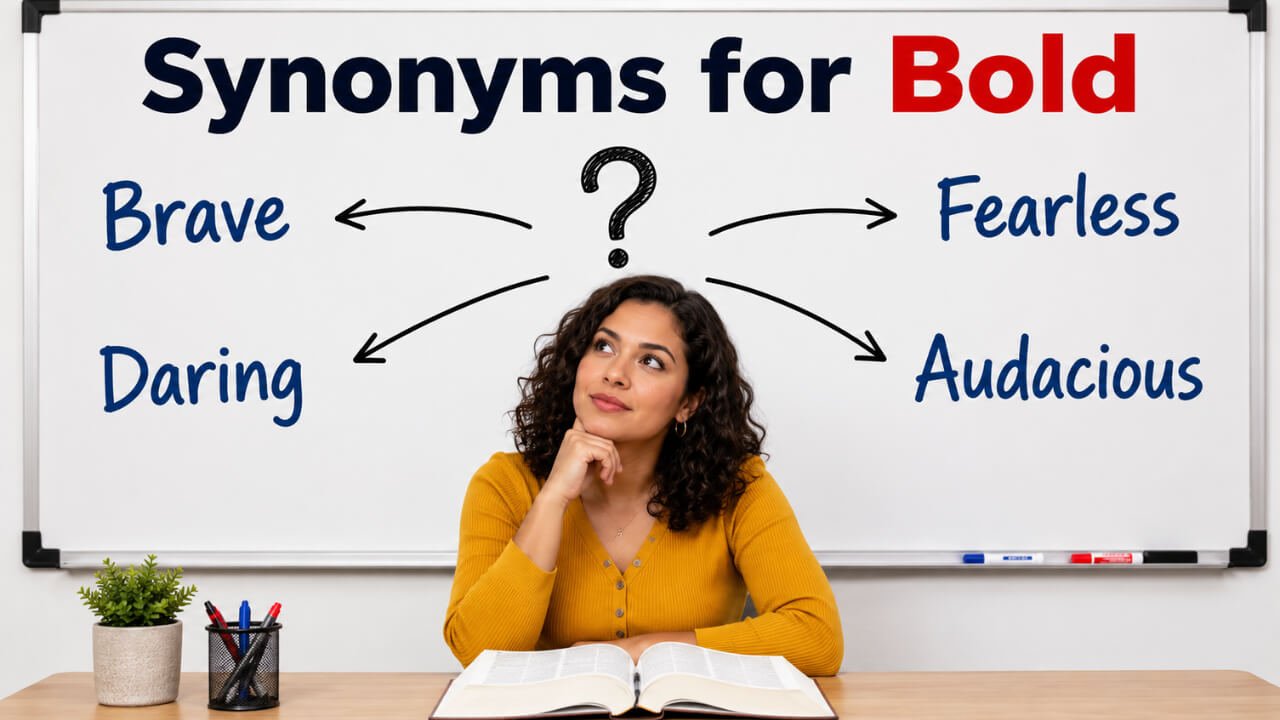
Quick Answer: Synonyms for bold include brave, courageous, daring, fearless, confident, assertive, audacious, striking, vivid, and forceful. Use courageous for brave actions, assertive for confident communication, audacious for surprising risks, striking for noticeable designs, vivid for strong colors, and forceful for powerful speech. The best replacement depends on whether bold describes courage, confidence, direct language, visual impact, or thick printed text.
Pronunciation and Word Details
Word: Bold.
Pronunciation: /boʊld/.
Part of Speech: Adjective, verb, and noun.
Meaning: Bold means brave, confident, noticeable, strongly expressed, or printed in thick and dark letters.
US Pronunciation:
UK Pronunciation:
What Does “Bold” Mean?
Bold means showing courage, confidence, strength, or a willingness to take risks. It is mainly used as an adjective, but it can also describe a style of printed text or the action of making text darker and thicker.
A bold person is willing to speak, act, or make decisions without being controlled by fear. A bold statement expresses a strong opinion clearly. A bold color is vivid and noticeable, while bold text appears thicker and darker than ordinary text.
The meaning changes with the sentence context. In “She made a bold decision,” the word suggests courage. In “He gave a bold response,” it suggests confidence or directness. In “The room has bold colors,” it describes strong visual impact.
Meaning, Tone, and Context of “Bold”
Bold is a strong and generally positive word when it describes courage, confidence, creativity, or leadership. It can suggest that someone is willing to act despite uncertainty or possible criticism.
In formal writing, bold may describe an ambitious proposal, a courageous decision, or a striking design. In casual conversation, it can describe someone who is fearless, confident, or willing to do something surprising.
The tone can become negative when bold means disrespectfully forward or overly confident. In this context, words such as brazen, impudent, or presumptuous may express the meaning more accurately.
Bold is also a neutral technical term in typography. Bold type is thicker and darker than regular type and is often used to make important words or headings more noticeable.
When and How to Use “Bold”
For Courage: Use bold when someone acts despite fear, danger, or uncertainty.
Example: The firefighter made a bold attempt to rescue the trapped family.
For Confident Decisions: Use bold for choices that require confidence and determination.
Example: Opening a second office was a bold business decision.
For Direct Communication: Use bold when someone expresses an opinion clearly and strongly.
Example: Her bold response surprised everyone in the meeting.
For Creative Ideas: Use bold for unusual, ambitious, or imaginative plans.
Example: The architect presented a bold vision for the new building.
For Visual Impact: Use bold to describe colors, patterns, shapes, or designs that attract attention.
Example: The artist combined bold colors with simple forms.
For Typography: Use bold when text is thicker or darker than surrounding text.
Example: Place the main heading in bold type.
For Risk Taking: Use bold when an action involves uncertainty but may lead to an important result.
Example: Changing the entire strategy was a bold move.
Best Synonyms for Bold
Brave: Willing to face fear, difficulty, or danger.
Example: She was brave enough to defend the innocent student.
Courageous: Showing strong moral or physical courage.
Example: His courageous actions protected several people.
Daring: Willing to attempt something risky or unusual.
Example: The team developed a daring plan to enter the new market.
Fearless: Appearing to have no fear in a difficult situation.
Example: The fearless climber continued toward the summit.
Confident: Certain of your ability, judgment, or position.
Example: She gave a confident presentation to the committee.
Assertive: Expressing needs and opinions clearly without being aggressive.
Example: His assertive response established a clear boundary.
Audacious: Extremely bold, ambitious, or willing to take surprising risks.
Example: The scientist proposed an audacious solution to the problem.
Striking: Immediately noticeable because of an unusual or impressive appearance.
Example: The building has a striking modern entrance.
Vivid: Producing a strong, bright, or clear impression.
Example: The designer selected vivid shades of blue and orange.
Forceful: Expressed with strength, confidence, and determination.
Example: She made a forceful argument for changing the policy.
50 Synonyms for Bold with Short Meanings
- Brave: Ready to face fear or difficulty.
- Courageous: Showing strong courage in a challenging situation.
- Daring: Willing to take unusual or dangerous risks.
- Fearless: Showing little or no fear.
- Valiant: Displaying admirable courage and determination.
- Heroic: Extremely brave or worthy of admiration.
- Audacious: Surprisingly brave, ambitious, or risky.
- Adventurous: Willing to explore unfamiliar experiences.
- Intrepid: Fearless and determined in dangerous situations.
- Gutsy: Informally brave, determined, and confident.
- Plucky: Cheerfully brave despite difficulty.
- Spirited: Full of confidence, energy, and determination.
- Confident: Certain about abilities, ideas, or decisions.
- Assertive: Clear and confident without being aggressive.
- Self assured: Calmly confident in personal ability.
- Decisive: Able to make firm choices quickly.
- Forthright: Direct and honest in communication.
- Outspoken: Willing to express opinions openly.
- Direct: Clear, honest, and uncomplicated.
- Candid: Truthful and open about thoughts or feelings.
- Unreserved: Open and not limited by hesitation.
- Unabashed: Not embarrassed or ashamed.
- Brazen: Bold in a shameless or disrespectful way.
- Cheeky: Casually bold in a playful or disrespectful manner.
- Impudent: Rudely bold and lacking proper respect.
- Shameless: Showing no embarrassment about improper behavior.
- Presumptuous: Too confident in taking action without permission.
- Striking: Highly noticeable and visually impressive.
- Vivid: Bright, clear, and strongly noticeable.
- Bright: Strong in color, light, or appearance.
- Intense: Strong, concentrated, or powerful.
- Dramatic: Exciting, noticeable, or visually powerful.
- Prominent: Standing out clearly from surrounding details.
- Noticeable: Easy to see, hear, or recognize.
- Conspicuous: Attracting attention because of clear visibility.
- Distinctive: Having a recognizable and unusual quality.
- Pronounced: Strongly noticeable or clearly marked.
- Powerful: Having great strength, effect, or influence.
- Forceful: Expressed with strength and confidence.
- Emphatic: Clearly and strongly expressed.
- Vigorous: Strong, energetic, and active.
- Robust: Strong, solid, and clearly developed.
- Strong: Powerful in appearance, expression, or effect.
- Heavy: Thick and dark in printed lettering.
- Thick: Broad or strongly formed in appearance.
- Dark: Deep and noticeable in color or print.
- Showy: Designed to attract attention.
- Flashy: Very noticeable and sometimes overly decorative.
- Saturated: Deep and intense in color.
- Commanding: Strong, impressive, and likely to attract attention.
Read Also:
Synonyms for Reliable

Synonyms for Bold by Context
When Bold Means Brave
When bold describes someone facing danger, fear, or difficulty, the best synonyms include brave, courageous, fearless, valiant, heroic, and intrepid. These words are usually positive and suggest admirable behavior.
Example: Her courageous decision helped protect the entire community.
Brave is the most general choice. Courageous sounds more formal, while fearless suggests that a person appears unaffected by fear.
When Bold Means Confident or Assertive
When bold describes confident speech, behavior, or decision making, use confident, assertive, self assured, decisive, forthright, or outspoken.
Example: He gave an assertive answer without becoming disrespectful.
Assertive is especially useful in professional communication because it suggests confidence with respect. Outspoken is better when someone regularly expresses opinions openly.
When Bold Means Daring or Risky
When bold describes a surprising or risky action, choose daring, audacious, adventurous, gutsy, or enterprising.
Example: The director made an audacious decision to change the entire production.
Daring emphasizes risk. Audacious suggests an unusually ambitious idea that may impress or shock other people.
When Bold Means Rude or Overly Forward
When bold behavior crosses the line into disrespect, use brazen, impudent, cheeky, shameless, forward, or presumptuous.
Example: His presumptuous request made the other guests uncomfortable.
These alternatives usually carry a negative meaning. Brazen suggests a shocking lack of shame, while cheeky can sound playful or mildly disrespectful.
When Bold Means Visually Striking
When bold describes colors, clothing, artwork, or design, choose striking, vivid, dramatic, intense, bright, prominent, or distinctive.
Example: The vivid red wall became the main feature of the room.
Striking describes the overall impression. Vivid is especially suitable for strong colors and clear mental images.
When Bold Means Thick Printed Text
When bold refers to typography, useful alternatives include heavy, thick, dark, prominent, and strongly emphasized.
Example: Use heavy lettering for the main title.
Heavy is a common design term for thick letterforms. Prominent focuses on how easily the text can be noticed rather than its exact thickness.
Another Word for Bold
Courageous is often the best single replacement for bold when the word describes brave behavior. However, the most accurate alternative depends on the context. Assertive works better for communication, striking suits appearance, and audacious describes an unusually risky idea.
Original: She made a bold choice during the emergency.
Better Option: She made a courageous choice during the emergency.
Original: He gave a bold answer to the manager.
Better Option: He gave an assertive answer to the manager.
Original: The room features a bold color scheme.
Better Option: The room features a striking color scheme.
Original: They introduced a bold plan for future growth.
Better Option: They introduced an audacious plan for future growth.
When Not to Use “Bold”
Do not use bold when a more specific word would explain the exact quality you mean. Bold can refer to courage, confidence, risk, color, speech, or typography, so it may become unclear without enough context.
Avoid using bold repeatedly in the same paragraph. Replacing it with a precise synonym can improve rhythm and meaning.
Weak: She made a bold decision and gave a bold speech about her bold plan.
Better: She made a courageous decision and delivered a forceful speech about her ambitious plan.
Do not use bold as a direct synonym for accurate. A bold statement may be confident, but it is not necessarily correct.
Weak: The researcher provided a bold description of the results.
Better: The researcher provided an accurate description of the results.
Avoid bold when the behavior is clearly rude or disrespectful.
Weak: His bold behavior offended the guests.
Better: His impudent behavior offended the guests.
Do not use brave or courageous when you are describing colors or typography.
Weak: The poster uses courageous lettering.
Better: The poster uses striking, heavy lettering.
Words Commonly Confused With Bold
Bold vs Brave: Brave mainly describes facing fear, pain, or danger. Bold has a broader meaning and can describe courage, confidence, risk, appearance, or typography.
Bold vs Courageous: Courageous usually expresses admirable moral or physical bravery. Bold may describe a risky action without judging whether it is admirable.
Bold vs Confident: Confident means certain of your ability or judgment. Bold suggests acting or speaking with noticeable courage and strength.
Bold vs Assertive: Assertive communication is clear, firm, and respectful. Bold communication may be stronger, more surprising, or more willing to challenge others.
Bold vs Audacious: Bold is a general word for brave or risky behavior. Audacious describes behavior that is unusually daring, ambitious, or shocking.
Bold vs Brazen: Bold can be positive, but brazen is usually negative. Brazen behavior shows a shocking lack of shame or respect.
Bold vs Vivid: Bold can describe any strong visual element. Vivid is mainly used for bright colors, clear descriptions, and powerful mental images.
Bold vs Striking: Bold suggests strength or visual intensity. Striking means immediately noticeable or impressive.
Bold vs Heavy: Bold is the general typography style. Heavy usually describes a particularly thick or dark type weight.
Which Synonym Should You Choose?
Choose courageous when describing admirable actions taken despite fear, danger, or pressure.
Choose brave for a simple and widely understood description of courage.
Choose daring when an action involves a clear risk or an unusual challenge.
Choose audacious for a highly ambitious proposal, unexpected strategy, or surprising risk.
Choose assertive for professional messages, discussions, emails, and respectful boundary setting.
Choose confident when someone appears certain about an opinion, decision, skill, or presentation.
Choose outspoken when someone openly shares strong opinions in conversation.
Choose forthright when honesty and direct communication are more important than courage.
Choose striking when describing a design, outfit, building, pattern, or visual presentation.
Choose vivid for intense colors, detailed descriptions, memories, or mental images.
Choose forceful for arguments, speeches, warnings, and strongly expressed opinions.
Choose pronounced in formal reports when a difference, change, feature, or effect is clearly noticeable.
Choose emphatic when describing strong emphasis, agreement, or denial.
For accuracy, use accurate, precise, or exact instead of bold. Bold describes strength or confidence, not correctness.
For detailed information, use specific, precise, or clear. These words communicate detail more accurately than bold.
Real Life Examples of “Bold” in Sentences
Original: She made a bold decision to speak against the unfair rule.
Better Option: She made a courageous decision to speak against the unfair rule.
Original: The company introduced a bold plan for expansion.
Better Option: The company introduced an audacious plan for expansion.
Original: He gave a bold reply during the discussion.
Better Option: He gave an assertive reply during the discussion.
Original: The designer selected a bold shade of green.
Better Option: The designer selected a vivid shade of green.
Original: Her bold personality made her a natural leader.
Better Option: Her confident personality made her a natural leader.
Original: The writer made a bold claim about the future.
Better Option: The writer made a forceful claim about the future.
Original: Their bold approach attracted public attention.
Better Option: Their daring approach attracted public attention.
Original: The poster has a bold visual style.
Better Option: The poster has a striking visual style.
Original: He was bold enough to question the old method.
Better Option: He was brave enough to question the old method.
Original: The title appears in bold letters.
Better Option: The title appears in heavy, prominent letters.
Synonym Groups and Usage Differences
Courage Group
Brave, courageous, fearless, valiant, heroic, and intrepid describe the ability to face fear, danger, pain, or serious difficulty. Courageous and valiant sound more formal than brave.
Example: The courageous volunteer entered the damaged building to help others.
Confidence Group
Confident, assertive, self assured, decisive, and commanding describe certainty, control, and strength of character. Assertive is especially useful when respectful communication is important.
Example: Her assertive tone made her expectations clear.
Risk Taking Group
Daring, audacious, adventurous, gutsy, and intrepid describe a willingness to attempt difficult, unfamiliar, or risky actions. Audacious suggests a particularly surprising level of ambition.
Example: The team presented an audacious plan to rebuild the entire system.
Directness Group
Forthright, outspoken, direct, candid, and unreserved describe open and honest communication. Forthright and candid often sound professional, while outspoken can suggest frequent public expression.
Example: His candid explanation helped resolve the misunderstanding.
Disrespect Group
Brazen, cheeky, impudent, shameless, and presumptuous describe confidence that has become rude, inappropriate, or excessive. These words should not replace bold when the intended meaning is positive.
Example: Her presumptuous demand annoyed the other participants.
Visual Impact Group
Striking, vivid, bright, intense, dramatic, conspicuous, and distinctive describe something that attracts attention through color, shape, size, or style.
Example: The artist created a striking contrast between light and shadow.
Strength Group
Powerful, forceful, emphatic, vigorous, robust, and strong describe language, actions, or effects with noticeable energy and influence.
Example: The speaker delivered a forceful argument for immediate action.
Typography Group
Heavy, thick, dark, and prominent describe letters that appear stronger or more noticeable than regular text.
Example: The editor placed the warning in heavy type.
Antonyms of Bold
The opposite of bold depends on whether the word describes courage, confidence, visual strength, or typography.
Timid: Lacking courage or confidence.
Cowardly: Unwilling to face danger or difficulty.
Fearful: Feeling or showing fear.
Hesitant: Uncertain or slow to act.
Cautious: Careful to avoid danger or risk.
Meek: Quiet, gentle, and unwilling to challenge others.
Reserved: Unwilling to express thoughts or emotions openly.
Uncertain: Lacking confidence or clear judgment.
Subtle: Delicate and not immediately noticeable.
Restrained: Controlled and not strongly expressed.
Faint: Weak in color, sound, or appearance.
Pale: Light and lacking strong color.
Inconspicuous: Not easily noticed.
Light: Thin or less dark in typography.
Ordinary: Not visually unusual or striking.
Comparison: Bold vs Related Words
Bold vs Brave
Bold is broader than brave. Brave mainly concerns facing fear or danger, while bold can also describe speech, ideas, colors, and printed text.
Example With Bold: She proposed a bold solution to the financial problem.
Example With Brave: She was brave enough to protect her colleague.
Bold vs Courageous
Courageous usually carries a positive and admirable meaning. Bold can be positive, neutral, or negative depending on the action.
Example With Bold: His bold proposal surprised the committee.
Example With Courageous: His courageous honesty inspired the group.
Bold vs Daring
Bold may describe general confidence, while daring highlights risk, adventure, or danger.
Example With Bold: She made a bold career change.
Example With Daring: She attempted a daring mountain rescue.
Bold vs Audacious
Audacious is stronger and more dramatic than bold. It often describes an action that is remarkably ambitious or shocking.
Example With Bold: They announced a bold growth strategy.
Example With Audacious: They announced an audacious plan to transform the entire industry.
Bold vs Assertive
Bold communication may be surprising or forceful. Assertive communication is clear and confident while still respecting other people.
Example With Bold: He made a bold demand during the meeting.
Example With Assertive: He made an assertive request and explained his reasons.
Bold vs Brazen
Bold often has a positive meaning, but brazen nearly always suggests shamelessness or disrespect.
Example With Bold: She made a bold attempt to change the outdated rule.
Example With Brazen: He told a brazen lie despite the clear evidence.
Bold vs Striking
Bold suggests strength, intensity, or confidence. Striking focuses on the powerful impression something creates.
Example With Bold: The room has a bold design.
Example With Striking: The room has a striking black and white design.
Bold vs Vivid
Bold can describe many strong visual qualities. Vivid specifically suggests bright color, clear detail, or a powerful mental image.
Example With Bold: The painting contains bold shapes.
Example With Vivid: The painting contains vivid shades of red and gold.
Common Phrases and Expressions With “Bold”
Bold Move: A brave, confident, or risky action.
Bold Choice: A decision that is unusual, courageous, or noticeable.
Bold Statement: A strong opinion or a visually noticeable design choice.
Bold Claim: A confident claim that may require strong evidence.
Bold Decision: A choice requiring courage or willingness to accept risk.
Bold Prediction: A confident statement about what will happen in the future.
Bold Vision: An ambitious and imaginative idea for future development.
Bold Design: A visually strong style that attracts attention.
Bold Colors: Bright, deep, or highly noticeable colors.
Bold Type: Thick and dark printed letters.
Bold Personality: A confident, expressive, and noticeable character.
Bold Approach: A confident or unconventional way of handling a situation.
Common Mistakes to Avoid
Repeating Bold Too Often: Using bold several times in one paragraph makes the writing sound limited. Replace repeated uses with courageous, daring, assertive, striking, or vivid according to context.
Choosing the Wrong Meaning: Bold does not always mean brave. A bold color is vivid, while a bold speaker may be assertive or outspoken.
Confusing Confidence With Accuracy: A bold statement can sound certain without being correct. Use accurate, factual, or precise when correctness is the intended meaning.
Using Positive Words for Rude Behavior: Do not use courageous or brave for behavior that is shameless or disrespectful. Brazen, impudent, or presumptuous may be more suitable.
Using Visual Synonyms for Actions: Striking and vivid usually describe appearance, color, description, or memory. They do not naturally replace bold in every sentence about courage.
Ignoring Formality: Gutsy and cheeky are more conversational. Courageous, assertive, forthright, pronounced, and audacious are generally more suitable for formal writing.
Using Unnatural Phrasing: A person may be brave, but a font is not brave. A font may be bold, heavy, thick, dark, or prominent.
Being Too Vague: Explain what makes an action bold. Mention the danger, uncertainty, ambition, confidence, or visual strength involved.
Conclusion
Synonyms for bold vary according to whether the word describes courage, confidence, risk, directness, visual impact, or typography. Brave and courageous suit difficult actions, while daring and audacious describe risky choices. Assertive and forthright improve descriptions of confident communication. Striking and vivid work well for designs and colors, while heavy describes thick lettering. Choosing a precise synonym makes each sentence clearer, more natural, and more meaningful for the reader.
FAQs About Synonyms for Bold
What Is the Best Synonym for Bold?
Courageous is the best general synonym when bold describes admirable bravery. The correct choice may be assertive, daring, striking, or vivid in another context.
Is Bold the Same as Brave?
Not completely. Brave mainly means willing to face fear or danger, while bold can also describe confidence, direct speech, bright colors, strong designs, and thick text.
What Is a Formal Synonym for Bold?
Courageous, audacious, assertive, forthright, pronounced, and striking are useful formal alternatives. The correct word depends on the intended meaning.
What Is a Positive Word for a Bold Person?
Confident, courageous, assertive, spirited, and self assured are positive descriptions of a bold person.
What Is a Negative Synonym for Bold?
Brazen, impudent, presumptuous, cheeky, and shameless describe boldness that appears rude, disrespectful, or inappropriate.
What Is Another Word for Bold Colors?
Vivid, striking, intense, bright, dramatic, and saturated are useful alternatives for bold colors.
What Is Another Word for Bold Text?
Heavy, thick, dark, prominent, or emphasized can describe bold text, depending on its appearance and purpose.
