
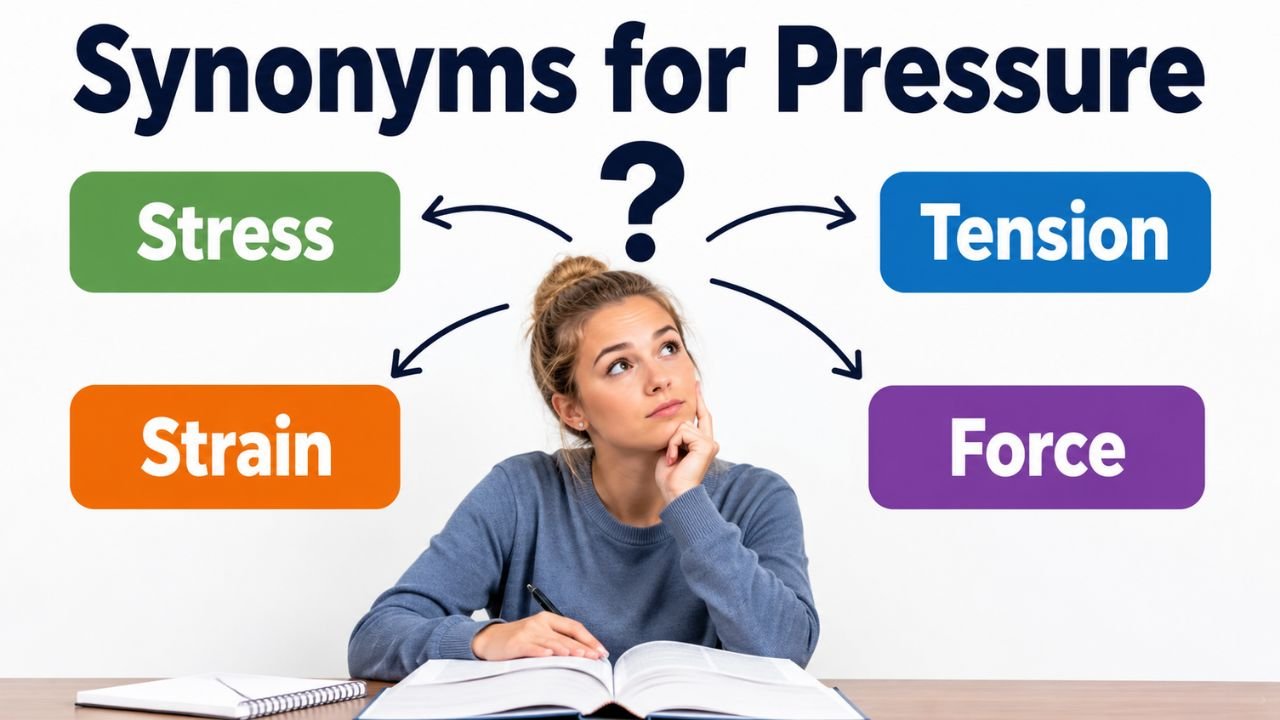
Quick Answer: The best synonyms for pressure include stress, strain, tension, burden, force, urgency, influence, coercion, compression, and demand. Use stress for emotional or mental difficulty, strain for pressure caused by heavy demands, and tension for nervousness or conflict. Burden works for responsibilities, while urgency suits situations that require fast action. Use influence for gentle persuasion, coercion for unwanted force, and compression for physical pressure. In formal writing, strain, coercion, urgency, and compression are precise choices. In casual speech, stress, push, and burden often sound more natural.
Pronunciation and Word Details
Word: Pressure
Pronunciation: /ˈpreʃ.ər/
Part of Speech: Noun and verb
Meaning: Pressure means physical force, emotional stress, urgent demand, or influence used to make someone act.
US Pronunciation:
UK Pronunciation:
What Does “Pressure” Mean?
Pressure means force, stress, demand, or influence placed on a person, object, or situation. It is commonly used as a noun, but it can also function as a verb.
As a noun, pressure can describe emotional strain caused by responsibilities, expectations, deadlines, or difficult circumstances. It can also refer to physical force applied to a surface.
In technical contexts, pressure describes the amount of force acting on a particular area. It appears in discussions about air, water, machinery, weather, and the human body.
Pressure can also mean influence or persuasion. A person may feel pressure from family members, coworkers, friends, or society to make a particular choice.
As a verb, pressure means to strongly encourage, influence, or force someone to do something.
Emotional Example: She felt pressure to complete the work before Friday.
Physical Example: Apply gentle pressure to the injured area.
Social Example: He faced pressure from others to change his decision.
Verb Example: They pressured her to accept the offer.
Meaning, Tone, and Context of “Pressure”
Pressure is a neutral word, but its emotional tone often depends on the situation. It may sound negative when it describes stress, coercion, heavy expectations, or unwanted influence.
In everyday conversation, pressure commonly refers to feeling worried, rushed, or overwhelmed. Someone might say that they are under pressure at work, at school, or during an important decision.
In professional writing, pressure may describe deadlines, performance expectations, workloads, competition, or workplace demands. It can sound formal when used to discuss economic pressure, public pressure, political pressure, or financial pressure.
In academic and technical writing, pressure has a precise physical meaning. It can describe force applied to a surface, air pressure, water pressure, or pressure inside a system.
In medical contexts, pressure appears in expressions such as blood pressure, eye pressure, and chest pressure. These uses should not always be replaced with a general synonym because the technical phrase may be necessary.
Pressure can also sound strong or critical when it refers to coercion. Saying that someone was pressured suggests that the person may not have acted completely freely.
When and How to Use “Pressure”
For Emotional Stress: Use pressure when responsibilities, expectations, or difficult conditions create mental strain.
Example: She was under pressure to finish several reports in one day.
For Deadlines: Use pressure when limited time creates urgency.
Example: The approaching deadline placed pressure on the entire team.
For Social Influence: Use pressure when people or groups encourage someone to act in a particular way.
Example: He resisted pressure from his friends to change his plans.
For Workplace Demands: Use pressure when duties, targets, or competition create difficulty.
Example: Employees faced increasing pressure to improve their results.
For Physical Force: Use pressure when force is applied to an object or surface.
Example: Apply light pressure to close the lid securely.
For Scientific Measurement: Use pressure when discussing force within air, water, gas, or another physical system.
Example: The equipment measures pressure inside the pipe.
For Persuasion: Use pressure as a verb when someone is strongly encouraged to make a decision.
Example: Nobody should pressure you into signing an agreement.
For Public Expectations: Use pressure when widespread attention creates demands for action.
Example: Public pressure encouraged the officials to review the decision.
Best Synonyms for Pressure
Stress: Mental or emotional difficulty caused by demands or worry.
Example: Continuous stress affected his ability to concentrate.
Strain: Pressure that causes emotional, physical, or practical difficulty.
Example: The long working hours placed a strain on her health.
Tension: Nervousness, worry, or conflict within a person or situation.
Example: Tension increased as the deadline approached.
Burden: A heavy responsibility, duty, or source of worry.
Example: Managing every task alone became a serious burden.
Force: Physical power or strong influence used to create movement or action.
Example: The door opened when enough force was applied.
Urgency: The need for immediate attention or action.
Example: The message communicated a clear sense of urgency.
Influence: The power to affect a person’s thoughts, choices, or actions.
Example: Family influence shaped his final decision.
Coercion: The use of threats, force, or strong pressure to control someone.
Example: The agreement must be made freely and without coercion.
Compression: The act of pressing or squeezing something into a smaller space.
Example: Compression reduced the size of the material.
Demand: A strong requirement or expectation placed on someone.
Example: The new role created a greater demand on her time.
50 Synonyms for Pressure with Short Meanings
- Stress: Mental or emotional difficulty caused by demands.
- Strain: Pressure that creates physical or emotional difficulty.
- Tension: Nervousness, worry, or conflict.
- Burden: A heavy responsibility or source of concern.
- Demand: A strong requirement or expectation.
- Urgency: A need for immediate action.
- Force: Physical power or strong influence.
- Influence: Power that affects choices or behavior.
- Coercion: Force or threats used to control someone.
- Compression: The act of pressing something together.
- Compulsion: A powerful force that makes action feel necessary.
- Duress: Pressure caused by threats or dangerous conditions.
- Constraint: A restriction that limits freedom or action.
- Intimidation: Pressure created through fear or threats.
- Persuasion: Influence used to change a person’s opinion or action.
- Insistence: Firm and repeated demand for something.
- Leverage: Influence used to gain a desired result.
- Expectation: A belief that someone should act or succeed.
- Obligation: A duty that a person is expected to fulfill.
- Responsibility: A duty that requires attention and effort.
- Workload: The amount of work someone must complete.
- Load: A physical or emotional weight being carried.
- Weight: A heavy influence, responsibility, or force.
- Push: Effort or influence used to cause action.
- Thrust: Strong forward force or movement.
- Impact: Forceful contact or a powerful effect.
- Squeeze: Force created by pressing from different sides.
- Confinement: Pressure caused by restricted space or movement.
- Oppression: Harsh control that limits freedom.
- Hardship: A difficult condition causing strain.
- Difficulty: A problem that creates effort or stress.
- Challenge: A demanding situation requiring effort.
- Adversity: Serious difficulty or unfavorable conditions.
- Scrutiny: Close attention that creates discomfort or stress.
- Attention: Notice that may create expectations or demands.
- Heat: Informal pressure caused by criticism or difficulty.
- Rush: A situation requiring fast action.
- Haste: Speed caused by limited time.
- Deadline: A time limit that creates urgency.
- Prompting: Encouragement intended to produce action.
- Prodding: Repeated encouragement or pressure to act.
- Urging: Strong encouragement to do something.
- Lobbying: Organized effort to influence a decision.
- Solicitation: A request intended to produce a response.
- Manipulation: Unfair influence used to control a choice.
- Control: Power used to direct actions or conditions.
- Dominance: Strong control over a person or situation.
- Resistance: Opposing force that creates pressure.
- Intensity: A high degree of force, emotion, or demand.
- Imposition: An unwanted duty, demand, or burden.
Read Also:
Synonyms for Project

Synonyms for Pressure by Context
When Pressure Means Emotional Stress
When pressure refers to mental or emotional difficulty, the best synonyms include stress, strain, tension, anxiety, burden, and emotional load.
Stress is the most common general alternative. Strain often suggests that demands have continued for a long time. Tension may describe nervousness, conflict, or emotional discomfort.
Example With Pressure: She felt pressure before the important interview.
Example With Stress: She felt stress before the important interview.
Example With Tension: She noticed growing tension before the important interview.
When Pressure Means Heavy Responsibility
When pressure comes from duties, expectations, or obligations, use burden, responsibility, demand, obligation, workload, or weight.
Burden suggests that the responsibility feels difficult to carry. Workload refers specifically to the amount of work. Obligation emphasizes a duty that must be completed.
Example With Pressure: Caring for every detail created pressure.
Example With Burden: Caring for every detail became a heavy burden.
Example With Responsibility: Caring for every detail was a major responsibility.
When Pressure Means Urgency
When pressure results from limited time, use urgency, rush, haste, deadline, time constraint, or demand.
Urgency describes the need for immediate action. Rush sounds more conversational and may suggest hurried activity. Time constraint is more precise in formal writing.
Example With Pressure: The short deadline created pressure.
Example With Urgency: The short deadline created a sense of urgency.
Example With Rush: The short deadline caused a last minute rush.
When Pressure Means Influence
When pressure refers to attempts to affect someone’s choice, use influence, persuasion, insistence, urging, prompting, or leverage.
Influence may be gentle or indirect. Persuasion usually involves reasons or arguments. Insistence is stronger and more persistent.
Example With Pressure: She faced pressure to reconsider her answer.
Example With Influence: She faced strong influence from those around her.
Example With Persuasion: They used persuasion to encourage her to reconsider.
When Pressure Means Unwanted Force
When pressure limits free choice, use coercion, compulsion, duress, intimidation, manipulation, or force.
Coercion is a formal word for controlling someone through threats or force. Duress describes a situation in which a person acts because of fear, danger, or serious pressure.
Example With Pressure: He signed the document under pressure.
Example With Duress: He signed the document under duress.
Example With Coercion: The agreement was obtained through coercion.
When Pressure Means Physical Force
When pressure describes force applied to an object, use force, weight, load, push, squeeze, compression, or impact.
Force is the broadest alternative. Compression refers to pressing material together. Weight may create downward pressure.
Example With Pressure: Apply pressure to the surface.
Example With Force: Apply gentle force to the surface.
Example With Compression: The material changed shape under compression.
When Pressure Means Public Attention
When pressure comes from close attention, criticism, or expectations, use scrutiny, attention, demand, influence, or public insistence.
Scrutiny describes careful examination. Demand is useful when people strongly expect action. Attention may be neutral, but it can still create stress.
Example With Pressure: The leader faced pressure after the announcement.
Example With Scrutiny: The leader faced intense scrutiny after the announcement.
Example With Demand: The leader faced growing public demand for action.
When Pressure Means Technical Force
In scientific and technical writing, pressure has a specific meaning and may not have an exact everyday synonym. Depending on the sentence, force, compression, load, or intensity may be suitable.
Example With Pressure: The pressure inside the container increased.
Example With Force: The force inside the system increased.
Example With Compression: Greater compression affected the material.
Another Word for Pressure
Stress is often the best single replacement for pressure when the word describes emotional or mental difficulty. However, the best alternative depends on the intended meaning.
Use strain for long lasting difficulty, burden for responsibility, urgency for limited time, influence for persuasion, coercion for unwanted force, and compression for physical pressure.
Original: She felt pressure to complete every task perfectly.
Better Option: She felt stress from trying to complete every task perfectly.
Original: The deadline placed pressure on the team.
Better Option: The deadline created urgency for the team.
Original: He accepted the decision because of family pressure.
Better Option: He accepted the decision because of family influence.
Original: The material changed shape under pressure.
Better Option: The material changed shape under compression.
When Not to Use “Pressure”
Pressure can become vague when the sentence does not explain whether it means stress, urgency, physical force, influence, or responsibility. Choose a more specific synonym when precision matters.
Do not use pressure when you mean a clear emotional condition such as anxiety or stress.
Weak: The examination caused a lot of pressure.
Better: The examination caused considerable stress.
Avoid pressure when describing a formal threat or loss of free choice. Coercion or duress may be more accurate.
Weak: She agreed because of pressure.
Better: She agreed under duress.
Do not use pressure when the problem is simply a large amount of work. Workload gives the reader clearer information.
Weak: He has too much pressure this week.
Better: He has an unusually heavy workload this week.
Avoid pressure when physical compression is the exact process being described.
Weak: The material becomes thinner through pressure.
Better: The material becomes thinner through compression.
Do not repeat pressure several times in the same paragraph.
Weak: The pressure of the deadline increased the pressure on the team, and this pressure affected quality.
Better: The deadline increased the team’s stress, and the growing strain affected quality.
Do not use pressure as a direct synonym for motivation. Motivation encourages action, while pressure often suggests stress, demand, or outside influence.
Weak: Her pressure helped me work harder.
Better: Her encouragement helped me work harder.
Words Commonly Confused With Pressure
Pressure vs Stress: Pressure is a demand, force, or expectation placed on someone. Stress is the emotional or physical response that may result from that pressure.
Pressure vs Strain: Pressure describes the force or demand itself. Strain describes the difficulty or damage created by that force.
Pressure vs Tension: Pressure may come from deadlines, expectations, or physical force. Tension usually refers to nervousness, conflict, or tightness.
Pressure vs Force: Pressure is force applied over an area or influence applied to a person. Force is the general power that causes movement or action.
Pressure vs Coercion: Pressure can be mild, strong, positive, or negative. Coercion specifically involves threats, force, or unfair control.
Pressure vs Demand: Pressure is the effect created by expectations or circumstances. A demand is a direct requirement or request.
Pressure vs Urgency: Pressure may come from many sources. Urgency specifically refers to the need for fast action.
Pressure vs Compression: Pressure is the force being applied. Compression is the process or result of pressing something together.
Pressure vs Anxiety: Pressure is an external or internal demand. Anxiety is the feeling of fear, worry, or nervousness that may follow.
Which Synonym Should You Choose?
Choose stress for everyday discussion of mental or emotional difficulty.
Choose strain when pressure has continued over time or is affecting health, relationships, or performance.
Choose tension when describing nervousness, conflict, or emotional discomfort.
Choose burden when responsibilities feel heavy or difficult to manage.
Choose workload when the pressure comes from having too much work.
Choose urgency when immediate action is necessary.
Choose deadline when a specific time limit creates the pressure.
Choose demand when someone is required or expected to achieve something.
Choose influence for polite, indirect, or neutral attempts to affect a decision.
Choose persuasion when reasons or arguments are used to change someone’s mind.
Choose insistence when a person repeatedly and firmly requests action.
Choose coercion for formal writing about threats, force, or unfair control.
Choose duress when someone acts because of fear, danger, or severe pressure.
Choose scrutiny when attention, examination, or criticism causes discomfort.
Choose force when referring to physical power.
Choose compression when discussing the process of pressing material together.
Choose push in casual conversation when describing encouragement or effort toward action.
Choose obligation when pressure comes from a duty or promise.
Choose responsibility when describing work that someone must manage.
Choose hardship when pressure comes from difficult living or working conditions.
Real Life Examples of “Pressure” in Sentences
Original: She felt pressure before speaking to the large audience.
Better Option: She felt tension before speaking to the large audience.
Original: The growing workload placed pressure on the staff.
Better Option: The growing workload placed strain on the staff.
Original: He faced pressure to accept the position.
Better Option: He faced strong persuasion to accept the position.
Original: The deadline created pressure for everyone involved.
Better Option: The deadline created urgency for everyone involved.
Original: Family pressure influenced her choice.
Better Option: Family expectations influenced her choice.
Original: The worker applied pressure to the damaged part.
Better Option: The worker applied force to the damaged part.
Original: The fabric became flatter under pressure.
Better Option: The fabric became flatter under compression.
Original: Public pressure led to a review of the policy.
Better Option: Public demand led to a review of the policy.
Original: He completed the task despite intense pressure.
Better Option: He completed the task despite intense stress.
Original: Nobody should pressure another person into agreeing.
Better Option: Nobody should coerce another person into agreeing.
Synonym Groups and Usage Differences
Emotional Stress Group
Stress, strain, tension, anxiety, burden, and emotional load describe the mental effects of difficult demands.
Stress is broad and common. Strain suggests continued difficulty. Tension often appears before an important event or during conflict.
Example: Constant stress made it difficult for her to relax.
Responsibility Group
Burden, obligation, responsibility, workload, load, and weight describe pressure connected with duties.
Burden often has a negative tone. Responsibility can be neutral or positive. Workload refers specifically to the amount of work.
Example: Managing the entire schedule became a heavy burden.
Urgency Group
Urgency, rush, haste, deadline, time constraint, and insistence relate to pressure for immediate action.
Urgency is suitable for formal and professional writing. Rush is more conversational. Haste can suggest that action is happening too quickly.
Example: The emergency created an immediate sense of urgency.
Influence Group
Influence, persuasion, prompting, prodding, urging, and lobbying describe attempts to affect a decision.
Influence is broad and may be indirect. Persuasion usually uses reasons. Prodding and urging suggest repeated encouragement.
Example: Her gentle persuasion helped them reconsider the plan.
Coercion Group
Coercion, duress, intimidation, compulsion, manipulation, and oppression describe strong or unfair pressure.
Coercion is a formal general term. Duress often involves fear or threats. Manipulation uses hidden or unfair methods.
Example: A valid decision should be made without coercion.
Physical Force Group
Force, compression, squeeze, weight, load, thrust, push, and impact describe pressure applied physically.
Compression is useful when material is pressed together. Weight describes downward force. Impact refers to sudden contact.
Example: The material became denser under compression.
Public Attention Group
Scrutiny, attention, criticism, demand, expectation, and influence describe pressure created by other people or the public.
Scrutiny emphasizes close examination. Demand focuses on expectations for action. Attention is broader and may be neutral.
Example: The decision received intense public scrutiny.
Antonyms of Pressure
The opposite of pressure depends on whether the word means emotional stress, physical force, urgency, or influence. Relief and calm oppose emotional pressure, while freedom and consent oppose coercion. Release and expansion may oppose physical compression.
Relief: The removal of worry, pain, or difficulty.
Calm: A peaceful state without stress or tension.
Relaxation: Freedom from physical or mental strain.
Ease: A condition without difficulty or heavy demand.
Comfort: A state of physical or emotional well being.
Freedom: The ability to choose without outside control.
Consent: Free and willing agreement.
Support: Help that reduces difficulty or burden.
Release: The act of removing force, tension, or restriction.
Expansion: An increase in size rather than compression.
Patience: Willingness to allow time without creating urgency.
Reassurance: Words or actions that reduce worry.
Lightness: The absence of heavy weight or burden.
Rest: A period without demanding activity.
Choice: The ability to decide freely without coercion.
Comparison: Pressure vs Related Words
Pressure vs Stress
Pressure is the demand, force, or expectation affecting someone. Stress is the reaction that pressure may produce.
Example With Pressure: The deadline placed pressure on the writer.
Example With Stress: The writer experienced stress because of the deadline.
Pressure vs Strain
Pressure describes the demand or force. Strain describes the difficulty, damage, or exhaustion caused by that pressure.
Example With Pressure: The new role created pressure.
Example With Strain: The new role placed a strain on his health.
Pressure vs Tension
Pressure can involve work, time, physical force, or expectations. Tension usually describes nervousness, conflict, or tightness.
Example With Pressure: She faced pressure to make a quick choice.
Example With Tension: Tension filled the room before the decision.
Pressure vs Burden
Pressure may be temporary or come from many sources. Burden usually refers to a heavy duty, responsibility, or emotional weight.
Example With Pressure: The approaching deadline created pressure.
Example With Burden: Managing the entire project alone became a burden.
Pressure vs Urgency
Pressure is a broad word for stress or demand. Urgency specifically describes the need for fast action.
Example With Pressure: The situation placed pressure on the team.
Example With Urgency: The situation required a response with great urgency.
Pressure vs Influence
Pressure often suggests stronger demands or discomfort. Influence can be gentle, indirect, and neutral.
Example With Pressure: They placed pressure on him to change his answer.
Example With Influence: Their advice influenced him to reconsider.
Pressure vs Coercion
Pressure can range from mild encouragement to strong demands. Coercion always suggests unfair force, threats, or loss of free choice.
Example With Pressure: She felt pressure to attend the meeting.
Example With Coercion: She attended because of coercion and threats.
Pressure vs Compression
Pressure is the force acting on something. Compression is the process of pressing or squeezing it into a smaller space.
Example With Pressure: The machine applies pressure to the material.
Example With Compression: Compression changes the material’s shape.
Pressure vs Demand
Pressure is the stress or influence created by a situation. Demand is the requirement, request, or expectation causing that pressure.
Example With Pressure: Rising costs placed pressure on the budget.
Example With Demand: Increased demand required a larger budget.
Common Phrases and Expressions With “Pressure”
Under Pressure: Experiencing stress, demands, or difficulty.
Apply Pressure: Use physical force or influence to produce a result.
Put Pressure On: Cause someone to feel stress or influence them to act.
Feel the Pressure: Become aware of increasing stress or expectations.
High Pressure Situation: A difficult situation requiring calm and fast decisions.
Peer Pressure: Influence from people of a similar age or social group.
Public Pressure: Strong expectations or demands from the public.
Time Pressure: Stress caused by limited time.
Blood Pressure: The force of blood against the walls of blood vessels.
Air Pressure: The force created by the weight and movement of air.
Pressure Point: A sensitive area or an important source of difficulty.
Mounting Pressure: Pressure that is steadily increasing.
Constant Pressure: Stress or force that continues without relief.
Resist Pressure: Refuse to be influenced or controlled.
Relieve Pressure: Reduce stress, force, or difficulty.
Common Mistakes to Avoid
A common mistake is treating all synonyms for pressure as interchangeable. Stress, force, urgency, burden, and coercion describe different ideas and should be selected carefully.
Avoid using stress when you mean the external demand. Pressure may cause stress, but the two words are not always identical.
Do not use coercion for ordinary encouragement. Coercion implies threats, force, or unfair control.
Avoid using burden for physical pressure. Burden normally refers to responsibility, weight, or emotional difficulty.
Do not replace technical expressions such as blood pressure or air pressure with general synonyms. These phrases have specific meanings.
Avoid repeating pressure several times in nearby sentences. Replace some uses with strain, stress, demand, urgency, or influence when those words remain accurate.
Do not use pressure vaguely. Explain its source whenever possible, such as deadline pressure, financial pressure, social pressure, or workplace pressure.
Use pressure as a verb carefully. A person pressures someone to act, but a situation usually places pressure on someone.
Unnatural: The deadline pressured stress on the workers.
Better: The deadline placed stress on the workers.
Better: The deadline put the workers under pressure.
Avoid confusing pressure with motivation. Motivation inspires action, while pressure may involve demands, stress, or outside influence.
Conclusion
The best synonyms for pressure change according to meaning. Use stress for emotional difficulty, strain for continuing demands, tension for nervousness, burden for responsibility, and urgency for limited time. Influence and persuasion describe attempts to shape a decision, while coercion and duress describe unfair or forceful control. For physical contexts, force and compression are clearer choices. Understanding these differences makes synonyms for pressure more accurate, natural, and useful in everyday speech, professional writing, academic work, and technical explanations.
FAQs About Synonyms for Pressure
What Is the Best Synonym for Pressure?
Stress is the best general synonym when pressure means emotional difficulty. Force, urgency, burden, or influence may be better in other contexts.
What Is Another Word for Feeling Pressure?
Stress, strain, tension, anxiety, burden, and emotional load can describe the feeling of pressure.
What Is a Formal Synonym for Pressure?
Strain, coercion, duress, urgency, constraint, and compression are useful formal alternatives, depending on the meaning.
What Is Another Word for Work Pressure?
Workload, job stress, strain, demand, responsibility, and workplace tension are suitable alternatives.
Are Pressure and Stress the Same?
Not exactly. Pressure is often the demand placed on a person, while stress is the mental or physical response to that demand.
What Is Another Word for Social Pressure?
Peer influence, social influence, expectation, persuasion, insistence, and coercion may fit different social situations.
What Is the Opposite of Pressure?
Relief, calm, ease, freedom, relaxation, release, and support are common opposites, depending on the context.
