
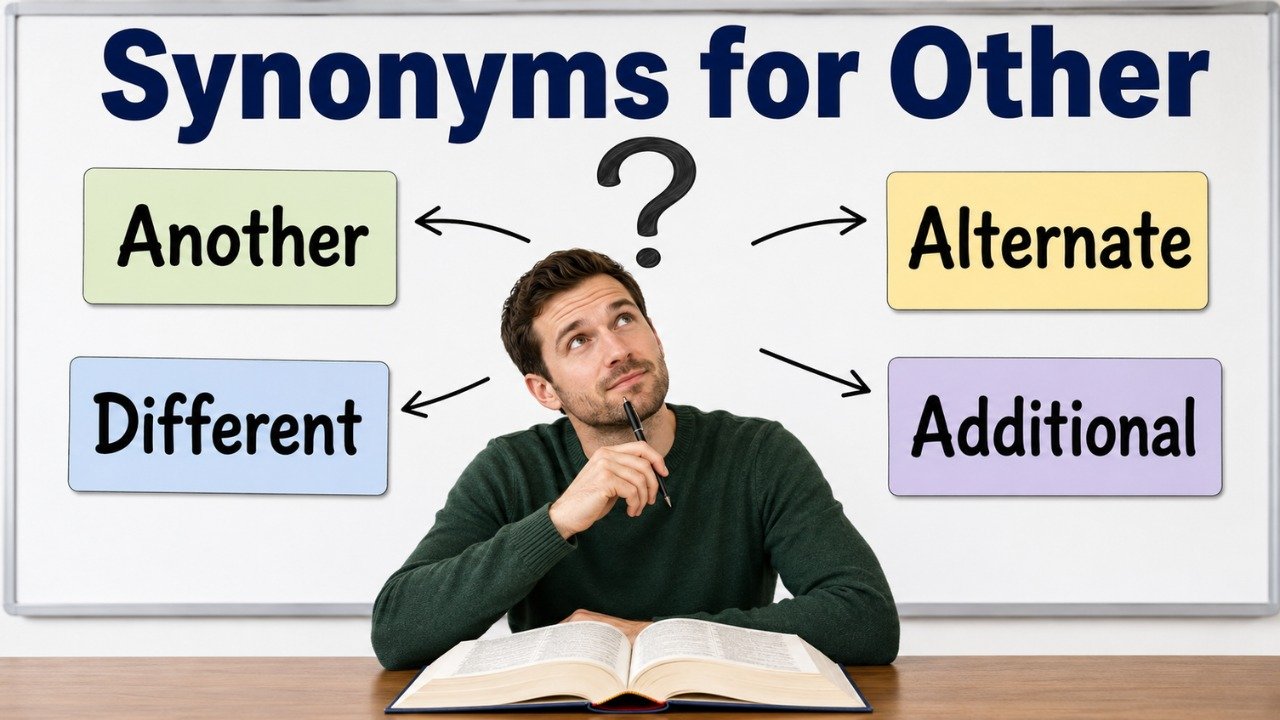
Quick Answer: The best synonyms for other include alternative, additional, different, another, further, remaining, separate, distinct, opposite, and else. Alternative works best when discussing another choice or possibility. Additional and further refer to something added. Different emphasizes that something is not the same. Remaining identifies what is left, while opposite suits locations, sides, or contrasting positions. Another is commonly used before a singular countable noun, and else is natural after words such as someone, anything, and where.
Pronunciation and Word Details
Word: Other.
Pronunciation: /ˈʌðər/.
Part of Speech: Determiner, adjective, pronoun, and noun.
Meaning: Different from the person or thing already mentioned, additional to it, or remaining after one has been identified.
US Pronunciation:
UK Pronunciation:
What Does “Other” Mean?
Other means different, additional, alternative, or remaining in relation to a person or thing that has already been mentioned.
The word can function as a determiner before a noun.
Example: We should consider other solutions.
In this sentence, other means additional or alternative solutions.
Other can also function as an adjective that distinguishes one person, object, idea, group, or side from another.
Example: Please use the other entrance.
Here, the other entrance means the second, remaining, or opposite entrance.
Other may also function as a pronoun when the noun is understood from context.
Example: One chair is broken, but the other is usable.
The other refers to the second chair without repeating the noun.
Its plural pronoun form is others.
Example: Some students finished early, while others needed more time.
Other is highly flexible. Its precise meaning changes according to the noun, determiner, number, and situation around it.
Meaning, Tone, and Context of “Other”
Other has a neutral tone and is common in formal, casual, academic, professional, technical, and conversational English. It does not usually express strong emotion by itself.
In everyday conversation, other commonly identifies an additional choice, a different person, or something that has not yet been mentioned.
Example: Do you have any other questions?
In formal and academic writing, other may help compare groups, theories, results, methods, or interpretations.
Example: Other studies reached a different conclusion.
In professional communication, the word may refer to additional responsibilities, alternative arrangements, remaining tasks, or separate departments.
Example: The other tasks can be completed next week.
Other can also create contrast. Expressions such as on the other hand and the other side signal an alternative perspective, location, or position.
Because other has several meanings, writers should make sure the surrounding noun or sentence provides enough detail. A more precise synonym may be better when clarity matters.
When and How to Use “Other”
For Additional Choices: Use other when more options are available beyond the ones already mentioned.
Example: We should explore other ways to solve the problem.
For Different Items: Use other when referring to people or things that are not the same as the current one.
Example: This key does not work, so try the other key.
For Remaining People or Things: Use the other or the others when identifying what remains after one part has been selected.
Example: Three guests arrived early, and the others came later.
For the Second of Two: Use the other when there are exactly two people, objects, choices, or sides.
Example: One shoe is under the bed, and the other is near the door.
For an Alternative Possibility: Use other when suggesting a different method, plan, explanation, or choice.
Example: There may be other reasons for the delay.
For the Opposite Side: Use the other when referring to a contrasting side, end, or position.
Example: The pharmacy is on the other side of the road.
For Unnamed People or Things: Use other when referring generally to people or things outside the group currently being discussed.
Example: We should respect other people’s opinions.
For Repeated Intervals: Use every other to describe something that happens on alternate occasions.
Example: The class meets every other Friday.
For Comparison: Use other to distinguish one category from another.
Example: This material is stronger than the other samples.
For Reciprocal Actions: Use each other when two or more people perform the same action toward one another.
Example: The teammates encouraged each other.
Best Synonyms for Other
Alternative: Another possible choice, method, or solution.
Example: We need an alternative plan in case the first one fails.
Additional: Added to what already exists or has been mentioned.
Example: The form requires additional information.
Different: Not the same as someone or something else.
Example: She chose a different color for the walls.
Another: One more person or thing, or a different one.
Example: Could I have another glass of water?
Further: More, additional, or extending beyond what has already been provided.
Example: Further details will be shared during the meeting.
Remaining: Still present after other people or things have been removed or considered.
Example: The remaining applicants will be interviewed tomorrow.
Separate: Existing independently or apart from something else.
Example: Each department keeps a separate record.
Distinct: Clearly different and recognizable as an individual type.
Example: The two words have distinct meanings.
Opposite: Located across from something or representing a contrasting position.
Example: They waited on the opposite side of the street.
Else: Additional to or different from what has already been mentioned.
Example: Does anyone else need assistance?
50 Synonyms for Other with Short Meanings
- Alternative: A different possible choice.
- Additional: Added to what already exists.
- Different: Not the same as something mentioned.
- Another: One more or a different one.
- Further: More than what has already been given.
- Extra: Added beyond the usual amount.
- Remaining: Still left after part has been removed.
- Rest: The people or things that remain.
- Separate: Existing apart from something else.
- Distinct: Clearly different in identity or quality.
- Alternate: Used or happening in turns.
- Supplementary: Added to complete or support something.
- Secondary: Less important or coming after the main one.
- Spare: Additional and available when needed.
- Opposite: Located across from or contrary to something.
- Else: Different from or additional to what was mentioned.
- Substitute: A person or thing used in place of another.
- Replacement: Something that takes the place of something else.
- Counterpart: A matching person or thing in another position.
- Partner: The second member of a pair.
- Contrasting: Showing a clear difference.
- Unrelated: Not connected with the subject being discussed.
- Next: Coming after the present one.
- Second: Following the first in order.
- Subsequent: Coming later in time or sequence.
- Latter: The second of two people or things mentioned.
- Remaining One: The one that is still left.
- Different One: A person or thing that is not the same.
- Additional One: One more person or thing.
- One More: An extra person, object, or occurrence.
- Someone Else: A different person.
- Anyone Else: Any additional or different person.
- Everyone Else: All people except those already identified.
- Something Else: A different or additional thing.
- Anything Else: Any additional thing or possibility.
- Somewhere Else: A different place.
- The Rest: All people or things that remain.
- The Remainder: The part that is left.
- The Alternative: The other available choice.
- The Opposite: The contrasting side or position.
- The Second One: The remaining member of a pair.
- Another Kind: A different category or variety.
- A Different Kind: A type that is not the same.
- Another Type: An additional or alternative variety.
- A Separate Type: A category treated independently.
- An Alternative Choice: A different available selection.
- An Additional Option: One more possible selection.
- A Further Option: Another possibility to consider.
- A Separate Category: A different group or classification.
- The Far Side: The side opposite the current position.
Read Also:
Synonyms for Argument

Synonyms for Other by Context
When Other Means Additional
Additional, further, extra, supplementary, another, and one more can replace other when something is being added.
Example: We need additional information before making a decision.
Example: She requested one more copy of the document.
Additional is a clear choice in formal writing. Further is common when discussing information, discussion, investigation, or action. Extra is more conversational and often describes quantity.
When Other Means Different
Different, distinct, separate, contrasting, unrelated, and alternative work when other identifies something that is not the same.
Example: We need a different approach to this problem.
Example: The report discusses three distinct categories.
Different is the most direct replacement. Distinct emphasizes a clear and meaningful difference. Separate indicates that people, objects, or ideas are kept apart.
When Other Means Another Choice
Alternative, alternate, substitute, replacement, another, and different one refer to another available choice.
Example: The committee proposed an alternative solution.
Example: We need a replacement for the damaged chair.
Alternative is best for choices, plans, routes, explanations, and methods. Substitute and replacement are more suitable when one person or object takes the place of another.
When Other Means Remaining
Remaining, rest, remainder, the others, and everyone else describe people or things left after one part has been identified.
Example: The remaining tickets will be sold at the entrance.
Example: One group stayed inside, while the rest went outdoors.
Remaining works before a noun. The rest and the remainder function as noun phrases and refer to what is left.
When Other Means the Second of Two
Second, latter, counterpart, partner, and the second one may replace the other when exactly two people or things are involved.
Example: One drawer contains tools, and the second contains documents.
Example: The first proposal was expensive, while the latter was more practical.
Latter is mainly used in formal writing to identify the second of two things already mentioned.
When Other Means Opposite
Opposite, far side, contrasting side, and alternative side work when other refers to location, direction, or position.
Example: The station is on the opposite side of the bridge.
Example: They walked toward the far side of the field.
Opposite is the clearest option for locations. Far side describes distance across an area rather than direct opposition.
When Other Refers to Unnamed People or Things
Someone else, anyone else, everyone else, something else, and anything else are useful when the exact person or thing is not named.
Example: Someone else has already reserved the room.
Example: Is there anything else you would like to discuss?
Else normally follows an indefinite pronoun or question word. It does not usually appear directly before a noun.
Another Word for Other
Different is often the best single replacement for other when the meaning is not the same. However, the strongest alternative depends on the sentence.
Use additional when something is being added. Use alternative when discussing another choice. Use remaining when referring to what is left. Use opposite when discussing sides or positions.
Original: We should consider other solutions.
Better Option: We should consider alternative solutions.
Original: Do you need any other information?
Better Option: Do you need any additional information?
Original: The other participants will arrive later.
Better Option: The remaining participants will arrive later.
Original: The shop is on the other side of the road.
Better Option: The shop is on the opposite side of the road.
When Not to Use “Other”
Other may sound vague when readers cannot identify which people, objects, or possibilities are being discussed. Use a more specific synonym or add information.
Weak: We need the other information.
Better: We need the additional information about the delivery schedule.
Do not use other without a determiner before a singular countable noun.
Weak: I need other notebook.
Better: I need another notebook.
Better: I need the other notebook.
Avoid placing others directly before a noun. Others is a pronoun and stands alone.
Weak: Others students completed the task.
Better: Other students completed the task.
Better: Some students completed the task, while others continued working.
Do not use the others directly before a noun.
Weak: The others documents are in the cabinet.
Better: The other documents are in the cabinet.
Other may also be less precise than alternative, additional, opposite, or remaining.
Weak: The other route may be safer.
Better: The alternative route may be safer.
Avoid repeating other too frequently in a single paragraph.
Weak: Other employees contacted other departments to discuss other solutions.
Better: Additional employees contacted separate departments to discuss alternative solutions.
Words Commonly Confused With Other
Other vs Another: Other normally appears before plural nouns, uncountable nouns, or singular nouns with a determiner. Another appears before a singular countable noun and means one more or a different one.
Example With Other: We need other ideas.
Example With Another: We need another idea.
Other vs Others: Other appears before a noun. Others is a plural pronoun and replaces the noun.
Example With Other: Other customers were waiting.
Example With Others: Some customers left, but others stayed.
Other vs the Other: Other refers generally to additional or different people and things. The other refers to a specific remaining person or thing.
Example With Other: Do you have other options?
Example With the Other: One option is expensive, but the other is affordable.
Other vs the Others: The other appears before a noun or refers to one remaining member of a pair. The others is a pronoun referring to specific remaining members of a group.
Example With the Other: The other students arrived early.
Example With the Others: Two students stayed, while the others left.
Other vs Else: Other normally comes before a noun. Else usually comes after indefinite pronouns and question words.
Example With Other: Are there other choices?
Example With Else: What else can we choose?
Other vs Different: Other identifies an additional or alternative person or thing. Different emphasizes that two people or things are not the same.
Example With Other: We visited other cities during the trip.
Example With Different: Each city had a different atmosphere.
Other vs Additional: Other may mean different, alternative, or remaining. Additional specifically means added to what already exists.
Example With Other: We considered other plans.
Example With Additional: We requested additional time.
Which Synonym Should You Choose?
Choose alternative when discussing another choice, method, route, plan, solution, or possibility.
Choose additional when referring to more information, responsibilities, costs, requirements, or resources.
Choose different when emphasizing that a person, object, idea, or result is not the same.
Choose another before a singular countable noun when you mean one more or a different one.
Choose further in formal writing when discussing more research, explanation, discussion, action, or development.
Choose remaining when identifying people or things left after part of a group has been removed or considered.
Choose separate when people, objects, records, ideas, or categories exist independently.
Choose distinct when a difference is clear, important, and recognizable.
Choose opposite when discussing sides, directions, opinions, or positions that face or contrast with each other.
Choose else after words such as someone, anyone, everyone, something, anything, what, where, and who.
Choose latter when identifying the second of two people, ideas, or objects mentioned in formal writing.
Choose replacement when an item or person takes the place of another.
Choose substitute when something temporarily or functionally serves in place of the original.
Choose rest when referring collectively to all remaining members of a group.
Real Life Examples of “Other” in Sentences
Original: We need other ideas for the event.
Better Option: We need alternative ideas for the event.
Original: Please provide the other details.
Better Option: Please provide the additional details.
Original: She moved to the other side of the room.
Better Option: She moved to the opposite side of the room.
Original: The other guests will arrive after dinner.
Better Option: The remaining guests will arrive after dinner.
Original: Can we choose another route or some other route?
Better Option: Can we choose an alternative route?
Original: The other departments maintain their own records.
Better Option: The separate departments maintain their own records.
Original: This design is unlike the other designs.
Better Option: This design is unlike the remaining designs.
Original: Ask the other person to sign the form.
Better Option: Ask the second person to sign the form.
Original: Do you want anything other?
Better Option: Do you want anything else?
Original: The two plans serve other purposes.
Better Option: The two plans serve distinct purposes.
Synonym Groups and Usage Differences
Additional Group
Additional, further, extra, supplementary, another, and one more describe something added to what already exists.
Additional and supplementary are suitable for formal writing. Extra sounds more conversational. Another and one more commonly refer to singular countable items.
Example: The application requires additional documents.
Difference Group
Different, distinct, separate, contrasting, and unrelated emphasize that something is not the same as another thing.
Different is broad and neutral. Distinct suggests a clear difference. Separate emphasizes independence or physical division.
Example: The two words have distinct meanings.
Choice Group
Alternative, alternate, substitute, replacement, and different option refer to another available selection.
Alternative is the broadest term. Substitute describes something that performs the same function. Replacement refers to something taking the place of an original.
Example: We selected an alternative date for the meeting.
Remaining Group
Remaining, rest, remainder, the others, and everyone else identify what is left after one part has been removed or discussed.
Remaining normally modifies a noun. The rest and the remainder can stand alone as noun phrases.
Example: The remaining work can be completed tomorrow.
Pair Group
Second, latter, counterpart, partner, and the second one relate to the other member of a pair.
Second is simple and direct. Latter is more formal. Counterpart describes a person or thing with a similar role in another place or group.
Example: One manager handles sales, while her counterpart handles operations.
Opposite Group
Opposite, far side, contrasting side, and contrary position refer to another side, direction, view, or location.
Opposite is the clearest choice for physical position. Contrary is more suitable for ideas, opinions, and arguments.
Example: They stood on the opposite side of the entrance.
Unnamed Person or Thing Group
Someone else, anyone else, everyone else, something else, and anything else refer to additional or different people and things without naming them.
These expressions are especially common in questions, requests, and conversational English.
Example: Does anyone else have a question?
Antonyms of Other
Other has several meanings, so it does not have one exact antonym in every context. The best opposite depends on whether other means different, additional, remaining, or alternative.
Same: Not different from the person or thing already mentioned.
Identical: Exactly the same in every relevant way.
This: Referring to the person or thing currently identified.
These: Referring to the people or things currently identified.
Current: Existing or happening at the present time.
Present: Existing in the place or situation being discussed.
Main: Most important among several possibilities.
Primary: First in importance, order, or purpose.
Original: The first form rather than a replacement.
Existing: Already present rather than newly added.
Only: Having no additional person, thing, or choice.
Same One: The identical person or object rather than a different one.
Selected: Specifically chosen rather than remaining.
Included: Already part of the identified group.
Near Side: The side closest to the speaker rather than the far side.
Comparison: Other vs Related Words
Other vs Another
Other is generally used before plural nouns, uncountable nouns, or singular nouns with words such as the, this, that, my, or any. Another is used before a singular countable noun.
Example With Other: We need other equipment.
Example With Another: We need another computer.
Another can mean one more or a different one. Other is broader and can refer to several additional or different things.
Other vs Alternative
Other is a general word that may mean additional, different, or remaining. Alternative specifically refers to another available choice or possibility.
Example With Other: We discussed other plans.
Example With Alternative: We developed an alternative plan.
Alternative is more precise when choices or solutions are being compared.
Other vs Additional
Other can describe something different or something added. Additional only describes something added.
Example With Other: The other report reached a different conclusion.
Example With Additional: The additional report provided more evidence.
Use additional when quantity is the main idea.
Other vs Different
Other identifies a person or thing outside the one currently discussed. Different emphasizes a lack of similarity.
Example With Other: We visited other towns.
Example With Different: The towns had different architectural styles.
Other does not always imply a major difference. Different clearly highlights contrast.
Other vs Remaining
Other may refer to anything additional or different. Remaining identifies what is specifically left after part of a group has been removed.
Example With Other: Other employees joined the meeting.
Example With Remaining: The remaining employees joined after lunch.
Remaining is clearer when the sentence describes what is left.
Other vs Separate
Other identifies another person, object, idea, or group. Separate emphasizes independence or division.
Example With Other: The other team presented its proposal.
Example With Separate: Each team prepared a separate proposal.
Separate is useful when categories, documents, locations, or responsibilities are kept apart.
Other vs Else
Other usually comes before a noun. Else normally follows a pronoun or question word.
Example With Other: What other information is required?
Example With Else: What else is required?
The expressions may communicate a similar idea, but their grammatical positions are different.
Other vs Opposite
Other may identify either side without necessarily emphasizing direction. Opposite clearly refers to a facing or contrasting side.
Example With Other: Use the other entrance.
Example With Opposite: Use the entrance on the opposite side of the building.
Opposite provides more precise location information.
Common Phrases and Expressions With “Other”
Other Than: Except for or different from someone or something.
Example: Other than one small error, the report was accurate.
Each Other: Used when people perform the same action toward one another.
Example: The two friends supported each other.
The Other Day: A recent day that is not specified.
Example: I met your neighbor the other day.
On the Other Hand: Used to introduce a contrasting idea or viewpoint.
Example: The apartment is small. On the other hand, it is affordable.
In Other Words: Used to explain an idea in a clearer or different way.
Example: The payment is nonrefundable. In other words, you cannot request the money back.
Every Other: Happening on alternate occasions or involving alternate members.
Example: The newsletter is published every other week.
Some Other Time: At a different time in the future.
Example: We can discuss the details some other time.
The Other Side: The opposite side of a place, issue, or situation.
Example: The path continues on the other side of the hill.
No Other: Not any different or additional person or thing.
Example: No other explanation seemed reasonable.
One or the Other: One of two available people, things, or choices.
Example: You must choose one or the other.
Common Mistakes to Avoid
A common mistake is using other before a singular countable noun without a determiner.
Incorrect: She needs other chair.
Correct: She needs another chair.
Correct: She needs the other chair.
Use another when referring to one more nonspecific item. Use the other when referring to a specific remaining item.
Another mistake is placing a noun after others.
Incorrect: Others employees attended the meeting.
Correct: Other employees attended the meeting.
Correct: Some employees stayed home, while others attended the meeting.
Others already replaces the noun, so another noun should not follow it.
Writers also confuse the other with the others.
Incorrect: The others students completed the work.
Correct: The other students completed the work.
Correct: Some students left, but the others completed the work.
Use the other before a noun. Use the others without a following noun.
Do not add an apostrophe when using others as a simple plural pronoun.
Incorrect: Some people agreed, while other’s disagreed.
Correct: Some people agreed, while others disagreed.
An apostrophe is only needed for possession.
Example: We should respect others’ opinions.
Avoid using other when a more precise term would improve clarity.
Vague: The other expenses increased.
Clearer: The additional expenses increased.
Vague: We considered other methods.
Clearer: We considered alternative methods.
Repeated use of other can also make writing sound plain or unclear.
Repetitive: Other teams used other methods to reach other results.
Improved: Separate teams used different methods to reach distinct results.
Be careful with every other. It normally means alternate rather than every additional item.
Example: Every other seat was empty.
This means alternating seats were empty, not that all additional seats were empty.
Finally, do not assume that other and different always communicate the same idea. Other may simply identify another member of a group without suggesting a major difference.
Example: The other cups are in the cupboard.
The cups may be identical. The sentence only identifies the remaining cups.
Conclusion
The best synonyms for other depend on whether the word means different, additional, alternative, remaining, or opposite. Alternative works well for choices, while additional and further introduce more information or items. Different and distinct emphasize contrast, remaining identifies what is left, and opposite describes another side or position. Another is best before a singular countable noun, while else follows words such as someone or anything. Choosing precise synonyms for other makes sentences clearer, more natural, and easier to understand.
FAQs About Synonyms for Other
What Is the Best Synonym for Other?
Different is a useful general synonym, but alternative, additional, remaining, and opposite may be more accurate in specific contexts.
What Is the Difference Between Other and Another?
Another appears before a singular countable noun and means one more or a different one. Other commonly appears before plural nouns, uncountable nouns, or nouns with a determiner.
Can Other Be Used as a Pronoun?
Yes. Other can function as a pronoun when the noun is understood, as in one option is expensive, but the other is affordable.
What Is the Plural Form of Other?
Others is the plural pronoun form. Use other before a plural noun, but use others when no noun follows.
Is Else a Synonym for Other?
Else can express a similar meaning, but its grammatical position is different. Other usually comes before a noun, while else follows pronouns and question words.
What Does Every Other Mean?
Every other means every second person, thing, day, week, or occurrence in a sequence.
What Is the Opposite of Other?
Same, identical, this, current, original, and primary can function as opposites, depending on how other is used.
