
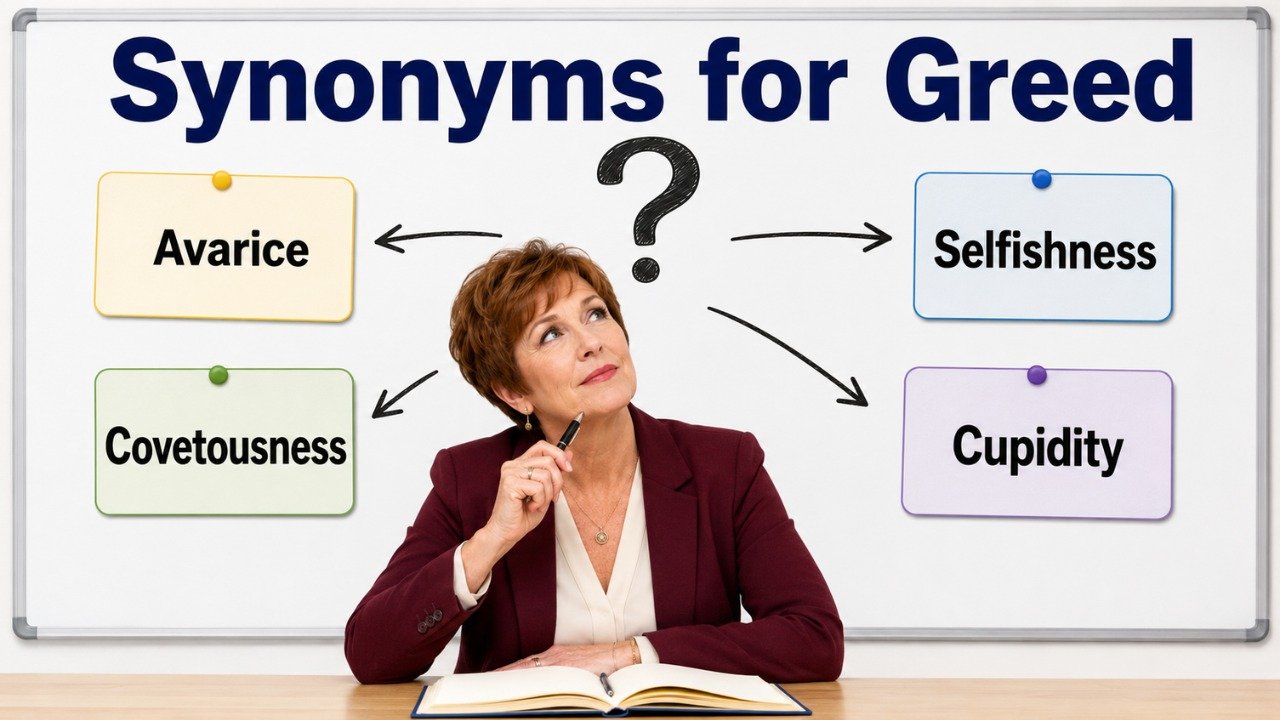
Quick Answer: The best synonyms for greed include avarice, covetousness, rapacity, acquisitiveness, cupidity, selfishness, materialism, greediness, gluttony, and insatiability. Avarice is best for a strong and often formal description of excessive desire for money. Covetousness focuses on wanting what another person owns. Rapacity suggests aggressive greed, while acquisitiveness describes a strong desire to collect wealth or possessions. Gluttony usually relates to excessive consumption, and selfishness is useful when greed causes someone to ignore the needs of others.
Pronunciation and Word Details
Word: Greed.
Pronunciation: /ɡriːd/
Part of Speech: Noun.
Meaning: An excessive and selfish desire for money, possessions, power, food, status, or more than a person reasonably needs.
US Pronunciation:
UK Pronunciation:
What Does “Greed” Mean?
Greed means an excessive desire to obtain or keep money, possessions, power, status, food, or other benefits.
Greed is a noun. It normally describes a harmful or unreasonable desire for more, especially when that desire causes someone to ignore fairness, moderation, or the needs of other people.
The word can refer to a desire for wealth.
Example: His greed for money damaged his relationships.
It can also describe a desire for authority or influence.
Example: Greed for power caused the leader to betray his principles.
Greed may refer to excessive consumption.
Example: The story warns readers about greed and waste.
The word often carries moral criticism. It suggests that ordinary desire has become excessive, selfish, uncontrolled, or harmful.
In some contexts, greed refers to a personal character flaw. In others, it describes the behavior of a group, institution, or system that takes more than is fair.
Meaning, Tone, and Context of “Greed”
Greed has a strongly negative tone. It is rarely neutral because it suggests excess, selfishness, and a lack of concern for other people.
The word is common in everyday conversation, moral discussions, literature, essays, news writing, business criticism, religious discussions, psychology, and social commentary.
In casual speech, greed may describe someone who always wants more.
Example: His greed made him unwilling to share.
In formal writing, avarice, rapacity, acquisitiveness, or excessive self interest may provide a more precise meaning.
Example: The novel presents avarice as a destructive moral weakness.
In business discussions, greed may describe excessive profit seeking, unfair exploitation, or decisions motivated only by financial gain.
Example: Critics argued that greed had influenced the pricing decision.
In literature, greed is often treated as a character flaw that leads to betrayal, corruption, isolation, or loss.
Example: The central character’s greed eventually causes his downfall.
The word can sound emotional and judgmental. Writers should use it only when they genuinely mean that a desire is excessive, selfish, or harmful.
When and How to Use “Greed”
For Excessive Desire for Money
Use greed when someone wants more money than they need and is willing to act unfairly to obtain it.
Example: Greed led him to deceive the people who trusted him.
For Wanting More Possessions
Use greed when a person constantly seeks additional property, objects, or resources without feeling satisfied.
Example: Her greed for luxury left her permanently dissatisfied.
For Hunger for Power
Use greed when someone seeks greater control, influence, or authority for selfish reasons.
Example: His greed for power destroyed the trust of his colleagues.
For Unfair Business Behavior
Use greed when profit becomes more important than fairness, honesty, safety, or responsibility.
Example: The decision appeared to be motivated by greed rather than necessity.
For Moral Criticism
Use greed when describing a serious failure of moderation, generosity, or ethical judgment.
Example: The fable shows how greed can ruin a person’s happiness.
For Excessive Consumption
Use greed when someone takes or consumes far more than is reasonable.
Example: The feast became a symbol of greed and waste.
For Literary Analysis
Use greed when discussing a character’s motivation, conflict, or moral decline.
Example: Greed drives the main character to betray his closest friend.
For Social Commentary
Use greed when discussing unfair accumulation, exploitation, or competition for limited resources.
Example: The author connects greed with inequality and corruption.
Best Synonyms for Greed
Avarice
Synonym: An extreme and selfish desire for money or material wealth.
Example: His avarice prevented him from helping people in need.
Covetousness
Synonym: A strong desire to possess something that belongs to another person.
Example: Covetousness made her resent her neighbor’s success.
Rapacity
Synonym: Aggressive and ruthless greed for wealth, resources, or power.
Example: The ruler’s rapacity placed a heavy burden on the population.
Acquisitiveness
Synonym: A strong desire to gain and collect money or possessions.
Example: His acquisitiveness filled the house with unnecessary objects.
Cupidity
Synonym: An excessive desire for wealth or material gain.
Example: Cupidity influenced every decision he made.
Greediness
Synonym: The quality of wanting more than is fair or necessary.
Example: The child’s greediness caused an argument over the treats.
Selfishness
Synonym: Concern for personal advantage without enough consideration for others.
Example: Her selfishness prevented the group from reaching a fair agreement.
Materialism
Synonym: Excessive importance placed on money, possessions, and material comfort.
Example: The novel questions the materialism of its wealthy characters.
Gluttony
Synonym: Excessive consumption, especially of food, drink, or other pleasures.
Example: The banquet represented gluttony and waste.
Insatiability
Synonym: The inability to feel satisfied, regardless of how much is obtained.
Example: His insatiability pushed him to demand even greater rewards.
50 Synonyms for Greed with Short Meanings
- Avarice: Extreme desire for money or wealth.
- Covetousness: Desire to possess what another person has.
- Rapacity: Aggressive and ruthless greed.
- Acquisitiveness: Strong desire to obtain possessions or wealth.
- Cupidity: Excessive desire for material gain.
- Greediness: Desire to take more than is fair.
- Graspingness: Selfish eagerness to gain money or advantage.
- Selfishness: Concern for personal benefit above others.
- Materialism: Excessive focus on money and possessions.
- Gluttony: Excessive consumption of food or pleasure.
- Voracity: An extremely eager or consuming appetite.
- Insatiability: Inability to feel satisfied.
- Possessiveness: Strong desire to own or control something.
- Hoarding: Collecting and keeping more than is needed.
- Miserliness: Extreme unwillingness to spend or share money.
- Stinginess: Reluctance to give, spend, or share.
- Profiteering: Seeking unfair profit from difficult circumstances.
- Exploitation: Using people or situations for selfish gain.
- Venality: Willingness to act dishonestly for money.
- Self Seeking: Pursuit of personal advantage above fairness.
- Self Enrichment: Increasing personal wealth through selfish actions.
- Money Hunger: Strong and excessive desire for money.
- Lust for Money: Intense desire to obtain greater wealth.
- Lust for Wealth: Uncontrolled desire for material riches.
- Hunger for Power: Excessive desire for authority or control.
- Thirst for Gain: Strong desire for personal profit.
- Craving for Profit: Excessive desire to earn more money.
- Excessive Desire: Wanting far more than is reasonable.
- Uncontrolled Appetite: Desire that is not limited by moderation.
- Excessive Appetite: An unreasonable desire for more.
- Immoderation: Lack of reasonable limits or restraint.
- Intemperance: Failure to control desires or consumption.
- Overconsumption: Using or taking more than is necessary.
- Selfish Ambition: Desire for success without regard for others.
- Grasping Ambition: Determination to gain wealth or status selfishly.
- Predatory Ambition: Ruthless pursuit of advantage at another person’s expense.
- Mercenary Ambition: Desire motivated mainly by money.
- Acquisitive Desire: Strong wish to obtain wealth or possessions.
- Possessive Desire: Excessive wish to own or control.
- Coveting: Wanting something owned by another person.
- Avariciousness: The quality of being extremely greedy for money.
- Rapaciousness: Aggressive desire to seize wealth or resources.
- Desire for More: Continued wanting despite already having enough.
- Obsession With Wealth: Unhealthy focus on becoming richer.
- Obsession With Money: Excessive concern with financial gain.
- Pursuit of Gain: Effort directed mainly toward personal advantage.
- Pursuit of Profit: Strong focus on obtaining financial rewards.
- Profit Obsession: Excessive concern with earning more profit.
- Power Hunger: Strong and selfish desire for control.
- Gain Seeking: Persistent pursuit of personal benefit.
Read Also:
Synonyms for Other

Synonyms for Greed by Context
When Greed Means Excessive Desire for Money
Use these alternatives when the main idea is an unreasonable desire for financial wealth.
Avarice: His avarice was stronger than his sense of loyalty.
Cupidity: Cupidity caused the official to accept an improper payment.
Money Hunger: His money hunger affected every personal decision.
Lust for Wealth: Her lust for wealth left little room for friendship.
Obsession With Money: His obsession with money prevented him from enjoying life.
When Greed Means Wanting Another Person’s Possessions
Use these alternatives when someone desires property, success, status, or advantages that belong to another person.
Covetousness: Covetousness made him jealous of his brother’s home.
Coveting: She recognized that coveting her friend’s success was harming their relationship.
Possessive Desire: His possessive desire extended to everything he admired.
Acquisitive Desire: Her acquisitive desire grew whenever she saw something new.
Acquisitiveness: His acquisitiveness encouraged constant spending.
When Greed Means Ruthless Taking
Use these alternatives when greed becomes aggressive, exploitative, or harmful.
Rapacity: The army’s rapacity left the region without essential supplies.
Rapaciousness: The landlord’s rapaciousness caused widespread hardship.
Exploitation: The workers protested against exploitation.
Profiteering: The seller was accused of profiteering during the shortage.
Predatory Ambition: His predatory ambition harmed everyone who opposed him.
When Greed Means Excessive Consumption
Use these alternatives when the context involves food, resources, pleasure, or consumption.
Gluttony: The feast became an image of gluttony.
Voracity: His voracity surprised everyone at the table.
Overconsumption: Overconsumption created unnecessary waste.
Intemperance: The story presents intemperance as a failure of self control.
Uncontrolled Appetite: Her uncontrolled appetite for luxury continued to grow.
When Greed Means Selfish Desire for Advantage
Use these alternatives when someone seeks personal benefit without considering fairness.
Selfishness: His selfishness prevented him from sharing the reward.
Self Seeking: Her self seeking behavior damaged the team.
Graspingness: His graspingness became obvious during the negotiation.
Self Enrichment: The investigation focused on the official’s self enrichment.
Gain Seeking: Constant gain seeking weakened the organization’s values.
When Greed Means Desire for Power
Use these alternatives when someone wants excessive authority, control, or influence.
Power Hunger: His power hunger made cooperation impossible.
Hunger for Power: Her hunger for power caused conflict within the group.
Grasping Ambition: Grasping ambition led him to betray his allies.
Selfish Ambition: Selfish ambition mattered more to her than public service.
Rapacity: The ruler’s rapacity extended beyond wealth to complete control.
Another Word for Greed
The best single replacement for greed is avarice when the sentence refers to an excessive desire for money or wealth. However, the strongest alternative depends on the context.
Use covetousness when someone wants what another person owns. Use rapacity for ruthless and aggressive greed. Use gluttony for excessive consumption. Use selfishness when the main problem is disregard for others.
Original: His greed caused him to value money above friendship.
Better Option: His avarice caused him to value money above friendship.
Original: Her greed made her want everything her neighbor owned.
Better Option: Her covetousness made her want everything her neighbor owned.
Original: The ruler’s greed caused suffering throughout the region.
Better Option: The ruler’s rapacity caused suffering throughout the region.
Original: The celebration became an example of greed and waste.
Better Option: The celebration became an example of gluttony and waste.
When Not to Use “Greed”
Greed is a strong and judgmental word. Do not use it for every desire for money, success, food, comfort, or improvement.
When Ordinary Ambition Is Intended
Ambition can be healthy and productive. Greed suggests that the desire has become excessive or harmful.
Weak: Her greed encouraged her to study for a better career.
Better: Her ambition encouraged her to study for a better career.
When Someone Has a Reasonable Financial Goal
Wanting financial security is not automatically greed.
Weak: His greed made him save money for emergencies.
Better: His desire for financial security made him save money for emergencies.
When Curiosity or Enthusiasm Is Intended
Greed should not replace eagerness, curiosity, or enthusiasm when no selfish excess is involved.
Weak: She had a greed for knowledge.
Better: She had a strong thirst for knowledge.
When Hunger Is Literal
Use hunger or appetite when discussing an ordinary physical need for food.
Weak: His greed increased because he had not eaten all day.
Better: His hunger increased because he had not eaten all day.
When the Exact Type of Greed Matters
A more precise word may communicate whether the problem involves wealth, possessions, power, consumption, or exploitation.
Weak: Greed influenced the corrupt official.
Better: Avarice and a hunger for power influenced the corrupt official.
When Writing in a Neutral Report
Greed may sound emotionally charged in objective or academic writing. Use precise language when the evidence shows financial motivation but not necessarily moral corruption.
Weak: Greed caused the managers to reduce expenses.
Better: Pressure to increase profits caused the managers to reduce expenses.
Words Commonly Confused With Greed
Greed vs Ambition
Greed vs Ambition: Ambition is a strong desire to achieve success. It can be positive or neutral. Greed is an excessive desire to gain more, often at another person’s expense.
Ambition Example: Her ambition motivated her to improve her skills.
Greed Example: Her greed caused her to take credit for another person’s work.
Greed vs Envy
Greed vs Envy: Greed is the desire to obtain more. Envy is resentment caused by another person’s possessions, success, qualities, or advantages.
Greed Example: His greed made him demand a larger share.
Envy Example: His envy made him resent his colleague’s promotion.
Greed vs Covetousness
Greed vs Covetousness: Greed is a broad desire for excessive gain. Covetousness specifically focuses on wanting something that belongs to another person.
Greed Example: Her greed for wealth had no limit.
Covetousness Example: Her covetousness grew whenever she saw her sister’s possessions.
Greed vs Selfishness
Greed vs Selfishness: Greed involves excessive desire for money, possessions, power, or consumption. Selfishness is a broader lack of concern for other people.
Greed Example: His greed made him keep the entire reward.
Selfishness Example: His selfishness made him ignore the group’s needs.
Greed vs Avarice
Greed vs Avarice: Greed is common in everyday language and can refer to money, food, power, or possessions. Avarice is more formal and usually refers to excessive desire for money or wealth.
Greed Example: Greed shaped many of his decisions.
Avarice Example: The character’s avarice eventually caused his downfall.
Greed vs Gluttony
Greed vs Gluttony: Greed can involve many kinds of excessive desire. Gluttony usually refers to excessive consumption of food, drink, pleasure, or resources.
Greed Example: His greed for property continued to grow.
Gluttony Example: The endless feast symbolized gluttony.
Greed vs Materialism
Greed vs Materialism: Greed is an excessive desire to obtain more. Materialism is the belief or attitude that money and possessions are especially important.
Greed Example: Her greed led her to deceive her partners.
Materialism Example: Her materialism caused her to judge people by their possessions.
Greed vs Desire
Greed vs Desire: Desire is any strong wish or want. Greed is an excessive and selfish form of desire.
Desire Example: He had a desire to improve his home.
Greed Example: His greed made him take resources that others needed.
Which Synonym Should You Choose?
Choose avarice when writing formally about an extreme desire for money or wealth.
Choose covetousness when someone wants property, success, or advantages belonging to another person.
Choose rapacity when the greed is aggressive, ruthless, or connected with exploitation.
Choose acquisitiveness when describing a person who constantly wants to collect possessions or wealth.
Choose cupidity in formal essays, literature, or moral discussions about financial greed.
Choose greediness in casual speech or when describing everyday selfish taking.
Choose selfishness when the main issue is disregard for other people rather than money alone.
Choose materialism when discussing excessive importance placed on possessions, luxury, and financial status.
Choose gluttony when the context involves excessive food, drink, pleasure, or consumption.
Choose insatiability when someone can never feel satisfied, regardless of how much they receive.
Choose profiteering when someone earns unfairly large profits during a shortage, emergency, or difficult situation.
Choose exploitation when one person benefits unfairly from another person’s work, weakness, or circumstances.
Choose power hunger when the desire involves control, authority, or influence.
Choose hoarding when someone collects and keeps more resources than necessary.
Choose miserliness when someone refuses to spend or share money because of an excessive attachment to wealth.
In formal reports, excessive profit seeking, self enrichment, exploitation, or financial self interest may be more precise than greed. In literary analysis, avarice, cupidity, covetousness, and rapacity provide stronger detail. In casual conversation, greed, greediness, selfishness, and money hunger sound more natural.
Real Life Examples of “Greed” in Sentences
Original: His greed for money ruined the friendship.
Better Option: His avarice ruined the friendship.
Original: Greed made her want her sister’s possessions.
Better Option: Covetousness made her want her sister’s possessions.
Original: The ruler’s greed harmed the entire nation.
Better Option: The ruler’s rapacity harmed the entire nation.
Original: His greed encouraged him to keep buying unnecessary items.
Better Option: His acquisitiveness encouraged him to keep buying unnecessary items.
Original: Greed caused the seller to raise prices unfairly.
Better Option: Profiteering caused the seller to raise prices unfairly.
Original: Her greed for control damaged the organization.
Better Option: Her hunger for power damaged the organization.
Original: Greed prevented him from sharing the food.
Better Option: Selfishness prevented him from sharing the food.
Original: The banquet represented greed and excess.
Better Option: The banquet represented gluttony and excess.
Original: Their greed led them to use vulnerable workers unfairly.
Better Option: Their desire for self enrichment led to exploitation of vulnerable workers.
Original: His greed could never be satisfied.
Better Option: His insatiability could never be satisfied.
Synonym Groups and Usage Differences
Wealth Group
This group includes avarice, cupidity, money hunger, lust for wealth, and obsession with money. These terms focus primarily on excessive desire for financial gain.
Avarice and cupidity are formal. Money hunger is more conversational. Lust for wealth is vivid and emotional.
Example: The character’s avarice slowly destroys his family relationships.
Possession Group
This group includes acquisitiveness, covetousness, possessiveness, coveting, and hoarding. These words describe a desire to obtain, own, collect, or control objects and resources.
Covetousness often involves wanting what another person owns. Acquisitiveness describes constant collecting. Hoarding emphasizes keeping excessive amounts.
Example: His acquisitiveness filled every room with objects he never used.
Ruthless Gain Group
This group includes rapacity, rapaciousness, profiteering, exploitation, and predatory ambition. These words describe greed that actively harms other people.
Rapacity is especially strong. Profiteering concerns unfair financial gain. Exploitation focuses on using others for personal benefit.
Example: The company owner’s rapacity left the workers underpaid and exhausted.
Consumption Group
This group includes gluttony, voracity, overconsumption, intemperance, and excessive appetite. These terms describe taking or consuming more than is reasonable.
Gluttony often refers to food and drink, but it may also describe excessive pleasure or consumption. Voracity emphasizes intensity.
Example: The feast becomes a symbol of gluttony and waste.
Self Interest Group
This group includes selfishness, self seeking, graspingness, gain seeking, and selfish ambition. These alternatives focus on personal benefit without proper concern for fairness.
Selfishness is broad and common. Self seeking describes behavior aimed at personal advantage. Graspingness suggests an unpleasant eagerness to obtain more.
Example: His self seeking behavior weakened the entire team.
Power Group
This group includes power hunger, hunger for power, grasping ambition, and predatory ambition. These phrases refer to excessive desire for authority, influence, or control.
Power hunger is direct and conversational. Grasping ambition suggests a determined and selfish pursuit of status.
Example: Her power hunger made every discussion feel like a competition.
Restraint Failure Group
This group includes insatiability, immoderation, intemperance, and uncontrolled appetite. These terms emphasize the inability to stop or feel satisfied.
Insatiability describes endless desire. Immoderation means a lack of reasonable limits. Intemperance often refers to failure of self control.
Example: His insatiability meant that no reward ever felt sufficient.
Antonyms of Greed
The opposites of greed involve generosity, fairness, moderation, satisfaction, restraint, and concern for others.
Generosity: Willingness to give, share, or help freely.
Selflessness: Concern for other people above personal advantage.
Contentment: Satisfaction with what one already has.
Moderation: Avoidance of excess in desire or behavior.
Restraint: Ability to control desires and impulses.
Charity: Willingness to give resources to people in need.
Altruism: Unselfish concern for the welfare of others.
Fairness: Treatment of people in an honest and reasonable way.
Benevolence: Kind desire to support and help others.
Temperance: Control over appetite, desire, or consumption.
Satisfaction: A feeling that one has enough.
Sharing: Allowing others to use or receive part of something.
Humility: Lack of excessive pride or demand for status.
Compassion: Concern for the suffering and needs of others.
Openhandedness: Readiness to give generously.
Comparison: Greed vs Related Words
Greed vs Avarice
Greed is a broad word for excessive desire involving wealth, food, possessions, or power. Avarice is more formal and usually focuses on money.
Example With Greed: His greed affected every part of his life.
Example With Avarice: His avarice prevented him from giving even a small amount to charity.
Greed vs Covetousness
Greed means wanting too much in general. Covetousness means wanting something that another person possesses.
Example With Greed: Her greed for luxury had no limit.
Example With Covetousness: Her covetousness made her resent her friend’s new home.
Greed vs Rapacity
Greed may remain a private desire. Rapacity suggests aggressive, ruthless, or destructive attempts to obtain wealth or power.
Example With Greed: His greed made him demand more money.
Example With Rapacity: His rapacity caused him to seize land from vulnerable families.
Greed vs Selfishness
Greed concerns excessive desire for gain. Selfishness refers more broadly to placing personal needs above those of others.
Example With Greed: Greed made him keep the entire profit.
Example With Selfishness: Selfishness made him ignore everyone else’s concerns.
Greed vs Materialism
Greed is the desire to acquire more. Materialism is excessive importance placed on possessions, wealth, and physical comfort.
Example With Greed: Her greed led her to manipulate her business partners.
Example With Materialism: Her materialism caused her to measure success only through possessions.
Greed vs Gluttony
Greed can involve money, power, property, food, or status. Gluttony focuses mainly on excessive consumption.
Example With Greed: His greed for property continued for years.
Example With Gluttony: His gluttony was obvious during the enormous feast.
Greed vs Ambition
Greed is excessive and usually harmful. Ambition is a strong desire for achievement and may be positive.
Example With Greed: Greed caused her to harm her competitors.
Example With Ambition: Ambition encouraged her to improve her qualifications.
Common Phrases and Expressions With Greed
Driven by Greed: Motivated by excessive desire for personal gain.
Greed for Money: Unreasonable desire to obtain more wealth.
Greed for Power: Excessive desire for authority or control.
Greed for Wealth: Strong and selfish desire for riches.
Pure Greed: Behavior motivated entirely by excessive self interest.
Human Greed: The tendency of people to want more than they need.
Insatiable Greed: Greed that can never be satisfied.
Boundless Greed: Greed that appears to have no limit.
Greed and Corruption: A connection between excessive desire and dishonest behavior.
Blinded by Greed: Unable to make fair or sensible decisions because of excessive desire.
Consumed by Greed: Completely controlled by the desire for more.
Greed Takes Over: Excessive desire begins controlling someone’s choices.
Common Mistakes to Avoid
Using Greed for Healthy Ambition
Wanting success, stability, or improvement does not automatically mean greed.
Incorrect: His greed inspired him to complete his education.
Correct: His ambition inspired him to complete his education.
Confusing Greed With Envy
Greed means wanting more. Envy means feeling resentment because another person has something desirable.
Incorrect: She felt greed when her friend received an award.
Correct: She felt envy when her friend received an award.
Treating Every Financial Goal as Greed
Saving money, earning a reasonable income, and planning for security are not necessarily greedy actions.
Vague: Her greed caused her to save for retirement.
Better: Her concern for financial security caused her to save for retirement.
Using Gluttony for Every Form of Greed
Gluttony usually involves excessive consumption, especially food, drink, pleasure, or resources.
Incorrect: His gluttony for political authority increased.
Correct: His hunger for power increased.
Using Greed Without Evidence
Greed is a strong moral judgment. Explain the unfair or excessive behavior that supports the description.
Vague: The decision was caused by greed.
Better: The decision was driven by a desire to increase profit despite the harm it caused.
Repeating Greed Too Often
Frequent repetition can make a paragraph sound emotional and imprecise. Use context specific alternatives.
Repetitive: His greed for money and greed for power showed how greed controlled him.
Improved: His avarice and hunger for power showed how excessive desire controlled him.
Using Greed as a Countable Noun
Greed is normally an uncountable noun. Writers usually do not say a greed or several greeds.
Incorrect: He developed a greed for money.
Correct: He developed an excessive desire for money.
Choosing an Overly Formal Synonym
Cupidity and rapacity may sound unnatural in simple conversation. Greed, selfishness, or money hunger may be clearer.
Unnatural: His cupidity made him take the last slice.
Natural: His greediness made him take the last slice.
Ignoring the Type of Desire
State whether the greed concerns money, possessions, food, status, attention, or power.
Vague: Greed ruined his reputation.
Specific: His greed for power ruined his reputation.
Conclusion
The best synonyms for greed depend on the kind of excessive desire being described. Use avarice or cupidity for money, covetousness for another person’s possessions, rapacity for ruthless taking, and acquisitiveness for constant collecting. Gluttony fits excessive consumption, while selfishness emphasizes disregard for others. When choosing among synonyms for greed, consider whether the sentence concerns wealth, power, possessions, profit, or appetite. A precise alternative makes criticism clearer, fairer, and more meaningful.
FAQs About Synonyms for Greed
What Is the Best Synonym for Greed?
Avarice is one of the strongest synonyms for greed, especially when discussing an excessive desire for money or wealth.
What Is a Formal Word for Greed?
Avarice, cupidity, rapacity, and acquisitiveness are formal alternatives. The best choice depends on whether the context involves money, possessions, or ruthless gain.
What Is Another Word for Greed for Money?
Avarice, cupidity, money hunger, lust for wealth, and obsession with money are useful alternatives.
What Is the Difference Between Greed and Avarice?
Greed can involve money, food, possessions, power, or status. Avarice usually refers specifically to an extreme desire for money or wealth.
Is Selfishness a Synonym for Greed?
Selfishness is a close alternative, but it is broader. A selfish person may ignore others without necessarily wanting excessive wealth, food, possessions, or power.
What Is the Opposite of Greed?
Generosity, contentment, selflessness, moderation, restraint, and altruism are common opposites of greed.
Can Greed Ever Have a Positive Meaning?
Greed usually has a negative meaning. Strong but healthy desire is better described as ambition, motivation, enthusiasm, or determination.
