
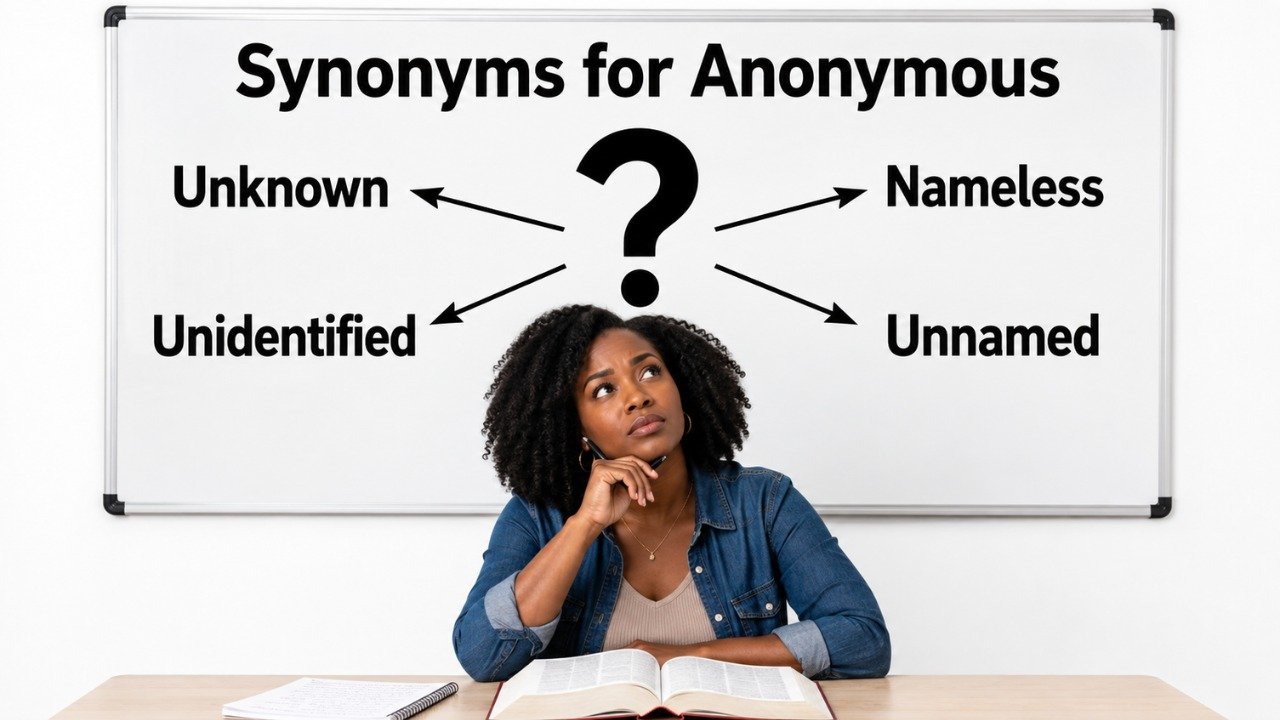
Quick Answer: Common synonyms for anonymous include unnamed, unidentified, unknown, undisclosed, nameless, uncredited, unattributed, incognito, confidential, and concealed. The best synonyms for anonymous depend on context. Use unnamed when a person’s name is deliberately omitted, unidentified when identity has not been established, undisclosed for information kept private, uncredited for creative work without attribution, incognito when someone deliberately hides their identity, and confidential when privacy is the main concern.
Pronunciation and Word Details
Word: Anonymous.
Pronunciation: /əˈnɑːnɪməs/
Part of Speech: Adjective.
Meaning: Having an identity, name, or source that is not known, revealed, or publicly stated.
US Pronunciation:
UK Pronunciation:
What Does “Anonymous” Mean?
Anonymous means having a name or identity that is unknown, hidden, or deliberately not revealed. It is an adjective commonly used for people, messages, donations, sources, writings, reports, and actions when the person responsible is not identified.
A person may remain anonymous because they want privacy.
Example: The donor chose to remain anonymous.
The word can also describe something whose creator or source is unknown.
Example: The poem was written by an anonymous author.
Anonymous may additionally refer to information given without identifying the person who supplied it.
Example: Employees were invited to submit anonymous feedback.
In each case, the central idea is the absence or concealment of a known identity.
Meaning, Tone, and Context of “Anonymous”
Anonymous has a neutral and flexible tone. It can appear naturally in formal writing, academic discussion, reports, professional communication, journalism, everyday conversation, and privacy related contexts.
The word itself is not emotional. Its effect depends on the situation. Anonymous can suggest privacy, protection, uncertainty, secrecy, or a lack of recognition.
Neutral Context: An anonymous reader sent a helpful suggestion.
Formal Context: Researchers collected anonymous responses from participants.
Privacy Context: The employee requested that the complaint remain anonymous.
Uncertain Identity Context: Police received information from an anonymous caller.
In formal writing, anonymous is especially useful when the person’s identity is intentionally withheld or genuinely unknown.
In casual conversation, unnamed, unknown, or unidentified may sometimes sound simpler.
Anonymous should not automatically imply dishonesty or secrecy. A person can remain anonymous for legitimate reasons such as privacy, safety, fairness, or personal preference.
When and How to Use “Anonymous”
For an Unnamed Person
For Identity: Use anonymous when a person’s name is intentionally not provided.
Example: An anonymous customer paid for everyone’s meal.
For an Unknown Author
For Authorship: Use anonymous when the creator of a piece of writing or artwork is not known.
Example: The collection includes several works by anonymous writers.
For Private Feedback
For Privacy: Use anonymous when people can provide opinions without revealing their identities.
Example: Students completed an anonymous survey about the course.
For Confidential Information
For Protection: Use anonymous when someone’s identity is concealed to protect privacy.
Example: The witness asked to remain anonymous.
For Donations
For Recognition: Use anonymous when a donor does not want public credit.
Example: An anonymous donor contributed funds to the community project.
For Unknown Sources
For Attribution: Use anonymous when information comes from a person whose identity is not disclosed.
Example: The report included a statement from an anonymous source.
Best Synonyms for Anonymous
Unnamed
Synonym: Having a name that is not stated or revealed.
Example: An unnamed official provided additional information.
Unidentified
Synonym: Not recognized or established by name or identity.
Example: An unidentified caller left a message.
Unknown
Synonym: Not known or recognized.
Example: The document was written by an unknown author.
Undisclosed
Synonym: Deliberately not made known to others.
Example: The buyer paid an undisclosed amount.
Nameless
Synonym: Without a known or stated name.
Example: A nameless figure appeared in the old story.
Uncredited
Synonym: Not publicly acknowledged for work or contribution.
Example: Several contributors remained uncredited in the final publication.
Unattributed
Synonym: Not connected with a named author, speaker, or source.
Example: The quotation was unattributed.
Incognito
Synonym: With one’s real identity deliberately concealed.
Example: The famous writer traveled incognito to avoid attention.
Confidential
Synonym: Intended to remain private or restricted.
Example: The information was treated as confidential.
Concealed
Synonym: Deliberately hidden from view or knowledge.
Example: The person’s identity remained concealed throughout the investigation.
50 Synonyms for Anonymous with Short Meanings
- Unnamed: Not identified by name.
- Unidentified: Having an identity that has not been established.
- Unknown: Not known or recognized.
- Undisclosed: Deliberately not revealed.
- Nameless: Without a known or stated name.
- Uncredited: Not acknowledged by name for a contribution.
- Unattributed: Not linked to a named source or creator.
- Incognito: Using a concealed identity.
- Confidential: Kept private or restricted.
- Concealed: Deliberately hidden from knowledge.
- Hidden: Kept out of public knowledge.
- Secret: Intentionally kept from being known.
- Private: Not intended for public identification.
- Unrevealed: Not made known.
- Unacknowledged: Not publicly recognized or credited.
- Unrecognized: Not identified or acknowledged.
- Untraceable: Difficult or impossible to connect to a source.
- Unspecified: Not clearly identified or named.
- Undetermined: Not yet established or identified.
- Unrecorded: Not formally documented by name.
- Unlisted: Not included in a public record or list.
- Unsigned: Lacking the writer’s or creator’s name.
- Unmarked: Carrying no identifying information.
- Unlabeled: Without an identifying label or name.
- Unregistered: Not officially recorded under a known identity.
- Unpublished: Not publicly issued or identified in publication.
- Pseudonymous: Using a false or substitute name.
- Disguised: Presented with identity deliberately obscured.
- Masked: Having one’s identity hidden.
- Obscured: Kept from clear recognition.
- Veiled: Partly or deliberately concealed.
- Unstated: Not openly expressed or identified.
- Unmentioned: Not named or referred to.
- Unspecified by Name: Not directly identified through a name.
- Without Attribution: Lacking a named author or source.
- Without Identification: Having no revealed identifying details.
- Without a Name: Not carrying a known or stated name.
- Identity Unknown: Having an identity that has not been established.
- Identity Withheld: Having identifying information deliberately concealed.
- Name Withheld: Having a name deliberately omitted.
- Source Unknown: Coming from an unidentified origin.
- Source Withheld: Coming from a source whose identity is deliberately hidden.
- Author Unknown: Written by a person whose identity is not known.
- Author Unnamed: Written by a person whose name is not given.
- Unacknowledged by Name: Not publicly credited through personal identification.
- Not Identified: Having no stated identity.
- Not Named: Having no name given publicly.
- Not Disclosed: Deliberately kept private.
- Identity Concealed: Having personal identity intentionally hidden.
- Name Concealed: Having a name intentionally kept private.
Read Also:
Synonyms for Blame
Synonyms for Anonymous by Context
When Anonymous Means Unnamed
Unnamed, nameless, and not named work well when someone’s name is simply not stated.
Unnamed: An unnamed employee provided the information.
Nameless: A nameless traveler appears throughout the story.
Not Named: Several participants were not named in the report.
When Anonymous Means Unidentified
Unidentified, unknown, undetermined, and identity unknown are useful when a person’s identity has not been established.
Unidentified: An unidentified visitor left the package.
Unknown: The author of the manuscript remains unknown.
Undetermined: The identity of the original owner remains undetermined.
When Anonymous Means Deliberately Hidden
Undisclosed, concealed, hidden, masked, and identity withheld fit situations where someone intentionally keeps an identity private.
Undisclosed: The information came from an undisclosed source.
Concealed: The witness’s identity remained concealed.
Identity Withheld: The document referred to a participant whose identity was withheld.
When Anonymous Means Without Credit
Uncredited, unattributed, unsigned, and without attribution describe creative work, statements, or contributions without a named creator.
Uncredited: Several people worked on the project but remained uncredited.
Unattributed: The statement appeared without an attributed speaker.
Unsigned: An unsigned letter arrived in the morning.
When Anonymous Means Acting Under a Hidden Identity
Incognito, disguised, masked, and pseudonymous fit situations where someone deliberately uses another identity or hides their real one.
Incognito: The performer traveled incognito.
Disguised: The visitor entered under a disguised identity.
Pseudonymous: The essay was published under a pseudonymous identity.
When Anonymous Means Private
Confidential, private, undisclosed, and secret may work when privacy is more important than literal lack of identity.
Confidential: All responses were treated as confidential.
Private: The person’s details remained private.
Undisclosed: The location remained undisclosed.
Another Word for Anonymous
Unnamed is often the best single replacement for anonymous when a person’s name is intentionally omitted. However, unidentified is more accurate when identity is genuinely unknown, while undisclosed is better when information is deliberately kept private.
Original: An anonymous employee reported the problem.
Better Option: An unnamed employee reported the problem.
Original: Police spoke with an anonymous person found near the scene.
Better Option: Police spoke with an unidentified person found near the scene.
Original: The organization received an anonymous donation.
Better Option: The organization received a donation from an unnamed contributor.
Original: The report relied on an anonymous source.
Better Option: The report relied on an undisclosed source.
When Not to Use “Anonymous”
Anonymous is useful, but it can be too broad when the exact reason an identity is missing is known.
When Identity Is Simply Unknown
If nobody knows who the person is, unidentified may be more precise.
Weak: Officers questioned an anonymous man whose identity had not yet been established.
Better: Officers questioned an unidentified man whose identity had not yet been established.
When a Name Is Intentionally Omitted
Unnamed may be clearer when a person’s identity is known but not published.
Weak: An anonymous official discussed the new proposal.
Better: An unnamed official discussed the new proposal.
When Discussing Creative Credit
Uncredited or unattributed can be more specific than anonymous.
Weak: Several anonymous contributors worked on the book.
Better: Several uncredited contributors worked on the book.
When Privacy Is the Main Point
Confidential may be better when information rather than identity is being protected.
Weak: The medical records were anonymous.
Better: The medical records were confidential.
When Repetition Sounds Awkward
Avoid repeating anonymous in every nearby sentence.
Weak: An anonymous donor gave money, and another anonymous donor later made an anonymous contribution.
Better: An anonymous donor gave money, and another unnamed contributor later made a private donation.
Words Commonly Confused With Anonymous
Anonymous vs Unnamed: Anonymous means identity is not publicly known or revealed. Unnamed usually means the person’s name is deliberately not stated.
Anonymous vs Unidentified: Anonymous often involves intentional privacy, while unidentified means identity has not been established.
Anonymous vs Unknown: Unknown is broader and can describe anything not known. Anonymous specifically concerns missing or concealed identity or authorship.
Anonymous vs Confidential: Anonymous means identity is absent or hidden. Confidential means information is kept private, even if the identity is known.
Anonymous vs Incognito: Anonymous describes an unrevealed identity. Incognito describes someone deliberately acting without revealing their familiar or real identity.
Anonymous vs Pseudonymous: Anonymous means no identity is given. Pseudonymous means a substitute or false name is used.
Anonymous vs Uncredited: Anonymous refers to unknown or concealed identity. Uncredited specifically means someone did not receive public recognition for work or contribution.
Which Synonym Should You Choose?
Choose unnamed when a person’s identity is known but their name is deliberately omitted from an article, report, statement, or conversation.
Choose unidentified when the person’s identity has not yet been established.
Choose unknown when neither the name nor identity is known and no deliberate concealment is implied.
Choose undisclosed when information is intentionally kept from the public.
Choose uncredited when someone contributed to creative or professional work but was not publicly acknowledged.
Choose unattributed when a quotation, statement, idea, or piece of writing has no named source.
Choose confidential when privacy of information is more important than absence of identity.
Choose incognito when someone deliberately moves, travels, or appears without revealing their usual identity.
Choose pseudonymous when someone uses a substitute name rather than remaining completely unnamed.
Choose anonymous in general essays, reports, surveys, and conversation when the broad idea of hidden or unknown identity is sufficient.
Real Life Examples of “Anonymous” in Sentences
Original: An anonymous donor paid for the new equipment.
Better Option: An unnamed donor paid for the new equipment.
Original: The police received a call from an anonymous individual.
Better Option: The police received a call from an unidentified individual.
Original: Employees completed an anonymous questionnaire.
Better Option: Employees completed a confidential questionnaire.
Original: The article quoted an anonymous source.
Better Option: The article quoted an undisclosed source.
Original: The novel was written by an anonymous author.
Better Option: The novel was written by an unknown author.
Original: An anonymous letter appeared on the manager’s desk.
Better Option: An unsigned letter appeared on the manager’s desk.
Original: The artist remained anonymous for many years.
Better Option: The artist remained unidentified for many years.
Original: Several anonymous contributors helped complete the project.
Better Option: Several uncredited contributors helped complete the project.
Original: The traveler wanted to remain anonymous during the trip.
Better Option: The traveler wanted to remain incognito during the trip.
Original: The complaint was submitted anonymously.
Better Option: The complaint was submitted without identification.
Synonym Groups and Usage Differences
Identity Group
Unnamed, unidentified, unknown, nameless, and identity unknown focus on the absence of a known or stated identity.
Example: An unidentified visitor was seen near the entrance.
Privacy Group
Undisclosed, confidential, private, concealed, and hidden emphasize the protection or withholding of information.
Example: The source’s identity remained confidential.
Authorship Group
Uncredited, unattributed, unsigned, author unknown, and without attribution work well for writing, artwork, quotations, or other creative contributions.
Example: The manuscript contains several unattributed passages.
Concealment Group
Incognito, masked, disguised, veiled, and identity concealed describe deliberate efforts to hide who someone is.
Example: The visitor traveled incognito to avoid public attention.
Unknown Source Group
Source unknown, unidentified, unknown, untraceable, and undetermined emphasize uncertainty about origin.
Example: The message came from an untraceable source.
Deliberately Withheld Group
Unnamed, undisclosed, name withheld, source withheld, and identity withheld indicate that someone knows the identity but chooses not to reveal it.
Example: The report included comments from a source whose identity was withheld.
Antonyms of Anonymous
The opposite of anonymous depends on whether the word refers to identity, recognition, authorship, or privacy.
Named: Identified by a stated name.
Identified: Recognized or established by identity.
Known: Recognized or familiar.
Recognized: Publicly identified or acknowledged.
Disclosed: Made known to others.
Revealed: Shown or made public.
Acknowledged: Publicly recognized for involvement or contribution.
Credited: Officially recognized by name for work.
Attributed: Connected to a known author or source.
Signed: Carrying the creator’s or sender’s name.
Public: Openly known rather than concealed.
Traceable: Capable of being linked to a known source.
Comparison: Anonymous vs Related Words
Anonymous vs Unnamed
Anonymous emphasizes concealed or unknown identity. Unnamed usually means a name is intentionally not given.
Example With Anonymous: An anonymous donor paid for the repairs.
Example With Unnamed: An unnamed official confirmed the decision.
Anonymous vs Unidentified
Anonymous may be intentional, while unidentified usually means nobody has established who the person is.
Example With Anonymous: An anonymous witness provided a written statement.
Example With Unidentified: An unidentified person was found near the entrance.
Anonymous vs Unknown
Unknown is broader and does not necessarily involve deliberate concealment.
Example With Anonymous: The anonymous writer never revealed her identity.
Example With Unknown: The writer’s identity remains unknown.
Anonymous vs Confidential
Anonymous concerns identity. Confidential concerns information that must remain private.
Example With Anonymous: Participants submitted anonymous responses.
Example With Confidential: The researcher kept participants’ records confidential.
Anonymous vs Incognito
Anonymous describes a person whose identity is not revealed. Incognito suggests deliberate concealment while moving or appearing in public.
Example With Anonymous: The letter came from an anonymous sender.
Example With Incognito: The actor traveled incognito during the holiday.
Anonymous vs Pseudonymous
Anonymous means no name or identity is revealed. Pseudonymous means a different name is used.
Example With Anonymous: The essay was published anonymously.
Example With Pseudonymous: The essay was published under a pseudonymous identity.
Anonymous vs Uncredited
Anonymous refers to hidden or unknown identity, while uncredited refers specifically to missing recognition for work.
Example With Anonymous: An anonymous artist created the mural.
Example With Uncredited: Several assistants remained uncredited for their work.
Common Phrases and Expressions With Anonymous
Anonymous Donor: A person who gives something without revealing their identity.
Anonymous Source: A person who supplies information without being publicly named.
Anonymous Author: A writer whose identity is unknown or withheld.
Anonymous Letter: A letter sent without the writer’s identity being revealed.
Anonymous Complaint: A complaint submitted without naming the person responsible.
Anonymous Feedback: Opinions or comments given without personal identification.
Anonymous Survey: A survey that does not reveal the identity of respondents.
Remain Anonymous: To keep one’s identity from being revealed.
Stay Anonymous: To continue without public identification.
Anonymous Contribution: Money, work, or assistance provided without public recognition of the contributor.
Common Mistakes to Avoid
A common mistake is treating anonymous and unidentified as exact synonyms in every situation. Anonymous often suggests that identity is intentionally hidden, while unidentified usually means identity has not yet been established.
Another mistake is confusing anonymous with confidential. A survey can be anonymous if respondents cannot be identified. It can be confidential if identities are known but protected from disclosure.
Writers should also distinguish anonymous from pseudonymous. A completely anonymous writer gives no identity, while a pseudonymous writer uses a substitute name.
Avoid using anonymous when a more precise word is available.
Vague: An anonymous document was found.
Better: An unsigned document was found.
Do not overuse anonymous within the same paragraph.
Repetitive: The anonymous writer sent an anonymous letter to an anonymous recipient.
Better: The unidentified writer sent an unsigned letter to an unnamed recipient.
Another mistake is assuming anonymous always means secretive or suspicious. People may remain anonymous for privacy, safety, fairness, or personal preference.
Finally, choose vocabulary according to the noun being described. Uncredited often works best for contributors, unsigned for letters, unidentified for unknown people, undisclosed for private information, and unattributed for quotations or statements.
Conclusion
Synonyms for anonymous include unnamed, unidentified, unknown, undisclosed, nameless, uncredited, unattributed, incognito, and confidential. Unnamed is useful when a person’s name is intentionally omitted, while unidentified fits an identity that has not been established. Undisclosed emphasizes deliberate privacy, uncredited suits missing recognition, and incognito describes someone deliberately concealing identity. Choosing the right synonym depends on whether the sentence focuses on privacy, unknown identity, authorship, recognition, confidentiality, or deliberate concealment.
FAQs About Synonyms for Anonymous
What Is the Best Synonym for Anonymous?
Unnamed is one of the best general synonyms when a person’s name is deliberately omitted. Unidentified is better when the person’s identity is genuinely unknown.
What Is a Formal Synonym for Anonymous?
Undisclosed, unidentified, unattributed, and confidential can work well in formal writing, depending on the context.
Is Unnamed the Same as Anonymous?
They are similar, but unnamed usually means a name is deliberately not provided. Anonymous can also mean that the identity itself is unknown.
What Is the Difference Between Anonymous and Confidential?
Anonymous means identity is not revealed. Confidential means information is protected from public disclosure, even when the person’s identity is known.
Can Incognito Be a Synonym for Anonymous?
Yes, in certain contexts. Incognito is appropriate when someone deliberately hides their familiar identity while appearing or traveling somewhere.
What Is a Synonym for an Anonymous Author?
Unknown author, unnamed author, unattributed writer, and unidentified writer can work depending on whether the identity is unknown or deliberately withheld.
What Is the Opposite of Anonymous?
Named, identified, known, disclosed, credited, attributed, and recognized are common opposites of anonymous, depending on context.
