
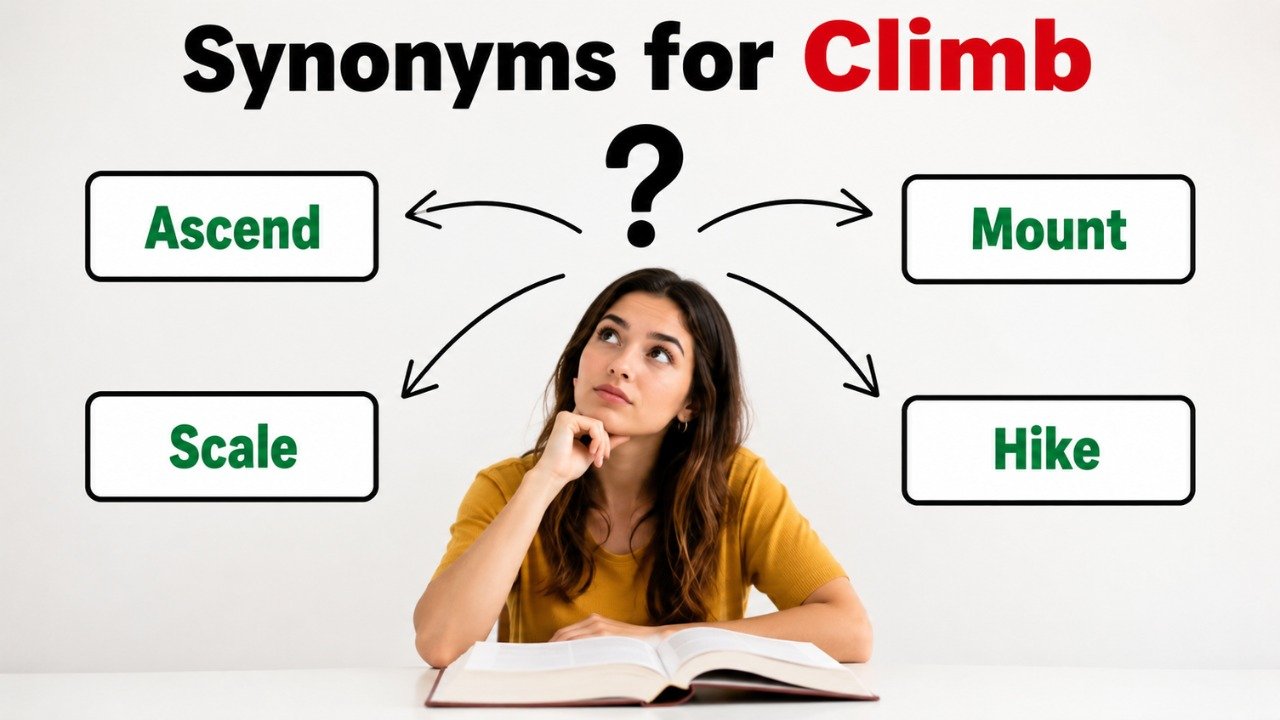
Quick Answer: The best synonyms for climb include ascend, rise, scale, mount, clamber, scramble, go up, increase, advance, and soar. Use ascend for formal descriptions of upward movement, scale for mountains and high structures, mount for steps or raised surfaces, and clamber for difficult or awkward movement. Choose rise or increase when numbers, prices, or temperatures move upward. Use advance when describing career progress, while soar emphasizes a fast or dramatic increase.
Pronunciation and Word Details
Word: Climb.
Pronunciation: /klaɪm/
Part of Speech: Verb and noun.
Meaning: To move upward, reach a higher place, increase in amount, or advance in position or status.
US Pronunciation:
UK Pronunciation:
What Does “Climb” Mean?
Climb means to move upward toward a higher position, often by using the hands, feet, or both.
As a verb, climb can describe physical movement.
Example: The hikers climbed the steep hill before sunset.
It can also describe movement onto or into something.
Example: She climbed into the boat carefully.
Climb may refer to reaching the top of a mountain, ladder, tree, wall, or staircase.
Example: He climbed the ladder to repair the roof.
The word also has several figurative meanings. Prices, temperatures, numbers, and rates can climb when they increase.
Example: Temperatures climbed throughout the afternoon.
A person can climb professionally or socially by reaching a higher rank or position.
Example: She climbed quickly through the organization.
As a noun, climb refers to an upward journey, a difficult ascent, or an increase.
Example: The final climb to the summit required patience and strength.
The exact meaning of climb depends on whether the sentence describes physical movement, numerical growth, personal progress, or a difficult challenge.
Meaning, Tone, and Context of “Climb”
Climb is a common, neutral, and flexible word. It appears naturally in casual speech, formal writing, news reports, essays, stories, travel descriptions, business discussions, and scientific explanations.
In physical contexts, climb describes upward movement that may require effort.
Example: The child climbed the tree to reach the lowest branch.
In outdoor and adventure contexts, climb often refers to ascending mountains, cliffs, rocks, or steep trails.
Example: The group planned to climb the mountain early in the morning.
In everyday conversation, climb can describe using stairs, ladders, fences, and similar structures.
Example: We had to climb three flights of stairs.
In financial or statistical writing, climb means increase.
Example: Production costs continued to climb during the final quarter.
In career contexts, climb describes advancement in rank, influence, or responsibility.
Example: He climbed from an entry level role to a senior position.
The tone of climb changes with the surrounding words. It can sound adventurous, difficult, positive, negative, or analytical.
Adventurous: They climbed the rocky peak despite the cold conditions.
Difficult: The long climb tested everyone’s strength.
Positive: Her confidence continued to climb.
Negative: Household expenses climbed unexpectedly.
Analytical: The response rate climbed from one period to the next.
Climb is usually less formal than ascend. It is more general than scale and less descriptive than clamber or scramble.
When and How to Use “Climb”
For Physical Upward Movement
Use climb when a person or animal moves toward a higher place.
Example: The cat climbed onto the wall.
For Mountains and Hills
Use climb when describing movement toward the top of a mountain, hill, cliff, or steep trail.
Example: They climbed the hill before the weather changed.
For Ladders and Stairs
Use climb for upward movement on a ladder, staircase, or similar structure.
Example: He climbed the stairs slowly.
For Difficult Movement
Use climb when moving upward requires effort, balance, or physical strength.
Example: She climbed over the fallen tree.
For Numerical Increases
Use climb when prices, temperatures, rates, figures, or totals move upward.
Example: The temperature climbed to its highest level of the week.
For Career Progress
Use climb when someone advances to a higher professional or social position.
Example: She climbed the ranks through consistent work.
For Gradual Improvement
Use climb when a score, rating, level, or performance improves over time.
Example: His confidence climbed after several successful presentations.
For Entering or Leaving Something
Use climb with words such as into, onto, out of, and over.
Example: The passengers climbed out of the vehicle.
For Describing a Challenge
As a noun, climb can refer to a difficult journey or demanding task.
Example: Completing the project was an uphill climb.
Best Synonyms for Climb
Ascend: To move from a lower position to a higher one.
Example: The balloon began to ascend above the trees.
Rise: To move upward or become higher.
Example: Smoke rose from the distant chimney.
Scale: To climb to the top of a mountain, wall, or high structure.
Example: The experienced climbers scaled the rocky face.
Mount: To go up onto a raised surface or structure.
Example: She mounted the steps and entered the building.
Clamber: To climb with difficulty by using the hands and feet.
Example: The children clambered over the large rocks.
Scramble: To climb quickly or awkwardly over rough ground.
Example: We scrambled up the loose hillside.
Go Up: To move toward a higher place or level.
Example: They went up the narrow staircase.
Increase: To become greater in amount, number, or degree.
Example: Demand increased during the summer months.
Advance: To move forward or reach a higher position.
Example: She advanced rapidly in her career.
Soar: To rise or increase quickly and dramatically.
Example: Energy costs soared during the cold season.
50 Synonyms for Climb with Short Meanings
- Ascend: To move upward toward a higher place.
- Rise: To move or become higher.
- Mount: To go up onto something raised.
- Scale: To climb a mountain, wall, or structure.
- Clamber: To climb awkwardly with the hands and feet.
- Scramble: To move upward quickly over difficult ground.
- Shinny: To climb using the arms and legs around a narrow object.
- Swarm Up: To climb quickly using repeated movements.
- Go Up: To move toward a higher level.
- Move Upward: To travel in an upward direction.
- Make an Ascent: To complete an upward journey.
- Gain Elevation: To reach a higher physical level.
- Gain Altitude: To move higher above the ground.
- Hike Up: To walk upward along a trail or slope.
- Trek Up: To make a long or demanding upward journey.
- Walk Up: To reach a higher place on foot.
- Crawl Up: To move upward slowly using the hands and knees.
- Pull Oneself Up: To raise the body using physical strength.
- Hoist Oneself Up: To lift the body onto a higher surface.
- Work One’s Way Up: To move upward gradually and carefully.
- Surmount: To reach the top of or overcome something difficult.
- Crest: To reach the top of a hill or slope.
- Top: To reach the highest point of something.
- Conquer: To successfully reach or overcome a difficult height.
- Increase: To become greater in amount or degree.
- Grow: To become larger, stronger, or higher.
- Advance: To move forward or reach a better position.
- Soar: To rise very quickly or dramatically.
- Surge: To increase suddenly and strongly.
- Escalate: To rise in intensity, seriousness, or amount.
- Jump: To increase suddenly.
- Spike: To rise sharply for a short period.
- Swell: To grow or increase in size or amount.
- Rise Sharply: To increase quickly and noticeably.
- Edge Up: To increase by a small amount.
- Creep Up: To rise slowly and gradually.
- Tick Up: To increase slightly, especially in figures or rates.
- Improve: To become better in quality or performance.
- Progress: To move toward a better or more advanced state.
- Move Up: To reach a higher level or position.
- Gain Ground: To make progress or improve one’s position.
- Rise in Rank: To reach a more senior position.
- Ascend the Ranks: To move through higher levels of authority.
- Earn Promotion: To advance to a higher professional position.
- Achieve Advancement: To gain progress in status or responsibility.
- Upturn: An upward movement or improvement.
- Upswing: A period of growth or increasing success.
- Gain: An increase in amount, value, or position.
- Growth: A process of becoming larger or more successful.
- Ascent: An upward journey or movement.
Read Also:
Synonyms for Tedious

Synonyms for Climb by Context
When Climb Means Move Upward
Ascend, rise, go up, move upward, gain elevation, and gain altitude describe movement from a lower position to a higher one.
Example With Ascend: The aircraft began to ascend through the clouds.
Example With Rise: Warm air rises toward the ceiling.
Example With Go Up: We went up the stairs to the second floor.
Example With Gain Elevation: The path gains elevation after the bridge.
Ascend is more formal than climb. Rise often describes movement without deliberate physical effort. Go up is the most conversational choice.
When Climb Means Reach the Top of Something
Scale, mount, crest, top, conquer, and surmount describe reaching or attempting to reach a high point.
Example With Scale: The team scaled the cliff before noon.
Example With Mount: He mounted the platform to address the audience.
Example With Crest: The hikers crested the ridge as the sun appeared.
Example With Top: They topped the hill after a difficult walk.
Scale is particularly useful for mountains, cliffs, walls, and tall structures. Crest means reaching the top edge of a hill or ridge. Conquer often emphasizes difficulty and achievement.
When Climb Means Move With Difficulty
Clamber, scramble, crawl up, pull oneself up, hoist oneself up, and work one’s way up suggest effort or awkward movement.
Example With Clamber: The children clambered onto the large stone.
Example With Scramble: We scrambled up the muddy slope.
Example With Pull Oneself Up: She pulled herself up onto the ledge.
Example With Work One’s Way Up: He worked his way up the narrow passage.
Clamber emphasizes awkward movement. Scramble often suggests speed, urgency, or unstable ground. Crawl up describes slow movement close to a surface.
When Climb Means Increase
Rise, increase, grow, soar, surge, escalate, jump, spike, swell, edge up, creep up, and tick up describe upward changes in numbers or levels.
Example With Increase: The total increased during the final month.
Example With Soar: Demand soared after the announcement.
Example With Spike: Energy use spiked during the heatwave.
Example With Creep Up: Monthly expenses continued to creep up.
Increase is neutral and precise. Soar describes dramatic growth. Spike suggests a sudden and often temporary rise. Creep up describes slow, gradual growth.
When Climb Means Career Progress
Advance, move up, rise in rank, ascend the ranks, earn promotion, achieve advancement, and gain ground describe improvement in professional or social position.
Example With Advance: She advanced to a leadership role.
Example With Move Up: He moved up after demonstrating strong judgment.
Example With Ascend the Ranks: She ascended the ranks through years of dedicated work.
Example With Gain Ground: The new candidate gained ground among senior decision makers.
Advance is suitable for professional writing. Move up is conversational. Ascend the ranks sounds more formal and emphasizes steady progress.
When Climb Is Used as a Noun
Ascent, rise, increase, gain, upturn, upswing, growth, and advancement can replace the noun climb in different contexts.
Example With Ascent: The final ascent required careful preparation.
Example With Rise: The sudden rise in temperature affected the equipment.
Example With Upswing: The business experienced an upswing in demand.
Example With Advancement: Her professional advancement resulted from consistent performance.
Ascent is the closest noun synonym for physical movement. Rise and increase work for figures. Advancement suits careers and status.
Another Word for Climb
The best general replacement for climb is ascend when the sentence describes formal or physical upward movement. However, the strongest alternative depends on context.
Use scale for mountains and walls, clamber for awkward movement, rise for natural upward motion, increase for numbers, and advance for professional progress.
Original: The hikers climbed the steep mountain.
Better Option: The hikers scaled the steep mountain.
Original: Prices climbed throughout the month.
Better Option: Prices increased throughout the month.
Original: She climbed quickly through the company.
Better Option: She advanced quickly through the organization.
Original: The child climbed over the rocks.
Better Option: The child clambered over the rocks.
When Not to Use “Climb”
Climb is useful, but another word may be more accurate when the movement, increase, or progress has a specific quality.
When Describing Natural Upward Movement
Rise is often better when something moves upward without using hands or feet.
Weak: Smoke climbed into the sky.
Better: Smoke rose into the sky.
When Describing a Formal Ascent
Ascend may sound more suitable in technical, scientific, or formal writing.
Weak: The aircraft climbed to a higher altitude.
Better: The aircraft ascended to a higher altitude.
Climb is still correct in aviation contexts, but ascend may suit general formal writing better.
When Describing a Mountain Achievement
Scale is more precise when the focus is reaching the top of a difficult mountain or wall.
Weak: They climbed the dangerous cliff face.
Better: They scaled the dangerous cliff face.
When Movement Is Awkward
Use clamber or scramble when the person moves with difficulty.
Weak: He climbed over the broken furniture.
Better: He clambered over the broken furniture.
When Reporting Numerical Change
Increase or rise may sound more objective in reports.
Weak: The error rate climbed by a small amount.
Better: The error rate increased by a small amount.
When the Increase Is Sudden
Use spike, jump, surge, or soar to show speed and intensity.
Weak: Demand climbed suddenly after the announcement.
Better: Demand surged after the announcement.
When Describing Career Development
Advance or progress may sound more professional than climb.
Weak: She climbed in her profession through careful planning.
Better: She advanced in her profession through careful planning.
When Climb Becomes Repetitive
Repeating climb several times can make a paragraph sound dull.
Weak: We climbed the hill, climbed over a wall, and climbed a ladder.
Better: We ascended the hill, clambered over a wall, and mounted a ladder.
Words Commonly Confused With Climb
Climb vs Ascend: Climb often suggests physical effort, while ascend simply means moving upward and may sound more formal.
Climb vs Rise: Climb usually involves deliberate movement or gradual increase. Rise often describes natural movement or an increase without mentioning effort.
Climb vs Scale: Climb is general. Scale usually means reaching or attempting to reach the top of a mountain, wall, or high structure.
Climb vs Mount: Climb emphasizes upward movement. Mount often means getting onto a raised surface, animal, vehicle, platform, or set of steps.
Climb vs Clamber: Climb is neutral. Clamber suggests awkward, difficult, or unsteady movement using the hands and feet.
Climb vs Scramble: Climb may be controlled and steady. Scramble suggests quick, hurried, or difficult movement over rough ground.
Climb vs Hike: Climb emphasizes upward movement. Hike refers to a long walk, which may include flat, descending, and rising ground.
Climb vs Crawl: Climb means moving upward. Crawl means moving close to the ground or surface using the hands and knees.
Climb vs Increase: Climb can describe both physical movement and numerical growth. Increase refers specifically to becoming greater in amount, size, number, or degree.
Climb vs Advance: Climb may describe physical ascent or figurative progress. Advance usually emphasizes forward development, improvement, or promotion.
Which Synonym Should You Choose?
Choose ascend when writing formally about upward movement.
Choose rise when smoke, heat, water, light, or another substance moves upward naturally.
Choose scale when describing mountains, cliffs, walls, towers, and difficult structures.
Choose mount when someone steps onto a platform, horse, bicycle, or raised surface.
Choose clamber when the movement is awkward, difficult, or unsteady.
Choose scramble when someone moves quickly over loose, rocky, or challenging ground.
Choose go up in casual speech and simple everyday explanations.
Choose hike up when describing an upward walk along a trail.
Choose gain elevation in travel, mapping, outdoor, or technical descriptions.
Choose increase in formal reports involving prices, rates, totals, figures, and measurements.
Choose rise for clear and neutral discussions of upward numerical movement.
Choose soar when the increase is large, fast, and dramatic.
Choose surge when the increase is sudden and powerful.
Choose spike when a number rises sharply, especially for a short period.
Choose creep up when the increase is slow and possibly unnoticed.
Choose edge up or tick up when the change is small.
Choose advance in essays, reports, emails, and professional discussions about career development.
Choose move up in casual conversations about promotion or status.
Choose ascend the ranks when emphasizing gradual professional progress.
Choose ascent when you need a noun for a physical upward journey.
Real Life Examples of “Climb” in Sentences
Original: We climbed the hill before breakfast.
Better Option: We ascended the hill before breakfast.
Original: The rescue team climbed the damaged tower.
Better Option: The rescue team scaled the damaged tower.
Original: The children climbed over the rocks near the stream.
Better Option: The children clambered over the rocks near the stream.
Original: The hikers climbed quickly up the loose slope.
Better Option: The hikers scrambled up the loose slope.
Original: The temperature climbed during the afternoon.
Better Option: The temperature rose during the afternoon.
Original: Food prices climbed during the winter.
Better Option: Food prices increased during the winter.
Original: Demand climbed rapidly after the product became available.
Better Option: Demand surged rapidly after the product became available.
Original: She climbed to a senior position within five years.
Better Option: She advanced to a senior position within five years.
Original: The plane climbed above the clouds.
Better Option: The plane ascended above the clouds.
Original: He climbed onto the stage to receive the award.
Better Option: He mounted the stage to receive the award.
Synonym Groups and Usage Differences
General Upward Movement Group
Ascend, rise, go up, move upward, and gain elevation describe movement toward a higher place.
Ascend is formal. Go up is conversational. Rise often describes natural movement.
Example: The elevator ascended to the highest floor.
Mountain and Structure Group
Scale, mount, crest, top, conquer, and surmount relate to reaching the top of something high or difficult.
Scale suits cliffs and mountains. Crest refers to reaching the upper edge of a slope. Conquer emphasizes achievement.
Example: The climbers scaled the icy peak before the storm arrived.
Difficult Movement Group
Clamber, scramble, crawl up, shinny, pull oneself up, and hoist oneself up emphasize effort.
Clamber suggests awkwardness. Scramble suggests quick movement over difficult ground. Shinny usually describes climbing a narrow object such as a pole.
Example: She clambered over the fallen branches.
Gradual Increase Group
Rise, grow, increase, edge up, creep up, and tick up describe steady or limited growth.
Increase is neutral. Creep up suggests slow growth. Tick up and edge up indicate a small change.
Example: Interest rates edged up slightly.
Rapid Increase Group
Soar, surge, jump, spike, escalate, and swell describe strong upward change.
Soar and surge suggest dramatic growth. Spike often refers to a brief rise. Escalate can suggest increasing seriousness or intensity.
Example: Requests surged after the new service opened.
Career and Status Group
Advance, move up, rise in rank, ascend the ranks, gain ground, and achieve advancement describe professional progress.
Advance is formal and direct. Move up is casual. Ascend the ranks emphasizes moving through several levels.
Example: She advanced to a more responsible role.
Noun Group
Ascent, rise, increase, growth, gain, upturn, upswing, and advancement are noun alternatives.
Ascent works for physical movement. Increase and rise suit data. Advancement describes professional or social progress.
Example: The ascent to the summit took four hours.
Antonyms of Climb
The opposite of climb depends on whether the word describes physical movement, numerical growth, or progress.
Descend: To move from a higher place to a lower one.
Fall: To move downward, often quickly or without control.
Drop: To move or become lower.
Decline: To decrease gradually or become weaker.
Decrease: To become smaller in amount, number, or degree.
Sink: To move downward below a surface or level.
Lower: To move something to a reduced position or level.
Retreat: To move backward or away from an advanced position.
Regress: To return to a less developed or successful state.
Tumble: To fall suddenly or sharply.
Plunge: To fall or decrease rapidly.
Slide: To move downward gradually.
Dismount: To get down from something that has been mounted.
Come Down: To move from a higher place to a lower one.
Lose Ground: To fall behind or become less successful.
Comparison: Climb vs Related Words
Climb vs Ascend
Climb often suggests physical effort and contact with a surface. Ascend simply means moving upward and usually sounds more formal.
Example With Climb: We climbed the steep staircase.
Example With Ascend: We ascended to the upper level.
Climb vs Rise
Climb often involves deliberate movement or a gradual increase. Rise may describe natural upward motion or a change in level.
Example With Climb: The hikers climbed the ridge.
Example With Rise: The sun rose above the ridge.
Climb vs Scale
Climb is a general word for upward movement. Scale usually suggests climbing a difficult mountain, wall, or structure.
Example With Climb: They climbed the hillside.
Example With Scale: They scaled the vertical rock face.
Climb vs Mount
Climb focuses on upward movement. Mount focuses on getting onto something raised.
Example With Climb: She climbed the steps.
Example With Mount: She mounted the platform.
Climb vs Clamber
Climb is neutral and does not show how difficult the movement is. Clamber suggests awkward or difficult movement.
Example With Climb: He climbed over the fence.
Example With Clamber: He clambered over the broken fence.
Climb vs Scramble
Climb may be slow and controlled. Scramble suggests hurried movement over rough or unstable ground.
Example With Climb: We climbed the path carefully.
Example With Scramble: We scrambled up the loose rocks.
Climb vs Increase
Climb can describe both physical ascent and numerical growth. Increase only refers to becoming greater.
Example With Climb: Costs climbed during the month.
Example With Increase: Costs increased during the month.
Climb vs Soar
Climb can describe a slow, steady, or moderate increase. Soar emphasizes a fast and dramatic rise.
Example With Climb: Sales climbed gradually.
Example With Soar: Sales soared after the launch.
Climb vs Advance
Climb can describe upward movement, increasing figures, or improved status. Advance focuses on forward progress or promotion.
Example With Climb: She climbed through the professional ranks.
Example With Advance: She advanced to a leadership position.
Common Phrases and Expressions With Climb
Climb a Mountain: To move toward the top of a mountain.
Example: They trained for months to climb the mountain safely.
Climb the Stairs: To move upward using a staircase.
Example: He climbed the stairs instead of using the elevator.
Climb a Ladder: To move upward using ladder steps.
Example: She climbed the ladder to reach the shelf.
Climb a Tree: To move upward through a tree using its trunk and branches.
Example: The child learned to climb a tree safely.
Climb the Ranks: To advance through levels of authority or status.
Example: She climbed the ranks through patience and strong performance.
Climb to the Top: To reach the highest point or most successful position.
Example: He worked steadily to climb to the top of his profession.
Climb Steadily: To rise at a consistent rate.
Example: Attendance continued to climb steadily.
Climb Sharply: To increase quickly and noticeably.
Example: Temperatures began to climb sharply after noon.
Steep Climb: A difficult or sharply rising ascent.
Example: The final section of the trail was a steep climb.
Uphill Climb: A difficult challenge requiring sustained effort.
Example: Rebuilding public confidence will be an uphill climb.
Common Mistakes to Avoid
Using “Climb” for Every Type of Upward Movement
Climb is not always the most precise verb. Smoke rises, aircraft ascend, and prices increase.
Less Precise: Steam climbed from the cup.
Better: Steam rose from the cup.
Overusing “Climb Up”
Climb already contains the idea of upward movement, so up is sometimes unnecessary.
Wordy: We climbed up the ladder.
Clearer: We climbed the ladder.
Climb up is still natural when the direction needs emphasis or when it is followed by a slope, path, or surface.
Natural: We climbed up the narrow path.
Confusing Climb With Scale
Scale is best used for difficult mountains, walls, cliffs, and structures.
Unnatural: She scaled the stairs to her room.
Natural: She climbed the stairs to her room.
Using Rise for Deliberate Physical Climbing
Rise does not normally describe using the hands and feet to move up a surface.
Incorrect: They rose the mountain.
Correct: They climbed the mountain.
Using Clamber Without Difficulty
Clamber suggests awkward effort. Do not use it for smooth, easy movement.
Unnatural: She clambered up the wide, comfortable staircase.
Natural: She climbed the wide, comfortable staircase.
Using Soar for a Small Increase
Soar describes a dramatic increase, not a minor change.
Incorrect: The rate soared from ten percent to ten point one percent.
Better: The rate edged up from ten percent to ten point one percent.
Repeating Climb in the Same Paragraph
Use context based alternatives to create variety.
Repetitive: The hikers climbed the hill, climbed the rocks, and climbed to the summit.
Improved: The hikers ascended the hill, scrambled over the rocks, and reached the summit.
Confusing the Verb and Noun Forms
Climb can be both a verb and a noun.
Verb: We will climb the ridge tomorrow.
Noun: The climb will take several hours.
Using the Wrong Past Tense
The correct past tense is climbed, not clumb or climb.
Incorrect: They clumb the hill yesterday.
Correct: They climbed the hill yesterday.
Pronouncing the Final Letter
The final b in climb is silent.
Correct Pronunciation: /klaɪm/
The b is written but not spoken.
Conclusion
Synonyms for climb vary according to movement, difficulty, growth, and progress. Ascend is a strong formal alternative, while scale works well for mountains and walls. Use clamber or scramble for difficult movement, rise or increase for numerical growth, and soar or surge for dramatic increases. Advance and move up are useful for career development. Choosing a context specific synonym makes each sentence clearer, more accurate, and more expressive without changing the intended meaning.
FAQs About Synonyms for Climb
What Is the Best Synonym for Climb?
Ascend is the best general synonym for formal upward movement. Scale, rise, clamber, and increase may be better in specific contexts.
What Is a Formal Word for Climb?
Ascend is the most common formal alternative. Surmount and make an ascent may also fit certain sentences.
What Is Another Word for Climbing a Mountain?
Scale is a strong alternative for climbing a mountain, cliff, wall, or difficult structure.
What Is Another Word for Climb in Prices?
Use rise, increase, grow, surge, soar, spike, or edge up, depending on the speed and size of the change.
What Is the Difference Between Climb and Ascend?
Climb often suggests physical effort. Ascend simply means moving upward and usually has a more formal tone.
Can Climb Mean Career Progress?
Yes. Someone can climb the ranks, move up, advance, rise in rank, or achieve professional advancement.
Is Clamber a Synonym for Climb?
Yes, but clamber specifically describes difficult, awkward, or unsteady climbing that often requires the hands and feet.
