
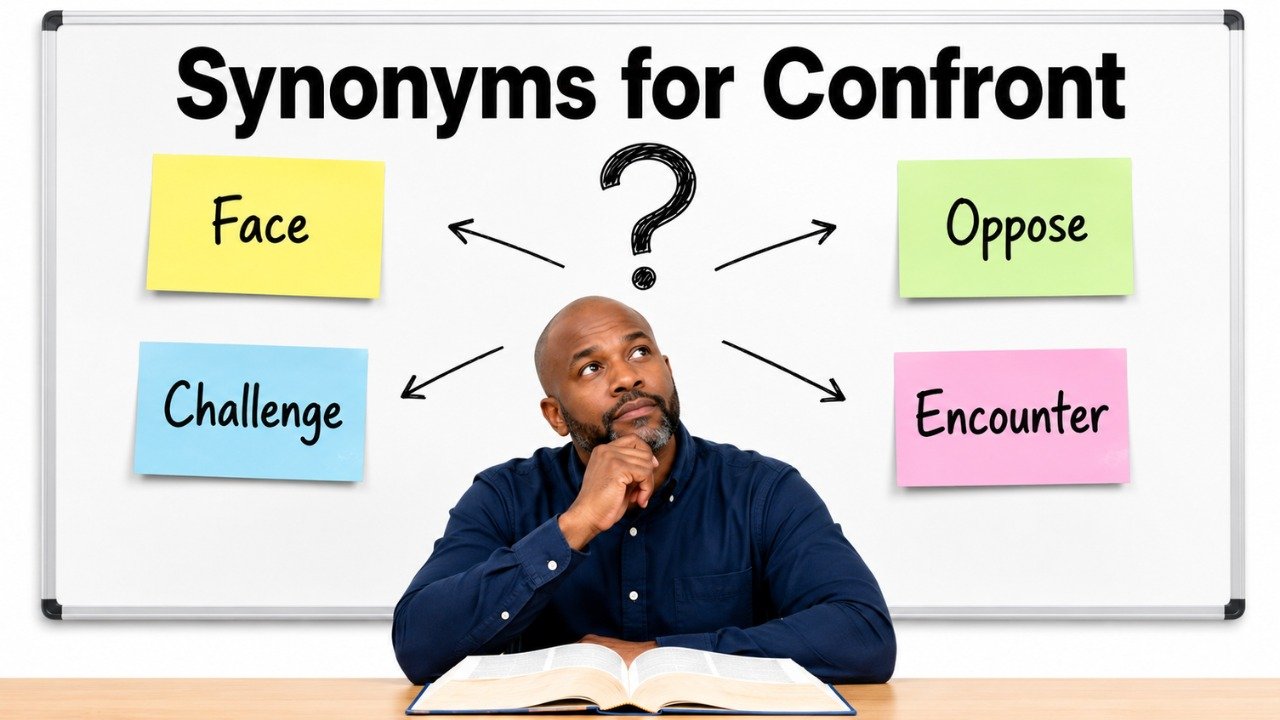
Quick Answer: The best synonyms for confront include face, address, challenge, tackle, encounter, oppose, question, accuse, stand up to, and deal with. Use face when someone accepts a difficult truth or situation. Choose address or tackle when discussing a problem professionally. Challenge and oppose work when resisting an idea, decision, or person. Question is suitable when asking for an explanation, while accuse is stronger and suggests blame. Stand up to is natural in casual speech when someone refuses to be intimidated.
Pronunciation and Word Details
Word: Confront.
Pronunciation: /kənˈfrʌnt/.
Part of Speech: Verb.
Meaning: To face, challenge, or deal directly with a person, problem, truth, or difficult situation.
US Pronunciation:
UK Pronunciation:
What Does “Confront” Mean?
Confront means to face a person, problem, truth, or difficult situation directly instead of avoiding it.
Confront is mainly used as a verb. It often describes a deliberate action in which someone deals openly with something uncomfortable, serious, or challenging.
A person can confront another person about dishonest behavior. Someone can also confront a fear, face a difficult truth, address a workplace problem, or encounter an unexpected obstacle.
Direct personal use: She decided to confront her colleague about the missing documents.
Problem related use: The organization must confront the issue before it becomes worse.
Emotional use: He finally confronted his fear of speaking in public.
Truth related use: They were forced to confront the reality of the situation.
Unexpected encounter use: The travelers confronted several difficulties during the journey.
The meaning changes slightly according to the object that follows the verb. Confronting a person often suggests a direct conversation or challenge. Confronting a problem means dealing with it. Confronting a truth means accepting something uncomfortable or difficult.
Meaning, Tone, and Context of “Confront”
Confront is a strong and direct word. It can sound neutral, serious, emotional, formal, or aggressive depending on the sentence.
Neutral tone: Confront may simply mean facing or dealing with something difficult.
Example: The team must confront several technical problems.
Serious tone: It often introduces an important issue that cannot be ignored.
Example: Communities must confront the causes of the conflict.
Emotional tone: The word can describe difficult personal conversations, fears, memories, or truths.
Example: She was not ready to confront her painful memories.
Aggressive tone: When used with a person, confront may suggest anger, accusation, or conflict.
Example: He confronted the driver after the argument.
Professional tone: In reports, essays, and workplace communication, confront often means address, manage, or respond to a serious challenge.
Example: Leaders must confront declining performance with a clear plan.
Conversational tone: In everyday speech, people use confront when talking about standing up to someone or asking for an explanation.
Example: You should confront him about what happened.
Confront is common in personal communication, academic writing, news style writing, workplace discussions, psychology, conflict resolution, and descriptions of courage.
When and How to Use “Confront”
For Directly Addressing a Person
Use confront when someone speaks directly to another person about a problem, action, or disagreement.
Example: She confronted her roommate about the unpaid bills.
For Facing a Difficult Problem
Use confront when a person or group begins dealing seriously with an issue.
Example: The company must confront its declining customer satisfaction.
For Accepting an Uncomfortable Truth
Use confront when someone stops avoiding reality and accepts a difficult fact.
Example: He had to confront the truth about his poor decisions.
For Challenging Unfair Behavior
Use confront when someone openly resists harmful, dishonest, or inappropriate conduct.
Example: The employee confronted the manager about the unfair treatment.
For Overcoming Fear
Use confront when a person deliberately faces something frightening or uncomfortable.
Example: She confronted her fear of heights by climbing the observation tower.
For Asking for an Explanation
Use confront when someone directly asks another person to explain suspicious or troubling behavior.
Example: He confronted his friend about the false statement.
For Encountering Difficulties
Use confront when someone meets an obstacle, danger, or unexpected situation.
Example: The rescue team confronted severe weather conditions.
For Formal Analysis
Use confront in essays and reports when discussing major challenges that require action.
Example: The report explains how cities can confront rising housing costs.
For Opposing an Idea or Decision
Use confront when a person directly challenges an argument, belief, policy, or decision.
Example: The speaker confronted several assumptions in the proposal.
Best Synonyms for Confront
Face
Synonym: To accept, meet, or deal directly with something difficult.
Example: We must face the consequences of our choices.
Address
Synonym: To give attention to a problem and begin dealing with it.
Example: The committee met to address concerns about safety.
Challenge
Synonym: To question, oppose, or test a person, claim, or decision.
Example: The lawyer challenged the accuracy of the statement.
Tackle
Synonym: To make a determined effort to solve a difficult problem.
Example: The team is ready to tackle the most urgent issue.
Encounter
Synonym: To meet or experience a person, obstacle, or situation.
Example: The researchers encountered several unexpected difficulties.
Oppose
Synonym: To disagree with or act against someone or something.
Example: Local residents opposed the proposed change.
Question
Synonym: To ask someone for information or challenge the truth of a claim.
Example: The supervisor questioned him about the missing equipment.
Accuse
Synonym: To claim that someone has done something wrong.
Example: She accused the contractor of hiding important information.
Stand Up To
Synonym: To resist someone without being frightened or controlled.
Example: He finally stood up to the person who had been intimidating him.
Deal With
Synonym: To take action concerning a person, problem, or situation.
Example: We need to deal with the complaint immediately.
50 Synonyms for Confront with Short Meanings
- Face: Deal directly with something difficult.
- Address: Give serious attention to an issue.
- Challenge: Question or oppose directly.
- Tackle: Make a determined effort to solve something.
- Encounter: Meet or experience unexpectedly.
- Oppose: Act or speak against something.
- Question: Ask for an explanation or test a claim.
- Accuse: State that someone has done something wrong.
- Resist: Refuse to accept or obey.
- Defy: Openly refuse to follow or submit.
- Approach: Move toward a person or issue.
- Meet: Come into contact with someone or something.
- Engage: Become directly involved with a person or issue.
- Contest: Dispute the truth or fairness of something.
- Dispute: Argue against a claim, decision, or statement.
- Counter: Respond to an argument or action with opposition.
- Combat: Act strongly against a problem or threat.
- Brave: Face danger or difficulty with courage.
- Endure: Continue through a difficult experience.
- Handle: Manage a situation effectively.
- Manage: Control or deal with a difficult matter.
- Resolve: Find an answer to a problem or conflict.
- Examine: Study an issue carefully.
- Investigate: Look closely into a problem or accusation.
- Discuss: Talk about an issue directly.
- Raise: Introduce a problem for discussion.
- Press: Question someone firmly and repeatedly.
- Interrogate: Question someone formally and intensely.
- Cross Question: Ask detailed questions to test an account.
- Rebuke: Express strong criticism directly.
- Criticize: Point out faults or problems.
- Condemn: Express strong disapproval.
- Call Out: Publicly or directly challenge improper behavior.
- Take On: Accept a challenge or opponent.
- Stand Up To: Resist an intimidating person or force.
- Deal With: Take action to manage something.
- Grapple With: Struggle to understand or solve something difficult.
- Contend With: Deal with a difficult situation or problem.
- Come Up Against: Meet resistance, opposition, or difficulty.
- Run Into: Encounter a person or problem unexpectedly.
- Clash With: Enter into direct disagreement or conflict.
- Face Down: Confront someone firmly without showing fear.
- Bring Up: Introduce a sensitive subject for discussion.
- Speak To: Address someone about a particular matter.
- Hold Accountable: Require someone to answer for their actions.
- Demand Answers From: Insist that someone explain their behavior.
- Reckon With: Accept and deal with a difficult reality.
- Cope With: Manage a challenging situation successfully.
- Respond To: Take action after facing an issue or challenge.
- Acknowledge: Recognize a fact or problem instead of avoiding it.
Read Also:
Synonyms for Terror

Synonyms for Confront by Context
When Confront Means Face a Problem
Use face, address, tackle, handle, manage, deal with, grapple with, or contend with when discussing problems and challenges.
Example With Confront: The school must confront the decline in attendance.
Example With Address: The school must address the decline in attendance.
Address sounds professional and solution focused. Tackle suggests determined action, while grapple with emphasizes that the problem is difficult or complex.
When Confront Means Challenge a Person
Use challenge, oppose, resist, defy, stand up to, face down, or call out when someone directly resists another person.
Example With Confront: She confronted the supervisor about his disrespectful remarks.
Example With Challenged: She challenged the supervisor about his disrespectful remarks.
Stand up to emphasizes courage. Call out often suggests openly identifying unacceptable behavior.
When Confront Means Ask for an Explanation
Use question, press, interrogate, cross question, demand answers from, or speak to when information is needed.
Example With Confront: The manager confronted him about the missing funds.
Example With Questioned: The manager questioned him about the missing funds.
Question is neutral. Press suggests firm and repeated questioning. Interrogate is much stronger and is commonly connected with formal investigations.
When Confront Means Accuse Someone
Use accuse, blame, charge, condemn, criticize, rebuke, or call out when someone claims that another person has acted wrongly.
Example With Confront: She confronted him about breaking the agreement.
Example With Accused: She accused him of breaking the agreement.
Accuse clearly communicates blame. Confront only means that the issue was discussed directly and does not always mean guilt was claimed.
When Confront Means Encounter Something
Use encounter, meet, come up against, run into, or face when someone experiences a difficulty or obstacle.
Example With Confront: The hikers confronted several dangers along the route.
Example With Encountered: The hikers encountered several dangers along the route.
Encounter is more neutral and does not necessarily suggest deliberate action.
When Confront Means Accept the Truth
Use face, acknowledge, accept, recognize, or reckon with when someone stops avoiding reality.
Example With Confront: He finally confronted the truth about the relationship.
Example With Acknowledged: He finally acknowledged the truth about the relationship.
Acknowledge emphasizes recognition. Reckon with suggests that the truth is serious and may have lasting consequences.
When Confront Means Oppose an Idea
Use challenge, dispute, contest, counter, oppose, or resist when questioning a claim, argument, decision, or belief.
Example With Confront: The article confronts traditional assumptions about leadership.
Example With Challenges: The article challenges traditional assumptions about leadership.
Challenge is usually the most natural choice for essays, reports, and academic discussion.
When Confront Means Face a Fear
Use face, brave, overcome, deal with, or stand up to when someone acts courageously despite fear.
Example With Confront: She decided to confront her fear of deep water.
Example With Face: She decided to face her fear of deep water.
Face is the most natural and widely used alternative in emotional and motivational contexts.
Another Word for Confront
The best single replacement for confront is often face. It works naturally when someone deals with a problem, fear, truth, consequence, or difficult situation.
However, the best alternative depends on context. Address is more professional when discussing an issue. Challenge is better when questioning a person or idea. Encounter is suitable when someone unexpectedly meets a difficulty.
Original: The organization must confront its financial problems.
Better Option: The organization must address its financial problems.
Original: She confronted her fear of failure.
Better Option: She faced her fear of failure.
Original: The researcher confronted the traditional explanation.
Better Option: The researcher challenged the traditional explanation.
Original: The travelers confronted several obstacles.
Better Option: The travelers encountered several obstacles.
When Not to Use “Confront”
Confront can sound too aggressive when the intended meaning is simply discuss, ask, or clarify. A more precise synonym may create a calmer and clearer tone.
When You Want a Polite Conversation
Use discuss, speak to, or raise the issue when the conversation is respectful and cooperative.
Weak: I will confront my manager about the schedule.
Better: I will speak to my manager about the schedule.
When You Mean Solve a Problem
Use address, tackle, handle, or resolve when the focus is on finding a solution.
Weak: The department will confront the software error.
Better: The department will address the software error.
When You Mean Meet Unexpectedly
Use encounter or run into when no disagreement or deliberate challenge is involved.
Weak: We confronted an old friend at the station.
Better: We encountered an old friend at the station.
When You Mean Ask a Neutral Question
Use ask or question if there is no conflict or accusation.
Weak: The teacher confronted the student about which book he preferred.
Better: The teacher asked the student which book he preferred.
When You Mean Accuse
Use accuse when someone directly claims that another person is responsible for wrongdoing.
Weak: She confronted him of dishonesty.
Better: She accused him of dishonesty.
When You Mean Oppose a Policy
Use challenge, contest, resist, or oppose when discussing formal disagreement.
Weak: The residents confronted the new regulation in court.
Better: The residents challenged the new regulation in court.
When Repetition Weakens the Writing
Using confront repeatedly can make writing sound harsh and monotonous.
Weak: She confronted the problem, confronted the manager, and confronted the consequences.
Better: She addressed the problem, questioned the manager, and faced the consequences.
Words Commonly Confused With Confront
Confront vs Face: Both words can mean dealing directly with something difficult. Confront often sounds more active or forceful, while face is broader and more neutral.
Confront vs Address: Confront suggests direct engagement with a difficult matter. Address focuses on giving attention to a problem and working toward a solution.
Confront vs Challenge: Confront means directly facing a person or issue. Challenge means questioning, opposing, or testing someone or something.
Confront vs Encounter: Confront may suggest deliberate action. Encounter usually means meeting a person, problem, or situation, often unexpectedly.
Confront vs Accuse: Confront means speaking directly about an issue. Accuse means claiming that someone has done something wrong.
Confront vs Question: Confront may involve conflict or seriousness. Question focuses on asking for information or testing the truth of a statement.
Confront vs Oppose: Confront means meeting or addressing something directly. Oppose means disagreeing with or acting against it.
Confront vs Tackle: Confront emphasizes facing a problem. Tackle emphasizes making a determined effort to solve it.
Confront vs Criticize: Confront involves direct engagement. Criticize means expressing disapproval or identifying faults.
Confront vs Deal With: Confront is stronger and more direct. Deal with is broader and can describe any method of managing a situation.
Which Synonym Should You Choose?
Choose face when writing about accepting a difficult truth, fear, consequence, or situation.
Choose address when discussing problems in reports, essays, emails, meetings, or professional communication.
Choose tackle when emphasizing active and determined problem solving.
Choose challenge when questioning a claim, decision, authority, assumption, or argument.
Choose encounter when someone meets a difficulty, person, or obstacle unexpectedly.
Choose oppose when expressing disagreement with a rule, plan, policy, or idea.
Choose question when asking someone to explain their behavior or provide information.
Choose accuse when directly claiming that someone committed an offence or acted wrongly.
Choose call out when discussing direct criticism of unacceptable behavior in casual language.
Choose stand up to when someone resists intimidation, pressure, or unfair treatment.
Choose grapple with when a problem is complex and difficult to understand or solve.
Choose contend with when describing ongoing difficulties in formal writing.
Choose discuss or speak to when you want a polite and cooperative tone.
Choose confront when directness, seriousness, courage, or conflict is an important part of the meaning.
Real Life Examples of “Confront” in Sentences
Original: We must confront the problem before it becomes more serious.
Better Option: We must address the problem before it becomes more serious.
Original: She confronted her fear of speaking in front of large groups.
Better Option: She faced her fear of speaking in front of large groups.
Original: The employee confronted his supervisor about the unfair decision.
Better Option: The employee challenged his supervisor about the unfair decision.
Original: The hikers confronted dangerous weather during their journey.
Better Option: The hikers encountered dangerous weather during their journey.
Original: He confronted his brother about the missing money.
Better Option: He questioned his brother about the missing money.
Original: The report confronts several common beliefs about education.
Better Option: The report challenges several common beliefs about education.
Original: The city must confront the growing housing shortage.
Better Option: The city must tackle the growing housing shortage.
Original: She confronted the person who had been spreading false information.
Better Option: She called out the person who had been spreading false information.
Original: He finally confronted the consequences of his actions.
Better Option: He finally faced the consequences of his actions.
Original: The small business confronted several financial difficulties.
Better Option: The small business contended with several financial difficulties.
Synonym Groups and Usage Differences
Problem Solving Group
Address, tackle, handle, manage, resolve, deal with, grapple with, and contend with describe taking action on a problem.
Address is professional and neutral. Tackle suggests determination. Resolve focuses on reaching a solution. Grapple with emphasizes complexity.
Example: The committee will address the concerns in its next meeting.
Direct Challenge Group
Challenge, oppose, resist, defy, contest, dispute, and counter describe disagreement or resistance.
Challenge is suitable for claims, ideas, and authority. Resist means refusing pressure or control. Defy is stronger and suggests open refusal.
Example: Several experts challenged the conclusion of the report.
Personal Confrontation Group
Face, confront, stand up to, face down, call out, rebuke, and criticize describe direct interaction with another person.
Stand up to emphasizes courage. Call out emphasizes identifying wrongful behavior. Rebuke communicates strong disapproval.
Example: She stood up to the person who had been threatening her.
Questioning Group
Question, press, interrogate, cross question, demand answers from, and investigate relate to seeking information.
Question is neutral. Press is firmer. Interrogate is formal and intense. Investigate focuses on examining evidence rather than directly challenging a person.
Example: The interviewer pressed the official for a clearer response.
Encounter Group
Encounter, meet, run into, come up against, and face describe coming into contact with a person, difficulty, or obstacle.
Encounter is neutral and often unexpected. Come up against usually involves resistance or difficulty.
Example: The team came up against several unexpected technical barriers.
Courage Group
Face, brave, confront, endure, and take on describe accepting danger, fear, or difficulty.
Brave emphasizes courage. Endure emphasizes continuing despite hardship. Take on suggests willingly accepting a challenge.
Example: She bravely faced the uncertainty of starting again.
Truth and Acceptance Group
Acknowledge, accept, recognize, face, and reckon with describe accepting an uncomfortable fact.
Acknowledge means admitting that something exists. Reckon with suggests understanding the seriousness of its effects.
Example: The organization must reckon with the consequences of the decision.
Antonyms of Confront
The opposite of confront depends on whether it means facing a person, solving a problem, opposing something, or accepting the truth.
Avoid: Stay away from a person, problem, or situation.
Evade: Escape from a question, duty, or difficulty.
Ignore: Refuse to give attention to something.
Overlook: Fail to notice or intentionally disregard an issue.
Sidestep: Avoid dealing directly with a difficult subject.
Retreat: Move away from conflict or danger.
Withdraw: Remove yourself from a situation or disagreement.
Flee: Run away from danger or confrontation.
Yield: Stop resisting and accept another person’s position.
Submit: Accept the authority or control of another.
Surrender: Stop opposing a person, force, or situation.
Accept: Agree without opposition or challenge.
Conceal: Hide a fact or problem instead of addressing it.
Dismiss: Treat an issue as unimportant.
Deny: Refuse to accept that something is true.
Comparison of Confront and Related Words
Confront vs Face
Confront sounds more direct and forceful. Face is more neutral and works naturally with fears, facts, consequences, and problems.
Example With Confront: She confronted the person responsible for the damage.
Example With Face: She faced the consequences of the mistake.
Confront vs Address
Confront emphasizes direct engagement. Address emphasizes attention, discussion, and problem solving.
Example With Confront: The manager confronted the employee about repeated lateness.
Example With Address: The manager addressed the problem of repeated lateness.
Confront vs Challenge
Confront means dealing directly with a person or issue. Challenge means questioning or opposing the validity, fairness, or authority of something.
Example With Confront: He confronted the official about the decision.
Example With Challenge: He challenged the legality of the decision.
Confront vs Encounter
Confront may be deliberate and serious. Encounter usually refers to meeting or experiencing something, often without planning.
Example With Confront: She confronted her neighbor about the noise.
Example With Encounter: She encountered heavy traffic on the way home.
Confront vs Accuse
Confront does not automatically suggest guilt. Accuse directly claims that someone is responsible for wrongdoing.
Example With Confront: He confronted her about the missing file.
Example With Accuse: He accused her of taking the missing file.
Confront vs Tackle
Confront focuses on facing the existence of a problem. Tackle focuses on actively working to solve it.
Example With Confront: The team must confront the decline in sales.
Example With Tackle: The team created a plan to tackle the decline in sales.
Confront vs Oppose
Confront means meeting or addressing something directly. Oppose means disagreeing with or attempting to prevent it.
Example With Confront: The speaker confronted difficult questions.
Example With Oppose: The speaker opposed the proposed restriction.
Confront vs Question
Confront may include emotion, conflict, or accusation. Question simply means asking for information or expressing doubt.
Example With Confront: She confronted him about his unexplained absence.
Example With Question: She questioned him about his unexplained absence.
Common Phrases and Expressions With Confront
Confront a Problem: Deal directly with a difficult issue.
Confront the Truth: Accept an uncomfortable or painful fact.
Confront a Person: Speak directly to someone about a serious matter.
Confront a Challenge: Face a demanding situation or task.
Confront Your Fears: Deliberately face something that causes fear.
Confront an Issue: Recognize and begin dealing with a problem.
Confront Reality: Accept a situation as it truly exists.
Confront the Consequences: Accept the results of an action or decision.
Confront Someone Directly: Speak openly to a person without avoiding the subject.
Confront Difficult Questions: Address serious or uncomfortable questions honestly.
Common Mistakes to Avoid
Using the Wrong Preposition
Confront usually takes a direct object. Say confront someone, not confront with someone.
Incorrect: She confronted with her neighbor about the noise.
Correct: She confronted her neighbor about the noise.
The passive structure can use with.
Correct: She was confronted with unexpected evidence.
Confusing Confront and Accuse
Confront means speaking directly about an issue. Accuse means claiming that someone did something wrong.
Incorrect: He confronted her of stealing the document.
Correct: He accused her of stealing the document.
Correct: He confronted her about the missing document.
Using Confront When the Tone Should Be Polite
Confront may sound aggressive in emails, workplace discussions, or sensitive conversations. Use discuss, address, raise, or speak to when cooperation is the goal.
Too Strong: I need to confront you about the schedule.
Better: I would like to discuss the schedule with you.
Using Confront for Every Type of Difficulty
Not every problem is confronted. Technical errors are usually addressed, fixed, handled, or resolved.
Unnatural: The technician confronted the broken connection.
Natural: The technician fixed the broken connection.
Confusing Confront and Encounter
Use encounter when someone unexpectedly meets a person or difficulty without direct conflict.
Unnatural: I confronted an old teacher at the market.
Natural: I encountered an old teacher at the market.
Repeating Confront Too Often
Repeated use can make a paragraph sound harsh and limited.
Repetitive: The leader confronted the issue, confronted the opposition, and confronted the consequences.
Improved: The leader addressed the issue, challenged the opposition, and faced the consequences.
Using a Vague Object
Readers should understand exactly what is being confronted.
Vague: The organization must confront it soon.
Clear: The organization must confront the growing shortage of skilled workers soon.
Choosing a Synonym Without Checking Its Tone
Accuse, condemn, interrogate, and rebuke are stronger than confront. Discuss, address, and speak to are gentler. Choose a word that matches the seriousness of the situation.
Conclusion
The most useful synonyms for confront include face, address, challenge, tackle, encounter, oppose, question, and stand up to. Face works best for fears, truths, and consequences, while address and tackle suit professional problem solving. Choose challenge for ideas or decisions, question for explanations, and encounter for unexpected difficulties. Understanding these distinctions helps you use synonyms for confront accurately in essays, reports, emails, workplace discussions, and everyday conversations without making your tone unnecessarily harsh.
FAQs About Synonyms for Confront
What Is the Best Synonym for Confront?
Face is the best general synonym. Address is better when discussing a problem, while challenge is more suitable for opposition or disagreement.
What Is a Formal Synonym for Confront?
Address, challenge, oppose, contend with, and reckon with are useful formal alternatives. The correct choice depends on the sentence.
What Is a Polite Synonym for Confront?
Discuss, speak to, raise, and address sound more polite. They are useful when you want a calm and cooperative tone.
Is Confront the Same as Face?
They are closely related, but confront often sounds more direct or forceful. Face is broader and more neutral.
Can Confront Mean Encounter?
Yes. Confront can describe meeting a difficulty or obstacle, although encounter is usually more natural when the meeting is unexpected.
Is It Correct to Say “Confront With Someone”?
No. Say confront someone. However, the passive expression be confronted with is correct when someone faces a fact, object, or situation.
What Is the Opposite of Confront?
Common opposites include avoid, evade, ignore, retreat, withdraw, sidestep, and surrender.
