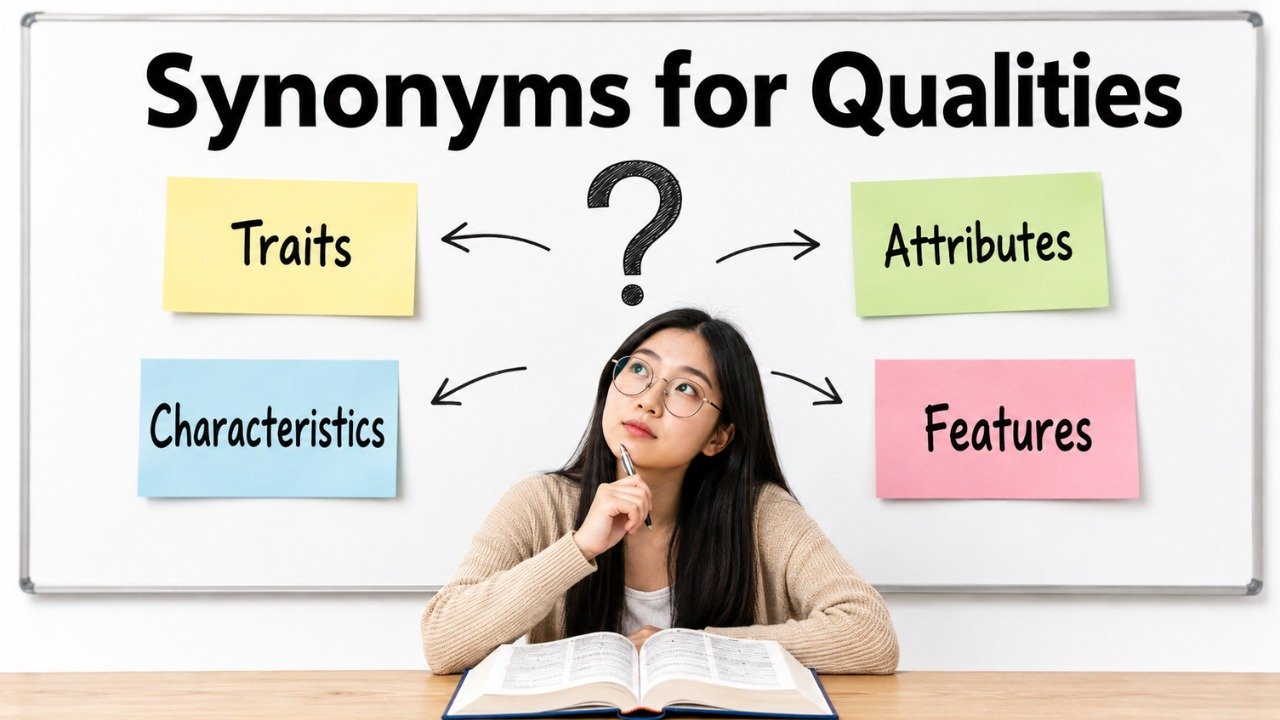
Quick Answer: The best synonyms for qualities are characteristics, traits, attributes, features, properties, virtues, strengths, abilities, merits, and capabilities. Characteristics and attributes work well in formal writing. Traits are best for personality and behavior. Features suit products, objects, and services. Properties are useful in scientific or technical contexts. Virtues describe positive moral qualities, while strengths and capabilities emphasize what a person or organization does well. The most accurate choice depends on whether qualities means personal traits, distinctive features, abilities, or standards of excellence.
Pronunciation and Word Details
Word: Qualities.
Pronunciation: /ˈkwɒl.ə.tiz/
Part of Speech: Plural noun.
Meaning: The features, traits, abilities, or standards that describe a person, thing, experience, or result.
US Pronunciation:
UK Pronunciation:
What Does “Qualities” Mean?
Qualities are the characteristics, traits, features, or standards that describe what someone or something is like.
The word qualities is the plural form of quality. It is mainly used as a noun and can have several related meanings. It may describe personal characteristics, useful abilities, physical properties, distinctive features, or the level of excellence found in something.
When qualities refers to people, it often describes personality traits or moral characteristics.
Example: Patience and honesty are valuable qualities in a leader.
When qualities refers to an object or product, it can describe noticeable features or properties.
Example: Durability and flexibility are important qualities of this material.
When the word relates to performance or excellence, it may refer to standards, strengths, or merits.
Example: The team valued the qualities of accuracy and consistency.
The exact meaning depends on the sentence. Qualities may be positive, negative, physical, emotional, moral, professional, or technical.
Meaning, Tone, and Context of “Qualities”
Qualities is a neutral and flexible word. It can appear in formal, academic, professional, technical, and conversational writing.
Tone: The word usually has a neutral or positive tone, although it can also describe negative characteristics.
Formal Use: In essays, reports, evaluations, and professional writing, qualities often means attributes, characteristics, strengths, or competencies.
Conversational Use: In everyday speech, qualities commonly refers to the traits people admire in someone.
Academic Use: Researchers and students may use qualities to discuss the features, properties, or characteristics of a subject.
Professional Use: Employers often discuss leadership qualities, communication qualities, personal strengths, and workplace abilities.
Technical Use: In scientific or technical contexts, qualities may refer to the properties or measurable characteristics of a substance, material, or system.
Emotional Use: When discussing relationships, qualities often refers to kindness, honesty, patience, loyalty, or empathy.
The word is broad, so a more specific synonym can make writing clearer. Traits is more precise for personality, properties for materials, features for products, and strengths for abilities.
When and How to Use “Qualities”
For Personal Characteristics
Use qualities when describing the personality, behavior, or character of a person.
Example: Her most admired qualities are patience, kindness, and reliability.
For Moral Traits
Qualities can describe positive values that guide someone’s behavior.
Example: Honesty and courage are essential qualities in a trusted leader.
For Professional Strengths
Use qualities when discussing abilities or characteristics that support success at work.
Example: Clear communication and good judgment are valuable qualities in a manager.
For Product Features
Qualities may describe the important features or benefits of an object or product.
Example: Comfort and durability are the main qualities of the chair.
For Physical Properties
In technical writing, qualities can refer to the physical or chemical properties of a material.
Example: The metal has qualities that make it suitable for outdoor construction.
For Artistic Characteristics
Use qualities when describing the tone, style, texture, or emotional effect of creative work.
Example: The painting has soft, peaceful qualities.
For Standards of Excellence
Qualities can refer to features that make something effective, valuable, or excellent.
Example: Accuracy and clarity are important qualities of strong academic writing.
For Relationships
Use qualities when describing the traits people value in friends, partners, or family members.
Example: Trustworthiness and empathy are important qualities in a close friend.
For Evaluation
Qualities can help identify what makes a person, idea, or object useful or distinctive.
Example: The committee considered the qualities of each proposal before making a decision.
Best Synonyms for Qualities
Characteristics: Distinctive features that describe a person, object, or subject.
Example: The report examines the main characteristics of effective teams.
Traits: Noticeable aspects of a person’s personality or behavior.
Example: Patience and confidence are useful leadership traits.
Attributes: Features or characteristics associated with someone or something.
Example: Reliability is one of her strongest professional attributes.
Features: Important or noticeable parts of a product, object, or service.
Example: The device includes several useful safety features.
Properties: Physical, chemical, or technical characteristics of a substance or material.
Example: Scientists studied the properties of the new material.
Virtues: Positive moral qualities such as honesty, courage, and kindness.
Example: Loyalty and fairness are widely respected virtues.
Strengths: Positive abilities or characteristics that support success.
Example: Communication and organization are two of his greatest strengths.
Abilities: Skills or powers that allow someone to perform an action.
Example: Her creative abilities helped the team solve the problem.
Merits: Valuable or praiseworthy features of a person, plan, or idea.
Example: The committee discussed the merits of each proposal.
Capabilities: The skills, resources, or potential needed to complete a task.
Example: The new system has advanced reporting capabilities.
50 Synonyms for Qualities with Short Meanings
- Characteristics: Features that help describe someone or something.
- Traits: Distinctive aspects of personality or behavior.
- Attributes: Features associated with a person, object, or idea.
- Features: Noticeable or useful parts of something.
- Properties: Physical, chemical, or technical characteristics.
- Virtues: Positive moral or personal qualities.
- Strengths: Abilities or features that create an advantage.
- Abilities: Powers or skills used to perform tasks.
- Merits: Positive features that deserve praise.
- Capabilities: Skills or potential for completing something.
- Talents: Natural or developed abilities.
- Skills: Learned abilities used to perform tasks effectively.
- Gifts: Natural talents or special abilities.
- Aptitudes: Natural abilities to learn or perform well.
- Competencies: Proven skills and knowledge in a particular area.
- Capacities: Abilities or potential to achieve something.
- Assets: Valuable strengths, features, or resources.
- Advantages: Features that create a better position or result.
- Distinctions: Features that make something different or notable.
- Values: Principles or standards that guide behavior.
- Standards: Expected levels of quality or performance.
- Excellence: An extremely high level of quality.
- Caliber: The level of ability, value, or quality.
- Worth: The value or usefulness of someone or something.
- Value: The importance, benefit, or usefulness of something.
- Nature: The basic character of a person or thing.
- Character: The moral and personal features of an individual.
- Disposition: A person’s usual emotional nature or attitude.
- Temperament: A person’s natural emotional style.
- Personality: The combination of traits that forms individual character.
- Essence: The most important or basic nature of something.
- Aspects: Particular parts or features of a subject.
- Elements: Individual parts that form a whole.
- Factors: Conditions or features that influence a result.
- Hallmarks: Distinctive features that identify quality or character.
- Marks: Noticeable signs of a particular character or standard.
- Signs: Indications that reveal a feature or condition.
- Indicators: Details that show the presence of a quality.
- Peculiarities: Unusual or distinctive characteristics.
- Individuality: The unique character of a person or thing.
- Specialties: Areas of particular skill or distinction.
- Specifications: Detailed features or requirements.
- Conditions: States or circumstances affecting something.
- States: Particular physical or emotional conditions.
- Tendencies: Usual patterns of behavior or development.
- Habits: Regular patterns of action or behavior.
- Behaviors: Observable ways in which someone acts.
- Manners: Ways of behaving toward other people.
- Advantages: Helpful qualities that improve a situation.
- Strong Points: Abilities or features that someone performs well.
Read Also:
Synonyms for Confront
Synonyms for Qualities by Context
When Qualities Means Personal Traits
Traits, characteristics, attributes, personality, character, disposition, and temperament describe what a person is like.
Example With Qualities: Her best qualities are patience and honesty.
Example With Traits: Her best traits are patience and honesty.
Example With Characteristics: Patience and honesty are her most admirable characteristics.
Traits is usually the most natural synonym when discussing personality. Character is broader and may include a person’s moral values.
When Qualities Means Positive Moral Features
Virtues, values, merits, strengths, and good character describe admirable personal qualities.
Example With Qualities: Courage and fairness are important qualities.
Example With Virtues: Courage and fairness are important virtues.
Example With Values: Courage and fairness are values that guide her decisions.
Virtues emphasizes moral goodness. Values refers to the principles a person believes are important.
When Qualities Means Skills or Abilities
Abilities, capabilities, talents, skills, aptitudes, competencies, capacities, and gifts describe what someone can do.
Example With Qualities: Her creative qualities made her suitable for the role.
Example With Abilities: Her creative abilities made her suitable for the role.
Example With Talents: Her creative talents made her suitable for the role.
Abilities is a broad replacement. Competencies is more formal and often appears in professional evaluations.
When Qualities Means Product Features
Features, attributes, advantages, assets, specifications, and strong points describe useful parts of a product or service.
Example With Qualities: The phone has several useful qualities.
Example With Features: The phone has several useful features.
Example With Advantages: The phone offers several practical advantages.
Features is usually more natural than qualities when describing a product.
When Qualities Means Physical Properties
Properties, characteristics, attributes, conditions, and states describe the physical or technical nature of a material.
Example With Qualities: The material has heat resistant qualities.
Example With Properties: The material has heat resistant properties.
Example With Characteristics: The material has characteristics that make it suitable for high temperatures.
Properties is the strongest choice in scientific and technical writing.
When Qualities Means Standards of Excellence
Excellence, caliber, standard, worth, value, and merit describe the level of quality found in something.
Example With Qualities: The school is known for the qualities of its teaching.
Example With Excellence: The school is known for the excellence of its teaching.
Example With Caliber: The school is known for the high caliber of its teaching.
Excellence emphasizes outstanding performance. Caliber refers to the level or standard of ability.
When Qualities Means Distinctive Features
Distinctions, hallmarks, marks, signs, peculiarities, and individuality describe features that make something recognizable or unique.
Example With Qualities: Simplicity and clarity are qualities of her writing.
Example With Hallmarks: Simplicity and clarity are hallmarks of her writing.
Example With Distinctions: These distinctions make her writing easy to recognize.
Hallmarks is useful when certain features strongly represent a style, person, or standard.
Another Word for Qualities
Characteristics is often the best general replacement for qualities because it can describe people, objects, ideas, and situations. However, the most accurate synonym depends on context.
Use traits for personality, features for products, properties for materials, virtues for moral goodness, and strengths for positive abilities.
Original: Patience is one of his best qualities.
Better Option: Patience is one of his best traits.
Original: The machine has several useful qualities.
Better Option: The machine has several useful features.
Original: Researchers examined the qualities of the material.
Better Option: Researchers examined the properties of the material.
Original: The candidate has strong professional qualities.
Better Option: The candidate has strong professional attributes.
When Not to Use “Qualities”
Qualities can sound vague when the reader needs to know whether you mean personality traits, abilities, features, properties, or standards. A more precise word often improves clarity.
When Referring to a Product
Weak: The camera has many useful qualities.
Better: The camera has many useful features.
Features clearly refers to the parts or functions of a product.
When Describing Scientific Characteristics
Weak: The scientist studied the qualities of the liquid.
Better: The scientist studied the properties of the liquid.
Properties is more accurate in scientific and technical writing.
When Discussing Personality
Weak: Kindness is one of her personal qualities.
Better: Kindness is one of her strongest character traits.
Traits gives the sentence a more specific meaning.
When Referring to Professional Ability
Weak: His qualities make him suitable for the position.
Better: His skills and strengths make him suitable for the position.
The improved sentence identifies the type of qualities being discussed.
When Describing Moral Goodness
Weak: Honesty and compassion are positive qualities.
Better: Honesty and compassion are admirable virtues.
Virtues emphasizes moral value more clearly.
When Discussing Performance Level
Weak: The qualities of the final report were excellent.
Better: The standard of the final report was excellent.
Standard is more natural when evaluating the overall level of work.
When Repetition Weakens the Paragraph
Weak: Her qualities include patience, and these qualities support other qualities needed for leadership.
Better: Her traits include patience, and this strength supports the abilities needed for leadership.
Using varied and precise vocabulary makes the meaning easier to understand.
Words Commonly Confused With Qualities
Qualities vs Characteristics: Qualities is broad and may refer to positive traits, abilities, properties, or standards. Characteristics are features that describe or identify someone or something.
Qualities vs Traits: Qualities can describe people or objects. Traits most often describe personality, behavior, appearance, or inherited features.
Qualities vs Attributes: Attributes are characteristics associated with a person, object, or idea. The word sounds more formal and analytical than qualities.
Qualities vs Features: Features usually refers to noticeable parts, functions, or design elements. Qualities may describe less visible characteristics such as reliability or kindness.
Qualities vs Properties: Properties is common in scientific and technical writing. It describes the physical, chemical, or functional characteristics of a material or substance.
Qualities vs Virtues: Qualities can be positive or negative. Virtues are specifically positive moral characteristics.
Qualities vs Strengths: Qualities describes what someone or something is like. Strengths are the positive abilities or characteristics that create success.
Qualities vs Skills: Qualities may include personality traits and moral characteristics. Skills are learned abilities used to perform particular tasks.
Qualities vs Values: Qualities describe characteristics. Values are principles or beliefs that guide decisions and behavior.
Qualities vs Standards: Qualities are individual characteristics, while standards are expected levels of performance, excellence, or acceptability.
Which Synonym Should You Choose?
Choose characteristics when you need a broad and neutral term for the features of a person, object, idea, or system.
Choose traits when discussing personality, behavior, appearance, or character in everyday writing.
Choose attributes in formal reports, academic writing, professional profiles, and analytical descriptions.
Choose features when writing about products, services, equipment, software, buildings, or designs.
Choose properties when discussing materials, substances, scientific subjects, or technical performance.
Choose virtues when describing positive moral qualities such as honesty, courage, patience, and fairness.
Choose strengths when discussing abilities or positive characteristics that support success.
Choose skills when referring to learned abilities used in work, education, or practical tasks.
Choose capabilities when describing what a person, system, machine, or organization can achieve.
Choose merits when evaluating the positive points of an idea, proposal, argument, or plan.
Choose caliber when discussing the level of talent, performance, or excellence.
Choose hallmarks when identifying features strongly associated with a person, style, process, or high standard.
In formal essays and reports, characteristics and attributes are usually effective. In professional emails, strengths, abilities, and skills sound clear. In casual conversation, traits and good points are more natural. In product descriptions, features and advantages provide greater precision.
Real Life Examples of “Qualities” in Sentences
Original: Honesty is one of the qualities I value in a friend.
Better Option: Honesty is one of the traits I value in a friend.
Original: The manager looked for qualities such as confidence and patience.
Better Option: The manager looked for attributes such as confidence and patience.
Original: This fabric has several useful qualities.
Better Option: This fabric has several useful properties.
Original: The device offers qualities that improve user safety.
Better Option: The device offers features that improve user safety.
Original: Her artistic qualities became clear during the project.
Better Option: Her artistic talents became clear during the project.
Original: The applicant has the qualities needed for leadership.
Better Option: The applicant has the strengths needed for leadership.
Original: The proposal has many positive qualities.
Better Option: The proposal has many merits.
Original: Flexibility and durability are valuable qualities of the material.
Better Option: Flexibility and durability are valuable characteristics of the material.
Original: His personal qualities helped him earn the team’s trust.
Better Option: His character traits helped him earn the team’s trust.
Original: The committee evaluated the qualities of each candidate.
Better Option: The committee evaluated the competencies of each candidate.
Synonym Groups and Usage Differences
Personality Group
Traits, characteristics, personality, disposition, temperament, and character describe a person’s usual way of thinking, feeling, or behaving.
Traits may be individual features such as patience or confidence. Personality refers to the complete combination of traits. Temperament focuses more on natural emotional reactions.
Example: Her calm temperament helps her remain focused during stressful situations.
Moral Character Group
Virtues, values, merits, integrity, and good character describe positive moral qualities.
Virtues are admirable moral traits. Values are principles that guide choices. Merits are positive points that deserve recognition.
Example: Fairness is one of the virtues expected in a responsible leader.
Ability Group
Abilities, skills, capabilities, competencies, aptitudes, talents, gifts, and capacities describe what someone can do.
Skills are usually learned. Talents and gifts may be natural. Competencies combine knowledge, ability, and practical performance.
Example: Her communication skills helped resolve the disagreement.
Product and Design Group
Features, attributes, specifications, advantages, assets, and strong points describe useful parts or benefits of an object, system, or service.
Features are noticeable functions or design elements. Specifications provide detailed technical information. Advantages explain how something is better or more useful.
Example: Energy efficiency is one of the product’s main advantages.
Scientific Group
Properties, characteristics, conditions, states, elements, and factors describe the nature or behavior of a material, substance, or process.
Properties often include measurable details such as weight, strength, temperature, or flexibility.
Example: Researchers tested the electrical properties of the material.
Excellence Group
Excellence, caliber, worth, value, merit, and standard describe the level of quality or usefulness.
Excellence suggests outstanding performance. Caliber refers to level or ability. Worth and value focus on importance or usefulness.
Example: The high caliber of the research impressed the review committee.
Distinctive Feature Group
Hallmarks, distinctions, marks, signs, indicators, peculiarities, and individuality identify features that make someone or something recognizable.
Hallmarks are defining features. Peculiarities are unusual characteristics. Individuality emphasizes uniqueness.
Example: Clear explanations are a hallmark of effective teaching.
Antonyms of Qualities
The opposite of qualities depends on the intended meaning. When qualities means strengths, the opposite may be weaknesses. When it means virtues, the opposite may be faults or vices. When it means useful features, the opposite may be defects or limitations.
Weaknesses: Areas in which someone or something lacks strength.
Faults: Negative features or personal failings.
Flaws: Imperfections that reduce effectiveness or value.
Defects: Problems in design, structure, or performance.
Shortcomings: Areas where a person or thing fails to meet expectations.
Limitations: Restrictions that reduce ability or usefulness.
Disadvantages: Features that create difficulty or reduce benefit.
Drawbacks: Negative aspects of a plan, product, or situation.
Vices: Negative moral habits or behaviors.
Deficiencies: Important qualities, resources, or abilities that are missing.
Imperfections: Features that prevent something from being perfect.
Inabilities: Lack of power or skill to perform something.
Liabilities: Characteristics or conditions that create difficulty or risk.
Inferiority: A lower level of quality, value, or performance.
Mediocrity: An ordinary or unsatisfactory level of quality.
Comparison: Qualities vs Related Words
Qualities vs Characteristics
Qualities is broader and may suggest positive traits, abilities, or standards. Characteristics simply describes features that identify someone or something.
Example With Qualities: Patience is one of her best qualities.
Example With Characteristics: The main characteristics of the material are strength and flexibility.
Qualities vs Traits
Qualities can refer to people, objects, materials, or work. Traits usually refers to personal, physical, behavioral, or inherited characteristics.
Example With Qualities: Reliability and honesty are valuable qualities.
Example With Traits: Reliability and honesty are valuable leadership traits.
Qualities vs Attributes
Qualities sounds natural in both conversation and general writing. Attributes is more formal and is often used in professional or analytical contexts.
Example With Qualities: The candidate has several valuable qualities.
Example With Attributes: The candidate has several valuable professional attributes.
Qualities vs Features
Qualities may describe visible or invisible characteristics. Features usually refers to noticeable parts, functions, or design elements.
Example With Qualities: Comfort is one of the chair’s best qualities.
Example With Features: Adjustable height is one of the chair’s best features.
Qualities vs Properties
Qualities is general. Properties is more precise when discussing scientific, physical, chemical, or technical characteristics.
Example With Qualities: The substance has unusual qualities.
Example With Properties: The substance has unusual chemical properties.
Qualities vs Virtues
Qualities can be positive, negative, or neutral. Virtues are always morally positive.
Example With Qualities: Confidence and impatience are both noticeable qualities.
Example With Virtues: Honesty and compassion are admirable virtues.
Qualities vs Strengths
Qualities describes characteristics in general. Strengths refers specifically to positive abilities or advantages.
Example With Qualities: The interviewer asked about her personal qualities.
Example With Strengths: The interviewer asked about her professional strengths.
Qualities vs Skills
Qualities may include personality and character. Skills are learned abilities used to perform tasks.
Example With Qualities: Patience is an important teaching quality.
Example With Skills: Lesson planning is an important teaching skill.
Common Phrases and Expressions With “Qualities”
Personal Qualities: Characteristics that describe an individual’s personality or behavior.
Example: Patience and honesty are valuable personal qualities.
Leadership Qualities: Traits and abilities that help someone guide others effectively.
Example: Confidence and fairness are essential leadership qualities.
Good Qualities: Positive features or characteristics.
Example: She has many good qualities, including kindness and reliability.
Best Qualities: The most admirable characteristics of a person or thing.
Example: His best qualities are loyalty and patience.
Positive Qualities: Characteristics that create a favorable impression or result.
Example: The candidate demonstrated several positive qualities during the interview.
Unique Qualities: Features that make someone or something different.
Example: The handmade bowl has several unique qualities.
Essential Qualities: Characteristics or abilities that are necessary for success.
Example: Accuracy and patience are essential qualities for this role.
Desirable Qualities: Features that people consider useful or attractive.
Example: Flexibility is one of the most desirable qualities in the material.
Natural Qualities: Characteristics or abilities that exist without being taught.
Example: She showed natural qualities of leadership from an early age.
Distinctive Qualities: Features that make someone or something easy to recognize.
Example: The writer’s distinctive qualities include clarity and warmth.
Common Mistakes to Avoid
Using Qualities When You Mean Features
Products and machines usually have features rather than personal qualities.
Unclear: The laptop has several advanced qualities.
Clearer: The laptop has several advanced features.
Using Qualities When You Mean Properties
In scientific and technical writing, properties is often more accurate.
Unclear: The team measured the qualities of the metal.
Clearer: The team measured the properties of the metal.
Assuming All Qualities Are Positive
A quality can be positive, negative, or neutral. Do not assume the word always means a strength.
Unclear: Impatience is one of his good qualities.
Clearer: Impatience is one of his less helpful traits.
Confusing Traits With Skills
Traits describe personality or behavior. Skills describe learned abilities.
Incorrect: Patience is a technical skill.
Correct: Patience is a personal trait.
Confusing Virtues With General Qualities
Virtues are specifically positive moral qualities.
Incorrect: Speed and flexibility are virtues of the machine.
Correct: Speed and flexibility are advantages of the machine.
Using a Vague Synonym
Broad words such as things or points can weaken the meaning.
Weak: The candidate has several good things.
Better: The candidate has several valuable professional attributes.
Repeating Qualities Too Often
Repeated use can make a paragraph sound dull and unclear.
Repetitive: Her qualities include patience, and these qualities support the qualities required for management.
Improved: Her traits include patience, and these strengths support the abilities required for management.
Mixing Singular and Plural Forms
Quality is singular, while qualities is plural.
Incorrect: Honesty and patience is an important quality.
Correct: Honesty and patience are important qualities.
Using Quality When You Mean Characteristic
Quality can also mean a level of excellence, which may create ambiguity.
Unclear: The quality of honesty is important.
Clearer: The trait of honesty is important.
Ignoring Context
Always identify what kind of qualities you mean. Personal qualities, product features, physical properties, moral virtues, and professional competencies require different vocabulary.
Conclusion
The most useful synonyms for qualities include characteristics, traits, attributes, features, properties, virtues, strengths, abilities, merits, and capabilities. Choose traits for personality, virtues for moral character, features for products, properties for materials, and strengths for positive abilities. Characteristics is the best general alternative, while attributes works well in formal writing. Understanding the intended meaning will help you select accurate synonyms for qualities and make your essays, reports, descriptions, evaluations, and everyday sentences clearer and more natural.
FAQs About Synonyms for Qualities
What Is the Best Synonym for Qualities?
Characteristics is the best general synonym. It can describe people, objects, ideas, materials, and situations.
What Is Another Word for Personal Qualities?
Traits, characteristics, attributes, virtues, strengths, and aspects of character are useful alternatives for personal qualities.
Can Traits Replace Qualities?
Yes, especially when qualities refers to personality, behavior, appearance, or character. Traits is less suitable for products or scientific materials.
What Is a Formal Synonym for Qualities?
Attributes and characteristics are strong formal alternatives. Competencies works well when discussing professional skills and abilities.
What Word Should Replace Qualities in Product Writing?
Features is usually the best replacement for products, machines, services, and designs. Advantages may be better when emphasizing benefits.
What Is the Difference Between Qualities and Virtues?
Qualities can be positive, negative, or neutral. Virtues are specifically positive moral traits such as honesty, courage, and compassion.
What Are the Opposites of Good Qualities?
Common opposites include faults, flaws, weaknesses, shortcomings, defects, vices, limitations, and disadvantages.
