
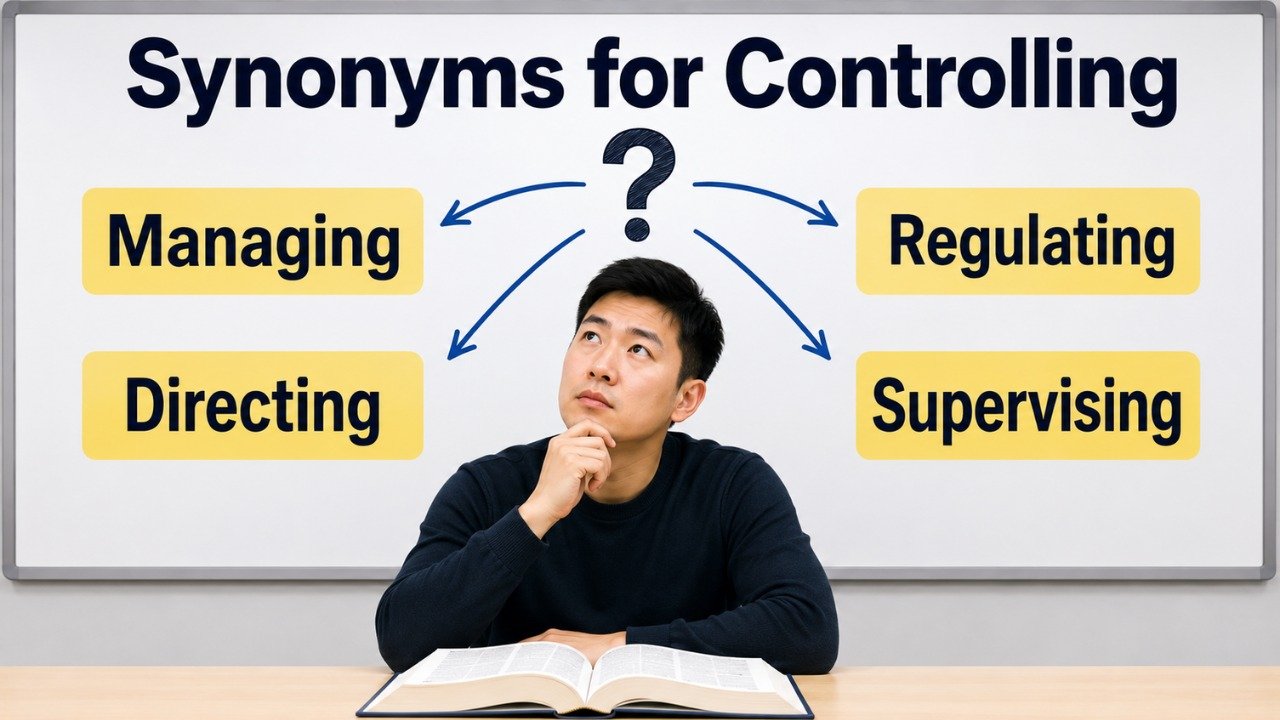
Quick Answer: The best synonyms for controlling include dominant, domineering, authoritarian, commanding, restrictive, manipulative, overbearing, regulating, supervising, and managing. Use domineering or overbearing when describing someone who tries to control other people too strongly. Choose authoritarian for strict leadership or rule, restrictive for limits on freedom or action, regulating for formal systems and processes, supervising for workplace oversight, and managing when control is neutral, practical, and organized.
Pronunciation and Word Details
Word: Controlling.
Pronunciation: /kənˈtroʊlɪŋ/
Part of Speech: Adjective, verb form, and present participle.
Meaning: Having power over people, actions, situations, or processes, often by directing, limiting, managing, or influencing them.
US Pronunciation:
UK Pronunciation:
What Does “Controlling” Mean?
Controlling means directing, managing, limiting, or influencing what someone or something does.
As an adjective, controlling often describes a person who tries to decide how other people should behave. In this sense, the word usually has a negative tone.
Example: Her controlling behavior made it difficult for others to make independent decisions.
Controlling can also describe the act of managing a process, system, resource, or situation. In these cases, the meaning may be neutral or positive.
Example: The engineer is responsible for controlling the temperature inside the system.
As a verb form, controlling comes from the verb control, meaning to direct, regulate, manage, restrain, or exercise authority over something.
The correct meaning depends heavily on context. A controlling manager may sound excessively demanding, while controlling costs simply means keeping expenses within reasonable limits.
Meaning, Tone, and Context of “Controlling”
The tone of controlling changes according to what is being controlled and why.
When describing personality or relationships, controlling is usually negative. It suggests that someone wants excessive authority over another person’s choices, behavior, communication, activities, or decisions.
Negative Context: A controlling person may try to make decisions for others rather than respecting their independence.
In professional or technical contexts, controlling can be neutral. A person may be controlling machinery, managing a budget, regulating a process, or monitoring a system.
Neutral Context: The operator is controlling the pressure inside the equipment.
In business and management language, controlling can also describe the process of comparing performance with plans and correcting problems.
Professional Context: The department focused on controlling expenses while maintaining service quality.
The word can therefore be strong and emotional when applied to people but practical and technical when applied to systems, resources, or operations.
When and How to Use “Controlling”
For Describing Excessive Authority
Use controlling when someone repeatedly tries to determine another person’s choices or behavior.
Example: His controlling attitude prevented the team from making decisions independently.
For Describing Strict Leadership
Controlling can describe leaders who keep most authority to themselves.
Example: The director became increasingly controlling as the project expanded.
For Managing a Process
Use controlling neutrally when discussing the management of machinery, systems, conditions, or procedures.
Example: The technician is controlling the airflow through the system.
For Limiting Costs
Controlling commonly appears in discussions about expenses, budgets, and resources.
Example: Controlling unnecessary spending helped the organization stay within its budget.
For Regulating Conditions
The word can describe keeping temperature, pressure, speed, or another condition within a desired range.
Example: The device is useful for controlling room temperature.
For Managing Emotions
Controlling can refer to restraining emotional reactions.
Example: She had difficulty controlling her frustration during the discussion.
For Restricting Behavior
Use controlling when rules, actions, or people limit what others are allowed to do.
Example: Critics considered the policy too controlling.
For Exercising Influence
The word can describe someone or something that strongly influences the direction of events.
Example: Economic conditions became a controlling factor in the decision.
Best Synonyms for Controlling
Dominant: Having greater power, authority, or influence than others.
Example: She played a dominant role in every major decision.
Domineering: Trying to control other people in an unpleasant or forceful way.
Example: His domineering manner made the group uncomfortable.
Authoritarian: Demanding obedience and allowing little personal freedom or disagreement.
Example: The organization developed an authoritarian leadership style.
Overbearing: Unpleasantly forceful, proud, or controlling toward other people.
Example: His overbearing approach discouraged open discussion.
Restrictive: Limiting freedom, choices, movement, or activity.
Example: The new rules were considered unnecessarily restrictive.
Manipulative: Influencing people unfairly or indirectly to achieve a desired result.
Example: Her manipulative behavior gradually damaged trust.
Commanding: Exercising authority or giving clear directions.
Example: He maintained a commanding presence during the emergency.
Regulating: Controlling something according to rules, standards, or required conditions.
Example: The system is responsible for regulating water pressure.
Supervising: Watching and directing work or activities to ensure they are completed correctly.
Example: She spent the afternoon supervising the new employees.
Managing: Organizing, directing, or keeping something under control.
Example: The team is managing its resources carefully.
50 Synonyms for Controlling with Short Meanings
- Dominant: Having greater power or influence.
- Domineering: Forcing one’s wishes on other people.
- Authoritarian: Demanding obedience and strict control.
- Overbearing: Excessively forceful toward others.
- Restrictive: Limiting freedom or choices.
- Manipulative: Influencing someone unfairly or indirectly.
- Commanding: Exercising clear authority.
- Regulating: Keeping something within rules or limits.
- Supervising: Watching and directing activities.
- Managing: Organizing and directing something effectively.
- Directing: Guiding actions or decisions.
- Governing: Exercising authority over people or systems.
- Ruling: Holding or exercising authority.
- Dictatorial: Exercising excessive or absolute authority.
- Imperious: Expecting unquestioned obedience.
- Bossy: Constantly telling others what to do.
- Possessive: Wanting excessive control over another person.
- Restraining: Preventing excessive movement, action, or behavior.
- Limiting: Reducing what is possible or allowed.
- Confining: Restricting movement, action, or freedom.
- Regimenting: Organizing people or activities very strictly.
- Oppressive: Exercising authority in a harsh or unfair way.
- Coercive: Using pressure or force to influence behavior.
- Forceful: Showing strong authority or determination.
- Exacting: Demanding very high standards or effort.
- Strict: Requiring close obedience to rules.
- Rigid: Allowing little flexibility or change.
- Watchful: Carefully observing what happens.
- Supervisory: Related to overseeing or directing work.
- Administrative: Connected with managing operations or responsibilities.
- Managerial: Related to organizing and directing work.
- Regulatory: Connected with controlling through rules.
- Restrictive: Preventing excessive freedom or action.
- Protective: Exercising control to prevent harm.
- Guiding: Directing someone toward a particular course.
- Influential: Having the power to affect decisions or behavior.
- Decisive: Exercising strong influence over an outcome.
- Determining: Having an important effect on what happens.
- Masterful: Showing confident command or control.
- Possessive: Seeking excessive personal control.
- Interfering: Becoming involved in matters that may belong to others.
- Intrusive: Entering another person’s affairs too much.
- Meddling: Interfering unnecessarily in other people’s matters.
- Demanding: Expecting a great deal from others.
- Restraining: Holding an action or reaction back.
- Moderating: Keeping something from becoming excessive.
- Containing: Keeping something within boundaries.
- Checking: Preventing something from increasing or developing too far.
- Curbing: Reducing or limiting an unwanted action.
- Monitoring: Observing something carefully to maintain oversight.
Read Also:
Synonyms for Described

Synonyms for Controlling by Context
When Controlling Means Dominating Other People
When controlling describes a person who wants too much authority over others, suitable alternatives include domineering, overbearing, bossy, authoritarian, possessive, dictatorial, and imperious.
Domineering: Best when someone imposes personal wishes on others.
Example: Her domineering approach left little room for disagreement.
Overbearing: Best when someone’s forceful personality becomes unpleasant.
Example: His overbearing manner made ordinary conversations uncomfortable.
Bossy: Best for informal descriptions of someone who frequently gives unnecessary orders.
Example: She sometimes sounded bossy when organizing the group.
Authoritarian: Best for leadership based on obedience and concentrated authority.
Example: The leader adopted an increasingly authoritarian approach.
When Controlling Means Managing
When controlling means organizing a process, resource, or operation, useful synonyms include managing, directing, supervising, administering, governing, and overseeing.
Managing: A broad and neutral alternative for organizing resources or activities.
Example: She is managing several projects at once.
Supervising: Appropriate when someone watches and directs the work of others.
Example: He is supervising the installation process.
Directing: Useful when guiding an activity toward a particular goal.
Example: She is directing the preparation of the report.
Governing: Appropriate when rules, principles, or authorities determine how something operates.
Example: Clear regulations are governing the process.
When Controlling Means Restricting
When the main idea is limiting behavior, movement, freedom, or growth, choose restrictive, restraining, limiting, confining, curbing, or checking.
Restrictive: Best for rules or conditions that reduce freedom.
Example: Employees considered the procedure unnecessarily restrictive.
Restraining: Best for holding back an action, reaction, or movement.
Example: He remained calm by restraining his anger.
Curbing: Best when reducing an unwanted activity or tendency.
Example: The policy aims at curbing unnecessary spending.
Limiting: A neutral choice when reducing quantity, possibility, or access.
Example: The organization is limiting unnecessary expenses.
When Controlling Means Regulating
For machines, systems, processes, conditions, and formal rules, use regulating, monitoring, moderating, checking, managing, or adjusting.
Regulating: Best when keeping something within established standards.
Example: The valve is regulating the flow of water.
Monitoring: Best when observation is central to keeping something under control.
Example: The team is monitoring system performance.
Moderating: Best when preventing something from becoming excessive.
Example: The new process helps in moderating temperature changes.
Checking: Useful when preventing growth, development, or movement from becoming excessive.
Example: The barrier helped in checking the spread of water.
When Controlling Means Strongly Influencing
Sometimes controlling describes the main factor that determines an outcome.
Useful alternatives include dominant, determining, decisive, influential, and governing.
Determining: Best when something strongly affects the final result.
Example: Cost was the determining factor in the decision.
Decisive: Best when something has enough influence to settle an outcome.
Example: Timing proved decisive in the final result.
Dominant: Best when one force, idea, or influence is stronger than the others.
Example: Safety remained the dominant concern throughout the project.
Another Word for Controlling
The best single alternative to controlling depends on what the sentence means. When describing unpleasant personal behavior, domineering is often one of the strongest replacements. When discussing processes or resources, managing is usually more neutral and accurate. For rules and systems, regulating may be the better choice.
Original: He has a controlling personality.
Better Option: He has a domineering personality.
Original: She is controlling the department’s daily operations.
Better Option: She is managing the department’s daily operations.
Original: The mechanism is controlling the water pressure.
Better Option: The mechanism is regulating the water pressure.
Original: The policy is too controlling.
Better Option: The policy is too restrictive.
When Not to Use “Controlling”
Controlling should not automatically replace every word connected with management or authority. It can sound negative when describing a person, even if no criticism is intended.
When You Mean Responsible Management
If a person is simply organizing work efficiently, managing or supervising may sound more accurate.
Weak: She is controlling the customer service team.
Better: She is managing the customer service team.
When You Mean Formal Regulation
For legal, technical, or procedural limits, regulating is often more precise.
Weak: The system is controlling pressure according to safety standards.
Better: The system is regulating pressure according to safety standards.
When You Mean Observation Rather Than Authority
If someone is only watching a situation, monitoring is clearer.
Weak: The staff is controlling changes in air quality.
Better: The staff is monitoring changes in air quality.
When You Mean Limitation
If something mainly reduces freedom or options, restrictive can express the idea more directly.
Weak: The policy feels controlling.
Better: The policy feels restrictive.
When You Mean Unpleasant Personal Dominance
If you want to emphasize excessive personal authority, domineering or overbearing may be stronger.
Weak: His behavior toward his colleagues was controlling.
Better: His behavior toward his colleagues was domineering.
Words Commonly Confused With Controlling
Controlling vs Managing: Controlling can imply authority, restriction, or dominance. Managing usually means organizing people, resources, or responsibilities to achieve a goal.
Controlling vs Dominant: Controlling describes behavior or action used to direct others. Dominant describes someone or something that holds greater influence or power.
Controlling vs Domineering: Controlling is broader and may be neutral in technical contexts. Domineering is almost always negative and refers to trying to impose personal wishes on others.
Controlling vs Manipulative: A controlling person may openly direct someone. A manipulative person usually influences someone indirectly, often through emotional or strategic pressure.
Controlling vs Restrictive: Controlling describes exercising power or direction. Restrictive emphasizes limits on freedom, choices, access, or action.
Controlling vs Authoritarian: Controlling can describe individual behavior or general management. Authoritarian specifically suggests strict authority and an expectation of obedience.
Controlling vs Supervising: Controlling can suggest broad authority. Supervising usually means observing and directing work as a normal responsibility.
Controlling vs Regulating: Controlling is a general term. Regulating is more precise when something is maintained according to rules, standards, or desired conditions.
Which Synonym Should You Choose?
Choose domineering when describing someone who aggressively imposes personal wishes on others.
Choose overbearing when a person’s forceful behavior makes others uncomfortable.
Choose authoritarian when discussing strict leadership, governance, or a system that demands obedience.
Choose bossy in casual conversation when someone frequently tells others what to do.
Choose manipulative when control is achieved indirectly through pressure, emotional influence, or calculated behavior.
Choose restrictive when rules, policies, or conditions limit freedom and choices.
Choose managing when describing ordinary professional responsibility for resources, teams, projects, or operations.
Choose supervising when someone watches and directs work.
Choose regulating for technical processes, standards, machines, temperature, pressure, and formal systems.
Choose monitoring when careful observation is more important than direct authority.
Choose dominant when describing the strongest person, factor, trend, or influence.
Choose determining when a factor strongly affects the final result.
In formal essays, authoritarian, restrictive, regulating, and dominant may provide greater precision than controlling.
In reports, managing, monitoring, regulating, or supervising often sound more objective.
In casual speech, bossy can work when the meaning is mild and informal.
In sensitive discussions about personal behavior, choose carefully because controlling, domineering, possessive, and manipulative describe different kinds of behavior.
Real Life Examples of “Controlling” in Sentences
Original: His controlling behavior frustrated the entire group.
Better Option: His domineering behavior frustrated the entire group.
Original: She became controlling whenever important decisions had to be made.
Better Option: She became overbearing whenever important decisions had to be made.
Original: The manager was controlling every small detail of the project.
Better Option: The manager was supervising every small detail of the project.
Original: The organization introduced controlling rules for access to the facility.
Better Option: The organization introduced restrictive rules for access to the facility.
Original: The equipment is controlling the temperature automatically.
Better Option: The equipment is regulating the temperature automatically.
Original: The department is controlling its annual expenses carefully.
Better Option: The department is managing its annual expenses carefully.
Original: She struggled with controlling her irritation during the meeting.
Better Option: She struggled with restraining her irritation during the meeting.
Original: One supplier became the controlling influence in the market.
Better Option: One supplier became the dominant influence in the market.
Original: The supervisor is controlling the work of the new employees.
Better Option: The supervisor is overseeing the work of the new employees.
Original: Cost became the controlling factor in the final decision.
Better Option: Cost became the determining factor in the final decision.
Synonym Groups and Usage Differences
Dominance Group
This group includes domineering, dominant, overbearing, imperious, dictatorial, authoritarian, and bossy.
These words describe different degrees of personal power and authority.
Domineering and overbearing are clearly negative. Bossy is more casual. Authoritarian and dictatorial are stronger and are commonly associated with leadership or systems of authority.
Example: His domineering manner discouraged other members from expressing their opinions.
Management Group
This group includes managing, supervising, directing, administering, governing, and overseeing.
These alternatives are usually more neutral than controlling because they describe ordinary responsibility rather than excessive personal authority.
Example: She is overseeing the preparation of the new facility.
Restriction Group
This group includes limiting, restricting, restraining, curbing, confining, and checking.
These words focus on preventing something from exceeding a boundary or reducing freedom, movement, growth, or behavior.
Example: The organization introduced measures for curbing unnecessary spending.
Regulation Group
This group includes regulating, moderating, monitoring, adjusting, managing, and checking.
These words are especially useful for technical systems, processes, machines, conditions, and formal procedures.
Example: The device is regulating the temperature automatically.
Influence Group
This group includes dominant, influential, determining, decisive, and governing.
These alternatives describe something that strongly affects an outcome rather than someone actively issuing commands.
Example: Price was the determining factor in their final choice.
Interference Group
This group includes meddling, interfering, intrusive, possessive, and manipulative.
These words emphasize unwanted involvement in another person’s affairs, choices, or decisions.
Example: His constant questions eventually began to feel intrusive.
Antonyms of Controlling
The opposite of controlling depends on whether the word refers to personality, authority, management, restriction, or behavior.
Permissive: Allowing greater freedom and fewer restrictions.
Flexible: Willing to adapt rather than impose rigid limits.
Easygoing: Relaxed and not strongly demanding toward others.
Tolerant: Accepting different behaviors, choices, or opinions.
Accommodating: Willing to adjust to the needs or preferences of others.
Cooperative: Working together rather than seeking individual dominance.
Submissive: Willing to accept another person’s authority or direction.
Yielding: Ready to give way rather than insist on control.
Unrestrictive: Allowing considerable freedom or choice.
Liberal: Allowing broader freedom within a particular context.
Trusting: Willing to allow others to act independently.
Uninvolved: Not interfering directly in another person’s actions.
Independent: Free from another person’s control or authority.
Free: Not subject to excessive restriction.
Unregulated: Not controlled by formal rules or regulations.
Comparison: Controlling vs Related Words
Controlling vs Domineering
Controlling is a broad word that can refer to people, processes, systems, emotions, resources, and conditions. Domineering specifically describes unpleasant attempts to impose authority over other people.
Example With Controlling: His controlling behavior affected the whole group.
Example With Domineering: His domineering manner made disagreement difficult.
Controlling vs Managing
Controlling can carry either neutral or negative meanings. Managing is normally neutral and focuses on organization and responsibility.
Example With Controlling: She is controlling the project’s spending.
Example With Managing: She is managing the project’s spending carefully.
The second sentence sounds more natural when ordinary financial responsibility is intended.
Controlling vs Manipulative
Controlling behavior may involve direct commands or restrictions. Manipulative behavior usually involves indirect methods designed to influence someone’s decisions.
Example With Controlling: He tried to control where everyone went.
Example With Manipulative: He used guilt to influence their decisions.
Controlling vs Authoritarian
Controlling is a general description of excessive direction or authority. Authoritarian refers more specifically to a style of leadership or rule that emphasizes obedience.
Example With Controlling: The supervisor became increasingly controlling.
Example With Authoritarian: The supervisor adopted an authoritarian leadership style.
Controlling vs Restrictive
Controlling focuses on exercising power or direction. Restrictive focuses on reducing freedom, access, or available choices.
Example With Controlling: The manager introduced controlling procedures.
Example With Restrictive: The manager introduced restrictive procedures.
Restrictive is more precise when the procedures mainly limit what people may do.
Controlling vs Regulating
Controlling is broad, while regulating usually means maintaining something according to rules, standards, or desired conditions.
Example With Controlling: The mechanism is controlling the pressure.
Example With Regulating: The mechanism is regulating the pressure.
Regulating is often more precise in technical writing.
Controlling vs Supervising
Controlling can suggest substantial authority. Supervising means observing and directing people or work as part of a legitimate responsibility.
Example With Controlling: She is controlling the training session.
Example With Supervising: She is supervising the training session.
Controlling vs Dominant
Controlling refers to the exercise of control. Dominant describes someone or something with the greatest power or influence.
Example With Controlling: His controlling personality affected group decisions.
Example With Dominant: He was the dominant voice in the discussion.
Common Phrases and Expressions With Controlling
Controlling Behavior: Actions intended to direct or limit another person’s choices.
Controlling Personality: A personality characterized by a strong desire to direct situations or people.
Controlling Person: Someone who frequently attempts to decide what others should do.
Controlling Interest: A level of influence or ownership that provides significant authority over decisions.
Controlling Factor: The main factor that determines an outcome.
Controlling Costs: Managing expenses and preventing unnecessary spending.
Controlling Expenses: Keeping spending within planned limits.
Controlling Emotions: Managing or restraining emotional reactions.
Controlling Temperature: Regulating temperature to maintain a desired level.
Controlling Access: Deciding who or what is allowed to enter, use, or reach something.
Common Mistakes to Avoid
Using Controlling When Managing Is More Accurate
Calling ordinary management controlling can unintentionally make neutral behavior sound negative.
Unnatural: She is controlling a team of twenty employees.
Better: She is managing a team of twenty employees.
Use controlling only when actual control is important to the meaning.
Treating Controlling and Manipulative as Identical
These words overlap but are not interchangeable.
A controlling person may openly give orders, impose restrictions, or make decisions for others. A manipulative person often influences others indirectly.
Advice: Choose manipulative only when indirect influence, pressure, or strategy is important to the meaning.
Using Bossy in Formal Writing
Bossy is natural in conversation but may sound too casual in reports, essays, or professional analysis.
Weak: The supervisor had a bossy leadership style.
Better: The supervisor had a domineering leadership style.
Using Authoritarian for Every Strict Person
Authoritarian is stronger than controlling. It usually suggests a structured preference for obedience and concentrated authority.
Advice: Use authoritarian when strict authority is a central feature, not merely because someone occasionally gives firm instructions.
Repeating Controlling Too Often
Repeated use makes writing sound monotonous and can hide important differences in meaning.
Repetitive: The controlling manager created controlling rules to maintain controlling oversight.
Better: The domineering manager created restrictive rules to maintain close oversight.
Choosing a Synonym Without Considering Tone
Domineering, manipulative, oppressive, and dictatorial carry stronger negative meanings than managing or supervising.
Advice: Decide whether the sentence requires criticism, neutrality, technical precision, or ordinary management before selecting a synonym.
Using a Vague Alternative
A broad synonym may weaken the meaning if a more precise word exists.
Vague: The machine is managing the pressure.
Better: The machine is regulating the pressure.
Confusing Influence With Direct Control
Dominant and influential describe power or effect, but they do not always imply direct control.
Advice: Use dominant when one factor is strongest. Use controlling when something actively directs, limits, or determines actions.
Conclusion
Understanding synonyms for controlling helps you choose a word that matches the exact kind of authority, management, restriction, or influence you want to describe. Use domineering or overbearing for excessive personal control, authoritarian for strict leadership, restrictive for limits on freedom, and manipulative for indirect influence. In neutral settings, managing, supervising, regulating, and monitoring are often more accurate. Choosing by context makes your writing clearer, more precise, and less likely to communicate an unintended negative tone.
FAQs About Synonyms for Controlling
What Is the Best Synonym for Controlling?
The best synonym depends on context. Domineering works well for excessive personal control, while managing is better for neutral professional situations.
What Is Another Word for a Controlling Person?
Useful choices include domineering, overbearing, bossy, authoritarian, possessive, and manipulative. Each describes a slightly different type of controlling behavior.
Is Domineering the Same as Controlling?
They are similar, but domineering is stronger and more negative. It specifically suggests forcing one’s wishes or authority on other people.
What Is a Formal Synonym for Controlling?
Authoritarian, restrictive, regulatory, supervisory, dominant, and governing can work in formal contexts depending on the intended meaning.
What Is a Positive Synonym for Controlling?
Managing, supervising, guiding, regulating, and directing can express responsible control without the negative tone often associated with controlling.
What Is the Difference Between Controlling and Manipulative?
Controlling behavior may involve direct rules, commands, or restrictions. Manipulative behavior generally involves indirect influence designed to shape another person’s choices.
What Synonym Should I Use for Controlling a Process?
Use managing for general operations, regulating for keeping conditions within limits, monitoring for observation, and supervising when directing people or work.
