
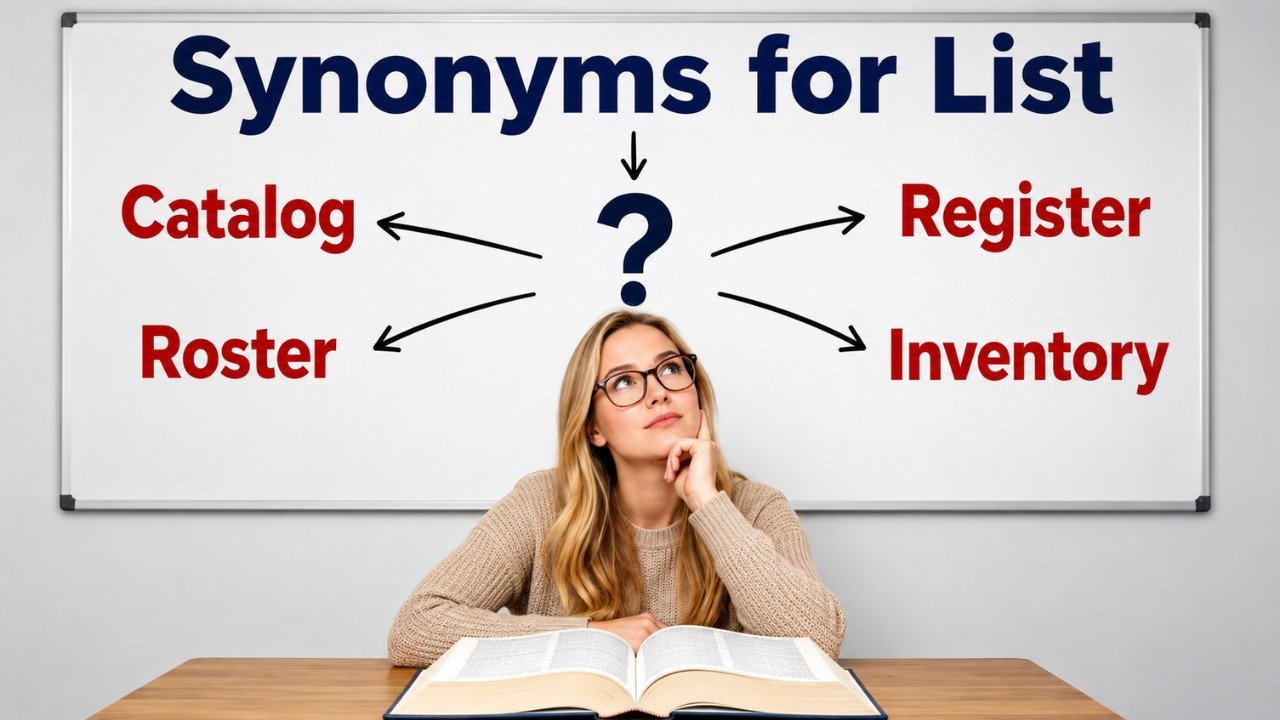
Quick Answer: The best synonyms for list include catalog, register, inventory, roster, index, directory, checklist, lineup, enumerate, and itemize. When referring to a general collection of items, catalog or listing often works well. Use roster for names of people, inventory for goods or supplies, index for organized reference information, and checklist for tasks that need confirmation. As a verb, enumerate is useful in formal writing, while itemize works well when giving detailed items separately. Choosing among synonyms for list depends mainly on what is being organized, recorded, or named.
Pronunciation and Word Details
Word: List.
Pronunciation: /lɪst/.
Part of Speech: Noun and verb.
Meaning: A list is a collection of names, items, ideas, or information presented together, or the act of naming or recording those things separately.
US Pronunciation:
UK Pronunciation:
What Does “List” Mean?
List means a collection of related items, names, ideas, tasks, or pieces of information presented together. It can also mean to write, name, or record several things separately.
As a noun, list often refers to organized information.
Example: I made a list of everything we need for dinner.
As a verb, list means to state, write, or record items individually.
Example: Please list the documents you have included.
The meaning changes slightly depending on context. A list of employees may be called a roster. A list of products may be called an inventory or catalog. A list of topics in a document may be called an index or contents section.
Because list is broad and neutral, it appears naturally in everyday conversation, professional communication, academic writing, instructions, planning, and record keeping.
Meaning, Tone, and Context of “List”
List is generally a neutral and flexible word. It works in both casual and formal situations, although a more specific synonym can sometimes make writing clearer.
Neutral Use: List is suitable when no special type of collection needs to be identified.
Example: She gave me a list of possible topics.
Formal Use: In reports and academic writing, words such as enumeration, register, index, or itemization may provide greater precision.
Example: The report contains an itemization of all expenses.
Professional Use: Roster, inventory, directory, schedule, and register are common when information has a specific organizational purpose.
Example: The manager reviewed the staff roster.
Casual Use: Words such as rundown or lineup can sound more conversational.
Example: Give me a quick rundown of your plans.
Technical Use: Index, manifest, inventory, log, and register may describe information recorded according to a structured system.
The best choice depends on whether you are discussing people, products, tasks, records, information, events, or the action of naming items.
When and How to Use “List”
For General Information
Use list when presenting several related items without needing a more specialized term.
Example: Write a list of your favorite books.
For Names of People
List works when identifying several people, but roster or register may be more precise when membership or attendance is involved.
Example: Her name appears on the guest list.
For Tasks
Use list when organizing things that need to be completed. Checklist is better when each task must be confirmed after completion.
Example: I made a list of jobs to finish before Friday.
For Products or Supplies
List is acceptable for products, but inventory is more precise when quantities or available stock matter.
Example: The team prepared a list of supplies.
For Organized Reference Information
Use list for general information, but index, directory, or catalog may be clearer when readers need to locate specific entries.
Example: The document includes a list of important terms.
For Naming Several Things
As a verb, list means to state items separately.
Example: List three reasons for your decision.
For Detailed Breakdown
Itemize is often stronger than list when each cost, product, or detail must appear separately.
Example: Please itemize every expense on the report.
For Formal Enumeration
Enumerate is useful when items are being stated systematically or in a formal sequence.
Example: The researcher enumerated the main causes of the problem.
Best Synonyms for List
Catalog
Synonym: Catalog means an organized collection of items or information, often arranged for easy reference.
Example: The library maintains a catalog of available materials.
Register
Synonym: Register means an official or organized record of names, events, or information.
Example: Her name was added to the attendance register.
Inventory
Synonym: Inventory means a detailed record of goods, materials, equipment, or possessions.
Example: The store completed an inventory of its supplies.
Roster
Synonym: Roster means a list of people belonging to a group, team, organization, or duty schedule.
Example: His name appears on the final roster.
Index
Synonym: Index means an organized list that helps readers locate information.
Example: Check the index to find the topic quickly.
Directory
Synonym: Directory means an organized list of people, organizations, places, or contact details.
Example: The office directory contains each department name.
Checklist
Synonym: Checklist means a list of tasks or requirements that can be checked as they are completed.
Example: She followed a checklist before submitting the application.
Lineup
Synonym: Lineup means a selected group of people, events, performers, or options arranged together.
Example: The event has an impressive lineup of speakers.
Enumerate
Synonym: Enumerate means to name or state several things separately and systematically.
Example: The report enumerates the major risks.
Itemize
Synonym: Itemize means to present individual items or details separately.
Example: The receipt itemizes every charge.
50 Synonyms for List with Short Meanings
- Catalog: An organized collection of items or information.
- Register: An official record of names or details.
- Inventory: A detailed record of goods or possessions.
- Roster: A record of people in a group or organization.
- Index: An organized guide to information or entries.
- Directory: A structured collection of names or contact information.
- Lineup: A selected arrangement of people, events, or choices.
- Record: Stored information about people, events, or items.
- Checklist: A collection of tasks or requirements to verify.
- Agenda: A collection of topics or tasks to be discussed.
- Schedule: An organized arrangement of events or activities.
- Roll: A formal record of names or members.
- Menu: A collection of available food, services, or choices.
- Table: Information arranged systematically in rows or columns.
- Enumeration: The formal act or result of naming items separately.
- Listing: A written or organized collection of entries.
- Series: Several related things presented in order.
- Collection: A group of related things gathered together.
- Compilation: Information gathered from several items or entries.
- Assortment: A varied collection of related items.
- Selection: A chosen group of available options.
- Set: A group of related items considered together.
- Rundown: A brief summary or collection of important points.
- Outline: An organized presentation of main points.
- Itemization: A detailed presentation of separate items.
- Tally: A recorded count or total of items.
- Log: A continuing record of events, activities, or entries.
- Archive: An organized collection of stored records.
- Manifest: A formal record of goods, passengers, or contents.
- Ledger: A systematic written record of transactions or entries.
- Docket: A record of matters, cases, or tasks awaiting attention.
- Queue: An ordered collection waiting for action or service.
- Sequence: A group of items arranged in a particular order.
- Slate: A selected collection of candidates, choices, or planned items.
- Program: An organized arrangement of scheduled events or activities.
- Calendar: An organized record of dates, events, or appointments.
- Contents: A collection showing what is included in a document or work.
- Bullet List: Information presented as separate bullet points.
- Numbered List: Information arranged in a numbered sequence.
- Name: To state or identify something individually.
- Enumerate: To state several items separately.
- Itemize: To present details one item at a time.
- Mention: To refer to or name something briefly.
- Note: To write or record information.
- Enter: To place information into a record.
- Specify: To state something clearly and precisely.
- Detail: To describe separate facts or elements fully.
- Identify: To name or recognize particular items.
- Tabulate: To organize information systematically, often in a table.
- Compile: To gather separate pieces of information into one collection.
Read Also:
Synonyms for Well Being

Synonyms for List by Context
When List Means a General Collection of Items
Catalog, listing, collection, compilation, set, series, assortment, and selection can describe several things presented together.
Example: We created a catalog of available materials.
Catalog suggests stronger organization than list, while collection emphasizes that several items have been gathered together.
When List Means Names or Members
Roster, register, roll, directory, and lineup are useful when the entries are people.
Example: The coach checked the roster before the event.
Roster is especially useful for members of a team or organization. Register often suggests a more official record.
When List Means Goods or Resources
Inventory, catalog, manifest, record, and itemization are useful for products, supplies, equipment, or possessions.
Example: The manager reviewed the inventory before ordering more supplies.
Inventory is the strongest choice when quantities or available goods matter.
When List Means Organized Reference Information
Index, directory, contents, table, catalog, and archive are useful when information is organized so readers can locate it.
Example: The index shows where each topic appears.
Index is particularly useful for reference material, while directory is better for names, organizations, locations, or contact details.
When List Means Tasks or Plans
Checklist, agenda, schedule, calendar, program, and docket can replace list depending on what is being organized.
Example: She checked every task on her checklist.
Checklist suggests completion, agenda suggests discussion, and schedule focuses on timing.
When List Means to State Items Separately
Enumerate, itemize, name, mention, specify, identify, detail, and note are useful verb alternatives.
Example: The instructions enumerate five important requirements.
Enumerate sounds more formal, while name and mention are more conversational.
When List Means to Record Information
Enter, note, compile, tabulate, register, and record can describe placing information into an organized system.
Example: Please enter each expense in the appropriate section.
Another Word for List
Catalog is one of the strongest single replacements for list when the word refers to an organized collection of items. However, the best alternative depends on what the collection contains and why it exists.
Use roster for people, inventory for goods, checklist for tasks, index for reference information, and itemize or enumerate when list is used as a verb.
Original: We created a list of every product available.
Better Option: We created a catalog of every product available.
Original: Check the list of team members.
Better Option: Check the roster of team members.
Original: She made a list of the remaining supplies.
Better Option: She prepared an inventory of the remaining supplies.
Original: List every expense separately.
Better Option: Itemize every expense separately.
When Not to Use “List”
List is useful because it is broad, but that broad meaning can also make writing less precise.
When a More Specific Record Is Intended
If you are discussing stock, equipment, or goods, inventory may communicate the meaning more clearly.
Weak: The manager reviewed the list of products in storage.
Better: The manager reviewed the inventory of products in storage.
When Referring to Group Members
Roster is often more precise than list when referring to members of a team, organization, or group.
Weak: The player was added to the team list.
Better: The player was added to the team roster.
When Tasks Must Be Checked
Checklist is clearer when every task must be confirmed after completion.
Weak: Follow the safety list before starting.
Better: Follow the safety checklist before starting.
When Writing Formally
Repeated use of list can sound vague in reports or academic writing.
Weak: The report lists a list of possible causes.
Better: The report provides an enumeration of possible causes.
When Detailed Costs Are Required
Itemize is better when separate charges or expenses need to be shown individually.
Weak: Please list the total expenses separately.
Better: Please itemize the expenses.
Words Commonly Confused With List
List vs Catalog: A list can be any collection of items. A catalog usually suggests that the items are organized systematically and often include additional information.
List vs Roster: List is general, while roster normally refers to people who belong to a team, organization, group, or schedule.
List vs Inventory: A list may contain anything. An inventory specifically records goods, resources, materials, equipment, or possessions.
List vs Index: A list simply presents information. An index helps readers locate information within a larger document or collection.
List vs Checklist: A list records items. A checklist normally includes tasks, conditions, or requirements that need to be confirmed.
List vs Register: A list may be informal. A register often suggests an official or maintained record.
List vs Enumeration: List can refer to the collection itself or the act of writing it. Enumeration emphasizes the systematic naming of items separately.
List vs Itemization: A list may be brief or general. Itemization gives individual details separately, especially costs, products, or charges.
Which Synonym Should You Choose?
Choose catalog when referring to a well organized collection of products, materials, records, or resources.
Choose roster when writing about members of a team, organization, committee, or group.
Choose inventory when discussing available goods, supplies, equipment, or possessions.
Choose index when helping readers find information within a document or collection.
Choose directory when presenting names, organizations, departments, places, or contact information.
Choose checklist when the reader needs to verify that individual tasks or requirements have been completed.
Choose enumeration for formal writing when several points are presented systematically.
Choose itemize when expenses, charges, products, or details must be shown individually.
Choose rundown in casual conversation when giving a quick summary of several points.
Choose lineup when referring to a selected group of people, events, performers, speakers, or options.
Choose agenda for meetings, discussions, and planned topics.
Choose schedule when time and order are important.
Choose list when a general, neutral word communicates the idea clearly without requiring additional precision.
Real Life Examples of “List” in Sentences
Original: I made a list of everything we need to buy.
Better Option: I made a checklist of everything we need to buy.
Original: The teacher checked the list of students.
Better Option: The teacher checked the student register.
Original: We reviewed the list of available equipment.
Better Option: We reviewed the inventory of available equipment.
Original: The document contains a list of important topics.
Better Option: The document contains an index of important topics.
Original: She gave me a list of the meeting topics.
Better Option: She gave me the meeting agenda.
Original: The manager showed us a list of employees working that day.
Better Option: The manager showed us the staff roster for that day.
Original: Please list the reasons for your decision.
Better Option: Please enumerate the reasons for your decision.
Original: The bill lists every separate charge.
Better Option: The bill itemizes every separate charge.
Original: The document lists several possible solutions.
Better Option: The document details several possible solutions.
Original: He gave me a short list of what happened.
Better Option: He gave me a short rundown of what happened.
Synonym Groups and Usage Differences
General Collection Group
Catalog, listing, collection, compilation, assortment, set, series, and selection all refer to several things gathered or presented together.
Catalog suggests organization. Collection emphasizes gathering. Assortment often suggests variety.
Example: The catalog contains hundreds of available items.
Names and Membership Group
Roster, register, roll, directory, slate, and lineup commonly relate to people.
Roster works well for members. Register suggests an official record. Lineup describes a selected group.
Example: The final roster contains twenty participants.
Goods and Resources Group
Inventory, manifest, catalog, ledger, and record are useful when tracking goods, resources, property, or transactions.
Inventory focuses on available items. Manifest often records transported goods or passengers. Ledger focuses on recorded transactions.
Example: The inventory shows how much equipment remains.
Planning Group
Checklist, agenda, schedule, calendar, docket, program, and queue organize actions, events, tasks, or upcoming matters.
Checklist focuses on completion. Agenda focuses on discussion. Schedule focuses on time.
Example: The agenda contains four discussion topics.
Reference Group
Index, directory, contents, archive, catalog, and table help organize information for later use.
Index helps readers locate material. Directory organizes names or contact details.
Example: Use the directory to locate the correct department.
Verb Group
Enumerate, itemize, name, mention, specify, identify, detail, note, enter, tabulate, and compile can replace the verb list.
Enumerate is formal. Itemize emphasizes individual details. Mention is lighter and less systematic.
Example: The writer enumerates three reasons for the change.
Antonyms of List
List has no single perfect opposite because it can function as both a noun and a verb. Its opposites depend on whether the intended meaning involves recording, including, organizing, or naming information.
Omit: To leave an item out.
Exclude: To deliberately prevent something from being included.
Remove: To take something away from an existing collection.
Delete: To erase an entry from a record.
Ignore: To avoid mentioning or considering something.
Conceal: To keep information from being shown or recorded openly.
Disorder: A lack of organized arrangement.
Randomness: A condition without deliberate sequence or structure.
Unlisted: Not included in a recorded collection.
Erase: To remove previously recorded information.
Comparison: List vs Related Words
List vs Catalog
List is broad and can contain almost any type of item. Catalog usually suggests greater organization and may include descriptions or additional information.
Example With List: I made a list of the books I want to read.
Example With Catalog: The catalog organizes the books by subject.
List vs Roster
List can refer to things or people. Roster usually refers specifically to people belonging to a team, organization, group, or duty schedule.
Example With List: I received a list of names.
Example With Roster: The final roster includes all registered participants.
List vs Inventory
List is general. Inventory specifically refers to goods, materials, resources, equipment, or possessions that are being tracked.
Example With List: We made a list of office supplies.
Example With Inventory: We completed an inventory of all office supplies.
List vs Index
List presents several entries. Index organizes entries to help someone locate related information.
Example With List: The page contains a list of important concepts.
Example With Index: The index shows where each concept appears.
List vs Checklist
A list simply gathers items. A checklist usually allows each item to be confirmed or marked after completion.
Example With List: She wrote a list of tasks.
Example With Checklist: She used a checklist to confirm every task was completed.
List vs Register
List is often general or informal. Register usually describes an official or continuously maintained record.
Example With List: We have a list of visitors.
Example With Register: Every visitor must sign the register.
List vs Enumerate
List can function as either a noun or verb. Enumerate is a verb that means to state items individually, usually in a systematic or formal manner.
Example With List: Please list the main benefits.
Example With Enumerate: Please enumerate the main benefits in your report.
List vs Itemize
List can present items without much detail. Itemize means to separate and show individual details clearly.
Example With List: The document lists the costs.
Example With Itemize: The document itemizes each individual cost.
Common Phrases and Expressions With “List”
Make a List: To write several related items together.
Shopping List: A collection of things that need to be purchased.
To Do List: A collection of tasks that need to be completed.
Guest List: A record of people invited to an event.
Waiting List: A record of people waiting for a place, service, or opportunity.
Reading List: A collection of books, articles, or materials recommended for reading.
Price List: A record showing products or services and their prices.
Priority List: A collection of tasks or goals arranged by importance.
Contact List: A collection of names and contact information.
Short List: A reduced selection containing the strongest or most suitable options.
Common Mistakes to Avoid
Using List When a More Precise Word Is Available
List is correct in many situations, but specific words often improve clarity.
Instead of list of products in storage, inventory may be more precise. Instead of list of players, roster may be stronger.
Repeating List Too Often
Using list repeatedly in the same paragraph can make writing monotonous.
Vary the wording naturally with catalog, register, checklist, inventory, roster, or another context appropriate alternative.
Choosing a Synonym With the Wrong Meaning
Not every synonym works in every situation.
Roster usually refers to people, while inventory usually refers to goods or possessions. Using one for the other may sound unnatural.
Using List Out Unnecessarily
In many sentences, list already means to state items individually, so adding out is unnecessary.
Weak: List out the main reasons.
Better: List the main reasons.
Confusing an Index With a General List
An index has a reference function. It usually helps readers locate information rather than simply presenting several items.
Using Enumerate in Casual Speech Without a Reason
Enumerate is correct but often sounds formal.
Weak: Can you enumerate what you need from the store?
Better: Can you list what you need from the store?
Forgetting Parallel Structure
Items within a list should normally follow a consistent grammatical pattern.
Weak: My goals are saving money, to exercise regularly, and better sleep.
Better: My goals are saving money, exercising regularly, and sleeping better.
Adding Unnecessary Detail to a Simple List
A simple list is often clearer than a highly formal alternative when the context is ordinary.
Use precise synonyms when they improve meaning, not simply to make the sentence sound more complicated.
Conclusion
Understanding synonyms for list helps you choose a word that matches the exact purpose of your sentence. Catalog works well for organized collections, roster for groups of people, inventory for goods and supplies, index for reference information, and checklist for tasks. When list is used as a verb, enumerate suits formal writing while itemize emphasizes separate details. The word list remains a useful neutral choice, but selecting a more specific alternative can make writing clearer, more natural, and more precise.
FAQs About Synonyms for List
What Is the Best Synonym for List?
Catalog is a strong general synonym when list means an organized collection. The best choice still depends on whether you are listing people, products, tasks, information, or details.
What Is a Formal Synonym for List?
Enumeration, register, catalog, and itemization are useful formal alternatives. Enumerate and itemize are strong verb choices.
What Is Another Word for a List of Names?
Roster, register, roll, and directory can all describe a list of names. Roster is especially useful for members of a group or team.
What Is Another Word for a List of Items?
Catalog, inventory, collection, listing, and checklist may work. Inventory is especially suitable for products, goods, supplies, or possessions.
What Is Another Word for List as a Verb?
Enumerate, itemize, name, mention, specify, detail, identify, and note can replace list as a verb depending on context.
What Is the Difference Between a List and a Checklist?
A list simply presents several items. A checklist usually contains tasks or requirements that can be confirmed after they are completed or reviewed.
Which Synonym for List Is Best in Academic Writing?
Enumeration works well for systematically presented points, while index is appropriate for reference information. Itemization is useful for detailed individual entries, and catalog may suit organized collections.
