
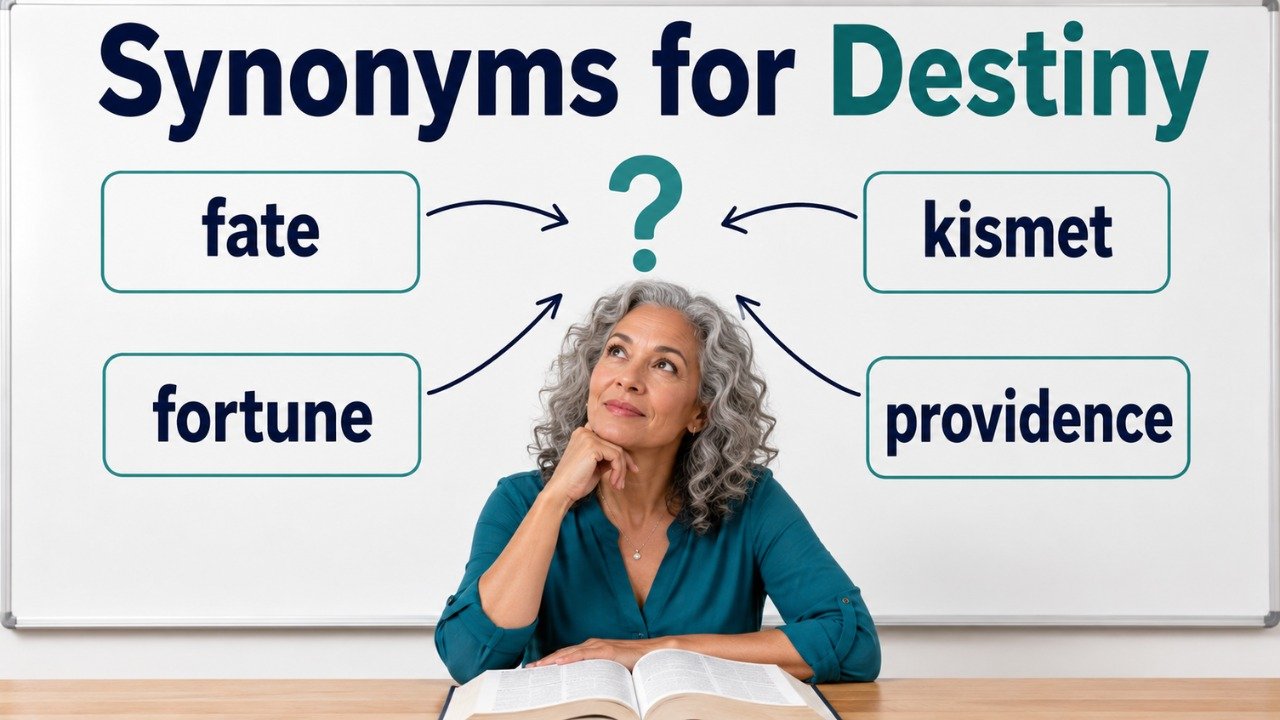
Quick Answer: The best synonyms for destiny include fate, fortune, future, lot, providence, predestination, outcome, doom, calling, and life path. Fate is the strongest general replacement when events seem fixed or unavoidable. Fortune works well when luck or changing circumstances shape a person’s life. Providence suits spiritual or religious contexts, while predestination is more formal and philosophical. Calling describes a meaningful purpose, doom suggests an unfortunate ending, and outcome is best when discussing the final result of actions or events.
Pronunciation and Word Details
Word: Destiny.
Pronunciation: /ˈdestəni/
Part of Speech: Noun.
Meaning: The future events believed to be fixed, intended, or shaped by forces beyond personal control.
US Pronunciation:
UK Pronunciation:
What Does “Destiny” Mean?
Destiny means the future course of a person, group, place, or thing, especially when that future is believed to be planned, inevitable, or controlled by forces beyond ordinary choice.
Destiny is a noun. It can describe a final outcome, a life purpose, an unavoidable future, or a series of events that seem meant to happen.
In personal sentences, destiny may refer to a life path or important purpose. In romantic language, it can suggest that two people were meant to meet. In historical writing, destiny may describe the expected future of a nation or civilization. In philosophical and spiritual contexts, it can refer to a future shaped by divine will, natural order, or a higher power.
The word does not always mean that every detail is fixed. Sometimes it simply expresses a strong belief that a certain result, role, or direction feels inevitable.
Meaning, Tone, and Context of “Destiny”
Destiny usually has a serious, emotional, dramatic, or philosophical tone. It is more expressive than ordinary words such as future or result.
In everyday conversation, people may use destiny when discussing love, success, purpose, dreams, or major life changes. In literature and storytelling, the word often creates a sense of mystery, inevitability, or importance.
In formal writing, destiny may appear in discussions about history, philosophy, religion, politics, culture, and human choice. It can describe the future direction of a nation, the consequences of collective decisions, or a person’s belief in a predetermined life path.
Destiny can carry a positive, negative, or neutral meaning. A person may fulfill a great destiny, escape a tragic destiny, or remain uncertain about their destiny.
The word is usually stronger than future because it suggests meaning, purpose, or inevitability rather than simply referring to events that have not happened yet.
When and How to Use “Destiny”
For an Unavoidable Future: Use destiny when a future event appears fixed or impossible to escape.
Example: He believed it was his destiny to lead the community.
For a Life Purpose: Use destiny when describing a role, mission, or direction that feels deeply meaningful.
Example: She felt that teaching was her destiny.
For Romantic Connection: Use destiny when two people appear meant to meet or share a life.
Example: They believed destiny had brought them together.
For a Final Outcome: Use destiny when discussing the eventual result of choices, conflicts, or historical events.
Example: The decisions made that year changed the nation’s destiny.
For Spiritual Belief: Use destiny when events are understood as part of a divine or higher plan.
Example: He trusted that his destiny would become clear with time.
For Historical Change: Use destiny when describing the future direction of a country, culture, or civilization.
Example: The agreement shaped the political destiny of the region.
For Personal Ambition: Use destiny when someone feels strongly drawn toward a particular achievement.
Example: She was determined to create her own destiny.
For Tragic Consequences: Use destiny when an unfortunate ending seems unavoidable.
Example: The warning arrived too late to change their destiny.
Best Synonyms for Destiny
Fate: A future believed to be fixed and beyond personal control.
Example: He accepted his fate with remarkable calm.
Fortune: The course of events shaped by luck, chance, or changing circumstances.
Example: A single decision changed her fortune.
Future: The time and events that are still to come.
Example: The students worked hard to build a secure future.
Lot: The condition or experience that seems assigned to someone in life.
Example: He accepted that hardship was his lot for the moment.
Providence: Protective or guiding influence believed to come from a higher power.
Example: She believed providence had guided her toward the opportunity.
Predestination: The belief that events or outcomes have been decided in advance.
Example: The debate focused on free will and predestination.
Outcome: The final result of an action, process, or event.
Example: No one could predict the outcome of the negotiations.
Doom: An unavoidable and usually disastrous fate.
Example: The careless decision sealed the expedition’s doom.
Calling: A strong sense that one is meant to follow a particular purpose or profession.
Example: Caring for others became her true calling.
Life Path: The direction and major experiences that shape a person’s life.
Example: Travel completely changed his life path.
50 Synonyms for Destiny with Short Meanings
- Fate: A future believed to be fixed or unavoidable.
- Fortune: The events and circumstances that shape a life.
- Future: The time and events still to come.
- Lot: A condition or experience assigned by circumstance.
- Providence: Guidance believed to come from a higher power.
- Predestination: The belief that events are decided beforehand.
- Outcome: The final result of an action or event.
- Doom: A terrible or unfortunate fate.
- Calling: A strong sense of intended purpose.
- Life Path: The direction a person’s life takes.
- Kismet: Fate understood as something meant to happen.
- Predetermination: A decision or outcome fixed in advance.
- Inevitability: The quality of being certain to happen.
- Destination: The final place, result, or direction reached.
- End: The final point or result of something.
- Conclusion: The final stage or result of a process.
- Result: What happens because of an action or event.
- Consequence: A result produced by a decision or action.
- Resolution: The final outcome of a situation or conflict.
- Culmination: The highest or final point of a process.
- Purpose: The reason or intended role behind a life or action.
- Mission: An important task or duty someone feels meant to complete.
- Vocation: A profession or role felt to be especially suitable.
- Life Purpose: The central meaning or direction of a person’s life.
- Ordained Future: A future believed to be officially or divinely planned.
- Appointed End: A final result believed to have been decided beforehand.
- Foreordained Course: A path believed to be fixed in advance.
- Predestined Path: A direction thought to be decided before events unfold.
- Unavoidable Future: A coming result that cannot be escaped.
- Certain End: A final outcome regarded as inevitable.
- Fixed Future: A future believed to be unchangeable.
- Final Outcome: The ultimate result of events or choices.
- Eventual Result: The result that appears after time has passed.
- Ultimate End: The final destination or conclusion.
- Life Course: The pattern and progression of a person’s life.
- Course of Life: The direction taken by a person’s experiences.
- Path in Life: The route created by choices and circumstances.
- Life Direction: The overall course toward which a person moves.
- Future Course: The direction that later events are expected to take.
- Prospects: The possibilities and expected conditions of the future.
- Portion: A share of experience or circumstance assigned to someone.
- Inheritance: A condition, role, or future received from earlier generations.
- Legacy: The lasting result or influence left behind.
- Chance: An unpredictable force that can shape events.
- Luck: Success or failure caused by circumstances beyond control.
- Necessity: A condition that makes an event unavoidable.
- Fatality: The quality of being controlled by unavoidable fate.
- Design: A plan or purpose believed to guide events.
- Divine Plan: A future believed to be directed by a higher power.
- Written Future: A poetic idea that future events have already been decided.
Read Also:
Synonyms for Emphasis

Synonyms for Destiny by Context
When Destiny Means an Unavoidable Future
Fate, inevitability, predestination, predetermination, and a fixed future describe events that appear decided before they happen.
Fate is the most natural and widely understood alternative. Predestination is more formal and often appears in religious or philosophical discussions. Inevitability focuses on the certainty of an event rather than on who or what caused it.
Example: The leader believed that victory was his fate.
Example: The collapse seemed inevitable after years of neglect.
When Destiny Means a Personal Purpose
Calling, mission, purpose, vocation, and life purpose describe a role that feels meaningful or intended.
Calling is especially useful for work, service, creativity, or spiritual responsibility. Vocation usually refers to a profession or occupation that feels personally suitable. Mission suggests an important goal that must be completed.
Example: She discovered her calling while working with children.
Example: Protecting the environment became his life purpose.
When Destiny Means a Future Outcome
Outcome, result, conclusion, consequence, and culmination describe what eventually happens.
Outcome is neutral and useful in formal writing. Result is simple and direct. Consequence often suggests that the outcome was caused by a particular choice or action. Culmination describes the final stage of a long process.
Example: The outcome depended on several difficult decisions.
Example: The award was the culmination of years of effort.
When Destiny Means Luck or Fortune
Fortune, luck, chance, kismet, and lot describe events influenced by circumstances beyond personal planning.
Fortune may refer to good or bad circumstances. Luck is more conversational. Chance emphasizes unpredictability. Kismet has a poetic tone and suggests that events were meant to happen.
Example: Good fortune brought the opportunity at the perfect time.
Example: Their unexpected meeting felt like kismet.
When Destiny Means a Life Journey
Life path, life course, course of life, path in life, and life direction describe the route a person follows through experiences and choices.
Life path is the most familiar alternative. Life course is more formal and often appears in social, educational, or psychological writing. Life direction emphasizes goals and movement toward the future.
Example: The experience changed her life path completely.
Example: Education gave him a clearer sense of life direction.
When Destiny Means Divine Guidance
Providence, divine plan, design, ordained future, and appointed end express the belief that a higher power guides events.
Providence often suggests protection or wise guidance. Divine plan directly emphasizes spiritual intention. Design can be used more broadly when events seem arranged according to a meaningful pattern.
Example: She trusted in providence during the difficult period.
Example: He viewed the unexpected change as part of a divine plan.
When Destiny Means a Tragic End
Doom, fatality, certain end, unavoidable future, and appointed end can describe an unfortunate conclusion.
Doom is the strongest negative alternative. Fatality suggests that events are controlled by unavoidable forces. Certain end is less dramatic and more descriptive.
Example: The damaged vessel appeared to be heading toward doom.
Example: Their refusal to act made failure a certain end.
When Destiny Means National or Historical Direction
Future course, legacy, inheritance, prospects, and national future describe the direction of a country, culture, or institution.
Future course emphasizes later development. Legacy focuses on what remains after past decisions. Prospects describe future possibilities rather than a fixed outcome.
Example: The election changed the country’s future course.
Example: The agreement left a lasting political legacy.
Another Word for Destiny
Fate is usually the best single replacement for destiny because both words can describe a future believed to be fixed or unavoidable. However, the best alternative depends on whether the sentence concerns purpose, luck, consequence, religion, romance, or a final result.
Original: She believed it was her destiny to become a doctor.
Better Option: She believed it was her calling to become a doctor.
Original: The defeat changed the kingdom’s destiny.
Better Option: The defeat changed the kingdom’s future.
Original: Their meeting seemed to be destiny.
Better Option: Their meeting seemed to be fate.
Original: Poor planning determined the project’s destiny.
Better Option: Poor planning determined the project’s outcome.
When Not to Use “Destiny”
Do not use destiny when a simpler and more precise word would communicate the meaning more clearly.
Destiny may sound too dramatic when discussing an ordinary future plan.
Weak: I am studying tonight because my destiny is to pass the test.
Better: I am studying tonight because my goal is to pass the test.
Do not use destiny when the sentence refers to a measurable result caused by specific actions.
Weak: The experiment’s destiny depended on temperature.
Better: The experiment’s outcome depended on temperature.
Avoid destiny when a person is describing a chosen profession without suggesting fate or inevitability.
Weak: Accounting became his destiny after graduation.
Better: Accounting became his career after graduation.
Do not use destiny as an automatic replacement for future. Destiny implies purpose, inevitability, or forces beyond control.
Weak: We discussed the weather’s destiny for next week.
Better: We discussed the weather forecast for next week.
Avoid destiny in highly technical reports unless the writing is discussing philosophy, history, culture, or belief.
Weak: The machine’s destiny is determined by battery life.
Better: The machine’s operating time is determined by battery life.
Do not repeat destiny several times in the same paragraph.
Weak: Her destiny changed when she accepted her destiny and followed the path of destiny.
Better: Her future changed when she accepted her calling and followed a new life path.
Words Commonly Confused With Destiny
Destiny vs Fate: Destiny often suggests a meaningful future or purpose, while fate more strongly suggests an unavoidable outcome beyond personal control.
Destiny vs Future: Future simply means the time and events ahead. Destiny suggests that those events have meaning, purpose, or inevitability.
Destiny vs Fortune: Destiny concerns an intended or unavoidable future. Fortune concerns luck, chance, and changing circumstances.
Destiny vs Providence: Destiny is a broad word for a fixed or meaningful future. Providence specifically suggests guidance or protection from a higher power.
Destiny vs Predestination: Destiny can be used casually, emotionally, or poetically. Predestination is more formal and refers to the belief that outcomes have been decided in advance.
Destiny vs Calling: Destiny describes a broad future course. Calling refers to a strong sense that a person is meant to perform a particular role or type of work.
Destiny vs Outcome: Destiny suggests meaning or inevitability. Outcome is neutral and simply refers to the final result.
Destiny vs Doom: Destiny can be positive, negative, or neutral. Doom almost always describes a disastrous or tragic fate.
Destiny vs Purpose: Destiny concerns what may happen to someone. Purpose concerns why someone acts or what role gives life meaning.
Destiny vs Chance: Destiny suggests events are planned or inevitable. Chance suggests they happen unpredictably without a fixed plan.
Which Synonym Should You Choose?
Choose fate when events seem fixed, unavoidable, or beyond personal control.
Choose future when you simply mean the time or events that lie ahead.
Choose fortune when luck or changing circumstances shape a person’s life.
Choose calling when a person feels meant to follow a profession, service, or purpose.
Choose purpose when the sentence concerns meaning, intention, or direction rather than a fixed future.
Choose outcome when discussing the final result of a process, decision, experiment, or event.
Choose consequence when the final result follows directly from an action or choice.
Choose providence when writing about spiritual guidance or protection.
Choose predestination in formal, religious, or philosophical discussions about events decided in advance.
Choose kismet in poetic or romantic writing when an event seems meant to happen.
Choose doom when the expected future is tragic or disastrous.
Choose life path when discussing personal growth, experience, and the direction of a person’s life.
Choose life course in essays, reports, and academic writing about long term development.
Choose mission when someone has an important duty or goal.
Choose vocation when a profession feels personally meaningful or naturally suitable.
Choose luck in casual conversation about unexpected success or failure.
Choose chance when unpredictability is more important than purpose.
Choose culmination when discussing the final stage of a long process.
Choose legacy when describing the lasting effects of past choices.
Choose prospects when writing about future possibilities rather than fixed events.
In formal essays and reports, fate, outcome, future course, predestination, providence, and consequence provide precise alternatives.
In casual speech, future, luck, purpose, and life path often sound more natural.
In emotional or literary writing, destiny, fate, kismet, calling, and doom create a stronger dramatic effect.
Real Life Examples of “Destiny” in Sentences
Original: She believed her destiny was to help others.
Better Option: She believed her calling was to help others.
Original: The decision changed the destiny of the company.
Better Option: The decision changed the future of the company.
Original: He accepted his destiny without complaint.
Better Option: He accepted his fate without complaint.
Original: Their unexpected meeting felt like destiny.
Better Option: Their unexpected meeting felt like kismet.
Original: The battle determined the nation’s destiny.
Better Option: The battle determined the nation’s future course.
Original: The project’s destiny remained uncertain.
Better Option: The project’s outcome remained uncertain.
Original: She worked hard to control her destiny.
Better Option: She worked hard to shape her future.
Original: The warning could not save them from their destiny.
Better Option: The warning could not save them from their doom.
Original: He saw the opportunity as part of his destiny.
Better Option: He saw the opportunity as part of his life path.
Original: They trusted destiny to guide their decisions.
Better Option: They trusted providence to guide their decisions.
Synonym Groups and Usage Differences
Fate and Inevitability Group
Fate, predestination, predetermination, inevitability, and fixed future describe events that seem decided before they happen.
Fate is the most flexible option. Predestination is formal and often connected with religion or philosophy. Inevitability emphasizes certainty without necessarily suggesting a guiding force.
Example: Their separation appeared to be an unavoidable fate.
Purpose and Calling Group
Calling, purpose, mission, vocation, and life purpose describe a meaningful role or direction.
Calling often feels personal and emotional. Mission suggests a specific task or responsibility. Vocation usually relates to a profession. Purpose is the broadest word in this group.
Example: Medicine became more than a career because it felt like her calling.
Future and Outcome Group
Future, outcome, result, conclusion, and culmination describe what will happen or what finally happens.
Future refers broadly to time ahead. Outcome and result describe final consequences. Culmination emphasizes the final stage of a long effort.
Example: The discovery changed the future of the entire field.
Luck and Chance Group
Fortune, luck, chance, kismet, and lot describe circumstances that may not be under personal control.
Luck is conversational. Fortune can sound more literary or formal. Chance emphasizes randomness, while kismet suggests that an event was meant to occur.
Example: A fortunate chance brought the two researchers together.
Life Direction Group
Life path, life course, life direction, path in life, and course of life describe personal development over time.
Life path is natural in everyday writing. Life course is more formal. Life direction focuses on choices, goals, and movement toward a future.
Example: The scholarship changed the direction of his life.
Spiritual Guidance Group
Providence, divine plan, ordained future, design, and appointed end describe events believed to be directed by a higher power.
Providence often carries a hopeful tone. Divine plan is direct and spiritual. Ordained future sounds formal and strongly suggests that events were chosen beforehand.
Example: She believed providence had protected her during the journey.
Tragic Future Group
Doom, fatality, certain end, unavoidable future, and ultimate end describe a negative or unavoidable conclusion.
Doom is dramatic and strongly negative. Fatality focuses on the power of fate. Certain end is more neutral but still communicates inevitability.
Example: Ignoring the warning seemed to seal the group’s doom.
Historical Direction Group
Future course, inheritance, legacy, prospects, and national future describe the long term direction of communities or nations.
Future course concerns development over time. Legacy focuses on lasting influence. Prospects refer to possibilities and may be positive or negative.
Example: The reforms shaped the country’s political future.
Antonyms of Destiny
The opposite of destiny depends on whether destiny means a fixed future, unavoidable result, life purpose, or external control.
Choice: The ability to select among different possibilities.
Free Will: The power to make decisions without complete control by fate.
Chance: Randomness rather than a planned or fixed future.
Uncertainty: A condition in which the future is unknown.
Possibility: An event or result that may happen but is not fixed.
Freedom: The ability to act without being controlled by an unavoidable course.
Control: The power to influence events and outcomes.
Agency: The ability to make choices and shape results.
Self Determination: The right to decide one’s own direction.
Randomness: The absence of an intended or predictable pattern.
Accident: An event occurring without deliberate planning.
Indeterminacy: The condition of not being decided or fixed.
Flexibility: The ability to change direction or adjust plans.
Choice of Direction: The freedom to select one’s own path.
Open Future: A future that remains changeable and uncertain.
Comparison: Destiny vs Related Words
Destiny vs Fate
Destiny often suggests a meaningful future or purpose. Fate more strongly suggests an unavoidable result that cannot be changed.
Example With Destiny: She believed leadership was her destiny.
Example With Fate: He accepted his fate after the final decision.
Destiny vs Future
Destiny carries ideas of purpose, intention, or inevitability. Future simply refers to events or time that have not yet arrived.
Example With Destiny: The agreement shaped the nation’s destiny.
Example With Future: The agreement created new opportunities for the nation’s future.
Destiny vs Fortune
Destiny suggests a planned or unavoidable course. Fortune describes the effects of luck, chance, and changing circumstances.
Example With Destiny: He felt it was his destiny to return home.
Example With Fortune: Good fortune helped him find a new position.
Destiny vs Providence
Destiny may result from fate, choice, or an unknown force. Providence specifically refers to guidance or protection believed to come from a higher power.
Example With Destiny: She believed the meeting was part of her destiny.
Example With Providence: She believed providence had guided her to safety.
Destiny vs Predestination
Destiny is common in general, emotional, and literary writing. Predestination is a formal concept that describes events or outcomes decided in advance.
Example With Destiny: He wondered whether success was his destiny.
Example With Predestination: The discussion examined the relationship between free will and predestination.
Destiny vs Calling
Destiny describes a broad future course. Calling describes a strong feeling that someone is meant to perform a particular role or service.
Example With Destiny: She believed greatness was her destiny.
Example With Calling: She believed teaching was her calling.
Destiny vs Outcome
Destiny suggests meaning or forces beyond ordinary control. Outcome is a neutral word for the final result of actions or events.
Example With Destiny: The battle determined the empire’s destiny.
Example With Outcome: The final strategy determined the outcome of the battle.
Destiny vs Purpose
Destiny concerns what is expected or meant to happen. Purpose concerns the reason for an action, life, or role.
Example With Destiny: He believed the journey was part of his destiny.
Example With Purpose: He joined the journey with a clear purpose.
Destiny vs Doom
Destiny can describe a positive, negative, or neutral future. Doom refers specifically to a tragic or disastrous fate.
Example With Destiny: The discovery changed the explorer’s destiny.
Example With Doom: The damaged bridge seemed to lead the travelers toward doom.
Destiny vs Chance
Destiny implies that events are meaningful, intended, or unavoidable. Chance suggests that events occur randomly or unpredictably.
Example With Destiny: They believed destiny had brought them together.
Example With Chance: They met by chance at a small gathering.
Common Phrases and Expressions With Destiny
Fulfill Your Destiny: Achieve the role or future believed to be intended for you.
Shape Your Destiny: Influence the direction and outcome of your own life.
Control Your Destiny: Take responsibility for future decisions and results.
Change Your Destiny: Alter a future that once seemed fixed.
Accept Your Destiny: Recognize and stop resisting an expected future.
Meet Your Destiny: Reach an important or unavoidable moment.
Follow Your Destiny: Move toward a future or purpose believed to be intended.
Written in Destiny: Believed to have been decided before it happened.
Destiny Awaits: An important future opportunity or event is approaching.
A Twist of Destiny: An unexpected event that changes the course of life.
Master of Your Destiny: A person who takes control of personal choices and future direction.
Destiny Brought Them Together: A phrase suggesting that two people were meant to meet.
Common Mistakes to Avoid
A common mistake is treating destiny and future as exact synonyms. Future is neutral, while destiny suggests purpose, inevitability, or a force guiding events.
Unclear: The report explains the destiny of the market next month.
Clearer: The report explains the expected future of the market next month.
Another mistake is using destiny when outcome is more precise.
Weak: The destiny of the experiment depended on temperature.
Better: The outcome of the experiment depended on temperature.
Do not confuse destiny with calling. A calling is a meaningful profession or purpose, while destiny is the broader course of a life.
Incorrect: Nursing was the final destiny she applied for.
Correct: Nursing was the calling she chose to pursue.
Avoid using doom when the expected result is not clearly negative.
Incorrect: Winning the award was his doom.
Correct: Winning the award changed his destiny.
Do not assume destiny always removes personal choice. Many sentences use destiny figuratively while still allowing a person to make decisions.
Vague: She had no choice because success was her destiny.
Clearer: She believed success was her destiny, but she still worked hard to achieve it.
Avoid mixing fate and chance without explaining the contrast.
Confusing: Their meeting was a planned chance of destiny.
Natural: Their meeting seemed like fate rather than chance.
Do not repeat destiny excessively.
Repetitive: His destiny changed when he understood his destiny and decided to follow his destiny.
Improved: His future changed when he understood his purpose and decided to follow a new life path.
Use the correct preposition. Destiny of refers to the future of a person, place, or thing. Destiny to is usually followed by a verb describing an intended role or action.
Destiny Of: The treaty influenced the destiny of the region.
Destiny To: She believed it was her destiny to lead.
Avoid unnatural phrases such as make a destiny or do a destiny. Natural verbs include shape, fulfill, accept, follow, change, control, meet, and determine.
Unnatural: He wanted to make his destiny.
Natural: He wanted to shape his destiny.
Conclusion
Synonyms for destiny range from fate and fortune to calling, outcome, providence, and life path. Fate is best for an unavoidable future, while calling and purpose suit meaningful roles. Outcome and result work in factual writing, fortune and chance describe luck, and providence fits spiritual contexts. Doom expresses a tragic ending, while future is the simplest neutral alternative. Choosing the right synonym helps clarify whether a sentence concerns inevitability, personal purpose, random events, divine guidance, or the final result of choices.
FAQs About Synonyms for Destiny
What Is the Best Synonym for Destiny?
Fate is the best general synonym because it describes a future believed to be fixed or unavoidable.
Is Fate the Same as Destiny?
The words are similar, but destiny often suggests purpose or meaning, while fate more strongly suggests an unavoidable result.
What Is a Positive Synonym for Destiny?
Calling, purpose, fortune, life path, and providence can express a positive sense of destiny.
What Is a Negative Synonym for Destiny?
Doom, fatality, tragic fate, and unavoidable end can describe a negative destiny.
What Is a Formal Synonym for Destiny?
Predestination, predetermination, providence, future course, and ultimate outcome are useful formal alternatives.
What Is Another Word for Romantic Destiny?
Fate, kismet, meant to be, and providence can describe a romantic connection that seems intended.
What Is the Opposite of Destiny?
Free will, choice, chance, uncertainty, agency, and an open future can express ideas opposite to a fixed destiny.
