
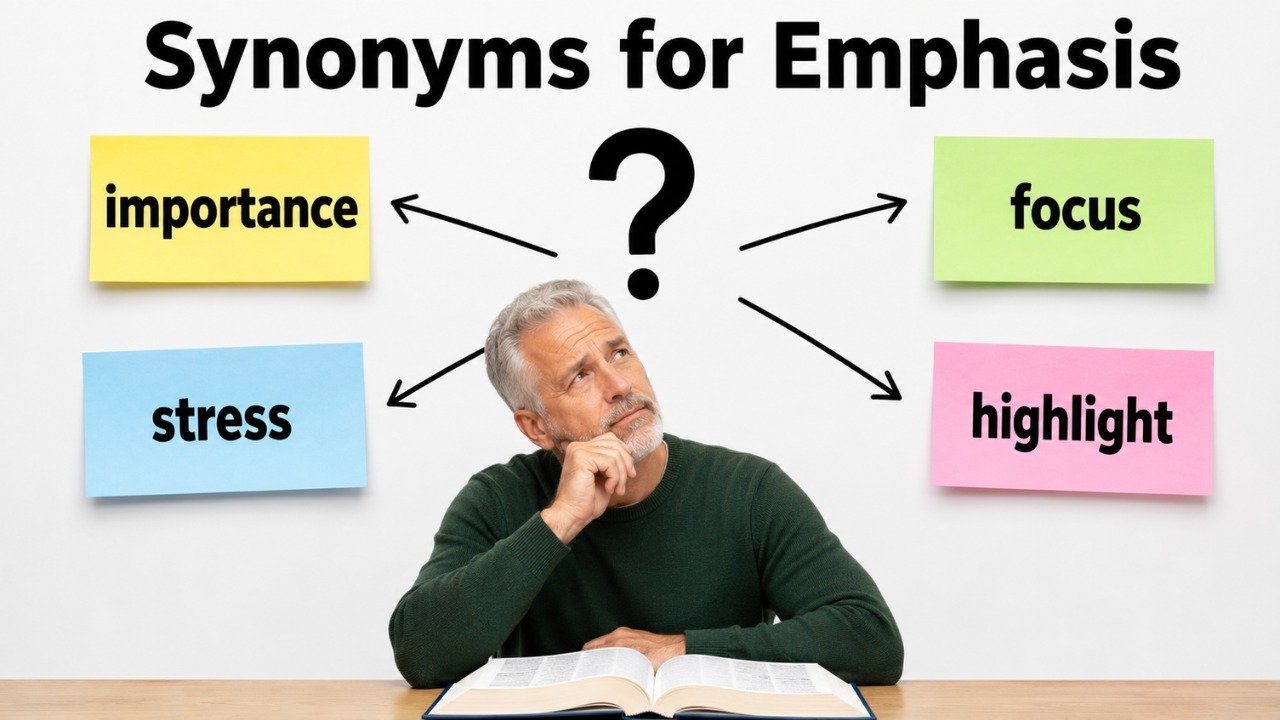
Quick Answer: The best synonyms for emphasis include stress, importance, focus, priority, prominence, weight, attention, significance, insistence, and force. Among these synonyms for emphasis, stress is best when making a point sound stronger, importance suits formal writing, focus describes concentrated attention, and priority shows that something should be handled first. Prominence works for visibility, weight suggests influence, insistence expresses determination, and force describes strength in speech or writing.
Pronunciation and Word Details
Word: Emphasis.
Pronunciation: /ˈem.fə.sɪs/
Part of Speech: Noun.
Meaning: Special importance, attention, or strength given to a word, idea, action, or detail.
US Pronunciation:
UK Pronunciation:
What Does “Emphasis” Mean?
Emphasis means special importance, attention, or strength given to something.
Emphasis is a noun. It is commonly used when a person wants an idea, word, detail, goal, or action to receive more attention than other information.
In writing, emphasis helps readers notice the most important point.
Example: The report places emphasis on customer satisfaction.
In speech, emphasis can mean saying a word more strongly or changing the tone of the voice.
Example: She added emphasis to the word “must.”
In planning or decision making, emphasis describes the area that receives the greatest attention or priority.
Example: The training program has a strong emphasis on safety.
In visual communication, emphasis can be created through size, position, contrast, repetition, or spacing.
Example: Larger text gives emphasis to the main heading.
The meaning of emphasis changes slightly according to context. It may refer to importance, vocal stress, focused attention, visual prominence, or strong insistence.
Meaning, Tone, and Context of “Emphasis”
Emphasis has a neutral and generally formal tone. It appears frequently in academic writing, professional communication, education, public speaking, grammar, design, management, and everyday conversation.
Formal Tone: Emphasis is suitable for reports, essays, policies, instructions, and professional discussions.
Example: The new policy places greater emphasis on accurate record keeping.
Academic Tone: Students and researchers use emphasis when identifying important ideas, arguments, themes, or evidence.
Example: The study gives particular emphasis to environmental factors.
Conversational Tone: Emphasis also sounds natural in everyday speech when discussing what matters most.
Example: Our teacher puts a lot of emphasis on clear writing.
Strong Tone: The word can communicate determination when someone stresses a rule, request, or opinion.
Example: He spoke with emphasis when explaining the deadline.
Technical Tone: In grammar and speech studies, emphasis can describe stress placed on a word or syllable.
Example: The meaning changes depending on where the speaker places the emphasis.
Visual Context: In design, emphasis refers to making one element stand out from the surrounding content.
Example: Contrast creates emphasis around the central image.
Emphasis is polite and professional, but it can sound repetitive if used too frequently. In some sentences, importance, focus, priority, stress, or prominence may provide a more exact meaning.
When and How to Use “Emphasis”
Use emphasis when describing special importance, concentrated attention, strong expression, or noticeable prominence.
For Importance
Explanation: Use emphasis when an idea, goal, or subject receives special importance.
Example: The course places emphasis on practical communication skills.
For Focus
Explanation: Use emphasis when attention is directed toward one particular area.
Example: This month, the team will put greater emphasis on customer support.
For Spoken Stress
Explanation: Use emphasis when a word or phrase is pronounced with extra force.
Example: She placed emphasis on the final word of the sentence.
For Written Stress
Explanation: Use emphasis when formatting or word choice makes information more noticeable.
Example: The writer used repetition to add emphasis to the main argument.
For Priority
Explanation: Use emphasis when one goal or responsibility should receive more attention than others.
Example: The organization has placed renewed emphasis on employee training.
For Strong Insistence
Explanation: Use emphasis when a speaker communicates determination or seriousness.
Example: He stated with emphasis that the rules applied to everyone.
For Visual Prominence
Explanation: Use emphasis when a design element is made more noticeable.
Example: The larger heading creates emphasis at the top of the page.
For Teaching
Explanation: Use emphasis when explaining which skills, facts, or ideas students should remember.
Example: The lesson puts special emphasis on sentence structure.
For Persuasive Writing
Explanation: Use emphasis when strengthening a claim or drawing attention to supporting evidence.
Example: The conclusion repeats the main finding for emphasis.
Best Synonyms for Emphasis
Stress
Synonym: Special importance or force placed on an idea, word, or detail.
Example: The teacher placed stress on careful preparation.
Importance
Synonym: The quality of being valuable, meaningful, or worthy of attention.
Example: The speaker explained the importance of regular practice.
Focus
Synonym: Concentrated attention directed toward a particular subject or goal.
Example: The discussion maintained a clear focus on safety.
Priority
Synonym: Something treated as more important than other matters.
Example: Protecting personal information is our main priority.
Prominence
Synonym: The state of being noticeable, important, or widely recognized.
Example: The issue gained greater prominence during the meeting.
Weight
Synonym: Importance, influence, or seriousness given to something.
Example: Her experience gave greater weight to the recommendation.
Attention
Synonym: Notice, thought, or consideration directed toward something.
Example: The problem requires immediate attention.
Significance
Synonym: The importance or meaning of an event, fact, or idea.
Example: The report explains the significance of the recent changes.
Insistence
Synonym: Firm and repeated expression of a demand, belief, or point.
Example: Her insistence on accuracy improved the final document.
Force
Synonym: Strength or power used when expressing an idea.
Example: He spoke with enough force to make his position clear.
50 Synonyms for Emphasis with Short Meanings
- Stress: Special importance given to something.
- Importance: The quality of deserving attention or concern.
- Significance: The meaning or value of something important.
- Focus: Concentrated attention on one subject.
- Attention: Notice or thought directed toward something.
- Priority: Something considered more important than other matters.
- Prominence: The state of being noticeable or important.
- Weight: Influence, importance, or seriousness.
- Force: Strength used in speech, writing, or expression.
- Intensity: A high degree of strength or power.
- Accent: Special stress placed on a word or feature.
- Accentuation: The act of making something more noticeable.
- Insistence: Firm and repeated attention to a point.
- Urgency: Importance that requires immediate attention.
- Concentration: Close attention directed toward one matter.
- Highlighting: Making an important part easier to notice.
- Underscoring: Drawing special attention to a fact or idea.
- Reinforcement: Strengthening an idea through support or repetition.
- Repetition: Saying or showing something again for greater effect.
- Assertion: A strong and confident statement.
- Conviction: Firm belief expressed with confidence.
- Strength: Power or effectiveness in expression.
- Power: The ability to create a strong effect.
- Impact: A powerful effect on attention or understanding.
- Salience: The quality of being especially noticeable.
- Spotlight: Special public or visual attention.
- Distinction: A quality that makes something stand out.
- Precedence: Greater importance or priority over something else.
- Centrality: The condition of being the main or central concern.
- Dominance: The state of being more noticeable or influential.
- Preference: Greater attention or approval given to one choice.
- Value: The importance or usefulness of something.
- Consequence: The importance or seriousness of a matter.
- Gravity: Seriousness or great importance.
- Seriousness: The quality of deserving careful attention.
- Forcefulness: Strong and confident expression.
- Vehemence: Intense feeling or strength in speech.
- Clarity: Clear expression that makes a point noticeable.
- Specificity: Exact detail that directs attention clearly.
- Amplification: The act of making a point stronger or fuller.
- Expression: The communication of a thought or feeling.
- Inflection: A change in voice that adds meaning or stress.
- Intonation: The rise and fall of the voice in speech.
- Articulation: Clear and effective expression of an idea.
- Declaration: A firm and direct statement.
- Special Attention: Greater notice given to a particular matter.
- Particular Importance: A higher degree of value or concern.
- Main Point: The most important idea in a discussion.
- Key Focus: The subject receiving the greatest attention.
- Strong Expression: Forceful communication of an idea or feeling.
Read Also:
Synonyms for Autonomy

Synonyms for Emphasis by Context
When Emphasis Means Importance
Use importance, significance, weight, value, consequence, gravity, or seriousness when referring to how meaningful or valuable something is.
Example With Emphasis: The report places emphasis on data protection.
Example With Importance: The report explains the importance of data protection.
Example With Significance: The report discusses the significance of data protection.
Importance is the most general choice. Significance suggests meaning or wider effects. Gravity is best for serious situations.
When Emphasis Means Focus
Use focus, attention, concentration, priority, centrality, or special attention when describing where effort or thought is directed.
Example With Emphasis: The program has an emphasis on practical learning.
Example With Focus: The program has a focus on practical learning.
Example With Priority: The program makes practical learning a priority.
Focus is natural in most everyday and professional contexts. Priority suggests that the subject comes before other concerns.
When Emphasis Means Spoken Stress
Use stress, accent, inflection, intonation, force, or intensity when discussing pronunciation or speech.
Example With Emphasis: Put emphasis on the first word.
Example With Stress: Put stress on the first word.
Example With Intonation: Use intonation to make the first word stand out.
Stress is the most precise choice in grammar and pronunciation. Intonation describes the movement of the voice, while force describes strength.
When Emphasis Means Insistence
Use insistence, assertion, conviction, forcefulness, vehemence, or declaration when a person strongly expresses a belief or demand.
Example With Emphasis: She stated with emphasis that the decision was final.
Example With Insistence: She stated with insistence that the decision was final.
Example With Conviction: She stated with conviction that the decision was final.
Insistence suggests firmness and repetition. Conviction communicates confidence and sincere belief. Vehemence is stronger and may suggest intense emotion.
When Emphasis Means Visual Prominence
Use prominence, highlighting, accentuation, spotlight, distinction, or dominance when something is made visually noticeable.
Example With Emphasis: The larger font adds emphasis to the title.
Example With Prominence: The larger font gives the title greater prominence.
Example With Highlighting: The larger font helps with highlighting the title.
Prominence describes the result. Highlighting describes the action used to make something noticeable.
When Emphasis Means Added Strength
Use reinforcement, repetition, amplification, impact, strength, or power when an idea is made stronger.
Example With Emphasis: The sentence was repeated for emphasis.
Example With Reinforcement: The sentence was repeated for reinforcement.
Example With Impact: The sentence was repeated for greater impact.
Reinforcement suggests support. Impact focuses on the effect created for the reader or listener.
Another Word for Emphasis
The best single replacement for emphasis is stress when referring to special importance placed on a word, idea, or subject. However, the best alternative depends on context.
Use focus for concentrated attention, priority for something that must come first, importance for general value, and prominence for increased visibility.
Original: The teacher placed emphasis on clear pronunciation.
Better Option: The teacher placed stress on clear pronunciation.
Original: The plan has an emphasis on customer service.
Better Option: The plan has a focus on customer service.
Original: The policy gives emphasis to workplace safety.
Better Option: The policy gives priority to workplace safety.
Original: The design adds emphasis to the main image.
Better Option: The design gives greater prominence to the main image.
When Not to Use “Emphasis”
Avoid emphasis when a more precise word can clearly express importance, attention, stress, or priority.
When the Meaning Is Simply Importance
Emphasis can sound less direct when you only mean that something matters.
Weak: The manager discussed the emphasis of accurate reporting.
Better: The manager discussed the importance of accurate reporting.
When Referring to a Main Goal
Use focus or priority when describing a specific objective.
Weak: Our main emphasis is improving response times.
Better: Our main focus is improving response times.
When Referring to Urgent Work
Use urgency or priority when immediate action is required.
Weak: The issue needs greater emphasis today.
Better: The issue needs immediate attention today.
When Describing Vocal Stress
Stress is often clearer than emphasis in grammar instruction.
Weak: Add emphasis to the second syllable.
Better: Place stress on the second syllable.
When the Word Becomes Repetitive
Repeated use can make a paragraph sound mechanical.
Weak: The report places emphasis on quality, emphasis on safety, and emphasis on training.
Better: The report prioritizes quality, highlights safety, and focuses on training.
When Emphasis Sounds Too Formal
In casual conversation, focus, attention, or importance may sound more natural.
Weak: I am putting emphasis on cleaning my room today.
Better: I am focusing on cleaning my room today.
When the Meaning Is Visual
Prominence, contrast, or highlighting may explain the design choice more clearly.
Weak: The bright color creates emphasis.
Better: The bright color makes the heading more prominent.
Words Commonly Confused With Emphasis
Emphasis vs Importance: Emphasis is the special attention given to something. Importance is the quality of being valuable or meaningful.
Emphasis vs Focus: Emphasis makes something stand out, while focus directs attention or effort toward a subject.
Emphasis vs Stress: Emphasis is a broad term for importance or strength. Stress often refers to spoken pronunciation or deliberate attention to a point.
Emphasis vs Accent: Emphasis may apply to ideas, actions, words, or design. Accent usually means vocal stress or a feature that makes something stand out.
Emphasis vs Priority: Emphasis gives something greater attention. Priority means it should be handled before other matters.
Emphasis vs Prominence: Emphasis is the act or effect of giving special importance. Prominence is the state of being noticeable or important.
Emphasis vs Repetition: Repetition is a technique that can create emphasis, but the two words do not have the same meaning.
Emphasis vs Exaggeration: Emphasis makes a point clearer or stronger. Exaggeration represents something as greater or more extreme than it really is.
Emphasis vs Intensity: Emphasis directs attention to a particular point. Intensity describes the strength or degree of an emotion, action, or quality.
Which Synonym Should You Choose?
Choose stress when discussing pronunciation, spoken words, or a strongly stated point.
Choose importance when explaining why a subject, action, or detail matters.
Choose focus when describing concentrated attention, a central topic, or a main goal.
Choose priority when something should be addressed before other responsibilities.
Choose prominence when a person, idea, heading, or design element becomes more noticeable.
Choose weight when discussing influence, seriousness, evidence, or authority.
Choose significance when writing about meaning, consequences, research findings, or historical events.
Choose attention in casual speech, instructions, emails, or requests that require notice.
Choose insistence when someone repeatedly and firmly demands or states something.
Choose force when describing powerful speech, writing, or emotional expression.
Choose intensity when discussing the degree of feeling or strength.
Choose highlighting when explaining how a detail is made visible in a document or design.
Choose reinforcement when an argument or lesson is strengthened through evidence or repetition.
Choose urgency when immediate action is necessary.
Choose gravity when writing formally about a serious situation.
Choose salience in academic or technical writing when referring to how noticeable or mentally prominent something is.
Real Life Examples of “Emphasis” in Sentences
Original: The school places emphasis on regular attendance.
Better Option: The school places importance on regular attendance.
Original: The manager put emphasis on completing the task today.
Better Option: The manager made completing the task today a priority.
Original: The course has an emphasis on practical experience.
Better Option: The course has a focus on practical experience.
Original: She repeated the warning for emphasis.
Better Option: She repeated the warning for greater impact.
Original: The speaker added emphasis to the final sentence.
Better Option: The speaker added force to the final sentence.
Original: The design creates emphasis around the central image.
Better Option: The design gives the central image greater prominence.
Original: He spoke with emphasis about the need for honesty.
Better Option: He spoke with conviction about the need for honesty.
Original: The report gives emphasis to the latest findings.
Better Option: The report highlights the latest findings.
Original: The teacher used emphasis to explain the main point.
Better Option: The teacher used repetition to reinforce the main point.
Original: There is increasing emphasis on responsible spending.
Better Option: Responsible spending is receiving greater attention.
Synonym Groups and Usage Differences
Importance Group
This group includes importance, significance, weight, value, consequence, gravity, and seriousness. These words explain why something matters.
Example: The findings have great significance for future research.
Focus Group
This group includes focus, attention, concentration, priority, centrality, and special attention. These words describe where effort, thought, or interest is directed.
Example: The project has a clear focus on improving accessibility.
Spoken Stress Group
This group includes stress, accent, inflection, intonation, force, and intensity. These words describe how a speaker makes a word or idea sound stronger.
Example: Place stress on the final syllable.
Strong Expression Group
This group includes insistence, assertion, conviction, forcefulness, vehemence, and declaration. These words describe firm communication.
Example: She defended her decision with conviction.
Visual Attention Group
This group includes prominence, highlighting, spotlight, accentuation, distinction, and dominance. These words describe how something is made noticeable.
Example: The main heading receives visual prominence through its size.
Support and Strength Group
This group includes reinforcement, repetition, amplification, strength, power, and impact. These words describe methods or effects that make an idea stronger.
Example: The final example provides reinforcement for the argument.
Urgency Group
This group includes urgency, priority, gravity, seriousness, and consequence. These words are useful when immediate attention or careful action is needed.
Example: The situation must be handled with urgency.
Antonyms of Emphasis
The opposite of emphasis depends on whether the word refers to importance, attention, strength, or visibility.
Neglect: Failure to give proper attention or care.
Disregard: Lack of attention or concern.
Inattention: Failure to notice or concentrate.
Indifference: Lack of interest, concern, or importance.
Minimization: The act of making something appear less important.
Understatement: Expression that makes something seem weaker or smaller.
Downplaying: Presenting something as less important than it is.
Obscurity: The state of being unknown or difficult to notice.
Insignificance: Lack of importance or meaning.
Weakness: Lack of strength or force.
Softness: Lack of strong expression or intensity.
Omission: Leaving out a detail or idea.
Distraction: Something that moves attention away from the main point.
Neutrality: Absence of special preference or force.
Balance: Equal attention given to different parts rather than special stress on one.
Comparison: Emphasis vs Related Words
Emphasis vs Stress
Emphasis is a broad term for special importance or attention. Stress is often used for spoken pronunciation or deliberate importance placed on a point.
Example With Emphasis: The article places emphasis on personal responsibility.
Example With Stress: The article stresses personal responsibility.
Emphasis vs Importance
Emphasis describes the attention given to something. Importance describes how valuable or meaningful that thing is.
Example With Emphasis: The teacher placed emphasis on revision.
Example With Importance: The teacher explained the importance of revision.
Emphasis vs Focus
Emphasis makes an idea stand out. Focus directs attention toward a particular subject or goal.
Example With Emphasis: The report gives emphasis to customer feedback.
Example With Focus: The report focuses on customer feedback.
Emphasis vs Priority
Emphasis means special attention. Priority means a task, goal, or concern should come before others.
Example With Emphasis: The plan places emphasis on faster service.
Example With Priority: The plan makes faster service a priority.
Emphasis vs Prominence
Emphasis is the process or effect of giving special importance. Prominence is the condition of being noticeable.
Example With Emphasis: The color adds emphasis to the title.
Example With Prominence: The color gives the title greater prominence.
Emphasis vs Significance
Emphasis concerns the attention given to something. Significance concerns its meaning, value, or effect.
Example With Emphasis: The speaker placed emphasis on the final result.
Example With Significance: The speaker explained the significance of the final result.
Emphasis vs Insistence
Emphasis makes a statement stronger. Insistence involves firmness, persistence, or repeated demands.
Example With Emphasis: She explained with emphasis that accuracy mattered.
Example With Insistence: Her insistence on accuracy shaped the entire process.
Emphasis vs Exaggeration
Emphasis draws attention to a true or relevant point. Exaggeration makes something appear greater than it really is.
Example With Emphasis: The writer repeated the fact for emphasis.
Example With Exaggeration: The writer exaggerated the effect to make the story more dramatic.
Common Phrases and Expressions With Emphasis
Place Emphasis On: Give special importance or attention to something.
Put Emphasis On: Direct greater focus toward a subject or goal.
With Emphasis: In a strong, clear, or forceful manner.
Strong Emphasis: A high level of importance or attention.
Greater Emphasis: More importance than was previously given.
Particular Emphasis: Special attention directed toward one detail.
Special Emphasis: Extra importance given to a specific matter.
Added Emphasis: Additional strength or attention.
Emphasis on Quality: Special importance given to maintaining high standards.
Repeat for Emphasis: Say something again to make it more noticeable or memorable.
Common Mistakes to Avoid
Repeating Emphasis Too Often
Using emphasis several times in one paragraph makes the writing sound repetitive.
Incorrect: The policy places emphasis on safety, emphasis on training, and emphasis on communication.
Improved: The policy prioritizes safety, supports training, and encourages clear communication.
Choosing the Wrong Synonym
Importance, focus, stress, and priority are related, but they are not interchangeable in every sentence.
Incorrect: Put priority on the first syllable.
Correct: Put stress on the first syllable.
Using Emphasis With an Unnatural Verb
Use common combinations such as place emphasis on, put emphasis on, or give emphasis to.
Unnatural: The report makes emphasis on safety.
Natural: The report places emphasis on safety.
Confusing Emphasis With Exaggeration
Emphasis strengthens a real point. Exaggeration changes or enlarges the truth.
Incorrect: The accurate facts were exaggerated for emphasis.
Better: The accurate facts were repeated for emphasis.
Using Emphasis Vaguely
Explain what receives emphasis and why it matters.
Vague: The project needs more emphasis.
Clear: The project needs greater emphasis on quality control.
Using Emphasis When Priority Is Clearer
When something must be completed first, priority is usually more precise.
Weak: Customer safety should receive emphasis.
Better: Customer safety should be the highest priority.
Using Too Much Emphasis
Excessive bold text, repetition, strong wording, or vocal force can reduce clarity.
Advice: Emphasize only the details that readers or listeners truly need to notice.
Confusing Emphasis and Emphases
Emphasis is singular. Emphases is the plural form.
Singular: The course has an emphasis on writing.
Plural: The two courses have different emphases.
Conclusion
The most useful synonyms for emphasis include stress, importance, focus, priority, prominence, weight, attention, and significance. Choose stress for pronunciation or strong expression, focus for concentrated attention, and priority for matters that should come first. Importance and significance work well in formal writing, while prominence suits visual or public attention. Understanding these differences helps you select a precise replacement, avoid repetition, and communicate your main point with greater clarity and strength.
FAQs About Synonyms for Emphasis
What Is the Best Synonym for Emphasis?
Stress is the best general synonym when emphasis means special importance placed on a word, idea, or detail.
What Is a Formal Synonym for Emphasis?
Importance, significance, prominence, priority, and weight are suitable formal alternatives.
What Is Another Word for Strong Emphasis?
Force, intensity, insistence, forcefulness, and vehemence can express strong emphasis.
Is Focus a Synonym for Emphasis?
Yes. Focus is a useful synonym when emphasis refers to concentrated attention on a particular subject or goal.
What Is a Synonym for Emphasis in Writing?
Stress, highlighting, reinforcement, repetition, amplification, and prominence are useful choices in writing.
What Is the Difference Between Emphasis and Importance?
Emphasis is the attention given to something, while importance is the quality that makes it valuable or meaningful.
What Is the Plural of Emphasis?
The plural of emphasis is emphases, pronounced /ˈem.fə.siːz/.
