
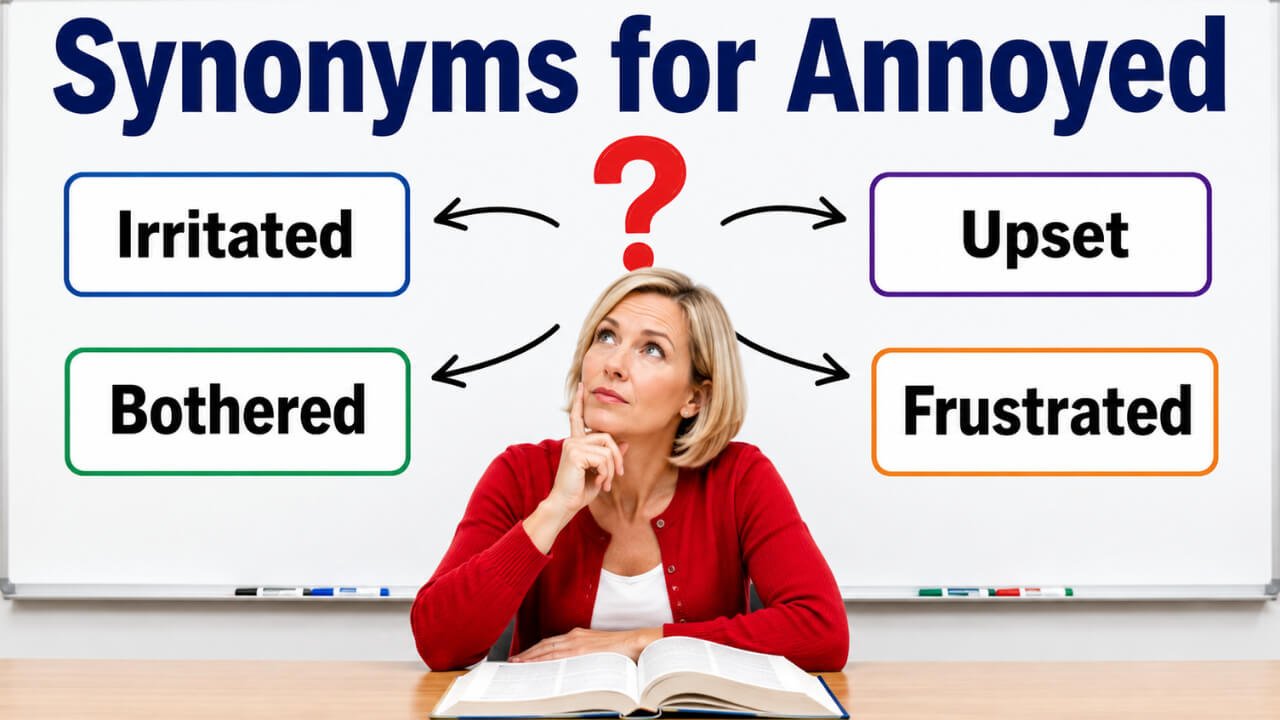
Quick Answer: The best synonyms for annoyed include irritated, bothered, frustrated, displeased, aggravated, exasperated, irked, vexed, peeved, and upset. Irritated is the strongest general replacement for mild annoyance. Frustrated works when a problem prevents progress, while exasperated describes annoyance caused by repeated difficulties. Displeased is suitable for formal or polite writing. Peeved, miffed, and irked sound more conversational. Aggravated and angry express stronger emotions than annoyed.
Pronunciation and Word Details
Word: Annoyed
Pronunciation: /əˈnɔɪd/
Part of Speech: Adjective
Meaning: Slightly angry, irritated, or bothered by a person, action, problem, or situation.
US Pronunciation:
UK Pronunciation:
What Does “Annoyed” Mean?
Annoyed means feeling slightly angry, impatient, or irritated because something is unpleasant, repetitive, inconvenient, or unwanted. It is mainly used as an adjective.
The word usually describes a moderate emotional reaction. Someone who is annoyed is unhappy about something, but the feeling may not be as intense as anger or rage.
Annoyed can appear with several prepositions depending on the cause of the feeling.
Annoyed With: Usually refers to a person.
Example: She was annoyed with her brother for borrowing her notes.
Annoyed By: Introduces an irritating action, sound, habit, or situation.
Example: He became annoyed by the constant noise.
Annoyed At: Refers to an action, event, or situation.
Example: They were annoyed at the unexpected delay.
Annoyed About: Introduces the subject causing concern or irritation.
Example: I was annoyed about the sudden change in plans.
The word can describe a temporary feeling, an obvious reaction, or a repeated emotional state.
Meaning, Tone, and Context of “Annoyed”
Annoyed has a neutral and conversational tone. It is common in everyday speech, personal writing, workplace communication, stories, and informal descriptions.
The word is emotional but not extremely strong. It usually communicates mild or moderate anger. This makes it useful when angry sounds too intense.
In polite or professional writing, displeased, dissatisfied, or concerned may sound more controlled. In casual conversation, bothered, irritated, peeved, or fed up may feel more natural.
Annoyed can also describe someone’s expression, voice, behavior, or reaction.
Expression: She gave him an annoyed look.
Voice: His annoyed tone made the problem obvious.
Behavior: The annoyed customer asked to speak with the manager.
Reaction: He appeared annoyed when the meeting started late.
The exact meaning depends on what caused the emotion and how strongly the person reacted.
When and How to Use “Annoyed”
For Mild Irritation
Use annoyed when something causes a small but noticeable amount of anger or discomfort.
Example: I was annoyed by the dripping tap.
For Repeated Problems
Use annoyed when the same problem continues and gradually becomes irritating.
Example: She became annoyed after receiving the same incorrect answer three times.
For Personal Frustration
Use annoyed when someone’s behavior causes impatience or dissatisfaction.
Example: He was annoyed with his friend for arriving late again.
For Inconvenience
Use annoyed when an unexpected problem interrupts plans or creates extra work.
Example: We were annoyed that the appointment had been canceled without notice.
For Unwanted Noise or Distraction
Use annoyed when sounds, interruptions, or movements make concentration difficult.
Example: The students were annoyed by the construction noise outside.
For Polite Disagreement
Use annoyed when describing dissatisfaction without suggesting extreme anger.
Example: The client seemed annoyed by the lack of clear information.
For Written Narratives
Use annoyed to show a character’s emotional response without making the reaction too dramatic.
Example: Annoyed by the interruption, Maya closed the door and continued reading.
Best Synonyms for Annoyed
Irritated
Synonym: Feeling mildly angry or uncomfortable because of something unpleasant.
Example: She felt irritated by the repeated interruptions.
Bothered
Synonym: Feeling disturbed, worried, or slightly annoyed.
Example: He seemed bothered by the loud conversation.
Frustrated
Synonym: Feeling annoyed because progress is blocked or a goal cannot be achieved.
Example: The team became frustrated by the confusing instructions.
Displeased
Synonym: Feeling dissatisfied or unhappy, especially in polite or formal situations.
Example: The manager was displeased with the final results.
Aggravated
Synonym: Made more irritated or angry by a problem.
Example: She became aggravated when the computer stopped working again.
Exasperated
Synonym: Extremely annoyed because of repeated problems or foolish behavior.
Example: His parents were exasperated by his constant excuses.
Irked
Synonym: Slightly angered or irritated by something.
Example: The unnecessary comment irked her.
Vexed
Synonym: Annoyed, worried, or troubled by a difficult issue.
Example: He looked vexed by the complicated question.
Peeved
Synonym: Informally annoyed or offended by something minor.
Example: She was peeved that no one had informed her.
Upset
Synonym: Emotionally disturbed, unhappy, or annoyed.
Example: He was upset about the careless mistake.
50 Synonyms for Annoyed with Short Meanings
- Irritated: Mildly angered or made uncomfortable.
- Bothered: Disturbed or made uneasy.
- Frustrated: Annoyed because progress is blocked.
- Displeased: Unhappy or dissatisfied with something.
- Aggravated: Made increasingly irritated or angry.
- Exasperated: Strongly annoyed by repeated problems.
- Irked: Slightly angered or irritated.
- Vexed: Annoyed, worried, or troubled.
- Peeved: Informally annoyed about something minor.
- Upset: Emotionally disturbed or unhappy.
- Impatient: Annoyed by waiting or delay.
- Resentful: Annoyed because of unfair treatment.
- Offended: Annoyed or hurt by disrespectful behavior.
- Disturbed: Emotionally unsettled or bothered.
- Inconvenienced: Annoyed because plans were made more difficult.
- Dissatisfied: Unhappy because expectations were not met.
- Disgruntled: Unhappy and annoyed about unfair conditions.
- Discontented: Not satisfied with a situation.
- Cross: Slightly angry or annoyed.
- Grumpy: Easily annoyed and in a bad mood.
- Grouchy: Irritable and likely to complain.
- Cranky: Easily upset or annoyed.
- Testy: Easily irritated and impatient.
- Touchy: Easily annoyed or offended.
- Snappy: Speaking sharply because of irritation.
- Edgy: Tense, nervous, or easily annoyed.
- Tense: Unable to relax because of stress or irritation.
- Agitated: Emotionally disturbed and unable to remain calm.
- Perturbed: Worried, unsettled, or annoyed.
- Nettled: Provoked into irritation.
- Chafed: Annoyed by restrictions or repeated discomfort.
- Rankled: Continued to cause annoyance or resentment.
- Provoked: Made angry or irritated by an action.
- Angered: Caused to feel anger.
- Riled: Made upset, excited, or angry.
- Incensed: Made extremely angry.
- Infuriated: Made intensely angry.
- Outraged: Shocked and angered by something unacceptable.
- Indignant: Angry because of unfair or insulting treatment.
- Bitter: Angry and resentful over past treatment.
- Hostile: Unfriendly because of anger or annoyance.
- Fed Up: Tired and annoyed after enduring too much.
- Sick of It: Extremely tired of an unpleasant situation.
- Put Out: Slightly annoyed or inconvenienced.
- Miffed: Somewhat annoyed or offended.
- Bugged: Informally irritated or bothered.
- Steamed: Informally very angry or annoyed.
- Sore: Annoyed or resentful about something.
- Tired Of: Annoyed because something has continued too long.
- Weary Of: Tired and irritated by a repeated experience.
Read Also:
Synonyms for Discuss
Synonyms for Annoyed by Context
When Annoyed Means Mildly Irritated
Irritated, bothered, irked, peeved, miffed, and put out describe mild annoyance. These words work well when the problem is unpleasant but not serious.
Example: She was mildly irritated by the slow service.
Example: He felt put out when the meeting time changed.
When Annoyed Means Frustrated
Frustrated, aggravated, exasperated, fed up, and tired of describe annoyance caused by repeated difficulties or blocked progress.
Example: The designer felt frustrated because the file would not open.
Example: We were fed up with receiving incomplete information.
When Annoyed Means Displeased
Displeased, dissatisfied, disgruntled, and discontented are useful when someone is unhappy with a result, decision, product, or service.
Example: The supervisor was displeased with the unfinished report.
Example: Several customers were dissatisfied with the response.
When Annoyed Means Offended
Offended, resentful, indignant, sore, and bitter describe annoyance connected to disrespect, unfairness, or hurt feelings.
Example: She was offended by the rude remark.
Example: He felt resentful after being excluded from the discussion.
When Annoyed Means Impatient
Impatient, testy, snappy, cranky, cross, and grouchy describe annoyance that affects someone’s mood or behavior.
Example: The long delay made everyone impatient.
Example: He sounded snappy after a stressful morning.
When Annoyed Means Very Angry
Angered, riled, incensed, infuriated, and outraged express stronger emotions than annoyed.
Example: Residents were outraged by the unfair decision.
Example: She was infuriated by the repeated dishonesty.
When Annoyed Is Used in Casual Speech
Peeved, miffed, bugged, steamed, fed up, and sick of it are conversational choices.
Example: I was a little peeved that they forgot my request.
Example: She was sick of dealing with the same problem.
When Annoyed Is Used in Formal Writing
Displeased, dissatisfied, perturbed, frustrated, and concerned are more suitable for reports, essays, formal messages, and professional communication.
Example: The committee was dissatisfied with the lack of evidence.
Example: Staff members were perturbed by the sudden policy change.
Another Word for Annoyed
Irritated is usually the best single replacement for annoyed because both words describe mild or moderate anger caused by an unpleasant person, action, sound, or situation. However, the best alternative depends on the reason and strength of the emotion.
Original: She was annoyed by the constant tapping.
Better Option: She was irritated by the constant tapping.
Original: He was annoyed because the application kept closing.
Better Option: He was frustrated because the application kept closing.
Original: The director was annoyed with the poor results.
Better Option: The director was displeased with the poor results.
Original: They were annoyed by his repeated excuses.
Better Option: They were exasperated by his repeated excuses.
When Not to Use “Annoyed”
Annoyed can sound vague when the exact cause or strength of the emotion matters. A more precise synonym often creates a clearer sentence.
Do not use annoyed when the person is experiencing extreme anger. Infuriated, outraged, or incensed may communicate the intensity more accurately.
Weak: The community was annoyed by the serious injustice.
Better: The community was outraged by the serious injustice.
Avoid annoyed when the real feeling is disappointment rather than irritation.
Weak: She was annoyed that she did not receive the position.
Better: She was disappointed that she did not receive the position.
In professional communication, annoyed may sound emotional or confrontational. Concerned, dissatisfied, or displeased may be more appropriate.
Weak: We are annoyed with the quality of the submitted work.
Better: We are dissatisfied with the quality of the submitted work.
Avoid repeating annoyed several times in one paragraph.
Weak: He was annoyed by the delay, annoyed by the noise, and annoyed by the lack of information.
Better: He was irritated by the delay, bothered by the noise, and frustrated by the lack of information.
Do not use annoyed when the emotion results specifically from blocked progress.
Weak: She was annoyed because she could not complete the task.
Better: She was frustrated because she could not complete the task.
Words Commonly Confused With Annoyed
Annoyed vs Angry: Annoyed usually describes mild or moderate irritation, while angry describes a stronger emotional reaction.
Annoyed vs Irritated: These words are often interchangeable. Irritated may also describe physical discomfort, such as irritated skin or eyes.
Annoyed vs Frustrated: Annoyed describes general irritation. Frustrated specifically describes irritation caused by difficulty, failure, or blocked progress.
Annoyed vs Upset: Annoyed focuses on irritation, while upset can include sadness, worry, disappointment, or emotional distress.
Annoyed vs Offended: Annoyed may result from any unpleasant experience. Offended usually involves hurt feelings, disrespect, or an insulting action.
Annoyed vs Exasperated: Annoyed can describe a small irritation. Exasperated expresses stronger annoyance caused by repeated problems.
Annoyed vs Disappointed: Annoyed involves irritation. Disappointed describes sadness because an expectation was not fulfilled.
Annoyed vs Impatient: Annoyed is a broad feeling. Impatient specifically describes irritation caused by waiting, delay, or slow progress.
Which Synonym Should You Choose?
Choose irritated when describing mild anger caused by an unpleasant sound, action, habit, or interruption.
Choose bothered when the feeling includes discomfort, worry, or emotional uneasiness.
Choose frustrated when someone cannot make progress, solve a problem, or reach a goal.
Choose displeased for formal writing, workplace messages, reports, reviews, and polite criticism.
Choose exasperated when repeated mistakes, excuses, or difficulties have caused strong annoyance.
Choose irked when describing a small but noticeable irritation in clear written English.
Choose peeved or miffed in casual conversation when the problem is minor.
Choose impatient when waiting, delay, or slow behavior causes the irritation.
Choose offended when disrespectful words or actions have hurt someone’s feelings.
Choose resentful when the annoyance continues because someone feels unfairly treated.
Choose aggravated when an existing problem becomes more irritating.
Choose infuriated, incensed, or outraged only when the emotion is much stronger than ordinary annoyance.
Real Life Examples of “Annoyed” in Sentences
Original: I was annoyed by the loud music next door.
Better Option: I was irritated by the loud music next door.
Original: She became annoyed when the printer stopped working.
Better Option: She became frustrated when the printer stopped working.
Original: The manager was annoyed with the careless error.
Better Option: The manager was displeased with the careless error.
Original: He looked annoyed after waiting for an hour.
Better Option: He looked impatient after waiting for an hour.
Original: They were annoyed by the repeated questions.
Better Option: They were exasperated by the repeated questions.
Original: Maya was annoyed that nobody had informed her.
Better Option: Maya was peeved that nobody had informed her.
Original: The residents were annoyed by the sudden decision.
Better Option: The residents were upset by the sudden decision.
Original: I felt annoyed when he interrupted me.
Better Option: I felt irked when he interrupted me.
Original: She was annoyed about being treated unfairly.
Better Option: She was resentful about being treated unfairly.
Original: The customer sounded annoyed during the call.
Better Option: The customer sounded dissatisfied during the call.
Synonym Groups and Usage Differences
Mild Irritation Group
Irritated, bothered, irked, peeved, miffed, and put out describe relatively small annoyances. They are suitable for minor delays, distracting sounds, interruptions, and inconsiderate behavior.
Example: He was slightly miffed when his suggestion was ignored.
Repeated Frustration Group
Frustrated, aggravated, exasperated, fed up, tired of, and weary of describe irritation that develops over time. They often suggest that the same difficulty has happened more than once.
Example: She was exasperated by the repeated technical problems.
Mood and Behavior Group
Cross, grumpy, grouchy, cranky, testy, touchy, and snappy describe how annoyance affects someone’s mood, speech, or behavior.
Example: He became testy after several hours without a break.
Formal Dissatisfaction Group
Displeased, dissatisfied, disgruntled, discontented, and perturbed are useful in formal descriptions, workplace communication, reports, and polite complaints.
Example: Employees were dissatisfied with the unclear instructions.
Personal Offense Group
Offended, resentful, indignant, sore, and bitter describe irritation connected to disrespect, unfairness, exclusion, or hurt feelings.
Example: She felt indignant about the unfair accusation.
Strong Anger Group
Angered, riled, incensed, infuriated, outraged, and hostile express stronger reactions than annoyed. These choices should be used only when the situation causes serious anger.
Example: The dishonest explanation infuriated the entire group.
Tension Group
Edgy, tense, agitated, and disturbed combine annoyance with stress, nervousness, or emotional discomfort.
Example: Everyone became tense as the disagreement continued.
Antonyms of Annoyed
The opposite of annoyed depends on whether the intended meaning involves mood, satisfaction, patience, or emotional calm.
Calm: Free from anger, stress, or irritation.
Pleased: Happy or satisfied with something.
Delighted: Feeling great happiness or pleasure.
Satisfied: Content because expectations have been met.
Patient: Able to wait without becoming irritated.
Relaxed: Free from tension or emotional pressure.
Content: Peacefully happy with a situation.
Cheerful: Noticeably happy and positive.
Amused: Entertained rather than irritated.
Unbothered: Not worried, disturbed, or annoyed.
Tolerant: Willing to accept behavior or conditions without irritation.
Comfortable: Feeling physically or emotionally at ease.
Agreeable: Pleasant, cooperative, and easy to deal with.
Understanding: Patient and sympathetic toward another person.
Comparison Annoyed vs Related Words
Annoyed vs Irritated
Annoyed and irritated both describe mild anger. Irritated can sound slightly sharper and can also describe physical discomfort.
Example With Annoyed: She was annoyed by his repeated interruptions.
Example With Irritated: Her eyes became irritated by the smoke.
Annoyed vs Frustrated
Annoyed describes general irritation. Frustrated describes irritation caused by difficulty, failure, or a lack of progress.
Example With Annoyed: He was annoyed by the unnecessary noise.
Example With Frustrated: He was frustrated because he could not solve the problem.
Annoyed vs Angry
Annoyed is usually less intense than angry. Someone may feel annoyed by a minor inconvenience but angry about serious dishonesty or harm.
Example With Annoyed: I was annoyed that the bus arrived late.
Example With Angry: I was angry that someone had deliberately damaged my property.
Annoyed vs Upset
Annoyed mainly communicates irritation. Upset is broader and may include sadness, worry, shock, or disappointment.
Example With Annoyed: She was annoyed by the rude interruption.
Example With Upset: She was upset after hearing the disappointing news.
Annoyed vs Exasperated
Annoyed may result from a single problem. Exasperated usually suggests that a problem has continued or happened repeatedly.
Example With Annoyed: The teacher was annoyed by the whispering.
Example With Exasperated: The teacher was exasperated after asking the class to be quiet several times.
Annoyed vs Offended
Annoyed may come from inconvenience or irritation. Offended involves hurt feelings caused by disrespectful words or behavior.
Example With Annoyed: He was annoyed that the meeting began late.
Example With Offended: He was offended by the insulting comment.
Annoyed vs Displeased
Annoyed sounds more conversational and emotional. Displeased sounds more controlled, polite, and formal.
Example With Annoyed: The customer was annoyed by the delay.
Example With Displeased: The customer was displeased with the quality of the service.
Common Phrases and Expressions With Annoyed
Mildly Annoyed: Feeling a small amount of irritation.
Clearly Annoyed: Showing irritation in an obvious way.
Visibly Annoyed: Displaying annoyance through facial expressions or behavior.
Deeply Annoyed: Feeling a strong degree of irritation.
Annoyed With Someone: Irritated by a particular person.
Annoyed By Something: Irritated because of an action, sound, habit, or situation.
Annoyed At Something: Unhappy about an event, action, or result.
Annoyed About Something: Irritated regarding a particular subject or situation.
Get Annoyed: Begin to feel irritated.
Become Annoyed: Gradually develop a feeling of irritation.
Sound Annoyed: Speak in a tone that communicates irritation.
Look Annoyed: Show irritation through facial expression or body language.
Easily Annoyed: Likely to become irritated quickly.
Increasingly Annoyed: Becoming more irritated over time.
Common Mistakes to Avoid
One common mistake is using annoyed for every negative emotion. Annoyance is different from sadness, disappointment, embarrassment, fear, and extreme anger. Select a word that identifies the actual feeling.
Another mistake is choosing a synonym that is too strong. Infuriated and outraged do not simply mean slightly annoyed. They communicate intense anger.
Writers may also confuse annoyed and frustrated. Use frustrated when difficulty or blocked progress causes the emotion.
Unclear: She was annoyed because the task was impossible to complete.
Clearer: She was frustrated because the task was impossible to complete.
Use suitable prepositions after annoyed.
Annoyed With: Commonly used for a person.
Correct: I was annoyed with my neighbor.
Annoyed By: Commonly used for a repeated action, sound, or condition.
Correct: I was annoyed by the constant barking.
Annoyed At: Commonly used for an action, event, or result.
Correct: She was annoyed at the sudden cancellation.
Annoyed About: Commonly used for a subject or situation.
Correct: He was annoyed about the change in schedule.
Avoid unnatural combinations such as annoyed from the noise. Annoyed by the noise is the natural construction.
Do not repeat very annoyed when a stronger and more exact synonym is available.
Repetitive: She was very annoyed by his repeated excuses.
Improved: She was exasperated by his repeated excuses.
Avoid using casual expressions such as bugged, peeved, or sick of it in highly formal reports unless the conversational tone is intentional.
Conclusion
The most useful synonyms for annoyed include irritated, bothered, frustrated, displeased, aggravated, exasperated, irked, and peeved. Irritated is the best general replacement, while frustrated suits blocked progress and exasperated describes repeated problems. Displeased works well in formal communication, and peeved or miffed fits casual speech. Stronger words such as infuriated and outraged should be reserved for serious anger. Choosing among synonyms for annoyed according to tone, cause, and intensity makes writing clearer and more emotionally accurate.
FAQs About Synonyms for Annoyed
What Is the Best Synonym for Annoyed?
Irritated is the best general synonym because it expresses mild or moderate anger in many everyday contexts.
What Is a Formal Synonym for Annoyed?
Displeased, dissatisfied, perturbed, and frustrated are suitable choices for formal or professional writing.
What Is a Casual Word for Annoyed?
Peeved, miffed, bugged, cross, and fed up are common conversational alternatives.
Is Frustrated the Same as Annoyed?
Not exactly. Frustrated describes annoyance caused by difficulty, failure, or blocked progress. Annoyed has a broader meaning.
Is Angry Stronger Than Annoyed?
Yes. Annoyed normally describes mild or moderate irritation, while angry communicates a stronger emotional reaction.
What Word Means Extremely Annoyed?
Exasperated, infuriated, incensed, and outraged can describe strong annoyance or anger. The correct choice depends on the cause and intensity.
Can Annoyed Be Used in Formal Writing?
Yes, but displeased, dissatisfied, concerned, or perturbed may sound more controlled and professional in formal communication.
