
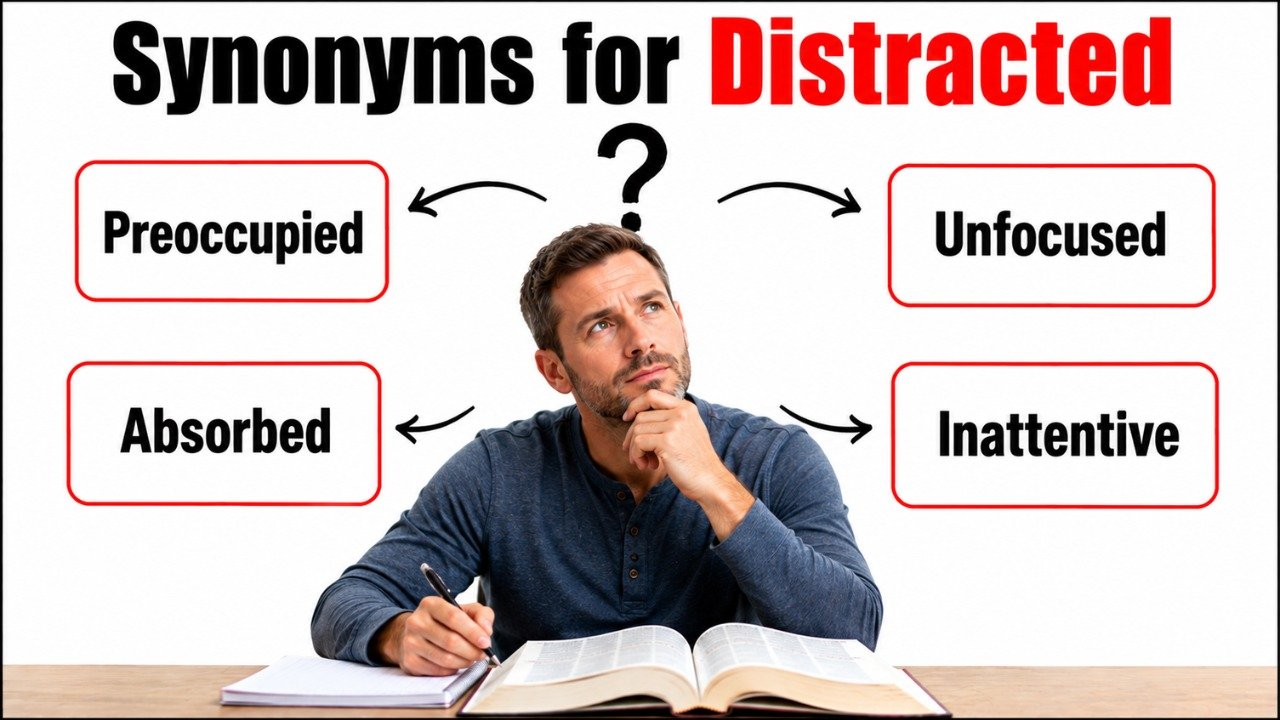
Quick Answer: The best synonyms for distracted include unfocused, inattentive, preoccupied, absentminded, sidetracked, scattered, diverted, restless, daydreaming, and disengaged. Use unfocused when someone cannot concentrate, inattentive when someone fails to notice important details, and preoccupied when thoughts about another matter occupy the mind. Sidetracked works well when an interruption changes someone’s direction, while absentminded describes forgetfulness caused by a lack of attention. Scattered suggests disorganized thinking, and diverted emphasizes attention being drawn elsewhere.
Pronunciation and Word Details
Word: Distracted.
Pronunciation: /dɪˈstræk.tɪd/.
Part of Speech: Adjective.
Meaning: Unable to give full attention because the mind is focused on something else.
US Pronunciation:
UK Pronunciation:
What Does “Distracted” Mean?
Distracted means unable to concentrate fully because something else has captured your attention, thoughts, or emotions.
The word is mainly used as an adjective. It describes a person whose attention has moved away from the task, conversation, activity, or situation that should receive focus.
Someone may become distracted by noise, movement, messages, worries, memories, hunger, tiredness, or another responsibility. The distraction may come from the surrounding environment or from thoughts inside the person’s mind.
Physical interruption: A loud sound may leave a student distracted during a lesson.
Mental preoccupation: Personal worries may make an employee distracted at work.
Emotional disturbance: Shocking news may cause someone to appear distracted and unsettled.
Temporary loss of focus: A person can become distracted for only a few seconds before returning attention to the original task.
Distracted can also be the past participle form of distract.
Example: The flashing light distracted the driver.
In that sentence, distracted functions as part of the verb. In “The driver seemed distracted,” it functions as an adjective describing the driver’s mental state.
Meaning, Tone, and Context of “Distracted”
Distracted is a common and generally neutral word. It can be used in formal writing, casual speech, workplace communication, educational settings, reports, and everyday conversations.
The tone depends on the situation.
Neutral tone: The word can simply describe a temporary lack of concentration.
Example: She looked distracted during the meeting.
Concerned tone: It may suggest that someone is worried, upset, or mentally occupied.
Example: He has seemed distracted since receiving the news.
Critical tone: It can express disapproval when someone should be paying closer attention.
Example: The distracted employee missed several important instructions.
Safety related tone: The word becomes more serious when lack of attention may cause harm.
Example: Distracted driving can place everyone on the road at risk.
Academic context: Teachers may use distracted to describe students who are not concentrating on lessons or assignments.
Professional context: Managers may use it to describe reduced attention, missed details, or poor engagement during work.
Conversational context: People often use distracted when explaining forgetfulness, delayed responses, or difficulty listening.
Emotional context: Distracted can also describe a person whose thoughts are controlled by worry, grief, excitement, or another strong feeling.
When and How to Use “Distracted”
For Loss of Concentration
Use distracted when someone cannot maintain attention on a task.
Example: I became distracted while reading the final chapter.
For Environmental Interruptions
Use distracted when sounds, movement, conversations, or nearby activity interrupt concentration.
Example: The children were distracted by the construction noise outside.
For Mental Preoccupation
Use distracted when someone is thinking deeply about another issue.
Example: She appeared distracted because she was worried about the interview.
For Missed Information
Use distracted when a person fails to hear, notice, or remember something because attention was elsewhere.
Example: He was distracted and missed the announcement.
For Changes in Direction
Use distracted when someone moves away from an original goal or subject.
Example: The discussion became distracted by an unrelated complaint.
For Emotional Disturbance
Use distracted when strong emotions make clear thinking difficult.
Example: He was too distracted by the upsetting news to complete the report.
For Casual Explanations
Use distracted when apologizing for forgetfulness or poor attention.
Example: Sorry, I was distracted and did not hear your question.
For Safety Warnings
Use distracted when lack of attention creates danger.
Example: A distracted pedestrian may fail to notice approaching traffic.
Best Synonyms for Distracted
Unfocused
Synonym: Unable to direct attention clearly toward one task or goal.
Example: Her thoughts were unfocused after a long and tiring day.
Inattentive
Synonym: Not giving enough attention to what is happening.
Example: The inattentive listener missed the most important instruction.
Preoccupied
Synonym: Thinking deeply about another matter.
Example: He seemed preoccupied with the financial problem.
Absentminded
Synonym: Forgetful or unaware because the mind is focused elsewhere.
Example: In an absentminded moment, she left her notebook at home.
Sidetracked
Synonym: Diverted from the original subject, task, or goal.
Example: We became sidetracked by a discussion about future plans.
Scattered
Synonym: Unable to organize thoughts or concentrate effectively.
Example: I felt scattered and struggled to complete simple tasks.
Diverted
Synonym: Drawn away from the original direction or focus.
Example: His attention was diverted by movement near the window.
Daydreaming
Synonym: Thinking about pleasant or imagined situations instead of the present activity.
Example: The student was daydreaming instead of completing the exercise.
Disengaged
Synonym: Mentally or emotionally disconnected from an activity.
Example: Several participants appeared disengaged during the discussion.
Restless
Synonym: Unable to remain calm or focused because of discomfort or impatience.
Example: The restless audience found it difficult to concentrate.
50 Synonyms for Distracted with Short Meanings
- Unfocused: Unable to concentrate clearly.
- Inattentive: Not giving enough attention.
- Preoccupied: Deeply concerned with another matter.
- Absentminded: Forgetful because attention is elsewhere.
- Sidetracked: Diverted from the original task.
- Diverted: Directed toward something different.
- Scattered: Mentally disorganized and unfocused.
- Daydreaming: Thinking about imagined situations.
- Disengaged: Mentally disconnected from an activity.
- Restless: Unable to remain calm and attentive.
- Forgetful: Likely to overlook or fail to remember things.
- Dreamy: Lost in pleasant or imaginative thoughts.
- Abstracted: Mentally removed from present surroundings.
- Distrait: Deeply preoccupied and unable to concentrate.
- Scatterbrained: Disorganized, forgetful, and easily distracted.
- Unobservant: Failing to notice what is happening.
- Heedless: Not paying proper attention to warnings or details.
- Unmindful: Not consciously aware of something important.
- Oblivious: Completely unaware of surrounding events.
- Wandering: Moving mentally from one thought to another.
- Lost in thought: Deeply occupied with private thoughts.
- Mentally elsewhere: Thinking about something unrelated to the present situation.
- Off task: Not concentrating on the required activity.
- Unable to concentrate: Having difficulty maintaining attention.
- Interrupted: Prevented from continuing attention or activity.
- Absorbed: Deeply focused on something other than the present matter.
- Engrossed: Giving complete attention to another subject.
- Occupied: Having the mind filled with another concern.
- Wrapped up: Fully involved in another thought or activity.
- Concerned: Mentally occupied by an important issue.
- Worried: Troubled by anxious thoughts.
- Troubled: Mentally affected by problems or concerns.
- Bothered: Unable to relax or focus because of irritation.
- Disturbed: Emotionally affected and unable to think calmly.
- Unsettled: Not mentally calm, certain, or comfortable.
- Agitated: Nervous or emotionally disturbed.
- Flustered: Confused and nervous because of pressure.
- Rattled: Shaken and temporarily unable to think clearly.
- Nervous: Anxious and unable to remain fully focused.
- Tense: Mentally strained and unable to relax.
- Confused: Unable to think or understand clearly.
- Disoriented: Unsure of the situation, direction, or surroundings.
- Dazed: Unable to think clearly because of shock or surprise.
- Bewildered: Completely confused by a situation.
- Bemused: Confused or deeply occupied in thought.
- Fidgety: Restless and unable to remain still or attentive.
- Flighty: Easily excited and unable to maintain steady attention.
- Distractible: Easily drawn away from a task or subject.
- Careless: Not giving enough attention to accuracy or detail.
- Detached: Mentally or emotionally separated from the present situation.
Read Also:
Synonyms for Multifaceted

Synonyms for Distracted by Context
When Distracted Means Unable to Concentrate
The strongest alternatives are unfocused, inattentive, scattered, distractible, restless, and off task.
Example With Distracted: The student was distracted during the explanation.
Example With Unfocused: The student was unfocused during the explanation.
Unfocused emphasizes weak concentration. Inattentive suggests that the person is not noticing or listening carefully. Scattered suggests disorganized thinking.
When Distracted Means Thinking About Something Else
Use preoccupied, absentminded, abstracted, dreamy, lost in thought, or mentally elsewhere.
Example With Distracted: She seemed distracted throughout dinner.
Example With Preoccupied: She seemed preoccupied throughout dinner.
Preoccupied is especially useful when another concern is filling someone’s mind. Lost in thought is more descriptive and conversational.
When Distracted Means Diverted From a Task
Use sidetracked, diverted, interrupted, or drawn away.
Example With Distracted: We were distracted from the main purpose of the meeting.
Example With Sidetracked: We were sidetracked from the main purpose of the meeting.
Sidetracked often describes moving toward an unrelated subject. Interrupted emphasizes that an outside event stopped attention or progress.
When Distracted Means Emotionally Troubled
Use worried, troubled, disturbed, unsettled, agitated, bothered, or rattled.
Example With Distracted: He appeared distracted after hearing the news.
Example With Troubled: He appeared troubled after hearing the news.
Troubled clearly communicates emotional concern. Rattled suggests a sudden emotional shock that temporarily affects clear thinking.
When Distracted Means Unaware
Use oblivious, unobservant, heedless, unmindful, or inattentive.
Example With Distracted: She was distracted and did not notice the open door.
Example With Unobservant: She was unobservant and did not notice the open door.
Oblivious is stronger because it suggests complete unawareness. Unobservant simply indicates failure to notice something.
When Distracted Means Mentally Disconnected
Use disengaged, detached, absentminded, or mentally elsewhere.
Example With Distracted: The audience looked distracted during the presentation.
Example With Disengaged: The audience looked disengaged during the presentation.
Disengaged suggests a lack of interest or emotional involvement, while distracted may only describe a temporary interruption.
Another Word for Distracted
The best single replacement for distracted is often unfocused. It clearly communicates that someone is having difficulty concentrating without suggesting a specific cause.
However, the best alternative depends on why the person is distracted. Preoccupied is better when thoughts or worries occupy the mind. Sidetracked is better when someone moves away from a task. Inattentive is more suitable when a person fails to listen or notice details.
Original: I felt distracted while preparing the report.
Better Option: I felt unfocused while preparing the report.
Original: She was distracted by thoughts about the examination.
Better Option: She was preoccupied with thoughts about the examination.
Original: Our conversation became distracted by an unrelated question.
Better Option: Our conversation became sidetracked by an unrelated question.
Original: The distracted employee overlooked the final instruction.
Better Option: The inattentive employee overlooked the final instruction.
When Not to Use “Distracted”
Distracted is useful, but it may sound too general when the exact reason for someone’s lack of attention matters.
When You Mean Worried
Use worried, troubled, or preoccupied when emotional concern is the main cause.
Weak: She seemed distracted about her father’s condition.
Better: She seemed worried about her father’s condition.
When You Mean Uninterested
Distracted does not always mean bored or uninterested. Use disengaged or uninterested when a person has mentally withdrawn from an activity.
Weak: The audience was distracted because the speech felt repetitive.
Better: The audience was disengaged because the speech felt repetitive.
When You Mean Interrupted
Use interrupted when an outside event clearly stops a task.
Weak: His work was distracted by a telephone call.
Better: His work was interrupted by a telephone call.
When You Mean Confused
Use confused when the problem is a lack of understanding rather than a lack of attention.
Weak: I was distracted by the complicated instructions.
Better: I was confused by the complicated instructions.
When You Mean Diverted
Use diverted when attention is deliberately or clearly redirected.
Weak: Her attention was distracted toward the entrance.
Better: Her attention was diverted toward the entrance.
When Repetition Makes Writing Weak
Repeating distracted several times can make a paragraph sound vague and monotonous.
Weak: He was distracted at breakfast, distracted during work, and distracted during the meeting.
Better: He was absentminded at breakfast, unfocused during work, and preoccupied throughout the meeting.
Words Commonly Confused With Distracted
Distracted vs Unfocused: Distracted often suggests that something has pulled attention away. Unfocused simply means that concentration is weak or unclear.
Distracted vs Inattentive: Distracted may be temporary and caused by an interruption. Inattentive often describes a broader failure to listen, observe, or notice details.
Distracted vs Preoccupied: Distracted describes reduced attention. Preoccupied explains that another thought, concern, or responsibility is occupying the mind.
Distracted vs Absentminded: Distracted refers to attention being drawn elsewhere. Absentminded often includes forgetfulness or failure to notice ordinary things.
Distracted vs Sidetracked: Distracted focuses on attention. Sidetracked emphasizes movement away from an original task, goal, or subject.
Distracted vs Confused: Distracted means unable to focus. Confused means unable to understand or organize information clearly.
Distracted vs Disengaged: Distracted may still involve interest in the activity. Disengaged suggests mental or emotional withdrawal.
Distracted vs Restless: Distracted describes divided attention. Restless describes difficulty remaining calm, comfortable, or still.
Distracted vs Disturbed: Distracted is usually neutral. Disturbed often suggests stronger emotional discomfort or concern.
Which Synonym Should You Choose?
Choose unfocused when someone is struggling to concentrate on a task, plan, or goal.
Choose inattentive when someone fails to listen carefully, notice details, or follow instructions.
Choose preoccupied when a worry, responsibility, memory, or important thought occupies someone’s mind.
Choose absentminded when poor attention leads to forgetfulness or small mistakes.
Choose sidetracked when a discussion, project, or activity moves away from its original purpose.
Choose scattered when thoughts feel disorganized and completing tasks becomes difficult.
Choose diverted when attention is clearly redirected by another person, event, sound, or object.
Choose daydreaming when someone is thinking about imagined or pleasant situations instead of the present task.
Choose disengaged when a person appears mentally or emotionally disconnected from an activity.
Choose troubled when emotional problems are affecting concentration.
Choose confused when the person does not understand the information.
Choose restless when physical discomfort, impatience, or excess energy prevents concentration.
Choose unfocused in essays, reports, and professional writing when you need a neutral description.
Choose preoccupied in emails or conversations when you want to explain that another concern was occupying your thoughts.
Choose sidetracked in casual speech when describing an interruption or change of subject.
Choose inattentive in formal evaluations when someone repeatedly overlooks instructions or details.
Real Life Examples of “Distracted” in Sentences
Original: I was distracted during the lecture and missed an important point.
Better Option: I was inattentive during the lecture and missed an important point.
Original: She looked distracted because she was thinking about the interview.
Better Option: She looked preoccupied because she was thinking about the interview.
Original: The team became distracted by an unrelated issue.
Better Option: The team became sidetracked by an unrelated issue.
Original: He felt distracted and could not organize his thoughts.
Better Option: He felt scattered and could not organize his thoughts.
Original: The child was distracted by the birds outside the window.
Better Option: The child’s attention was diverted by the birds outside the window.
Original: I have been distracted all morning and have completed very little.
Better Option: I have been unfocused all morning and have completed very little.
Original: She was distracted and forgot where she had placed the keys.
Better Option: She was absentminded and forgot where she had placed the keys.
Original: The participants appeared distracted during the final discussion.
Better Option: The participants appeared disengaged during the final discussion.
Original: He seemed distracted after receiving the unexpected message.
Better Option: He seemed unsettled after receiving the unexpected message.
Original: The student was distracted and stared out of the window.
Better Option: The student was daydreaming and stared out of the window.
Synonym Groups and Usage Differences
Concentration Group
Unfocused, inattentive, distractible, scattered, and off task describe difficulty maintaining attention.
Unfocused is neutral and broad. Inattentive often suggests that someone should have paid more attention. Distractible describes a tendency to lose focus easily.
Example: The unfocused writer struggled to complete the final paragraph.
Mental Preoccupation Group
Preoccupied, abstracted, lost in thought, occupied, and wrapped up describe attention being controlled by another thought or concern.
Preoccupied is the most versatile option. Abstracted is more formal, while lost in thought is more conversational and descriptive.
Example: She was preoccupied with preparations for the interview.
Forgetfulness Group
Absentminded, forgetful, scatterbrained, and unmindful describe poor awareness that may lead to mistakes or forgotten responsibilities.
Absentminded is usually gentler than careless. Scatterbrained is informal and may sound critical.
Example: His absentminded behavior caused him to leave the documents at home.
Diversion Group
Sidetracked, diverted, interrupted, and drawn away describe attention moving from one subject or task to another.
Sidetracked often refers to a change in direction. Interrupted focuses on an outside event that stops progress.
Example: The discussion was sidetracked by questions about an unrelated project.
Emotional Disturbance Group
Worried, troubled, disturbed, unsettled, rattled, and agitated describe concentration affected by strong emotions.
Troubled suggests continuing concern. Rattled often describes a sudden event that temporarily affects confidence or clear thinking.
Example: He appeared rattled after the unexpected announcement.
Awareness Group
Oblivious, unobservant, heedless, and inattentive describe failure to notice people, details, warnings, or surroundings.
Oblivious is the strongest word because it suggests complete unawareness.
Example: She was oblivious to the conversation taking place behind her.
Disconnection Group
Disengaged, detached, and mentally elsewhere describe a person who is not fully involved in the present activity.
Disengaged may suggest lost interest. Detached can indicate emotional distance rather than simple distraction.
Example: The employee seemed disengaged during the planning session.
Antonyms of Distracted
The opposite of distracted depends on whether the word refers to concentration, awareness, organization, or emotional control.
Focused: Giving full attention to one task or goal.
Attentive: Listening, watching, or noticing carefully.
Concentrated: Directing mental effort toward a specific activity.
Alert: Fully aware of what is happening.
Observant: Quick to notice details and changes.
Engaged: Actively interested and involved.
Absorbed: Completely involved in the intended activity.
Mindful: Consciously aware of actions, thoughts, and surroundings.
Organized: Able to arrange thoughts and tasks clearly.
Calm: Free from emotional disturbance or agitation.
Composed: Mentally controlled and emotionally steady.
Present: Giving full mental attention to the current moment.
Intent: Showing determined and serious attention.
Watchful: Carefully observing possible changes or risks.
Undivided: Giving complete attention without interruption.
Comparison of Distracted and Related Words
Distracted vs Unfocused
Distracted usually suggests that something specific has pulled attention away. Unfocused describes a general inability to concentrate, even when no clear interruption exists.
Example With Distracted: I became distracted when people began talking nearby.
Example With Unfocused: I felt unfocused after sleeping poorly.
Distracted vs Preoccupied
Distracted describes the result, which is reduced attention. Preoccupied identifies the cause, which is usually another thought, concern, or responsibility.
Example With Distracted: She appeared distracted during the conversation.
Example With Preoccupied: She was preoccupied with concerns about her examination.
Distracted vs Inattentive
Distracted may describe a brief interruption. Inattentive often suggests ongoing carelessness or failure to listen properly.
Example With Distracted: He became distracted when the door opened.
Example With Inattentive: He was inattentive and repeatedly missed key instructions.
Distracted vs Absentminded
Distracted describes attention moving elsewhere. Absentminded commonly describes forgetfulness caused by internal thoughts.
Example With Distracted: The music made her distracted while studying.
Example With Absentminded: In an absentminded moment, she placed the book in the wrong drawer.
Distracted vs Sidetracked
Distracted relates to concentration, while sidetracked relates to changing direction or leaving the original subject.
Example With Distracted: The noise distracted me during the task.
Example With Sidetracked: An unrelated question sidetracked the discussion.
Distracted vs Disengaged
A distracted person may still care about the activity but struggle to concentrate. A disengaged person may have lost interest or emotional involvement.
Example With Distracted: The student was distracted by activity in the hallway.
Example With Disengaged: The student became disengaged because the lesson felt repetitive.
Distracted vs Confused
Distracted means attention is divided. Confused means understanding is unclear.
Example With Distracted: I was distracted and did not hear the final instruction.
Example With Confused: I heard the instruction but remained confused about its meaning.
Distracted vs Restless
Distracted focuses on attention, while restless focuses on discomfort, impatience, or an inability to remain still.
Example With Distracted: She was distracted by the conversation behind her.
Example With Restless: She became restless after sitting for several hours.
Common Phrases and Expressions With Distracted
Easily Distracted: Likely to lose concentration quickly.
Visibly Distracted: Clearly showing signs of poor concentration.
Mentally Distracted: Unable to focus because thoughts are elsewhere.
Emotionally Distracted: Unable to concentrate because of strong feelings.
Distracted by Noise: Unable to focus because of surrounding sounds.
Distracted From Work: Drawn away from a professional task.
Too Distracted to Listen: Unable to pay proper attention to what someone is saying.
Distracted Attention: Focus that has moved away from the intended subject.
Distracted Mind: A mental state filled with competing thoughts.
Constantly Distracted: Repeatedly unable to maintain concentration.
Common Mistakes to Avoid
Using Distracted When You Mean Confused
Distracted concerns attention, while confused concerns understanding.
Incorrect: I was distracted by the meaning of the instructions.
Correct: I was confused by the meaning of the instructions.
Using Distracted With the Wrong Preposition
Use distracted by for the cause of the distraction. Use distracted from for the activity that loses attention.
Correct: She was distracted by the noise.
Correct: She was distracted from her work.
Repeating Distracted Too Often
Repeated use can make writing sound vague. Replace it with a more precise synonym when the cause or effect is clear.
Repetitive: He was distracted during breakfast and distracted during the meeting.
Improved: He was absentminded during breakfast and unfocused during the meeting.
Choosing a Synonym With the Wrong Meaning
Preoccupied does not simply mean careless. Disengaged does not always mean distracted. Confused does not mean inattentive.
Choose a synonym according to the reason for the lack of focus.
Using Distracted for Deliberate Avoidance
Distracted normally describes an unplanned loss of attention. Use avoiding, ignoring, or refusing to engage when the behavior is deliberate.
Weak: He was distracted from answering the question.
Better: He avoided answering the question.
Confusing Distracted and Distracting
Distracted describes the person whose attention has been affected. Distracting describes the thing that causes the loss of attention.
Distracted: The student was distracted.
Distracting: The loud music was distracting.
Using Distracted Too Vaguely
Explain the cause when it helps the reader understand the situation.
Vague: She was distracted.
Clearer: She was distracted by concerns about the upcoming examination.
Using Overly Formal Synonyms in Casual Writing
Words such as distrait and abstracted may sound unnatural in ordinary conversation. Use preoccupied, unfocused, or absentminded unless the writing requires a formal or literary tone.
Conclusion
The most useful synonyms for distracted include unfocused, inattentive, preoccupied, absentminded, sidetracked, scattered, diverted, and disengaged. Unfocused is the best general choice for weak concentration, while preoccupied explains that another concern is occupying the mind. Use sidetracked when attention moves away from a goal, and inattentive when someone fails to notice details. Understanding these differences will help you choose more precise language and use synonyms for distracted naturally in essays, reports, emails, and everyday conversations.
FAQs About Synonyms for Distracted
What Is the Best Synonym for Distracted?
Unfocused is the best general synonym. It clearly describes a person who is having difficulty concentrating.
What Is a Formal Synonym for Distracted?
Preoccupied, inattentive, abstracted, and diverted are suitable for formal writing. The best choice depends on the reason attention was lost.
What Is a Casual Synonym for Distracted?
Sidetracked, scattered, daydreaming, and mentally elsewhere are natural choices in casual conversation.
Is Preoccupied the Same as Distracted?
Not exactly. Preoccupied means another thought or concern is occupying the mind, while distracted more generally means attention has been pulled away.
Is Distracted the Same as Unfocused?
They are closely related. Distracted often suggests a particular interruption, while unfocused can describe a general lack of concentration.
What Is the Opposite of Distracted?
Common opposites include focused, attentive, alert, engaged, mindful, observant, and concentrated.
Can Distracted Describe Emotions?
Yes. A person may appear distracted because of worry, grief, excitement, stress, or another strong emotion that makes concentration difficult.
