
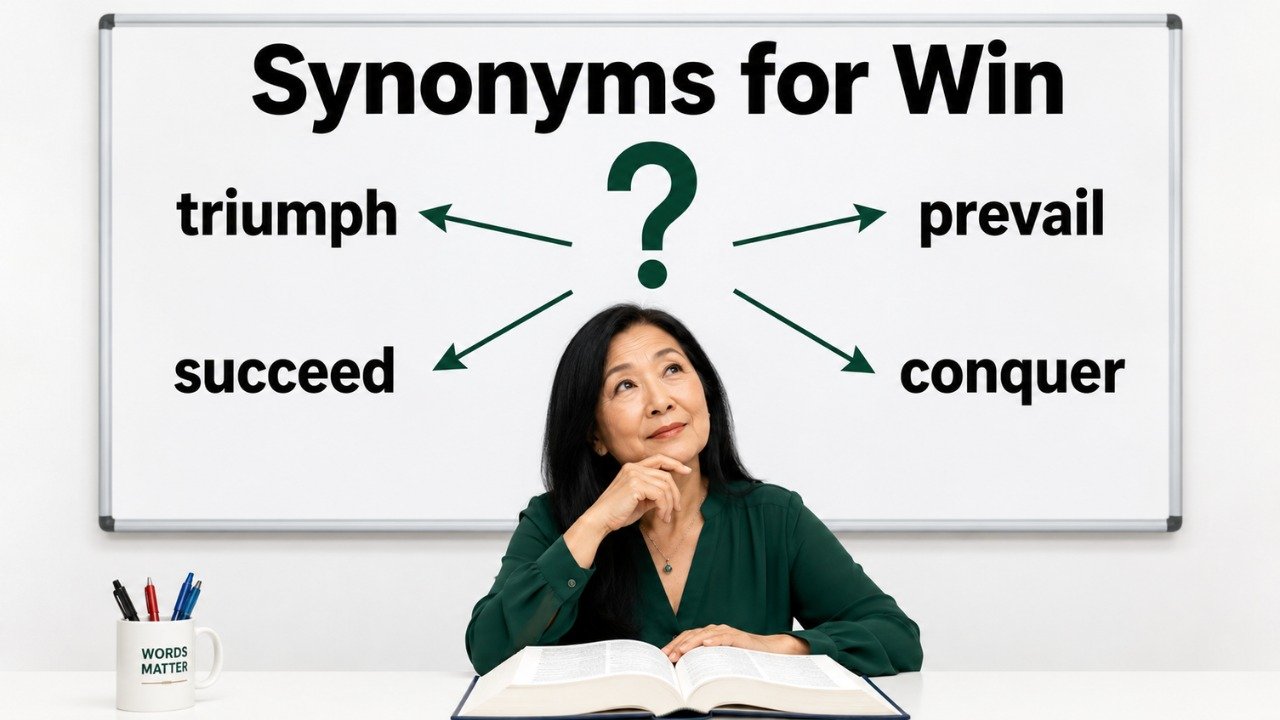
Quick Answer: The best synonyms for win include triumph, prevail, succeed, conquer, defeat, overcome, secure, gain, achieve, and clinch. Use triumph or prevail when describing victory in a competition or difficult struggle. Succeed and achieve work well for goals, careers, projects, and formal writing. Defeat and beat are useful when an opponent is involved. Secure, gain, and clinch fit prizes, contracts, positions, or advantages. In casual conversation, beat and win are common, while prevail, secure, and achieve often sound more polished in professional or academic contexts.
Pronunciation and Word Details
Word: Win
Pronunciation: /wɪn/
Part of Speech: Verb and noun
Meaning: To succeed in a competition, achieve a desired result, gain something through effort, or receive victory.
US Pronunciation:
UK Pronunciation:
What Does “Win” Mean?
Win means to succeed in a competition, achieve a desired result, or obtain something valuable through effort, skill, chance, or persuasion.
As a verb, win commonly describes defeating competitors or becoming successful. A team can win a game, a runner can win a race, and a candidate can win a contest. Someone can also win an award, win approval, win support, or win an opportunity.
As a noun, a win means a successful result or victory. For example, a team may celebrate an important win after a difficult competition.
The exact meaning depends on the sentence. In competitive situations, win usually means finishing ahead of others. In personal or professional situations, it can mean achieving a goal. When something valuable is involved, win can mean receiving or securing it.
Meaning, Tone, and Context of “Win”
Win is a common, neutral, and versatile word. It appears naturally in casual conversation, journalism, business communication, academic discussion, sports writing, and everyday speech.
In conversation, win sounds simple and direct. Someone might say that they hope to win a game, win a prize, or win an argument.
In formal writing, more specific alternatives may sometimes communicate the meaning better. Succeed works well when discussing goals. Achieve suits accomplishments and measurable results. Prevail fits struggles, disputes, and difficult situations. Secure is useful when something valuable is obtained.
Win can also carry a positive and energetic tone because it suggests success, progress, advantage, or victory. However, the strength of the word depends on context. Winning a major competition sounds significant, while winning a small game may simply describe an ordinary result.
The noun form is especially common when referring to a successful outcome. A win can describe a victory, achievement, favorable result, or useful advantage.
When and How to Use “Win”
For Competition: Use win when someone or something finishes ahead of competitors.
Example: Our team hopes to win the final match.
For Races: Win is appropriate when a person finishes first in a race or similar contest.
Example: She trained every morning because she wanted to win the race.
For Prizes: Use win when someone receives a prize through competition, selection, or chance.
Example: He was excited to win the writing contest.
For Achievement: Win can describe reaching an important result after effort.
Example: The group worked together to win approval for the proposal.
For Persuasion: Win can describe gaining another person’s trust, support, affection, or agreement.
Example: Her clear explanation helped win the audience’s support.
For Business: Win can refer to securing a contract, customer, opportunity, or competitive advantage.
Example: The company hoped to win the contract through a strong proposal.
For Arguments: Win may describe successfully defending a position or convincing others.
Example: He used clear evidence to win the debate.
For Challenges: Win can describe overcoming opposition or difficulty.
Example: Persistence helped her win a difficult battle against stronger competitors.
As a Noun: Use a win to describe a successful result.
Example: Completing the project ahead of schedule was a major win for the team.
Best Synonyms for Win
Triumph: To achieve an impressive or important victory.
Example: The young athlete triumphed after months of demanding training.
Prevail: To succeed after difficulty, opposition, or struggle.
Example: Patience eventually prevailed during the difficult negotiations.
Succeed: To achieve a desired goal or result.
Example: She succeeded in completing the challenging assignment.
Conquer: To overcome an opponent, challenge, fear, or difficulty.
Example: He worked hard to conquer every obstacle in his path.
Defeat: To win against a person, team, or opposing force.
Example: The home team defeated its strongest rival.
Overcome: To successfully deal with a difficulty or obstacle.
Example: She overcame several setbacks and completed the project.
Secure: To successfully obtain something valuable or desired.
Example: The organization secured an important agreement.
Gain: To obtain an advantage, benefit, position, or support.
Example: The proposal gained widespread approval.
Achieve: To successfully reach a goal through effort.
Example: The students achieved excellent results through consistent practice.
Clinch: To finally secure a victory, deal, position, or result.
Example: The final goal helped the team clinch the championship.
50 Synonyms for Win with Short Meanings
- Triumph: Achieve an important victory.
- Prevail: Succeed despite opposition or difficulty.
- Succeed: Accomplish a desired goal.
- Conquer: Overcome an opponent or challenge.
- Defeat: Beat an opponent in competition.
- Overcome: Successfully deal with an obstacle.
- Vanquish: Defeat someone completely.
- Beat: Win against another person or team.
- Outdo: Perform better than someone else.
- Surpass: Exceed another person’s performance or standard.
- Excel: Perform extremely well.
- Dominate: Control a competition through superior performance.
- Secure: Successfully obtain something desired.
- Gain: Obtain something useful or valuable.
- Obtain: Successfully get something.
- Acquire: Come into possession of something.
- Earn: Gain something through effort or achievement.
- Achieve: Reach a desired result.
- Attain: Successfully reach a goal or position.
- Capture: Gain possession of a prize, title, or position.
- Claim: Gain or take something deserved or awarded.
- Clinch: Make a victory or result certain.
- Take: Gain a prize, title, or position.
- Land: Successfully obtain an opportunity or reward.
- Garner: Gain support, recognition, or attention.
- Score: Gain a point, success, advantage, or opportunity.
- Carry: Win support, approval, or a decision.
- Sweep: Win every part of a series or contest.
- Edge Out: Defeat someone by a small margin.
- Outscore: Score more points than an opponent.
- Outplay: Perform better than an opponent during a game.
- Outmatch: Prove superior to an opponent.
- Best: Defeat or outperform someone.
- Top: Finish ahead of competitors.
- Finish First: End a competition in the leading position.
- Come First: Take the highest position in a competition.
- Place First: Finish in the top position.
- Emerge Victorious: Finish a struggle or contest as the winner.
- Take the Prize: Become the recipient of a prize.
- Take First Place: Finish ahead of all competitors.
- Gain Victory: Achieve a successful competitive result.
- Achieve Victory: Successfully reach a winning outcome.
- Secure Victory: Make a successful result certain.
- Carry Off: Successfully win a prize or distinction.
- Walk Away With: Win or obtain something successfully.
- Take Home: Win and receive a prize or award.
- Wrest: Gain something through determined effort or struggle.
- Victory: A successful result in a contest or struggle.
- Success: Achievement of a desired outcome.
- Conquest: A victory achieved by overcoming resistance.
Read Also:
Synonyms for Assistance

Synonyms for Win by Context
When Win Means Defeat an Opponent
When win refers to competition, the best alternatives usually emphasize victory over another person or team.
Beat: Directly defeat an opponent.
Example: Our team beat the visitors in the final game.
Defeat: Overcome an opponent, especially in formal writing.
Example: The champion defeated a highly skilled challenger.
Vanquish: Defeat an opponent completely or dramatically.
Example: The hero finally vanquished his strongest rival.
Outplay: Perform better than an opponent.
Example: The younger team outplayed its experienced competitors.
Outscore: Gain more points than another participant.
Example: The players outscored their opponents during the second half.
When Win Means Achieve Success
Win can describe reaching a goal even when no direct opponent exists.
Succeed: Reach the intended result.
Example: She succeeded after several attempts.
Achieve: Reach a goal through effort.
Example: The group achieved its main objective.
Attain: Reach a desired level, position, or goal.
Example: He attained the highest level of performance.
Triumph: Achieve a major or emotionally meaningful success.
Example: The team triumphed despite difficult conditions.
Prevail: Succeed after resistance or difficulty.
Example: Common sense eventually prevailed.
When Win Means Obtain Something
Win may refer to gaining a prize, opportunity, contract, title, or advantage.
Secure: Successfully obtain something important.
Example: She secured a place in the final round.
Land: Obtain something desirable, especially an opportunity.
Example: He landed the position after a strong interview.
Claim: Gain a title, prize, or recognized position.
Example: The runner claimed first place.
Capture: Successfully gain a title or prize.
Example: The team captured the regional championship.
Earn: Receive something because of effort or ability.
Example: Her performance earned widespread praise.
When Win Means Gain Support
Win can also describe persuading people or gaining their trust, approval, or support.
Persuade: Cause someone to accept an idea or take an action.
Example: His explanation persuaded the committee to reconsider.
Convince: Cause someone to believe or accept something.
Example: The evidence convinced the audience.
Gain: Obtain support, trust, or approval.
Example: The proposal gained strong public support.
Attract: Bring interest or support toward something.
Example: The campaign attracted many new supporters.
When Win Means Finish First
For races, rankings, and competitions, several alternatives focus specifically on position.
Finish First: End in the highest position.
Example: She finished first in the final race.
Come First: Reach the top position.
Example: Their team came first in the competition.
Place First: Receive the highest ranking.
Example: He placed first in his category.
Top: Finish ahead of others.
Example: She topped the final rankings.
Another Word for Win
A strong general replacement for win is succeed, especially when the sentence describes reaching a goal rather than defeating an opponent. However, the best alternative depends on the exact meaning.
Use triumph for an impressive victory, prevail for success after difficulty, defeat when an opponent is involved, and secure when something valuable is obtained.
Original: She hopes to win in her new career.
Better Option: She hopes to succeed in her new career.
Original: The team managed to win despite several setbacks.
Better Option: The team managed to prevail despite several setbacks.
Original: They hope to win the contract.
Better Option: They hope to secure the contract.
Original: The champion won against a strong opponent.
Better Option: The champion defeated a strong opponent.
When Not to Use “Win”
Win is useful, but it is not always the most precise choice. Replacing it with a more specific verb can make writing clearer and more professional.
Avoid win when the sentence is really about achieving a goal rather than competing against someone.
Weak: She wants to win at completing the research project.
Better: She wants to succeed in completing the research project.
Win can also sound vague when the exact reward or result can be described more clearly.
Weak: The organization won an agreement from the committee.
Better: The organization secured an agreement from the committee.
Avoid using win repeatedly in nearby sentences.
Weak: The team wanted to win the game, win the championship, and win recognition.
Better: The team wanted to win the game, capture the championship, and earn recognition.
Do not use win when earn better reflects effort or merit.
Weak: She won the respect of her colleagues through years of reliable work.
Better: She earned the respect of her colleagues through years of reliable work.
Win may also be less natural when describing a personal skill or ability.
Weak: He won the ability to communicate clearly.
Better: He developed the ability to communicate clearly.
Words Commonly Confused With Win
Win vs Beat: Win usually takes the competition, prize, or result as its object, while beat usually takes the opponent. You win a game, but you beat another team.
Win vs Victory: Win can be a verb or noun, while victory is a noun describing the successful result itself.
Win vs Succeed: Win often suggests competition, while succeed has a broader meaning and can describe reaching any goal.
Win vs Earn: Win may depend on competition or chance, while earn usually suggests receiving something because of effort, merit, or work.
Win vs Gain: Win often involves success in competition, while gain means obtaining something such as knowledge, support, experience, or an advantage.
Win vs Achieve: Win often focuses on a successful outcome against competition, while achieve emphasizes reaching a planned goal.
Win vs Prevail: Win is more general. Prevail often suggests succeeding after resistance, disagreement, or difficulty.
Win vs Defeat: Win focuses on the successful result, while defeat focuses directly on overcoming an opponent.
Which Synonym Should You Choose?
Choose triumph when the victory is important, impressive, or emotionally powerful.
Choose prevail when someone succeeds after difficulty, opposition, or disagreement.
Choose succeed when describing goals, careers, projects, education, or personal development.
Choose achieve when discussing measurable goals, results, objectives, or accomplishments.
Choose defeat when a person, team, or group directly overcomes an opponent.
Choose beat in casual speech when talking about games, contests, scores, or competitors.
Choose secure when someone obtains a contract, position, agreement, advantage, or opportunity.
Choose clinch when a final action makes a victory, title, agreement, or result certain.
Choose earn when the result comes mainly through effort, performance, or merit.
Choose gain when describing support, knowledge, approval, influence, experience, or an advantage.
For essays and reports, achieve, prevail, secure, succeed, and defeat often provide greater precision than repeatedly using win.
For professional emails, secure, achieve, obtain, and succeed can sound polished when they accurately match the intended meaning.
For casual conversation, win and beat are usually natural and easy to understand.
Real Life Examples of “Win” in Sentences
Original: Our team hopes to win the championship this season.
Better Option: Our team hopes to capture the championship this season.
Original: She worked hard to win the competition.
Better Option: She worked hard to triumph in the competition.
Original: He hopes to win the respect of his coworkers.
Better Option: He hopes to earn the respect of his coworkers.
Original: The group managed to win approval for the plan.
Better Option: The group managed to secure approval for the plan.
Original: She wants to win in her chosen profession.
Better Option: She wants to succeed in her chosen profession.
Original: Their team won against a difficult opponent.
Better Option: Their team defeated a difficult opponent.
Original: Careful preparation helped them win the debate.
Better Option: Careful preparation helped them prevail in the debate.
Original: The athlete hopes to win first place.
Better Option: The athlete hopes to claim first place.
Original: The project won considerable support from the community.
Better Option: The project gained considerable support from the community.
Original: The final point allowed the team to win the title.
Better Option: The final point allowed the team to clinch the title.
Synonym Groups and Usage Differences
Competition Group
This group includes beat, defeat, vanquish, outplay, outscore, outmatch, and best. These words work when a clear opponent exists.
Beat is common and conversational. Defeat sounds more formal. Outplay focuses on skill, while outscore focuses specifically on points.
Example: The visiting team outplayed its opponent throughout the match.
Success Group
This group includes succeed, achieve, triumph, prevail, attain, and excel.
Succeed is broad and neutral. Achieve focuses on reaching a goal. Triumph suggests a significant victory. Prevail suggests success despite difficulty.
Example: After several unsuccessful attempts, she finally succeeded.
Acquisition Group
This group includes secure, gain, obtain, acquire, claim, capture, land, and clinch.
These words are useful when win means getting something valuable rather than simply defeating someone.
Example: The organization secured enough support to continue the project.
Reward Group
This group includes earn, claim, take home, carry off, and take the prize.
Earn emphasizes merit or effort, while claim and take home emphasize receiving a prize or title.
Example: Her excellent performance earned the highest award.
First Place Group
This group includes finish first, come first, place first, top, and emerge victorious.
These expressions clearly communicate the final position in a contest or ranking.
Example: She finished first among more than fifty competitors.
Persuasion Group
This group includes persuade, convince, attract, gain, and secure when win refers to support or approval.
These alternatives are especially useful when the goal involves changing opinions or gaining trust.
Example: The detailed explanation convinced several undecided members.
Victory Noun Group
Victory, success, triumph, and conquest can replace the noun form of win in appropriate contexts.
Victory focuses on defeating opposition. Success is broader. Triumph often suggests an especially satisfying result.
Example: Completing the difficult challenge was a significant triumph.
Antonyms of Win
The opposite of win depends on whether win refers to competition, achievement, acquisition, or persuasion.
Lose: Fail to win a competition or keep something.
Fail: Be unsuccessful in reaching a goal.
Surrender: Stop resisting and accept defeat.
Yield: Give way to another person or force.
Forfeit: Lose something because of a mistake, rule, or decision.
Miss: Fail to obtain an opportunity or desired result.
Fall Short: Fail to reach the required goal or standard.
Be Defeated: Lose to an opponent.
Relinquish: Give up possession, control, or a position.
Give Up: Stop trying to achieve a goal.
Reject: Refuse to give approval or acceptance.
Lose Support: Experience a reduction in approval or backing.
Comparison: Win vs Related Words
Win vs Triumph
Win is the broader and more common term. Triumph usually describes an impressive, difficult, or emotionally meaningful victory.
Example With Win: The team won the final game.
Example With Triumph: The team triumphed after overcoming a difficult start.
Win vs Prevail
Win can describe almost any successful competition or result. Prevail usually suggests success after resistance, struggle, disagreement, or difficulty.
Example With Win: She hopes to win the contest.
Example With Prevail: Her argument eventually prevailed after a long discussion.
Win vs Succeed
Win often involves competition, while succeed describes reaching a desired goal whether or not competitors are involved.
Example With Win: He wants to win the race.
Example With Succeed: He wants to succeed in his new career.
Win vs Beat
Win normally refers to a contest, prize, or result. Beat normally refers to the opponent.
Example With Win: They won the match.
Example With Beat: They beat the strongest team in the tournament.
Win vs Defeat
Win emphasizes the successful result. Defeat emphasizes overcoming a specific opponent.
Example With Win: She won the final competition.
Example With Defeat: She defeated the defending champion.
Win vs Achieve
Win often has a competitive meaning, while achieve focuses on successfully reaching a goal.
Example With Win: The team hopes to win the tournament.
Example With Achieve: The team hopes to achieve its performance goals.
Win vs Earn
Win may result from competition, skill, or chance. Earn usually suggests that effort, merit, or work produced the result.
Example With Win: She won the prize in the contest.
Example With Earn: She earned the promotion through excellent performance.
Win vs Secure
Win is general, while secure emphasizes successfully obtaining something important.
Example With Win: They hope to win the contract.
Example With Secure: They hope to secure the contract.
Win vs Gain
Win often implies success or competition. Gain simply means obtaining something useful, valuable, or beneficial.
Example With Win: The speaker hoped to win the audience’s support.
Example With Gain: The speaker hoped to gain the audience’s support.
Common Phrases and Expressions With “Win”
Win a Game: Finish a game as the successful player or team.
Win a Race: Finish ahead of the other competitors.
Win a Prize: Receive a reward through a contest or selection.
Win an Award: Receive formal recognition for achievement.
Win a Championship: Become the overall champion of a competition.
Win Support: Gain approval or backing from others.
Win Approval: Successfully gain acceptance for an idea or action.
Win Someone Over: Persuade someone to support, trust, or like you.
Win the Day: Ultimately succeed in a difficult situation.
Win Hands Down: Win very easily or clearly.
Common Mistakes to Avoid
One common mistake is confusing win with beat. You normally win a game, competition, prize, race, or championship, but you beat an opponent.
Incorrect: Our team won the other team.
Correct: Our team beat the other team.
Another common mistake is using the wrong past tense. The past tense and past participle of win is won.
Incorrect: She winned the race yesterday.
Correct: She won the race yesterday.
Avoid repeating win excessively when more precise alternatives are available.
Repetitive: She won the race, won the trophy, and won the admiration of the crowd.
Improved: She won the race, claimed the trophy, and earned the admiration of the crowd.
Do not assume that every synonym fits every context. Defeat needs an opponent, achieve usually needs a goal or result, and secure normally refers to obtaining something.
Be careful when using win with people. Saying win a person can sound unnatural when the intended meaning is persuasion.
Unnatural: She tried to win the manager.
Natural: She tried to win the manager over.
Avoid vague use of win in formal writing when a more exact verb can communicate what happened.
Vague: The organization won several important things during the negotiations.
Better: The organization secured several important concessions during the negotiations.
Remember that win can function as both a verb and a noun.
Verb Example: The team hopes to win.
Noun Example: The result was an important win for the team.
Conclusion
The best synonyms for win depend on what kind of success you want to describe. Triumph and prevail suit victories after difficulty, while beat and defeat work when an opponent is involved. Succeed and achieve are stronger choices for goals and accomplishments. Secure, claim, clinch, and gain are useful for prizes, opportunities, support, and advantages. Understanding these synonyms for win helps you choose clearer, more precise vocabulary for conversations, essays, reports, professional writing, and everyday situations.
FAQs About Synonyms for Win
What Is the Best Synonym for Win?
The best general alternatives are triumph, prevail, succeed, defeat, achieve, and secure. The strongest choice depends on whether the sentence describes competition, achievement, persuasion, or gaining something.
What Is a Formal Synonym for Win?
Prevail, triumph, succeed, achieve, secure, and attain can work as formal alternatives. Defeat is also useful when a specific opponent is involved.
What Is Another Word for Winning a Competition?
Triumph, prevail, defeat, finish first, come first, place first, and emerge victorious can describe winning a competition.
What Is Another Word for Win a Prize?
Claim, secure, capture, take home, carry off, and take the prize are useful alternatives when someone receives a prize or award.
What Is the Difference Between Win and Beat?
Win usually refers to the competition or result, while beat refers to the opponent. You win a race, but you beat another runner.
Can Succeed Be a Synonym for Win?
Yes. Succeed is a strong synonym when win means achieving a goal rather than defeating an opponent.
What Is the Opposite of Win?
Lose is the most common opposite. Other antonyms include fail, surrender, yield, forfeit, fall short, and be defeated, depending on the context.
