
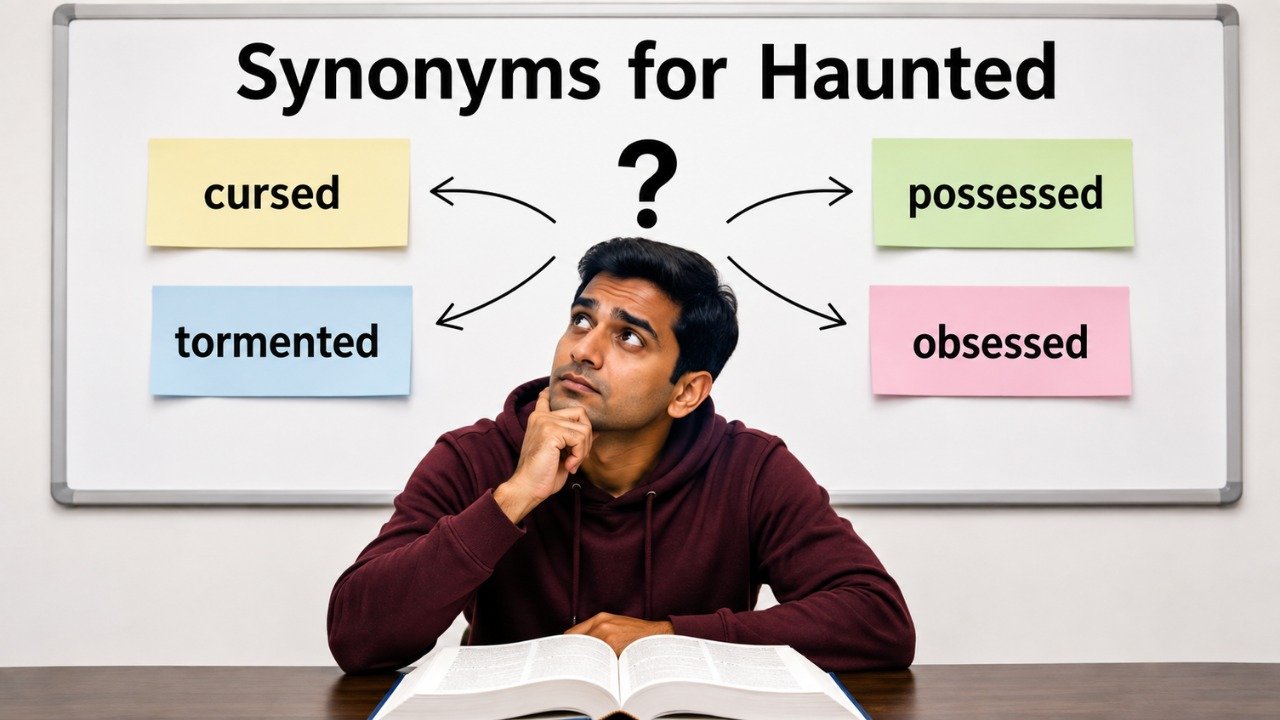
Quick Answer: The best synonyms for haunted include ghostly, possessed, cursed, eerie, spectral, troubled, tormented, plagued, shadowed, and obsessed. Use ghostly or spectral for places associated with spirits, possessed for supernatural control, eerie for a strange and frightening atmosphere, troubled for emotional pain, tormented for intense mental suffering, plagued for recurring problems, and shadowed for memories or fears that continue to affect someone.
Pronunciation and Word Details
Word: Haunted.
Pronunciation: /ˈhɔːntɪd/.
Part of Speech: Adjective and past participle.
Meaning: Inhabited or visited by spirits, or repeatedly troubled by painful memories, fears, thoughts, or regrets.
US Pronunciation:
UK Pronunciation:
What Does “Haunted” Mean?
Haunted means believed to be inhabited or regularly visited by a ghost or spirit. It can also describe a person who remains deeply troubled by a memory, fear, regret, or painful experience.
As an adjective, haunted often appears before a noun.
Example: They explored a haunted house at the edge of the village.
In this sentence, haunted suggests that people believe spirits are present in the house.
Haunted can also appear after a linking verb.
Example: The abandoned hotel was said to be haunted.
As the past participle of haunt, it commonly appears with the preposition by.
Example: He was haunted by memories of the accident.
Here, no ghost is involved. The word means that the memory repeatedly returned and caused emotional distress.
Haunted may describe places, people, expressions, dreams, memories, and atmospheres. Its exact meaning depends on whether the context is supernatural, emotional, or figurative.
Meaning, Tone, and Context of “Haunted”
Haunted usually has a dark, emotional, mysterious, or frightening tone. It is stronger than words such as worried or sad because it suggests that something keeps returning and is difficult to escape.
Supernatural Context: Haunted describes a place believed to contain ghosts, spirits, or unexplained activity.
Example: The old theater was rumored to be haunted.
Emotional Context: Haunted describes someone who cannot stop thinking about a painful memory, mistake, loss, or fear.
Example: She remained haunted by the decision she had made.
Visual Context: Haunted can describe a person’s face or expression when it shows fear, sadness, exhaustion, or emotional suffering.
Example: His haunted eyes revealed how deeply the experience had affected him.
Literary Context: Haunted is common in fiction, poetry, descriptive writing, and storytelling because it creates mystery, tension, and emotional depth.
Example: A haunted silence settled over the empty street.
Formal Context: In reports, essays, or serious discussions, haunted may describe the lasting psychological effect of war, violence, loss, or trauma.
Example: The survivors were haunted by what they had witnessed.
Conversational Context: In everyday speech, haunted can be used dramatically to describe a disturbing memory or recurring thought.
Example: I am still haunted by that embarrassing mistake.
The word is usually emotional and vivid. It may sound too dramatic when the situation is minor, so writers should choose it carefully.
When and How to Use “Haunted”
For Places Associated With Ghosts
Use haunted for houses, castles, hotels, forests, roads, or other locations believed to contain spirits.
Example: Local stories describe the mansion as haunted.
For Painful Memories
Use haunted when a memory repeatedly returns and causes sadness, guilt, fear, or regret.
Example: He was haunted by memories of the final conversation.
For Guilt and Regret
Use haunted when someone cannot escape thoughts about a past mistake or harmful decision.
Example: The leader was haunted by the consequences of his choice.
For Fearful Expressions
Use haunted to describe eyes, faces, or voices that reveal deep emotional suffering.
Example: She had a haunted look after the frightening event.
For Repeated Thoughts
Use haunted when an idea, question, or image continues returning to someone’s mind.
Example: One unanswered question haunted him for years.
For Disturbing Dreams
Use haunted when frightening images or memories repeatedly appear during sleep.
Example: She was haunted by the same dream every night.
For Literary Atmosphere
Use haunted to create a mysterious, sorrowful, or unsettling mood in descriptive writing.
Example: The haunted landscape seemed filled with forgotten voices.
For Lasting Trauma
Use haunted in serious contexts when a painful experience continues affecting a person emotionally.
Example: Many witnesses remained haunted by the disaster.
Best Synonyms for Haunted
Ghostly
Synonym: Ghostly means resembling a ghost or connected with spirits and supernatural appearances.
Example: A ghostly figure appeared near the staircase.
Possessed
Synonym: Possessed means controlled or inhabited by a spirit or supernatural force.
Example: The villagers believed the object was possessed.
Cursed
Synonym: Cursed means affected by an evil force, harmful spell, or continuing misfortune.
Example: Legends claimed that the ruined castle was cursed.
Eerie
Synonym: Eerie means strange, mysterious, and frightening in a way that creates uneasiness.
Example: An eerie silence filled the abandoned building.
Spectral
Synonym: Spectral means ghostlike or related to a spirit or apparition.
Example: A spectral shape moved through the dark corridor.
Troubled
Synonym: Troubled means worried, distressed, or emotionally disturbed.
Example: He remained troubled by the memory of the argument.
Tormented
Synonym: Tormented means experiencing severe mental or emotional suffering.
Example: She was tormented by guilt after the incident.
Plagued
Synonym: Plagued means repeatedly troubled by an unpleasant problem, thought, or experience.
Example: The athlete was plagued by doubts before the competition.
Shadowed
Synonym: Shadowed means continually affected by something dark, painful, or threatening.
Example: His success was shadowed by memories of earlier failure.
Obsessed
Synonym: Obsessed means unable to stop thinking about a particular subject, person, or experience.
Example: The investigator became obsessed with the unsolved mystery.
50 Synonyms for Haunted with Short Meanings
- Ghostly: Resembling or connected with a ghost.
- Possessed: Controlled or inhabited by a spirit.
- Cursed: Affected by an evil force or continuing misfortune.
- Spectral: Having the appearance of a ghost.
- Eerie: Strange and frightening in a mysterious way.
- Spooky: Frightening because of a supernatural feeling.
- Supernatural: Beyond ordinary natural explanation.
- Phantomlike: Resembling a ghost or unreal figure.
- Otherworldly: Seeming to come from another world or realm.
- Uncanny: Strangely unfamiliar and difficult to explain.
- Sinister: Suggesting danger, evil, or harm.
- Ominous: Giving the impression that something bad may happen.
- Macabre: Disturbing because of death or horror.
- Creepy: Causing fear, discomfort, or uneasiness.
- Chilling: Causing strong fear or emotional shock.
- Frightening: Making someone feel afraid.
- Foreboding: Creating a sense of coming danger.
- Bewitched: Affected or controlled by magic.
- Enchanted: Influenced by magic or supernatural power.
- Accursed: Under a curse or associated with evil.
- Inhabited: Occupied by people, creatures, or spirits.
- Occupied: Containing or being used by a presence.
- Visited: Repeatedly entered or approached by someone or something.
- Frequented: Regularly visited by a person, animal, or spirit.
- Infested: Filled with unwanted or threatening beings.
- Troubled: Experiencing worry or emotional distress.
- Tormented: Suffering severe mental or emotional pain.
- Plagued: Repeatedly troubled by something unpleasant.
- Disturbed: Emotionally unsettled or mentally troubled.
- Distressed: Experiencing serious worry, sadness, or pain.
- Unsettled: Unable to feel calm, secure, or peaceful.
- Restless: Unable to relax because of worry or discomfort.
- Burdened: Carrying a heavy emotional concern.
- Oppressed: Weighed down by suffering or anxiety.
- Afflicted: Seriously affected by pain or difficulty.
- Beset: Surrounded or repeatedly troubled by problems.
- Dogged: Persistently followed by a problem or fear.
- Pursued: Continually followed by a thought, memory, or threat.
- Stalked: Followed persistently in a threatening way.
- Shadowed: Continuously affected by sadness, fear, or danger.
- Wracked: Experiencing intense emotional or physical suffering.
- Scarred: Marked emotionally by a painful experience.
- Traumatized: Deeply affected by a frightening or painful event.
- Obsessed: Unable to stop thinking about something.
- Preoccupied: Continually focused on a particular concern.
- Consumed: Completely controlled by a feeling or thought.
- Remorseful: Deeply sorry about a past action.
- Regretful: Feeling sadness about a past choice.
- Guilt ridden: Overwhelmed by guilt about something.
- Fearful: Filled with fear or anxiety.
Read Also:
Synonyms for Workshop

Synonyms for Haunted by Context
When Haunted Means Inhabited by Ghosts
The strongest choices are possessed, ghostly, spectral, cursed, accursed, and supernatural.
Possessed suggests that a spirit controls or occupies a person, object, or place. Ghostly and spectral describe an appearance or atmosphere rather than definite control. Cursed suggests that evil or misfortune affects the location.
Example With Possessed: The family believed the old mirror was possessed.
Example With Spectral: A spectral figure appeared beside the window.
Example With Cursed: Travelers avoided the cursed ruins after sunset.
When Haunted Means Strange and Frightening
Useful alternatives include eerie, spooky, creepy, uncanny, sinister, chilling, and ominous.
Eerie and uncanny emphasize unexplained strangeness. Spooky and creepy are more conversational. Sinister and ominous suggest danger or evil.
Example With Eerie: An eerie sound echoed through the empty station.
Example With Creepy: The narrow hallway felt creepy at night.
Example With Ominous: Ominous clouds gathered over the silent village.
When Haunted Means Troubled by Memories
Choose troubled, plagued, shadowed, burdened, disturbed, or preoccupied.
Troubled is broad and neutral. Plagued suggests that the memory returns repeatedly. Shadowed implies that the past continues darkening the present.
Example With Troubled: She was troubled by memories of the disagreement.
Example With Plagued: He was plagued by thoughts of what might have happened.
Example With Shadowed: Her childhood remained shadowed by the loss.
When Haunted Means Emotionally Tormented
The best alternatives are tormented, wracked, distressed, afflicted, oppressed, and consumed.
Tormented is intense and suggests continuing suffering. Wracked often appears with guilt, grief, pain, or doubt. Consumed means that the emotion takes over someone’s thoughts and behavior.
Example With Tormented: He was tormented by the harm his decision had caused.
Example With Wracked: She was wracked by guilt after the argument.
Example With Consumed: He became consumed by regret.
When Haunted Means Persistently Followed
Choose pursued, stalked, dogged, beset, or plagued.
These words suggest that a problem, fear, or memory continues following someone. Dogged is common in formal descriptions of recurring difficulties.
Example With Dogged: The project was dogged by financial problems.
Example With Pursued: She felt pursued by memories of the past.
Example With Beset: The administration was beset by repeated criticism.
When Haunted Describes a Face or Expression
Suitable alternatives include troubled, fearful, distressed, hollow, strained, and tormented.
These words describe visible signs of emotional pain. Troubled is softer, while tormented is much stronger.
Example With Troubled: A troubled expression crossed his face.
Example With Distressed: Her distressed eyes revealed her fear.
Example With Tormented: He wore the tormented look of someone unable to sleep.
Another Word for Haunted
The best general replacement for haunted depends on the meaning. For supernatural places, ghostly is a strong alternative. For emotional suffering, troubled is usually the clearest replacement. For intense suffering, tormented is more powerful.
Original: They entered a haunted house near the forest.
Better Option: They entered a ghostly house near the forest.
Original: She was haunted by memories of the accident.
Better Option: She was troubled by memories of the accident.
Original: He looked haunted after hearing the news.
Better Option: He looked deeply distressed after hearing the news.
Original: The town was haunted by stories of its violent past.
Better Option: The town was shadowed by stories of its violent past.
When Not to Use “Haunted”
Haunted is vivid and emotional, but it can be too dramatic, unclear, or repetitive in some sentences.
When You Mean Ordinary Worry
Do not use haunted for a small concern unless you intentionally want a dramatic tone.
Weak: I was haunted by the thought that I forgot to buy milk.
Better: I was worried that I had forgotten to buy milk.
When You Mean Accurate Psychological Language
In formal or clinical writing, a more precise term may be needed to describe anxiety, trauma, recurring memories, or emotional distress.
Weak: The patient was haunted after the event.
Better: The patient experienced recurring distressing memories after the event.
When No Supernatural Meaning Is Intended
Haunted may make a place sound occupied by ghosts when you only mean that it feels empty, old, or unpleasant.
Weak: The neglected office looked haunted.
Better: The neglected office looked abandoned and eerie.
When The Word Becomes Repetitive
Repeated use can weaken the mysterious or emotional effect.
Weak: The haunted man entered the haunted house with a haunted expression.
Better: The troubled man entered the ghostly house with a fearful expression.
When A More Precise Emotion Is Available
Use guilt ridden, regretful, fearful, grieving, or anxious when the specific emotion matters.
Weak: She felt haunted by her mistake.
Better: She felt deeply remorseful about her mistake.
When You Mean Physical Occupation
Haunted is inappropriate when a building is simply occupied by people or animals.
Weak: The warehouse was haunted by workers during the day.
Better: The warehouse was occupied by workers during the day.
Words Commonly Confused With Haunted
Haunted vs Ghostly: Haunted usually describes a place, person, or object affected by ghosts or disturbing memories. Ghostly describes something that resembles a ghost in appearance, sound, or atmosphere.
Haunted vs Possessed: Haunted suggests repeated supernatural activity or the presence of spirits. Possessed suggests direct control by a spirit or supernatural force.
Haunted vs Cursed: Haunted refers to ghosts or persistent emotional memories. Cursed refers to an evil spell, harmful fate, or continuing misfortune.
Haunted vs Eerie: Haunted suggests a supernatural presence or recurring emotional pain. Eerie describes an unsettling atmosphere without claiming that a ghost is present.
Haunted vs Spooky: Haunted can be serious, emotional, or supernatural. Spooky is more casual and usually describes something mildly frightening.
Haunted vs Troubled: Haunted suggests that something repeatedly returns to the mind. Troubled is broader and can describe any emotional worry or difficulty.
Haunted vs Traumatized: Haunted is descriptive and figurative. Traumatized specifically suggests a deep emotional response to a severely distressing event.
Haunted vs Obsessed: Haunted usually involves unwanted memories, fear, or regret. Obsessed means thinking constantly about something, which may be wanted or unwanted.
Which Synonym Should You Choose?
Choose ghostly when describing an appearance, sound, or atmosphere that resembles a ghost.
Choose possessed when a spirit or supernatural force is believed to control a person, place, or object.
Choose cursed when emphasizing evil influence, misfortune, or a harmful supernatural force.
Choose spectral in formal, literary, or descriptive writing about ghostlike forms.
Choose eerie when a place, sound, or situation feels strange and unsettling without definite proof of supernatural activity.
Choose spooky for casual speech about something mildly frightening or ghost related.
Choose sinister when the atmosphere suggests danger, evil, or harmful intentions.
Choose troubled when describing general emotional concern, sadness, or worry.
Choose tormented when someone experiences severe and continuing emotional pain.
Choose plagued when thoughts, fears, or problems return repeatedly.
Choose shadowed when a painful past continues affecting a person’s present life.
Choose distressed in reports, essays, or formal descriptions of visible emotional suffering.
Choose traumatized when referring precisely to deep emotional harm caused by a frightening or painful experience.
Choose obsessed when someone cannot stop thinking about a subject, mystery, person, or goal.
Choose guilt ridden when guilt is the exact emotion affecting someone.
Choose regretful or remorseful when sadness about a past decision is the main idea.
Real Life Examples of “Haunted” in Sentences
Original: The abandoned mansion was believed to be haunted.
Better Option: The abandoned mansion was believed to be possessed by restless spirits.
Original: She was haunted by memories of the fire.
Better Option: She was plagued by memories of the fire.
Original: His haunted expression worried his friends.
Better Option: His distressed expression worried his friends.
Original: The village remained haunted by its violent history.
Better Option: The village remained shadowed by its violent history.
Original: He was haunted by guilt after breaking his promise.
Better Option: He was tormented by guilt after breaking his promise.
Original: A haunted voice seemed to come from the attic.
Better Option: A ghostly voice seemed to come from the attic.
Original: The haunted road was empty after dark.
Better Option: The eerie road was empty after dark.
Original: She felt haunted by the possibility of failure.
Better Option: She felt consumed by the fear of failure.
Original: The soldier was haunted by what he had witnessed.
Better Option: The soldier was traumatized by what he had witnessed.
Original: The old theater had a haunted atmosphere.
Better Option: The old theater had a spooky and mysterious atmosphere.
Synonym Groups and Usage Differences
Supernatural Presence Group
Possessed, ghostly, spectral, supernatural, phantomlike, and otherworldly belong to this group.
These words describe spirits, apparitions, or unexplained supernatural activity. Possessed is the strongest because it suggests control. Spectral and ghostly focus more on appearance.
Example: A spectral figure moved through the supposedly possessed building.
Frightening Atmosphere Group
Eerie, spooky, creepy, uncanny, chilling, ominous, sinister, and foreboding belong to this group.
These words create fear or uneasiness. Eerie and uncanny suggest unexplained strangeness. Ominous and foreboding suggest that danger is approaching.
Example: An eerie silence gave the empty forest a foreboding atmosphere.
Emotional Suffering Group
Troubled, tormented, distressed, disturbed, wracked, afflicted, and burdened belong to this group.
These words describe mental or emotional pain. Troubled is moderate, while tormented and wracked express intense suffering.
Example: He was tormented by a burdened conscience.
Recurring Problem Group
Plagued, dogged, beset, pursued, stalked, and shadowed belong to this group.
These terms show that a difficulty keeps returning. Plagued is especially useful for recurring thoughts, illness, doubt, or failure.
Example: The team was dogged by mistakes and plagued by delays.
Memory and Trauma Group
Scarred, traumatized, regretful, remorseful, guilt ridden, and fearful belong to this group.
These words identify the emotional result of a painful experience. Traumatized is appropriate for serious emotional harm. Regretful and remorseful focus on sorrow about past actions.
Example: She remained remorseful and emotionally scarred by the event.
Mental Focus Group
Obsessed, preoccupied, and consumed belong to this group.
These words describe thoughts that dominate the mind. Obsessed can involve intense interest, while consumed suggests that an emotion or thought controls nearly everything.
Example: He became consumed by the mystery and obsessed with finding an answer.
Antonyms of Haunted
The opposite of haunted depends on whether the word describes a place, emotional state, memory, or atmosphere.
Peaceful: Calm and free from fear or disturbance.
Comforting: Producing reassurance, warmth, or emotional ease.
Cheerful: Bright, positive, and happy in mood.
Serene: Calm, quiet, and undisturbed.
Untroubled: Free from worry, guilt, or emotional pain.
Relaxed: Calm and free from tension.
Reassured: No longer worried or afraid.
Content: Satisfied and emotionally peaceful.
Joyful: Filled with happiness rather than fear or sorrow.
Ordinary: Normal and without supernatural qualities.
Natural: Explained by normal physical causes.
Blessed: Protected or favored rather than cursed.
Safe: Free from danger or threatening influence.
Vacant: Empty and not occupied by people or spirits.
Forgotten: No longer remembered or mentally disturbing.
Comparison: Haunted vs Related Words
Haunted vs Ghostly
Haunted describes a place, object, or person affected by spirits or recurring memories. Ghostly describes something that looks, sounds, or feels like a ghost.
Example With Haunted: The villagers avoided the haunted cottage.
Example With Ghostly: A ghostly light appeared behind the curtain.
Haunted vs Possessed
Haunted suggests the presence or repeated activity of spirits. Possessed suggests that a supernatural force has taken control.
Example With Haunted: The hotel was rumored to be haunted.
Example With Possessed: The characters believed the statue was possessed.
Haunted vs Cursed
Haunted is connected with spirits or memories. Cursed describes something affected by evil, misfortune, or a harmful supernatural power.
Example With Haunted: The haunted castle echoed with unexplained footsteps.
Example With Cursed: The cursed treasure brought misfortune to everyone who touched it.
Haunted vs Eerie
Haunted suggests a cause, such as a ghost or disturbing memory. Eerie describes the strange feeling created by a place, sound, or event.
Example With Haunted: They entered a haunted room.
Example With Eerie: An eerie whisper came from the empty room.
Haunted vs Spooky
Haunted may sound serious, dark, or emotionally intense. Spooky is more casual and often describes entertainment, stories, decorations, or mild fear.
Example With Haunted: The abandoned hospital was believed to be haunted.
Example With Spooky: The children told spooky stories in the dark.
Haunted vs Troubled
Haunted suggests that a memory, image, or thought returns repeatedly. Troubled describes general worry, distress, or emotional difficulty.
Example With Haunted: She was haunted by the final words he had spoken.
Example With Troubled: She felt troubled about the unresolved disagreement.
Haunted vs Tormented
Haunted may describe moderate or severe recurring distress. Tormented always suggests intense suffering.
Example With Haunted: He was haunted by memories of the loss.
Example With Tormented: He was tormented by overwhelming guilt.
Haunted vs Traumatized
Haunted is a vivid descriptive word. Traumatized refers more specifically to serious emotional harm after a distressing experience.
Example With Haunted: The witness was haunted by what she saw.
Example With Traumatized: The witness was traumatized by the violent event.
Common Phrases and Expressions With Haunted
Haunted House: A house believed to contain ghosts or spirits.
Haunted Mansion: A large house associated with supernatural activity.
Haunted Castle: An old castle believed to be visited by ghosts.
Haunted Forest: A forest connected with spirits, frightening legends, or mysterious events.
Haunted by Memories: Repeatedly troubled by thoughts of the past.
Haunted by Guilt: Unable to escape feelings of responsibility or remorse.
Haunted by the Past: Continually affected by earlier experiences or mistakes.
Haunted Look: An expression showing fear, sadness, exhaustion, or distress.
Haunted Eyes: Eyes that appear deeply troubled or emotionally affected.
Haunted Dreams: Disturbing dreams that repeatedly return.
Common Mistakes to Avoid
Using Haunted as a General Word for Scary
Not every frightening place is haunted. Haunted specifically suggests spirits, supernatural activity, or recurring emotional memories.
Incorrect: The aggressive dog looked haunted.
Improved: The aggressive dog looked frightening.
Confusing Haunted With Possessed
A haunted building may contain a spirit, but a possessed person or object is believed to be directly controlled by one.
Incorrect: The ghost possessed the empty hallway every night.
Improved: The ghost haunted the empty hallway every night.
Confusing Haunted With Hunted
Haunted means affected by ghosts or persistent memories. Hunted means chased or searched for.
Incorrect: The escaped animal was haunted by trackers.
Improved: The escaped animal was hunted by trackers.
Using Haunted for Minor Concerns
Haunted often suggests deep or recurring distress. It may sound exaggerated when describing an ordinary inconvenience.
Exaggerated: I was haunted by the missing pen.
Natural: I was annoyed by the missing pen.
Repeating Haunted Too Often
Because haunted is vivid, repeated use quickly becomes noticeable.
Repetitive: The haunted traveler entered the haunted village and heard a haunted voice.
Improved: The troubled traveler entered the ghostly village and heard an eerie voice.
Choosing Spooky in Formal Writing
Spooky is natural in casual conversation but may sound too informal in a serious report or essay.
Too Casual: The witnesses reported a spooky atmosphere.
Better: The witnesses reported an eerie and unsettling atmosphere.
Using Traumatized Without Serious Context
Traumatized is stronger and more specific than haunted or troubled. Use it carefully for genuinely distressing experiences.
Weak Choice: She was traumatized because the meeting started late.
Better: She was frustrated because the meeting started late.
Ignoring the Cause of the Emotion
A precise synonym often communicates more than haunted.
Vague: He felt haunted after the event.
Better: He felt guilt ridden after realizing that his actions had harmed others.
Conclusion
The most useful synonyms for haunted include ghostly, possessed, cursed, eerie, troubled, tormented, plagued, shadowed, and obsessed. Ghostly and spectral work best for supernatural appearances, while eerie and spooky describe unsettling atmospheres. Troubled suits general emotional pain, tormented expresses severe suffering, and plagued emphasizes recurring thoughts or problems. Choosing the right alternative depends on whether haunted refers to spirits, fear, guilt, memories, trauma, or a mysterious mood.
FAQs About Synonyms for Haunted
What Is the Best Synonym for Haunted?
Ghostly is a strong choice for supernatural contexts, while troubled is the best general alternative for emotional contexts.
What Is Another Word for a Haunted House?
A haunted house may be described as a ghostly, possessed, cursed, spooky, eerie, or spirit inhabited house.
Is Eerie a Synonym for Haunted?
Eerie is a close alternative when haunted describes an unsettling atmosphere. However, eerie does not necessarily mean that ghosts are present.
What Is a Synonym for Haunted by Memories?
Troubled, plagued, tormented, shadowed, burdened, and preoccupied are useful alternatives for haunted by memories.
What Is the Difference Between Haunted and Possessed?
Haunted suggests the presence or repeated activity of spirits. Possessed suggests direct control by a supernatural force.
Can Haunted Mean Emotionally Troubled?
Yes. Haunted often means repeatedly troubled by a painful memory, fear, regret, image, or past experience.
What Is the Opposite of Haunted?
Common opposites include peaceful, serene, untroubled, cheerful, safe, natural, comforting, and reassured.
