
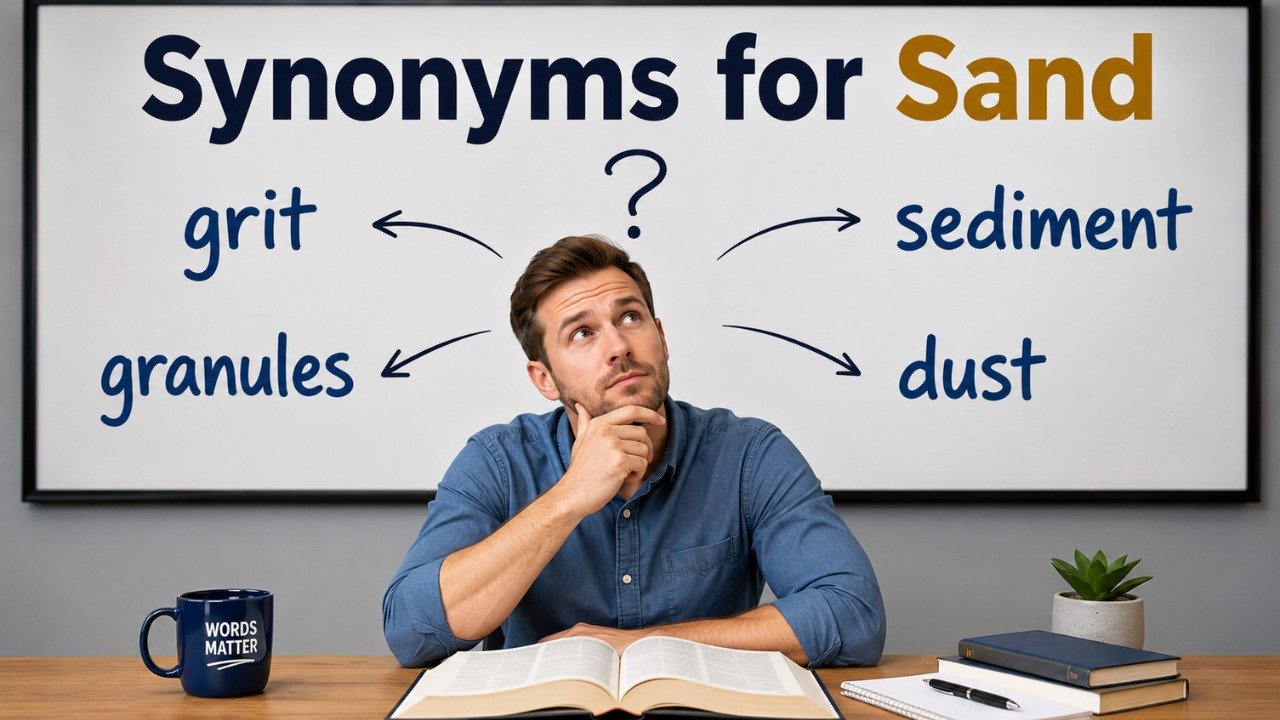
Quick Answer: The best synonyms for sand include grit, grains, granules, particles, sediment, mineral grains, sandy soil, abrasive, silica, and beige. Use grit for a rough granular substance, grains or particles for individual pieces, sediment in geological or scientific writing, and sandy soil when discussing land. Abrasive works when sand is used for rubbing or cleaning. As a verb, sand can mean abrade, smooth, polish, or rub down. Beige and sandy brown are useful when sand refers to a color.
Pronunciation and Word Details
Word: Sand
Pronunciation: /sænd/
Part of Speech: Noun and verb
Meaning: Sand is a loose granular material made of small mineral or rock particles, while the verb means to smooth or prepare a surface with an abrasive material.
US Pronunciation:
UK Pronunciation:
What Does “Sand” Mean?
Sand is a loose material consisting of small grains of rock, minerals, shells, or other natural matter.
As a noun, sand commonly refers to the material found on beaches, in deserts, beside rivers, and beneath shallow water. It may also be used in construction, landscaping, manufacturing, cleaning, gardening, and surface preparation.
Example: The children played in the soft sand near the water.
Sand can also describe a pale yellowish brown or beige color.
Example: She selected a warm sand color for the walls.
As a verb, sand means to rub a surface with sandpaper or another abrasive material. This process can smooth rough areas, remove an old coating, or prepare a surface for painting.
Example: Sand the wooden table before applying the finish.
The meaning of sand therefore changes according to context. It may describe a natural substance, a construction material, a color, or an action performed on a surface.
Meaning, Tone, and Context of “Sand”
Sand is a neutral and familiar word. It works naturally in casual conversation, formal descriptions, academic writing, scientific explanations, construction instructions, and technical guides.
In everyday language, sand usually creates an image of a beach, desert, playground, or shoreline.
Example: Warm sand covered the beach.
In geography and geology, sand refers to a category of loose sediment containing small particles. Writers may use more specific alternatives such as sediment, mineral grains, quartz grains, or granular material.
Example: Layers of sand and sediment formed along the riverbank.
In construction, sand may be described as fine aggregate, building sand, fill sand, or abrasive material, depending on its purpose.
Example: Fine aggregate was added to the mixture.
As a verb, sand has a practical and technical tone. It appears in instructions about wood, metal, walls, furniture, and painted surfaces.
Example: Sand the surface until it feels smooth.
When used as a color term, sand has a calm, warm, and natural tone. It usually describes a pale beige or light brown shade.
Example: The room featured sand and cream tones.
When and How to Use “Sand”
For Beach or Shore Material
Use sand for the loose grains found beside seas, lakes, and rivers.
Example: The waves carried wet sand along the shore.
For Desert Terrain
Use sand when describing dunes, dry landscapes, and loose desert ground.
Example: Strong winds moved the sand across the desert.
For Geological Material
Use sand when discussing sediment, mineral grains, erosion, or deposited particles.
Example: The sample contained sand, silt, and small pieces of gravel.
For Construction
Use sand for material added to concrete, mortar, paving mixtures, and other building products.
Example: The workers mixed sand with cement and water.
For Gardening and Soil
Sand can describe a soil component that improves drainage and changes texture.
Example: The gardener added sand to the heavy soil.
For Surface Preparation
As a verb, use sand when smoothing, cleaning, or preparing wood, metal, plaster, or paint.
Example: Sand the damaged area before repainting it.
For Removing a Coating
Sand may describe rubbing away paint, varnish, rust, or another surface layer.
Example: They sanded the old finish from the cabinet.
For Describing Color
Use sand as a color word for a light beige or pale brown shade.
Example: He chose a sand colored fabric for the curtains.
Best Synonyms for Sand
1. Grit
Synonym: A rough substance consisting of small hard particles.
Example: Grit collected inside the traveler’s shoes.
2. Grains
Synonym: Individual small pieces that form sand or another granular material.
Example: Tiny grains covered the wet towel.
3. Granules
Synonym: Small separate particles of a solid substance.
Example: The container was filled with pale granules.
4. Particles
Synonym: Very small separate pieces of matter.
Example: Fine particles remained suspended in the water.
5. Sediment
Synonym: Material deposited by water, wind, or another natural process.
Example: Sediment gathered at the bottom of the stream.
6. Mineral Grains
Synonym: Small pieces of naturally occurring mineral material.
Example: The sample contained several types of mineral grains.
7. Sandy Soil
Synonym: Soil containing a high proportion of sand.
Example: These plants grow well in sandy soil.
8. Abrasive
Synonym: A rough material used to clean, smooth, or wear down a surface.
Example: The worker used a fine abrasive on the metal.
9. Silica
Synonym: A mineral substance that forms much common sand, though not all sand is made entirely of it.
Example: The material contained a high amount of silica.
10. Beige
Synonym: A pale brown color similar to the color of light sand.
Example: The designer selected beige for the background.
50 Synonyms for Sand with Short Meanings
- Grit: A collection of rough, hard particles.
- Grains: Individual pieces that make up sand.
- Granules: Small separate pieces of solid material.
- Particles: Tiny pieces of a larger substance.
- Sediment: Material deposited by water, wind, or gravity.
- Mineral Grains: Small pieces of naturally occurring minerals.
- Rock Particles: Tiny fragments produced from larger rocks.
- Granular Material: A substance consisting of many separate grains.
- Loose Granules: Small particles that are not firmly joined.
- Fine Aggregate: Small granular material used in construction.
- Silica: A mineral substance commonly present in sand.
- Quartz Grains: Small particles of quartz found in many sands.
- Siliceous Grains: Particles containing a significant amount of silica.
- Weathered Rock Particles: Small fragments formed as rocks break down.
- Sandy Soil: Soil containing a large proportion of sand.
- Loose Soil: Uncompacted earth with a light or crumbly texture.
- Fine Gravel: Small stones that are coarser than ordinary sand.
- Dust: Extremely fine dry particles.
- Powder: Fine loose particles produced from a solid substance.
- Silt: Fine sediment that is usually smaller and smoother than sand.
- Alluvium: Loose material deposited by flowing water.
- Beach Sand: Sand found along a beach or coastline.
- Shore Sand: Loose grains located beside a body of water.
- Coastal Sediment: Material deposited along a coast.
- Dune Sand: Sand collected and shaped into dunes by wind.
- Desert Sand: Loose granular material found in dry regions.
- River Sand: Sand deposited or collected by river movement.
- Sea Sand: Sand originating from or found near the sea.
- Building Sand: Sand prepared for construction work.
- Fill Sand: Sand used to fill spaces or level ground.
- Abrasive: Rough material used to rub or clean a surface.
- Abrasive Grains: Hard particles used for smoothing or wearing away material.
- Abrade: Wear down a surface through rubbing.
- Smooth: Make a rough surface more even.
- Polish: Improve a surface by rubbing it until smooth.
- Scour: Rub a surface firmly to clean or wear it down.
- Grind: Wear material away through friction.
- Scrape: Remove material by dragging a hard edge across it.
- Rasp: Rub with a rough tool to shape or smooth.
- File: Shape or smooth a surface with an abrasive tool.
- Rub Down: Smooth or clean a surface by rubbing it.
- Wear Away: Gradually remove material through friction.
- Finish: Complete and refine the surface of an object.
- Refine: Improve a surface by removing roughness or flaws.
- Level: Make a surface flat and even.
- Even Out: Remove irregularities from a surface.
- Beige: A light brown color similar to pale sand.
- Tan: A warm light brown shade.
- Buff: A soft yellowish brown color.
- Sandy Brown: A warm brown shade resembling natural sand.
Read Also:
Synonyms for Haunted

Synonyms for Sand by Context
When Sand Means a Loose Granular Material
Grit, grains, granules, particles, mineral grains, rock particles, and granular material are useful alternatives when describing the physical substance.
Example With Sand: Sand covered the floor of the cave.
Example With Grit: Grit covered the floor of the cave.
Grit emphasizes roughness. Grains and particles emphasize the separate pieces. Granular material is more technical and works well in reports or scientific descriptions.
When Sand Means Geological Sediment
Sediment, alluvium, mineral grains, quartz grains, coastal sediment, and weathered rock particles are suitable for geological or environmental contexts.
Example With Sand: The river deposited sand along the bank.
Example With Sediment: The river deposited sediment along the bank.
Sediment is broader because it may include sand, silt, clay, and other materials. Alluvium specifically refers to loose material deposited by flowing water.
When Sand Means Beach or Desert Material
Beach sand, shore sand, dune sand, desert sand, coastal sediment, and sea sand are useful when the location matters.
Example With Sand: Wind carried sand across the dunes.
Example With Dune Sand: Wind carried dune sand across the landscape.
Beach sand identifies coastal material, while desert sand refers to grains in a dry inland environment. Dune sand emphasizes material shaped and moved by wind.
When Sand Means Construction Material
Fine aggregate, building sand, fill sand, granular material, and abrasive grains are helpful in construction and industrial writing.
Example With Sand: The builders added sand to the mixture.
Example With Fine Aggregate: The builders added fine aggregate to the mixture.
Fine aggregate is the more technical choice. Building sand is clearer for general readers, while fill sand identifies material used to fill holes or level ground.
When Sand Means Smooth a Surface
Abrade, smooth, polish, scour, grind, file, rasp, rub down, and even out can replace sand as a verb.
Example With Sand: Sand the rough edge before painting it.
Example With Smooth: Smooth the rough edge before painting it.
Abrade emphasizes wearing material away. Smooth emphasizes the intended result. Rub down sounds natural in practical instructions, while file suits metal, plastic, or hard edges.
When Sand Refers to a Color
Beige, tan, buff, and sandy brown are useful color alternatives.
Example With Sand: She selected a sand shade for the walls.
Example With Beige: She selected a beige shade for the walls.
Beige is the most common general alternative. Tan is usually deeper and warmer, while buff may contain more yellow.
Another Word for Sand
Grit is often the best single replacement for sand when referring to a rough collection of small particles. However, it is not suitable in every sentence. Sediment works better in geology, fine aggregate suits construction, and beige is best when sand describes a color.
Original: Sand had collected on the stone floor.
Better Option: Grit had collected on the stone floor.
Original: The river carried sand toward the coast.
Better Option: The river carried sediment toward the coast.
Original: The mixture requires clean sand.
Better Option: The mixture requires clean fine aggregate.
Original: The sofa has a soft sand color.
Better Option: The sofa has a soft beige color.
When Not to Use “Sand”
When a More Exact Material Is Known
Sand may be too general when the material has already been identified as quartz, silica, sediment, or fine aggregate.
Weak: The sample contained sand particles made mainly from quartz.
Better: The sample contained quartz grains.
When Describing All River Deposits
River deposits may include clay, silt, gravel, and organic material as well as sand. Sediment is often the more accurate term.
Weak: The flood left sand across the entire field.
Better: The flood left sediment across the entire field.
When the Particle Size Is Different
Dust, silt, sand, and gravel have different textures and particle sizes. Do not use sand as a general term for every loose material.
Weak: A cloud of sand rose from the chalk.
Better: A cloud of dust rose from the chalk.
When the Method of Surface Treatment Matters
Sand may be less precise than file, polish, grind, or scour.
Weak: Sand the sharp metal point.
Better: File the sharp metal point.
When the Color Requires Precision
Sand can describe several pale brown shades. Beige, tan, buff, or sandy brown may communicate the exact color more clearly.
Weak: The fabric is sand.
Better: The fabric is pale beige.
When Sand Sounds Repetitive
Repeating sand in every sentence can weaken descriptive writing.
Weak: Sand covered the beach, and the sand moved as wind blew across the sand.
Better: Fine grains covered the beach, and the loose material shifted in the wind.
Words Commonly Confused With Sand
Sand vs Soil: Sand is a granular material made of small mineral or rock particles. Soil is a broader natural mixture that may contain sand, silt, clay, minerals, and organic matter.
Sand vs Silt: Sand generally feels coarser and has larger particles. Silt is finer and often feels smoother when dry.
Sand vs Gravel: Sand consists of smaller particles. Gravel contains larger pieces of stone.
Sand vs Dust: Sand particles are usually heavier and more visible. Dust consists of very fine particles that can easily become airborne.
Sand vs Sediment: Sand is one type of sediment. Sediment may also include mud, silt, clay, gravel, or organic matter.
Sand vs Sandstone: Sand is loose granular material. Sandstone is solid rock formed from sand sized grains that have become joined together.
Sand vs Silica: Silica is a mineral compound found in many types of sand. Sand is a physical material that may contain silica, quartz, shell fragments, or other substances.
Sand vs Grit: Sand is a natural granular material. Grit is a broader word for small rough particles and may refer to sand, crushed stone, dirt, or another abrasive substance.
Sand vs Beige: Sand is primarily a material. Beige is a color that may resemble pale sand.
Which Synonym Should You Choose?
Choose Grit: For rough particles found on floors, roads, shoes, or machinery.
Choose Grains: When focusing on the individual pieces that form sand.
Choose Granules: In technical or descriptive writing about small separate particles.
Choose Sediment: In environmental reports, geography, river studies, coastal writing, and scientific explanations.
Choose Mineral Grains: In geology, earth science, and detailed academic writing.
Choose Fine Aggregate: In construction reports, engineering descriptions, and material specifications.
Choose Sandy Soil: In gardening, agriculture, landscaping, and soil descriptions.
Choose Abrasive: When sand is used for rubbing, cleaning, blasting, or smoothing.
Choose Smooth: In simple instructions when the intended result is a more even surface.
Choose Abrade: In formal or technical writing about material being worn away through friction.
Choose Rub Down: In casual instructions for furniture, walls, wood, or painted surfaces.
Choose Beige: When sand refers to a pale natural color.
Choose Tan: For a warmer or slightly deeper brown shade.
Choose Sand: In ordinary conversation when the natural material itself is clearly intended.
Real Life Examples of “Sand” in Sentences
Example One
Original: Sand covered the path near the shore.
Better Option: Fine grains covered the path near the shore.
Example Two
Original: The river carried sand downstream.
Better Option: The river carried sediment downstream.
Example Three
Original: Sand collected inside our shoes.
Better Option: Grit collected inside our shoes.
Example Four
Original: The soil contains a large amount of sand.
Better Option: The area has very sandy soil.
Example Five
Original: Workers added sand to the building mixture.
Better Option: Workers added fine aggregate to the building mixture.
Example Six
Original: Sand the wooden panel before painting it.
Better Option: Smooth the wooden panel before painting it.
Example Seven
Original: Sand the sharp edge with a rough tool.
Better Option: File the sharp edge with a rough tool.
Example Eight
Original: The table has a warm sand finish.
Better Option: The table has a warm beige finish.
Example Nine
Original: Wind moved the sand across the desert.
Better Option: Wind moved the dune sand across the desert.
Example Ten
Original: The sample included sand and small stones.
Better Option: The sample included mineral grains and small stones.
Synonym Groups and Usage Differences
Granular Material Group
Grit, grains, granules, particles, mineral grains, and granular material describe sand as a collection of small pieces.
Grit emphasizes roughness. Grains are the individual units. Granules sound more technical, while particles can refer to pieces of many different sizes and materials.
Example: Small mineral grains sparkled in the sunlight.
Geological Sediment Group
Sediment, alluvium, silt, quartz grains, coastal sediment, and weathered rock particles appear in scientific and environmental writing.
Sediment is broad and flexible. Alluvium refers to material deposited by water. Silt is finer than sand and should not be treated as an exact replacement.
Example: Layers of sediment formed along the riverbank.
Landscape Group
Beach sand, shore sand, dune sand, desert sand, river sand, and sea sand identify sand by its setting or origin.
These phrases are more precise than sand alone when location affects the meaning.
Example: Strong winds carried dune sand toward the road.
Construction Group
Fine aggregate, building sand, fill sand, granular material, and abrasive grains are useful in practical and technical contexts.
Fine aggregate is formal and technical. Building sand is easier for general readers. Fill sand has a particular purpose in leveling and filling spaces.
Example: Fine aggregate improved the consistency of the mixture.
Surface Treatment Group
Abrade, smooth, polish, scour, grind, scrape, rasp, file, and rub down describe actions related to sanding.
Smooth focuses on the result. Abrade emphasizes friction. Polish usually creates a refined surface, while grind removes more material.
Example: Rub down the surface before applying the final coat.
Color Group
Beige, tan, buff, and sandy brown describe shades associated with sand.
Beige is pale and neutral. Tan is warmer and often darker. Buff has a muted yellow tone, while sandy brown is more descriptive.
Example: The walls were painted a soft sandy brown.
Antonyms of Sand
Sand has no single direct antonym as a material. Its opposites depend on whether the context concerns texture, particle size, firmness, color, or surface treatment.
Bedrock: Solid rock beneath loose surface material.
Solid Rock: Firm stone rather than loose grains.
Clay: Very fine soil material with a dense, smooth texture.
Boulder: A large piece of rock rather than a collection of tiny particles.
Hard Ground: Firm land rather than loose sandy terrain.
Solid Surface: A compact surface that does not consist of loose grains.
Roughen: Make a surface less smooth, which can oppose sanding for smoothness.
Scratch: Damage a surface rather than carefully refine it.
Coat: Add a layer to a surface instead of removing material from it.
Build Up: Add material rather than wear it away.
Dark Brown: A much deeper shade than a pale sand color.
Black: A dark color that contrasts strongly with light sand shades.
Comparison: Sand vs Related Words
Sand vs Grit
Sand is a natural granular substance. Grit refers more broadly to rough particles and often emphasizes their unpleasant or abrasive texture.
Example With Sand: Wet sand covered the beach.
Example With Grit: Grit scratched the polished floor.
Sand vs Sediment
Sand is one particular kind of loose material. Sediment includes any matter deposited by water, wind, ice, or gravity.
Example With Sand: Sand formed a narrow bank beside the river.
Example With Sediment: Sediment collected at the river’s edge.
Sand vs Silt
Sand has a coarser texture. Silt is finer and can be carried easily by slow moving water.
Example With Sand: Coarse sand remained at the bottom.
Example With Silt: Fine silt made the water cloudy.
Sand vs Gravel
Sand consists of small grains. Gravel consists of larger stones or rock fragments.
Example With Sand: The children filled the bucket with sand.
Example With Gravel: Gravel covered the driveway.
Sand vs Soil
Sand is a material that may form part of soil. Soil is a natural mixture supporting plant growth and may contain minerals, water, air, and organic matter.
Example With Sand: Sand drained quickly after the rain.
Example With Soil: The soil supported healthy plant growth.
Sand vs Dust
Sand is heavier and coarser than dust. Dust contains extremely small dry particles that often float in the air.
Example With Sand: Sand stuck to the wet towel.
Example With Dust: Dust settled on the shelf.
Sand vs Silica
Sand describes a granular material. Silica is a mineral substance found in many sands and rocks.
Example With Sand: The beach was covered with pale sand.
Example With Silica: The laboratory measured the silica content of the sample.
Sand vs Sandstone
Sand is loose. Sandstone is solid rock created when sand sized grains become compacted and joined.
Example With Sand: Wind moved the sand across the ground.
Example With Sandstone: The old wall was built from sandstone.
Sand vs Beige
Sand is a physical material, though it can also name a color. Beige is specifically a pale brown color.
Example With Sand: Sand covered the floor near the entrance.
Example With Beige: Beige curtains softened the room.
Common Phrases and Expressions With “Sand”
Grain of Sand: One tiny particle of sand.
Sand Dune: A hill or ridge of sand formed by wind.
Sand Castle: A structure made by shaping wet sand.
Sand Between Your Toes: A phrase describing the feeling of walking barefoot on a beach.
Shifting Sands: Changing conditions that are difficult to control or predict.
Draw a Line in the Sand: Establish a firm limit or boundary.
Bury Your Head in the Sand: Ignore an unpleasant fact or problem.
Sand Down: Rub a surface to make it smoother or remove a coating.
Sand Smooth: Use an abrasive material until a surface becomes even.
A Sea of Sand: A large sandy area that appears endless.
Common Mistakes to Avoid
Treating Sand as a Countable Noun
Sand is usually uncountable when referring to the material in general.
Incorrect: There were many sands on the floor.
Correct: There was a lot of sand on the floor.
Use sands when referring to different sandy regions or varieties in a literary or specialized context.
Using Grain When You Mean the Whole Material
A grain is one individual particle. Sand is the collection of those particles.
Incorrect: The beach was covered in a grain.
Correct: The beach was covered in sand.
Confusing Sand With Soil
Not all soil is sand, and not all sand functions as fertile soil.
Unclear: The farmer planted crops in the sand.
Clearer: The farmer planted crops in sandy soil.
Confusing Sand With Silt
Silt is finer than sand. Using the words interchangeably may make technical writing inaccurate.
Incorrect: The fine mud was made entirely of sand.
Better: The fine deposit contained silt.
Using Silica as a Universal Replacement
Many sands contain silica, but silica and sand are not identical terms.
Weak: Children played in silica beside the water.
Better: Children played in sand beside the water.
Choosing the Wrong Sanding Verb
Smooth, polish, file, grind, and scour describe different actions.
Vague: Sand the large metal projection.
Better: Grind down the large metal projection.
Repeating Sand Too Often
Use grains, sediment, grit, sandy soil, or dune sand when the context makes the alternative accurate.
Repetitive: Sand covered the beach, and the sand became hot as sunlight warmed the sand.
Improved: Fine grains covered the beach and became hot in the sunlight.
Using Sand as a Color Without Detail
Sand can refer to several pale brown shades. Add a clearer color term when precision matters.
Vague: Choose the sand fabric.
Clearer: Choose the pale beige fabric.
Adding Unnecessary Words to the Verb
Sand already describes rubbing a surface with an abrasive.
Wordy: Sand down and smooth the surface smooth.
Better: Sand the surface until smooth.
Conclusion
The best synonyms for sand depend on whether the word describes a natural material, sediment, construction product, surface treatment, or color. Grit, grains, granules, and particles suit general descriptions, while sediment and mineral grains work well in scientific writing. Fine aggregate is useful in construction, and sandy soil fits gardening contexts. As a verb, sand can mean smooth, abrade, file, or rub down. Beige, tan, buff, and sandy brown are accurate color alternatives.
FAQs About Synonyms for Sand
What Is the Best Synonym for Sand?
Grit is a useful general synonym when sand is viewed as a rough collection of particles. Sediment, grains, or fine aggregate may be better in specific contexts.
Is Sediment Another Word for Sand?
Sediment can replace sand in some geological and environmental sentences. However, sediment is broader and may also include silt, clay, gravel, and organic material.
What Is Another Word for Sand on a Beach?
Beach sand, shore sand, coastal sediment, and grains are useful alternatives. The best choice depends on whether you are describing location, texture, or scientific composition.
What Is Another Word for Sand as a Verb?
Smooth, abrade, polish, file, grind, scour, and rub down can replace sand as a verb. Choose the word that matches the surface and intended result.
What Is a Technical Word for Sand?
Granular material, mineral grains, sediment, and fine aggregate are useful technical alternatives. Fine aggregate is common in construction, while sediment suits environmental writing.
Is Grit the Same as Sand?
Grit and sand are related but not identical. Grit is a broader term for rough particles and may include sand, crushed stone, dirt, or another abrasive substance.
What Color Is Similar to Sand?
Beige, tan, buff, and sandy brown are colors similar to sand. Beige is usually the closest general alternative for a pale neutral sand shade.
