
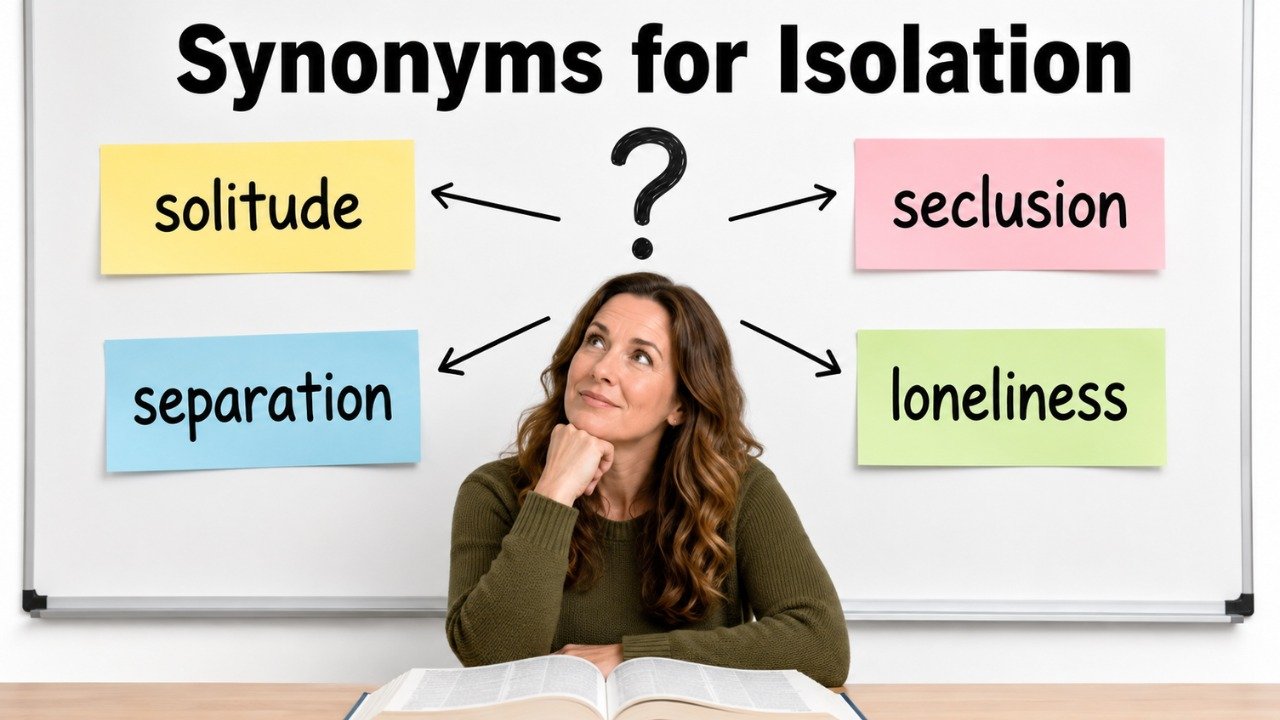
Quick Answer: The best synonyms for isolation include seclusion, solitude, separation, detachment, remoteness, loneliness, alienation, withdrawal, quarantine, and segregation. Seclusion and solitude work well for peaceful privacy. Separation is the clearest general replacement. Loneliness and alienation describe painful emotional isolation. Quarantine is best for medical separation, while segregation refers to forced social or physical division. Detachment suits emotional or professional distance, and remoteness describes a location far from other people or places.
Pronunciation and Word Details
Word: Isolation.
Pronunciation: /ˌaɪsəˈleɪʃən/
Part of Speech: Noun.
Meaning: The state of being separated from other people, places, groups, or things.
US Pronunciation:
UK Pronunciation:
What Does “Isolation” Mean?
Isolation means the state or condition of being separated from other people, groups, objects, or surroundings. It is a noun formed from the verb isolate.
The word can describe physical separation, emotional distance, social exclusion, medical restriction, geographic remoteness, or technical separation.
A person may experience isolation when they have little contact with others. A remote village may exist in geographic isolation. A patient may remain in isolation to prevent an illness from spreading. In science and engineering, isolation can describe keeping substances, systems, or signals separate.
Isolation can be voluntary or forced. Voluntary isolation may provide peace, privacy, and concentration. Forced isolation may cause loneliness, distress, or a feeling of exclusion.
Meaning, Tone, and Context of “Isolation”
Isolation is generally a neutral to formal word, but its emotional meaning depends on context.
In everyday conversation, isolation often suggests loneliness or a lack of human contact. In emotional writing, it can communicate sadness, alienation, rejection, or disconnection.
In formal and academic writing, isolation may describe geographic separation, social exclusion, political distance, or the separation of variables and materials. It is common in essays, reports, research, health discussions, psychology, sociology, biology, engineering, and environmental studies.
The word can also have a neutral or positive meaning. A writer may seek isolation to concentrate. A researcher may isolate a material for examination. A quiet home may provide temporary isolation from noise and activity.
Because isolation has several meanings, the surrounding sentence should make the intended sense clear.
When and How to Use “Isolation”
For Physical Separation: Use isolation when a person, object, place, or group is physically separated from others.
Example: The mountain community remained in isolation during the winter.
For Emotional Disconnection: Use isolation when someone feels distant, unsupported, or disconnected from other people.
Example: His sense of isolation increased after he moved away from his friends.
For Social Exclusion: Use isolation when a person or group has limited participation, acceptance, or contact within society.
Example: Language barriers can contribute to social isolation.
For Peace and Privacy: Use isolation when someone intentionally spends time alone to think, rest, create, or concentrate.
Example: The artist worked in isolation to complete the painting.
For Medical Separation: Use isolation when a patient is kept apart to reduce the risk of infection.
Example: The patient remained in isolation until the medical team confirmed that contact was safe.
For Geographic Distance: Use isolation when a location is remote and difficult to reach.
Example: The island’s isolation protected several rare species.
For Technical Separation: Use isolation when systems, materials, signals, or components must remain separate.
Example: The design provides electrical isolation between the two circuits.
For Scientific Study: Use isolation when a substance, organism, variable, or component is separated for examination.
Example: The isolation of the compound allowed researchers to study its properties.
Best Synonyms for Isolation
Seclusion: The condition of being private and away from other people.
Example: She enjoyed the seclusion of the quiet cottage.
Solitude: The state of being alone, often by personal choice and without sadness.
Example: He found inspiration in the solitude of the early morning.
Separation: The condition of being divided, removed, or kept apart.
Example: The separation of the two groups prevented further conflict.
Detachment: A state of emotional, mental, or physical distance.
Example: Her professional detachment helped her evaluate the situation calmly.
Remoteness: The quality of being far from populated or easily reached places.
Example: The remoteness of the village made travel difficult.
Loneliness: Sadness caused by lacking company, connection, or support.
Example: Moving to a new city left him with a deep sense of loneliness.
Alienation: A feeling of being disconnected from a group, society, or familiar environment.
Example: The sudden changes created alienation among longtime residents.
Withdrawal: The act of moving away from social contact, involvement, or activity.
Example: Her withdrawal from group activities concerned her friends.
Quarantine: A period of medical separation intended to prevent the possible spread of illness.
Example: The travelers completed the required quarantine before joining the group.
Segregation: The enforced or deliberate separation of people, groups, or things.
Example: The policy resulted in the segregation of residents into separate areas.
50 Synonyms for Isolation with Short Meanings
- Seclusion: Private separation from other people.
- Solitude: The state of being peacefully alone.
- Separation: The condition of being kept or placed apart.
- Detachment: Emotional, mental, or physical distance.
- Remoteness: Great distance from people or populated places.
- Loneliness: Sadness caused by a lack of company or connection.
- Alienation: A feeling of disconnection from people or society.
- Withdrawal: Movement away from contact or participation.
- Segregation: The division of people or things into separate groups.
- Quarantine: Medical separation intended to prevent possible infection.
- Confinement: The state of being restricted to a particular place.
- Exclusion: The act of preventing someone from joining or participating.
- Privacy: Freedom from observation, interruption, or unwanted contact.
- Retreat: Withdrawal to a quiet or protected place.
- Reclusion: A private life spent away from society.
- Insulation: Protection through separation from outside influence.
- Disconnection: The state of no longer being linked or involved.
- Estrangement: Loss of closeness in a personal relationship.
- Apartness: The quality of being separate or distant.
- Abandonment: The state of being left without support or company.
- Desolation: A condition of emptiness, sadness, or lack of companionship.
- Lonesomeness: The feeling of being alone and unhappy.
- Sequestration: Formal removal or separation from others.
- Partition: The act of dividing an area, group, or object.
- Division: Separation into distinct sections or groups.
- Distancing: The act of creating physical, emotional, or social space.
- Dissociation: Mental or emotional separation from an experience or group.
- Disengagement: Withdrawal from involvement, responsibility, or interaction.
- Exile: Forced separation from one’s home or community.
- Banishment: Official or forced removal from a place or group.
- Ostracism: Deliberate exclusion from a social group.
- Marginalization: Treatment that pushes a person or group outside normal participation.
- Enclosure: The state of being surrounded or contained.
- Containment: The act of keeping something within controlled limits.
- Internment: Forced confinement, usually under official authority.
- Solitary Confinement: Imprisonment in a cell apart from other people.
- Social Withdrawal: Reduced interaction or participation with others.
- Social Exclusion: Prevention from fully joining a community or group.
- Physical Separation: Spatial distance between people or objects.
- Emotional Distance: A lack of emotional closeness or openness.
- Geographic Remoteness: Physical distance from major communities or services.
- Disconnectedness: The condition of lacking meaningful links or relationships.
- Aloneness: The basic state of being without other people.
- Independence: The condition of functioning without reliance on others.
- Autonomy: Freedom to act or make decisions independently.
- Self Sufficiency: The ability to manage without outside assistance.
- Nonparticipation: The state of not taking part in an activity or group.
- Inaccessibility: The quality of being difficult to reach or approach.
- Purification: Separation of unwanted substances from a material.
- Extraction: Removal of a particular substance or component from a mixture.
Read Also:
Synonyms for Admire

Synonyms for Isolation by Context
When Isolation Means Peaceful Seclusion
Solitude, seclusion, privacy, retreat, and reclusion describe being alone in a quiet or private way.
Solitude is often positive because it suggests chosen time alone. Seclusion emphasizes privacy and distance from interruption. Retreat can describe either a place or a temporary withdrawal from activity. Reclusion is more formal and often refers to a lifestyle spent away from society.
Example: She valued the solitude of her garden each morning.
Example: The cabin offered complete seclusion from city noise.
When Isolation Means Loneliness
Loneliness, lonesomeness, alienation, disconnectedness, and desolation describe the painful emotional side of isolation.
Loneliness focuses on sadness caused by limited companionship. Alienation suggests feeling disconnected from a group, culture, workplace, or society. Desolation is stronger and may suggest emotional emptiness or abandonment.
Example: His loneliness became more noticeable during the quiet evenings.
Example: She felt alienation after being repeatedly excluded from decisions.
When Isolation Means Physical Separation
Separation, division, partition, containment, enclosure, and distancing describe physical space or barriers between people and things.
Separation is the broadest option. Partition often refers to dividing a physical space. Containment emphasizes keeping something within controlled boundaries. Enclosure suggests surrounding an area or object.
Example: A glass partition created separation between the two work areas.
Example: The containment system prevented the material from spreading.
When Isolation Means Medical Separation
Quarantine, confinement, containment, and medical separation are useful when discussing health precautions.
Quarantine usually applies to people who may have been exposed to an illness. Medical isolation generally applies to a person who is known or suspected to be infectious. Confinement is broader and does not always involve health.
Example: The traveler remained in quarantine while awaiting the test result.
Example: Medical isolation reduced unnecessary contact with the patient.
When Isolation Means Social Exclusion
Exclusion, ostracism, segregation, marginalization, and banishment describe separation from a group or society.
Exclusion is the broadest word. Ostracism refers to deliberate social rejection. Segregation describes organized separation, often involving serious social or institutional consequences. Marginalization means pushing people away from full participation or influence.
Example: Repeated exclusion caused several members to leave the group.
Example: The policy increased the marginalization of vulnerable residents.
When Isolation Means Emotional Distance
Detachment, estrangement, withdrawal, disengagement, and dissociation describe psychological or emotional separation.
Detachment may be intentional and calm. Estrangement usually refers to a damaged personal relationship. Withdrawal describes reduced social involvement. Dissociation has a more specific psychological meaning and should be used carefully.
Example: Emotional detachment allowed her to review the complaint objectively.
Example: Years of disagreement led to estrangement between the relatives.
When Isolation Means Geographic Remoteness
Remoteness, geographic separation, inaccessibility, seclusion, and distance describe places that are far from communities, roads, or services.
Remoteness is the strongest general option. Inaccessibility emphasizes difficulty reaching the location. Seclusion may sound more peaceful and appealing.
Example: The region’s remoteness limited access to medical services.
Example: The inaccessibility of the valley protected it from heavy development.
When Isolation Means Technical Separation
Insulation, containment, separation, purification, extraction, and partition are useful in scientific and technical contexts.
Insulation protects a system from heat, sound, electricity, or outside influence. Purification separates unwanted material from a substance. Extraction removes a selected component from a mixture. Containment keeps a substance or process within controlled boundaries.
Example: The material provides insulation against electrical current.
Example: The extraction process separated the oil from the remaining mixture.
Another Word for Isolation
Separation is usually the best general replacement for isolation because it works in physical, social, emotional, and technical contexts. However, the most accurate alternative depends on whether the sentence describes peaceful privacy, painful loneliness, medical precautions, geographic distance, or forced exclusion.
Original: The house stood in complete isolation.
Better Option: The house stood in complete seclusion.
Original: She struggled with isolation after moving abroad.
Better Option: She struggled with loneliness after moving abroad.
Original: The patient was placed in isolation.
Better Option: The patient was placed in medical isolation.
Original: The two systems require isolation from each other.
Better Option: The two systems require complete separation from each other.
When Not to Use “Isolation”
Do not use isolation when a more precise word would explain the situation more clearly.
Isolation may sound negative when the intended meaning is peaceful time alone. In that context, solitude or privacy may be better.
Weak: She enjoyed the isolation of the reading room.
Better: She enjoyed the solitude of the reading room.
Do not use isolation as an automatic replacement for loneliness. A person can be physically isolated without feeling lonely.
Weak: He felt isolation even while surrounded by friends.
Better: He felt loneliness even while surrounded by friends.
Do not use isolation when discussing a specific medical precaution if quarantine provides the more accurate meaning.
Weak: The travelers entered isolation after possible exposure.
Better: The travelers entered quarantine after possible exposure.
Do not use isolation when deliberate social rejection is the main idea.
Weak: She experienced isolation from the group after the disagreement.
Better: She experienced ostracism from the group after the disagreement.
Avoid using isolation repeatedly in the same paragraph. Replace unnecessary repetition with separation, seclusion, remoteness, loneliness, detachment, or another contextually accurate term.
Weak: The village’s isolation created isolation among its residents, and this isolation affected access to services.
Better: The village’s remoteness limited access to services and increased social isolation among its residents.
Words Commonly Confused With Isolation
Isolation vs Solitude: Isolation is a broad word for separation and may be voluntary or forced. Solitude usually describes chosen and peaceful time alone.
Isolation vs Seclusion: Isolation can be emotional, physical, social, medical, or technical. Seclusion mainly refers to privacy and distance from other people.
Isolation vs Loneliness: Isolation describes a condition of separation. Loneliness describes the sad emotional feeling that may result from limited connection.
Isolation vs Quarantine: Isolation is the broad condition of being separated. Quarantine is a specific health precaution for someone who may have been exposed to illness.
Isolation vs Segregation: Isolation can happen naturally, voluntarily, or accidentally. Segregation involves organized or deliberate separation into different groups.
Isolation vs Alienation: Isolation describes separation. Alienation describes feeling disconnected, unwelcome, or unfamiliar within a group or society.
Isolation vs Detachment: Isolation may involve physical or social separation. Detachment usually describes emotional distance or an objective lack of personal involvement.
Isolation vs Estrangement: Isolation is a general lack of contact. Estrangement refers more specifically to the loss of closeness in a relationship.
Isolation vs Confinement: Isolation emphasizes separation from others. Confinement emphasizes restriction within a particular place.
Isolation vs Remoteness: Isolation can describe people, objects, emotions, and systems. Remoteness mainly describes physical distance from populated or accessible locations.
Which Synonym Should You Choose?
Choose separation when you need a broad and neutral replacement for isolation.
Choose solitude when someone willingly spends peaceful time alone.
Choose seclusion when privacy and freedom from interruption are important.
Choose loneliness when the sentence describes sadness caused by limited companionship.
Choose alienation when someone feels disconnected from a community, workplace, culture, or society.
Choose withdrawal when someone reduces social contact or stops participating.
Choose detachment when emotional distance or professional objectivity is the main idea.
Choose remoteness when describing a location far from cities, roads, services, or communities.
Choose quarantine when writing about medical separation after possible exposure to illness.
Choose segregation when describing deliberate, organized, or enforced separation of people or groups.
Choose ostracism when someone is intentionally rejected by a social group.
Choose confinement when a person is restricted to a room, building, cell, or controlled area.
Choose insulation when discussing protection from heat, electricity, sound, or outside influence.
Choose containment when a substance, risk, process, or problem must remain within controlled limits.
Choose purification or extraction when discussing scientific separation of substances or components.
In formal reports and essays, separation, exclusion, alienation, remoteness, and segregation provide precise meanings.
In casual conversation, being alone, loneliness, distance, and withdrawal may sound more natural.
In professional emails, separation or limited contact often sounds clearer and less emotional than isolation.
Real Life Examples of “Isolation” in Sentences
Original: Working from home increased his sense of isolation.
Better Option: Working from home increased his sense of loneliness.
Original: The cottage offered isolation from the busy town.
Better Option: The cottage offered seclusion from the busy town.
Original: The village developed in isolation from major cities.
Better Option: The village developed in geographic remoteness from major cities.
Original: Her isolation from the group affected her confidence.
Better Option: Her exclusion from the group affected her confidence.
Original: The patient remained in isolation for several days.
Better Option: The patient remained in medical isolation for several days.
Original: He chose isolation so he could finish the manuscript.
Better Option: He chose solitude so he could finish the manuscript.
Original: The conflict caused isolation between the two departments.
Better Option: The conflict caused separation between the two departments.
Original: Her emotional isolation made communication difficult.
Better Option: Her emotional detachment made communication difficult.
Original: The system requires isolation from external interference.
Better Option: The system requires insulation from external interference.
Original: The island’s isolation helped preserve its ecosystem.
Better Option: The island’s remoteness helped preserve its ecosystem.
Synonym Groups and Usage Differences
Peaceful Privacy Group
Solitude, seclusion, privacy, retreat, and reclusion describe being alone without necessarily feeling unhappy.
Solitude is the most positive and natural choice for chosen time alone. Seclusion emphasizes privacy. Retreat often suggests a temporary escape from activity. Reclusion is formal and may describe a long term lifestyle.
Example: The poet sought solitude in a quiet house near the forest.
Emotional Disconnection Group
Loneliness, alienation, estrangement, detachment, and disconnectedness relate to emotional distance.
Loneliness describes sadness. Alienation suggests separation from society or a group. Estrangement concerns damaged personal relationships. Detachment may be intentional and emotionally neutral.
Example: Years of limited communication created estrangement between the brothers.
Social Exclusion Group
Exclusion, ostracism, marginalization, segregation, and banishment describe being kept outside a group or community.
Exclusion is broad. Ostracism is deliberate social rejection. Marginalization limits participation or influence. Segregation creates organized separation. Banishment involves forced removal.
Example: Public criticism led to his ostracism from the group.
Physical Separation Group
Separation, partition, division, enclosure, and distancing describe physical space between people or objects.
Separation is the most flexible choice. Partition usually involves a barrier. Division emphasizes the creation of separate sections. Enclosure emphasizes surrounding boundaries.
Example: A movable partition divided the room into two work areas.
Medical Separation Group
Isolation, quarantine, confinement, and containment may appear in health related writing.
Isolation separates a person who is suspected or confirmed to be infectious. Quarantine restricts someone who may have been exposed. Containment refers to controlling a wider health risk. Confinement focuses on restriction to a place.
Example: The medical team used isolation to reduce contact with the patient.
Geographic Distance Group
Remoteness, inaccessibility, seclusion, and geographic separation describe distant places.
Remoteness emphasizes distance. Inaccessibility emphasizes difficulty reaching a place. Seclusion can make a remote setting sound peaceful or desirable.
Example: The remoteness of the settlement made supplies difficult to obtain.
Technical Separation Group
Insulation, containment, extraction, purification, and separation describe controlled division in science and engineering.
Insulation protects a system from outside effects. Containment prevents spreading. Extraction removes one component. Purification removes unwanted material.
Example: Proper insulation prevents electrical current from reaching the outer surface.
Antonyms of Isolation
The opposite of isolation depends on whether the sentence refers to social contact, emotional connection, physical unity, or group participation.
Connection: A meaningful link between people, ideas, or things.
Inclusion: The act of welcoming someone into a group or activity.
Companionship: Friendly contact and shared time with another person.
Togetherness: The state of being emotionally or physically close.
Integration: The process of joining separate people or parts into a whole.
Participation: Active involvement in an event, group, or activity.
Engagement: Meaningful involvement or interaction.
Contact: Communication or physical connection with others.
Belonging: The feeling of being accepted and valued within a group.
Community: A group connected by place, interest, identity, or support.
Unity: The condition of being joined together as one.
Association: Connection or involvement with a person, group, or organization.
Interaction: Communication or action between people or things.
Companionship: The comfort of spending time with another person.
Accessibility: The quality of being easy to reach, enter, or approach.
Comparison: Isolation vs Related Words
Isolation vs Solitude
Isolation is a general condition of separation. It may be chosen, accidental, or forced. Solitude is usually chosen and often has a peaceful or positive tone.
Example With Isolation: Extended isolation affected his emotional health.
Example With Solitude: She enjoyed an hour of solitude before beginning work.
Isolation vs Seclusion
Isolation can describe physical, emotional, social, medical, or technical separation. Seclusion mainly describes privacy away from people and activity.
Example With Isolation: The damaged road left the village in isolation.
Example With Seclusion: The private garden offered welcome seclusion.
Isolation vs Loneliness
Isolation is an external condition. Loneliness is an internal emotional experience. A person can be isolated without feeling lonely and can feel lonely while surrounded by people.
Example With Isolation: The storm caused the family’s temporary isolation.
Example With Loneliness: She experienced loneliness after her closest friend moved away.
Isolation vs Alienation
Isolation means being separated. Alienation means feeling disconnected, unwelcome, or unable to identify with a group or environment.
Example With Isolation: His remote job involved long periods of isolation.
Example With Alienation: Sudden workplace changes created alienation among employees.
Isolation vs Detachment
Isolation refers to separation from people, places, objects, or systems. Detachment usually refers to emotional distance or objective thinking.
Example With Isolation: The researcher worked in isolation for several weeks.
Example With Detachment: The reviewer maintained professional detachment while evaluating the complaint.
Isolation vs Quarantine
Isolation is a broad term. Quarantine is a specific precaution for someone who may have been exposed to a contagious illness.
Example With Isolation: The patient was moved to an isolation room.
Example With Quarantine: The traveler remained in quarantine after possible exposure.
Isolation vs Segregation
Isolation can occur naturally or voluntarily. Segregation usually involves intentional, organized, or enforced separation of people or categories.
Example With Isolation: Geographic isolation shaped the island’s culture.
Example With Segregation: The rule resulted in the segregation of residents into separate areas.
Isolation vs Confinement
Isolation focuses on being apart from others. Confinement focuses on being restricted within a limited space.
Example With Isolation: The prisoner experienced complete isolation from other people.
Example With Confinement: The prisoner remained in confinement within a small cell.
Isolation vs Remoteness
Isolation has physical, emotional, social, medical, and technical meanings. Remoteness mainly refers to distance from populated or accessible areas.
Example With Isolation: The community’s isolation affected trade and communication.
Example With Remoteness: The region’s remoteness made road construction expensive.
Isolation vs Exclusion
Isolation describes a state of separation. Exclusion emphasizes the action of preventing someone from entering, joining, or participating.
Example With Isolation: Social isolation affected her confidence.
Example With Exclusion: Her exclusion from the meeting prevented her from sharing important information.
Common Phrases and Expressions With Isolation
Social Isolation: Limited contact, participation, or communication with other people.
Physical Isolation: Separation created by distance, barriers, or restricted access.
Emotional Isolation: A feeling of being unable to share emotions or connect deeply with others.
Complete Isolation: Total separation with little or no contact.
Relative Isolation: A condition of being separated to some degree, but not completely.
Geographic Isolation: Separation caused by distance, terrain, water, or limited transportation.
Medical Isolation: Separation used to reduce contact with a person who may spread infection.
Isolation Room: A specially controlled room used to separate a patient from others.
Period of Isolation: A specific length of time spent apart from other people.
Sense of Isolation: The personal feeling of being alone, disconnected, or unsupported.
Isolation Barrier: A physical or technical barrier that prevents contact or interference.
Isolation from Society: Separation from normal social interaction and community participation.
Isolation of a Substance: The process of separating a substance from a mixture.
Isolation of Variables: The process of separating factors so they can be examined individually.
Common Mistakes to Avoid
A common mistake is treating every synonym for isolation as interchangeable. Solitude, loneliness, quarantine, segregation, and seclusion communicate very different ideas.
Use solitude for peaceful and voluntary time alone. Use loneliness when sadness is central. Use quarantine for a specific medical precaution. Use segregation when separation is organized or enforced.
Another mistake is assuming isolation always has a negative meaning. Isolation can provide privacy, safety, concentration, or technical protection. The context determines whether the word sounds positive, negative, or neutral.
Avoid repeating isolation several times in one paragraph. Use a more specific synonym when the meaning changes.
Repetitive: The isolation of the town caused isolation among residents, and this isolation affected local businesses.
Improved: The town’s remoteness reduced business activity and increased social isolation among residents.
Do not use alienation when you simply mean physical distance. Alienation includes emotional or social disconnection.
Incorrect: The alienation between the two buildings is ten feet.
Correct: The separation between the two buildings is ten feet.
Do not use quarantine for every form of medical isolation. Quarantine usually concerns possible exposure, while isolation may concern a person who is already suspected or confirmed to be infectious.
Avoid vague phrases when readers need to know the type of isolation involved.
Vague: The project failed because of isolation.
Clear: The project failed because of poor communication and isolation between departments.
Use the correct preposition. Isolation from something emphasizes separation from a person, group, place, or influence. Isolation of something emphasizes the process of separating a particular item or substance.
Isolation From: The village remained in isolation from surrounding communities.
Isolation Of: The isolation of the compound required several laboratory steps.
Conclusion
Synonyms for isolation vary according to whether the sentence describes peaceful privacy, emotional pain, physical distance, medical precautions, or social exclusion. Separation is the strongest general alternative. Solitude and seclusion suit chosen privacy, while loneliness and alienation express emotional disconnection. Remoteness describes distant locations, quarantine fits specific health contexts, and segregation refers to deliberate division. Choosing the most precise synonym helps readers understand not only that something is separate, but also why the separation exists and how it affects the people or things involved.
FAQs About Synonyms for Isolation
What Is the Best Synonym for Isolation?
Separation is the best general synonym because it works in physical, social, emotional, and technical contexts.
Is Solitude the Same as Isolation?
No. Solitude usually describes peaceful and voluntary time alone, while isolation can be unwanted, forced, or emotionally painful.
What Is a Positive Synonym for Isolation?
Solitude, seclusion, privacy, and retreat can express positive or peaceful separation.
What Is a Negative Synonym for Isolation?
Loneliness, alienation, ostracism, abandonment, and exclusion often communicate negative experiences.
What Is a Formal Synonym for Isolation?
Separation, seclusion, detachment, segregation, sequestration, and alienation are suitable formal alternatives, depending on context.
What Word Describes Emotional Isolation?
Loneliness, alienation, detachment, estrangement, and disconnectedness can describe emotional isolation.
What Is the Difference Between Isolation and Quarantine?
Isolation is a broad word for separation. Quarantine is a specific health precaution for someone who may have been exposed to an infectious illness.
