
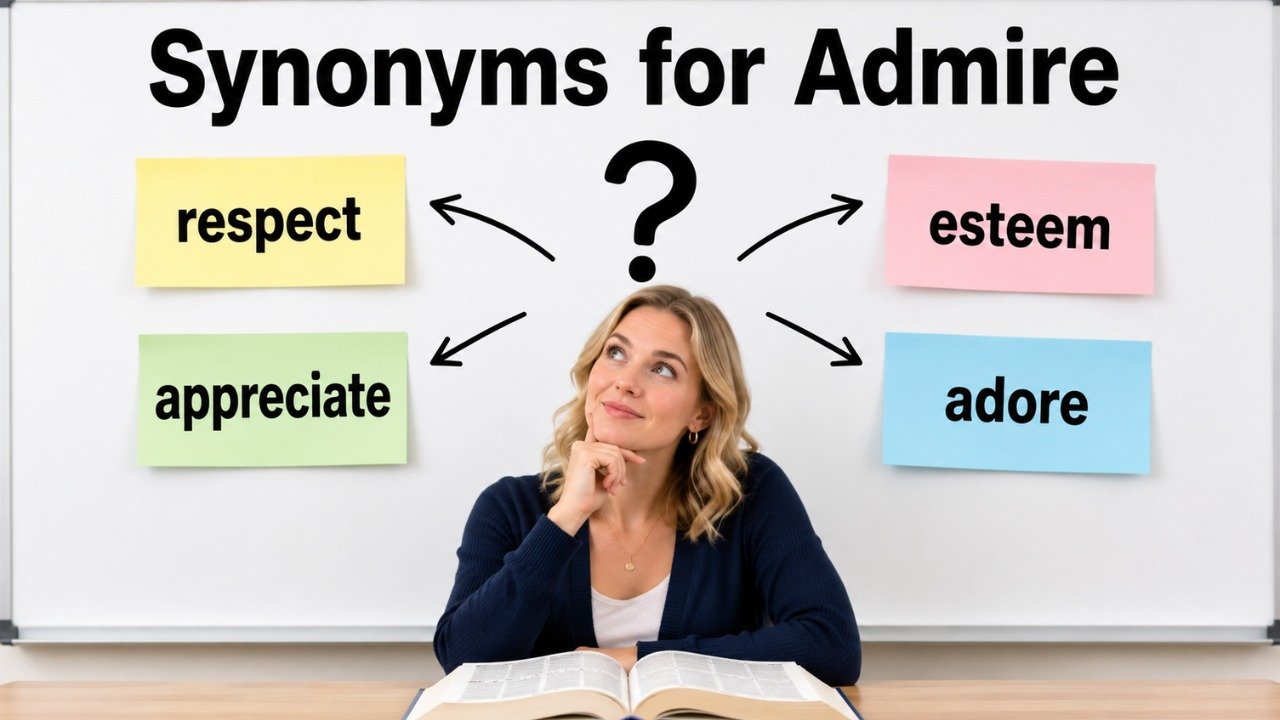
Quick Answer: The best synonyms for admire include respect, esteem, appreciate, praise, revere, honor, adore, value, applaud, and look up to. Respect is best when you recognize someone’s character, ability, or achievements. Appreciate suits talent, beauty, effort, and thoughtful actions. Praise and applaud express approval openly, while esteem is more formal. Revere shows profound respect, and adore adds strong affection. Use look up to in casual conversation when someone serves as a positive example.
Pronunciation and Word Details
Word: Admire.
Pronunciation: /ədˈmaɪər/
Part of Speech: Verb.
Meaning: To regard someone or something with respect, approval, pleasure, or appreciation.
US Pronunciation:
UK Pronunciation:
What Does “Admire” Mean?
Admire means to feel respect, approval, pleasure, or appreciation for someone or something.
Admire is a verb. It may describe respect for a person’s qualities, appreciation of an achievement, or enjoyment of something attractive.
When admire refers to a person, it often shows approval of character, courage, talent, honesty, or success.
Example: I admire her determination and patience.
The word can also describe appreciation of beauty, design, scenery, or craftsmanship.
Example: We stopped to admire the mountain view.
Admire may express a mixture of respect and affection.
Example: He has always admired his grandfather.
It can also describe looking at something with pleasure.
Example: She admired the painting for several minutes.
Admire is normally followed by a person, object, action, or quality. It can also appear with for when explaining the reason for the admiration.
Example: They admire him for his generosity.
Meaning, Tone, and Context of “Admire”
Admire has a positive and respectful tone. It is common in both formal and casual English.
The word can sound warm, sincere, appreciative, or thoughtful. Its strength depends on the situation and the object being admired.
In everyday conversation, admire often means to respect or look up to someone.
Example: I admire people who remain calm under pressure.
In formal writing, admire may describe respect for leadership, academic work, professional ability, or personal character.
Example: Her colleagues admire her commitment to ethical decision making.
In emotional contexts, admire may suggest affection as well as respect.
Example: He deeply admires his older sister.
In artistic and visual contexts, admire means to look at something with pleasure or recognize its beauty.
Example: Visitors gathered to admire the detailed sculpture.
Admire is usually stronger than like but less intense than worship or idolize. It is often more personal than approve and warmer than respect.
The word is common in conversations, essays, biographies, speeches, reviews, descriptions, personal messages, and literary analysis.
When and How to Use “Admire”
For Respecting Character
Use admire when you respect someone’s honesty, kindness, courage, patience, or integrity.
Example: I admire her honesty, even when the truth is difficult.
For Recognizing Ability
Use admire when someone’s talent, intelligence, skill, or discipline impresses you.
Example: The students admire their teacher’s ability to explain complex ideas.
For Appreciating Achievement
Use admire when you approve of an accomplishment or the effort required to achieve it.
Example: We admire the team for completing the project under pressure.
For Looking Up to Someone
Use admire when a person serves as an example or source of inspiration.
Example: She admires her aunt and hopes to follow a similar career path.
For Appreciating Beauty
Use admire when looking at a beautiful person, object, place, design, or work of art.
Example: They paused to admire the colorful garden.
For Valuing Creativity
Use admire when recognizing imagination, originality, craftsmanship, or artistic skill.
Example: I admire the careful detail in this handmade table.
For Expressing Approval
Use admire when you want to communicate sincere approval without sounding exaggerated.
Example: I admire the way you handled that difficult conversation.
For Describing Romantic Interest
Use admire when someone feels attracted to another person but the emotion is respectful or not openly expressed.
Example: He admired her from a distance but never introduced himself.
For Professional Appreciation
Use admire when recognizing someone’s leadership, judgment, work ethic, or expertise.
Example: Her coworkers admire her calm and organized approach.
Best Synonyms for Admire
Respect
Synonym: To recognize someone’s good qualities, rights, achievements, or abilities.
Example: I respect her willingness to defend what is right.
Esteem
Synonym: To regard someone with formal or serious respect.
Example: The researchers esteem her for her careful and honest work.
Appreciate
Synonym: To recognize and value the quality, beauty, effort, or importance of something.
Example: I appreciate the skill required to create this sculpture.
Praise
Synonym: To express approval or admiration openly.
Example: The manager praised the employees for their excellent work.
Revere
Synonym: To feel deep and profound respect for someone or something.
Example: The community reveres the elder for her wisdom.
Honor
Synonym: To show respect or recognition for someone’s qualities or achievements.
Example: The ceremony honored volunteers who had served the community.
Adore
Synonym: To admire and love someone or something greatly.
Example: She adores her grandmother and values every moment with her.
Value
Synonym: To consider someone or something important, useful, or worthy.
Example: I value his honest opinion and practical advice.
Applaud
Synonym: To express strong approval of an action, effort, or achievement.
Example: We applaud her decision to accept responsibility.
Look Up To
Synonym: To admire and respect someone as a positive example.
Example: Many young athletes look up to their experienced coach.
50 Synonyms for Admire with Short Meanings
- Respect: Regard someone with approval and consideration.
- Esteem: Hold someone in serious or formal respect.
- Appreciate: Recognize and value quality, effort, or beauty.
- Praise: Express approval or admiration openly.
- Revere: Feel profound respect for someone or something.
- Honor: Show respect or recognition.
- Adore: Admire and love greatly.
- Value: Consider important, worthy, or useful.
- Applaud: Express strong approval of an action or achievement.
- Look Up To: Regard someone as a respected example.
- Commend: Formally praise a person or action.
- Acclaim: Praise publicly and enthusiastically.
- Laud: Speak highly of someone or something.
- Extol: Praise enthusiastically and at length.
- Celebrate: Publicly recognize positive qualities or achievements.
- Cherish: Value with deep affection.
- Prize: Consider highly valuable or important.
- Treasure: Value greatly and protect with care.
- Approve Of: Have a favorable opinion of someone or something.
- Think Highly Of: Hold a favorable and respectful opinion.
- Hold in High Regard: Respect and value greatly.
- Regard Highly: Consider worthy of strong respect.
- Be Impressed By: Feel approval because of ability or achievement.
- Marvel At: Feel wonder and admiration.
- Wonder At: Respond with surprise and appreciation.
- Stand in Awe Of: Feel deep wonder and respect.
- Venerate: Regard with very deep respect.
- Idolize: Admire someone excessively or without criticism.
- Worship: Admire or love with extreme intensity.
- Glorify: Praise someone or something excessively.
- Exalt: Raise someone in praise or status.
- Salute: Publicly recognize courage, effort, or achievement.
- Compliment: Express admiration for a quality or achievement.
- Congratulate: Express pleasure about someone’s success.
- Recognize: Acknowledge value, talent, or achievement.
- Acknowledge: Show awareness of someone’s merit or contribution.
- Delight In: Take great pleasure in something.
- Enjoy: Take pleasure in seeing or experiencing something.
- Savor: Appreciate something slowly and fully.
- Behold: Look at something notable or impressive.
- Gaze At: Look steadily with interest or pleasure.
- Contemplate: Look at or consider thoughtfully.
- View Appreciatively: Observe with pleasure and approval.
- Love: Feel deep affection or strong enjoyment.
- Like: Feel positive interest or approval.
- Fancy: Feel attraction or liking.
- Defer To: Respect someone’s experience, authority, or judgment.
- Eulogize: Praise someone highly, often in formal speech.
- Magnify: Present someone’s qualities as especially great.
- Idealize: Regard someone as better or more perfect than reality.
Read Also:
Synonyms for Skilled

Synonyms for Admire by Context
When Admire Means Respect
Use these alternatives when you approve of someone’s character, judgment, ability, or achievements.
Respect: I respect her courage in admitting the mistake.
Esteem: His colleagues esteem him for his fairness.
Honor: We honor those who serve others without seeking recognition.
Regard Highly: The community regards the doctor highly.
Hold in High Regard: Her students hold her in high regard.
Respect is the most natural general alternative. Esteem is more formal, while hold in high regard adds emphasis.
When Admire Means Appreciate
Use these alternatives for talent, effort, beauty, craftsmanship, ideas, or thoughtful actions.
Appreciate: I appreciate the patience required to complete this work.
Value: We value her careful attention to detail.
Prize: He prizes the honesty of his closest friends.
Treasure: She treasures the advice her mother gave her.
Savor: They savored every detail of the elegant performance.
Appreciate is broad and natural. Value suits importance, while treasure and prize express stronger personal attachment.
When Admire Means Praise
Use these words when admiration is expressed openly through speech or writing.
Praise: The teacher praised the student’s improvement.
Commend: The report commended the team for its quick response.
Applaud: We applaud her willingness to speak honestly.
Laud: Critics lauded the performance for its originality.
Extol: The speaker extolled the benefits of patience and cooperation.
Praise is common and direct. Commend is more formal. Laud and extol are stronger and more literary.
When Admire Means Feel Awe
Use these alternatives when something produces wonder, amazement, or profound respect.
Marvel At: We marveled at the skill of the young musician.
Wonder At: Visitors wondered at the size of the ancient structure.
Stand in Awe Of: They stood in awe of the vast landscape.
Revere: Many people revere the poet for her lasting influence.
Venerate: The community venerates the teacher as a symbol of wisdom.
Marvel at suits surprising skill or beauty. Revere and venerate express deeper and more serious respect.
When Admire Means Love Deeply
Use these alternatives when admiration includes strong affection.
Adore: The children adore their patient grandfather.
Cherish: She cherishes the friend who supported her during difficult times.
Love: I love the way this room feels in the morning.
Treasure: He treasures every letter his father wrote.
Prize: She prizes their friendship above material success.
Adore is warm and emotional. Cherish and treasure suggest lasting personal value.
When Admire Means Look at with Pleasure
Use these alternatives for scenery, artwork, architecture, clothing, or physical appearance.
Gaze At: They gazed at the stars in silence.
Behold: The travelers stopped to behold the impressive waterfall.
Contemplate: She contemplated the painting from across the room.
View Appreciatively: The visitors viewed the restored building appreciatively.
Enjoy: We enjoyed the beauty of the peaceful coastline.
Gaze at emphasizes continued looking. Behold sounds literary or dramatic. Contemplate suggests thoughtful observation.
When Admire Means Approve Of
Use these alternatives when you support a choice, quality, principle, or action.
Approve Of: I approve of her calm response.
Applaud: Many people applauded his decision to apologize.
Recognize: We recognize the value of her contribution.
Acknowledge: The committee acknowledged his excellent service.
Celebrate: The article celebrates people who overcome difficult circumstances.
Approve of is direct but less emotional than admire. Applaud and celebrate show stronger enthusiasm.
Another Word for Admire
Respect is often the best single replacement for admire when the sentence concerns character, ability, courage, honesty, or achievement. However, the best alternative changes with the context.
Use appreciate for beauty, effort, or craftsmanship. Use praise when admiration is expressed publicly. Use adore when admiration includes strong affection. Use marvel at when something creates wonder.
Original: I admire her courage during difficult situations.
Better Option: I respect her courage during difficult situations.
Original: We admired the careful detail in the artwork.
Better Option: We appreciated the careful detail in the artwork.
Original: The coach admired the team’s determination.
Better Option: The coach praised the team’s determination.
Original: The visitors admired the enormous waterfall.
Better Option: The visitors marveled at the enormous waterfall.
When Not to Use “Admire”
Admire is useful, but it may sound vague when you need to identify the exact kind of respect, affection, approval, or appreciation involved.
When You Mean Formal Respect
Use esteem, honor, or hold in high regard when the tone is formal or ceremonial.
Weak: The organization admires her years of service.
Better: The organization honors her years of service.
When You Mean Public Praise
Use praise, commend, acclaim, or applaud when admiration is expressed openly.
Weak: The report admired the team’s quick response.
Better: The report commended the team’s quick response.
When You Mean Appreciation of Effort
Use appreciate or value when recognizing work, assistance, or thoughtful behavior.
Weak: I admire your help with the assignment.
Better: I appreciate your help with the assignment.
When You Mean Romantic Love
Admire may sound distant if you intend to express deep romantic affection.
Weak: She admires her husband very much.
Better: She loves and deeply respects her husband.
When You Mean Envy
Do not use admire if the emotion includes resentment or a desire to possess what someone else has.
Weak: He admired his neighbor’s success and felt angry about it.
Better: He envied his neighbor’s success and felt angry about it.
When Admiration Is Excessive
Use idolize, idealize, or worship when someone admires another person without reasonable criticism.
Weak: The fans admire the performer as if she can do nothing wrong.
Better: The fans idolize the performer as if she can do nothing wrong.
When Describing a Visual Action
Use gaze at, view, contemplate, or behold when the physical act of looking matters more than the feeling.
Weak: She admired the painting silently for twenty minutes.
Better: She contemplated the painting silently for twenty minutes.
Words Commonly Confused With Admire
Admire vs Respect: Admire often combines respect with pleasure or approval. Respect focuses more on recognizing someone’s worth, rights, qualities, or ability.
Admire Example: I admire her creative approach to difficult problems.
Respect Example: I respect her right to make a different decision.
Admire vs Appreciate: Admire often focuses on impressive qualities. Appreciate emphasizes recognizing value, effort, beauty, or importance.
Admire Example: We admire his remarkable talent.
Appreciate Example: We appreciate the effort he contributed.
Admire vs Adore: Admire shows respect or approval. Adore expresses intense affection, love, or enjoyment.
Admire Example: I admire my teacher’s patience.
Adore Example: The children adore their playful puppy.
Admire vs Praise: Admire is an internal feeling or opinion. Praise is the act of expressing approval aloud or in writing.
Admire Example: She admires his dedication.
Praise Example: She praised him for his dedication.
Admire vs Envy: Admire is positive approval. Envy includes dissatisfaction or resentment because someone else has something desirable.
Admire Example: He admires his friend’s success.
Envy Example: He envies his friend’s success and wishes it were his own.
Admire vs Idolize: Admire is generally balanced. Idolize means admiring someone excessively or treating that person as nearly perfect.
Admire Example: The students admire their coach.
Idolize Example: Some students idolize the coach and ignore his mistakes.
Admire vs Love: Admire focuses on respect, approval, or beauty. Love involves deeper emotional attachment and care.
Admire Example: I admire her confidence.
Love Example: I love her and want to support her happiness.
Admire vs Look Up To: Admire may apply to people, objects, or beauty. Look up to normally describes respect for a person viewed as an example.
Admire Example: We admire the architecture.
Look Up To Example: Young musicians look up to their experienced instructor.
Which Synonym Should You Choose?
Choose respect when discussing character, ability, principles, rights, or achievements.
Choose esteem when you need a formal word for serious respect.
Choose appreciate when recognizing effort, beauty, value, craftsmanship, or kindness.
Choose praise when admiration is expressed openly through positive words.
Choose commend in reports, professional writing, formal messages, and official recognition.
Choose applaud when strongly supporting a decision, action, or achievement.
Choose revere when the respect is profound and connected with wisdom, tradition, or lasting influence.
Choose venerate when the tone is formal and the admiration is exceptionally deep.
Choose adore when admiration includes love, warmth, or strong affection.
Choose look up to in casual conversation when someone is a positive example.
Choose marvel at when skill, beauty, size, or complexity creates wonder.
Choose value when emphasizing importance rather than emotional admiration.
Choose cherish or treasure when someone or something has deep personal meaning.
Choose acclaim or laud when discussing public praise in reviews, essays, speeches, or formal descriptions.
Choose admire in general conversation when the emotion combines approval, respect, and positive interest.
For essays, respect, esteem, appreciate, revere, and commend often provide precise meaning. In professional emails, appreciate and value usually sound natural and polite. In conversation, admire, respect, adore, and look up to are common. In reports, commend, recognize, and acknowledge may sound more objective.
Real Life Examples of “Admire” in Sentences
Original: I admire her honesty in difficult situations.
Better Option: I respect her honesty in difficult situations.
Original: We admire the effort you put into this project.
Better Option: We appreciate the effort you put into this project.
Original: The teacher admired the student’s improvement.
Better Option: The teacher praised the student’s improvement.
Original: Many young players admire their coach.
Better Option: Many young players look up to their coach.
Original: Visitors admired the detailed ceiling.
Better Option: Visitors marveled at the detailed ceiling.
Original: The community admires the doctor for her service.
Better Option: The community esteems the doctor for her service.
Original: She admires her grandmother deeply.
Better Option: She adores and respects her grandmother deeply.
Original: Critics admired the originality of the performance.
Better Option: Critics acclaimed the originality of the performance.
Original: We admire his decision to accept responsibility.
Better Option: We applaud his decision to accept responsibility.
Original: She stood quietly and admired the sunset.
Better Option: She stood quietly and gazed at the sunset.
Synonym Groups and Usage Differences
Respect Group
This group includes respect, esteem, honor, revere, venerate, and hold in high regard.
These words focus on recognizing worth, character, wisdom, ability, or achievement. Respect is broad and natural. Esteem is formal. Revere and venerate express profound admiration.
Example: The students hold their teacher in high regard because of her fairness.
Appreciation Group
This group includes appreciate, value, prize, treasure, and cherish.
These alternatives emphasize recognizing worth, importance, beauty, effort, or emotional value. Appreciate is practical and common. Cherish and treasure are more personal and emotional.
Example: I value her thoughtful and honest advice.
Praise Group
This group includes praise, commend, applaud, acclaim, laud, extol, and celebrate.
These words describe admiration that is openly expressed. Commend suits formal recognition. Applaud shows strong approval. Laud and extol sound more elevated.
Example: The committee commended the volunteers for their dedication.
Affection Group
This group includes adore, love, cherish, treasure, and fancy.
These words combine admiration with emotional attachment or attraction. Adore is strong and warm. Fancy may describe romantic or personal attraction in casual speech.
Example: The children adore their gentle and humorous grandfather.
Awe Group
This group includes marvel at, wonder at, stand in awe of, revere, and behold.
These alternatives describe admiration mixed with amazement or profound respect. Marvel at is common for impressive skill or beauty. Stand in awe of is more dramatic.
Example: We marveled at the complexity of the ancient design.
Visual Appreciation Group
This group includes gaze at, contemplate, behold, view appreciatively, savor, and enjoy.
These expressions focus on observing something attractive, meaningful, or impressive. Gaze at emphasizes continued looking. Contemplate suggests thoughtfulness.
Example: She contemplated the sculpture from several different angles.
Approval Group
This group includes approve of, applaud, recognize, acknowledge, salute, and celebrate.
These alternatives emphasize support or positive judgment. Approve of is measured. Applaud is enthusiastic. Recognize and acknowledge are more objective.
Example: We salute her willingness to defend vulnerable people.
Excessive Admiration Group
This group includes idolize, worship, glorify, exalt, idealize, and magnify.
These words suggest admiration that may be extreme, unrealistic, or exaggerated. Idolize and idealize can imply that faults are being ignored.
Example: He idealized the leader and refused to recognize any weaknesses.
Antonyms of Admire
The opposites of admire vary according to whether the intended meaning is respect, approval, affection, or visual appreciation.
Despise: Feel strong dislike and lack of respect.
Disdain: Regard someone or something as unworthy.
Scorn: Show open contempt or disrespect.
Disrespect: Fail to show proper regard.
Detest: Dislike intensely.
Hate: Feel strong hostility or dislike.
Condemn: Express strong disapproval.
Criticize: Point out faults or weaknesses.
Disapprove Of: Hold an unfavorable opinion.
Belittle: Make someone or something seem unimportant.
Mock: Treat with ridicule rather than respect.
Devalue: Reduce or deny the worth of someone or something.
Ignore: Give no attention or recognition.
Dismiss: Treat as unworthy of consideration.
Resent: Feel bitterness about someone’s qualities or advantages.
Comparison: Admire vs Related Words
Admire vs Respect
Admire often includes pleasure, approval, or inspiration. Respect may exist even when personal admiration is absent.
Example With Admire: I admire her creative confidence.
Example With Respect: I respect her professional judgment.
Admire vs Appreciate
Admire focuses on impressive qualities. Appreciate focuses on recognizing value, effort, help, or beauty.
Example With Admire: We admire his musical talent.
Example With Appreciate: We appreciate the time he spent helping us.
Admire vs Praise
Admire describes a feeling or opinion. Praise describes the expression of that approval.
Example With Admire: The coach admires her discipline.
Example With Praise: The coach praised her discipline.
Admire vs Adore
Admire expresses respect or positive appreciation. Adore adds intense affection or enjoyment.
Example With Admire: I admire my sister’s courage.
Example With Adore: I adore my sister and enjoy spending time with her.
Admire vs Revere
Admire is common and moderate. Revere expresses deeper, more solemn respect.
Example With Admire: Readers admire the writer’s imagination.
Example With Revere: Generations revere the writer for her lasting influence.
Admire vs Envy
Admire is positive and generous. Envy involves dissatisfaction because another person has something desirable.
Example With Admire: She admires her friend’s confidence.
Example With Envy: She envies her friend’s confidence.
Admire vs Idolize
Admire can be balanced and realistic. Idolize suggests excessive admiration that overlooks faults.
Example With Admire: He admires the athlete’s discipline.
Example With Idolize: He idolizes the athlete and copies everything she does.
Common Phrases and Expressions With Admire
Admire Greatly: Feel strong respect or approval.
Admire Deeply: Experience sincere and meaningful admiration.
Admire From Afar: Feel admiration without having a close relationship.
Admire Someone For Something: Respect a person because of a particular quality or action.
Admire the View: Look at attractive scenery with pleasure.
Admire the Beauty: Appreciate the attractive qualities of something.
Admire the Craftsmanship: Appreciate the skill used to make an object.
Widely Admired: Respected or appreciated by many people.
Much Admired: Regarded with considerable approval.
Stop to Admire: Pause in order to appreciate something.
Cannot Help but Admire: Feel admiration despite another opinion or circumstance.
Secretly Admire: Feel respect or attraction without expressing it openly.
Common Mistakes to Avoid
Confusing Admire with Envy
Admiration is positive, while envy often includes resentment or dissatisfaction.
Incorrect: I admire her success and wish she had failed.
Correct: I envy her success and feel disappointed about my own progress.
Using Admire Without an Object
Admire is normally a transitive verb and usually needs a person, quality, action, or object after it.
Incomplete: I truly admire.
Correct: I truly admire your courage.
Using Admire To Before a Verb
Do not use admire to followed directly by another verb when explaining what someone respects.
Incorrect: I admire her to remain calm.
Correct: I admire her ability to remain calm.
Using Admire For Incorrectly
Use admire someone for a quality, action, or achievement.
Incorrect: I admire for his honesty.
Correct: I admire him for his honesty.
Choosing Praise When No Words Are Expressed
Praise requires an outward expression of approval. Admire may remain an internal feeling.
Incorrect: She praised the painting silently.
Correct: She admired the painting silently.
Choosing Adore for Formal Respect
Adore may sound overly emotional in reports, formal essays, or professional communication.
Weak: The committee adores her leadership skills.
Better: The committee highly values her leadership skills.
Repeating Admire Too Often
Repeated use can make writing sound plain or imprecise.
Repetitive: I admire her courage, admire her honesty, and admire her patience.
Improved: I respect her courage, value her honesty, and appreciate her patience.
Using Idolize as a Neutral Replacement
Idolize suggests excessive admiration and may imply poor judgment.
Weak: The employees idolize their fair and capable manager.
Better: The employees respect their fair and capable manager.
Ignoring the Intended Meaning
Choose a synonym that shows whether you mean respect, affection, praise, awe, or visual appreciation.
Vague: We admired the volunteers.
Specific: We commended the volunteers for their generous service.
Conclusion
The best synonyms for admire depend on the feeling and situation being described. Use respect or esteem for character and ability, appreciate for effort or beauty, praise and commend for open approval, and revere for profound respect. Adore adds affection, while look up to suits casual descriptions of a positive example. When choosing among synonyms for admire, consider whether the sentence expresses respect, appreciation, praise, love, awe, or simple visual enjoyment.
FAQs About Synonyms for Admire
What Is the Best Synonym for Admire?
Respect is the best general synonym when admire refers to someone’s character, ability, or achievements. Appreciate is often better for effort, beauty, or value.
What Is a Formal Synonym for Admire?
Esteem, revere, venerate, commend, and regard highly are useful formal alternatives.
What Is Another Word for Deeply Admire?
Revere, venerate, adore, hold in high regard, and stand in awe of can express deep admiration.
Is Respect the Same as Admire?
Not completely. Respect recognizes worth, rights, or ability. Admire often adds personal approval, pleasure, or inspiration.
What Is the Difference Between Admire and Appreciate?
Admire focuses on impressive qualities. Appreciate focuses on recognizing effort, value, beauty, kindness, or importance.
Can Admire Describe Physical Beauty?
Yes. Admire can mean looking at a person, object, landscape, or artwork with pleasure and appreciation.
What Is the Opposite of Admire?
Common opposites include despise, disdain, scorn, disrespect, criticize, condemn, and disapprove of.
