
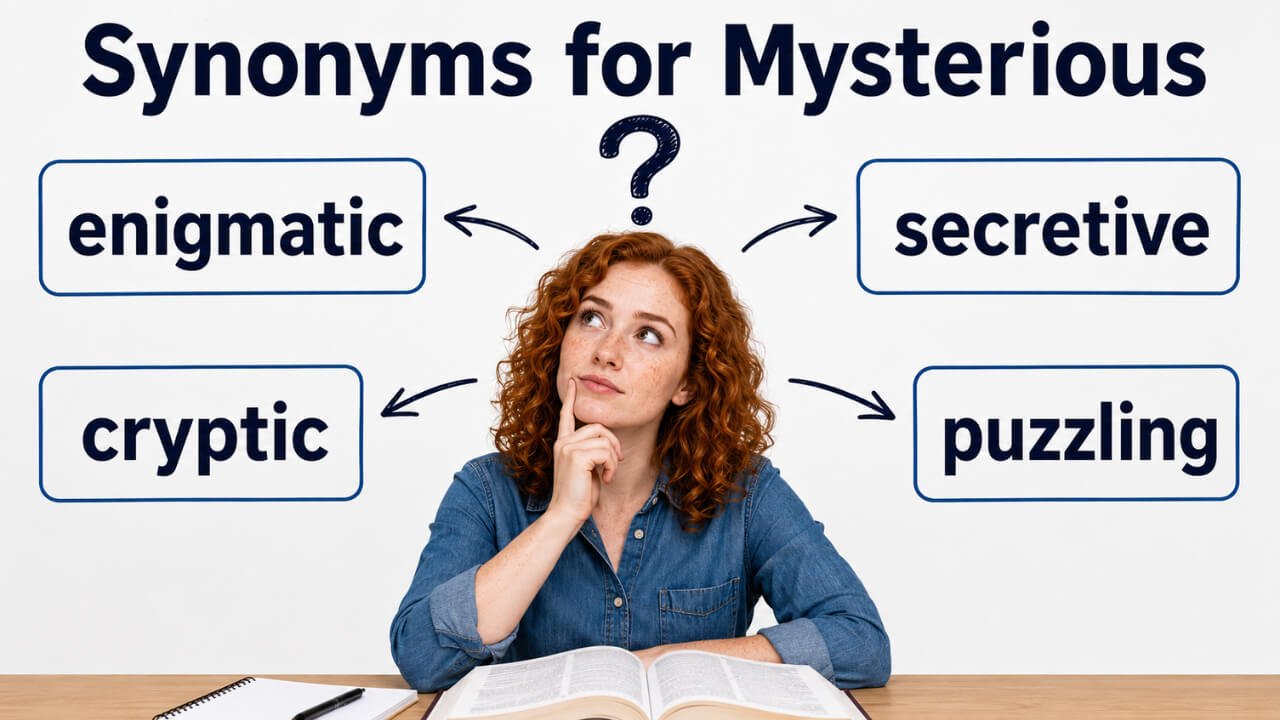
Quick Answer: Synonyms for mysterious include enigmatic, puzzling, strange, secretive, unknown, obscure, cryptic, unexplained, hidden, and mystifying. Use enigmatic for something hard to understand, secretive for a person who hides information, cryptic for unclear messages, unexplained for events without a known cause, obscure for something not well known, and mystifying when something creates confusion or curiosity.
Pronunciation and Word Details
Word: Mysterious
Pronunciation: /mɪˈstɪəriəs/
Part of Speech: Adjective
Meaning: Difficult to understand, explain, or identify because important details are hidden or unknown.
US Pronunciation:
UK Pronunciation:
What Does “Mysterious” Mean?
Direct Answer: Mysterious means difficult to understand, explain, recognize, or solve because something is unknown, hidden, strange, or unclear.
Mysterious is an adjective. It can describe a person, place, event, sound, object, message, feeling, or situation. A mysterious person may hide their thoughts. A mysterious sound may have no clear source. A mysterious event may not have an obvious explanation. The word works before a noun, as in a mysterious letter, or after a linking verb, as in the case remains mysterious.
Meaning, Tone, and Context of “Mysterious”
Tone: Mysterious is usually neutral, curious, emotional, or slightly dramatic.
It can sound positive when it describes something interesting, magical, deep, or attractive. It can sound negative when it suggests danger, secrecy, confusion, or suspicion. The word is common in stories, news writing, conversation, academic discussion, descriptive writing, reports, and essays.
In formal writing, enigmatic, unexplained, obscure, and ambiguous often sound more precise. In casual speech, strange, weird, secretive, and puzzling feel more natural.
When and How to Use “Mysterious”
For Unknown Causes: Use mysterious when something happens but the reason is not clear.
Example: A mysterious noise came from the empty room.
For Hidden Information: Use it when important details are not available.
Example: The company made a mysterious change to its plans.
For Secretive People: Use it when someone gives little information about themselves.
Example: The new neighbor seemed quiet and mysterious.
For Strange Events: Use it when an event feels unusual or hard to explain.
Example: The lights went out under mysterious circumstances.
For Storytelling: Use it when you want to create curiosity, suspense, or interest.
Example: The novel begins with a mysterious letter on the doorstep.
Best Synonyms for Mysterious
Enigmatic: Hard to understand or explain, often in an interesting way.
Example: Her enigmatic smile made everyone wonder what she knew.
Puzzling: Confusing and difficult to solve.
Example: The missing document created a puzzling problem.
Secretive: Hiding information or avoiding openness.
Example: He became secretive about his weekend plans.
Cryptic: Having a hidden or unclear meaning.
Example: The note contained a cryptic warning.
Unexplained: Not yet understood or accounted for.
Example: The team studied the unexplained signal.
Obscure: Not clearly known, understood, or noticed.
Example: The book referred to an obscure historical event.
Mystifying: Very confusing or difficult to understand.
Example: His sudden decision was mystifying.
Strange: Unusual, unexpected, or hard to understand.
Example: A strange sound echoed through the hallway.
Hidden: Kept out of sight or not openly known.
Example: The map revealed a hidden entrance.
Ambiguous: Open to more than one meaning or interpretation.
Example: Her ambiguous answer left the question unresolved.
50 Synonyms for Mysterious with Short Meanings
- Enigmatic: Difficult to understand in an intriguing way.
- Puzzling: Confusing and hard to solve.
- Secretive: Tending to hide information.
- Cryptic: Unclear and full of hidden meaning.
- Unexplained: Not yet understood or clarified.
- Obscure: Not clearly known or understood.
- Mystifying: Deeply confusing or hard to explain.
- Strange: Unusual or not easily understood.
- Hidden: Kept out of sight or knowledge.
- Ambiguous: Having more than one possible meaning.
- Unknown: Not identified or familiar.
- Unclear: Not easy to see or understand.
- Shadowy: Dark, vague, or not fully known.
- Veiled: Covered, hidden, or indirectly expressed.
- Concealed: Carefully hidden from view or knowledge.
- Secret: Kept private or not revealed.
- Private: Not openly shared with others.
- Unrevealed: Not yet made known.
- Undisclosed: Not officially stated or shared.
- Unnamed: Not identified by name.
- Anonymous: Having no known name or identity.
- Unidentified: Not recognized or named.
- Baffling: Extremely confusing.
- Perplexing: Causing uncertainty or confusion.
- Confusing: Difficult to understand clearly.
- Bewildering: Making someone feel lost or uncertain.
- Curious: Strange or interesting enough to attract attention.
- Odd: Different from what is normal or expected.
- Weird: Very strange or unusual.
- Eerie: Strange in a frightening or unsettling way.
- Uncanny: Strange and hard to explain.
- Haunting: Staying in the mind in a strange or emotional way.
- Elusive: Difficult to find, define, or understand.
- Inscrutable: Impossible or very hard to read or understand.
- Impenetrable: Extremely difficult to understand or access.
- Opaque: Not clear or easy to understand.
- Vague: Lacking clear details.
- Indistinct: Not clear in form, sound, or meaning.
- Dim: Not clear, bright, or easily understood.
- Arcane: Known or understood by very few people.
- Occult: Connected with hidden or supernatural knowledge.
- Esoteric: Understood by a small group only.
- Oracular: Mysterious and difficult to interpret.
- Sibylline: Darkly mysterious or hard to interpret.
- Riddle like: Similar to a puzzle or riddle.
- Unfathomable: Too deep or difficult to understand.
- Inexplicable: Impossible to explain clearly.
- Unsolved: Not yet answered or resolved.
- Questionable: Uncertain or open to doubt.
- Suspicious: Creating doubt, concern, or mistrust.
Read Also:
Synonyms for Yes

Synonyms for Mysterious by Context
When Mysterious Means Hard to Understand
Use these synonyms when something is confusing, unclear, or difficult to explain.
Useful Synonyms: Enigmatic, puzzling, mystifying, baffling, perplexing.
Example: The professor gave an enigmatic answer that raised more questions.
When Mysterious Means Hidden or Secret
Use these words when information, identity, motive, or meaning is not openly shown.
Useful Synonyms: Secretive, hidden, concealed, veiled, undisclosed.
Example: The letter mentioned a concealed plan.
When Mysterious Means Unknown
Use these options when a person, place, object, event, or cause has not been identified.
Useful Synonyms: Unknown, unidentified, unnamed, anonymous, unrevealed.
Example: An unidentified caller left a short message.
When Mysterious Means Strange or Unusual
Use these words when something feels odd, eerie, or not normal.
Useful Synonyms: Strange, weird, odd, uncanny, eerie.
Example: An eerie silence filled the old house.
When Mysterious Means Deep or Difficult to Interpret
Use these words for complex ideas, symbolic language, old texts, or hidden meanings.
Useful Synonyms: Cryptic, obscure, ambiguous, arcane, esoteric.
Example: The poem used cryptic symbols and obscure references.
Another Word for Mysterious
Direct Answer: The best single replacement for mysterious is usually enigmatic, because it means difficult to understand in a way that creates curiosity.
The best alternative depends on context. Use secretive for a person who hides information, cryptic for unclear wording, unexplained for an event without a known cause, and eerie for something strange and unsettling.
Original: She gave him a mysterious smile.
Better Option: She gave him an enigmatic smile.
Original: A mysterious sound came from the attic.
Better Option: An unexplained sound came from the attic.
Original: He was mysterious about his past.
Better Option: He was secretive about his past.
Original: The message was mysterious and hard to read.
Better Option: The message was cryptic and hard to read.
When Not to Use “Mysterious”
Do not use mysterious when a more exact word would explain the situation better. The word can sound vague if the reader does not know whether you mean secret, confusing, strange, unknown, or suspicious. It can also sound too dramatic in formal reports when unexplained, undisclosed, or unclear would be more accurate.
Weak: The results were mysterious.
Better: The results were unexplained.
Weak: He gave a mysterious answer.
Better: He gave an ambiguous answer.
Weak: The person was mysterious.
Better: The person was secretive about his identity.
Weak: The rule sounded mysterious.
Better: The rule sounded unclear and confusing.
Words Commonly Confused With Mysterious
Mysterious vs Enigmatic: Mysterious is general, while enigmatic often describes something or someone that is hard to understand in an intriguing way.
Mysterious vs Secretive: Mysterious can describe anything unknown or unclear, while secretive usually describes a person or group that hides information.
Mysterious vs Cryptic: Mysterious is broad, while cryptic usually describes words, messages, clues, or statements with hidden meaning.
Mysterious vs Strange: Strange means unusual or unexpected, while mysterious means hard to explain or understand.
Mysterious vs Suspicious: Suspicious suggests doubt or possible wrongdoing, while mysterious only means unclear or unknown.
Mysterious vs Obscure: Obscure means not well known or not clearly understood, while mysterious often adds curiosity or suspense.
Which Synonym Should You Choose?
Choose enigmatic when writing about a person, smile, expression, clue, or situation that feels interesting but hard to understand.
Choose secretive when someone hides personal details, plans, motives, or information.
Choose cryptic when a message, note, clue, or answer has hidden or unclear meaning.
Choose unexplained when an event, sound, result, or change has no known reason.
Choose obscure when something is not well known, not easy to find, or not clearly understood.
Choose puzzling when something creates confusion and needs thought.
Choose eerie when something is strange in a spooky or unsettling way.
Choose ambiguous when a statement, answer, or meaning can be understood in more than one way.
Choose undisclosed in formal writing when information has not been officially shared.
Real Life Examples of “Mysterious” in Sentences
Original: A mysterious woman entered the room.
Better Option: An enigmatic woman entered the room.
Original: The mysterious noise woke everyone.
Better Option: The unexplained noise woke everyone.
Original: His mysterious reply confused the team.
Better Option: His cryptic reply confused the team.
Original: The case remains mysterious.
Better Option: The case remains unsolved.
Original: She was mysterious about her childhood.
Better Option: She was secretive about her childhood.
Original: The book described a mysterious island.
Better Option: The book described an obscure island.
Original: A mysterious shadow moved across the wall.
Better Option: A shadowy figure moved across the wall.
Original: The results were mysterious to the researchers.
Better Option: The results were baffling to the researchers.
Original: The old house felt mysterious at night.
Better Option: The old house felt eerie at night.
Original: He received a mysterious message.
Better Option: He received a cryptic message.
Synonym Groups and Usage Differences
Mystery and Confusion Group
Words such as puzzling, baffling, perplexing, and mystifying focus on mental confusion. They work well when something is difficult to solve or understand.
Example: The sudden error was baffling to the whole team.
Secrecy and Hidden Information Group
Words such as secretive, hidden, concealed, veiled, and undisclosed focus on information that is not openly shown.
Example: The agreement included several undisclosed terms.
Unknown Identity Group
Words such as unknown, anonymous, unidentified, and unnamed describe people, objects, or causes that have not been identified.
Example: An anonymous donor paid for the repairs.
Strange Atmosphere Group
Words such as eerie, uncanny, weird, and haunting create a stronger emotional feeling. They are useful in stories, descriptions, and suspenseful scenes.
Example: The empty hallway had an uncanny silence.
Hidden Meaning Group
Words such as cryptic, ambiguous, obscure, and arcane describe language, symbols, ideas, or messages that are difficult to interpret.
Example: The ancient text contained arcane instructions.
Antonyms of Mysterious
Clear: Easy to understand or see.
Obvious: Easily noticed or understood.
Plain: Simple and not hidden.
Known: Already identified or understood.
Explained: Made clear through reasons or details.
Transparent: Open, honest, and easy to understand.
Straightforward: Direct and simple.
Familiar: Well known or easily recognized.
Understandable: Easy to make sense of.
Unambiguous: Having only one clear meaning.
Comparison: Mysterious vs Related Words
Mysterious vs Enigmatic
Difference: Mysterious is a broad word for anything hard to explain. Enigmatic often sounds more refined and suggests a person, expression, or situation that attracts curiosity.
Example With Mysterious: The letter had a mysterious tone.
Example With Enigmatic: The letter had an enigmatic tone.
Mysterious vs Secretive
Difference: Mysterious describes something unclear or unknown. Secretive describes someone who intentionally hides information.
Example With Mysterious: The stranger looked mysterious.
Example With Secretive: The stranger was secretive about his name.
Mysterious vs Cryptic
Difference: Mysterious can describe people, places, events, or feelings. Cryptic is best for unclear words, clues, notes, or messages.
Example With Mysterious: The warning sounded mysterious.
Example With Cryptic: The warning sounded cryptic.
Mysterious vs Obscure
Difference: Mysterious suggests hidden meaning or curiosity. Obscure means not widely known or not clearly understood.
Example With Mysterious: They found a mysterious symbol on the wall.
Example With Obscure: They found an obscure symbol in the old book.
Mysterious vs Suspicious
Difference: Mysterious means unknown or hard to explain. Suspicious suggests that something may be wrong, dishonest, or unsafe.
Example With Mysterious: A mysterious package arrived at noon.
Example With Suspicious: A suspicious package was left near the gate.
Common Phrases and Expressions With Mysterious
Mysterious Person: Someone whose thoughts, past, or motives are not clear.
Mysterious Stranger: An unknown person who creates curiosity or suspicion.
Mysterious Noise: A sound with no clear source.
Mysterious Disappearance: A disappearance without an obvious explanation.
Mysterious Circumstances: Conditions that are unclear or unexplained.
Mysterious Smile: A smile that hides meaning or emotion.
Mysterious Message: A message that is hard to interpret.
Mysterious Place: A location that feels unknown, strange, or secret.
Mysterious Event: An event that is difficult to explain.
Mysterious Past: A history that is hidden, unclear, or not fully known.
Common Mistakes to Avoid
One common mistake is using mysterious when the meaning is actually secretive. A person is secretive when they choose to hide information. A situation is mysterious when it is difficult to understand.
Another mistake is using mysterious too often in the same paragraph. Repetition makes writing weak. Replace it with enigmatic, cryptic, unexplained, obscure, or puzzling when the context is clear.
Also avoid using dramatic words when plain language is better. In reports or formal writing, unexplained result, undisclosed reason, or unclear statement may be stronger than mysterious result, mysterious reason, or mysterious statement.
Conclusion
Synonyms for mysterious help you describe unknown people, hidden meanings, confusing events, and strange situations with better accuracy. Use enigmatic for something intriguing, secretive for hidden behavior, cryptic for unclear messages, unexplained for events without known causes, and eerie for unsettling scenes. For formal writing, ambiguous, obscure, and undisclosed can sound more exact. The best word depends on whether the mystery involves secrecy, confusion, identity, atmosphere, or hidden meaning.
FAQs About Synonyms for Mysterious
What is the best synonym for mysterious?
Answer: The best synonym for mysterious is enigmatic when something is hard to understand in an interesting way. For hidden information, secretive may be better.
What is a formal synonym for mysterious?
Answer: Formal synonyms for mysterious include enigmatic, ambiguous, obscure, unexplained, and undisclosed.
What is a casual synonym for mysterious?
Answer: Casual synonyms include strange, weird, puzzling, and odd. These words sound natural in everyday conversation.
What is another word for a mysterious person?
Answer: Another word for a mysterious person is enigmatic. If the person hides information on purpose, secretive is more accurate.
Is mysterious the same as suspicious?
Answer: No. Mysterious means hard to explain or understand. Suspicious means something creates doubt, concern, or possible mistrust.
What is a synonym for mysterious message?
Answer: A good synonym for a mysterious message is cryptic message, because cryptic means unclear or having hidden meaning.
What is the opposite of mysterious?
Answer: Opposites of mysterious include clear, obvious, known, explained, transparent, and straightforward.
