
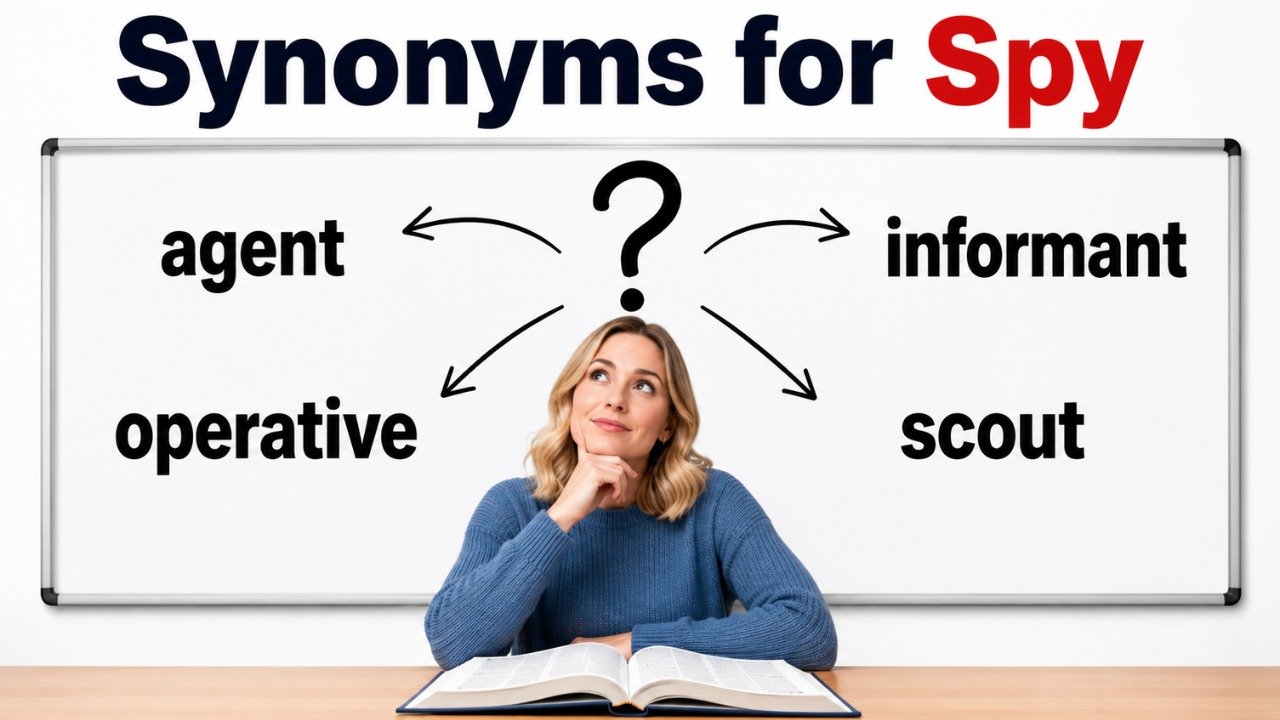
Quick Answer: The best synonyms for spy include agent, operative, secret agent, intelligence officer, informant, mole, infiltrator, observer, snoop, and surveil. Use agent or operative in formal and professional writing. Choose informant for someone who secretly provides information, mole for a hidden insider, and infiltrator for someone who enters a group secretly. Observer is a neutral choice, while snoop is more casual and negative. As a verb, surveil, monitor, shadow, and track describe different forms of secret observation.
Pronunciation and Word Details
Word: Spy.
Pronunciation: /spaɪ/.
Part of Speech: Noun and verb.
Meaning: A spy is someone who secretly collects information, or to spy means to watch or investigate secretly.
US Pronunciation:
UK Pronunciation:
What Does “Spy” Mean?
Spy means a person who secretly collects information about another person, organization, group, or country. It can also mean to secretly watch, follow, or investigate someone.
As a noun, spy refers to the person performing the secret activity.
Example: The spy gathered information about the rival group.
As a verb, spy describes the action of secretly observing or collecting information.
Example: They tried to spy on the private meeting.
Spy can also mean to notice or catch sight of something, especially from a distance.
Example: She spied a small boat near the shore.
The word may appear in formal intelligence discussions, crime stories, casual conversations, games, and figurative descriptions. Its meaning changes slightly depending on whether it refers to secret information gathering, hidden observation, following someone, or simply noticing something.
Meaning, Tone, and Context of “Spy”
Spy usually has a secretive, suspicious, or negative tone. It often suggests that someone is collecting information without permission or knowledge.
In formal contexts, spy may describe a person involved in intelligence gathering. Words such as intelligence agent, operative, intelligence officer, and covert agent are often more precise in professional writing.
In everyday conversation, spy can describe someone who watches another person too closely.
Example: Are you trying to spy on me?
In humorous situations, the word may be used playfully.
Example: The child pretended to be a spy while searching for hidden clues.
In fiction, spy is often dramatic and adventurous. It may suggest secret missions, hidden identities, coded messages, and confidential information.
As a verb, spy can also be neutral when it means notice or see.
Example: I spied a familiar face across the room.
Writers should consider the context carefully because calling someone a spy can sound accusatory. A more neutral word such as observer, investigator, or monitor may be better when secrecy or wrongdoing is not intended.
When and How to Use “Spy”
For Secret Intelligence: Use spy for a person who secretly gathers political, military, business, or organizational information.
Example: The spy collected confidential documents during the mission.
For Hidden Observation: Use spy when someone watches another person without being noticed.
Example: He was accused of trying to spy on his neighbors.
For Following Someone: Use spy when a person secretly follows or tracks another individual.
Example: The detective suspected that someone had been sent to spy on him.
For Entering a Group Secretly: Use spy when someone joins a group to learn private information.
Example: The organization discovered a spy among its members.
For Casual Suspicion: Use spy in conversation when someone appears overly curious about another person’s private activities.
Example: Stop trying to spy on my conversation.
For Playful Situations: Use spy when describing games, costumes, puzzles, or imaginary missions.
Example: The children played spy and searched for hidden messages.
For Noticing Something: Use spy when something is suddenly seen or noticed.
Example: We spied a bright light in the distance.
For Written Narratives: Use spy to create a feeling of secrecy, danger, mystery, or suspense.
Example: A mysterious spy waited silently outside the building.
Best Synonyms for Spy
Agent
Synonym: A person who acts for a government, organization, or other authority, sometimes in secret.
Example: The agent was sent to gather information about the operation.
Operative
Synonym: A person who performs secret, political, military, or intelligence work.
Example: The operative completed the confidential assignment successfully.
Secret Agent
Synonym: A person whose identity and activities are hidden while collecting information.
Example: The secret agent entered the building using a false identity.
Intelligence Officer
Synonym: A professional who gathers, studies, or manages confidential information.
Example: The intelligence officer prepared a detailed security report.
Informant
Synonym: A person who secretly provides information to another person or authority.
Example: An informant revealed where the group planned to meet.
Mole
Synonym: A hidden insider who secretly passes information to an opposing group.
Example: Investigators believed that a mole was leaking confidential plans.
Infiltrator
Synonym: Someone who secretly enters a group or organization to observe or disrupt it.
Example: The infiltrator gained the members’ trust before collecting evidence.
Observer
Synonym: A person who watches people, situations, or events carefully.
Example: A quiet observer recorded everything that happened during the meeting.
Snoop
Synonym: A person who secretly looks for private information, usually in a rude or intrusive way.
Example: The office snoop was always listening to private conversations.
Surveil
Synonym: To watch a person or place closely, especially for security or investigation.
Example: The team was instructed to surveil the building throughout the night.
50 Synonyms for Spy with Short Meanings
- Agent: A person who performs work for an authority or organization.
- Secret Agent: A person who carries out confidential assignments under a hidden identity.
- Intelligence Agent: Someone who secretly gathers valuable information.
- Operative: A person who performs a planned secret operation.
- Covert Operative: Someone who works secretly to complete sensitive assignments.
- Undercover Agent: An agent who hides their real identity while investigating.
- Intelligence Officer: A professional who gathers and analyzes confidential information.
- Field Agent: An agent who carries out practical assignments outside an office.
- Case Officer: A person who manages intelligence sources and operations.
- Informant: Someone who secretly provides useful information.
- Informer: A person who reports private information about others.
- Intelligence Source: A person who supplies confidential knowledge.
- Mole: A hidden insider who passes information to another group.
- Plant: A secretly placed person who observes or influences a group.
- Infiltrator: Someone who secretly enters a group to collect information.
- Double Agent: A spy who appears to serve one side while secretly helping another.
- Sleeper Agent: A hidden agent who remains inactive until needed.
- Scout: A person sent ahead to collect information about an area or situation.
- Reconnaissance Agent: Someone who examines an area to gather strategic information.
- Observer: A person who watches events or behavior carefully.
- Watcher: Someone who keeps a person or place under observation.
- Surveillance Observer: A person assigned to watch and record activities.
- Snooper: Someone who searches for private information without permission.
- Eavesdropper: A person who secretly listens to private conversations.
- Tracker: Someone who follows a person’s location or movements.
- Investigator: A person who examines facts to discover the truth.
- Detective: Someone who investigates suspicious activities or crimes.
- Sleuth: A clever investigator who searches for hidden information.
- Intelligence Gatherer: A person who collects information for analysis.
- Covert Observer: Someone who secretly watches people or events.
- Secret Investigator: A person who investigates without revealing their purpose.
- Surveillance Specialist: Someone trained to observe and document activities.
- Reconnaissance Specialist: A person skilled in gathering information about places or movements.
- Undercover Operative: Someone who secretly works within a group using a hidden identity.
- Intelligence Collector: A person responsible for obtaining confidential information.
- Watch: To look at someone or something carefully over time.
- Observe: To notice and study actions or events closely.
- Monitor: To regularly check a person, place, activity, or system.
- Surveil: To keep a person or location under close observation.
- Track: To follow movements, progress, or activities.
- Follow: To move behind someone or watch their actions.
- Trail: To secretly follow someone from a distance.
- Shadow: To follow a person closely without being noticed.
- Tail: To follow someone secretly, often during an investigation.
- Snoop: To search secretly for private or personal information.
- Pry: To ask questions or investigate matters that should remain private.
- Eavesdrop: To secretly listen to a private conversation.
- Infiltrate: To secretly enter a group, place, or organization.
- Investigate: To examine a situation carefully to discover facts.
- Reconnoiter: To inspect an area in order to gather useful information.
Read Also:
Synonyms for Imply
Synonyms for Spy by Context
When Spy Means a Secret Intelligence Worker
Agent, operative, secret agent, intelligence agent, intelligence officer, covert operative, and field agent are useful when spy refers to someone performing organized intelligence work.
Agent is the broadest and most natural formal replacement. Operative emphasizes active participation in a mission. Intelligence officer sounds professional and may include information analysis as well as collection.
Example: The intelligence officer studied the confidential reports before the operation.
Example: A covert operative was sent to gather information from inside the group.
When Spy Means a Hidden Insider
Mole, plant, infiltrator, sleeper agent, and double agent describe people who secretly enter or remain inside a group.
A mole is usually a trusted insider who passes information to another side. A plant is deliberately placed inside a group. An infiltrator enters secretly to observe, influence, or investigate.
Example: The company suspected that a mole had shared its private plans.
Example: The infiltrator attended every meeting without revealing his real purpose.
When Spy Means an Information Provider
Informant, informer, intelligence source, and source describe someone who gives information to another person or authority.
Informant is often the most neutral and precise choice. Informer may sound more negative because it can suggest betrayal. Intelligence source is formal and focuses on the person’s role as a provider of information.
Example: The informant gave investigators an important warning.
Example: Officials protected the identity of the intelligence source.
When Spy Means to Watch Secretly
Surveil, monitor, observe, watch, and keep under observation describe careful watching.
Surveil is formal and usually suggests planned observation. Monitor may be neutral and does not always imply secrecy. Observe focuses on careful attention rather than hidden motives.
Example: Investigators continued to surveil the entrance.
Example: Staff members monitored the area for unusual activity.
When Spy Means to Follow Someone
Shadow, tail, trail, track, and follow are useful when someone secretly watches another person’s movements.
Shadow suggests staying close to the person. Tail is common in crime and investigation contexts. Track emphasizes locating or recording movement.
Example: The investigator was ordered to shadow the suspect.
Example: Someone had been trailing her since she left the building.
When Spy Means to Search for Private Information
Snoop, pry, eavesdrop, and investigate can describe attempts to discover information.
Snoop and pry are casual and usually disapproving. Eavesdrop specifically refers to secretly listening. Investigate is more neutral and professional.
Example: It is rude to snoop through another person’s belongings.
Example: He tried to eavesdrop on the private discussion.
When Spy Means to Notice Something
Notice, see, spot, detect, glimpse, and catch sight of are useful when spy means to suddenly observe something.
These alternatives do not suggest secret intelligence activity.
Example: She spotted a rare bird near the lake.
Example: We caught sight of a small cabin through the trees.
Another Word for Spy
The best single replacement for spy is agent when the word is used as a noun. Agent is clear, professional, and suitable for most formal contexts.
When spy is used as a verb, observe is a useful neutral alternative. Surveil is better when the watching is organized and secret, while shadow is better when someone is being followed.
Original: The spy entered the private meeting.
Better Option: The undercover agent entered the private meeting.
Original: Someone was sent to spy on the group.
Better Option: Someone was sent to observe the group secretly.
Original: They continued to spy on the building.
Better Option: They continued to surveil the building.
Original: The detective spied on the suspect throughout the afternoon.
Better Option: The detective shadowed the suspect throughout the afternoon.
When Not to Use “Spy”
Do not use spy when the situation does not involve secrecy, hidden observation, or confidential information. The word may sound too dramatic or accusatory in neutral situations.
Weak: The teacher spied on the students during the examination.
Better: The teacher monitored the students during the examination.
Do not call an ordinary observer a spy unless that person is intentionally hiding their purpose.
Weak: A spy watched the sports match from the front row.
Better: An observer watched the sports match from the front row.
Avoid spy when investigator provides a more professional and accurate meaning.
Weak: The insurance spy examined the damaged property.
Better: The insurance investigator examined the damaged property.
Do not use spy when someone simply notices an object.
Weak: She spied the missing document on her desk.
Better: She spotted the missing document on her desk.
Avoid repeating spy several times in the same paragraph.
Weak: The spy tried to spy on another spy who was spying on the meeting.
Better: The operative tried to observe another agent who was monitoring the meeting.
Do not use spy casually when it may create a serious accusation.
Weak: My coworker is definitely a spy because she asked about the project.
Better: My coworker seems unusually curious about the project.
Words Commonly Confused With Spy
Spy vs Agent: A spy secretly gathers information, while an agent is a broader term for someone acting on behalf of a person or organization. Not every agent is a spy.
Spy vs Operative: Spy emphasizes secret information gathering. Operative emphasizes participation in a planned operation or mission.
Spy vs Informant: A spy actively collects information, while an informant usually provides information to someone else.
Spy vs Mole: A spy may work from outside or inside a group. A mole is specifically a hidden insider who secretly helps an opposing side.
Spy vs Infiltrator: A spy gathers secret information. An infiltrator secretly enters a group or location, often to observe, influence, or disrupt it.
Spy vs Detective: A spy works secretly to collect confidential information. A detective investigates facts, suspicious activity, or crimes.
Spy vs Observer: A spy watches secretly and often has a hidden purpose. An observer may watch openly and neutrally.
Spy vs Snoop: Spy may describe serious intelligence activity. Snoop usually describes casual, rude, or intrusive curiosity.
Spy vs Surveil: Spy can be a noun or verb. Surveil is a verb that specifically means to keep someone or somewhere under observation.
Spy vs Eavesdrop: Spy covers many forms of secret information gathering. Eavesdrop refers specifically to secretly listening to a conversation.
Which Synonym Should You Choose?
Choose agent when you need a broad, formal noun for someone carrying out confidential work.
Choose operative when emphasizing a person’s active role in a planned mission.
Choose secret agent when the person’s identity and assignment are deliberately hidden.
Choose intelligence officer when writing formal reports, essays, or professional descriptions about intelligence work.
Choose informant when someone secretly supplies information rather than personally conducting a complete investigation.
Choose mole when describing a trusted insider who secretly passes information to another side.
Choose infiltrator when someone secretly enters a group, organization, or location.
Choose observer when the watching is neutral, open, or not necessarily suspicious.
Choose monitor when someone regularly checks activity, behavior, or progress.
Choose surveil when describing formal, organized, and continuous observation.
Choose shadow when one person secretly follows another person closely.
Choose tail when writing crime, mystery, or investigation scenes involving secret following.
Choose track when the focus is on movements, location, or progress.
Choose snoop in casual speech when someone rudely searches for private information.
Choose eavesdrop when someone secretly listens to a private conversation.
Choose investigate in reports, essays, emails, and professional writing when the purpose is to discover facts.
Choose spot or notice when spy simply means to see something unexpectedly.
Real Life Examples of “Spy” in Sentences
Original: The spy secretly entered the organization.
Better Option: The infiltrator secretly entered the organization.
Original: Police believed a spy was sharing information with the group.
Better Option: Police believed an informant was sharing information with the group.
Original: Someone was sent to spy on the warehouse.
Better Option: Someone was sent to surveil the warehouse.
Original: The journalist tried to spy on the private discussion.
Better Option: The journalist tried to eavesdrop on the private discussion.
Original: She accused her neighbor of spying on her.
Better Option: She accused her neighbor of secretly watching her.
Original: The detective spied on the suspect after work.
Better Option: The detective tailed the suspect after work.
Original: The spy had worked inside the organization for several years.
Better Option: The mole had worked inside the organization for several years.
Original: The children pretended to be spies in the garden.
Better Option: The children pretended to be secret agents in the garden.
Original: I spied a small animal behind the tree.
Better Option: I spotted a small animal behind the tree.
Original: The manager was spying on every employee’s activity.
Better Option: The manager was monitoring every employee’s activity.
Synonym Groups and Usage Differences
Intelligence Personnel Group
Agent, operative, intelligence officer, field agent, and secret agent refer to people who perform confidential or intelligence related work.
Agent is broad and flexible. Operative suggests action and missions. Intelligence officer sounds formal and professional.
Example: The intelligence officer reviewed the information collected by the field agent.
Hidden Insider Group
Mole, plant, infiltrator, sleeper agent, and double agent describe people secretly positioned within a group.
Mole emphasizes betrayal from inside. Plant emphasizes deliberate placement. Sleeper agent emphasizes remaining inactive until receiving instructions.
Example: Investigators discovered that a mole had been passing information for months.
Information Provider Group
Informant, informer, source, and intelligence source refer to people who supply information.
Informant is usually the safest general choice. Informer can sound judgmental. Source is neutral and may be used when the person’s identity is protected.
Example: A reliable informant provided details about the planned meeting.
Observation Group
Observe, watch, monitor, and surveil describe looking at someone or something carefully.
Observe is neutral. Watch is common and conversational. Monitor suggests repeated checking. Surveil suggests organized observation for investigative or security purposes.
Example: The team continued to monitor the entrance throughout the evening.
Following Group
Shadow, tail, trail, track, and follow describe watching a person’s movement.
Shadow and tail often imply secrecy. Trail suggests following from behind. Track focuses on maintaining knowledge of someone’s location.
Example: The investigator was asked to shadow the suspect without being noticed.
Intrusive Curiosity Group
Snoop, pry, and eavesdrop describe improper attempts to discover private information.
Snoop may involve searching through possessions or records. Pry involves intrusive questions. Eavesdrop involves secretly listening.
Example: It is inappropriate to pry into another person’s private affairs.
Investigation Group
Investigate, inspect, examine, and detect describe efforts to discover facts or identify problems.
These words are often more neutral and professional than spy.
Example: A specialist was hired to investigate the unexplained data loss.
Discovery Group
Spot, notice, see, detect, glimpse, and catch sight of can replace spy when it means to suddenly see something.
These words do not suggest hidden observation.
Example: She caught sight of a familiar person in the crowd.
Antonyms of Spy
The opposite of spy depends on whether spy refers to a secret person, an action, or hidden information gathering.
Open Observer: Someone who watches without hiding their identity or purpose.
Public Representative: A person who openly represents an organization or authority.
Ally: Someone who openly supports another person or group.
Supporter: A person who gives visible help or encouragement.
Protector: Someone who guards people or information rather than secretly collecting it.
Defender: A person who protects someone from danger, attack, or accusation.
Discloser: Someone who reveals information rather than secretly gathering it.
Revealer: A person who makes hidden facts known.
Ignore: To give no attention to a person, activity, or situation.
Overlook: To fail to notice or examine something.
Disregard: To intentionally pay no attention to something.
Trust: To believe in someone without secretly checking their actions.
Reveal: To make secret information visible or known.
Announce: To communicate information openly and publicly.
Withdraw: To move away instead of continuing to observe or follow.
Comparison: Spy vs Related Words
Spy vs Agent
Spy specifically suggests secret information gathering. Agent is broader and can describe anyone authorized to act for another person or organization.
Example With Spy: The spy collected confidential information about the group.
Example With Agent: The agent delivered the official documents.
Spy vs Operative
Spy focuses on secrecy and intelligence. Operative focuses on carrying out a particular mission or operation.
Example With Spy: The spy listened carefully to the private conversation.
Example With Operative: The operative entered the location to complete the assignment.
Spy vs Informant
A spy actively searches for information. An informant usually gives information they already know or can access.
Example With Spy: The spy photographed the confidential files.
Example With Informant: The informant explained where the files were stored.
Spy vs Mole
A spy may operate from many locations. A mole is hidden inside the organization being observed.
Example With Spy: The spy watched the organization from a nearby building.
Example With Mole: The mole attended private meetings as a trusted member.
Spy vs Infiltrator
Spy describes the purpose of gathering information. Infiltrator describes the act of secretly entering a group or place.
Example With Spy: The spy collected details about the group’s plans.
Example With Infiltrator: The infiltrator joined the group using a false background.
Spy vs Detective
A spy seeks confidential information, often secretly. A detective investigates crimes, mysteries, or suspicious events.
Example With Spy: The spy searched for classified documents.
Example With Detective: The detective examined the evidence at the scene.
Spy vs Observer
A spy has a hidden purpose. An observer may watch openly without interfering.
Example With Spy: The spy watched the meeting from a concealed position.
Example With Observer: The observer sat quietly at the back of the room.
Spy vs Snoop
Spy can describe serious or organized intelligence activity. Snoop usually describes intrusive curiosity in everyday situations.
Example With Spy: The spy gathered information about the rival organization.
Example With Snoop: The snoop looked through another employee’s desk.
Spy vs Surveil
Spy can refer to either a person or an action. Surveil is only a verb and describes planned observation.
Example With Spy: They tried to spy on the building.
Example With Surveil: Investigators were assigned to surveil the building.
Spy vs Shadow
Spy is a broad term for secret observation or information gathering. Shadow specifically means following someone closely and secretly.
Example With Spy: They hired someone to spy on the suspect.
Example With Shadow: They hired an investigator to shadow the suspect.
Common Phrases and Expressions With “Spy”
Spy on Someone: To secretly watch or investigate another person.
Example: He suspected that someone was trying to spy on him.
Spy Something: To suddenly notice or see something.
Example: She spied an empty seat near the window.
Spy Out the Land: To secretly examine a place before taking action.
Example: The scout was sent to spy out the land before the journey.
Spy Network: An organized group of people who secretly gather information.
Example: Investigators uncovered a large spy network.
Spy Ring: A group of spies working together.
Example: The authorities believed that a spy ring was operating in the area.
Spy Mission: A secret assignment involving information gathering.
Example: The character accepted a dangerous spy mission.
Spy Story: A story involving secret agents, hidden information, and confidential missions.
Example: She enjoys reading a suspenseful spy story.
Spy Camera: A small or hidden camera used for secret observation.
Example: The story involved a spy camera hidden inside an ordinary object.
Spy Satellite: A satellite designed to collect information through observation.
Example: The novel described images collected by a spy satellite.
Play Spy: To pretend to be a secret agent, usually as a game.
Example: The children decided to play spy and search for imaginary clues.
Common Mistakes to Avoid
One common mistake is using spy when the situation is not secret. If someone is watching openly, observer, monitor, or supervisor may be more accurate.
Another mistake is confusing a spy with an informant. A spy usually gathers information, while an informant provides information to another person or authority.
Writers may also use spy too often in mystery or crime writing. Repeating agent, operative, observer, investigator, or infiltrator can improve variety and precision.
Remember that spy is both a noun and a verb.
Correct Noun: The spy entered the building.
Correct Verb: They planned to spy on the meeting.
When spy is used in the present tense with he, she, or it, change it to spies.
Incorrect: She spy on the group every evening.
Correct: She spies on the group every evening.
The past tense of spy is spied, not spyed.
Incorrect: He spyed on the meeting.
Correct: He spied on the meeting.
Use spy on when describing secret observation of a person, group, or activity.
Unnatural: They spied the employees for several weeks.
Natural: They spied on the employees for several weeks.
However, spy can be used without on when it means notice.
Correct: She spied a familiar face in the crowd.
Avoid using snoop, pry, and eavesdrop as exact replacements in every sentence. Snoop involves searching for private information, pry involves intrusive questioning, and eavesdrop specifically involves listening.
Do not use mole for every secret agent. A mole must be secretly positioned inside the group whose information is being shared.
Finally, consider the seriousness of the word. Calling someone a spy may suggest betrayal, illegal activity, or deliberate dishonesty. Use a neutral alternative when the evidence does not support such a strong description.
Conclusion
The most useful synonyms for spy depend on the intended meaning. Agent, operative, and intelligence officer work well in formal contexts. Informant describes someone who provides information, while mole and infiltrator emphasize hidden access within a group. Observer and monitor are more neutral choices. As verbs, surveil, shadow, tail, track, and eavesdrop describe specific methods of secret observation. Understanding these differences helps you choose precise synonyms for spy in essays, reports, stories, emails, and everyday conversations.
FAQs About Synonyms for Spy
What Is the Best Synonym for Spy?
Agent is the best general noun synonym for spy. It sounds natural and works well in formal writing, stories, and professional descriptions.
What Is a Formal Word for Spy?
Operative, intelligence agent, intelligence officer, and covert operative are formal alternatives. The best choice depends on the person’s exact role.
What Is Another Word for Someone Who Spies?
A person who spies may be called an agent, operative, observer, snooper, infiltrator, mole, or informant. These words have different meanings and tones.
What Is a Casual Synonym for Spy?
Snoop is a common casual alternative. It usually describes someone who intrudes into another person’s private matters.
What Is the Difference Between a Spy and a Mole?
A spy secretly gathers information. A mole is a spy or informant who is hidden inside the organization being observed.
What Verb Can Replace Spy?
Observe, monitor, surveil, shadow, track, tail, and investigate can replace spy as a verb. Surveil is formal, while snoop is casual and negative.
Can Spy Mean Notice?
Yes. Spy can mean to suddenly see or notice something. In this context, spot, notice, glimpse, or catch sight of may be better alternatives.
