
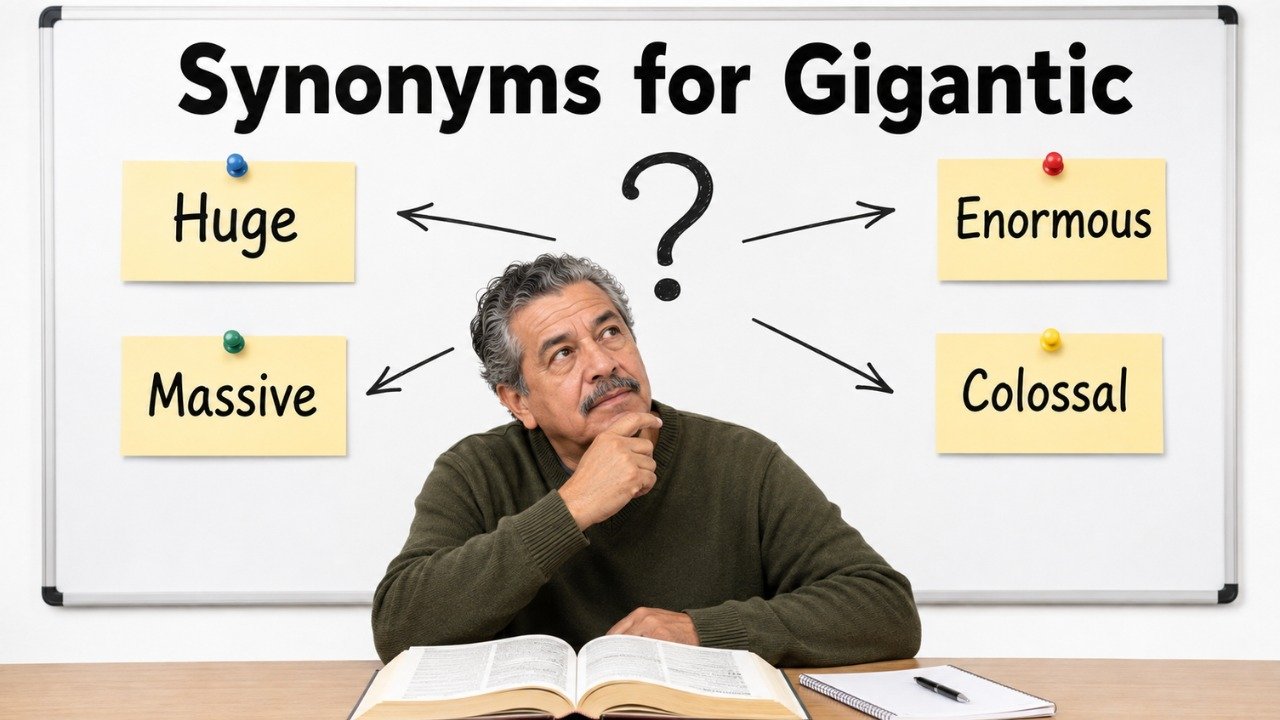
Quick Answer: The best synonyms for gigantic include enormous, immense, colossal, massive, mammoth, vast, monumental, titanic, prodigious, and huge. Use enormous or immense in formal and general writing, colossal for something impressively large, massive for physical size or major impact, mammoth for an unusually large task or object, and vast for spaces, areas, or quantities. Huge works naturally in casual conversation, while monumental is best for achievements, changes, or challenges of great importance.
Pronunciation and Word Details
Word: Gigantic.
Pronunciation: /dʒaɪˈɡæn.tɪk/.
Part of Speech: Adjective.
Meaning: Extremely large in size, amount, degree, or importance.
US Pronunciation:
UK Pronunciation:
What Does “Gigantic” Mean?
Gigantic means extremely large, huge, or much greater than normal. It is an adjective used to describe the size, amount, importance, difficulty, or effect of something.
The word can describe something physically enormous, such as a gigantic building, animal, ship, or statue. It can also express a figurative idea, such as a gigantic problem, opportunity, achievement, or mistake.
In literal contexts, gigantic refers to visible or measurable size.
Example: A gigantic tree stood in the center of the forest.
In figurative contexts, it emphasizes intensity, importance, quantity, or difficulty.
Example: Finishing the project on time was a gigantic challenge.
Gigantic usually adds strong emphasis. It suggests that something is not merely large but unusually, impressively, or overwhelmingly large.
Meaning, Tone, and Context of “Gigantic”
Gigantic has a strong and expressive tone. It is more intense than large or big and often creates a vivid picture in the reader’s mind.
General Tone: Strong, descriptive, and emphatic.
Formality: Neutral enough for most writing, although immense, enormous, or substantial may sound more polished in formal reports.
Casual Use: Common in everyday conversations when emphasizing size, quantity, or importance.
Descriptive Writing: Useful for creating dramatic or memorable images.
Academic Writing: Acceptable in some contexts, but precise measurements or more specific terms may be better.
Emotional Context: It can communicate amazement, concern, excitement, fear, or admiration.
Literal Context: It describes exceptionally large people, animals, buildings, objects, or natural features.
Figurative Context: It describes unusually important problems, successes, changes, risks, or opportunities.
Gigantic is commonly used in conversations, stories, articles, reviews, descriptions, and persuasive writing. It is less suitable when exact measurements are required.
When and How to Use “Gigantic”
For Physical Size
Use gigantic when an object, creature, or structure is exceptionally large.
Example: A gigantic whale appeared beside the boat.
For Large Quantities
Use gigantic to emphasize a very large amount or number.
Example: The event attracted a gigantic crowd.
For Major Problems
Use gigantic when a problem is unusually serious, complicated, or difficult to solve.
Example: The missing information created a gigantic problem for the research team.
For Impressive Achievements
Use gigantic to describe an accomplishment that required remarkable effort or produced major results.
Example: Completing the restoration was a gigantic achievement.
For Important Changes
Use gigantic when a change has a powerful or far reaching effect.
Example: The new transport system made a gigantic difference to the town.
For Difficult Tasks
Use gigantic to emphasize that a task requires considerable time, strength, money, or effort.
Example: Organizing thousands of records was a gigantic task.
For Opportunities
Use gigantic when an opportunity offers unusually high potential.
Example: The growing demand created a gigantic opportunity for local producers.
For Emotional Emphasis
Use gigantic in conversational or expressive writing when you want the description to sound vivid and dramatic.
Example: Everyone was surprised by the gigantic birthday cake.
Best Synonyms for Gigantic
Enormous
Synonym: Enormous means extremely large in size, quantity, or degree.
Example: The company faced an enormous amount of work.
Immense
Synonym: Immense means extremely great in size, extent, or intensity.
Example: The library contains an immense collection of historical documents.
Colossal
Synonym: Colossal means exceptionally large, impressive, or powerful.
Example: Building the bridge required a colossal investment.
Massive
Synonym: Massive means very large, heavy, extensive, or important.
Example: A massive stone wall surrounded the property.
Mammoth
Synonym: Mammoth means unusually large and often difficult to manage.
Example: Preparing the entire archive was a mammoth task.
Vast
Synonym: Vast means extremely large in area, quantity, range, or extent.
Example: The desert covers a vast region.
Monumental
Synonym: Monumental means extremely important, impressive, or difficult.
Example: The discovery was a monumental achievement.
Titanic
Synonym: Titanic means enormous in size, power, strength, or effort.
Example: The rescue operation required a titanic effort.
Prodigious
Synonym: Prodigious means remarkably great in size, amount, ability, or degree.
Example: She completed a prodigious amount of research.
Huge
Synonym: Huge means extremely large and is common in everyday speech.
Example: They received a huge response from readers.
50 Synonyms for Gigantic with Short Meanings
- Enormous: Extremely large in size, amount, or degree.
- Immense: Exceptionally great in size or extent.
- Colossal: Impressively or extraordinarily large.
- Massive: Very large, heavy, extensive, or important.
- Mammoth: Unusually large and difficult to manage.
- Vast: Extremely large in area, range, quantity, or extent.
- Monumental: Extremely important, impressive, or demanding.
- Titanic: Enormous in strength, power, size, or effort.
- Prodigious: Remarkably great in size, amount, or ability.
- Huge: Extremely large in a general or informal sense.
- Giant: Much larger than others of the same kind.
- Gargantuan: Extremely large in size, quantity, or appetite.
- Tremendous: Very great in size, power, effect, or quality.
- Stupendous: Amazingly large, impressive, or remarkable.
- Towering: Extremely tall, powerful, or important.
- Hulking: Large, heavy, and often awkward in appearance.
- Oversized: Larger than the normal or expected size.
- Elephantine: Extremely large, heavy, or slow moving.
- Mountainous: Resembling a mountain in size or quantity.
- Monstrous: Shockingly or unnaturally large.
- Humongous: Extremely large in an informal and expressive way.
- Astronomical: Extremely large, especially in amount, cost, or number.
- Jumbo: Very large compared with the standard size.
- Mega: Extremely large, important, or powerful.
- Substantial: Considerable in size, value, amount, or importance.
- Voluminous: Occupying a large amount of space or containing much material.
- Expansive: Covering a wide area or extending greatly.
- Extensive: Large in amount, area, range, or scope.
- Sprawling: Extending across a broad and often irregular area.
- Boundless: So extensive that it appears to have no limit.
- Limitless: Without an apparent limit in amount or extent.
- Grand: Impressive in size, appearance, importance, or style.
- Formidable: Impressively large, powerful, difficult, or capable.
- Mighty: Great in strength, size, importance, or influence.
- Hefty: Large, heavy, considerable, or powerful.
- Bulky: Large and difficult to carry or manage.
- Broad: Extending widely from side to side or across a subject.
- Wide: Covering a large distance, area, or range.
- Capacious: Having a great deal of space inside.
- Palatial: Extremely large, luxurious, and impressive like a palace.
- Whopping: Unusually large or impressive in an informal context.
- Walloping: Extremely large, powerful, or impressive.
- Herculean: Requiring enormous strength, courage, or effort.
- Epic: Remarkably large, impressive, difficult, or ambitious.
- Supersized: Made much larger than the standard size.
- Outsized: Unusually large in physical size, influence, or importance.
- Cavernous: Extremely large, deep, and spacious inside.
- Brobdingnagian: Exceptionally large or gigantic.
- King Size: Larger than the ordinary or standard size.
- Larger Than Life: Unusually impressive, powerful, dramatic, or important.
Read Also:
Synonyms for Qualities

Synonyms for Gigantic by Context
When Gigantic Means Extremely Large
The most useful synonyms for physical size include enormous, immense, colossal, massive, mammoth, giant, gargantuan, and huge.
Example With Gigantic: A gigantic statue overlooked the harbor.
Example With Enormous: An enormous statue overlooked the harbor.
Example With Colossal: A colossal statue overlooked the harbor.
Colossal sounds more dramatic, while enormous is a natural choice for both formal and general descriptions.
When Gigantic Means Very Tall
Use towering, giant, immense, monumental, or mountainous for objects that rise far above their surroundings.
Example With Gigantic: A gigantic tower stood beside the river.
Example With Towering: A towering structure stood beside the river.
Towering is more precise when height is the main quality being described.
When Gigantic Means Very Spacious
Use vast, expansive, extensive, sprawling, capacious, cavernous, or palatial for large spaces.
Example With Gigantic: They entered a gigantic hall.
Example With Cavernous: They entered a cavernous hall.
Cavernous emphasizes the impressive interior space, while palatial suggests size and luxury.
When Gigantic Means a Large Amount
Use enormous, immense, astronomical, prodigious, substantial, vast, or tremendous for quantities, costs, numbers, and workloads.
Example With Gigantic: The repairs required a gigantic amount of money.
Example With Astronomical: The repairs required an astronomical amount of money.
Astronomical is especially suitable for extremely high prices, costs, figures, or distances.
When Gigantic Means a Difficult Task
Use mammoth, monumental, herculean, colossal, formidable, or titanic.
Example With Gigantic: Moving the entire collection was a gigantic task.
Example With Mammoth: Moving the entire collection was a mammoth task.
Mammoth emphasizes the size of the task, while herculean emphasizes the strength and effort needed to complete it.
When Gigantic Means Important or Influential
Use monumental, enormous, massive, tremendous, outsized, grand, or mighty.
Example With Gigantic: The decision had a gigantic effect on the community.
Example With Massive: The decision had a massive effect on the community.
Massive is natural for major consequences, while monumental is more suitable for historically important changes.
When Gigantic Is Used Casually
Use huge, humongous, jumbo, mega, whopping, supersized, or walloping.
Example With Gigantic: They ordered a gigantic meal.
Example With Humongous: They ordered a humongous meal.
Humongous and whopping are highly informal, while huge works in nearly any everyday conversation.
Another Word for Gigantic
Enormous is often the best single replacement for gigantic because it works naturally in formal writing, descriptive writing, and everyday conversation. However, the strongest alternative depends on what is being described.
Use colossal for something visually impressive, vast for space or range, mammoth for a difficult task, and monumental for an important achievement or change.
Original: A gigantic building stood at the end of the street.
Better Option: An enormous building stood at the end of the street.
Original: The researchers faced a gigantic task.
Better Option: The researchers faced a mammoth task.
Original: The new policy caused a gigantic change.
Better Option: The new policy caused a monumental change.
Original: The farm covered a gigantic area.
Better Option: The farm covered a vast area.
When Not to Use “Gigantic”
Gigantic is useful for emphasis, but it may sound exaggerated, repetitive, vague, or imprecise in certain situations.
When Exact Measurements Are Available
Avoid gigantic when the reader needs specific information about size, weight, distance, or quantity.
Weak: The warehouse was gigantic.
Better: The warehouse covered more than sixty thousand square feet.
When the Size Is Only Moderately Large
Do not use gigantic for something that is simply above average.
Weak: She carried a gigantic notebook.
Better: She carried a large notebook.
When Formal Precision Is Required
Gigantic may sound too expressive in technical or analytical writing.
Weak: The report revealed a gigantic increase in costs.
Better: The report revealed a substantial increase in costs.
When Describing a Wide Area
Vast or expansive may communicate the meaning more accurately.
Weak: They traveled across a gigantic plain.
Better: They traveled across a vast plain.
When Describing a Difficult Task
Mammoth, monumental, or herculean may be more specific.
Weak: Organizing the records was a gigantic job.
Better: Organizing the records was a mammoth job.
When the Word Is Repeated
Using gigantic several times in one paragraph can make the writing sound unnatural.
Weak: The gigantic hall contained a gigantic table beneath a gigantic light.
Better: The cavernous hall contained an enormous table beneath a massive light.
When the Meaning Is Importance Rather Than Size
Monumental, significant, or major may be clearer.
Weak: The agreement was a gigantic moment in the negotiations.
Better: The agreement was a monumental moment in the negotiations.
Words Commonly Confused With Gigantic
Gigantic vs Enormous: Both mean extremely large. Enormous is more versatile and slightly more neutral, while gigantic often sounds more vivid and dramatic.
Gigantic vs Massive: Gigantic emphasizes exceptional size. Massive can describe large physical size, weight, quantity, impact, or importance.
Gigantic vs Giant: Gigantic is an adjective that means extremely large. Giant can be an adjective or a noun referring to a very large person, creature, company, object, or organization.
Gigantic vs Vast: Gigantic usually describes overall size. Vast is more suitable for wide spaces, large areas, extensive knowledge, or great quantities.
Gigantic vs Colossal: Both express extraordinary size. Colossal often suggests something impressive, powerful, or difficult to comprehend.
Gigantic vs Mammoth: Gigantic describes size generally. Mammoth is especially useful for large tasks, projects, expenses, or objects.
Gigantic vs Monumental: Gigantic focuses mainly on size or degree. Monumental often emphasizes historical importance, achievement, difficulty, or lasting influence.
Gigantic vs Tremendous: Gigantic mainly concerns size or scale. Tremendous can also mean excellent, powerful, intense, or highly impressive.
Gigantic vs Astronomical: Gigantic can describe physical objects and figurative ideas. Astronomical is commonly used for extremely high numbers, costs, distances, or amounts.
Gigantic vs Humongous: Gigantic is neutral and widely acceptable. Humongous is highly informal and best suited to casual speech.
Which Synonym Should You Choose?
Choose enormous when you need a natural and versatile replacement in formal or general writing.
Choose immense when describing great size, emotional intensity, influence, knowledge, or importance.
Choose colossal when something is extraordinarily large, visually impressive, or difficult to imagine.
Choose massive when discussing physical weight, major changes, large responses, serious damage, or powerful effects.
Choose mammoth when describing an unusually large task, project, challenge, expense, or object.
Choose vast when writing about areas, spaces, distances, quantities, knowledge, or possibilities.
Choose monumental when describing an important achievement, decision, change, challenge, or historical event.
Choose titanic when emphasizing extreme strength, conflict, effort, or power.
Choose prodigious when discussing remarkable productivity, talent, appetite, memory, ability, or quantity.
Choose huge for casual conversations, simple descriptions, emails, and general communication.
Choose astronomical when describing exceptionally high costs, prices, numbers, or distances.
Choose towering when height is the most important feature.
Choose cavernous when describing an extremely large interior space.
Choose herculean when a task requires exceptional effort or strength.
Choose substantial when you want a measured and professional tone in reports, essays, or formal communication.
Real Life Examples of “Gigantic” in Sentences
Original: A gigantic tree shaded the entire garden.
Better Option: An enormous tree shaded the entire garden.
Original: The company received a gigantic number of applications.
Better Option: The company received a vast number of applications.
Original: Cleaning the abandoned property was a gigantic task.
Better Option: Cleaning the abandoned property was a mammoth task.
Original: The storm created a gigantic wave near the coast.
Better Option: The storm created a colossal wave near the coast.
Original: The team made a gigantic effort to finish the work.
Better Option: The team made a herculean effort to finish the work.
Original: The new library was a gigantic building.
Better Option: The new library was a massive building.
Original: The discovery represented a gigantic achievement.
Better Option: The discovery represented a monumental achievement.
Original: They paid a gigantic amount for the repairs.
Better Option: They paid an astronomical amount for the repairs.
Original: The mountain created a gigantic shadow over the village.
Better Option: The mountain created an immense shadow over the village.
Original: The decision had a gigantic influence on the final result.
Better Option: The decision had an outsized influence on the final result.
Synonym Groups and Usage Differences
Physical Size Group
Enormous, massive, colossal, mammoth, gargantuan, giant, and hulking describe objects or creatures with exceptional physical size.
Enormous and massive are widely applicable. Hulking often describes something large, heavy, and awkward. Gargantuan adds dramatic emphasis.
Example: A gargantuan machine occupied the entire workshop.
Space and Area Group
Vast, expansive, extensive, sprawling, cavernous, capacious, and palatial describe large spaces or areas.
Vast is useful for open land, oceans, deserts, and abstract ranges. Cavernous describes a large interior, while palatial adds a sense of luxury.
Example: The building contained a cavernous entrance hall.
Quantity and Amount Group
Enormous, immense, astronomical, prodigious, substantial, tremendous, and whopping describe large quantities or amounts.
Astronomical often refers to costs and numbers. Prodigious emphasizes an unusually high level of production, ability, or quantity.
Example: The repair work required an astronomical budget.
Height Group
Towering, giant, monumental, mountainous, and immense can describe exceptional height.
Towering is the most precise choice when something rises far above its surroundings.
Example: Towering cliffs surrounded the narrow beach.
Effort and Difficulty Group
Mammoth, monumental, herculean, titanic, colossal, and formidable describe demanding tasks or challenges.
Mammoth focuses on scale. Herculean focuses on effort. Formidable suggests that something is difficult and may cause fear or respect.
Example: Restoring the damaged building was a herculean undertaking.
Importance and Impact Group
Monumental, massive, tremendous, grand, mighty, and outsized describe something with great importance, power, or influence.
Monumental is suitable for historic achievements or changes. Outsized often describes influence that is greater than expected.
Example: Her research had an outsized influence on the discussion.
Informal Emphasis Group
Huge, humongous, jumbo, mega, whopping, walloping, and supersized are common in conversational or promotional descriptions.
Huge is the most flexible. Humongous and whopping are more playful and expressive.
Example: They found a humongous pumpkin in the field.
Antonyms of Gigantic
The opposite of gigantic depends on whether the word refers to physical size, quantity, importance, influence, or degree.
Tiny: Extremely small in size.
Minuscule: Exceptionally small or insignificant.
Microscopic: So small that it is difficult or impossible to see without magnification.
Small: Limited in size, amount, or degree.
Little: Small in size, quantity, importance, or age.
Compact: Designed to fit into a small amount of space.
Miniature: A very small representation or version of something.
Modest: Limited or moderate in size, amount, or ambition.
Slight: Small in degree, strength, or importance.
Narrow: Limited in width, range, or scope.
Limited: Restricted in quantity, size, range, or availability.
Insignificant: Too small or unimportant to have much effect.
Negligible: So small that it is not worth serious attention.
Minor: Less important, serious, or extensive.
Manageable: Small or controlled enough to handle successfully.
Comparison of Gigantic and Related Words
Gigantic vs Enormous
Gigantic and enormous both describe something extremely large. Gigantic is often more vivid, while enormous is more neutral and versatile.
Example With Gigantic: A gigantic creature emerged from the lake.
Example With Enormous: An enormous creature emerged from the lake.
Gigantic vs Immense
Gigantic commonly describes physical size, while immense works well for size, emotion, knowledge, importance, and intensity.
Example With Gigantic: They built a gigantic storage facility.
Example With Immense: She felt immense pride in the final result.
Gigantic vs Massive
Gigantic emphasizes extreme size. Massive may also suggest weight, density, scale, seriousness, or impact.
Example With Gigantic: A gigantic balloon floated above the crowd.
Example With Massive: The storm caused massive damage across the region.
Gigantic vs Colossal
Gigantic is a general word for extreme size. Colossal sounds more dramatic and often communicates wonder, power, or difficulty.
Example With Gigantic: The museum displayed a gigantic sculpture.
Example With Colossal: The project ended in a colossal failure.
Gigantic vs Vast
Gigantic is best for individual objects or general scale. Vast is better for areas, spaces, ranges, quantities, and abstract concepts.
Example With Gigantic: A gigantic ship entered the port.
Example With Vast: A vast ocean stretched beyond the island.
Gigantic vs Mammoth
Gigantic can describe almost anything exceptionally large. Mammoth is particularly effective for tasks, projects, challenges, and expenses.
Example With Gigantic: They saw a gigantic machine inside the factory.
Example With Mammoth: Updating every file was a mammoth undertaking.
Gigantic vs Monumental
Gigantic usually emphasizes size or degree. Monumental emphasizes importance, achievement, difficulty, or historical value.
Example With Gigantic: The artist created a gigantic mural.
Example With Monumental: Completing the mural was a monumental achievement.
Gigantic vs Huge
Gigantic is slightly more dramatic and descriptive. Huge is simpler, more conversational, and more frequently used in everyday speech.
Example With Gigantic: The children discovered a gigantic pumpkin.
Example With Huge: The children discovered a huge pumpkin.
Common Phrases and Expressions With Gigantic
Gigantic Size: An exceptionally large physical measurement.
Gigantic Amount: A quantity that is much greater than normal.
Gigantic Problem: A serious or extremely difficult issue.
Gigantic Task: A job requiring considerable time, effort, or resources.
Gigantic Success: An achievement that greatly exceeds expectations.
Gigantic Difference: A major and easily noticeable contrast.
Gigantic Leap: A dramatic improvement or important advance.
Gigantic Effort: An unusually high level of work or determination.
Gigantic Structure: A building or construction of exceptional size.
Gigantic Opportunity: A possibility with extremely high potential.
Common Mistakes to Avoid
Using Gigantic for Every Large Object
Not everything above average should be described as gigantic. Use large, big, considerable, or substantial when the size is not truly exceptional.
Incorrect: She placed a gigantic cup beside the plate.
Improved: She placed a large cup beside the plate.
Repeating Gigantic Too Often
Repeating the word can make descriptions sound dull or exaggerated. Use relevant alternatives based on context.
Repetitive: The gigantic building had a gigantic entrance and a gigantic garden.
Improved: The enormous building had a grand entrance and a vast garden.
Choosing an Informal Synonym in Formal Writing
Humongous, whopping, and jumbo may sound unsuitable in reports, academic work, or professional communication.
Informal: The organization faced a humongous financial challenge.
Formal: The organization faced a substantial financial challenge.
Using Vast for Individual Objects
Vast usually describes areas, ranges, quantities, or abstract concepts rather than individual objects.
Unnatural: A vast truck blocked the road.
Natural: A massive truck blocked the road.
Using Mammoth for Every Physical Description
Mammoth can describe large objects, but it is especially effective for tasks, projects, expenses, or challenges.
Less Precise: They crossed a mammoth field.
Better: They crossed a vast field.
Confusing Physical Size With Importance
A decision may be monumental rather than physically gigantic.
Unclear: The meeting produced a gigantic decision.
Clearer: The meeting produced a monumental decision.
Using Gigantic When Exact Data Is Needed
Descriptive adjectives should not replace precise facts in technical or analytical writing.
Vague: The reservoir holds a gigantic amount of water.
Precise: The reservoir holds nearly three billion gallons of water.
Combining Similar Intensifiers
Avoid phrases such as very gigantic or extremely gigantic because gigantic already expresses an extreme degree.
Incorrect: They built a very gigantic wall.
Correct: They built a gigantic wall.
Conclusion
The best synonyms for gigantic depend on the size, subject, and tone you want to express. Enormous and immense are versatile choices, while colossal and massive add stronger visual impact. Use vast for areas and quantities, mammoth for demanding tasks, monumental for important achievements, and astronomical for extremely high figures. Huge works naturally in casual conversation. Choosing a precise alternative makes descriptions clearer, reduces repetition, and helps readers understand whether you mean physical size, quantity, difficulty, influence, or importance.
FAQs About Synonyms for Gigantic
What Is the Best Synonym for Gigantic?
Enormous is one of the best general synonyms because it works naturally for physical size, amounts, problems, and effects. The best choice still depends on context.
Is Huge a Synonym for Gigantic?
Yes. Huge is a common and natural synonym for gigantic. It is slightly more casual and less dramatic.
What Is a Formal Synonym for Gigantic?
Immense, enormous, substantial, extensive, and monumental are suitable formal alternatives. Choose the word that matches the intended meaning.
What Is a Stronger Word Than Gigantic?
Gargantuan, colossal, and Brobdingnagian can sound even more dramatic. However, they may be too exaggerated for neutral or formal writing.
Can Massive Replace Gigantic?
Massive can replace gigantic when describing large objects, serious damage, major changes, or powerful effects. It may also suggest heaviness or density.
What Is Another Word for a Gigantic Task?
Mammoth, monumental, herculean, formidable, and colossal are strong alternatives. Mammoth emphasizes size, while herculean emphasizes effort.
What Is the Opposite of Gigantic?
Common opposites include tiny, minuscule, microscopic, small, compact, miniature, modest, and insignificant.
