
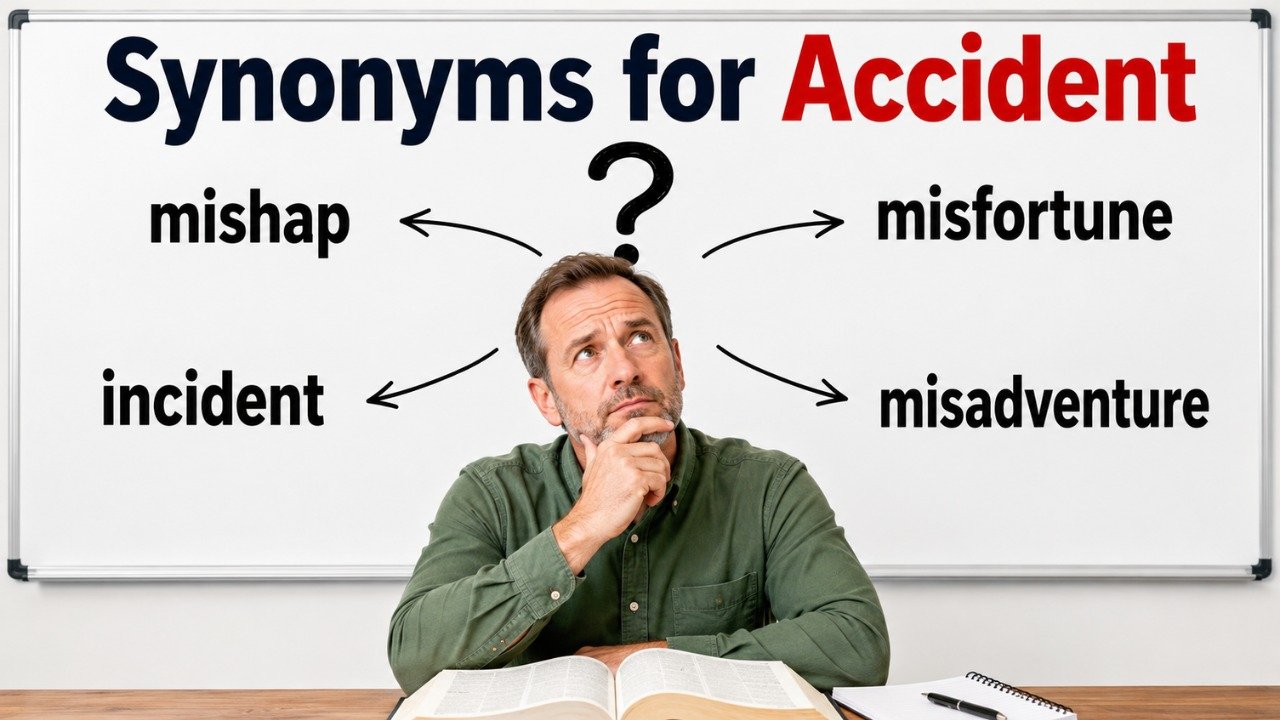
Quick Answer: The best synonyms for accident include mishap, incident, mischance, collision, crash, mistake, error, misadventure, disaster, and chance event. Use mishap for a minor unfortunate event, incident for formal or neutral reporting, collision for vehicles or objects striking each other, crash for a forceful impact, mistake or error for an unintentional action, and disaster for a severe event. The right choice depends on whether you are describing physical harm, human error, bad luck, an unexpected occurrence, or a serious emergency.
Pronunciation and Word Details
Word: Accident.
Pronunciation: /ˈæk.sɪ.dənt/
Part of Speech: Noun.
Meaning: An unexpected and unplanned event that causes damage, injury, loss, or an unwanted result.
US Pronunciation:
UK Pronunciation:
What Does “Accident” Mean?
An accident is an unexpected event that happens without deliberate intention, often causing damage, injury, inconvenience, or loss.
The word accident is mainly used as a noun. It can describe a road collision, a fall, a mistake, an injury, or any event that was not planned.
In physical situations, accident often refers to something that causes harm.
Example: The cyclist was injured in an accident.
In everyday conversation, it can describe a small mistake or an unintended action.
Example: I deleted the document by accident.
In formal reports, accident may refer to an event involving safety, property damage, equipment failure, or personal injury.
Example: The manager investigated the workplace accident.
The word can also describe something that happens through chance rather than planning.
Example: Their meeting was a fortunate accident.
The meaning becomes clearer through context. A traffic accident usually involves vehicles. A household accident may involve a fall, burn, cut, or breakage. An accident of timing describes something that happened because of circumstances rather than intention.
Meaning, Tone, and Context of “Accident”
Accident is a neutral and widely understood word. It can appear in casual conversation, formal writing, safety instructions, news reports, medical discussions, insurance documents, academic writing, and workplace communication.
The emotional strength of the word depends on the situation. A minor accident may cause little harm, while a serious accident may involve major injuries, loss, or destruction.
In casual speech, accident often describes a small unintended action.
Example: I took your notebook by accident.
In formal writing, accident can describe an event that requires investigation.
Example: A detailed report was prepared after the accident.
In technical or safety related contexts, writers may prefer a more precise term such as incident, collision, equipment failure, fall, spill, or injury event. These alternatives provide clearer information about what actually happened.
Accident can sometimes sound too general when the exact cause or result is known. For example, collision is more precise when two vehicles strike each other, while error is more accurate when a person makes an incorrect decision.
The word is not automatically emotional, but it can carry a serious tone when connected with injury, death, danger, or major damage.
When and How to Use “Accident”
For an Unexpected Harmful Event
Use accident when something unplanned causes injury, damage, or loss.
Example: The accident damaged the front of the building.
For a Road Event
Use accident when vehicles, cyclists, or pedestrians are involved in an unexpected harmful event.
Example: Traffic slowed because of an accident near the bridge.
For an Unintended Action
Use accident when someone does something without meaning to do it.
Example: She sent the unfinished message by accident.
For a Minor Mishap
Use accident for a small event that causes inconvenience or slight damage.
Example: A kitchen accident left a small stain on the counter.
For a Workplace Event
Use accident when an employee is injured or equipment is damaged unexpectedly.
Example: The supervisor recorded the accident in the safety log.
For a Household Injury
Use accident for falls, cuts, burns, spills, or breakages that happen at home.
Example: The broken glass caused a minor household accident.
For a Serious Emergency
Use accident when an unexpected event causes major injuries or destruction.
Example: Emergency teams responded quickly to the serious accident.
For Something Caused by Chance
Use accident when an outcome happens without planning or deliberate action.
Example: Their discovery was partly an accident.
Best Synonyms for Accident
Mishap
Synonym: A small or less serious unfortunate event.
Example: A minor mishap delayed the family trip.
Incident
Synonym: An event, especially one that requires attention, investigation, or documentation.
Example: The safety officer prepared a report about the incident.
Miscue
Synonym: An unfortunate event caused by bad luck or chance.
Example: A sudden mischance prevented them from reaching the station.
Collision
Synonym: An event in which vehicles, people, or objects strike one another.
Example: The collision blocked both sides of the road.
Crash
Synonym: A forceful accident involving a vehicle, machine, or falling object.
Example: The driver walked away from the crash without serious injuries.
Mistake
Synonym: An action or decision that produces an unintended result.
Example: Adding the wrong address was an honest mistake.
Error
Synonym: An incorrect action, calculation, judgment, or result.
Example: A technical error caused the system to stop working.
Misadventure
Synonym: An unfortunate experience involving difficulty, danger, or bad luck.
Example: Their hiking trip became an unexpected misadventure.
Disaster
Synonym: A severe event that causes extensive damage, suffering, or failure.
Example: The industrial disaster affected the entire area.
Chance Event
Synonym: Something that happens without planning or intention.
Example: The discovery occurred through a chance event.
50 Synonyms for Accident with Short Meanings
- Mishap: A minor unfortunate event.
- Incident: An event that requires notice or investigation.
- Mischance: An unlucky or unfortunate occurrence.
- Misfortune: Bad luck or an unfortunate experience.
- Misadventure: An unlucky experience involving trouble or danger.
- Collision: An event in which objects or vehicles strike each other.
- Crash: A forceful impact involving a vehicle or machine.
- Wreck: A destructive accident that badly damages something.
- Smash: A violent collision or forceful impact.
- Pileup: A road accident involving several vehicles.
- Fender Bender: A minor vehicle collision with limited damage.
- Spill: An accidental fall or the unintended release of liquid.
- Fall: An accidental movement from a higher position to a lower one.
- Slip: An accidental loss of balance or footing.
- Stumble: A loss of balance caused by catching the foot on something.
- Tumble: A sudden or uncontrolled fall.
- Breakage: Accidental damage that causes something to break.
- Derailment: An accident in which a train leaves its tracks.
- Capsize: An accident in which a boat overturns.
- Blunder: A careless or serious mistake.
- Mistake: An action that produces an unintended result.
- Error: An incorrect action, judgment, calculation, or result.
- Oversight: A mistake caused by failing to notice something.
- Misstep: A wrong action or poorly judged decision.
- Miscalculation: A mistake in judgment, planning, or calculation.
- Mishandling: Incorrect or careless treatment of an object or situation.
- Disaster: A severe event causing major harm or destruction.
- Calamity: A serious event causing great damage or suffering.
- Catastrophe: An extremely destructive or tragic event.
- Tragedy: A deeply distressing event involving suffering or loss.
- Emergency: A sudden dangerous situation requiring immediate action.
- Occurrence: Something that happens.
- Event: An action or situation that takes place.
- Episode: A particular event within a longer situation.
- Contingency: An unexpected event that may require a response.
- Chance Event: An event that happens without planning.
- Chance Occurrence: Something that takes place unexpectedly.
- Unexpected Event: An occurrence that was not anticipated.
- Unforeseen Event: An occurrence that could not be predicted.
- Unplanned Event: Something that happens without preparation.
- Unintended Event: An occurrence that was not deliberately caused.
- Accidental Event: An event caused without intention.
- Accidental Occurrence: Something unexpected that happens by chance.
- Inadvertent Act: An action completed without deliberate intention.
- Unintended Act: Something done without meaning to do it.
- Happenstance: A situation produced by chance.
- Coincidence: Events occurring together without an obvious planned connection.
- Fluke: An unlikely result caused by chance.
- Fortuity: The condition of happening unexpectedly or by chance.
- Chance: The uncontrolled possibility that something may happen.
Read Also:
Synonyms for Spy

Synonyms for Accident by Context
When Accident Means a Minor Mishap
Mishap is usually the best choice for a small accident that causes limited harm, inconvenience, or embarrassment. Spill, slip, stumble, and fender bender are also useful when the exact event is known.
Mishap Example: A small mishap caused paint to spill across the floor.
Spill Example: He cleaned the spill before it damaged the carpet.
Slip Example: A slip on the wet surface caused a minor injury.
Fender Bender Example: The fender bender left a small mark on the car.
When Accident Means a Vehicle Collision
Collision is more precise when two vehicles or objects strike each other. Crash suggests greater force, while pileup describes an accident involving several vehicles. Fender bender refers to a minor collision.
Collision Example: The collision occurred at a busy intersection.
Crash Example: The road remained closed after the crash.
Pileup Example: Heavy fog contributed to a large pileup.
Fender Bender Example: No one was injured in the fender bender.
When Accident Means an Unintended Mistake
Mistake, error, oversight, blunder, and miscalculation are better choices when the problem results from a person’s action, judgment, or failure to notice something.
Mistake Example: Sending the file to the wrong person was a mistake.
Error Example: A calculation error changed the final total.
Oversight Example: The missing signature was an oversight.
Blunder Example: Announcing the decision too early was a serious blunder.
When Accident Means an Unexpected Event
Incident, occurrence, unforeseen event, unplanned event, and contingency work well when the event is unexpected but not necessarily harmful.
Incident Example: The unusual incident attracted attention.
Occurrence Example: Such an occurrence is extremely rare.
Unforeseen Event Example: An unforeseen event delayed the opening.
Contingency Example: The plan includes funding for every possible contingency.
When Accident Means Bad Luck
Mischance, misfortune, misadventure, and happenstance emphasize chance, bad luck, or an unfortunate turn of events.
Mischance Example: Through mischance, the package arrived at the wrong building.
Misfortune Example: The family faced a series of unexpected misfortunes.
Misadventure Example: Their short journey turned into a difficult misadventure.
Happenstance Example: They discovered the hidden path through happenstance.
When Accident Means a Serious Event
Disaster, calamity, catastrophe, tragedy, and emergency are stronger alternatives. They should only be used when the event is severe enough to justify their emotional weight.
Disaster Example: The explosion became a major industrial disaster.
Calamity Example: The community worked together after the calamity.
Catastrophe Example: Quick action prevented a greater catastrophe.
Tragedy Example: The accident became a tragedy for several families.
Another Word for Accident
The best general replacement for accident is mishap, especially when the event is minor and unintentional. However, the best alternative always depends on what happened and how serious it was.
Use incident for formal reporting, collision for vehicles, error for incorrect actions, and disaster for major harm.
Original: A small accident happened during the presentation.
Better Option: A small mishap happened during the presentation.
Original: The company investigated the accident.
Better Option: The company investigated the incident.
Original: Two vehicles were involved in an accident.
Better Option: Two vehicles were involved in a collision.
Original: I entered the wrong number by accident.
Better Option: I entered the wrong number by mistake.
When Not to Use “Accident”
Do not use accident when a more precise word can explain what happened. The word may sound vague in reports, safety documents, technical writing, or detailed descriptions.
When Describing a Specific Road Event
Collision is clearer when two vehicles strike each other.
Weak: The accident involved two buses.
Better: The collision involved two buses.
When Describing Human Error
Mistake or error is more accurate when a person makes an incorrect choice.
Weak: There was an accident in the calculation.
Better: There was an error in the calculation.
When Writing a Formal Safety Report
Incident may sound more neutral and professional, particularly before the cause has been established.
Weak: The accident was reported to the safety department.
Better: The incident was reported to the safety department.
When the Event Was Deliberate
Do not call an intentional act an accident. Doing so may incorrectly remove responsibility or hide the true nature of the event.
Weak: The deliberate damage was an accident.
Better: The investigation confirmed that the damage was intentional.
When the Event Was Extremely Severe
Accident may sound too mild when describing widespread destruction or significant loss.
Weak: The explosion was an unfortunate accident for the region.
Better: The explosion was a devastating disaster for the region.
When Repeating the Word Too Often
Using accident repeatedly can make writing sound dull or unclear.
Weak: The accident happened after another accident had already delayed traffic near the accident site.
Better: The collision happened after an earlier incident had already delayed traffic near the site.
Words Commonly Confused With Accident
Accident vs Incident: An accident is normally unplanned and may cause damage or injury. An incident is any notable event and does not always involve harm.
Accident vs Mistake: An accident is an event, while a mistake is an incorrect action, judgment, or decision. A mistake may cause an accident, but the two words are not identical.
Accident vs Collision: Accident is a broad term. Collision specifically describes two or more objects, vehicles, or people striking one another.
Accident vs Crash: Crash usually suggests a forceful impact involving a vehicle, aircraft, machine, or falling object. Accident can refer to many other events.
Accident vs Coincidence: An accident is an unplanned event, often with an unwanted result. A coincidence is an unexpected connection between events that may not cause harm.
Accident vs Emergency: An accident is what happens. An emergency is the dangerous situation created by an event and the need for immediate action.
Accident vs Disaster: An accident can be minor or serious. A disaster is always severe and causes major damage, suffering, or failure.
Accident vs Casualty: An accident is an event. A casualty is a person who is injured, killed, or otherwise affected by a harmful event.
Which Synonym Should You Choose?
Choose mishap for a small, inconvenient, or mildly unfortunate event.
Choose incident for formal writing, workplace reports, safety documents, official emails, and neutral descriptions.
Choose collision when vehicles, people, or objects strike each other.
Choose crash when describing a violent impact involving a vehicle, aircraft, machine, or falling object.
Choose fender bender for a minor road collision in casual conversation.
Choose mistake when someone does something incorrectly without intending the result.
Choose error for reports, essays, data, calculations, technical writing, and professional communication.
Choose oversight when someone fails to notice or include an important detail.
Choose blunder for a careless or embarrassing mistake with noticeable consequences.
Choose miscalculation when the problem results from incorrect planning, judgment, or numerical work.
Choose misadventure for an unlucky experience involving trouble, difficulty, or danger.
Choose mischance or misfortune when emphasizing bad luck.
Choose coincidence when two events occur together unexpectedly without an obvious planned connection.
Choose happenstance when something occurs entirely through chance.
Choose disaster, calamity, or catastrophe only when the event causes serious destruction, suffering, or loss.
Choose tragedy when emphasizing emotional suffering, death, or personal loss.
Real Life Examples of “Accident” in Sentences
Original: A small accident delayed the school event.
Better Option: A small mishap delayed the school event.
Original: The factory accident is still being investigated.
Better Option: The factory incident is still being investigated.
Original: Two cars were damaged in the accident.
Better Option: Two cars were damaged in the collision.
Original: The driver escaped from the accident without injury.
Better Option: The driver escaped from the crash without injury.
Original: I closed the application by accident.
Better Option: I closed the application by mistake.
Original: The wrong total appeared because of an accident.
Better Option: The wrong total appeared because of a calculation error.
Original: The missing attachment was an accident.
Better Option: The missing attachment was an oversight.
Original: Their journey became a difficult accident.
Better Option: Their journey became a difficult misadventure.
Original: The explosion caused a terrible accident.
Better Option: The explosion caused a terrible disaster.
Original: We discovered the quiet garden by accident.
Better Option: We discovered the quiet garden through happenstance.
Synonym Groups and Usage Differences
Minor Event Group
Mishap, spill, slip, stumble, tumble, and fender bender describe relatively small accidents. They are useful when the consequences are limited and the tone should not sound overly dramatic.
Example: A minor mishap caused a short delay.
Vehicle Event Group
Collision, crash, wreck, smash, pileup, and fender bender relate to road or transport accidents. Collision is precise and neutral. Crash is stronger. Wreck often focuses on severe vehicle damage.
Example: The collision damaged both vehicles but caused no serious injuries.
Human Error Group
Mistake, error, oversight, blunder, misstep, miscalculation, and mishandling describe problems caused by human action or judgment.
Example: A simple oversight caused the application to be rejected.
Chance Group
Chance, happenstance, coincidence, fluke, fortuity, and chance occurrence emphasize that something happened without planning.
Example: Their meeting occurred through pure happenstance.
Bad Luck Group
Mischance, misfortune, and misadventure emphasize an unlucky outcome. Misadventure often suggests a longer experience involving several difficulties.
Example: The camping holiday became an uncomfortable misadventure.
Serious Event Group
Disaster, calamity, catastrophe, tragedy, and emergency describe severe situations. Disaster focuses on extensive harm. Catastrophe is even stronger. Tragedy focuses on emotional loss and suffering.
Example: The structural failure led to a major disaster.
Formal Reporting Group
Incident, occurrence, event, episode, and contingency are useful in reports, essays, safety documents, and professional communication. They are often more neutral than accident.
Example: Every safety incident must be documented.
Antonyms of Accident
The opposite of accident changes according to whether accident means an unplanned event, an unintended action, or an unfortunate result.
Intention: A clear decision to do something deliberately.
Plan: An organized arrangement made before an action or event.
Purpose: The intended reason for an action.
Design: A deliberate arrangement or planned method.
Deliberate Act: An action performed knowingly and intentionally.
Intentional Action: Something done with a conscious purpose.
Preparation: Advance work completed before an event.
Control: The ability to direct an action or outcome.
Certainty: A condition in which an outcome is known or expected.
Prevention: Action taken to stop an accident or harmful event from happening.
Comparison: Accident vs Related Words
Accident vs Incident
Accident emphasizes that an event was unplanned and often harmful. Incident is broader and can describe any notable event, whether harmful or not.
Example With Accident: The worker was injured in an accident.
Example With Incident: The manager documented the unusual incident.
Accident vs Mishap
Accident can be minor or serious. Mishap usually describes a smaller event with limited consequences.
Example With Accident: The accident caused extensive property damage.
Example With Mishap: A minor mishap caused the drinks to spill.
Accident vs Mistake
Accident describes an event. Mistake describes an incorrect action or decision. A mistake can lead to an accident.
Example With Accident: The ladder accident caused an injury.
Example With Mistake: Leaving the ladder unsecured was a mistake.
Accident vs Collision
Accident is a general term for an unplanned harmful event. Collision specifically refers to objects or vehicles striking one another.
Example With Accident: The accident delayed traffic for an hour.
Example With Collision: The collision damaged the front of both cars.
Accident vs Crash
Accident may describe a fall, spill, injury, mistake, or collision. Crash normally suggests a strong impact involving transport or machinery.
Example With Accident: She was treated after a household accident.
Example With Crash: Emergency workers reached the crash within minutes.
Accident vs Coincidence
Accident refers to something unplanned and often unwanted. Coincidence describes an unexpected connection or similarity between separate events.
Example With Accident: I broke the glass by accident.
Example With Coincidence: It was a coincidence that both guests wore the same color.
Accident vs Disaster
An accident may cause little or great harm. Disaster describes an event with severe consequences.
Example With Accident: The minor accident caused a short delay.
Example With Disaster: The building collapse became a major disaster.
Common Phrases and Expressions With Accident
By Accident: Without planning or intention.
Example: She opened the wrong folder by accident.
Pure Accident: Something completely unintentional.
Example: Meeting at the station was a pure accident.
Complete Accident: An event with no deliberate planning.
Example: Finding the old photograph was a complete accident.
Minor Accident: An event causing limited damage or injury.
Example: He returned to work after a minor accident.
Serious Accident: An event causing major damage or injury.
Example: The road was closed after a serious accident.
Traffic Accident: An accident involving vehicles, cyclists, or pedestrians on a road.
Example: A traffic accident caused a long delay.
Workplace Accident: An unplanned harmful event occurring during work.
Example: Safety procedures can reduce the risk of a workplace accident.
Household Accident: An accidental injury or damaging event inside or around a home.
Example: Many household accidents can be prevented through careful storage.
Freak Accident: A highly unusual and unexpected accident.
Example: The damage resulted from a freak accident.
Accident Prone: Likely to experience frequent minor accidents.
Example: The accident prone child was reminded to walk carefully.
An Accident Waiting to Happen: A dangerous situation that is likely to cause harm.
Example: The damaged step was an accident waiting to happen.
Common Mistakes to Avoid
Repeating Accident Too Frequently
Repeated use of accident can make a paragraph vague and monotonous. Replace it with precise alternatives when the context is clear.
Repetitive: The accident happened near the accident site where another accident occurred last month.
Improved: The collision happened near the site of another road incident that occurred last month.
Using Incident as an Exact Synonym Every Time
Incident does not always mean accident. An incident may be intentional, harmless, or simply unusual.
Incorrect: The planned demonstration was an accident.
Correct: The planned demonstration was an event.
Confusing Accident With Mistake
A mistake is an incorrect action or decision. An accident is the event that may result from that action.
Incorrect: Forgetting the appointment was an accident.
Better: Forgetting the appointment was a mistake.
Using Collision for Every Accident
Collision only works when objects, vehicles, or people strike each other. It does not describe every fall, spill, burn, or mistake.
Incorrect: She had a collision when she slipped in the kitchen.
Correct: She had an accident when she slipped in the kitchen.
Using Disaster for a Minor Problem
Disaster is much stronger than accident. Do not use it for small inconveniences unless you are intentionally exaggerating in casual speech.
Too Strong: Spilling a little water was a disaster.
Better: Spilling a little water was a minor mishap.
Confusing Casualty With Accident
Casualty refers to an injured or deceased person, not the event itself.
Incorrect: The road casualty blocked traffic.
Correct: The road accident blocked traffic.
Using Vague Language in Reports
Formal reports should identify the exact type of event whenever possible.
Vague: An accident happened near the storage area.
Precise: A chemical spill occurred near the storage area.
Writing “On Accident” in Formal English
In edited and formal English, by accident is generally the clearer and more widely accepted phrase.
Less Formal: I deleted the record on accident.
Preferred: I deleted the record by accident.
Assuming Every Accident Is Unavoidable
Calling something an accident does not prove that it could not have been prevented. Carelessness, poor planning, unsafe conditions, or equipment failure may still be involved.
Unclear: It was only an accident, so no investigation was necessary.
Better: Although the event was unintentional, the cause still required investigation.
Conclusion
The most useful synonyms for accident depend on the event, its cause, and its seriousness. Mishap works well for minor problems, incident suits formal reports, collision and crash describe vehicle impacts, while mistake and error refer to unintended actions. For severe situations, disaster, calamity, catastrophe, or tragedy may be more accurate. When using synonyms for accident, choose the word that clearly explains whether the event involved harm, chance, human error, bad luck, or a serious emergency.
FAQs About Synonyms for Accident
What Is the Best Synonym for Accident?
Mishap is the best general synonym for a minor accident. Incident is better for formal reporting, while collision is more precise for vehicles.
What Is a Formal Synonym for Accident?
Incident is a common formal alternative. Occurrence, unforeseen event, and unintended event may also work in reports and professional writing.
What Is a Synonym for a Minor Accident?
Mishap, fender bender, spill, slip, and stumble can describe minor accidents, depending on what happened.
What Is Another Word for a Car Accident?
Collision, crash, wreck, pileup, and fender bender are useful alternatives. Collision is neutral, while crash suggests a stronger impact.
Are Accident and Mistake the Same?
No. A mistake is an incorrect action or decision. An accident is an unplanned event, which may be caused by a mistake.
Can Incident Replace Accident?
Incident can replace accident in many formal contexts, but it is broader. An incident may be harmless, intentional, or unrelated to injury.
What Is a Stronger Word Than Accident?
Disaster, calamity, catastrophe, and tragedy are stronger words. Use them only when the event causes serious damage, suffering, injury, or loss.
