
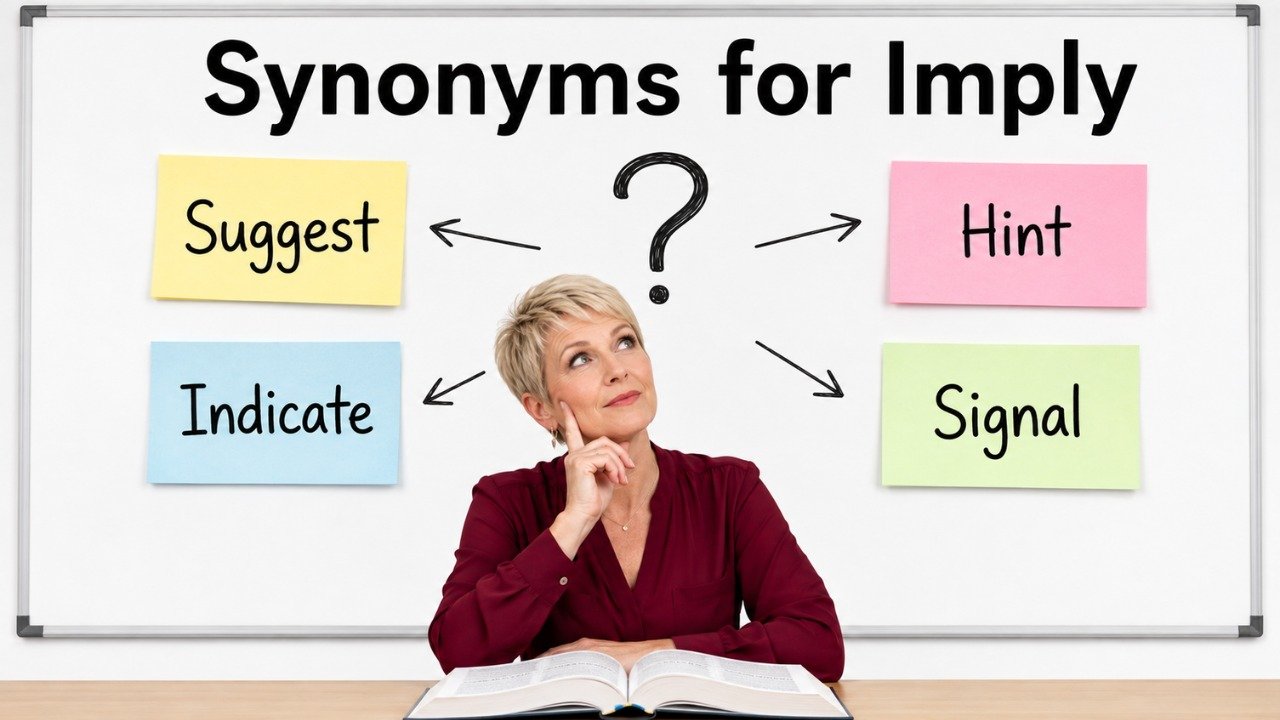
Quick Answer: The best synonyms for imply include suggest, indicate, hint, insinuate, convey, signal, signify, intimate, allude to, and entail. Use suggest as the most flexible replacement in everyday and formal writing. Choose indicate when evidence points toward a conclusion, hint for a subtle message, insinuate for an indirect negative accusation, convey for communication, signify for meaning or symbolism, and entail when one fact creates a necessary consequence.
Pronunciation and Word Details
Word: Imply.
Pronunciation: /ɪmˈplaɪ/.
Part of Speech: Verb.
Meaning: To suggest, communicate, or indicate something without stating it directly.
US Pronunciation:
UK Pronunciation:
What Does “Imply” Mean?
Imply means to communicate an idea without expressing it directly. It is a verb commonly used when words, actions, expressions, facts, or circumstances suggest an additional meaning.
A person can imply something through tone, wording, silence, or behavior. Evidence can also imply that a conclusion is likely. In logical or technical contexts, imply can mean that one fact necessarily leads to another.
Indirect Communication: Her expression implied that she was disappointed.
Evidence: The footprints imply that someone entered through the garden.
Logical Consequence: Signing the agreement implies acceptance of its conditions.
The word often describes what a speaker, writer, action, or fact communicates. The listener or reader then interprets that unstated meaning.
Meaning, Tone, and Context of “Imply”
Imply usually has a neutral tone, but its emotional effect depends on the context. It may sound polite, cautious, critical, suspicious, academic, or technical.
Neutral Use: Imply can describe a simple unstated meaning without criticism.
Example: His smile implied that the surprise had worked.
Formal Use: The word is common in reports, essays, research, analysis, and professional communication.
Example: The results imply a connection between preparation and performance.
Conversational Use: People use imply when discussing what someone appeared to mean.
Example: Are you implying that I forgot the appointment?
Negative Use: Imply can describe criticism, blame, dishonesty, or suspicion that is communicated indirectly.
Example: Her question implied that the figures were inaccurate.
Logical Use: In formal reasoning, imply describes a conclusion that follows from a condition or statement.
Example: A complete refund implies that the original payment will be returned.
Imply is usually less direct than state, declare, or explain. It allows the meaning to remain partly unstated.
When and How to Use “Imply”
For Indirect Meaning
Use imply when a person communicates an idea without saying it openly.
Example: His careful wording implied that the plan might change.
For Evidence
Use imply when facts, signs, or results support a likely conclusion.
Example: The empty shelves imply that the store has been unusually busy.
For Tone and Body Language
Use imply when a voice, expression, gesture, or reaction communicates an unstated feeling.
Example: Her raised eyebrows implied surprise.
For Polite Communication
Use imply when someone avoids making a direct or potentially uncomfortable statement.
Example: The invitation implied that formal clothing would be appropriate.
For Criticism or Suspicion
Use imply when a statement indirectly questions someone’s honesty, ability, or behavior.
Example: His comment implied that the work had not been completed carefully.
For Academic Analysis
Use imply when interpreting evidence, arguments, themes, or results.
Example: The final paragraph implies that the character has accepted her decision.
For Logical Consequences
Use imply when one condition leads to a necessary or expected result.
Example: Greater responsibility implies greater accountability.
Best Synonyms for Imply
Suggest
Synonym: Suggest means to communicate an idea indirectly or make something seem possible.
Example: Her silence suggested that she disagreed.
Indicate
Synonym: Indicate means to show that something is likely, true, or present.
Example: The latest figures indicate steady improvement.
Hint
Synonym: Hint means to communicate something in a very subtle or incomplete way.
Example: He hinted that a new opportunity was approaching.
Insinuate
Synonym: Insinuate means to imply something negative, insulting, or suspicious without stating it openly.
Example: The question insinuated that she had hidden important information.
Convey
Synonym: Convey means to communicate a thought, feeling, or meaning.
Example: His expression conveyed disappointment.
Signal
Synonym: Signal means to show that a change, condition, or event is likely.
Example: The sudden delay signaled a possible problem.
Signify
Synonym: Signify means to represent, indicate, or carry a particular meaning.
Example: The gesture signified respect.
Intimate
Synonym: Intimate means to communicate something indirectly in a formal or literary way.
Example: She intimated that she might leave the position.
Allude To
Synonym: Allude to means to mention or refer to a subject indirectly.
Example: The speaker alluded to earlier disagreements without describing them.
Entail
Synonym: Entail means to involve something as a necessary condition or consequence.
Example: Accepting the role entails working with several departments.
50 Synonyms for Imply with Short Meanings
These words and phrases are synonyms or close alternatives for imply. Their suitability depends on whether the intended meaning involves suggestion, evidence, symbolism, indirect criticism, or logical consequence.
- Suggest: To communicate an idea without stating it directly.
- Indicate: To show that something is likely or true.
- Hint: To give a small or subtle clue.
- Insinuate: To suggest something negative indirectly.
- Intimate: To communicate an idea indirectly or discreetly.
- Convey: To communicate a meaning, thought, or feeling.
- Signal: To show that something may happen or exist.
- Signify: To represent or communicate a particular meaning.
- Mean: To express or represent an intended idea.
- Denote: To have a direct or established meaning.
- Connote: To suggest an additional associated meaning.
- Allude To: To refer to something indirectly.
- Point To: To provide evidence for a conclusion.
- Gesture Toward: To suggest an idea without fully explaining it.
- Refer Obliquely To: To mention something in an indirect manner.
- Communicate Indirectly: To share a meaning without stating it openly.
- Express Indirectly: To communicate an idea through suggestion.
- Suggest Without Stating: To make an idea understandable while leaving it unspoken.
- Give the Impression: To cause someone to form a particular belief.
- Leave the Impression: To create a lasting but unstated understanding.
- Lead Someone to Believe: To cause a person to reach a conclusion.
- Give Someone to Understand: To communicate an idea without saying it plainly.
- Carry the Suggestion Of: To contain a subtle or associated meaning.
- Raise the Possibility: To suggest that something may be true.
- Foreshadow: To suggest that something will happen later.
- Presage: To indicate that an event is likely to occur.
- Herald: To signal the approach of an important event or change.
- Betoken: To be a sign of something.
- Bespeak: To provide evidence of a quality or condition.
- Adumbrate: To suggest or describe something in an incomplete way.
- Betray: To reveal a feeling or fact unintentionally.
- Reveal Indirectly: To make something known through signs or clues.
- Disclose Indirectly: To communicate hidden information without a direct statement.
- Manifest: To show a feeling, quality, or condition clearly.
- Evidence: To show signs that support a conclusion.
- Evoke: To bring an idea, feeling, or association to mind.
- Represent: To stand for or communicate a particular idea.
- Stand For: To symbolize or have a particular meaning.
- Import: To mean or signify something in formal usage.
- Presuppose: To assume that something is already true.
- Entail: To involve a necessary result or condition.
- Involve: To include something as a part or consequence.
- Require: To make something necessary.
- Necessitate: To cause a condition or action to become essential.
- Assume: To take an idea as true without directly proving it.
- Carry: To possess or communicate an additional meaning.
- Contain: To include an unstated idea or consequence.
- Say Without Saying: To communicate something while leaving it unspoken.
- Let It Be Understood: To make a meaning clear without stating it directly.
- Point in the Direction Of: To provide signs supporting a possible conclusion.
Read Also:
Synonyms for Gigantic

Synonyms for Imply by Context
When Imply Means Suggest Indirectly
Suggest, hint, intimate, convey, and give the impression are useful when an idea is communicated without a direct statement.
Example With Imply: Her response implied that she needed more time.
Example With Suggest: Her response suggested that she needed more time.
Example With Hint: Her response hinted that she needed more time.
Suggest is the most natural general alternative. Hint describes a weaker or more subtle message. Intimate is more formal.
When Imply Means Show Through Evidence
Indicate, signal, point to, evidence, and bespeak work well when signs or facts support a conclusion.
Example With Imply: The damaged lock implies that someone attempted to enter.
Example With Indicate: The damaged lock indicates that someone attempted to enter.
Example With Point To: The damaged lock points to an attempted entry.
Indicate is usually the best choice in reports, research, and factual explanations. Point to is slightly more conversational.
When Imply Means Communicate Criticism
Insinuate, suggest, intimate, and cast suspicion on can describe indirect blame, criticism, or accusation.
Example With Imply: His question implied that she had acted carelessly.
Example With Insinuate: His question insinuated that she had acted carelessly.
Insinuate is stronger and more negative than imply. Use it only when the indirect message is insulting, suspicious, or unwelcome.
When Imply Means Carry a Meaning
Signify, mean, denote, connote, represent, and stand for describe what a word, object, action, or symbol communicates.
Example With Imply: In this story, the open window implies freedom.
Example With Signify: In this story, the open window signifies freedom.
Example With Represent: In this story, the open window represents freedom.
Signify and represent are especially useful when discussing symbols, themes, literature, or visual details.
When Imply Means Create a Logical Consequence
Entail, involve, require, necessitate, and presuppose work when one fact creates or assumes another condition.
Example With Imply: Full membership implies acceptance of the rules.
Example With Entail: Full membership entails acceptance of the rules.
Example With Require: Full membership requires acceptance of the rules.
Entail is more precise when the second condition is unavoidable rather than merely suggested.
Another Word for Imply
The best single replacement for imply is usually suggest. It is natural, widely understood, and suitable for indirect statements, behavior, evidence, and possible conclusions.
However, the strongest alternative depends on the intended meaning. Indicate is better for evidence, insinuate is better for negative suggestions, convey is better for communication, and entail is better for necessary consequences.
Original: Her tone implied that the discussion was over.
Better Option: Her tone suggested that the discussion was over.
Original: The results imply that the new process is more efficient.
Better Option: The results indicate that the new process is more efficient.
Original: His remark implied that the mistake was intentional.
Better Option: His remark insinuated that the mistake was intentional.
Original: Taking control of the project implies accepting its risks.
Better Option: Taking control of the project entails accepting its risks.
When Not to Use “Imply”
Do not use imply when the information has been stated directly. Words such as state, explain, specify, show, or declare will be clearer.
Weak: The notice implies that the office closes at five.
Better: The notice states that the office closes at five.
Use indicate rather than imply when evidence clearly supports a factual conclusion.
Weak: The temperature reading implies that the machine is overheating.
Better: The temperature reading indicates that the machine is overheating.
Do not use imply with at before its object. Imply is usually followed directly by a noun, pronoun, or that clause.
Weak: She implied at a possible delay.
Better: She implied that there might be a delay.
Better: She hinted at a possible delay.
Avoid imply when a more precise word identifies the type of indirect communication.
Weak: He implied something unpleasant about her honesty.
Better: He insinuated that she was dishonest.
Do not use imply when describing the conclusion reached by a listener or reader. Use infer instead.
Weak: From his expression, I implied that he was worried.
Better: From his expression, I inferred that he was worried.
Avoid repeating imply when several sentences discuss the same unstated meaning.
Weak: The speech implied concern. It also implied doubt and implied that changes were coming.
Better: The speech conveyed concern, suggested doubt, and signaled that changes were coming.
Words Commonly Confused With Imply
Imply vs Infer: Imply describes sending an indirect meaning. Infer describes reaching a conclusion from that meaning.
Example With Imply: Her silence implied disagreement.
Example With Infer: We inferred from her silence that she disagreed.
Imply vs Suggest: Imply always involves an unstated or indirect meaning. Suggest can also mean to offer an idea or recommendation directly.
Example With Imply: His expression implied that he was unhappy.
Example With Suggest: She suggested meeting earlier.
Imply vs Insinuate: Imply can be neutral, positive, or negative. Insinuate usually communicates an unpleasant accusation or criticism.
Example With Imply: The message implied that further discussion was needed.
Example With Insinuate: The message insinuated that someone had been dishonest.
Imply vs Indicate: Imply emphasizes an unstated meaning. Indicate emphasizes evidence, signs, or information that points toward a conclusion.
Example With Imply: Her careful answer implied uncertainty.
Example With Indicate: The test results indicate improvement.
Imply vs Entail: Imply may describe a possible or indirect conclusion. Entail describes a necessary condition or consequence.
Example With Imply: His decision implied that he accepted some responsibility.
Example With Entail: The position entails managing the entire team.
Imply vs Allude To: Imply communicates an unstated meaning. Allude to means to mention a particular subject indirectly.
Example With Imply: His comment implied that the project had failed.
Example With Allude To: His comment alluded to the earlier project failure.
Which Synonym Should You Choose?
Choose suggest when you need a natural and flexible replacement in general writing or conversation.
Choose indicate when facts, evidence, reports, results, or behavior point toward a conclusion.
Choose hint when the message is subtle, incomplete, or deliberately indirect.
Choose insinuate when the speaker indirectly communicates blame, criticism, dishonesty, or another negative idea.
Choose convey when discussing the communication of feelings, attitudes, messages, or meaning.
Choose signal when an action, change, or pattern shows that something may happen next.
Choose signify when explaining the meaning of a symbol, gesture, event, or literary detail.
Choose allude to when someone briefly refers to a known subject without naming or explaining it directly.
Choose intimate in formal or literary writing when someone discreetly communicates an intention or possibility.
Choose entail when one decision, condition, or responsibility necessarily includes another.
Choose connote when a word carries an emotional, cultural, or associated meaning beyond its direct definition.
Choose presuppose when a statement assumes that another idea is already true.
Real Life Examples of “Imply” in Sentences
Original: Her brief reply implied that she was still upset.
Better Option: Her brief reply suggested that she was still upset.
Original: The dark clouds imply that rain may arrive soon.
Better Option: The dark clouds signal that rain may arrive soon.
Original: His question implied that the report contained an error.
Better Option: His question insinuated that the report contained an error.
Original: The survey results imply that customers prefer simpler instructions.
Better Option: The survey results indicate that customers prefer simpler instructions.
Original: Her smile implied that she understood the joke.
Better Option: Her smile conveyed that she understood the joke.
Original: The ending implies that the main character will return.
Better Option: The ending foreshadows the main character’s return.
Original: His speech implied that major changes were approaching.
Better Option: His speech signaled that major changes were approaching.
Original: The symbol implies courage and personal strength.
Better Option: The symbol signifies courage and personal strength.
Original: Accepting the offer implies moving to another city.
Better Option: Accepting the offer entails moving to another city.
Original: She implied that an earlier conversation had influenced her decision.
Better Option: She alluded to an earlier conversation that had influenced her decision.
Synonym Groups and Usage Differences
Indirect Suggestion Group
Suggest, hint, intimate, allude to, and give the impression communicate ideas that are not expressed openly.
Suggest is the broadest choice. Hint is more subtle. Intimate is formal. Allude to refers indirectly to a particular subject.
Example: He hinted that he might apply for another position.
Evidence and Indication Group
Indicate, signal, point to, evidence, and bespeak connect signs or facts with a likely conclusion.
Indicate is common in reports and analysis. Signal often refers to change or future action. Point to works well in general explanations.
Example: The rising numbers indicate stronger demand.
Negative Implication Group
Insinuate, intimate, suggest, and cast suspicion on can communicate criticism or accusation indirectly.
Insinuate carries the strongest negative tone and should not replace imply in neutral sentences.
Example: The interviewer insinuated that the applicant had exaggerated her experience.
Meaning and Symbolism Group
Signify, denote, connote, represent, mean, and stand for explain what a word, symbol, action, or image communicates.
Denote refers to direct meaning. Connote refers to associated meaning. Represent and signify are useful for symbols and themes.
Example: The locked door represents isolation.
Logical Consequence Group
Entail, involve, require, necessitate, and presuppose describe conditions, results, or assumptions connected through logic.
Entail and require are stronger than imply because they show necessity rather than possibility.
Example: Managing the account entails reviewing every payment.
Future Sign Group
Foreshadow, presage, herald, signal, and betoken suggest that an event or change is approaching.
Foreshadow is common in storytelling. Presage is formal. Herald often introduces a major or positive change.
Example: The early disagreement foreshadowed later conflict.
Antonyms of Imply
The antonyms of imply usually describe direct, explicit, or fully explained communication.
State: To communicate something directly.
Declare: To announce something clearly and formally.
Say Directly: To express an idea without indirect wording.
Specify: To provide exact details.
Explain: To make an idea understandable through information.
Clarify: To remove uncertainty or confusion.
Spell Out: To describe something clearly and completely.
Disclose: To reveal information openly.
Make Explicit: To express a meaning in direct language.
Assert: To state a belief or claim confidently.
Confirm: To establish that something is true.
Deny: To state that an idea or accusation is not true.
Comparison: Imply vs Related Words
Imply vs Suggest
Imply communicates a meaning indirectly. Suggest may communicate an indirect meaning, but it can also mean to recommend an action.
Example With Imply: Her expression implied that she was tired.
Example With Suggest: Her expression suggested that she was tired.
Example With Suggest as Advice: She suggested taking a short break.
Imply vs Infer
The speaker, writer, action, or evidence implies. The listener, reader, or observer infers.
Example With Imply: His hesitation implied uncertainty.
Example With Infer: We inferred from his hesitation that he was uncertain.
Imply vs Indicate
Imply focuses on meaning that is not directly stated. Indicate focuses on signs, facts, or evidence.
Example With Imply: Her tone implied that she disliked the idea.
Example With Indicate: The figures indicate that costs are decreasing.
Imply vs Insinuate
Imply is neutral in many contexts. Insinuate usually suggests something insulting, dishonest, or critical.
Example With Imply: He implied that more information was needed.
Example With Insinuate: He insinuated that she had deliberately hidden the information.
Imply vs Entail
Imply can express an indirect possibility or logical conclusion. Entail describes something that is necessarily included.
Example With Imply: The promotion implies that she has earned greater trust.
Example With Entail: The promotion entails supervising several new employees.
Imply vs Connote
Imply describes an unstated meaning created by a statement, action, or fact. Connote describes the associations carried by a word or expression.
Example With Imply: His answer implied that he was uncertain.
Example With Connote: The word home connotes comfort and belonging.
Common Phrases and Expressions With Imply
Imply That: To communicate an unstated conclusion through a statement or action.
Example: Her response implied that the decision had already been made.
Seem to Imply: To appear to communicate a particular meaning.
Example: The wording seems to imply that payment is optional.
Strongly Imply: To provide powerful signs of an unstated conclusion.
Example: The evidence strongly implies that the records were changed.
Clearly Imply: To communicate an indirect meaning that is easy to recognize.
Example: His reaction clearly implied that he knew the answer.
Not Mean to Imply: To explain that an unintended meaning was communicated.
Example: I did not mean to imply that your work was incomplete.
Imply a Connection: To suggest that two people, events, or facts are related.
Example: The report implies a connection between training and productivity.
Imply Criticism: To communicate disapproval indirectly.
Example: Her carefully worded question implied criticism of the original plan.
Imply Consent: To suggest agreement through behavior or circumstances rather than direct words.
Example: Silence should not automatically be assumed to imply consent.
Imply Responsibility: To suggest that someone has a duty or may be at fault.
Example: His statement implied responsibility for resolving the problem.
Imply a Consequence: To suggest that one condition will lead to a particular result.
Example: Ignoring the instructions may imply a serious consequence.
Common Mistakes to Avoid
Confusing Imply With Infer
Use imply for the person, action, statement, or evidence that sends the meaning. Use infer for the person who receives information and reaches a conclusion.
Incorrect: I implied from her expression that she was worried.
Correct: I inferred from her expression that she was worried.
Adding “At” After Imply
Imply is normally followed directly by an object or a that clause. Hint can be followed by at, but imply usually cannot.
Incorrect: He implied at a possible change.
Correct: He implied that a change was possible.
Correct: He hinted at a possible change.
Using Imply for Direct Statements
Do not describe directly stated information as implied.
Incorrect: The instructions imply that users must enter a password.
Correct: The instructions state that users must enter a password.
Choosing Insinuate for Neutral Meanings
Insinuate often carries a negative or accusatory tone. It can make a neutral sentence sound hostile.
Unnatural: Her smile insinuated that she was pleased.
Natural: Her smile suggested that she was pleased.
Writing “Implicitly Imply”
The phrase implicitly imply is usually repetitive because imply already means to communicate indirectly.
Repetitive: His statement implicitly implied that the schedule had changed.
Better: His statement implied that the schedule had changed.
Leaving the Implied Meaning Unclear
Make sure readers can understand what the subject is suggesting.
Vague: The results imply something important.
Clear: The results imply that early preparation improves performance.
Overusing the Same Word
Repeated use of imply can make a paragraph sound mechanical. Use suggest, indicate, convey, signal, or signify when they express the intended meaning more precisely.
Repetitive: Her words implied doubt, her expression implied concern, and her silence implied disagreement.
Better: Her words suggested doubt, her expression conveyed concern, and her silence signaled disagreement.
Ignoring Logical Strength
Do not use imply when the relationship is necessary rather than merely suggested. Entail, require, or necessitate may be more accurate.
Less Precise: The position implies regular travel.
More Precise: The position requires regular travel.
Conclusion
The most useful synonyms for imply include suggest, indicate, hint, convey, signal, signify, insinuate, allude to, and entail. Suggest is the strongest general replacement, while indicate works best for evidence and reports. Use hint for subtle communication, insinuate for indirect criticism, signify for symbols, and entail for necessary consequences. Understanding these differences makes it easier to select synonyms for imply that match the tone, meaning, and level of certainty required in each sentence.
FAQs About Synonyms for Imply
What Is the Best Synonym for Imply?
Suggest is usually the best general synonym because it works naturally in formal writing, everyday speech, and indirect communication.
What Is a Formal Synonym for Imply?
Indicate, intimate, signify, and entail are useful formal alternatives. The best choice depends on whether the sentence involves evidence, communication, meaning, or consequence.
What Is a Casual Synonym for Imply?
Hint and suggest are the most natural choices in casual conversation.
Are Imply and Infer the Same?
No. A speaker or statement implies something, while a listener or reader infers the meaning.
Can Imply Have a Negative Meaning?
Yes. Imply can communicate blame, criticism, suspicion, or doubt indirectly. Insinuate is a stronger synonym for this negative sense.
What Is the Difference Between Imply and Suggest?
Imply always involves an indirect meaning. Suggest can describe an indirect meaning, but it can also mean to offer advice or recommend an action.
Does Imply Always Mean Something Is Unstated?
Usually, yes. However, in logical contexts, imply can also mean that one fact or condition leads to another conclusion or necessary consequence.
