
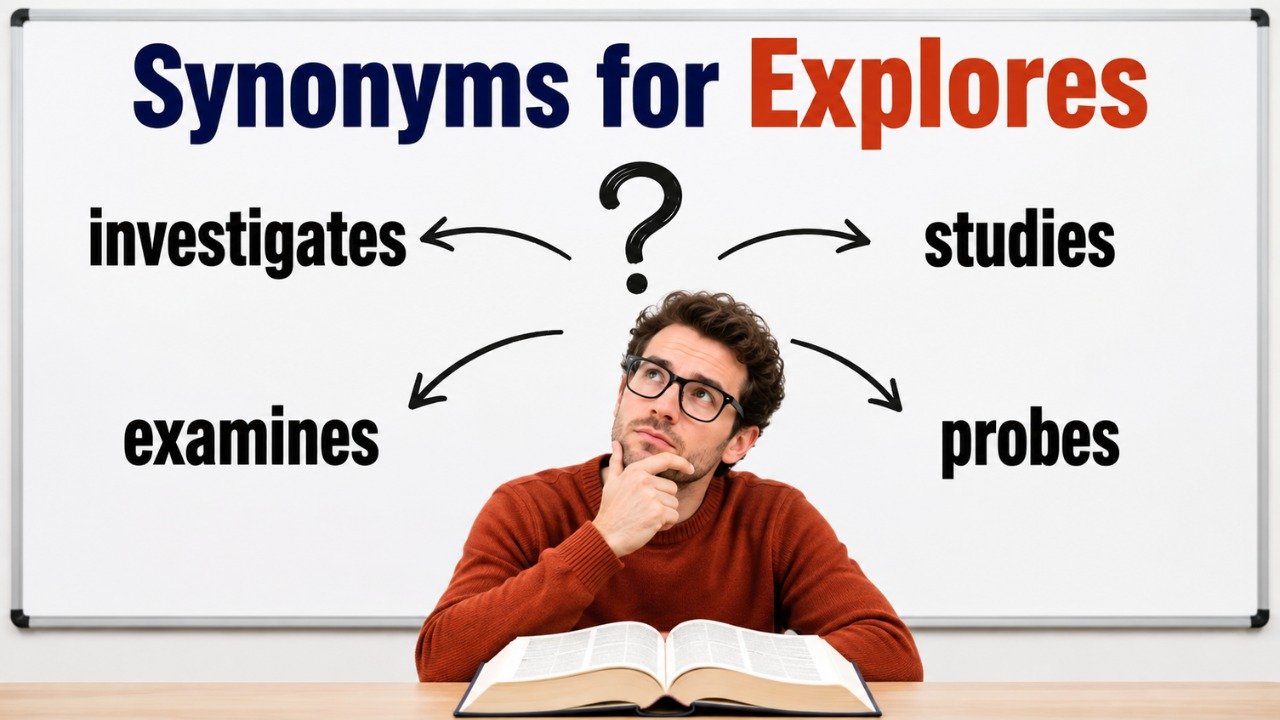
Quick Answer: Synonyms for explores include investigates, examines, studies, analyzes, researches, considers, discusses, surveys, probes, and discovers. Use investigates for a careful search into facts, examines for close inspection, studies for academic learning, analyzes for detailed interpretation, considers for possibilities, and discusses when a text presents a subject. For physical places, discovers, tours, navigates, or ventures into may be more suitable.
Pronunciation and Word Details
Word: Explores.
Pronunciation: /ɪkˈsplɔːrz/
Part of Speech: Verb, third person singular present tense.
Meaning: Looks closely at a subject, possibility, place, or idea to learn more about it.
US Pronunciation:
UK Pronunciation:
What Does “Explores” Mean?
Explores means investigates, examines, or travels through something to gain knowledge or discover new information.
The word explores is the third person singular present tense form of the verb explore. It is commonly used with subjects such as he, she, it, the article, the report, the researcher, or the story.
In an academic sentence, explores often means studies or analyzes a subject.
Example: The essay explores the effects of stress on learning.
In a discussion, it may mean considers different ideas or possibilities.
Example: The meeting explores several solutions to the problem.
In a travel context, it can mean visits, travels through, or investigates an unfamiliar place.
Example: She explores the forest during her weekend trips.
In creative writing, explores may describe how a book, film, poem, or story presents a theme.
Example: The novel explores courage, loss, and personal growth.
The exact meaning depends on what is being explored and why the action is taking place.
Meaning, Tone, and Context of “Explores”
Explores usually has a neutral and thoughtful tone. It suggests curiosity, investigation, learning, discovery, or careful consideration.
In formal writing, explores is often used to introduce the purpose of an essay, report, study, chapter, or presentation.
Formal Use: This report explores the causes of declining customer satisfaction.
In academic writing, it suggests that a topic is examined from different angles rather than simply mentioned.
Academic Use: The research explores the relationship between sleep and memory.
In conversational language, explores can describe trying new activities, visiting unfamiliar places, or considering different choices.
Conversational Use: He explores different hobbies during the summer.
In literary and creative contexts, the word often describes themes, emotions, relationships, or social issues presented in a story.
Creative Use: The play explores the difficulty of rebuilding trust.
In technical or scientific contexts, it may refer to investigating systems, testing possibilities, or studying evidence.
Technical Use: The team explores methods for improving the efficiency of the process.
Explores is generally more thoughtful than looks at and less definite than proves. It indicates investigation, but it does not automatically mean that a final answer has been found.
When and How to Use “Explores”
For Academic Topics: Use explores when an essay, study, or lesson examines a subject from several perspectives.
Example: The paper explores how language changes across generations.
For Research: Use explores when researchers investigate a question, relationship, pattern, or possibility.
Example: The study explores the connection between exercise and concentration.
For Ideas: Use explores when someone considers concepts, opinions, or possible explanations.
Example: The discussion explores several reasons for the sudden change.
For Possibilities: Use explores when a person or organization considers potential actions without making a final decision.
Example: The committee explores alternative ways to reduce expenses.
For Literature: Use explores when a story, poem, or novel develops a theme or emotional issue.
Example: The novel explores the meaning of forgiveness.
For Travel: Use explores when someone visits or moves through an unfamiliar place to discover it.
Example: She explores the old city on foot.
For Personal Growth: Use explores when someone learns about personal interests, feelings, values, or abilities.
Example: The course helps each student explore personal strengths.
For Technology: Use explores when a person tests tools, systems, features, or methods.
Example: The developer explores different ways to improve the application.
Best Synonyms for Explores
Investigates
Synonym: Investigates means searches carefully for facts, causes, or explanations.
Example: The journalist investigates the cause of the unexpected failure.
Examines
Synonym: Examines means looks at something closely and carefully.
Example: The report examines changes in consumer behavior.
Studies
Synonym: Studies means gives careful attention to a subject in order to understand it.
Example: The researcher studies the effects of temperature on plant growth.
Analyzes
Synonym: Analyzes means separates information into parts to understand its meaning or structure.
Example: The article analyzes the language used in political speeches.
Researches
Synonym: Researches means gathers and studies information systematically.
Example: She researches the history of the local community.
Considers
Synonym: Considers means thinks carefully about an idea, choice, or possibility.
Example: The proposal considers several methods of reducing waste.
Discusses
Synonym: Discusses means presents information or ideas about a subject.
Example: The chapter discusses the importance of effective communication.
Surveys
Synonym: Surveys means examines a broad area, group, or subject.
Example: The book surveys major developments in modern architecture.
Probes
Synonym: Probes means investigates deeply in order to uncover hidden information.
Example: The investigation probes the reasons behind the financial loss.
Discovers
Synonym: Discovers means finds or learns something that was previously unknown.
Example: The traveler discovers several quiet villages along the coast.
50 Synonyms for Explores with Short Meanings
- Investigates: Searches carefully for facts or causes.
- Examines: Looks at something closely.
- Studies: Gives careful attention to a subject.
- Analyzes: Breaks information into parts for understanding.
- Researches: Collects and studies information systematically.
- Considers: Thinks carefully about an idea or possibility.
- Discusses: Presents or talks about a subject.
- Reviews: Looks over information for evaluation.
- Surveys: Examines a subject or area broadly.
- Probes: Investigates something deeply.
- Inspects: Checks something carefully for details or problems.
- Assesses: Judges the condition, value, or importance of something.
- Evaluates: Determines quality, effectiveness, or meaning.
- Observes: Watches or notices something carefully.
- Searches: Looks for information, objects, or answers.
- Seeks: Tries to find or achieve something.
- Discovers: Finds something previously unknown.
- Looks Into: Investigates a subject or situation.
- Delves Into: Studies a subject deeply.
- Inquires Into: Seeks information about a matter.
- Traces: Follows the development, cause, or history of something.
- Uncovers: Reveals hidden facts or information.
- Tests: Tries something to determine how it works.
- Experiments With: Tries different methods or ideas.
- Tries: Uses or experiences something to learn about it.
- Examines Closely: Studies small details with care.
- Scrutinizes: Examines with intense attention.
- Questions: Challenges or investigates an idea.
- Interrogates: Examines a subject through detailed questioning.
- Unpacks: Explains or examines a complex idea in parts.
- Addresses: Deals with a subject or problem.
- Covers: Includes or discusses a topic.
- Treats: Presents or handles a particular subject.
- Engages With: Gives active attention to an idea or issue.
- Reflects On: Thinks carefully about an experience or subject.
- Contemplates: Considers something deeply and thoughtfully.
- Weighs: Compares possibilities before deciding.
- Pursues: Continues searching for knowledge or answers.
- Follows: Tracks a subject, route, development, or process.
- Ventures Into: Enters an unfamiliar subject or place.
- Travels Through: Moves across an area to experience it.
- Tours: Visits different parts of a place.
- Visits: Goes to a place to see or experience it.
- Navigates: Finds a way through a place or complex situation.
- Traverses: Travels across an area.
- Scouts: Searches an area for useful information.
- Maps: Records or examines the features of an area or subject.
- Roams: Moves around a place freely.
- Ranges Across: Covers several subjects, places, or possibilities.
- Journeys Through: Travels through a place, experience, or process.
Read Also:
Synonyms for Horrifying

Synonyms for Explores by Context
When Explores Means Investigates
When explores refers to searching for facts, causes, or answers, suitable synonyms include investigates, probes, inquires into, looks into, uncovers, and scrutinizes.
Example With Explores: The committee explores the cause of the accounting error.
Example With Investigates: The committee investigates the cause of the accounting error.
Investigates is often the strongest choice when facts, evidence, problems, or suspicious events are involved.
When Explores Means Examines a Topic
When a report, essay, book, or presentation explores a subject, useful alternatives include examines, analyzes, discusses, studies, reviews, covers, and addresses.
Example With Explores: The article explores the effects of poor time management.
Example With Examines: The article examines the effects of poor time management.
Examines is suitable for formal writing, while discusses works well when the content presents ideas without conducting detailed analysis.
When Explores Means Considers Possibilities
When explores describes thinking about options or potential actions, use considers, evaluates, weighs, tests, or experiments with.
Example With Explores: The business explores ways to improve customer service.
Example With Considers: The business considers ways to improve customer service.
Considers emphasizes careful thought, while tests suggests practical action.
When Explores Means Studies Deeply
When explores suggests detailed intellectual investigation, use delves into, analyzes, researches, scrutinizes, interrogates, or unpacks.
Example With Explores: The course explores the psychology of decision making.
Example With Delves Into: The course delves into the psychology of decision making.
Delves into creates a stronger sense of depth than explores.
When Explores Means Travels Through a Place
When explores refers to discovering a physical location, suitable alternatives include tours, visits, navigates, traverses, scouts, roams, or travels through.
Example With Explores: She explores the mountain villages during her trip.
Example With Tours: She tours the mountain villages during her trip.
Tours suggests an organized visit, while roams suggests free and unplanned movement.
When Explores Means Discovers Something New
When the focus is on finding unfamiliar information, places, or experiences, use discovers, uncovers, seeks, searches, or ventures into.
Example With Explores: He explores new methods of creative expression.
Example With Discovers: He discovers new methods of creative expression.
Discovers focuses on what is found, while explores focuses on the process of searching.
Another Word for Explores
The best single replacement for explores is examines when the sentence refers to a topic, issue, report, or idea. However, the strongest alternative depends on the intended meaning.
Use investigates for facts and causes, considers for possibilities, analyzes for detailed information, and tours for physical places.
Original: The report explores the reasons for the decline.
Better Option: The report examines the reasons for the decline.
Original: The officer explores the cause of the accident.
Better Option: The officer investigates the cause of the accident.
Original: The team explores several possible solutions.
Better Option: The team considers several possible solutions.
Original: She explores the historic district during her visit.
Better Option: She tours the historic district during her visit.
When Not to Use “Explores”
Avoid explores when a more precise verb can clearly show the type of action being performed.
The word may sound vague when the reader needs to know whether a subject is being investigated, tested, analyzed, discussed, or visited.
Weak: The scientist explores the samples.
Better: The scientist analyzes the samples.
The improved sentence explains the exact scientific action.
Do not use explores when the action has already produced a confirmed finding. Explores describes investigation, not necessarily proof or discovery.
Weak: The experiment explores that the treatment is effective.
Better: The experiment demonstrates that the treatment is effective.
Avoid repeating explores several times in the same paragraph.
Weak: The chapter explores identity, explores family relationships, and explores social pressure.
Better: The chapter examines identity, discusses family relationships, and analyzes social pressure.
Avoid using explores for simple movement when no discovery or investigation is involved.
Weak: He explores to the office each morning.
Better: He travels to the office each morning.
Do not replace explores with a formal synonym when the sentence requires simple conversational language.
Weak: She scrutinizes new restaurants during her vacation.
Better: She tries new restaurants during her vacation.
Words Commonly Confused With Explores
Explores vs Investigates: Explores is broad and can involve ideas, places, possibilities, or themes. Investigates usually focuses on finding facts, causes, evidence, or explanations.
Explores vs Examines: Explores suggests open discovery from different directions. Examines suggests close and careful attention to a specific subject.
Explores vs Analyzes: Explores introduces or investigates a topic broadly. Analyzes breaks information into parts to understand patterns, meanings, or relationships.
Explores vs Researches: Explores may be informal, creative, physical, or academic. Researches usually involves systematic information gathering and study.
Explores vs Discovers: Explores describes the process of searching or learning. Discovers describes finding something new.
Explores vs Searches: Explores involves learning about a place, idea, or subject. Searches focuses on trying to locate a particular object, person, answer, or piece of information.
Explores vs Surveys: Explores may be broad or detailed. Surveys usually means reviewing a large area or giving a general overview.
Explores vs Discusses: Explores often suggests deeper investigation. Discusses means presents ideas or information about a topic.
Which Synonym Should You Choose?
Choose investigates when writing about evidence, causes, complaints, problems, or unexplained events.
Choose examines when a report, article, essay, or lesson studies a subject carefully.
Choose analyzes when the sentence involves data, results, language, patterns, or detailed information.
Choose researches when information is collected from several materials or through a structured study.
Choose considers when someone is thinking about options, plans, or possible decisions.
Choose discusses when a text or conversation presents opinions and information about a subject.
Choose delves into when you want to emphasize detailed or deep study.
Choose looks into for casual speech, simple messages, or informal conversation.
Choose reviews when previously available information is checked or evaluated.
Choose tours when someone visits the main parts of a physical location.
Choose navigates when the subject moves through a difficult place, system, or situation.
Choose discovers when the result of exploration is more important than the searching process.
For formal reports, examines, investigates, and analyzes are usually stronger than explores.
For essays, explores is useful in an introduction because it allows the writer to discuss several aspects of a subject.
For emails, considers or looks into may sound clearer depending on whether the message concerns an option or a problem.
For conversation, tries, checks out, looks into, and visits may sound more natural than formal alternatives.
Real Life Examples of “Explores” in Sentences
Original: The report explores the reasons for employee dissatisfaction.
Better Option: The report examines the reasons for employee dissatisfaction.
Original: The detective explores every possible explanation.
Better Option: The detective investigates every possible explanation.
Original: The article explores how exercise affects mental focus.
Better Option: The article analyzes how exercise affects mental focus.
Original: The company explores a new payment system.
Better Option: The company considers a new payment system.
Original: The student explores the history of ancient trade routes.
Better Option: The student researches the history of ancient trade routes.
Original: The novel explores the pain of losing a close friend.
Better Option: The novel examines the pain of losing a close friend.
Original: She explores the coastal town during her holiday.
Better Option: She tours the coastal town during her holiday.
Original: The engineer explores different materials for the design.
Better Option: The engineer tests different materials for the design.
Original: The lesson explores several methods of solving the equation.
Better Option: The lesson discusses several methods of solving the equation.
Original: The documentary explores events that shaped the community.
Better Option: The documentary traces events that shaped the community.
Synonym Groups and Usage Differences
Investigation Group
Investigates, probes, looks into, inquires into, and scrutinizes belong to the investigation group. These words are useful when the purpose is to find facts, causes, evidence, or hidden details.
Example: The panel investigates how the confidential information was released.
Academic Study Group
Examines, studies, researches, analyzes, and evaluates are common in academic and professional writing. They suggest structured attention to a subject.
Example: The paper analyzes the relationship between income and education.
Discussion Group
Discusses, covers, addresses, treats, and reviews are useful when a text presents information or opinions about a topic.
Example: The guide covers the main principles of effective writing.
Possibility Group
Considers, weighs, tests, experiments with, and contemplates describe the examination of choices, methods, or possible actions.
Example: The organization considers several locations for its new office.
Deep Examination Group
Delves into, scrutinizes, interrogates, unpacks, and probes suggest a detailed or critical examination.
Example: The lecture delves into the ethical questions surrounding the decision.
Travel and Discovery Group
Tours, visits, navigates, traverses, scouts, roams, and journeys through describe physical exploration.
Example: The photographer travels through remote villages in search of new subjects.
Discovery Group
Discovers, uncovers, seeks, searches, and traces focus on finding new information or following its development.
Example: The researcher uncovers an important pattern in the records.
Antonyms of Explores
The opposite of explores depends on whether the word refers to investigation, consideration, discussion, or travel.
Ignores: Gives no attention to a subject or issue.
Avoids: Deliberately stays away from a topic, place, or problem.
Overlooks: Fails to notice or consider something important.
Dismisses: Rejects an idea without careful consideration.
Neglects: Fails to give necessary attention to something.
Abandons: Stops pursuing an investigation, idea, or journey.
Conceals: Hides information instead of uncovering it.
Limits: Restricts attention to a narrow subject or area.
Excludes: Leaves a topic, possibility, or detail out.
Remains: Stays in one place rather than travelling through unfamiliar areas.
Comparison: Explores vs Related Words
Explores vs Investigates
Explores has a broad meaning and may refer to ideas, possibilities, themes, places, or experiences. Investigates is more focused and usually involves a search for facts, causes, or evidence.
Example With Explores: The article explores attitudes toward remote work.
Example With Investigates: The committee investigates a complaint about workplace safety.
Explores vs Examines
Explores suggests open inquiry and discovery. Examines suggests close inspection of a defined subject.
Example With Explores: The course explores different theories of motivation.
Example With Examines: The study examines one theory of motivation in detail.
Explores vs Analyzes
Explores may introduce several aspects of a topic. Analyzes involves breaking information into parts and interpreting relationships or patterns.
Example With Explores: The report explores changes in shopping habits.
Example With Analyzes: The report analyzes sales figures from the previous quarter.
Explores vs Researches
Explores can describe informal curiosity, travel, or consideration. Researches usually describes an organized process of gathering reliable information.
Example With Explores: She explores different career paths.
Example With Researches: She researches the qualifications required for each career.
Explores vs Considers
Explores suggests active investigation or testing. Considers mainly refers to careful thought.
Example With Explores: The team explores new production methods.
Example With Considers: The team considers whether a new method is affordable.
Explores vs Discovers
Explores focuses on the search or learning process. Discovers focuses on the result of that process.
Example With Explores: He explores the caves beneath the hill.
Example With Discovers: He discovers an underground stream inside the caves.
Common Phrases and Expressions With Explores
Explores the Possibility: Considers whether something could happen or be done.
Explores New Ideas: Examines unfamiliar thoughts or concepts.
Explores the Topic: Studies or discusses a particular subject.
Explores the Issue: Investigates or examines a problem.
Explores Different Options: Considers several possible choices.
Explores the Relationship: Examines how two people, ideas, or factors are connected.
Explores the Causes: Investigates why something happened.
Explores the Effects: Studies the results or consequences of something.
Explores the World: Travels to unfamiliar places and learns about them.
Explores in Detail: Examines something thoroughly.
Common Mistakes to Avoid
Using Explores for a Confirmed Result: Explores means investigates or considers. It does not mean proves, confirms, or demonstrates.
Incorrect: The study explores that the new method is successful.
Correct: The study demonstrates that the new method is successful.
Choosing an Unnatural Synonym: Not every synonym works in every context. A person may explore a city, but it would sound unnatural to say that the person analyzes the city during a holiday.
Incorrect: She analyzes the city during her vacation.
Correct: She explores the city during her vacation.
Repeating the Same Word: Using explores several times in one paragraph makes the writing sound repetitive.
Repetitive: The article explores stress, explores sleep, and explores motivation.
Improved: The article examines stress, analyzes sleep patterns, and discusses motivation.
Confusing Exploration With Discovery: Exploring is the process of looking. Discovering is the result of finding.
Incorrect: The researchers discovered the problem for several months.
Correct: The researchers explored the problem for several months before discovering its cause.
Using a Vague Verb: Explores may be too broad when a sentence requires a specific action.
Vague: The technician explores the damaged equipment.
Specific: The technician inspects the damaged equipment.
Ignoring Grammar Agreement: Use explores with a third person singular subject. Use explore with plural subjects and with I, you, we, and they.
Correct: The chapter explores the main theme.
Correct: The chapters explore several related themes.
Using Explores Without a Clear Object: Readers should understand what subject, place, possibility, or problem is being explored.
Vague: The report explores.
Clear: The report explores the causes of rising transportation costs.
Conclusion
Synonyms for explores include investigates, examines, studies, analyzes, researches, considers, discusses, probes, and discovers. The best choice depends on the intended meaning. Use investigates for facts and causes, examines for careful study, analyzes for detailed information, considers for possible choices, and discusses for presented topics. For physical locations, tours, navigates, and travels through are more precise. Choosing a context specific alternative makes writing clearer, more natural, and easier for readers to understand.
FAQs About Synonyms for Explores
What Is the Best Synonym for Explores?
Examines is often the best general synonym when explores refers to studying a topic. Investigates is better for facts, causes, or evidence.
What Is a Formal Synonym for Explores?
Investigates, examines, analyzes, evaluates, and researches are formal alternatives suitable for academic and professional writing.
What Is a Casual Synonym for Explores?
Looks into, checks out, tries, visits, and looks around are natural choices for casual conversation.
Can “Investigates” Replace “Explores”?
Investigates can replace explores when the sentence involves facts, causes, evidence, or problems. It is less suitable for relaxed travel or creative experimentation.
What Is Another Word for Explores in an Essay?
Examines, analyzes, discusses, studies, and considers are useful alternatives in essays. The right choice depends on the depth and purpose of the section.
What Is Another Word for Explores a Place?
Tours, visits, navigates, traverses, roams, and travels through can replace explores when referring to a physical place.
What Is the Difference Between Explores and Examines?
Explores suggests broad investigation or discovery, while examines suggests close and careful attention to a specific subject.
