
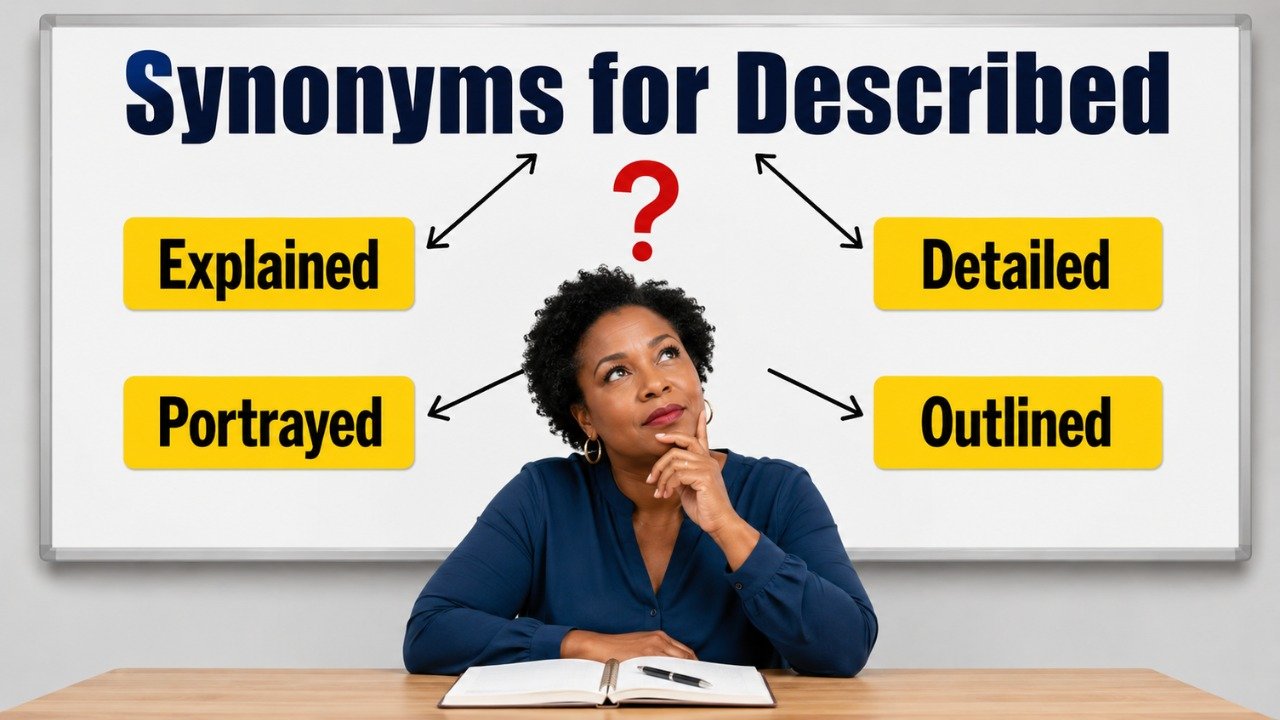
Quick Answer: The best synonyms for described include explained, portrayed, depicted, outlined, detailed, characterized, presented, illustrated, narrated, and represented. Use explained when making an idea clear, portrayed or depicted for people, scenes, and artistic representation, outlined for a brief summary, detailed for specific information, characterized for defining qualities, narrated for telling events, and represented when showing something in a particular form.
Pronunciation and Word Details
Word: Described
Pronunciation: /dɪˈskraɪbd/
Part of Speech: Verb, past tense and past participle of describe
Meaning: Gave an account of someone or something by explaining its qualities, appearance, features, events, or details.
US Pronunciation:
UK Pronunciation:
What Does “Described” Mean?
Described means gave information about a person, object, place, event, idea, or situation so that someone could understand or imagine it.
It is the past tense and past participle form of the verb describe. The word commonly refers to explaining characteristics, appearance, behavior, circumstances, or events.
You might say that someone described a house by explaining its size, color, rooms, and location. A writer may have described a character by discussing appearance and personality. A report may have described a problem by explaining what happened and why it mattered.
The exact meaning changes slightly with context.
In everyday conversation, described often means told someone what something was like.
In academic or professional writing, it can mean presented facts or explained characteristics objectively.
In literature, described may refer to creating a mental picture through carefully chosen details.
In reports, research, and technical writing, it often means documented or explained specific features, conditions, or processes.
Meaning, Tone, and Context of “Described”
Described is generally a neutral and widely accepted word. It works naturally in formal writing, academic work, reports, essays, storytelling, professional communication, and everyday conversation.
Tone: Usually neutral and informative.
Formal Use: Common in reports, essays, research, documentation, and professional communication.
Casual Use: Natural when talking about how someone explained a person, event, place, or experience.
Academic Use: Useful when discussing how an author, researcher, participant, or source explained a concept or condition.
Literary Use: Often refers to language that creates an image, mood, setting, or character in the reader’s mind.
Technical Use: Can refer to documenting properties, procedures, systems, conditions, or results.
Although described is versatile, a more precise synonym can often communicate the intended meaning more clearly. For example, outlined suggests a brief explanation, while detailed suggests a thorough one.
When and How to Use “Described”
For Explaining Something Clearly
Use described when someone gave enough information for another person to understand an idea, object, situation, or process.
Example: The instructor described the procedure clearly before the exercise began.
For Physical Appearance
Use described when explaining what a person, place, or object looked like.
Example: She described the garden as spacious, peaceful, and filled with colorful flowers.
For Giving Specific Details
Described works when someone provided characteristics or important information about something.
Example: The report described several problems affecting the project.
For Storytelling
Use described when a speaker or writer explained events, experiences, or surroundings.
Example: He described what happened during the journey.
For Characterizing a Person
Described can explain someone’s personality, behavior, abilities, or reputation.
Example: Her colleagues described her as thoughtful and dependable.
For Academic Writing
The word is useful when referring to how a concept, theory, process, or finding was explained.
Example: The essay described the major causes of the conflict.
For Reports and Documentation
Use described when information has been formally recorded or presented.
Example: The investigation described the sequence of events in detail.
Best Synonyms for Described
Explained
Synonym: Explained means made something understandable by giving information or reasons.
Example: The teacher explained the concept in simple language.
Portrayed
Synonym: Portrayed means represented a person, situation, or subject in a particular way.
Example: The novel portrayed the leader as ambitious but compassionate.
Depicted
Synonym: Depicted means represented something through words, pictures, or another form.
Example: The painting depicted a quiet village at sunset.
Outlined
Synonym: Outlined means presented the main points without giving every detail.
Example: The manager outlined the new plan during the meeting.
Detailed
Synonym: Detailed means gave complete or specific information about something.
Example: The report detailed the causes of the decline.
Characterized
Synonym: Characterized means identified or explained the distinctive qualities of someone or something.
Example: The researcher characterized the behavior as unusual.
Presented
Synonym: Presented means communicated, introduced, or displayed information in a particular way.
Example: The speaker presented the findings clearly.
Illustrated
Synonym: Illustrated means explained or clarified something by giving examples, images, or supporting details.
Example: The example illustrated how the process worked.
Narrated
Synonym: Narrated means told a sequence of events as a story or account.
Example: She narrated the events of the evening in chronological order.
Represented
Synonym: Represented means showed, expressed, or portrayed something in a particular form.
Example: The diagram represented the structure of the system.
50 Synonyms for Described with Short Meanings
- Explained: Made something understandable through information or reasons.
- Portrayed: Represented someone or something in a particular way.
- Depicted: Showed something through words, pictures, or another medium.
- Outlined: Presented the main points briefly.
- Detailed: Gave specific and complete information.
- Characterized: Identified the distinctive qualities of something.
- Presented: Communicated or introduced information.
- Illustrated: Clarified something through examples or visual representation.
- Narrated: Told events as a connected account.
- Represented: Showed or expressed something in a particular form.
- Defined: Explained the meaning or essential qualities of something.
- Expressed: Communicated an idea, feeling, or quality.
- Reported: Gave information about an event or situation.
- Recounted: Told what happened, usually in sequence.
- Related: Told or communicated an event or experience.
- Told: Communicated information or a story.
- Stated: Expressed information clearly in words.
- Specified: Identified something precisely.
- Clarified: Made something easier to understand.
- Elaborated: Added further explanation or detail.
- Summarized: Gave the main points in a shortened form.
- Documented: Recorded information systematically.
- Recorded: Preserved information in written or another permanent form.
- Identified: Recognized or named someone or something.
- Labeled: Classified or called something by a particular term.
- Designated: Identified something by a particular name or role.
- Interpreted: Explained the meaning or significance of something.
- Rendered: Represented something through words, art, or another form.
- Pictured: Represented or imagined something visually.
- Visualized: Formed or communicated a mental image.
- Painted: Created a vivid impression through words or imagery.
- Sketched: Gave a brief or general account.
- Mapped: Showed the structure, arrangement, or progression of something.
- Traced: Followed and explained the development or sequence of something.
- Chronicled: Recorded events in their order of occurrence.
- Recounted: Gave a detailed account of past events.
- Communicated: Shared information, ideas, or meaning.
- Conveyed: Made an idea, feeling, or impression understood.
- Articulated: Expressed something clearly and effectively.
- Mentioned: Referred to something briefly.
- Discussed: Examined or talked about a subject.
- Explored: Examined a subject in greater depth.
- Reviewed: Examined and discussed information.
- Enumerated: Listed items individually.
- Cataloged: Organized and recorded items or information systematically.
- Classified: Arranged or identified according to type or category.
- Summed Up: Expressed the main points concisely.
- Set Forth: Presented information clearly and formally.
- Accounted For: Gave an explanation of something.
- Spelled Out: Explained something clearly and in detail.
Read Also:
Synonyms for List

Synonyms for Described by Context
When Described Means Explained
When described refers to making something understandable, explained, clarified, articulated, interpreted, and elaborated are strong alternatives.
Explained Example: The instructor explained why the method was effective.
Clarified Example: She clarified the difference between the two concepts.
Elaborated Example: The author elaborated on the reasons for the change.
When Described Means Portrayed
For people, personalities, situations, characters, or scenes, portrayed, depicted, represented, rendered, and pictured are useful choices.
Portrayed Example: The story portrayed the character as courageous and generous.
Depicted Example: The mural depicted daily life in the village.
Represented Example: The figure represented strength and determination.
When Described Means Gave Details
When the focus is on specific information, use detailed, specified, documented, recorded, or outlined.
Detailed Example: The witness detailed everything she remembered.
Specified Example: The instructions specified the required dimensions.
Documented Example: The report documented several important changes.
When Described Means Told a Story
For events and personal experiences, narrated, recounted, related, chronicled, and told are natural replacements.
Narrated Example: He narrated the entire experience from beginning to end.
Recounted Example: She recounted what happened during the meeting.
Chronicled Example: The book chronicled the family’s experiences over several decades.
When Described Means Defined or Characterized
When explaining essential qualities, use characterized, defined, identified, classified, or labeled.
Characterized Example: The period was characterized by rapid social change.
Defined Example: The document defined the main responsibilities of the role.
Identified Example: The study identified several common patterns.
When Described Means Presented Information
For formal, academic, or professional communication, presented, reported, stated, conveyed, and articulated often work better.
Presented Example: The researcher presented the results clearly.
Reported Example: The committee reported several significant findings.
Conveyed Example: Her explanation conveyed the seriousness of the situation.
Another Word for Described
The best single replacement for described is often explained, especially when the sentence is about making information understandable.
However, the best alternative depends on what was being described. Use portrayed for representation, detailed for specific information, outlined for main points, and narrated for events or stories.
Original: The teacher described how the machine worked.
Better Option: The teacher explained how the machine worked.
Original: The article described the actor as thoughtful and reserved.
Better Option: The article portrayed the actor as thoughtful and reserved.
Original: The report described every stage of the process.
Better Option: The report detailed every stage of the process.
Original: She described the main goals of the proposal.
Better Option: She outlined the main goals of the proposal.
When Not to Use “Described”
Described is useful, but it can become repetitive or vague when a more precise verb communicates the meaning better.
When the Information Was Brief
If only the main points were given, outlined may be more accurate.
Weak: The manager described the main objectives in three short points.
Better: The manager outlined the main objectives in three short points.
When Something Was Explained
If the purpose was to make an idea understandable, explained may sound more precise.
Weak: The teacher described why the answer was incorrect.
Better: The teacher explained why the answer was incorrect.
When Specific Details Were Given
Use detailed when the speaker provided extensive information.
Weak: The report described every expense from the previous month.
Better: The report detailed every expense from the previous month.
When Discussing Artistic Representation
Depicted or portrayed can be more natural for literature, visual art, characters, or scenes.
Weak: The painting described a busy marketplace.
Better: The painting depicted a busy marketplace.
When Telling Events in Sequence
Narrated or recounted may be more accurate.
Weak: She described everything that happened during the trip from beginning to end.
Better: She recounted everything that happened during the trip from beginning to end.
When Repetition Becomes Noticeable
Avoid repeatedly using described when discussing several different forms of communication.
Weak: The report described the problem, described its causes, and described several solutions.
Better: The report identified the problem, explained its causes, and outlined several solutions.
Words Commonly Confused With Described
Described vs Explained: Described tells what something is like, while explained usually tells how or why something happens.
Described vs Defined: Described gives characteristics or details, while defined states the exact meaning or essential nature of something.
Described vs Depicted: Described usually refers to giving information in words, while depicted often refers to representation through words, pictures, or visual art.
Described vs Portrayed: Described provides information about something, while portrayed often emphasizes the impression or image created of a person, character, or situation.
Described vs Outlined: Described can include many details, while outlined usually gives only the main points.
Described vs Detailed: Described is broad, while detailed specifically suggests thorough or precise information.
Described vs Narrated: Described focuses on qualities or information, while narrated focuses on telling events as a story.
Described vs Reported: Described explains qualities or circumstances, while reported communicates information, findings, or events.
Which Synonym Should You Choose?
Choose explained when the purpose is to make an idea, reason, process, or concept easier to understand.
Choose portrayed when discussing how a person, character, group, or situation is represented.
Choose depicted for visual scenes, artistic representation, or vivid written imagery.
Choose outlined when only the main points are given.
Choose detailed when extensive or specific information is provided.
Choose characterized when identifying distinctive qualities or features.
Choose narrated when telling events in sequence.
Choose recounted when retelling something that happened in the past.
Choose documented for reports, records, evidence, or formally preserved information.
Choose presented when information, findings, arguments, or ideas are formally communicated.
Choose articulated when emphasizing clear and effective expression.
Choose conveyed when focusing on the meaning, feeling, or impression communicated.
For essays and academic writing, explained, outlined, detailed, characterized, presented, and documented are especially useful.
For reports, detailed, documented, reported, identified, and presented often provide greater precision.
For conversation, explained, told, mentioned, and recounted usually sound natural.
Real Life Examples of “Described” in Sentences
Original: She described the new apartment as spacious and comfortable.
Better Option: She portrayed the new apartment as spacious and comfortable.
Original: The teacher described how the experiment worked.
Better Option: The teacher explained how the experiment worked.
Original: The report described several weaknesses in the system.
Better Option: The report identified several weaknesses in the system.
Original: He described every stage of the project.
Better Option: He detailed every stage of the project.
Original: The guide described the main steps of the procedure.
Better Option: The guide outlined the main steps of the procedure.
Original: She described what happened after the event began.
Better Option: She recounted what happened after the event began.
Original: The novel described the hero as intelligent but impatient.
Better Option: The novel portrayed the hero as intelligent but impatient.
Original: The document described the responsibilities of each team member.
Better Option: The document specified the responsibilities of each team member.
Original: The speaker described the importance of clear communication.
Better Option: The speaker explained the importance of clear communication.
Original: The study described several patterns in the results.
Better Option: The study documented several patterns in the results.
Synonym Groups and Usage Differences
Explanation Group
Explained, clarified, elaborated, interpreted, and articulated belong to this group. Use them when the purpose is understanding rather than appearance.
Example: The instructor clarified why the procedure had changed.
Representation Group
Portrayed, depicted, represented, rendered, and pictured are useful when showing how something appears or is presented.
Example: The story portrayed the town as peaceful but isolated.
Detail Group
Detailed, specified, documented, recorded, and enumerated emphasize particular information.
Example: The report detailed the costs associated with the project.
Summary Group
Outlined, summarized, sketched, and summed up are appropriate when only the main information is needed.
Example: She outlined the proposal before discussing each section.
Storytelling Group
Narrated, recounted, related, chronicled, and told are useful for experiences and events.
Example: He recounted the events of the previous evening.
Characterization Group
Characterized, defined, identified, classified, and labeled focus on qualities, categories, or identity.
Example: The researchers characterized the response as unusually strong.
Communication Group
Presented, conveyed, expressed, stated, and communicated focus on transferring information or meaning.
Example: The presentation conveyed the urgency of the situation.
Antonyms of Described
There is no single perfect opposite of described because its opposite depends on context. Words connected with silence, concealment, omission, or confusion can function as antonyms.
Antonym: Concealed. Kept information or qualities hidden.
Antonym: Hid. Prevented something from being known or seen.
Antonym: Omitted. Left information out.
Antonym: Withheld. Deliberately did not provide information.
Antonym: Suppressed. Prevented information from being revealed.
Antonym: Obscured. Made something difficult to understand or recognize.
Antonym: Confused. Made something less clear rather than explaining it.
Antonym: Misrepresented. Presented something inaccurately.
Antonym: Distorted. Changed information so that it gave a misleading impression.
Antonym: Ignored. Gave no attention or explanation to something.
Comparison: Described vs Related Words
Described vs Explained
Described tells what someone or something is like. Explained usually tells why something happens, how something works, or what something means.
Example With Described: She described the machine as compact and lightweight.
Example With Explained: She explained how the machine operated.
Described vs Portrayed
Described gives information about qualities or features. Portrayed emphasizes the image or impression created.
Example With Described: The biography described him as a dedicated teacher.
Example With Portrayed: The biography portrayed him as a dedicated teacher who inspired generations of students.
Described vs Depicted
Described commonly refers to verbal information. Depicted is especially useful for visual or artistic representation.
Example With Described: He described the landscape as peaceful.
Example With Depicted: The illustration depicted a peaceful landscape.
Described vs Outlined
Described can involve general or detailed information. Outlined focuses mainly on essential points.
Example With Described: The document described the entire procedure.
Example With Outlined: The document outlined the five main stages of the procedure.
Described vs Detailed
Described does not indicate how much information was provided. Detailed strongly suggests thoroughness and specificity.
Example With Described: She described the incident.
Example With Detailed: She detailed every event that occurred during the incident.
Described vs Characterized
Described gives information about something broadly. Characterized focuses on defining or distinctive qualities.
Example With Described: The researcher described the participants’ behavior.
Example With Characterized: The researcher characterized the behavior as cautious and deliberate.
Described vs Narrated
Described focuses on qualities, conditions, or details. Narrated focuses on a sequence of events.
Example With Described: He described the crowded station.
Example With Narrated: He narrated what happened after the train arrived.
Common Phrases and Expressions With Described
Described As: Identified or characterized in a particular way.
Described Above: Previously explained in an earlier section.
Described Below: Explained in information that follows.
Clearly Described: Explained in an understandable way.
Fully Described: Explained with all necessary details.
Accurately Described: Represented correctly and truthfully.
Previously Described: Mentioned or explained earlier.
Often Described As: Frequently characterized in a particular way.
Best Described As: Most accurately characterized using a particular word or phrase.
Described in Detail: Explained thoroughly with specific information.
Common Mistakes to Avoid
Repeating Described Too Often
Using described several times in a paragraph can make writing sound repetitive.
Weak: The author described the city, described the residents, and described their daily routines.
Better: The author portrayed the city, characterized its residents, and detailed their daily routines.
Choosing a Synonym Without Considering Meaning
Not every synonym for described works in every sentence. Narrated is appropriate for events, but it may sound unnatural when discussing physical characteristics.
Weak: The report narrated the dimensions of the building.
Better: The report specified the dimensions of the building.
Using Explained When Portrayed Is More Accurate
Explained focuses on understanding, while portrayed focuses on representation.
Weak: The novel explained the villain as cold and calculating.
Better: The novel portrayed the villain as cold and calculating.
Using Depicted for Every Type of Description
Depicted is especially natural for visual or imaginative representation, but explained or detailed may work better for processes and factual information.
Weak: The manual depicted why the device stopped working.
Better: The manual explained why the device stopped working.
Confusing Described With Defined
A description gives characteristics. A definition states meaning.
Weak: The dictionary described the term as meaning a gradual change.
Better: The dictionary defined the term as a gradual change.
Using a Vague Verb in Formal Writing
More precise vocabulary can strengthen reports and essays.
Weak: The report described some problems.
Better: The report identified several operational problems.
Ignoring the Amount of Detail
Use outlined for a brief account and detailed for a thorough one.
Weak: She detailed the plan in two short sentences.
Better: She outlined the plan in two short sentences.
Conclusion
The best synonyms for described depend on what the sentence is communicating. Explained works well for ideas and processes, while portrayed and depicted suit representation. Use outlined for main points, detailed for thorough information, characterized for defining qualities, narrated or recounted for events, and documented for formal records. Choosing a precise alternative can make essays, reports, stories, and everyday communication clearer. Instead of replacing described automatically, consider whether the context involves explanation, appearance, detail, storytelling, or formal presentation.
FAQs About Synonyms for Described
What Is the Best Synonym for Described?
Explained is one of the best general synonyms for described when someone made information understandable. Portrayed, detailed, outlined, and depicted may be better in other contexts.
What Is Another Word for Described in an Essay?
Useful alternatives include explained, outlined, detailed, presented, characterized, documented, and articulated. Choose the word that most accurately reflects what the writer did.
What Is a Formal Synonym for Described?
Presented, documented, characterized, articulated, specified, and detailed are strong formal alternatives.
Is Explained the Same as Described?
Not exactly. Described tells what something is like, while explained usually tells how something works, why something happens, or what something means.
Can Portrayed Replace Described?
Yes, especially when discussing how a person, character, group, or situation was represented. It is particularly useful in literary and analytical writing.
What Is a Better Word Than Described for Giving Details?
Detailed is usually the strongest choice when someone provided thorough and specific information. Specified and documented can also work depending on context.
What Is a Synonym for Described When Telling a Story?
Narrated, recounted, related, chronicled, and told are useful alternatives when described refers to communicating events or experiences.
