
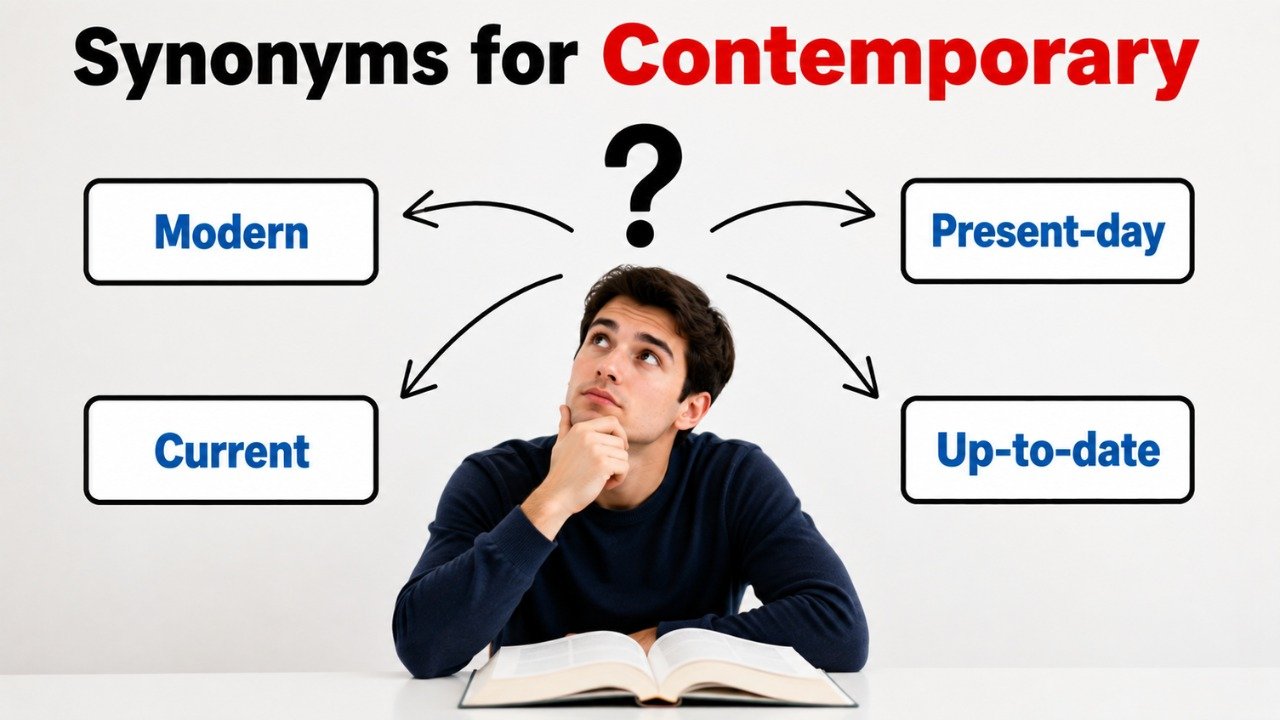
Quick Answer: The best synonyms for contemporary include modern, current, present day, recent, up to date, stylish, innovative, advanced, contemporaneous, and coeval. Use modern for ideas, buildings, lifestyles, and designs connected with the present age. Choose current for information, conditions, events, or issues happening now. Stylish works for fashion and interior design, while innovative suits technology and creative methods. Contemporaneous and coeval are best when describing people, events, or works that existed during the same historical period.
Pronunciation and Word Details
Word: Contemporary.
Pronunciation: /kənˈtem.pə.rer.i/
Part of Speech: Adjective and noun.
Meaning: Belonging to the present time, existing during the same period, or referring to a person who lives at the same time as another.
US Pronunciation:
UK Pronunciation:
What Does “Contemporary” Mean?
Contemporary means belonging to the present time or existing during the same period as another person, event, or work.
As an adjective, contemporary commonly describes modern ideas, culture, art, architecture, fashion, literature, music, society, and lifestyles.
Example: The apartment has a contemporary design.
In this sentence, contemporary means modern in appearance and suitable for current tastes.
The word can also describe two people, events, or works that existed at the same time.
Example: The two writers were contemporary authors.
Here, contemporary means that the authors lived and worked during the same historical period.
As a noun, a contemporary is a person who lives during the same time as another person.
Example: Several of the poet’s contemporaries admired her work.
In this example, contemporaries refers to people who lived during the poet’s lifetime.
Contemporary therefore has three main uses. It can mean modern, belonging to the present age, or existing during the same period.
Meaning, Tone, and Context of “Contemporary”
Contemporary is generally a neutral, polished, and slightly formal word. It appears frequently in academic writing, professional communication, historical discussion, art criticism, architecture, fashion, literature, and cultural analysis.
When contemporary means modern, it often has a positive tone. It can suggest freshness, simplicity, relevance, innovation, or suitability for current needs.
Example: The building combines traditional materials with contemporary features.
In art and design, contemporary often refers to styles, ideas, and works associated with the present period. It does not always mean fashionable or trendy. A contemporary work may reflect current thinking without following a temporary trend.
Example: The exhibition presents contemporary sculpture.
In academic or historical writing, contemporary can describe people or events from the same period.
Example: Contemporary records provide different accounts of the event.
In this context, contemporary records are records created during the period being discussed, not necessarily records created today.
As a noun, contemporary usually has a formal or historical tone.
Example: The scientist was respected by her contemporaries.
The exact meaning depends on whether the sentence concerns the present age, modern style, historical timing, or people from the same generation.
When and How to Use “Contemporary”
For Modern Design: Use contemporary to describe buildings, furniture, clothing, or interiors that reflect present tastes.
Example: The restaurant has a clean contemporary interior.
For Current Culture: Use contemporary when discussing the beliefs, habits, entertainment, and concerns of present society.
Example: The novel explores contemporary culture and family life.
For Present Issues: Use contemporary to describe topics that are relevant to the current age.
Example: The course examines contemporary environmental issues.
For Modern Art: Use contemporary for art created in the present period or shaped by current ideas.
Example: The gallery displays contemporary paintings and sculptures.
For Current Literature: Use contemporary when referring to recent authors, themes, styles, or literary works.
Example: She studies contemporary fiction.
For Current Methods: Use contemporary when describing methods or practices suited to modern conditions.
Example: The school uses contemporary teaching methods.
For the Same Historical Period: Use contemporary when two people, works, or events existed at the same time.
Example: The two philosophers were contemporary thinkers.
For a Person of the Same Time: Use contemporary as a noun for someone who lived during the same period as another person.
Example: He was a contemporary of several influential artists.
Best Synonyms for Contemporary
Modern: Belonging to the present age or using current styles and ideas.
Example: The office has a modern and comfortable layout.
Current: Existing, happening, or being used at the present time.
Example: The report explains current economic conditions.
Present Day: Connected with the period in which people live now.
Example: Present day technology has changed communication.
Recent: Having happened, appeared, or been created not long ago.
Example: The article reviews recent developments in education.
Up to Date: Including the newest information, methods, or features.
Example: The guide contains up to date safety advice.
Stylish: Attractive and suitable for current fashion or design preferences.
Example: They selected stylish furniture for the living room.
Innovative: Introducing new ideas, methods, or creative solutions.
Example: The company adopted an innovative production method.
Advanced: Highly developed and based on modern knowledge or technology.
Example: The hospital uses advanced medical equipment.
Contemporaneous: Existing or occurring during the same period.
Example: The documents are contemporaneous with the events they describe.
Coeval: Having the same age or belonging to the same historical period.
Example: The two ancient settlements were roughly coeval.
50 Synonyms for Contemporary with Short Meanings
- Modern: Belonging to the present age.
- Current: Existing or happening now.
- Present Day: Connected with the current period.
- Present: Existing at this time.
- Recent: Happening or created not long ago.
- Latest: Most recently produced or discovered.
- New: Recently created, introduced, or developed.
- Newest: More recent than all similar alternatives.
- Up to Date: Including the latest information or features.
- Updated: Changed to include recent information or improvements.
- Existing: Present or available at the current time.
- Ongoing: Continuing to happen at present.
- Prevailing: Common or generally accepted at the present time.
- Modern Day: Belonging to the world as it exists now.
- Of Today: Connected with current people, events, or conditions.
- Of the Present: Belonging to the current period.
- Present Age: Connected with the era in which people now live.
- Modern Era: Related to the current historical period.
- In Style: Popular and fashionable at the present time.
- Fashionable: Following current tastes in clothing or design.
- Stylish: Attractive according to modern tastes.
- Trendy: Popular for a limited period.
- In Vogue: Currently fashionable or widely admired.
- Fashion Forward: Showing awareness of developing styles.
- Cutting Edge: Using the newest and most advanced ideas.
- Advanced: Highly developed through modern knowledge.
- Innovative: Introducing original ideas or methods.
- Progressive: Supporting improvement and modern ideas.
- Forward Looking: Focused on future needs and developments.
- Futuristic: Appearing unusually modern or advanced.
- Fresh: New, original, or recently introduced.
- Novel: New and different from familiar examples.
- Newly Developed: Recently designed, created, or improved.
- State of the Art: Using the highest available level of development.
- High Tech: Using advanced technology.
- Modernized: Updated to meet present standards.
- Redesigned: Changed to suit newer needs or tastes.
- Contemporaneous: Existing or occurring during the same period.
- Coeval: Belonging to the same age or era.
- Cotemporary: Existing at the same time as something else.
- Concurrent: Happening or existing during the same period.
- Simultaneous: Happening at exactly the same time.
- Synchronous: Occurring together or at matching times.
- Coincident: Happening at the same time.
- Coexisting: Existing together during one period.
- Same Period: Belonging to an identical span of history.
- Same Era: Existing within the same historical age.
- Peer: A person of similar age, status, or period.
- Age Mate: A person who is approximately the same age.
- Person of the Same Period: Someone who lived during the same historical time.
Read Also:
Synonyms for Partnership

Synonyms for Contemporary by Context
When Contemporary Means Modern
When contemporary means modern, the strongest alternatives include modern, present day, modern day, current, of today, and of the present.
Modern is the best general replacement. Present day is useful when contrasting current conditions with the past. Current works best for situations, ideas, information, and issues that exist now.
Example With Contemporary: The house has a contemporary kitchen.
Example With Modern: The house has a modern kitchen.
Example With Present Day: The design meets present day needs.
Example With Current: The building follows current design principles.
When Contemporary Means Current
When contemporary describes current events, society, culture, or concerns, useful synonyms include current, present, ongoing, prevailing, existing, and recent.
Current focuses directly on what is happening now. Ongoing emphasizes continuation. Prevailing describes an idea, practice, or attitude that is common at the present time.
Example With Contemporary: The book examines contemporary political concerns.
Example With Current: The book examines current political concerns.
Example With Ongoing: The book examines ongoing political concerns.
Example With Prevailing: The book examines prevailing political attitudes.
When Contemporary Means Stylish
When contemporary describes fashion, furniture, architecture, or interior design, alternatives include stylish, fashionable, trendy, in style, in vogue, and fashion forward.
Stylish suggests attractive modern taste. Fashionable means accepted by current fashion. Trendy often suggests temporary popularity, so it is not always an exact replacement.
Example With Contemporary: She chose a contemporary dining table.
Example With Stylish: She chose a stylish dining table.
Example With Fashionable: She chose a fashionable dining table.
Example With In Vogue: She chose a table that is currently in vogue.
When Contemporary Means Innovative
When contemporary suggests modern methods, technology, or creative thinking, suitable alternatives include innovative, advanced, progressive, cutting edge, state of the art, and forward looking.
Innovative emphasizes original ideas. Advanced emphasizes a high level of development. Cutting edge suggests the newest available methods or technology.
Example With Contemporary: The center uses contemporary medical techniques.
Example With Innovative: The center uses innovative medical techniques.
Example With Advanced: The center uses advanced medical techniques.
Example With Cutting Edge: The center uses cutting edge medical techniques.
When Contemporary Means Existing at the Same Time
When contemporary describes people, events, writings, or objects from the same historical period, useful synonyms include contemporaneous, coeval, cotemporary, concurrent, coincident, and coexisting.
Contemporaneous is the clearest formal alternative. Coeval is more literary or academic. Concurrent usually describes events or processes that overlap in time.
Example With Contemporary: The two rulers were contemporary figures.
Example With Contemporaneous: The two rulers were contemporaneous figures.
Example With Coeval: The two rulers were coeval.
Example With Coexisting: The two political systems were coexisting during that period.
When Contemporary Is Used as a Noun
As a noun, contemporary means a person who lived during the same period as another person. Possible alternatives include peer, age mate, fellow member of the same generation, and person of the same period.
Peer is useful when the people also share a similar age, status, or profession. Person of the same period is clearer in historical explanations.
Example With Contemporary: She was a contemporary of the famous composer.
Example With Peer: She was a peer of the famous composer.
Example With Person of the Same Period: She was a person of the same period as the famous composer.
Another Word for Contemporary
Modern is usually the best single replacement for contemporary when the word describes present styles, ideas, buildings, technology, or society.
However, the best alternative depends on context. Use current for information or issues happening now, stylish for attractive modern design, innovative for original methods, and contemporaneous for people or events from the same historical period.
Original: They live in a contemporary apartment.
Better Option: They live in a modern apartment.
Original: The course examines contemporary social problems.
Better Option: The course examines current social problems.
Original: The room has contemporary furniture.
Better Option: The room has stylish modern furniture.
Original: The two poets were contemporary writers.
Better Option: The two poets were contemporaneous writers.
When Not to Use “Contemporary”
Do not use contemporary when a more exact word would explain whether something is modern, current, fashionable, recent, or from the same historical period.
When You Mean Happening Right Now
Contemporary can sound broad when the sentence refers to a specific event or condition happening at present.
Weak: The report describes contemporary weather conditions.
Better: The report describes current weather conditions.
Current is more precise because weather conditions can change quickly.
When You Mean Recently Created
Contemporary does not always mean newly created. Something contemporary may belong to the present period without being recent.
Weak: She purchased a contemporary model released last week.
Better: She purchased the latest model released last week.
Latest clearly identifies the newest version.
When You Mean Fashionable
Contemporary can describe modern design, but it does not always mean popular or fashionable.
Weak: That color is contemporary this season.
Better: That color is fashionable this season.
Fashionable is more accurate for a temporary style preference.
When You Mean Highly Advanced
Contemporary only means modern or current. It does not automatically mean technologically superior.
Weak: The laboratory uses contemporary equipment that is more advanced than every alternative.
Better: The laboratory uses state of the art equipment.
When You Mean Exactly the Same Time
Contemporary can refer to the same general period, not necessarily the same moment.
Weak: The two alarms sounded contemporary.
Better: The two alarms sounded simultaneously.
Simultaneously clearly means at the same moment.
When the Historical Period Is Unclear
Contemporary can confuse readers because it may mean current today or current during the historical period being discussed.
Weak: Contemporary accounts described the battle.
Better: Accounts written during the battle period described the event.
The better sentence clearly identifies the intended time.
When Writing Casual Conversation
Contemporary can sound formal when a simpler expression would feel more natural.
Weak: I prefer contemporary clothes.
Better: I prefer modern clothes.
Words Commonly Confused With Contemporary
Contemporary vs Modern: Contemporary and modern can both describe present styles or ideas. Contemporary often refers to what belongs to the current period, while modern can also describe a broader movement away from older traditions.
Contemporary vs Current: Contemporary relates to the present age or period. Current usually describes something happening, existing, or being used right now.
Contemporary vs Recent: Contemporary means belonging to the present period. Recent means something happened or appeared not long ago.
Contemporary vs Contemporaneous: Contemporary can mean modern or from the same period. Contemporaneous specifically means existing or occurring during the same time.
Contemporary vs Simultaneous: Contemporary refers to the same general period. Simultaneous means happening at exactly the same moment.
Contemporary vs Trendy: Contemporary means suited to the present age. Trendy means temporarily fashionable or popular.
Contemporary vs Traditional: Contemporary describes current ideas or styles. Traditional describes customs, designs, or methods passed down from earlier generations.
Contemporary vs Classic: Contemporary describes the present period. Classic describes something recognized for lasting quality or an established traditional style.
Which Synonym Should You Choose?
Choose modern when describing present styles, lifestyles, buildings, furniture, art, or ideas in general writing.
Choose current when discussing information, events, laws, conditions, concerns, research, or situations that exist now.
Choose present day when comparing the world today with an earlier historical period.
Choose recent when something happened or was created only a short time ago.
Choose latest when referring to the newest version, report, model, development, or announcement.
Choose up to date when information, equipment, or knowledge includes recent changes.
Choose stylish when describing modern clothing, furniture, interiors, or visual appearance.
Choose fashionable or in vogue when something follows current fashion preferences.
Choose trendy when the popularity may be temporary.
Choose innovative when emphasizing original ideas, methods, products, or creative solutions.
Choose advanced when describing a high level of technological, scientific, or practical development.
Choose cutting edge when emphasizing the newest and most advanced work in a field.
Choose progressive when discussing ideas, policies, or attitudes that encourage social or practical improvement.
Choose contemporary in essays, cultural analysis, art discussion, architecture, literature, and formal descriptions of the present age.
Choose contemporaneous in academic or historical writing when two people, works, or events belonged to the same period.
Choose coeval when you need a formal or literary word for things that are the same age or from the same era.
Choose peer when contemporary is a noun referring to a person of similar age, status, or historical position.
Real Life Examples of “Contemporary” in Sentences
Original: The hotel has a contemporary interior.
Better Option: The hotel has a modern interior.
Original: The article discusses contemporary health concerns.
Better Option: The article discusses current health concerns.
Original: She enjoys contemporary fashion.
Better Option: She enjoys fashionable modern clothing.
Original: The school introduced contemporary teaching techniques.
Better Option: The school introduced innovative teaching techniques.
Original: The clinic uses contemporary equipment.
Better Option: The clinic uses advanced equipment.
Original: The exhibition features contemporary art.
Better Option: The exhibition features present day art.
Original: The novel reflects contemporary society.
Better Option: The novel reflects modern society.
Original: The two scientists were contemporary researchers.
Better Option: The two scientists were contemporaneous researchers.
Original: He was a contemporary of the famous painter.
Better Option: He was a peer of the famous painter.
Original: The company adopted a contemporary approach to training.
Better Option: The company adopted a forward looking approach to training.
Synonym Groups and Usage Differences
Present Time Group
This group includes modern, current, present day, present, modern day, of today, and of the present.
These words describe things connected with the period in which people now live. Modern is the broadest alternative, while current focuses more directly on what exists or happens now.
Example: The book examines current challenges in education.
Recent Development Group
This group includes recent, latest, new, newest, updated, and newly developed.
These words emphasize newness rather than simply belonging to the present period. Latest identifies the most recent example, while updated means something older has been revised.
Example: The website contains updated information about the program.
Modern Style Group
This group includes stylish, fashionable, trendy, in style, in vogue, and fashion forward.
These synonyms relate to visual taste, clothing, furniture, architecture, and design. Stylish suggests lasting attractiveness, while trendy may describe temporary popularity.
Example: The room combines stylish furniture with simple decoration.
Innovation Group
This group includes innovative, advanced, cutting edge, progressive, forward looking, futuristic, state of the art, and high tech.
These words emphasize new ideas or high levels of development. They are useful for technology, science, education, business methods, and creative work.
Example: The engineers developed an innovative energy system.
Same Period Group
This group includes contemporaneous, coeval, cotemporary, concurrent, coincident, synchronous, and coexisting.
These words describe people, events, or objects that exist during the same time. Contemporaneous is the safest formal choice, while simultaneous refers to the exact same moment.
Example: The researchers compared contemporaneous historical records.
Person Group
This group includes peer, age mate, fellow member of a generation, and person of the same period.
These alternatives apply when contemporary functions as a noun. Peer may also suggest similar status, profession, or ability.
Example: Her peers respected her original ideas.
Antonyms of Contemporary
The opposites of contemporary change according to whether the word means modern, present, stylish, or existing during the same period.
Ancient: Belonging to a very distant historical period.
Historical: Connected with events or conditions from the past.
Past: Belonging to an earlier time.
Former: Existing or holding a position previously.
Old: Having existed for a long time.
Old Fashioned: Following styles or ideas no longer considered modern.
Traditional: Based on established customs or long used methods.
Conventional: Following familiar and generally accepted practices.
Outdated: No longer suitable for present needs.
Obsolete: No longer used because something newer has replaced it.
Antiquated: Very old and unsuitable for modern conditions.
Archaic: Belonging to an earlier period and rarely used now.
Predecessor: A person who came before another.
Successor: A person who came after another.
Nonconcurrent: Not happening or existing during the same period.
Comparison: Contemporary vs Related Words
Contemporary vs Modern
Contemporary generally means belonging to the current period. Modern also means present in style or thinking, but it can describe a broader break from traditional methods.
Example With Contemporary: The gallery displays contemporary art.
Example With Modern: The gallery has a modern interior.
Contemporary art may refer to art produced in the present period. Modern art may refer to a particular artistic style or earlier movement, depending on context.
Contemporary vs Current
Contemporary relates to the present age as a whole. Current usually refers to something existing, happening, or being discussed now.
Example With Contemporary: The book explores contemporary culture.
Example With Current: The report explains current market conditions.
Use current for changing facts and conditions. Use contemporary for broader cultural, artistic, or social descriptions.
Contemporary vs Recent
Contemporary means belonging to the present period. Recent means happening or appearing a short time ago.
Example With Contemporary: She studies contemporary literature.
Example With Recent: She reviewed several recent novels.
A work can be contemporary without being extremely recent.
Contemporary vs Contemporaneous
Contemporary can mean modern or existing during the same period. Contemporaneous has the narrower meaning of occurring or existing at the same time.
Example With Contemporary: The museum presents contemporary sculpture.
Example With Contemporaneous: The two documents were contemporaneous with the event.
Use contemporaneous when historical timing must be clear.
Contemporary vs Trendy
Contemporary describes something suitable for the present age. Trendy describes something temporarily popular.
Example With Contemporary: The room has a contemporary design.
Example With Trendy: The room includes several trendy decorations.
Contemporary design may remain attractive for many years, while trendy decoration may quickly lose popularity.
Contemporary vs Traditional
Contemporary reflects present ideas, styles, or methods. Traditional follows customs and practices established over time.
Example With Contemporary: The architect proposed a contemporary building.
Example With Traditional: The architect preserved the traditional structure.
The two styles can also be combined successfully.
Common Phrases and Expressions With Contemporary
Contemporary Art: Art produced in the present period or shaped by current ideas.
Contemporary Design: Design that reflects modern tastes, materials, and needs.
Contemporary Society: People, institutions, and social conditions of the present age.
Contemporary Culture: Current beliefs, habits, entertainment, values, and creative expression.
Contemporary Literature: Literature written in the present period or dealing with current themes.
Contemporary Music: Music created in recent times or influenced by current styles.
Contemporary Issues: Problems and topics that matter in present society.
Contemporary World: The world as it exists in the current age.
Contemporary Architecture: Architecture using present styles, materials, and building ideas.
Contemporary Audience: People living in the current period who receive a work or message.
Common Mistakes to Avoid
Assuming Contemporary Always Means Newest
Contemporary means belonging to the present period, but it does not always identify the newest available example.
Incorrect: This is the contemporary version released this morning.
Better: This is the latest version released this morning.
Confusing Contemporary With Current
Use current for rapidly changing information, conditions, and events.
Less Precise: The document lists contemporary prices.
Better: The document lists current prices.
Confusing Contemporary With Contemporaneous
Contemporary can refer to modern life, while contemporaneous clearly describes things from the same period.
Unclear: The two records were contemporary.
Clearer: The two records were contemporaneous with the event.
Using Trendy as an Exact Synonym
Trendy suggests temporary popularity. Contemporary can describe a modern style that is not based on a short lived trend.
Inaccurate: Every contemporary building is trendy.
Accurate: Many contemporary buildings use modern materials and simple forms.
Overusing Contemporary
Repeated use can make an article sound vague and monotonous.
Repetitive: Contemporary writers discuss contemporary issues in contemporary society.
Improved: Present day writers discuss current issues in modern society.
Using Contemporary Without a Clear Time Reference
In historical writing, contemporary may mean current during the period being discussed rather than current today.
Unclear: Contemporary observers criticized the decision.
Clearer: Observers living during that period criticized the decision.
Using the Wrong Noun Form
Contemporary can be a noun for a person who lived at the same time as another person.
Incorrect: The two artists were contemporaries to each other.
Better: The two artists were contemporaries.
Also Correct: One artist was a contemporary of the other.
Assuming Contemporary Means Superior
A contemporary method is modern, but it is not automatically better.
Unclear: The contemporary method is obviously more effective.
Better: The modern method proved more effective during testing.
Conclusion
The most useful synonyms for contemporary depend on whether the word means modern, current, stylish, innovative, or from the same historical period. Choose modern for general present day styles, current for information and conditions, stylish for design, and innovative or advanced for new methods and technology. Use contemporaneous or coeval when people or events existed during the same period. Understanding these differences helps you select precise synonyms for contemporary and write clearer descriptions in essays, reports, conversations, and creative work.
FAQs About Synonyms for Contemporary
What Is the Best Synonym for Contemporary?
Modern is the best general synonym when contemporary means belonging to the present age. Current, stylish, and contemporaneous may be better in specific contexts.
Are Contemporary and Modern the Same?
They are often similar, but not always identical. Contemporary usually refers to the current period, while modern may describe present styles or a broader movement away from tradition.
Can Current Replace Contemporary?
Current can replace contemporary when discussing present issues, conditions, information, or events. It may sound less natural for art, furniture, and architecture.
What Is a Formal Synonym for Contemporary?
Contemporaneous is a strong formal synonym when two people or events existed during the same period. Present day and current are useful in formal writing about modern life.
What Is Another Word for Contemporary Design?
Modern, stylish, fashionable, updated, and cutting edge can describe contemporary design. Modern is usually the safest general alternative.
Can Contemporary Refer to a Person?
Yes. As a noun, a contemporary is someone who lived during the same period as another person. Peer and person of the same period are useful alternatives.
What Is the Opposite of Contemporary?
Common opposites include ancient, historical, traditional, old fashioned, outdated, obsolete, and antiquated. The best antonym depends on the sentence.
